Revelation 18:11

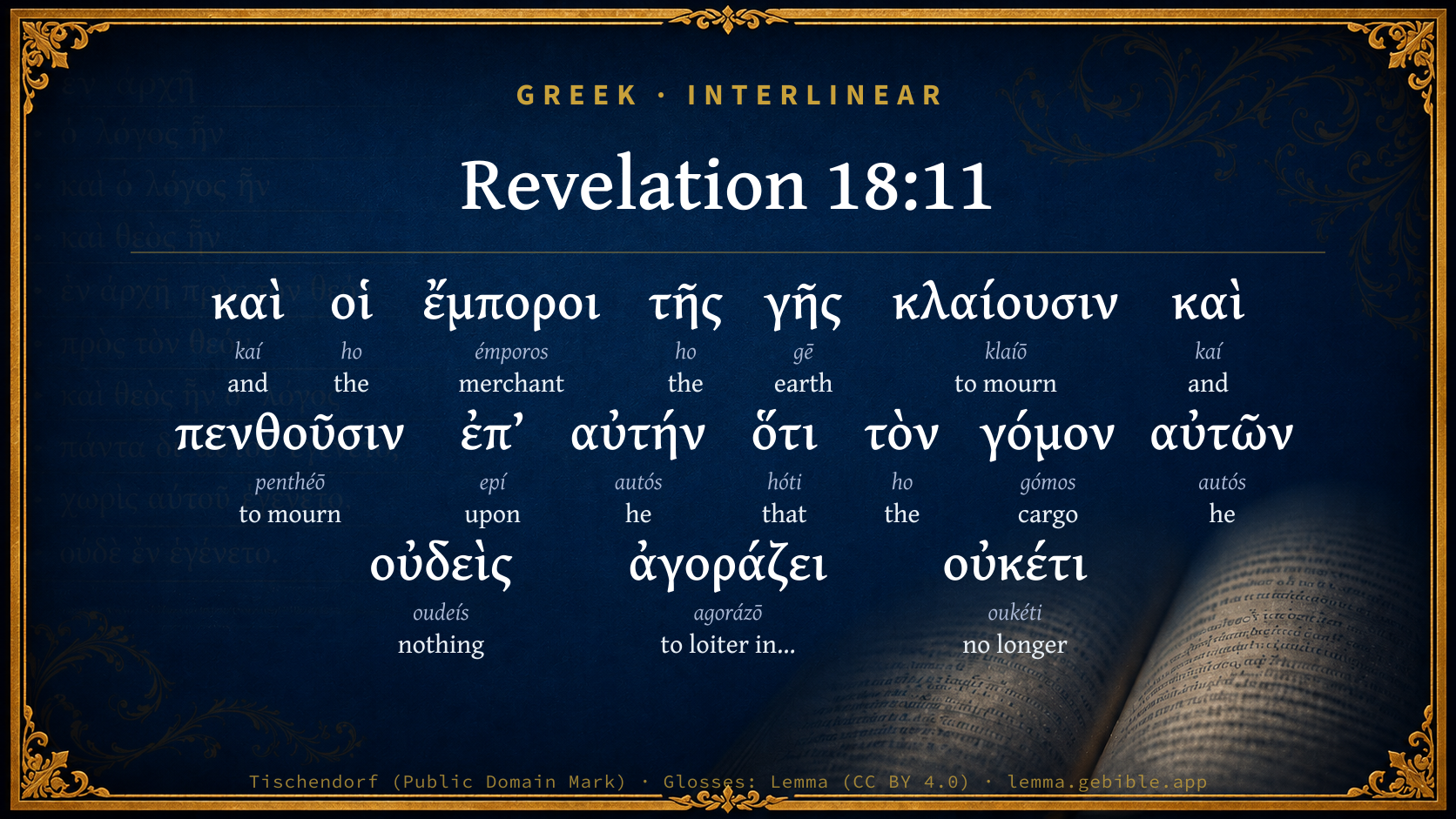
Greek (Tischendorf 8th ed.) Revelation 18:11 appears in the Greek New Testament. The text above is from the Tischendorf 8th edition. Each word links to its Strong’s number and a concise gloss. Click any word for its full Thayer’s Greek Lexicon entry.
Download image
Cite this verse

Revelation 18:11 (World English Bible). Public Domain. Lemma interlinear Bible study tool, https://lemma.gebible.app/v/revelation/18/11.

Show BibTeX & RIS
BibTeX
RIS
English Translation
The merchants of the earth weep and mourn over her, for no one buys their merchandise any more;
World English Bible · Public Domain
Download a study sheet

One document with this verse’s original text, its word-by-word gloss line, the meaning frame, cross-references with their text, attributed commentary, and full source and license credits — printable, and it pastes into notes with its structure intact.

This verse Autodidact and up

Study sheet (.html) Plain text (.txt)

A passage Seminary Student

Up to 50 verses in one chapter. A passage sheet keeps up to 6 commentary sources and 12 cross-references per verse, in the order this page ranks them, and says so on the sheet whenever that leaves anything out. Ask for a single verse and you get the Autodidact verse sheet above.

Everything on this page stays free to read, with no account — the sheet is a download of what is already on screen, not access to it.

Want to remove ads? Support Godless Engineer
Compare translations 3

The same verse in 3 English versions, stacked beneath the original-language interlinear above. Click any original word for its lexicon entry.

Each is an independent rendering of the whole verse — the interlinear is not word-aligned to these translations.

Highlighted words mark where these versions differ — a whole-verse word diff, not a word-by-word alignment.

  • World English Bible Public Domain
    The merchants of the earth weep and mourn over her, for no one buys their merchandise any more;
  • King James Version Public Domain
    And the merchants of the earth shall weep and mourn over her; for no man buyeth their merchandise any more:
  • unfoldingWord Literal Text CC BY-SA 4.0
    And the merchants of the earth weep and mourn for her, because no one buys their cargo anymore—

unfoldingWord Literal Text — © unfoldingWord, licensed CC BY-SA 4.0. Word-aligned USFM3 via Door43 (git.door43.org/unfoldingWord/en_ult).

Versions to compare (up to 4)

3 of 4 selected

Show all 19 translations

Every available English version of this verse, each an independent rendering of the whole verse.

  • World English Bible Public Domain
    The merchants of the earth weep and mourn over her, for no one buys their merchandise any more;
  • Berean Standard Bible Public Domain
    And the merchants of the earth will weep and mourn over her, because there is no one left to buy their cargo—
  • Majority Standard Bible Public Domain
    And the merchants of the earth will weep and mourn over her, because there is no one left to buy their cargo—
  • King James Version Public Domain
    And the merchants of the earth shall weep and mourn over her; for no man buyeth their merchandise any more:
  • American Standard Version (1901) Public Domain
    And the merchants of the earth weep and mourn over her, for no man buyeth their merchandise any more;
  • Revised Version (1885) Public Domain
    And the merchants of the earth weep and mourn over her, for no man buyeth their merchandise any more;
  • Geneva Bible (1599) Public Domain
    And the marchants of the earth shall weepe and wayle ouer her: for no man byeth their ware any more.
  • Douay-Rheims (1899) Public Domain
    And the merchants of the earth shall weep, and mourn over her: for no man shall buy their merchandise any more.
  • Young's Literal Translation Public Domain
    `And the merchants of the earth shall weep and sorrow over her, because their lading no one doth buy any more;
  • Literal Standard Version CC BY-SA 4.0
    And the merchants of the earth will weep and mourn over her, because no one buys their cargo anymore;
  • Unlocked Literal Bible CC BY-SA 4.0
    The merchants of the earth weep and mourn for her, since no one buys her merchandise anymore—
  • unfoldingWord Literal Text CC BY-SA 4.0
    And the merchants of the earth weep and mourn for her, because no one buys their cargo anymore—
  • Darby Bible Public Domain
    And the merchants of the earth weep and grieve over her, because no one buys their lading any more;
  • World Messianic Bible Public Domain
    The merchants of the earth weep and mourn over her, for no one buys their merchandise any more:
  • Webster's Bible Public Domain
    And the merchants of the earth shall weep and mourn over her; for no man buyeth their merchandise any more:
  • Free Bible Version CC BY-SA 4.0
    The traders of the earth cry and grieve over her, because nobody is buying their goods any more—
  • Bible in Basic English Public Domain
    And the traders of the earth are weeping and crying over her, because no man has any more desire for their goods,
  • Text-Critical English NT CC BY 4.0
    The merchants of the earth will weep and mourn over her, because no one buys their cargo anymore,
  • Tyndale New Testament (1534) Public Domain
    And the marchauntes of the erth shall wepe and wayle in them selves for no man wyll bye their ware eny more

Literal Standard Version (2020), Covenant Press — licensed CC BY-SA 4.0. Text via the HelloAO Bible API (eBible.org). Unlocked Literal Bible (unfoldingWord) — licensed CC BY-SA 4.0. Text via the HelloAO Bible API (eBible.org). unfoldingWord Literal Text — © unfoldingWord, licensed CC BY-SA 4.0. Word-aligned USFM3 via Door43 (git.door43.org/unfoldingWord/en_ult). Free Bible Version, Dr. Jonathan Gallagher — licensed CC BY-SA 4.0. Text via the HelloAO Bible API (eBible.org).

Word by word

More ways to search: Search by grammar → Find every occurrence → Compare this word →

Practice this passage: Drill this verse → Learn its vocabulary →

γόμον
gómos
G1117
“cargo”
Noun, Accusative, Singular, Masculine
Part of Speech
Noun
Case
Accusative
Number
Singular
Gender
Masculine
Full Thayer's Definition

Origin: from G1073

TDNT: None

1. a lading or freight of a ship, cargo, merchandise conveyed in a ship 2. any merchandise
  1. καὶ kaí G2532 “and” Conjunction
  2. οἱ ho G3588 “the” Article, Nominative, Plural, Masculine
  3. ἔμποροι émporos G1713 “merchant” Noun, Nominative, Plural, Masculine
  4. τῆς ho G3588 “the” Article, Genitive, Singular, Feminine
  5. γῆς gē G1093 “earth” Noun, Genitive, Singular, Feminine
  6. κλαίουσιν klaíō G2799 “to mourn” Verb, Present, Active, Indicative, 3rd person, Plural
  7. καὶ kaí G2532 “and” Conjunction
  8. πενθοῦσιν penthéō G3996 “to mourn” Verb, Present, Active, Indicative, 3rd person, Plural
  9. ἐπ’ epí G1909 “upon” Preposition
  10. αὐτήν autós G846 “he” Personal pronoun, Accusative, Singular, Feminine
  11. ὅτι hóti G3754 “that” Conjunction
  12. τὸν ho G3588 “the” Article, Accusative, Singular, Masculine
  13. αὐτῶν autós G846 “he” Personal pronoun, Genitive, Plural, Masculine
  14. οὐδεὶς oudeís G3762 “nothing” Adjective, Nominative, Singular, Masculine, Negative
  15. ἀγοράζει agorázō G59 “to loiter in marketplace” Verb, Present, Active, Indicative, 3rd person, Singular
  16. οὐκέτι oukéti G3765 “no longer” Adverb, Negative

About this verse

These counts appear in no published source. They are computed here, from the morphology-tagged text and Lemma’s own curated glosses. What Lemma adds →

17
words
13
distinct lemmas
Revelation
section

Notable vocabulary

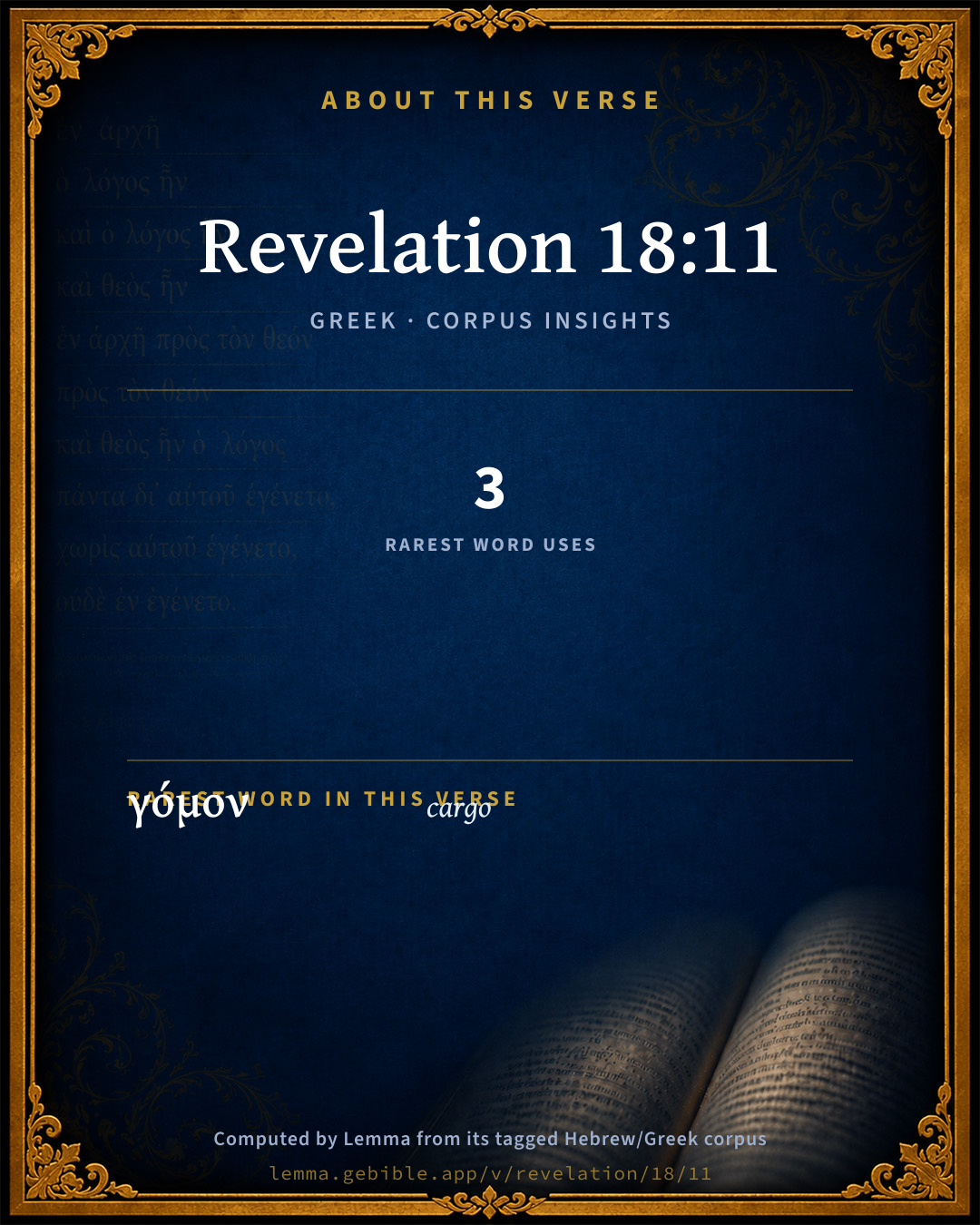
The rarest word here is γόμον cargo G1117 — appearing just 3 times in the whole Greek New Testament.

Shared distinctive vocabulary

γόμον cargo G1117 occurs in 3 verses of the Greek New Testament. Also found in:

Repetition

Words recur within this verse:

Cross-references

16

Topical passages linked to Revelation 18:11 in the Treasury of Scripture Knowledge — connected by theme and wording, ordered by reader-vote popularity; previews shown in the World English Bible.

  • Revelation 18:3 For all the nations have drunk of the wine of the wrath of her sexual immorality, the kings of the earth committed sexual immorality with her, and the merchants of the earth grew rich from the abundance of her luxury."
  • Ezekiel 27:27–36 Your riches, and your wares, your merchandise, your mariners, and your pilots, your repairers of ship seams, and the dealers in your merchandise, and all your men of war, who are in you, with all your company which is in the midst of you, shall fall into the heart of the seas in the day of your ruin.
  • Revelation 18:23 The light of a lamp will shine no more at all in you. The voice of the bridegroom and of the bride will be heard no more at all in you; for your merchants were the princes of the earth; for with your sorcery all the nations were deceived.
  • Ezekiel 26:17–21 They shall take up a lamentation over you, and tell you, How are you destroyed, who were inhabited by seafaring men, the renowned city, who was strong in the sea, she and her inhabitants, who caused their terror to be on all who lived there!
  • Zephaniah 1:11 Wail, you inhabitants of Maktesh, for all the people of Canaan are undone! All those who were loaded with silver are cut off.
  • Revelation 13:16–17 He causes all, the small and the great, the rich and the poor, and the free and the slave, to be given marks on their right hands, or on their foreheads;
  • Revelation 18:15 The merchants of these things, who were made rich by her, will stand far away for the fear of her torment, weeping and mourning;
  • Revelation 18:20 Rejoice over her, O heaven, you saints, apostles, and prophets; for God has judged your judgment on her."
  • Isaiah 23:1–15 The burden of Tyre. Howl, you ships of Tarshish; for it is laid waste, so that there is no house, no entering in: from the land of Kittim it is revealed to them.
  • Isaiah 47:15 Thus shall the things be to you in which you have labored: those who have trafficked with you from your youth shall wander everyone to his quarter; there shall be none to save you.
  • Zephaniah 1:18 Neither their silver nor their gold will be able to deliver them in the day of Yahweh's wrath, but the whole land will be devoured by the fire of his jealousy; for he will make an end, yes, a terrible end, of all those who dwell in the land.
  • 2 Peter 2:3 In covetousness they will exploit you with deceptive words: whose sentence now from of old doesn't linger, and their destruction will not slumber.
  • Revelation 18:9 The kings of the earth, who committed sexual immorality and lived wantonly with her, will weep and wail over her, when they look at the smoke of her burning,
  • Matthew 22:5 But they made light of it, and went their ways, one to his own farm, another to his merchandise,
  • Proverbs 3:14 For her good profit is better than getting silver, And her return is better than fine gold.
  • John 2:16 To those who sold the doves, he said, "Take these things out of here! Don't make my Father's house a marketplace!"

Cross-references courtesy of OpenBible.info (CC BY 4.0).

Commentary

Notes on Revelation 18:11 from classic Christian and Jewish commentators (each source and its license shown beneath its notes). The classic Christian expositions comment on the surrounding passage and are grouped to its opening verse, so a note may address several verses; the Jewish commentaries on the Tanakh (Rashi and others) are per-verse, so they appear only where the commentator wrote on this verse.

Lemma curates 59 commentaries, every one of them public domain or Creative Commons licensed, each selected and text-cleaned for this edition rather than reprinted as found. About our sources →

Tyndale Open Study Notes

Tyndale Open Resources

18:11-17 The merchants of the world sing the second lament (18:14; see study note on 18:9-19). They profited from the Roman economy (18:12-13), but their trade ceased as the great city was swiftly destroyed.

Tyndale Open Study Notes — © Tyndale Open Resources, licensed CC BY-SA 4.0. Text via the HelloAO Bible API.

Bengel's Gnomon

Johann Albrecht Bengel

Rev 18:11. etc. Γόμον,[199] Κ.Τ.Λ.) The construction is easy from ΓΌΜΟΝ to ΠΡΌΒΑΤΑ, and ΨΥΧᾺς coheres with these in the same case; but at ἽΠΠΩΝ, ῬΕΔῶΝ, ΣΩΜΆΤΩΝ, you may understand afresh ΓΌΜΟΝ: for horses, chariots, and slaves, are serviceable for the conveyance of different kinds of merchandise. There is a mixture of cases, as in Hippocr. de Humoribus, ch. 25. Pricæus is very full, in setting forth this enumeration. If you examine the Romish Ceremonial, you may see that all kinds of these wares repeatedly occur in abundance.

[199] But the reading γόμος also, ver. 12, is preferred in the margin of each Edition.—E. B.

But the oldest authorities read γόμον. Vulg. “merces,” ver. 11; “mercem,” ver. 12.—E.

Bengel's Gnomon of the New Testament — English translation (T&T Clark, Edinburgh, 1860) — public domain. Text from a community e-Sword module.

Meyer's Critical & Exegetical Commentary

Heinrich August Wilhelm Meyer

Rev_18:11-16. The lament of the merchants.

κλαίουσιν καὶ πενθοῦσιν.

By the present, John passes over to the tone of narration;[3961] but does not choose here as yet the preterite,[3962] so that he still does not express the idea that he himself had observed the destruction of the city, or the accompanying lamentations. The easier afterwards is the return to the original course (Rev_18:15); but the recent transition to the narrative brings finally with it also the preterites (Rev_18:17 sq.).

τὸν γόμον. The cargo.[3963]

The entire description of the many precious things, for which the merchants can no more find purchasers, gives a view of the previous necessities of the luxurious[3964] city. The mass of different things are mentioned with suitable grouping

σηρικοῦ. Silk.[3965]

καὶ πᾶν ξύλον θύϊνον, κ.τ.λ. The alternation of accusatives and genitives dependent upon the τὸν γόμον until the close of Rev_18:13, which is here presented very definitely, may serve as an explanation of the ambiguous construction, Rev_17:4.

The precious, sweet-scented thyine wood,[3966] the citreum of the Romans, comes from the tree called θύον, θύα, θύϊα, which is possibly identical with the white cedar (cupressus thyioides).[3967]

The expression πᾶν ξύλ. θύ. designates, first of all, the collected precious material;[3968] upon this follows the enumeration of the vessels made from the precious material, under which is σκ. ἐκ ξύλου τιμ.

κινάμωμον. Cinnamon.[3969]

ἄμωμον. The precious hair-ointment procured from an Asiatic shrub.[3970]

σεμίδαλιν. Finest wheat-flour, simila[3971] or similago.[3972]

κτήνη. The general expression, which includes also horned cattle,[3973] precedes.

ῥεδῶν. A kind of four-wheeled vehicle.[3974] Alexander Sev. furnished the Roman senators with such vehicles, decorated with silver,thinking that it pertained to the Roman dignity, that senators of so great a city should be carried therein.[3975]

σωμάτων, i.e., slaves, σώματα δοῦλα[3976] See examples from the LXX. in Biel.[3977] The following expression ψυχὰς ἀνθρώπων[3978] also points to the slaves, and because of the difference in the constructionthe γόμον being understood with the genitiveit seems that a distinction is intended to be made.[3979] The most probable[3980] explanation is that which understands the ΣΩΜ. as referring to such slaves as belong to the horses and chariots, and the latter expression, ΨΥΧ. ἈΝΘΡ., as referring to slaves in general. So, too, in Rev_18:17, Ew. ii. understands, in the last place, female slaves. Volkm., who gives a false emphasis to the ΚΑῚ before ΨΥΧ. ἈΝΘΡ.,[3981] finds here the judgment given by the Christian spirit, that transactions in the slave-trade are not concerning the bodies, but the souls, of men. But it is nevertheless correct, that, according to the heathen view, the slaves are considered only as ΣΏΜΑΤΑ; the ΨΥΧ. ἈΝΘΡ. also receives a certain importance from the fact that it concludes a short paragraph. Yet the explanation of Volkmar, with respect to the change of construction, seems to me impossible.

The lamentation in Rev_18:14[3982] turns to the objects that have served another chief class of the ΣΤΡῆΝΟς of the great city, daintiness and gluttony; this part of the description, by its description of the punishment, calls to mind the corresponding guilt of sin.

Ἡ ὈΠΏΡΑ ΣΟΥ Τῆς ἘΠΙΘΥΜΊΑς Τῆς ΨΥΧῆς. Excellently, Luther, who also describes, with correct meaning, the genitive limitation to Ἡ ὈΠΏΡΑ: das Obst, da Deine Seele Lust dran hatte.[3983]

ἈΠῆΛΘΕΝ ἈΠῸ ΣΟῦ. In the same sense as the parallel ἈΠΌΛΕΤΟ ἈΠῸ ΣΟῦ. Cf. Psa_142:5. LXX.

ΤᾺ ΛΙΠΑΡᾺ. Properly the fat, but its combination with ΤᾺ ΛΑΜΠΡᾺ points to the fact that the expression is to be taken[3984] in the ordinary improper sense.[3985] Every thing pre-eminent and glorious, in its class, is finally grouped together.

The two last verses, which refer to the lamentation of the merchants, establish the conformity with Rev_18:9 sqq., which could not as yet be attained because of Rev_18:11-14; also in the two points that the merchants appear standing at a distance and raising the express cry of lamentation. The τούτων, Rev_18:15, corresponding to this, refers not only to those of Rev_18:14,[3986] but to all things mentioned by Rev_18:11,[3987] so that there is no reason to censure the discourse for inconcinnity.[3988]

κόκκινον. That the scarlet raiment here,[3989] like the purple, indicates the royal glory of the city, is self-evident in the impression of the merchants. By those who neither see nor understand the scarlet beast, only such an idea of the woman is presupposed, as she corresponds in harmonious connection with the view of the luxurious glory of the city granted the prophet in ch. 17.

[3961] De Wette.

[3962] Cf. Rev_11:11.

[3963] Act_21:3. Cf. Eustath. in Wetst.: φόρτος νηὸς, ὁ καὶ γόμος.

[3964] Rev_18:3 : τ. στρήνους αὐτ.; Rev_18:7; Rev_18:9. Cf. Rev_17:4.

[3965] Cf. Winer, Rwb., on this word.

[3966] Luther.

[3967] Cf. Wetst. and Winer, Rwb., on the word.

[3968] Against De Wette: All sorts of vessels made therefrom. Cf. Hengstenb.

[3969] Luth. Cf. Winer, Rwb., on this word, and Zimmt.

[3970] Plin., H. N., xii. 28. Cf. Martial, viii. 77: Assyrio semper tibi crinis amomo splendeat [May thy hair always shine with the Assyrian amomus]. See Wetst.

[3971] Vulg.

[3972] Cf. Plin., H. N., xviii. Revelation 20 : Similago ex tritico fit laudatissima.

[3973] See lexicons.

[3974] Isidor., xx. 17.

[3975] Lamprid. in Wetst.

[3976] Pollux, III. 71.

[3977] Cf. Wetst., Wolf, etc.

[3978] Eze_27:13. Cf. 1Ch_5:21.

[3979] Cf. Wetst., who refers the ψυχ. ἀνθρ. to gladiators; Züll., who refers σώμ. to proper slaves, ψυχ. ἀνθρ. to such as are hired also for lust.

[3980] Cf. Beng., Ewald, Hengstenb.

[3981] Aye, souls of men.

[3982] Vitr. has thought, with Beza and Laun., that Rev_18:14 belongs not to this place, but between Rev_18:23-24. Ew. i. regards the verse as a marginal note of John, who did not immediately find a suitable place for the thought. Ew. ii. concedes it to be possible, that the verse is here derived from an entirely different book; but if it belong to the Apoc., he would introduce it in the midst of Rev_18:23. Cf. also Volkm. But even though the form of the address giving offence could not be understood as the lament of the merchants,this does not follow until Rev_18:15 sqq., in a manner corresponding to Rev_18:10,it must be decided, nevertheless, that the interpreting angel (Bleek), or the voices interposed in Rev_18:4, directly address the city now lamented and threatened. A similar alternation in the form of description occurs also in Rev_18:22 sqq., in comparison with Rev_18:21; Rev_18:24. Cf. also Hos_2:8.

[3983] [The fruit in which thy soul had pleasure.]

[3984] Luther, Bengel, Hengstenb.

[3985] Isa_30:23. Cf. Hesych., who explains λιπ.: καλόν, ἔλαφρον, κ.τ.λ. [beautiful, easy, etc.].

[3986] De Wette.

[3987] Beng.

[3988] Against De Wette.

[3989] Cf., on the other hand, Rev_17:4.

NOTES BY THE AMERICAN EDITOR

LXXXIII. Rev_18:11-16

Alford suggests a difficulty which he confesses himself unable to answer, that Rome never has been, nor can be, a great commercial city; and that this description, based on the lament over Tyre in Ezekiel 27, would be better adapted to London than to Rome. Contrast Rome, however, with Jerusalem, and its relative pertinency becomes manifest. In addition, the metropolis may be here regarded as the impersonation of all the luxury of the whole empire. The reading of chapter 1 of Farrars Early Days of Christianity will throw light upon this point.

Meyer — Critical and Exegetical Commentary on the New Testament — English translation by Peter Christie, edited by Frederick Crombie (T&T Clark, 1880) — public domain. Text from a community e-Sword module.

Cambridge Greek Testament for Schools and Colleges

11. κλαίουσιν καὶ πενθοῦσιν. See crit. note. The present here between the futures in Rev 18:9; Rev 18:15 is more difficult than the past tenses in Rev 18:18, which can be explained as in Rev 11:11. Apart from this, Rev 18:11-13 might seem to interrupt the connexion between Rev 18:10; Rev 18:14, and Rev 18:9-10; Rev 18:14 would be quite naturally continued by Rev 18:15-17. Rev 18:11-13 may have once stood before Rev 18:4.

ὅτι οὐδεὶς ἀγοράζει. Their sorrow is even more purely selfish than that of the kings.

Cambridge Greek Testament for Schools and Colleges (Cambridge University Press, 1896; 21 vols, various authors incl. Carr, Maclear, Plummer, Farrar, Lumby, Moule, M. R. James, Simcox) — public domain. Text from a community e-Sword module.

Geneva Bible (1599)

Geneva Bible translators

The lamentation of those that trade by land, as I distinguished immediately before.

Geneva Bible (1599) marginal notes — public domain. Text via Bolls.life.

Jamieson, Fausset & Brown

Robert Jamieson, A. R. Fausset & David Brown

shall--So. B. But A and C read the present, "weep and mourn."

merchandise--Greek, "cargo": wares carried in ships: ship-lading (compare Rev 18:17). Rome was not a commercial city, and is not likely from her position to be so. The merchandise must therefore be spiritual, even as the harlot is not literal, but spiritual. She did not witness against carnal luxury and pleasure-seeking, the source of the merchants' gains, but conformed to them (Rev 18:7). She cared not for the sheep, but for the wool. Professing Christian merchants in her lived as if this world not heaven, were the reality, and were unscrupulous as to the means of getting gain. Compare Notes, see on Zac 5:4-11, on the same subject, the judgment on mystical Babylon's merchants for unjust gain. All the merchandise here mentioned occurs repeatedly in the Roman Ceremonial.

Jamieson, Fausset & Brown — Commentary Critical and Explanatory on the Whole Bible (1871) — public domain (CC PDM 1.0). Text via the HelloAO Bible API.

Adam Clarke's Commentary

Verse 11. The merchants of the earth] These are represented as mourning over her, because their traffic with her was at an end.

Bishop Bale, who applies all these things to the Church of Rome, thus paraphrases the principal passages:-

"The mighty kinges and potentates of the earth, not havinge afore their eyes the love and feare of God, have committed with this whore moste vile filthynesse; abusinge themselves by many straunge or uncommaunded worshippings, and bynding themselves by othe to observe hyr lawes and customs. At the examples, doctrines, counsels, and perswasions of hyr holy whoremongers, have they broken the covenaunts of peace; battailed, oppressed, spoyled, ravished, tyrannously murthered innocents; yea, for vain foolish causes, and more vaine titles, as though there were neither heaven nor hel, God nor accounts to be made.

"And her mitred marchantes, hyr shorne souldiers, hir massemongers, hyr soulesellers, and hir martbrokers, waxed very riche, through the sale of hir oyles, creme, salt, water, bread, orders, hallowings, houselinges, ashes, palme, waxe, frankensence, beades, crosses, candlesticks, copes, belles, organes, images, reliques, and other pedlary wares.

"They have gotten in unto them pallaces and princely houses, fat pastors and parkes, meadowes and warrens, rivers and pondes, villages and towns, cities and whole provinces, with the divill and all els; besides other men's wives, daughters, mayde servantes, and children, whom they have abhominably corrupted. What profites they have drawen unto them also by the sale of great bishopricks, prelacies, promocions, benefices, tot quoties, pardons, pilgrymages, confessions, and purgatory; besides the yearely rents of cathedrall churches, abbayes, colleges, covents, for sutes and suche other.-Specially shal they be sore discontented with the matter, which have with hir committed the whordom of the spyrite, by many externe worshipings of drye waffer cakes, oyles, roods, relyques, ladyes, images, sculles, bones, chippes, olde ragges, showes, (shoes,) bootes, spurres, hattes, breches, whodes, night capes, and such like.

"And they that have lived wantonly with hir, (Re 18:9), in following hir idle observacions, in mattenses, houres, and masses; in sensinges, halowings, and font halowing; in going processions with canapye, crosse, and pyx; with banneres, stremers, and torche light; with such other gaudes to folish for children.

"Alas, alas, that great cyty (Re 18:10) that beautiful Babilon, that blessed holy mother the Church, which somtime had so many popes pardons, so many bishoppes blessinges, so many holye stations, so many cleane remissions a pena et culpa, so many good ghostly fathers, so many religious orders, so much holy water for spirites, and Saint John's gospel, with the five woundes and the length of our Lord for drowning, is nowe decayed for ever!

'Alas, alas, who shall pray for us now? Who shall singe dirges and trentoles? Who shal spoile us of our sinnes? Who shal give us ashes and palmes? Who shal blesse us with a spade, and singe us out of purgatory when we are deade? If we lacke these things we are like to want heaven. These are the desperate complaints of the wicked."

Adam Clarke's Commentary on the Bible (1810–1826) — public domain. Text from a community e-Sword/MySword module.

Ellicott's Commentary for English Readers

(11-13) And the merchants of the earth . . .—Better, The merchants of the earth weep and mourn (not “shall weep;” the vividness of the description is intensified by the use of the present tense) over her; because their cargo no one buyeth any longer—the cargo of gold, &c. The list of the cargoes and merchandise is not without arrangement. The various goods are placed in groups. The treasures come first—gold, silver, precious stones, and pearls. The soft goods used for raiment are placed next—fine linen, purple, silk and scarlet; in the description of Dives, clothed in purple and fine linen (Byssus, the same word as here), we have a suggestive resemblance. Materials used in giving splendour to the furnishing of houses come next. Thyine wood, and every article (vessel, as in the English version, is hardly wide enough in meaning) of ivory, costly wood, brass, iron, and marble. The thyine wood was derived probably from a kind of citron-tree of African growth; the wood was sweet-scented, and was a favourite wood for doors, panels, and ceilings; its rich brown hue was often relieved by inlaid ivory. To articles used in furniture aromatics succeed. Cinnamon, amomum (this is omitted in the English version, but authority is in favour of its insertion), odours, ointments, and frankincense. Cinnamon, on its use, comp. Exo_30:2-3; it was one of the perfumes employed to enhance the delight of the voluptuary (Pro_7:17). It is doubtful whether it is the same as our modern cinnamon. Amomum, a kind of sweet-scented shrub, yielding an ointment much used for the hair. Odours, employed in incense. Next come articles of food—wine, oil, fine meal, wheat, cattle, and sheep. Then come the equipages—horses and chariots. The chariot (rheda) was a vehicle much used in Rome by the wealthy classes. Lastly, the traffic in human beings closes the list. Slaves (literally, bodies, and souls of men. There is perhaps an allusion specially to those slaves who were attached to the chariots or litters used by the rich. The traffic in slaves (“persons of men”) is mentioned as part of the commerce of Tyre (Eze_27:13). The number of slaves in Rome was enormous. “Souls of men.” The climax of wicked worldliness is reached in this last; it gives the finishing touch to the picture of society wholly engrossed in pleasure and indolence and selfishness, which lays every market under tribute to add to its luxuriousness, and sacrifices not only the happiness, but the lives and liberties of their fellow-creatures, to their own enjoyment. It has been said that the general description here does not suit Rome, as Rome never was, and never could be, a commercial centre; but the picture is designed to show the corrupt luxury and voluptuousness of society in great Babylon, not necessarily the accumulated merchandize of a great commercial city. The various wares are “for her use and consumption,” not for her to sell. All the avenues from every distant spot of the earth found their focus in Rome; her existence, her political supremacy, and her luxuriousness of living, created and sustained all the commercial activity here described; with her fall, the hope of their gains passed from the merchants of the earth. Compare the language of Gibbon:—“The most remote countries of the ancient world were ransacked to supply the pomp and delicacy of Rome. The forests of Scythia afforded some valuable furs; amber was brought from the shores of the Baltic and the Danube; and the barbarians were astonished at the price which they received for so useless a commodity. There was a considerable demand for Babylonian carpets and other manufactures of the East; but the most important and unpopular branch of foreign trade was carried on with Arabia and India. Every year, about the time of the summer solstice, a fleet of an hundred and twenty vessels sailed from Myos-hormos, a port of Egypt on the Red Sea. The coast of Malabar or the island of Ceylon was the usual term of their navigation, and it was in those markets that the merchants from the more remote countries of Asia expected their arrival. The return of the fleet was fixed to the months of December or January; and as soon as their rich cargo had been transported on the backs of camels, from the Red Sea to the Nile, and had descended that river as far as Alexandria, it was poured without delay into the capital of the Empire. The objects of Oriental traffic were splendid and trifling: silk, a pound of which was esteemed in value not inferior to a pound of gold; precious stones also, among which the pearl claimed the first rank after the diamond, and a variety of aromatics that were consumed in religious worship and the pomp of funerals. The labour and risk of the voyage was rewarded with almost incredible profits; but the profits were made upon Roman subjects, and a few individuals were enriched at the expense of the public” (Gibbon’s Decline and Fall, vol. i., Rev. ii.).

A Bible Commentary for English Readers, edited by Charles John Ellicott (1878–1897) — public domain. Text from a community e-Sword module.

The Cambridge Bible for Schools and Colleges

gen. ed. J. J. S. Perowne

11. shall weep and mourn] Read, weep and mourn (in the present tense).

for no man buyeth &c.] Their sorrow is even more purely selfish than that of the kings.

merchandise] Strictly, cargo.

The Cambridge Bible for Schools and Colleges (gen. ed. J. J. S. Perowne; Cambridge University Press, 1878–1918) — public domain. Text from a community e-Sword module.

John Gill's Exposition

And the merchants of the earth shall weep and mourn over over her,.... Who these are; see Gill on Rev 18:3 and, what their lamentation, Rev 18:16 the reason of their weeping and mourning follows: for no man buyeth their merchandise any more; what their merchandise is, is expressed in the two next verses; and this shows that it is not to be understood merely in a literal sense; for such commodities in general as are there mentioned, if they do not sell at one place, they will at another; and the decline of trade in one city does not put a stop to business all the world over; and often so it is, that the ruin of commerce in one place is the rise of it in another; and all the things hereafter spoken of, excepting the last article, are what will be merchandised in one place or another to the end of the world; unless the sense should be, that no man at Rome, and the parts adjacent, will buy of this merchandise any more; but though they should not, this could not be cause of such lamentation as is afterwards expressed, since their goods might be sold elsewhere; but it looks as if this must be understood of such kind of wares as will be disused and despised all the world over, and they will meet with no customers any where to deal with them in them.

the reason of their weeping and mourning follows: for no man buyeth their merchandise any more; what their merchandise is, is expressed in the two next verses; and this shows that it is not to be understood merely in a literal sense; for such commodities in general as are there mentioned, if they do not sell at one place, they will at another; and the decline of trade in one city does not put a stop to business all the world over; and often so it is, that the ruin of commerce in one place is the rise of it in another; and all the things hereafter spoken of, excepting the last article, are what will be merchandised in one place or another to the end of the world; unless the sense should be, that no man at Rome, and the parts adjacent, will buy of this merchandise any more; but though they should not, this could not be cause of such lamentation as is afterwards expressed, since their goods might be sold elsewhere; but it looks as if this must be understood of such kind of wares as will be disused and despised all the world over, and they will meet with no customers any where to deal with them in them.

Revelation 18:12

rev 18:12

rev 18:12

rev 18:12The merchandise of gold and silver, and precious stones, and of pearls,.... Things for treasure and ornament, and with which the great whore is said to be decked, Rev 17:4 and, literally understood, may denote the vast riches which these spiritual merchants, or factors for Rome, cardinals, archbishops, bishops, priests, monks, and friars, bring into their own coffers and the pope's, by the trade they drive in her wares with the souls of men; and may have also a regard to what their images, chalices, crowns, mitres, &c. are made of, and what some of them are adorned with; and as Tyre, to whom the reference is in the several particulars of this account, had her merchants for these things, Eze 27:12 so Mr. Brightman thinks that in these, and in some following ones, Spain is Rome's merchant, which fetches them from the Indies for her: but these things, mystically taken, sometimes design the doctrines of the Gospel, Co1 3:12 and which are to be preferred to, and more to be esteemed than thousands of gold and silver; and these Rome's merchants pretended to deliver out; but instead of them, they put off wood, hay, and stubble, yea, doctrines of devils, and lies in hypocrisy; and sometimes the grace of God is meant, Rev 3:18 which is more precious than gold that perisheth; and this they pretend to convey to men "ex opere operato", in the ordinances, as baptism, &c. and to communicate the Spirit, with his gifts and graces, for money, which is direct simony; yea, they pretend to sell eternal life, nay, Christ, and God himself:

and fine linen, and purple, and silk, and scarlet: things which belong to apparel and dress; and, literally taken, the "fine linen" is for their copes, wore by bishops and by chanters, and sub-chanters, and for surplices wore by their priests, in imitation of the Jewish priests, and for Mass clothes, &c. the "purple, silk", and "scarlet", were for the popes, cardinals, archbishops, and bishops; so the woman on the scarlet coloured beast is said to be arrayed in purple and scarlet, Rev 17:4, Tyre had its merchants for these, Eze 27:7 the fine linen and silk may mystically denote the holy lives, good works, and merits of the saints, those of them called works of supererogation, which become the church's stock, and they sell out for others that want; which is a monstrous kind of ware, and a dreadful imposition upon men, since men cannot be saved and justified by works; and the best of men are so far from having a redundancy of works, that in everything they sin and offend, and are greatly deficient: and they are so far from helping others, that they are unprofitable servants themselves: the purple and scarlet may signify the blood of Christ, which they pretend to sell in the Mass; nay, they have pretended to have had the very liquid blood of Christ, which they have carried in a crystal glass, thick on one side, and transparent on the other; and so could not be seen by persons in a mortal sin, until they had given a good deal of money, and then the clear side was by sleight of hand turned to them; and which was no other than the blood of a duck, renewed weekly by the priest; which trick for a long time brought in vast sums of money, and was detected at Hales in Gloucestershire, in Henry the Eighth's time; or these may intend the sufferings of the saints, which likewise come into the treasure of the church, and are at its dispose for money, the virtue of which being very great for the salvation of men's souls:

and all thyine wood, and all manner vessels of ivory, and all manner vessels of most precious wood, and of brass, and iron, and marble: things for utensils and furniture, not so much for their houses, as for their churches; Tyre had its merchants for these, Eze 27:5. "Thyine wood", Pliny says (i), was very durable, and of it the rafters of ancient temples were made; and may design such like lasting and odoriferous wood as cypress, cedar, &c. used in the Popish churches, for the embellishing of them, and for images in them; it may be the same with the wood of the Almug, or Algum trees, since these are rendered thyine wood in the Vulgate Latin version in Kg1 10:11 vessels of ivory may be boxes made thereof, in which the host is put, and the relics of saints are preserved: and "vessels of most precious wood", or "stone", as the Alexandrian copy, Vulgate Latin, and Ethiopic versions read,

and of brass, iron, and marble, may intend various vessels used in their churches; as vessels for holy water, fonts of marble, and other valuable stones, for baptism, censers of iron and brass to burn incense in. Cocceius thinks that by these vessels of different materials are meant good men; who are like sweet smelling wood for the fragrancy of their doctrines and lives; and like iron, brass, and marble, for their courage, constancy, and patience; and who have been canonized for saints, which has brought in much money into the pope's coffers: this is a practice in imitation of the Heathens, who deified men, and set them over particular days and affairs; and the privileges of such canonization among the Papists are, that such a saint has his name set in the calendar in red letters, may have churches and altars dedicated to him, and his image set up in them, and a holiday be kept for him, and may be prayed to, and worshipped; a practice dreadfully derogatory to the glory of Christ's person and office, but is that in which these merchants have found their account; for through references, commissions, and reports, for proof of the saint's character and miracles, his friends are at very great expense before the affair is issued, especially if rich; our King Henry the Seventh was very desirous of having his kinsman Henry the Sixth canonized, and solicited the pope for it, but he would not do it under fifteen hundred ducats of gold, which the king thought was too much, and so declined it.

(i) Nat. Hist. l. 13. c. 16.

John Gill's Exposition of the Whole Bible (1746–1763) — public domain (CC PDM 1.0). Text via the HelloAO Bible API.

Trapp's Complete Commentary

John Trapp

11 And the merchants of the earth shall weep and mourn over her; for no man buyeth their merchandise any more:

Ver. 11. And the merchants of the earth] The pope’s indulgencers, and other officers of his exchequer. What huge sums of money did Tecelius and his companions rake together out of Germany. The pope had yearly out of England above nine tons of gold; Polydore Virgil was his collector of the Peter’s pence here. Otto (one of the pope’s muscipulatores , mice catchers, as the story calls him) departing hence, left not so much money in the whole kingdom as he either carried with him or sent to Rome before him. (Job. Manl., loc. com., p. 492.) It was truly and trimly said by Pope Innocent IV, Vere enim hortus deliciarum Papis fuit tum Anglia, et puteus inexhaustus, England was then a gallant garden to the pope, and a wellspring of wealth that could not be drawn dry. (Speed, 1027.) Cardinal Wolsey emptied the land of two hundred and forty thousand pounds, to relieve and ransom Pope Clement VII, imprisoned by the Duke of Bourbon. And being himseff sent ambassador beyond sea for the pope’s release, and coming through Canterbury toward Dover, he was seen to weep tenderly at mass for the pope’s calamity.

For no man buyeth their merchandise] Men shall see further into their fopperies and knaveries than to endure to be any longer gulled and cheated. William of Malmesbury began to groan long since under the grievance. Romani hodie (saith he) auro trutinant iustitiam, pretio venditant canonum regulam: The Romans today sell justice, sacraments, masses, dispensations, benefices, all. Mantuan comes after, and cries out,

--" venalia nobis

Templa, sacerdotes, altaria, sacra, coronae,

Ignis, thura, preces, caelum est venale, Deusque."

"Temples, priests, altars, rites (I tell no tale),

Crowns, sacrifices, heaven, and God, are set to sale."

The leaguers here for the liberty of the kingdom in the days of King John, drove Martin, the pope’s publican, out of the land; the king also cursed him grievously at parting, with Diabolus te ad inferos ducat et perducat. (Jac. Revius, lib. iii., de Pont. Rom., cap. xxi.) But now much more than ever these merchants want chapmen, {a} as Bellarmine sadly complains; their markets are well fallen, their Euphrates much dried up.

{a} A man whose business is buying and selling; a merchant, trader, dealer. Obs. or arch. ŒD

John Trapp, A Commentary or Exposition upon All the Books of the Old and New Testament (1647–1656) — public domain. Text from a community e-Sword module.

Albert Barnes' Notes on the Bible

And the merchants of the earth - Who have been accustomed to traffic with her, and who have been enriched by the traffic. The image is that of a rich and splendid city. Of course, such a city depends much on its merchandise; and when it declines and falls, many who had been accustomed to deal with it, as merchants or traffickers, are affected by it, and have occasion to lament its fall.

Shall weep and mourn over her; for no man buyeth their merchandise anymore - The merchandise which they were accustomed to take to the city, and by the sale of which they lived. The enumeration of the articles of merchandise which follows, seems to have been inserted for the purpose of filling out the representation of what is usually found in such a city, and to show the desolation which would occur when this traffic was suspended.

Albert Barnes' Notes on the Bible (1834–1885) — public domain. Text from a community e-Sword/MySword module.

Matthew Poole's English Annotations

As the merchants, Eze 27:27, lamented for Tyre, that they could barter and truck no more there, because all the trade thereof was destroyed; so those ecclesiastical merchants, that were wont to trade with Rome for indulgences, and pardons, and dispensations, and faculties, for cardinals’ caps, and bishoprics, and prebendaries, and other church preferments, shall lament when the papacy falls, that there will be no more such merchandise to be bought or sold there.

Matthew Poole's English Annotations on the Holy Bible (1683–1685) — public domain. Text from a community e-Sword/MySword module.

Whedon's Commentary on the Bible

Daniel D. Whedon

11. Shall—The speaker here adopts the present tense, buyeth, as if detailing what is truly now occurring over the late ruin. At Rev_18:15 the future is resumed; at Rev_18:17 the preterite.

Daniel D. Whedon (gen. ed.), Commentary on the Old and New Testaments (1874–1909) — public domain. Text from a community e-Sword module.

The Pulpit Commentary

And the merchants of the earth shall weep and mourn over her. Weep and mourn; the historical present (see on ver. 9). The kings have been mentioned; the merchants and next the seamen are referred to, showing the wide distribution of "Babylon," and forbidding the application to a single state or city. The description which follows is analogous to that in Eze 27 Isa 23. For no man buyeth their merchandise any more; their cargo. We are naturally reminded of the action of the second beast in forbidding to buy and sell. (Rev_13:17) Alford here recognizes the difficulty in applying the prophecy to Rome, either pagan or papal, and adds, "I leave this difficulty unsolved .... The details of this mercantile lamentation far more nearly suit London than Rome." (See the interpretation given of the harlot and Babylon on Rev_17:1)

The Pulpit Commentary (1880–1919), ed. H.D.M. Spence-Jones & Joseph S. Exell — public domain. Text from a community e-Sword module.

Burkitt's Expository Notes on the New Testament

William Burkitt

The second sort of persons who passionately lament and bitterly bewail Babylon’s downfall and destruction, are the merchants who traded in and with Babylon.

Here we have an allusion to the merchants and merchandise of Tyre spoken of, Ezekiel 17 As Tyre was the mart of the earth for temporal things, so was Babylon for spiritual things, making merchandise even of the souls of men, persuading people that they could purchase the redemption of souls out of purgatory by masses.

Here note, That Pagan Rome, though she did traffic for slaves, yet not for souls: but Papal Rome deals for both. She sells also the souls of men, by selling her ecclesiastical benefices, and cure of souls. And I would to God that this piece of spiritual merchandise were only found amongst them, and not heard of elsewhere.

Observe next, The Holy Ghost is pleased to enumerate at last several sorts of wares, and the kinds of merchandise, which Babylon, dealt and trafficked in, namely, gold, silver, precious stones, fine linen, purple, silk, and scarlet; all things for ornament, necessity, and delight; the pride and sensuality of Rome prompted her to buy up all sorts of commodities, and took off all that the countries round about could bring in; partly to gratify her pride, and partly to serve her idolatry.

Observe farther, What a bitter lamentation is here taken up; but for what? not for their sins, their luxury, or idolatry, but for the loss of their market and merchandise only. Behold in these Babylonians, the spirit and temper of all natural men, they weep not for sin, but for sufferings: for any temporal cross they have tears enough, they refuse to be comforted: but for their sins, which are not their cross, but their curse, their plague, yea, the greatest of all plagues, because spiritual, these they can speak of with dry eyes and unaffected hearts.

Observe lastly, How these merchants here, as the kings before, stand afar off for fear of her torment, weeping and wailing; pitying and condoling one another, greatly affected and sorely afflicted to see the ruin of that polity that sustained them, but not able to help one another.

Behold! how fruitless and helpless the wicked’s friendship is to one another in the day of visitation; they stand afar off for fear of torments, but can afford no succour to each other: they durst not come near to help Babylon or them.

William Burkitt's Expository Notes on the New Testament (1700–1703) — public domain. Text from a community e-Sword module.

The People's New Testament

B. W. Johnson

11. And the merchants of the earth shall weep. All who had made gain in any way from the sins or the luxury of Babylon shall mourn. There follows, then, an enumeration of the articles in which there was traffic.

B. W. Johnson's The People's New Testament with Notes (1889–1891) — public domain. Electronic text from the Christian Classics Ethereal Library (CCEL) ThML edition.

unfoldingWord translationNotes

Door43 World Missions Community

mourn for her

"mourn for the people of Babylon"

precious stone, pearls

"many kinds of expensive stones." See how you translated these in Revelation 17:4.

fine linen

expensive cloth made from flax. See how you translated "linen" in Revelation 15:6.

purple, silk, scarlet

Purple is a very dark red cloth that is very expensive. Silk is a soft, strong cloth made from the fine string that silkworms make when they make their cocoons. Scarlet is an expensive red cloth. (See: Translate Unknowns)

every vessel of ivory

"all kinds of containers made of ivory"

ivory

a beautiful hard, white material that people get from the tusks or teeth of very large animals such as elephants or walruses. AT: "tusks" or "valuable animal teeth" (See: Translate Unknowns)

marble

a precious stone used for building (See: Translate Unknowns)

cinnamon

a spice that smells nice and comes from the bark of a certain kind of tree

spice

a substance used to add flavor to food or a good smell to oil

translationWords

gold

silver

bronze

incense

myrrh

frankincense

wine

oil

wheat

cow

ewe

horse

chariot

servant

soul

unfoldingWord translationNotes — © Distant Shores Media and the Door43 World Missions Community, licensed CC BY-SA 4.0. Source: git.door43.org/Door43/en_tn.

Alford’s Greek Testament

Henry Alford

11-16.] Lamentation of the merchants. And the merchants of the earth weep and lament (the construction passes into the graphic present, but resumes the future again below, ver. 15, in speaking of the same thing) over her, because no one any longer buys their cargo (reff.: so Eustath. in Wetst.: φόρτος νηός, ὃ καὶ γόμος. The description which follows is perhaps drawn, in its poetic and descriptive features, from the relation of Rome to the world which then was, rather than from its relation at the future time depicted in the prophecy. But it must not for a moment be denied, that the character of this lamentation throws a shade of obscurity over the interpretation, otherwise so plain from the explanation given in ch. 17 ult. The difficulty is however not confined to the application of the prophecy to Rome papal, but extends over the application of it to Rome at all, which last is determined for us by the solution given ch. 17 ult. For Rome never has been, and from its very position never could be, a great commercial city. I leave this difficulty unsolved, merely requesting the student to bear in mind its true limits, and not to charge it exclusively on that interpretation which only shares it with any other possible one. The main features of the description are taken from that of the destruction of and lamentation over Tyre in Eze_27, to which city they were strictly applicable. And possibly it may be said that they are also applicable to the church which has wedded herself to the pride of the earth and its luxuries. But certainly, as has been observed, the details of this mercantile lamentation far more nearly suit London, than Rome at any assignable period of her history), a cargo of gold, and of silver, and of precious stone, and of pearls, and of fine linen manufacture (βυσσίνου is the neut. adj. from βύσσος), and of purple, and of silken stuff (in describing Vespasian’s triumph, Jos., B. J. vii. 5. 4, says, κἀκεῖνοι χωρὶς ὅπλων ἦσαν ἐσθήσεσι σηρικαῖς, ἐστεφανωμένοι δάφναις) and of scarlet stuff, and (the accusative is now taken up instead of the genitive governed by γόμον, which latter is however resumed below at ἵππων, and again dropped at ψυχάς) all citron wood (the wood of the θύον, θύα, or θυΐα, the citrus of the Romans (Plin. iii. 29), probably the cupressus thyioides, or the thyia articulata. Theophrastus, Hist. Plant. v. 5, thus describes it: τὸ δὲ θύϊον, οἱ δὲ θυΐαν καλοῦσι, παρʼ Ἀμμωνίδι γίνεται, καὶ ἐν τῇ Κυρηναίᾳ· τὴν μὲν μορφὴν ὅμοιον κυπαρίττῳ καὶ τοῖς κλάδοις καὶ τοῖς φύλλοις καὶ τῷ στελέχει καὶ τῷ καρπῷ.… ἀσαπὶς.… ὅλως τὸ ξύλον, οὐλότατον δὲ τὴν ῥίζαν ἐστί, καὶ ἐκ ταύτης τὰ σπουδαιότατα ποιεῖται τῶν ἔργων. It was used for costly doors, with fittings of ivory, v. 205 b, 207 f, and for tables, Strabo iv. 310 a. It had a sweet smell, Plin. ut supra, “Nota etiam Homero fuit; θύον Græce vocatur, ab aliis thya. Hanc igitur inter odores uri tradit in deliciis Circes … magno errore eorum qui odoramenta in eo vocabulo accipiunt, cum præsertim eodem versu cedrum laricemque una tradat: in quo manifestum est de arboribus tantum locutum.” But Pliny is clearly wrong: for Homer’s words are πῦρ μὲν ἐπʼ ἐσχαρόφιν μέγα καίετο, τηλόθι δʼ ὀδμὴ Κέδρου τʼ εὐκεάτοιο θύου τʼ ἀνὰ νῆσον ὀδώδει Δαιομένων, Od. ε. 60. See Wetst. for more illustrations, and Winer, Realw. art. Thinenholz), and every article of ivory, and every article of most costly wood, and of brass, and of iron, and of marble; and cinnamon (it is not certain, whether the κιννάμωμον or κίνναμον, קִנָּמוֹן, of the ancients was the same as our cinnamon. Various accounts are given of its origin (see Winer, Realw. art. Zimmt, and Theophr. plant. ix. 4; Strabo xvi. p. 778; Diod. Sic. ii. 49, iii. 46), but Herodotus, who (iii. 111) ascribes it to the country where Dionysus was born, i. e. to India, seems to give the right statement, if at least it is the modern cinnamon, which comes from Ceylon. In ref. Exod. it is an ingredient in the holy oil for anointing: in Pro 7:17 it is one of the perfumes of the bed of the adulteress: in Son 4:14 it is one of the plants growing in the garden of the beloved) and amomum (a precious ointment made from an Asiatic shrub, and used for the hair: see the numerous citations from Ovid, Martial, &c., in Wetst., and Plin. H. N. xii. 13 (28)), and odours (for incense), and ointment, and frankincense, and wine, and oil, and fine meal (σεμίδαλις, the simila or similago of the Latins, the finest wheaten meal: see Wetst. and Palm and Rost sub voce), and wheat, and cattle and sheep, and of horses and of chariots (“Rheda genus vehiculi iv. rotarum,” Isidor. xx. 17 in Wetst., who also quotes Lampridius to the effect that Alexander Severus “rhedas senatoribus omnibus ut argentatas haberent permisit: interesse Romanæ dignitatis putans ut his tantæ urbis senatores versarentur”. Quintilian, i. 5, ascribes to the word a Gallic origin: “plurima Gallica valuerunt, ut rheda et petorritum, quorum altero Cicero tamen, altero Horatius utitur”) and of bodies (i. e. slaves. The expression is blamed by the Atticists as not used by the ancients: so Pollux, iii. 78, σώματα ἁπλῶς οὐκ ἂν εἴποις, ἀλλὰ σώματα δοῦλα. And so Phrynichus, p. 378, σώματα ἐπὶ τῶν ὠνίων ἀνδραπόδων, οἷον σώματα πωλεῖται, οὐ χρῶνται οἱ ἀρχαῖοι. Lobeck, in his note there, shews that Plato and Demosthenes use σώματα for any kind of men indefinitely (Plato, Legg. x. 114: Dem. p. 910), and it is the appropriating it to σώμ. δοῦλα alone which constitutes the later usage),—and (the accus. here comes in after genitives) persons of men (so the E. V. for נֶפֶשׁ אָדָם, ref. Ezek. which the LXX render as here, ψυχαῖς ἀνθρώπων. But in Gen 36:6, for כָּל־נַפְשׁוֹת בֵּיתוֹ, they have πάντα τὰ σώματα τοῦ οἴκου αὐτοῦ, where also E. V. has persons. It seems vain to attempt to draw a distinction between the σώματα and ψυχὰς ἀνθρώπων. If any is to be sought, the most obvious is that pointed out by Bengel, and adopted by Ewald, Hengstb, and Düsterd., that the σωμάτων expresses such slaves as belong to the horses and chariots, and ψυχὰς ἀνθρ. slaves in general).

Henry Alford, The Greek Testament (1849–1861) — public domain. Text from a community e-Sword module.

Vincent's Word Studies in the New Testament

Marvin R. Vincent

Merchandise [γομον] . Only here, ver. 12, and Act 21:3. From gemw to be full. Hence, literally, lading or cargo. So Rev., in margin. The main features of the following description are taken from that of the destruction of Tyre, Ezekiel 26, 27.

Marvin R. Vincent, Word Studies in the New Testament (1887–1900) — public domain. Text from a community e-Sword/MySword module.

Lesson kit

Teaching starters — assembled from the data on this page, not authored interpretation. Every prompt links to the verse data it draws on. Edit before teaching.

Revelation, in the Revelation, opens this verse with 17 words (13 distinct Greek lemmas). Its most distinctive word is gómos (“cargo”). A historical commentator’s framing appears above. Read the whole chapter for the surrounding context.

Discussion questions

  1. The word gómos carries the sense “cargo.” How does it shape the verse?
  2. Acts 21:3 shares the word «cargo» with this verse. How do the two illuminate each other?
  3. “the” occurs 3× in this one verse. What is the effect of the repetition?
  4. These translations render this verse differently; the difference is in the English rendering, not the original. What questions does that raise?
  5. Reading how Tyndale Open Study Notes and Bengel's Gnomon read this verse, where do the two commentators agree and where do they part?

Things to notice

Reading settings

Reading text

Shown beneath each verse's original-language words.

Old Testament
Old Testament edition

Read the OT as the Masoretic Hebrew (MT) or the Greek Septuagint (LXX).

English shown for the Greek Septuagint (in the Hebrew ↔ Greek comparison).

Comparing translations? Open the Compare panel on any verse page to stack up to four side by side.