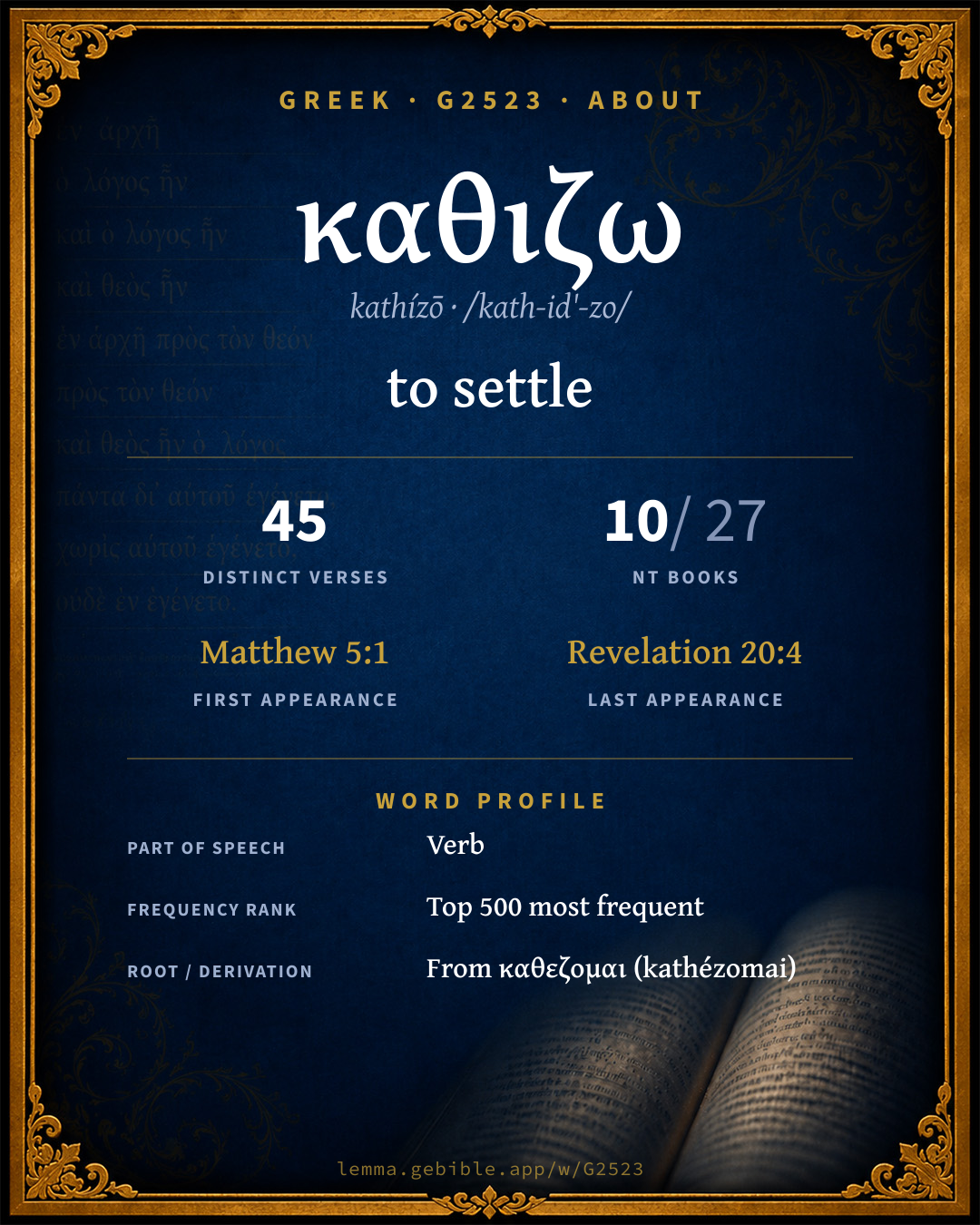
καθίζω
to settle
‘to settle’ is one of 2 main senses fuller range ↓
Full lexicon entry — Thayer's Greek Lexicon
From Thayer's Greek Lexicon
Where this word appears
See every Aorist-tense verb in the Greek New Testament →
Grammar key — what these labels mean
Part of speech
- Verb
- An action or state-of-being word.
Tense
- Aorist
- Action viewed as a simple whole, without regard to duration — often past (perfective aspect).
- Perfect
- A completed past action with continuing present results.
- Future
- Action expected in future time.
- Present
- Ongoing or general action in present time (imperfective aspect).
Voice
- Active
- The subject performs the action.
- Middle
- The subject acts on or for itself, or with special interest in the action.
Mood
- Indicative
- States a fact or asks a factual question (the mood of reality).
- Participle
- A verbal adjective (“writing,” “having written”).
- Infinitive
- A verbal noun (“to write”), unmarked for person or number.
- Imperative
- Expresses a command or request.
- Subjunctive
- Expresses probability, purpose, or possibility (the mood of contingency).
Case
- Nominative
- The case of the subject (and the predicate nominative).
- Genitive
- The case of source, possession, or “of” — answers “whose / from what.”
Person
- 3rd person
- The one spoken about (“he / she / it / they”).
- 2nd person
- The one addressed (“you”).
- 1st person
- The speaker (“I / we”).
Gender
- Masculine
- Grammatically masculine.
Number
- Singular
- One.
- Plural
- More than one.
Grammatical forms 15 distinct
- Verb, Aorist, Active, Indicative, 3rd person, Singular 12 times (26%)
- Verb, Aorist, Active, Participle, Nominative, Singular, Masculine 11 times (23%)
- Verb, Aorist, Active, Infinitive 6 times (13%)
- Verb, Aorist, Active, Indicative, 3rd person, Plural 3 times (6%)
- Verb, Aorist, Active, Imperative, 2nd person, Plural 3 times (6%)
- Verb, Aorist, Active, Participle, Nominative, Plural, Masculine 2 times (4%)
- Verb, Perfect, Active, Indicative, 3rd person, Singular 2 times (4%)
- Verb, Aorist, Active, Indicative, 1st person, Singular 1 time (2%)
+7 more forms (7 occurrences)
Parsed forms decoded from the imported morphology (Robinson–Tischendorf, public domain), counted across 47 parsed occurrences — not distinct verses.
Every verse where G2523 appears — 45 distinct verses across 10 books. Click any verse to open its interlinear word-by-word view. Verse text shown in the World English Bible for context — . Each verse’s Greek form is shown with its reference; the English is not keyword-highlighted, since the data carries no word-level English alignment. Use “Compare translations” on any verse to read it across multiple English versions. This concordance covers the Greek New Testament; Septuagint (Greek Old Testament) occurrences of this word are not indexed here.
Matthew 8 verses
- Matthew 5:1 καθίσαντος aor act ptcp gen sg masc Seeing the multitudes, he went up onto the mountain. When he had sat down, his disciples came to him.
- Matthew 13:48 καθίσαντες aor act ptcp nom pl masc which, when it was filled, they drew up on the beach. They sat down, and gathered the good into containers, but the bad they threw away.
- Matthew 19:28 καθίσῃ καθίσεσθε aor act subj 3sg fut mid ind 2pl Jesus said to them, "Most assuredly I tell you that you who have followed me, in the regeneration when the Son of Man will sit on the throne of his glory, you also will sit on twelve thrones, judging the twelve tribes of Israel.
- Matthew 20:21 καθίσωσιν aor act subj 3pl He said to her, "What do you want?" She said to him, "Command that these, my two sons, may sit, one on your right hand, and one on your left hand, in your Kingdom."
- Matthew 20:23 καθίσαι aor act inf He said to them, "You will indeed drink my cup, and be baptized with the baptism that I am baptized with, but to sit on my right hand and on my left hand is not mine to give; but it is for whom it has been prepared by my Father."
- Matthew 23:2 ἐκάθισαν aor act ind 3pl saying, "The scribes and the Pharisees sat on Moses' seat.
- Matthew 25:31 καθίσει fut act ind 3sg "But when the Son of Man comes in his glory, and all the holy angels with him, then he will sit on the throne of his glory.
- Matthew 26:36 καθίσατε aor act impv 2pl Then Jesus came with them to a place called Gethsemane, and said to his disciples, "Sit here, while I go there and pray."
Mark 8 verses
- Mark 9:35 καθίσας aor act ptcp nom sg masc He sat down, and called the twelve; and he said to them, "If any man wants to be first, he shall be last of all, and servant of all."
- Mark 10:37 καθίσωμεν aor act subj 1pl They said to him, "Grant to us that we may sit, one at your right hand, and one at your left hand, in your glory."
- Mark 10:40 καθίσαι aor act inf but to sit at my right hand and at my left hand is not mine to give, but for whom it has been prepared."
- Mark 11:2 κεκάθικεν perf act ind 3sg and said to them, "Go your way into the village that is opposite you. Immediately as you enter into it, you will find a young donkey tied, on which no one has sat. Untie him, and bring him.
- Mark 11:7 ἐκάθισεν aor act ind 3sg They brought the young donkey to Jesus, and threw their garments on it, and Jesus sat on it.
- Mark 12:41 καθίσας aor act ptcp nom sg masc Jesus sat down opposite the treasury, and saw how the multitude cast money into the treasury. Many who were rich cast in much.
- Mark 14:32 καθίσατε aor act impv 2pl They came to a place which was named Gethsemane. He said to his disciples, "Sit here, while I pray."
- Mark 16:19 ἐκάθισεν aor act ind 3sg So then the Lord Jesus, after he had spoken to them, was received up into heaven, and sat down at the right hand of God.
Luke 7 verses
- Luke 4:20 ἐκάθισεν aor act ind 3sg He closed the book, gave it back to the attendant, and sat down. The eyes of all in the synagogue were fastened on him.
- Luke 5:3 καθίσας aor act ptcp nom sg masc He entered into one of the boats, which was Simon's, and asked him to put out a little from the land. He sat down and taught the multitudes from the boat.
- Luke 14:28 καθίσας aor act ptcp nom sg masc For which of you, desiring to build a tower, doesn't first sit down and count the cost, to see if he has enough to complete it?
- Luke 14:31 καθίσας aor act ptcp nom sg masc Or what king, as he goes to encounter another king in war, will not sit down first and consider whether he is able with ten thousand to meet him who comes against him with twenty thousand?
- Luke 16:6 καθίσας aor act ptcp nom sg masc He said, 'A hundred batos of oil.' He said to him, 'Take your bill, and sit down quickly and write fifty.'
- Luke 19:30 ἐκάθισεν aor act ind 3sg saying, "Go your way into the village on the other side, in which, as you enter, you will find a colt tied, whereon no man ever yet sat. Untie it, and bring it.
- Luke 24:49 καθίσατε aor act impv 2pl Behold, I send forth the promise of my Father on you. But wait in the city of Jerusalem until you are clothed with power from on high."
John 3 verses
- John 8:2 καθίσας aor act ptcp nom sg masc Now very early in the morning, he came again into the temple, and all the people came to him. He sat down, and taught them.
- John 12:14 ἐκάθισεν aor act ind 3sg Jesus, having found a young donkey, sat on it. As it is written,
- John 19:13 ἐκάθισεν aor act ind 3sg When Pilate therefore heard these words, he brought Jesus out, and sat down on the judgment seat at a place called "The Pavement," but in Hebrew, "Gabbatha."
Acts 9 verses
- Acts 2:3 ἐκάθισεν aor act ind 3sg Tongues like fire appeared and were distributed to them, and one sat on each of them.
- Acts 2:30 καθίσαι aor act inf Therefore, being a prophet, and knowing that God had sworn with an oath to him that of the fruit of his body, according to the flesh, he would raise up the Christ to sit on his throne,
- Acts 8:31 καθίσαι aor act inf He said, "How can I, unless someone explains it to me?" He begged Philip to come up and sit with him.
- Acts 12:21 καθίσας aor act ptcp nom sg masc On an appointed day, Herod dressed himself in royal clothing, sat on the throne, and gave a speech to them.
- Acts 13:14 ἐκάθισαν aor act ind 3pl But they, passing on from Perga, came to Antioch of Pisidia. They went into the synagogue on the Sabbath day, and sat down.
- Acts 16:13 καθίσαντες aor act ptcp nom pl masc On the Sabbath day we went forth outside of the city by a riverside, where we supposed there was a place of prayer, and we sat down, and spoke to the women who had come together.
- Acts 18:11 ἐκάθισεν aor act ind 3sg He lived there a year and six months, teaching the word of God among them.
- Acts 25:6 καθίσας aor act ptcp nom sg masc When he had stayed among them more than ten days, he went down to Caesarea, and on the next day he sat on the judgment seat, and commanded Paul to be brought.
- Acts 25:17 καθίσας aor act ptcp nom sg masc When therefore they had come together here, I didn't delay, but on the next day sat on the judgment seat, and commanded the man to be brought.
1 Corinthians 2 verses
- 1 Corinthians 6:4 καθίζετε pres act ind 2pl If then, you have to judge things pertaining to this life, do you set them to judge who are of no account in the assembly?
- 1 Corinthians 10:7 ἐκάθισεν aor act ind 3sg Neither be idolaters, as some of them were. As it is written, "The people sat down to eat and drink, and rose up to play."
Ephesians 1 verse
2 Thessalonians 1 verse
Hebrews 4 verses
- Hebrews 1:3 ἐκάθισεν aor act ind 3sg His Son is the radiance of his glory, the very image of his substance, and upholding all things by the word of his power, when he had by himself made purification for our sins, sat down on the right hand of the Majesty on high;
- Hebrews 8:1 ἐκάθισεν aor act ind 3sg Now in the things which we are saying, the main point is this. We have such a high priest, who sat down on the right hand of the throne of the Majesty in the heavens,
- Hebrews 10:12 ἐκάθισεν aor act ind 3sg but he, when he had offered one sacrifice for sins for ever, sat down on the right hand of God;
- Hebrews 12:2 κεκάθικεν perf act ind 3sg looking to Jesus, the author and perfecter of faith, who for the joy that was set before him endured the cross, despising shame, and has sat down at the right hand of the throne of God.
Revelation 2 verses
- Revelation 3:21 καθίσαι ἐκάθισα aor act inf aor act ind 1sg He who overcomes, I will give to him to sit down with me on my throne, as I also overcame, and sat down with my Father on his throne.
- Revelation 20:4 ἐκάθισαν aor act ind 3pl I saw thrones, and they sat on them, and judgment was given to them. I saw the souls of those who had been beheaded for the testimony of Jesus, and for the word of God, and such as didn't worship the beast nor his image, and didn't receive the mark on their forehead and on their hand. They lived, and reigned with Christ for the thousand years.
About this entry
At a glance — auto-summarized from this page’s data, not written by a person. Every figure links to its source below. This summary describes the numbers; it doesn’t interpret them.
καθιζω (kathízō) is a Greek verb most often rendered “to settle.” It first appears in Matthew 5:1. It turns up in 45 verses across 10 books, a moderately common footprint. Its lexical range runs to 2 senses. The sections below give every sense, occurrence, and version rendering.
Gloss history
Strong's 1890 vs modern scholarship

About this word
Strong's G2523 catalogs a Greek word from the Greek New Testament.
These counts are not copied from any lexicon or concordance. They are computed here, from the morphology-tagged Greek New Testament. What Lemma adds →
- 45
- distinct verses
- The word appears in 45 distinct verses.
- 10 / 27
- NT books
- The word appears in 10 of 27 New Testament books.
- #326
- by frequency
- Top 500 most frequent Greek words (rank 326 of 5,347 Greek words by occurrence).
View all 45 occurrences in the concordance →
By section of the New Testament
By traditional corpus
Conventional, traditional groupings — biblical authorship is debated, so this is a traditional corpus grouping, not an authorship claim. Some books belong to more than one corpus (Luke is in both the Gospels and the Lukan corpus, and so on), so these shares overlap and need not total 100%. Each figure is a share of the word’s 45 distinct verses.
- Gospels 26 verses · 58%
- Lukan (Luke–Acts) 16 verses · 36%
- Johannine 5 verses · 11%
- Pauline corpus 4 verses · 9%
- Hebrews 4 verses · 9%
- Revelation 2 verses · 4%
How translations render this word
Counts come from each version’s own published word-to-Strong’s tagging or interlinear alignment — an approximate guide to how each version renders this word, not a word-level alignment the data otherwise carries. Because each total is that version’s own tagged count, the per-version totals vary from one another and need not match the appearance or distinct-verse counts above. These counts may also differ from a printed concordance because Lemma counts each distinctly tagged rendering and does not collapse phrase taggings into a single head-word total. This is a fixed set of word-tagged versions (KJV, ASV, BSB, ULT) and does not change with the reading translation you choose elsewhere. Each version’s license is shown beside its name below (and on Sources).
- King James Version: Sat 7×, Sat down 7×, Sit 7×
- American Standard Version: Sat 9×, Sit 8×, Sat down 7×
- Berean Standard Bible: Sat down 8×, Sit 7×, Sat 4×
- unfoldingWord Literal Text: Sat down 6×, Sit 6×, Having sat down 5×
King James Version Public Domain
Renders G2523 across 50 tagged occurrences — most commonly:
Plus 15 renderings that appear only once — usually multi-word phrases or single function words the recovered tagging swept in, not distinct renderings.
American Standard Version Public Domain
Renders G2523 across 48 tagged occurrences — most commonly:
Plus 13 renderings that appear only once — usually multi-word phrases or single function words the recovered tagging swept in, not distinct renderings.
Berean Standard Bible Public Domain
Renders G2523 across 46 tagged occurrences — most commonly:
Plus 13 renderings that appear only once — usually multi-word phrases or single function words the recovered tagging swept in, not distinct renderings.
unfoldingWord Literal Text CC BY-SA 4.0
Renders G2523 across 51 tagged occurrences — most commonly:
Plus 17 renderings that appear only once — usually multi-word phrases or single function words the recovered tagging swept in, not distinct renderings.
Senses in Thayer's
The 2 senses Thayer's distinguishes for this word, in lexicon order (not ranked by frequency or importance). The full entry — with sub-senses — is in the Lexicon Entry tab.
- to set, appoint, to confer a kingdom on one
- intransitively
Word origin
Derived from καθεζομαι (kathézomai) (G2516) — to sit down.
Another (active) form for G2516 ; to seat down that is set (figuratively appoint ); intransitively to sit (down); figuratively to settle ( hover dwell ): - continue set sit (down) tarry.
— Strong’s Exhaustive Concordance (1890), public domain.
Forms in the corpus
The 15 distinct written forms G2523 takes in the Greek New Testament, most frequent first — each parse links to that tense’s occurrences in the concordance.
Septuagint usage
The same Greek word καθιζω appears 223 times in the Greek Old Testament (Septuagint), across 212 verses in 30 books.
- 223
- LXX occurrences
- Tagged occurrences of this Greek word in the Septuagint.
- 212
- verses
- Distinct Septuagint verses containing this word.
- 30 / 39
- OT books
- The word appears in 30 of the 39 Old Testament books.
Sample Septuagint occurrences
- Genesis 8:4 καταἵζω
- Exodus 2:15 καταἵζω
- Leviticus 15:4 καταἵζω
- Numbers 11:4 καταἵζω
- Deuteronomy 1:45 καταἵζω
- Joshua 5:2 καταἵζω
- Judges 5:16 καταἵζω
- Ruth 2:14 καταἵζω
- 1 Samuel 1:23 καταἵζω
- 2 Samuel 1:1 καταἵζω
- 1 Kings 1:13 καταἵζω
- 2 Kings 6:24 καταἵζω
Septuagint occurrences (same lexeme)
Every verse where the same Strong’s number (G2523) appears in the Greek Septuagint — showing the first 50 of 212. Verse text shown in the World English Bible for context; the Greek form is the matched word — the English is not keyword-highlighted.
- Genesis 8:4 καταἵζω The ark rested in the seventh month, on the seventeenth day of the month, on Ararat's mountains.
- Genesis 15:11 καταἵζω The birds of prey came down on the carcasses, and Abram drove them away.
- Genesis 21:16 καταἵζω She went and sat down opposite him, a good way off, about a bow shot away. For she said, "Don't let me see the death of the child." She sat over against him, and lifted up her voice, and wept.
- Genesis 22:5 καταἵζω Abraham said to his young men, "Stay here with the donkey. The boy and I will go yonder. We will worship, and come back to you.
- Genesis 27:19 καταἵζω Jacob said to his father, "I am Esau your firstborn. I have done what you asked me to do. Please arise, sit and eat of my venison, that your soul may bless me."
- Genesis 31:34 καταἵζω Now Rachel had taken the teraphim, put them in the camel's saddle, and sat on them. Laban felt about all the tent, but didn't find them.
- Genesis 37:25 καταἵζω They sat down to eat bread, and they lifted up their eyes and looked, and saw a caravan of Ishmaelites was coming from Gilead, with their camels bearing spices and balm and myrrh, going to carry it down to Egypt.
- Genesis 38:14 καταἵζω She took off of her the garments of her widowhood, and covered herself with her veil, and wrapped herself, and sat in the gate of Enaim, which is by the way to Timnah; for she saw that Shelah was grown up, and she wasn't given to him as a wife.
- Genesis 43:33 καταἵζω They sat before him, the firstborn according to his birthright, and the youngest according to his youth, and the men marveled one with another.
- Genesis 48:2 καταἵζω Someone told Jacob, and said, "Behold, your son Joseph comes to you," and Israel strengthened himself, and sat on the bed.
- Exodus 2:15 καταἵζω Now when Pharaoh heard this thing, he sought to kill Moses. But Moses fled from the face of Pharaoh, and lived in the land of Midian, and he sat down by a well.
- Exodus 16:3 καταἵζω and the children of Israel said to them, "We wish that we had died by the hand of Yahweh in the land of Egypt, when we sat by the flesh-pots, when we ate our fill of bread, for you have brought us out into this wilderness, to kill this whole assembly with hunger."
- Exodus 18:13 καταἵζω It happened on the next day, that Moses sat to judge the people, and the people stood around Moses from the morning to the evening.
- Exodus 32:6 καταἵζω They rose up early on the next day, and offered burnt offerings, and brought peace-offerings; and the people sat down to eat and to drink, and rose up to play.
- Leviticus 15:4 καταἵζω "'Every bed whereon he who has the discharge lies shall be unclean; and everything he sits on shall be unclean.
- Leviticus 15:6 καταἵζω He who sits on anything whereon the man who has the discharge sat shall wash his clothes, and bathe himself in water, and be unclean until the evening.
- Leviticus 15:20 καταἵζω "'Everything that she lies on in her impurity shall be unclean. Everything also that she sits on shall be unclean.
- Leviticus 15:22 καταἵζω Whoever touches anything that she sits on shall wash his clothes, and bathe himself in water, and be unclean until the evening.
- Leviticus 15:23 καταἵζω If it is on the bed, or on anything whereon she sits, when he touches it, he shall be unclean until the evening.
- Leviticus 15:26 καταἵζω Every bed whereon she lies all the days of her discharge shall be to her as the bed of her period: and everything whereon she sits shall be unclean, as the uncleanness of her period.
- Numbers 11:4 καταἵζω The mixed multitude that was among them lusted exceedingly: and the children of Israel also wept again, and said, Who shall give us flesh to eat?
- Numbers 22:27 καταἵζω The donkey saw the angel of Yahweh, and she lay down under Balaam: and Balaam's anger was kindled, and he struck the donkey with his staff.
- Deuteronomy 1:45 καταἵζω You returned and wept before Yahweh; but Yahweh didn't listen to your voice, nor gave ear to you.
- Deuteronomy 17:18 καταἵζω It shall be, when he sits on the throne of his kingdom, that he shall write him a copy of this law in a book, out of [that which is] before the priests the Levites:
- Deuteronomy 20:12 καταἵζω If it will make no peace with you, but will make war against you, then you shall besiege it:
- Deuteronomy 20:19 καταἵζω When you shall besiege a city a long time, in making war against it to take it, you shall not destroy the trees of it by wielding an axe against them; for you may eat of them, and you shall not cut them down; for is the tree of the field man, that it should be besieged of you?
- Deuteronomy 21:13 καταἵζω and she shall put the clothing of her captivity from off her, and shall remain in your house, and bewail her father and her mother a full month: and after that you shall go in to her, and be her husband, and she shall be your wife.
- Deuteronomy 25:2 καταἵζω and it shall be, if the wicked man be worthy to be beaten, that the judge shall cause him to lie down, and to be beaten before his face, according to his wickedness, by number.
- Joshua 5:2 καταἵζω At that time Yahweh said to Joshua, Make you flint knives, and circumcise again the children of Israel the second time.
- Joshua 8:9 καταἵζω Joshua sent them forth; and they went to set up the ambush, and stayed between Bethel and Ai, on the west side of Ai: but Joshua lodged that night among the people.
- Joshua 10:5 καταἵζω Therefore the five kings of the Amorites, the king of Jerusalem, the king of Hebron, the king of Jarmuth, the king of Lachish, the king of Eglon, gathered themselves together, and went up, they and all their hosts, and encamped against Gibeon, and made war against it.
- Joshua 10:31 καταἵζω Joshua passed from Libnah, and all Israel with him, to Lachish, and encamped against it, and fought against it:
- Joshua 10:34 καταἵζω Joshua passed from Lachish, and all Israel with him, to Eglon; and they encamped against it, and fought against it;
- Joshua 10:36 καταἵζω Joshua went up from Eglon, and all Israel with him, to Hebron; and they fought against it:
- Joshua 10:38 καταἵζω Joshua returned, and all Israel with him, to Debir, and fought against it:
- Judges 5:16 καταἵζω Why sat you among the sheepfolds, To hear the whistling for the flocks? At the watercourses of Reuben There were great searchings of heart.
- Judges 5:17 καταἵζω Gilead abode beyond the Jordan: Dan, why did he remain in ships? Asher sat still at the haven of the sea, Abode by his creeks.
- Judges 6:11 καταἵζω The angel of Yahweh came, and sat under the oak which was in Ophrah, that pertained to Joash the Abiezrite: and his son Gideon was beating out wheat in the winepress, to hide it from the Midianites.
- Judges 8:29 καταἵζω Jerubbaal the son of Joash went and lived in his own house.
- Judges 11:17 καταἵζω then Israel sent messengers to the king of Edom, saying, Please let me pass through your land; but the king of Edom didn't listen. In the same way, he sent to the king of Moab; but he would not: and Israel abode in Kadesh.
- Judges 15:8 καταἵζω He struck them hip and thigh with a great slaughter: and he went down and lived in the cleft of the rock of Etam.
- Judges 19:4 καταἵζω His father-in-law, the young lady's father, retained him; and he abode with him three days: so they ate and drink, and lodged there.
- Judges 19:6 καταἵζω So they sat down, and ate and drink, both of them together: and the young lady's father said to the man, Please be pleased to stay all night, and let your heart be merry.
- Judges 19:7 καταἵζω The man rose up to depart; but his father-in-law urged him, and he lodged there again.
- Judges 19:15 καταἵζω They turned aside there, to go in to lodge in Gibeah: and he went in, and sat him down in the street of the city; for there was no man who took them into his house to lodge.
- Judges 20:26 καταἵζω Then all the children of Israel, and all the people, went up, and came to Bethel, and wept, and sat there before Yahweh, and fasted that day until even; and they offered burnt-offerings and peace-offerings before Yahweh.
- Judges 20:47 καταἵζω But six hundred men turned and fled toward the wilderness to the rock of Rimmon, and abode in the rock of Rimmon four months.
- Judges 21:2 καταἵζω The people came to Bethel, and sat there until evening before God, and lifted up their voices, and wept sore.
- Judges 21:23 καταἵζω The children of Benjamin did so, and took them wives, according to their number, of those who danced, whom they carried off: and they went and returned to their inheritance, and built the cities, and lived in them.
- Ruth 2:14 καταἵζω At meal-time Boaz said to her, Come here, and eat of the bread, and dip your morsel in the vinegar. She sat beside the reapers, and they reached her parched grain, and she ate, and was sufficed, and left of it.
These are occurrences of the same Greek lexeme (G2523) in the Septuagint — not a translation of any one Hebrew word. The store carries no word-level Hebrew↔Greek alignment, so no Hebrew original is asserted here. Counts come from the recovered LXX Strong's tagging — high-frequency vocabulary is well covered, while rare or late forms may be untagged — so they reflect tagged occurrences and may slightly undercount.