
Joshua 10:36

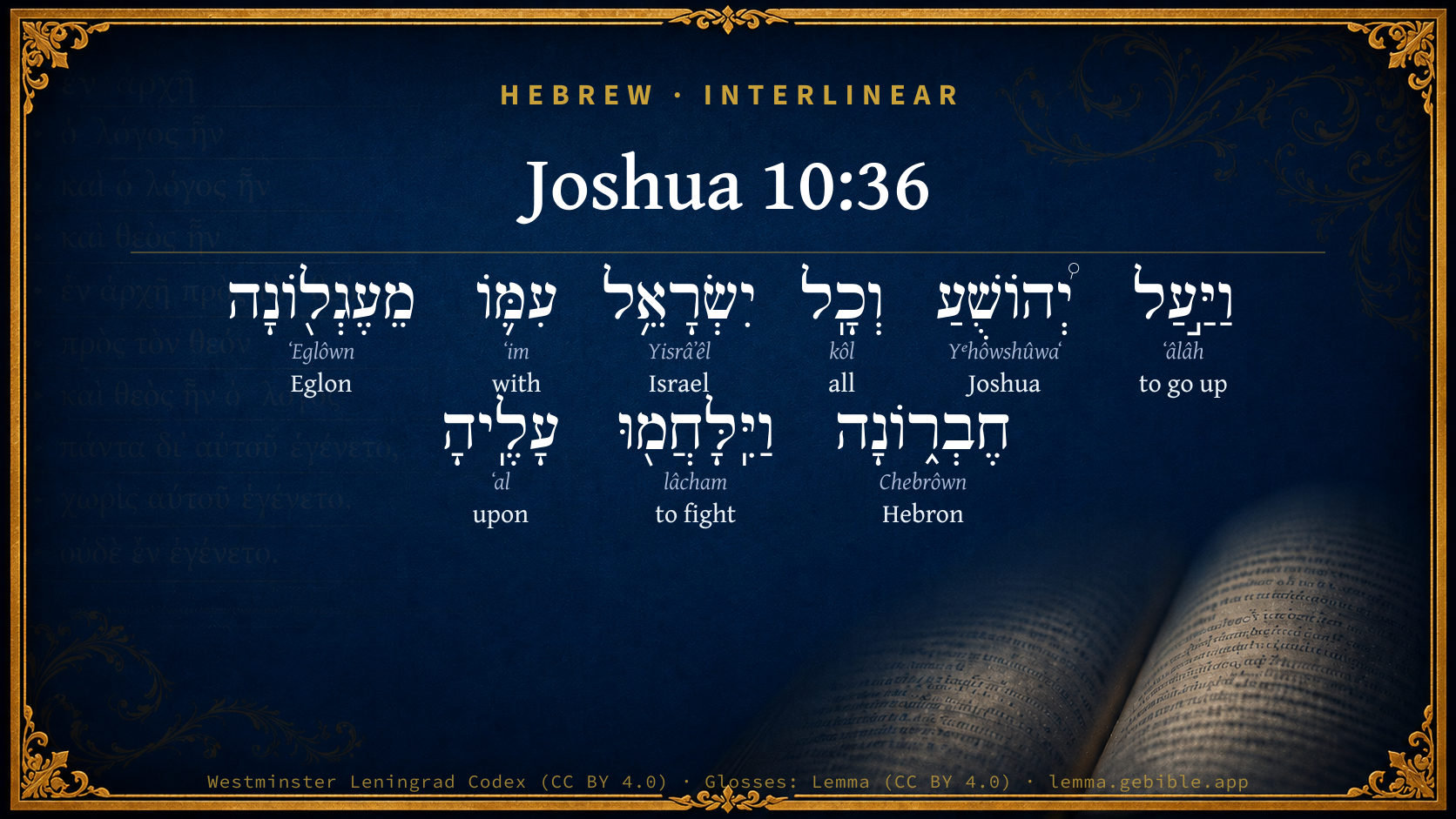
Hebrew (Westminster Leningrad Codex) Joshua 10:36 appears in the Hebrew Old Testament. The text above is from the Westminster Leningrad Codex. Each word links to its Strong’s number, a concise gloss, and parsing drawn from the Open Scriptures Hebrew Bible morphology. Click any word for its full Brown-Driver-Briggs (BDB) entry.
Download image
Cite this verse

Joshua 10:36 (World English Bible). Public Domain. Lemma interlinear Bible study tool, https://lemma.gebible.app/v/joshua/10/36.

Show BibTeX & RIS
BibTeX
RIS
English Translation
Joshua went up from Eglon, and all Israel with him, to Hebron; and they fought against it:
World English Bible · Public Domain
Download a study sheet

One document with this verse’s original text, its word-by-word gloss line, the meaning frame, cross-references with their text, attributed commentary, and full source and license credits — printable, and it pastes into notes with its structure intact.

This verse Autodidact and up

Study sheet (.html) Plain text (.txt)

A passage Seminary Student

Up to 50 verses in one chapter. A passage sheet keeps up to 6 commentary sources and 12 cross-references per verse, in the order this page ranks them, and says so on the sheet whenever that leaves anything out. Ask for a single verse and you get the Autodidact verse sheet above.

Everything on this page stays free to read, with no account — the sheet is a download of what is already on screen, not access to it.

Want to remove ads? Support Godless Engineer
Compare translations 3

The same verse in 3 English versions, stacked beneath the original-language interlinear above. Click any original word for its lexicon entry.

Each is an independent rendering of the whole verse — the interlinear is not word-aligned to these translations.

Highlighted words mark where these versions differ — a whole-verse word diff, not a word-by-word alignment.

  • World English Bible Public Domain
    Joshua went up from Eglon, and all Israel with him, to Hebron; and they fought against it:
  • King James Version Public Domain
    And Joshua went up from Eglon, and all Israel with him, unto Hebron; and they fought against it:
  • unfoldingWord Literal Text CC BY-SA 4.0
    And Joshua and all of Israel with him went up from Eglon to Hebron, and they fought with it.

unfoldingWord Literal Text — © unfoldingWord, licensed CC BY-SA 4.0. Word-aligned USFM3 via Door43 (git.door43.org/unfoldingWord/en_ult).

Versions to compare (up to 4)

3 of 4 selected

Show all 18 translations

Every available English version of this verse, each an independent rendering of the whole verse.

  • World English Bible Public Domain
    Joshua went up from Eglon, and all Israel with him, to Hebron; and they fought against it:
  • Berean Standard Bible Public Domain
    Then Joshua and all Israel with him went up from Eglon to Hebron and fought against it.
  • Majority Standard Bible Public Domain
    Then Joshua and all Israel with him went up from Eglon to Hebron and fought against it.
  • King James Version Public Domain
    And Joshua went up from Eglon, and all Israel with him, unto Hebron; and they fought against it:
  • American Standard Version (1901) Public Domain
    And Joshua went up from Eglon, and all Israel with him, unto Hebron; and they fought against it:
  • Revised Version (1885) Public Domain
    And Joshua went up from Eglon, and all Israel with him, unto Hebron; and they fought against it:
  • Geneva Bible (1599) Public Domain
    Then Ioshua went vp from Eglon, and all Israel with him vnto Hebron, and they fought against it.
  • Douay-Rheims (1899) Public Domain
    He went up also with all Israel from Eglon to Hebron, and fought against it:
  • Young's Literal Translation Public Domain
    And Joshua goeth up, and all Israel with him, from Eglon to Hebron, and they fight against it,
  • Literal Standard Version CC BY-SA 4.0
    And Joshua goes up, and all Israel with him, from Eglon to Hebron, and they fight against it,
  • Unlocked Literal Bible CC BY-SA 4.0
    Then Joshua and all Israel passed on from Eglon to Hebron. They waged war against it.
  • unfoldingWord Literal Text CC BY-SA 4.0
    And Joshua and all of Israel with him went up from Eglon to Hebron, and they fought with it.
  • Darby Bible Public Domain
    And Joshua went up, and all Israel with him, from Eglon to Hebron; and they fought against it.
  • World Messianic Bible Public Domain
    Joshua went up from Eglon, and all Israel with him, to Hebron; and they fought against it.
  • Webster's Bible Public Domain
    And Joshua went up from Eglon, and all Israel with him, to Hebron; and they fought against it:
  • Free Bible Version CC BY-SA 4.0
    Joshua and the Israelite army left Eglon and went to attack Hebron.
  • Bible in Basic English Public Domain
    And Joshua and all Israel with him went up from Eglon to Hebron, and made an attack on it;
  • JPS Tanakh (1917) Public Domain
    And Joshua went up from Eglon, and all Israel with him, unto Hebron; and they fought against it.

Literal Standard Version (2020), Covenant Press — licensed CC BY-SA 4.0. Text via the HelloAO Bible API (eBible.org). Unlocked Literal Bible (unfoldingWord) — licensed CC BY-SA 4.0. Text via the HelloAO Bible API (eBible.org). unfoldingWord Literal Text — © unfoldingWord, licensed CC BY-SA 4.0. Word-aligned USFM3 via Door43 (git.door43.org/unfoldingWord/en_ult). Free Bible Version, Dr. Jonathan Gallagher — licensed CC BY-SA 4.0. Text via the HelloAO Bible API (eBible.org).

Word by word

More ways to search: Search by grammar → Find every occurrence → Compare this word →

Practice this passage: Drill this verse → Learn its vocabulary →

מֵעֶגְל֖וֹנָה
ʻEglôwn
H5700
“from · Eglon · toward”
Preposition + Noun, Proper + Suffix, Demonstrative
Part of Speech
Preposition + Noun
Type
Proper
Full BDB Definition

Origin: from H5695

TWOT: None

Eglon = "calf-like" - king of Moab who oppressed the children of Israel for 18 years before he was killed by the judge Ehud (noun proper masculine) - a royal city in Canaan that opposed the conquest; located in the low lands of Judah (noun proper locative)
  1. וַיַּ֣עַל ʻâlâh H5927 “and · to go up” Conjunction + Verb, Qal, Sequential Imperfect, 3rd Person, Masculine, Singular
  2. יְ֠הוֹשֻׁעַ Yᵉhôwshûwaʻ H3091 “Joshua” Noun, Proper
  3. וְכָֽל kôl H3605 “and · all of” Conjunction + Noun, Common, Masculine, Singular, Construct
  4. יִשְׂרָאֵ֥ל Yisrâʼêl H3478 “Israel” Noun, Proper
  5. עִמּ֛וֹ ʻim H5973 “with · him” Preposition + Suffix, Personal, 3rd Person, Masculine, Singular
  6. חֶבְר֑וֹנָה Chebrôwn H2275 “Hebron · toward” Noun, Proper + Suffix, Demonstrative
  7. וַיִּֽלָּחֲמ֖וּ lâcham H3898 “and · to fight” Conjunction + Verb, Niphal, Sequential Imperfect, 3rd Person, Masculine, Plural
  8. עָלֶֽיהָ ʻal H5921 “upon · her” Preposition + Suffix, Personal, 3rd Person, Feminine, Singular

About this verse

These counts appear in no published source. They are computed here, from the morphology-tagged text and Lemma’s own curated glosses. What Lemma adds →

9
words
9
distinct lemmas
Historical
section

Notable vocabulary

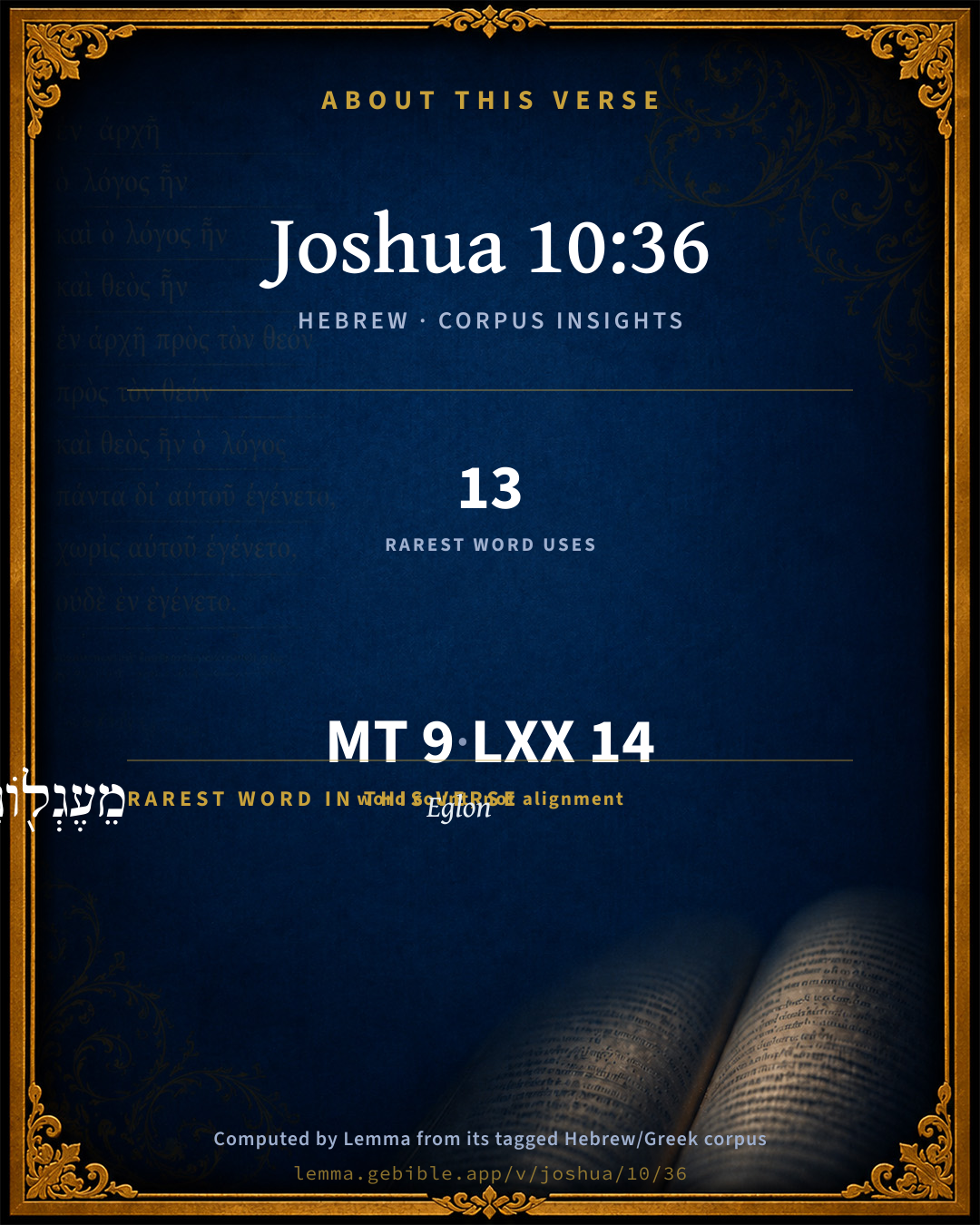
The rarest word here is מֵעֶגְל֖וֹנָה Eglon H5700 — appearing just 13 times in the whole Hebrew Bible.

Shared distinctive vocabulary

מֵעֶגְל֖וֹנָה Eglon H5700 occurs in 12 verses of the Hebrew Bible. Also found in:

Grammatical profile

  • 2 verbs
  • 5 nouns
  • 2 prepositions

Verb forms

  • וַיַּ֣עַל Qal · Sequential Imperfect
  • וַיִּֽלָּחֲמ֖וּ Niphal · Sequential Imperfect

Hebrew & Septuagint length

In English translation the verse runs 17 words from the Hebrew and 14 from the Septuagint (LXX English) — closely comparable.

A rough comparison of the two English renderings, which tokenize alike — not a word-level alignment.

Word counts can differ between the Hebrew and the Greek without any difference in meaning — e.g. the Hebrew direct-object marker אֵת has no separate Greek word, and Greek often adds the article ὁ.

In the original languages it is 9 Hebrew tokens and 14 Greek tokens — but the two are counted differently (Hebrew bundles its prefixes and suffixes into one token; the Greek is in lemma form), so that isn’t a like-for-like length.

Cross-references

13

Topical passages linked to Joshua 10:36 in the Treasury of Scripture Knowledge — connected by theme and wording, ordered by reader-vote popularity; previews shown in the World English Bible.

  • Judges 1:10 Judah went against the Canaanites who lived in Hebron (now the name of Hebron before was Kiriath Arba); and they struck Sheshai, and Ahiman, and Talmai.
  • Joshua 15:13 To Caleb the son of Jephunneh he gave a portion among the children of Judah, according to the commandment of Yahweh to Joshua, even Kiriath Arba, [which Arba was] the father of Anak (the same is Hebron).
  • Numbers 13:22 They went up by the South, and came to Hebron; and Ahiman, Sheshai, and Talmai, the children of Anak, were there. (Now Hebron was built seven years before Zoan in Egypt.)
  • Joshua 14:13–14 Joshua blessed him; and he gave Hebron to Caleb the son of Jephunneh for an inheritance.
  • Genesis 13:18 Abram moved his tent, and came and lived by the oaks of Mamre, which are in Hebron, and built an altar there to Yahweh.
  • Joshua 10:3 Therefore Adoni-zedek king of Jerusalem sent to Hoham king of Hebron, and to Piram king of Jarmuth, and to Japhia king of Lachish, and to Debir king of Eglon, saying,
  • Joshua 10:5 Therefore the five kings of the Amorites, the king of Jerusalem, the king of Hebron, the king of Jarmuth, the king of Lachish, the king of Eglon, gathered themselves together, and went up, they and all their hosts, and encamped against Gibeon, and made war against it.
  • Joshua 15:54 and Humtah, and Kiriath Arba (the same is Hebron), and Zior; nine cities with their villages.
  • Joshua 21:13 To the children of Aaron the priest they gave Hebron with its suburbs, the city of refuge for the manslayer, and Libnah with its suburbs,
  • 2 Samuel 5:1–5 Then came all the tribes of Israel to David to Hebron, and spoke, saying, Behold, we are your bone and your flesh.
  • 2 Samuel 15:9–10 The king said to him, Go in peace. So he arose, and went to Hebron.
  • 1 Chronicles 12:23 These are the numbers of the heads of those who were armed for war, who came to David to Hebron, to turn the kingdom of Saul to him, according to the word of Yahweh.
  • 1 Chronicles 12:28 and Zadok, a young man mighty of valor, and of his father's house twenty-two captains.

Cross-references courtesy of OpenBible.info (CC BY 4.0).

Hebrew and Greek witnesses Masoretic Hebrew ↔ Greek Septuagint

The same verse in the two great witnesses to the Old Testament, shown verse-for-verse.

These are two independent witnesses, not word-aligned to each other, and the Septuagint is shown in lemma (dictionary) form.

Hebrew Joshua 10:36 Masoretic · Westminster Leningrad Codex

וַיַּ֣עַל יְ֠הוֹשֻׁעַ וְכָֽל יִשְׂרָאֵ֥ל עִמּ֛וֹ מֵעֶגְל֖וֹנָה חֶבְר֑וֹנָה וַיִּֽלָּחֲמ֖וּ עָלֶֽיהָ

Joshua went up from Eglon, and all Israel with him, to Hebron; and they fought against it:

World English Bible · Public Domain

Greek LXX Joshua 10:36 Septuagint · lemma form

καί ἀποἔρχομαι ἰησοῦς καί πᾶς ἰσραήλ μετά αὐτός εἰς χεβρων καί περι καταἵζω αὐτός

And Joshua and all Israel with him departed to Chebron, and encamped about it.

LXX2012 (modern English Septuagint) · Public Domain

Hebrew: Westminster Leningrad Codex (CC BY 4.0). Greek: Septuagint (public domain); English from LXX2012 (modern English Septuagint) (Public Domain). How the Septuagint differs from the Hebrew →

Targum (Aramaic paraphrase)

1

The Targum is the ancient Jewish Aramaic paraphrase of the Hebrew Scriptures — an interpretive translation, not the Hebrew text itself. Onkelos (literal) and Pseudo-Jonathan (expansive) render the Torah, and Jonathan the Prophets. Coverage is partial: where no permissively-licensed English translation exists for a verse, only the Aramaic is shown. This is verse-level text, not a word-by-word alignment to the Hebrew.

  1. Targum Jonathan Prophets (Joshua–Malachi)
    וּסְלִיק יְהוֹשֻׁעַ וְכָל יִשְׂרָאֵל עִמֵיהּ מֵעֶגְלוֹן לְחֶבְרוֹן וְאַגִיחוּ קְרָבָא עֲלָהּ:

    (no public-domain English translation for this verse)

    Targum Jonathan — Aramaic: “Mikraot Gedolot” (public domain). English: “Sefaria Community Translation” (CC0 1.0 (public-domain dedication)); “London "Chaldee Paraphrase," 1871” (public domain). Text via Sefaria.

Commentary

Notes on Joshua 10:36 from classic Christian and Jewish commentators (each source and its license shown beneath its notes). The classic Christian expositions comment on the surrounding passage and are grouped to its opening verse, so a note may address several verses; the Jewish commentaries on the Tanakh (Rashi and others) are per-verse, so they appear only where the commentator wrote on this verse.

Lemma curates 59 commentaries, every one of them public domain or Creative Commons licensed, each selected and text-cleaned for this edition rather than reprinted as found. About our sources →

Trapp's Complete Commentary

John Trapp

Jos 10:36 And Joshua went up from Eglon, and all Israel with him, unto Hebron; and they fought against it:

Ver. 36. Unto Hebron.] See more of this victory in Jos 14:13-15; Jos 15:13

John Trapp, A Commentary or Exposition upon All the Books of the Old and New Testament (1647–1656) — public domain. Text from a community e-Sword module.

Adam Clarke's Commentary

Verse 36. - 37. Hebron - and the king thereof] See the note on Jos 10:3. From Jos 10:23 we learn that the king of Hebron was one of those five whom Joshua slew and hanged on five trees at Makkedah. How then can it be said that he slew the king of Hebron when he took the city, which was some days after the transactions at Makkedah? Either this slaying of the king of Hebron must refer to what had already been done, or the Hebronites, finding that their king fell in battle, had set up another in his place; which was the king Joshua slew, after he had taken the city and its dependencies, as is related Jos 10:37.

It appears that the city of Hebron had fallen back into the hands of the Canaanites, for it was again taken from them by the tribe of Judah, Jdg 1:10. Debir had also fallen into their hands, for it was reconquered by Othniel, the son-in-law of Caleb, Jdg 1:11-13. The manner in which Calmet accounts for this is very natural: Joshua, in his rapid conquests, contented himself with taking, demolishing, and burning those cities; but did not garrison any of them, for fear of weakening his army. In several instances no doubt the scattered Canaanites returned, repeopled, and put those cities in a state of defence. Hence the Israelites were obliged to conquer them a second time. This is a more rational way of accounting for these things, than that which supposes that the first chapter of Judges gives the more detailed account of the transactions recorded here; for there it is expressly said, that these transactions took place after the death of Joshua, (see Jdg 1:1), and consequently cannot be the same that are mentioned here.

Adam Clarke's Commentary on the Bible (1810–1826) — public domain. Text from a community e-Sword/MySword module.

The Cambridge Bible for Schools and Colleges

gen. ed. J. J. S. Perowne

36. unto Hebron] which lay next in a tolerably direct line. He is said to have “gone up” to it, for, in order to invest it, he had to march from the plain to the hill country.

The Cambridge Bible for Schools and Colleges (gen. ed. J. J. S. Perowne; Cambridge University Press, 1878–1918) — public domain. Text from a community e-Sword module.

John Gill's Exposition

And they took it, and smote it with the edge of the sword,

and the king thereof,.... For though the king of Hebron was one of the kings that were taken in the cave of Makkedah, and hanged; yet before Joshua came up to it, they had set up another king over them:

and all the cities thereof; for Hebron was a metropolitan city, and had other cities dependent on it, and subject to it:

and all the souls that were therein; both in Hebron, and in the cities subject to it:

he left none remaining; in any of them:

according to all that he had done to Eglon; the last place he came from:

but destroyed it utterly, and all the souls that were therein; but it seems that afterwards some that made their escape before the taking of the city, and other Canaanites driven out of their habitations, repeopled it; so that after Joshua's death it was recovered again by the tribe of Judah, Jdg 1:10; unless there is given in that place a more particular account of the taking of this city, with others at this time; but the former seems most likely.

John Gill's Exposition of the Whole Bible (1746–1763) — public domain (CC PDM 1.0). Text via the HelloAO Bible API.

Matthew Poole's English Annotations

Which though they took and killed all its inhabitants, yet they did not keep it; and therefore when Joshua and his army had forsaken it, and were returned to Gilgal, it seems the giants and other Canaanites being burnt out, or driven away from their former seats, planted and fortified themselves there; which made it necessary for Caleb to take it a second time, as is recorded Jos 15:14; Jdg 1:10. Or this is the same story, and the same conquest of Hebron, which is here generally related, and afterwards repeated, and more particularly described, Jos 15:13,14.

Matthew Poole's English Annotations on the Holy Bible (1683–1685) — public domain. Text from a community e-Sword/MySword module.

The Pulpit Commentary

Went up. The accuracy of the geographical details must here be noticed. Joshua "passes" from one city to another in the plain. He "goes up" to Hebron, which is situated among the hills. See note on ver. 3; cf. Jos_11:21 Jos_14:12. Hebron. Commentators of the school of Maurer and De Wette regard the taking of Hebron and Debir as irreconcilable with Jos_11:21, Jos_14:12, Jos_15:13-17. But this is by no means certain. The operations of Joshua were sudden, and, so far as they went, decisive, But it is never pretended that his conquest of southern Palestine was complete. It is impossible to assert this in the face of such passages as Jos_16:10, Jos_17:12, Jos_17:13, and especially in the face of such a fact as the continued existence of the Philistine power. Joshua extirpated the inhabitants of the cities he took, but there were many others some of at least equal importance which he did not take. We may instance Gaza, Garb, and Ashdod. See Jos_11:22. Their inhabitants came and occupied again the cities which Joshua had destroyed, first when he was engaged in operations in the north and west, and again when the Israelites had begun to repose upon their laurels, and to neglect the task God had set them, namely, the complete extermination of the Canaanite race from Palestine. Thus Joshua returned from the north and found a large part of the country he had subdued reoccupied by the giant tribes of the south. He "cut them off from Hebron and Debir," i.e ., he compelled them to evacuate those cities, but there was no necessity for a second of either. Yet at a later period they still lurked in the neighborhood, (Jos_14:12) perhaps in the mountain fastnessess (a very common thing in the history of nations, as the history of our own country, of the Basques in the Pyrenees, and of Swiss freedom shows), and were strong enough to regain Debir. (Jos_15:17) Jerusalem itself (see also note on ver. 1) had a similar fate. After the capture of Jerusalem the Israelites were unable to hold it permanently. (Jos_15:63; cf. Jud_1:8, 21) And such expressions as "all the cities thereof" show that the south of Palestine was thickly populated. Each city was, like Gibeon, the head of a small confederacy. And as the chief cities smitten by Joshua would have been but a tithe of the confederations existing in the south, the task of reoccupying must have been an easy one. It seems to be implied in Judges 1 that Caleb took Hebron and Debir after Joshua"s death.

The Pulpit Commentary (1880–1919), ed. H.D.M. Spence-Jones & Joseph S. Exell — public domain. Text from a community e-Sword module.

John Wesley's Explanatory Notes

Unto Hebron - The conquest of Hebron is here generally related, afterwards repeated, and more particularly described, chap. xv, 13, 14.

John Wesley, Explanatory Notes Upon the Whole Bible (1754–1765) — public domain. Text via the GEBible commentary corpus.

unfoldingWord translationNotes

Door43 World Missions Community

Eglon

This is the name of a city. See how you translated this in Joshua 10:3. (See: How to Translate Names)

They captured it and struck it with the edge of the sword

The sword represents the army of Israel and striking expresses the idea of slaughter and destruction. AT: "They captured and killed and destroyed" (See: Metonymy)

translationWords

Joshua

Israel

Hebron

sword

king

creature

unfoldingWord translationNotes — © Distant Shores Media and the Door43 World Missions Community, licensed CC BY-SA 4.0. Source: git.door43.org/Door43/en_tn.

Lesson kit

Teaching starters — assembled from the data on this page, not authored interpretation. Every prompt links to the verse data it draws on. Edit before teaching.

Joshua, in the Historical, opens this verse with 9 words (9 distinct Hebrew lemmas). Its most distinctive word is ʻEglôwn (“Eglon”). A historical commentator’s framing appears above. Read the whole chapter for the surrounding context.

Discussion questions

  1. How does “Eglon” (ʻEglôwn) shape what this verse is saying?
  2. Joshua 10:3 shares the word «Eglon» with this verse. How do the two illuminate each other?
  3. These translations render this verse differently; the difference is in the English rendering, not the original. What questions does that raise?
  4. The verb «וַיַּ֣עַל» is Qal Sequential Imperfect. How does its form color the action?
  5. Reading how Trapp's Complete Commentary and Adam Clarke's Commentary read this verse, where do the two commentators agree and where do they part?

Things to notice

Reading settings

Reading text

Shown beneath each verse's original-language words.

Old Testament
Old Testament edition

Read the OT as the Masoretic Hebrew (MT) or the Greek Septuagint (LXX).

English shown for the Greek Septuagint (in the Hebrew ↔ Greek comparison).

Comparing translations? Open the Compare panel on any verse page to stack up to four side by side.