
Revelation 3:21

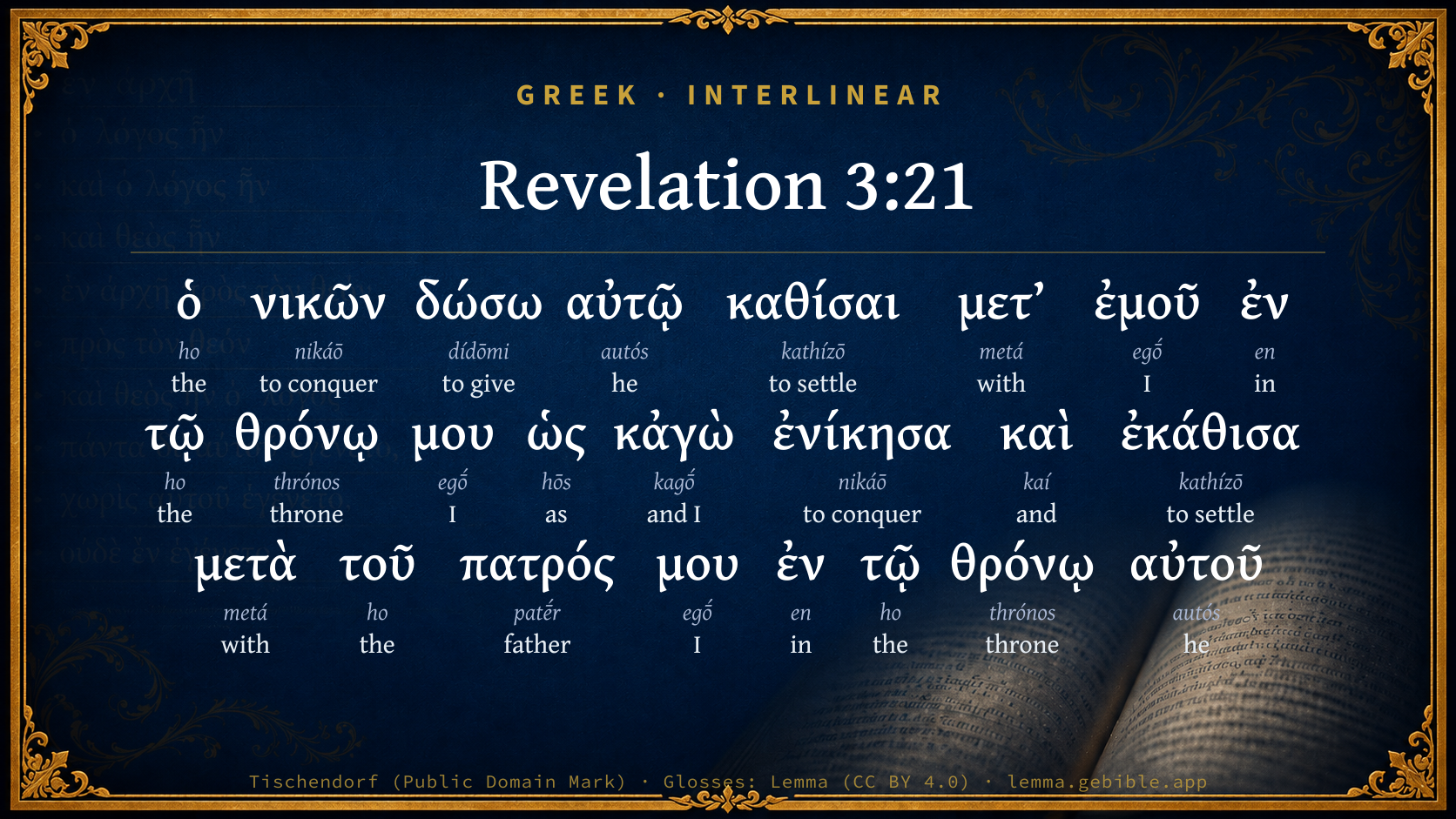
Greek (Tischendorf 8th ed.) Revelation 3:21 appears in the Greek New Testament. The text above is from the Tischendorf 8th edition. Each word links to its Strong’s number and a concise gloss. Click any word for its full Thayer’s Greek Lexicon entry.
Download image
Cite this verse

Revelation 3:21 (World English Bible). Public Domain. Lemma interlinear Bible study tool, https://lemma.gebible.app/v/revelation/3/21.

Show BibTeX & RIS
BibTeX
RIS
English Translation
He who overcomes, I will give to him to sit down with me on my throne, as I also overcame, and sat down with my Father on his throne.
World English Bible · Public Domain
Download a study sheet

One document with this verse’s original text, its word-by-word gloss line, the meaning frame, cross-references with their text, attributed commentary, and full source and license credits — printable, and it pastes into notes with its structure intact.

This verse Autodidact and up

Study sheet (.html) Plain text (.txt)

A passage Seminary Student

Up to 50 verses in one chapter. A passage sheet keeps up to 6 commentary sources and 12 cross-references per verse, in the order this page ranks them, and says so on the sheet whenever that leaves anything out. Ask for a single verse and you get the Autodidact verse sheet above.

Everything on this page stays free to read, with no account — the sheet is a download of what is already on screen, not access to it.

Want to remove ads? Support Godless Engineer
Compare translations 3

The same verse in 3 English versions, stacked beneath the original-language interlinear above. Click any original word for its lexicon entry.

Each is an independent rendering of the whole verse — the interlinear is not word-aligned to these translations.

Highlighted words mark where these versions differ — a whole-verse word diff, not a word-by-word alignment.

  • World English Bible Public Domain
    He who overcomes, I will give to him to sit down with me on my throne, as I also overcame, and sat down with my Father on his throne.
  • King James Version Public Domain
    To him that overcometh will I grant to sit with me in my throne, even as I also overcame, and am set down with my Father in his throne.
  • unfoldingWord Literal Text CC BY-SA 4.0
    The one conquering, I will grant to him to sit with me on my throne, as I also have conquered and have sat with my Father on his throne.

unfoldingWord Literal Text — © unfoldingWord, licensed CC BY-SA 4.0. Word-aligned USFM3 via Door43 (git.door43.org/unfoldingWord/en_ult).

Versions to compare (up to 4)

3 of 4 selected

Show all 19 translations

Every available English version of this verse, each an independent rendering of the whole verse.

  • World English Bible Public Domain
    He who overcomes, I will give to him to sit down with me on my throne, as I also overcame, and sat down with my Father on his throne.
  • Berean Standard Bible Public Domain
    To the one who overcomes, I will grant the right to sit with Me on My throne, just as I overcame and sat down with My Father on His throne.
  • Majority Standard Bible Public Domain
    To the one who overcomes, I will grant the right to sit with Me on My throne, just as I overcame and sat down with My Father on His throne.
  • King James Version Public Domain
    To him that overcometh will I grant to sit with me in my throne, even as I also overcame, and am set down with my Father in his throne.
  • American Standard Version (1901) Public Domain
    He that overcometh, I will give to him to sit down with me in my throne, as I also overcame, and sat down with my Father in his throne.
  • Revised Version (1885) Public Domain
    He that overcometh, I will give to him to sit down with me in my throne, as I also overcame, and sat down with my Father in his throne.
  • Geneva Bible (1599) Public Domain
    To him that ouercommeth, will I graunt to sit with me in my throne, euen as I ouercame, and sit with my Father in his throne.
  • Douay-Rheims (1899) Public Domain
    To him that shall overcome, I will give to sit with me in my throne: as I also have overcome, and am set down with my Father in his throne.
  • Young's Literal Translation Public Domain
    He who is overcoming -- I will give to him to sit with me in my throne, as I also did overcome and did sit down with my Father in His throne.
  • Literal Standard Version CC BY-SA 4.0
    He who is overcoming—I will give to him to sit with Me in My throne, as I also overcame and sat down with My Father in His throne.
  • Unlocked Literal Bible CC BY-SA 4.0
    The one who conquers, I will give him the right to sit down with me on my throne, just as I also conquered and sat down with my Father on his throne.
  • unfoldingWord Literal Text CC BY-SA 4.0
    The one conquering, I will grant to him to sit with me on my throne, as I also have conquered and have sat with my Father on his throne.
  • Darby Bible Public Domain
    He that overcomes, to him will I give to sit with me in my throne; as *I* also have overcome, and have sat down with my Father in his throne.
  • World Messianic Bible Public Domain
    He who overcomes, I will give to him to sit down with me on my throne, as I also overcame and sat down with my Father on his throne.
  • Webster's Bible Public Domain
    To him that overcometh will I grant to sit with me on my throne, even as I also overcame, and am set down with my Father on his throne.
  • Free Bible Version CC BY-SA 4.0
    I will have those who are victorious sit down with me beside my throne, just as I was victorious and sat down beside my Father on his throne.
  • Bible in Basic English Public Domain
    To him who overcomes I will give a place with me on my high seat, even as I overcame, and am seated with my Father on his high seat.
  • Text-Critical English NT CC BY 4.0
    To him who overcomes I will give the right to sit with me on my throne, just as I overcame and sat down with my Father on his throne.
  • Tyndale New Testament (1534) Public Domain
    To him that overcommeth will I graunte to sytt with me in my seate evyn as I overcam and have sytten with my father in his seate.

Literal Standard Version (2020), Covenant Press — licensed CC BY-SA 4.0. Text via the HelloAO Bible API (eBible.org). Unlocked Literal Bible (unfoldingWord) — licensed CC BY-SA 4.0. Text via the HelloAO Bible API (eBible.org). unfoldingWord Literal Text — © unfoldingWord, licensed CC BY-SA 4.0. Word-aligned USFM3 via Door43 (git.door43.org/unfoldingWord/en_ult). Free Bible Version, Dr. Jonathan Gallagher — licensed CC BY-SA 4.0. Text via the HelloAO Bible API (eBible.org).

Word by word

More ways to search: Search by grammar → Find every occurrence → Compare this word →

Practice this passage: Drill this verse → Learn its vocabulary →

νικῶν
nikáō
G3528
“to conquer”
Verb, Present, Active, Participle, Nominative, Singular, Masculine
Part of Speech
Verb
Tense
Present
Voice
Active
Mood
Participle
Case
Nominative
Number
Singular
Gender
Masculine
Full Thayer's Definition

Origin: from G3529

TDNT: 19:42,6

1. to conquer a. to carry off the victory, come off victorious 1. of Christ, victorious over all His foes 2. of Christians, that hold fast their faith even unto death against the power of their foes, and temptations and persecutions 3. when one is arraigned or goes to law, to win the case, maintain one's cause
  1. ὁ ho G3588 “the” Article, Nominative, Singular, Masculine
  2. δώσω dídōmi G1325 “to give” Verb, Future, Active, Indicative, 1st person, Singular
  3. αὐτῷ autós G846 “he” Personal pronoun, Dative, Singular, Masculine
  4. καθίσαι kathízō G2523 “to settle” Verb, Aorist, Active, Infinitive
  5. μετ’ metá G3326 “with” Preposition
  6. ἐμοῦ egṓ G1473 “I” Personal pronoun, 1st person, Genitive, Singular
  7. ἐν en G1722 “in” Preposition
  8. τῷ ho G3588 “the” Article, Dative, Singular, Masculine
  9. θρόνῳ thrónos G2362 “throne” Noun, Dative, Singular, Masculine
  10. μου egṓ G1473 “I” Personal pronoun, 1st person, Genitive, Singular
  11. ὡς hōs G5613 “as” Adverb
  12. κἀγὼ kagṓ G2504 “and I” Personal pronoun, 1st person, Nominative, Singular, Aramaic form
  13. ἐνίκησα nikáō G3528 “to conquer” Verb, Aorist, Active, Indicative, 1st person, Singular
  14. καὶ kaí G2532 “and” Conjunction
  15. ἐκάθισα kathízō G2523 “to settle” Verb, Aorist, Active, Indicative, 1st person, Singular
  16. μετὰ metá G3326 “with” Preposition
  17. τοῦ ho G3588 “the” Article, Genitive, Singular, Masculine
  18. πατρός patḗr G3962 “father” Noun, Genitive, Singular, Masculine
  19. μου egṓ G1473 “I” Personal pronoun, 1st person, Genitive, Singular
  20. ἐν en G1722 “in” Preposition
  21. τῷ ho G3588 “the” Article, Dative, Singular, Masculine
  22. θρόνῳ thrónos G2362 “throne” Noun, Dative, Singular, Masculine
  23. αὐτοῦ autós G846 “he” Personal pronoun, Genitive, Singular, Masculine

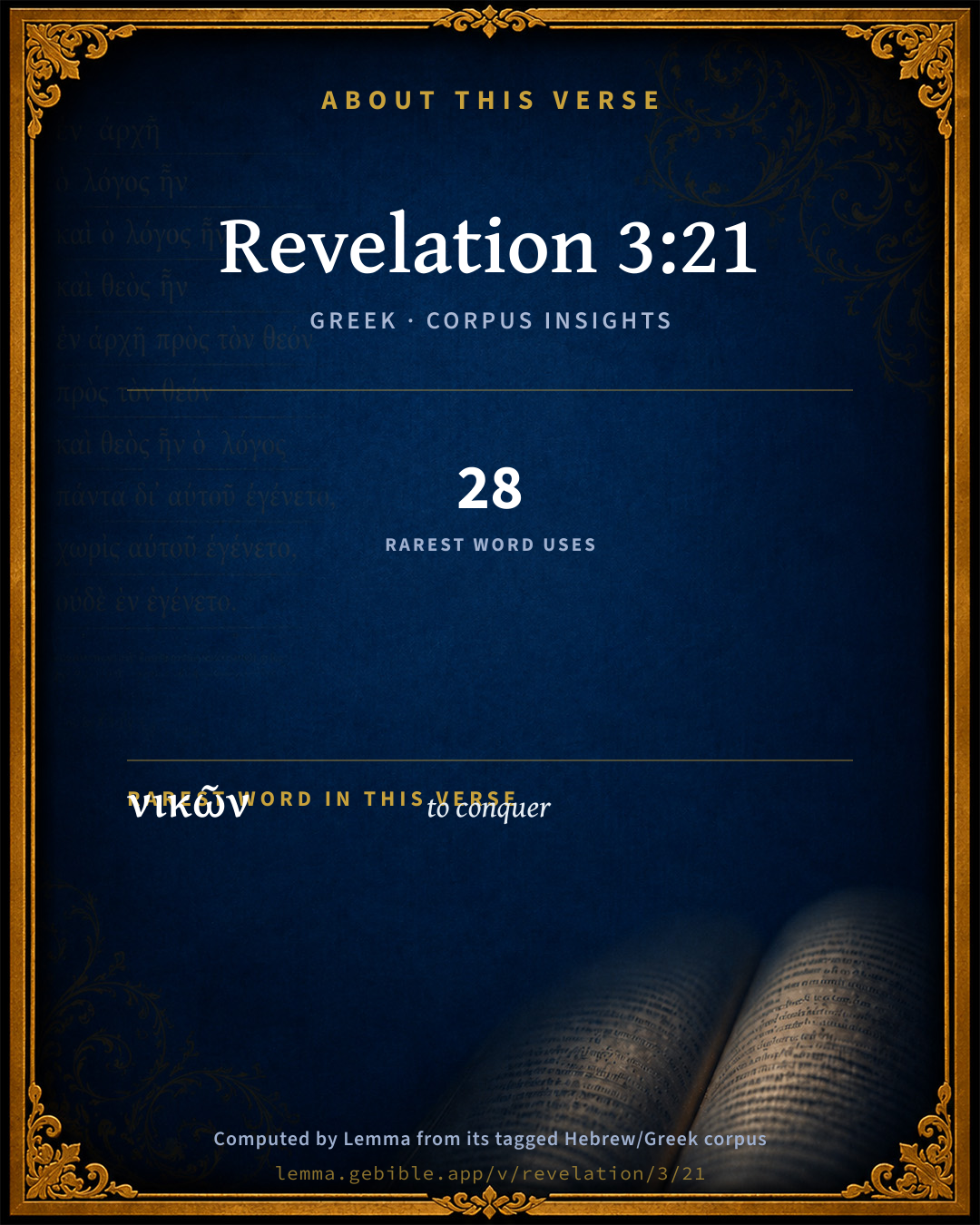
About this verse

These counts appear in no published source. They are computed here, from the morphology-tagged text and Lemma’s own curated glosses. What Lemma adds →

24
words
13
distinct lemmas
Revelation
section

Shared distinctive vocabulary

νικῶν to conquer G3528 occurs in 24 verses of the Greek New Testament. Also found in:
Repetition

Words recur within this verse:

  • νικῶν to conquer G3528 ×2
  • καθίσαι to settle G2523 ×2
  • θρόνῳ throne G2362 ×2
  • ὁ the G3588 ×4
  • ἐμοῦ I G1473 ×3
  • αὐτῷ he G846 ×2
  • μετ’ with G3326 ×2
  • ἐν in G1722 ×2

Cross-references

20

Topical passages linked to Revelation 3:21 in the Treasury of Scripture Knowledge — connected by theme and wording, ordered by reader-vote popularity; previews shown in the World English Bible.

  • 2 Timothy 2:12 If we endure, We will also reign with him. If we deny him, He also will deny us.
  • Matthew 19:28 Jesus said to them, "Most assuredly I tell you that you who have followed me, in the regeneration when the Son of Man will sit on the throne of his glory, you also will sit on twelve thrones, judging the twelve tribes of Israel.
  • Revelation 2:26–27 He who overcomes, and he who keeps my works to the end, to him I will give authority over the nations.
  • John 16:33 I have told you these things, that in me you may have peace. In the world you have oppression; but cheer up! I have overcome the world."
  • Revelation 2:7 He who has an ear, let him hear what the Spirit says to the assemblies. To him who overcomes I will give to eat of the tree of life, which is in the Paradise of my God.
  • 1 Corinthians 6:2–3 Don't you know that the saints will judge the world? And if the world is judged by you, are you unworthy to judge the smallest matters?
  • 1 John 5:4–5 For whatever is born of God overcomes the world. This is the victory that has overcome the world: your faith.
  • Luke 22:30 that you may eat and drink at my table in my Kingdom. You will sit on thrones, judging the twelve tribes of Israel."
  • Matthew 28:18 Jesus came to them and spoke to them, saying, "All authority has been given to me in heaven and on earth.
  • Revelation 1:6 and he made us to be a Kingdom, priests to his God and Father; to him be the glory and the dominion forever and ever. Amen.
  • Revelation 20:4 I saw thrones, and they sat on them, and judgment was given to them. I saw the souls of those who had been beheaded for the testimony of Jesus, and for the word of God, and such as didn't worship the beast nor his image, and didn't receive the mark on their forehead and on their hand. They lived, and reigned with Christ for the thousand years.
  • Daniel 7:13–14 I saw in the night-visions, and, behold, there came with the clouds of the sky one like a son of man, and he came even to the ancient of days, and they brought him near before him.
  • Ephesians 1:20–23 which he worked in Christ, when he raised him from the dead, and made him to sit at his right hand in the heavenly places,
  • Philippians 2:9–21 Therefore God also highly exalted him, and gave to him the name which is above every name;
  • Revelation 7:17 for the Lamb who is in the midst of the throne shepherds them, and leads them to springs of waters of life. And God will wipe away every tear from their eyes."
  • Revelation 12:11 They overcame him because of the Lamb's blood, and because of the word of their testimony. They didn't love their life, even to death.
  • Revelation 17:14 These will war against the Lamb, and the Lamb will overcome them, for he is Lord of lords, and King of kings. They also will overcome who are with him, called and chosen and faithful."
  • Revelation 6:2 And behold, a white horse, and he who sat on it had a bow. A crown was given to him, and he came forth conquering, and to conquer.
  • John 5:22–23 For the Father judges no one, but he has given all judgment to the Son,
  • Revelation 5:5–8 One of the elders said to me, "Don't weep. Behold, the Lion who is of the tribe of Judah, the Root of David, has overcome; he who opens the book and its seven seals."

Cross-references courtesy of OpenBible.info (CC BY 4.0).

Commentary

Notes on Revelation 3:21 from classic Christian and Jewish commentators (each source and its license shown beneath its notes). The classic Christian expositions comment on the surrounding passage and are grouped to its opening verse, so a note may address several verses; the Jewish commentaries on the Tanakh (Rashi and others) are per-verse, so they appear only where the commentator wrote on this verse.

Lemma curates 59 commentaries, every one of them public domain or Creative Commons licensed, each selected and text-cleaned for this edition rather than reprinted as found. About our sources →

Jamieson, Fausset & Brown

Robert Jamieson, A. R. Fausset & David Brown

sit with me in my throne-- (Rev 2:26-27; Rev 20:6; Mat 19:28; Mat 20:23; Joh 17:22, Joh 17:24; Ti2 2:12). The same whom Christ had just before threatened to spue out of His mouth, is now offered a seat with Him on His throne! "The highest place is within reach of the lowest; the faintest spark of grace may be fanned into the mightiest flame of love" [TRENCH].

even as I also--Two thrones are here mentioned: (1) His Father's, upon which He now sits, and has sat since His ascension, after His victory over death, sin, the world; upon this none can sit save God, and the God-man Christ Jesus, for it is the incommunicable prerogative of God alone; (2) the throne which shall be peculiarly His as the once humbled and then glorified Son of man, to be set up over the whole earth (heretofore usurped by Satan) at His coming again; in this the victorious saints shall share (Co1 6:2). The transfigured elect Church shall with Christ judge and reign over the nations in the flesh, and Israel the foremost of them; ministering blessings to them as angels were the Lord's mediators of blessing and administrators of His government in setting up His throne in Israel at Sinai. This privilege of our high calling belongs exclusively to the present time while Satan reigns, when alone there is scope for conflict and for victory (Ti2 2:11-12). When Satan shall be bound (Rev 20:4), there shall be no longer scope for it, for all on earth shall know the Lord from the least to the greatest. This, the grandest and crowning promise, is placed at the end of all the seven addresses, to gather all in one. It also forms the link to the next part of the book, where the Lamb is introduced seated on His Father's throne (Rev 4:2-3; Rev 5:5-6). The Eastern throne is broad, admitting others besides him who, as chief, occupies the center. TRENCH notices; The order of the promises in the seven epistles corresponds to that of the unfolding of the kingdom of God its first beginnings on earth to its consummation in heaven. To the faithful at Ephesus: (1) The tree of life in the Paradise of God is promised (Rev 2:7), answering to Gen 2:9. (2) Sin entered the world and death by sin; but to the faithful at Smyrna it is promised, they shall not be hurt by the second death (Rev 2:11). (3) The promise of the hidden manna (Rev 2:17) to Pergamos brings us to the Mosaic period, the Church in the wilderness. (4) That to Thyatira, namely, triumph over the nations (Rev 2:26-27), forms the consummation of the kingdom in prophetic type, the period of David and Solomon characterized by this power of the nations. Here there is a division, the seven falling into two groups, four and three, as often, for example, the Lord's Prayer, three and four. The scenery of the last three passes from earth to heaven, the Church contemplated as triumphant, with its steps from glory to glory. (5) Christ promises to the believer of Sardis not to blot his name out of the book of life but to confess him before His Father and the angels at the judgment-day, and clothe him with a glorified body of dazzling whiteness (Rev 3:4-5). (6) To the faithful at Philadelphia Christ promises they shall be citizens of the new Jerusalem, fixed as immovable pillars there, where city and temple are one (Rev 3:12); here not only individual salvation is promised to the believer, as in the case of Sardis, but also privileges in the blessed communion of the Church triumphant. (7) Lastly, to the faithful of Laodicea is given the crowning promise, not only the two former blessings, but a seat with Christ on His throne, even as He has sat with His Father on His Father's throne (Rev 3:21).

Next: Revelation Chapter 4

Jamieson, Fausset & Brown — Commentary Critical and Explanatory on the Whole Bible (1871) — public domain (CC PDM 1.0). Text via the HelloAO Bible API.

The Biblical Illustrator

Joseph S. Exell

Rev_3:21

To him that overcometh will I grant to sit with Me.

The Christian raised to the throne of Christ

I. To him that overcometh; this supposes a conflict.

1. You must contend against yourself. The main battle is fought on the field of your own heart. Your closest foes are the affections which struggle there.

2. Allied with your heart and habits stands the world. God has so mercifully made us that we hail as a light upon our path the beam of kindliness in the eye of a fellow man. Even this will be turned against you.

3. But self and the world are but visible weapons of an invisible hand. Behind them, setting their edge and thrusting them home, is your great adversary the devil. Watchful when you are drowsy, plotting when you are unsuspicious, laying snares when you are tripping heedlessly, bending the bow when you are exposing your breast, he is ever going about seeking to devour.

II. Here we have a promise to stimulate us to overcome.

1. Whatever this promise means, it must mean at least that the faithful Christian will be received into the immediate presence of his Lord. And this is a thought you must set well before you.

2. But as you linger on these words of promise your heart feels that they tell of more than merely of the abundant entrance. I will grant to sit with Me in My throne. Ah I this seems, you think, to say that you shall be wondrously close to Him.

3. This seems to declare also that, if faithful, you shall share at last in the very honours which Invest your adorable Head.

4. But, lingering still on this rich promise, your heart gathers from it another assurance, and one that to us in our struggles is wondrous sweet. In His throne, you repeat, in His throne, what foe can approach me there? In this wide world I can find no inviolable rest. But on His throne, surely eternal repose dwells there.

III. Here you have the example set before you for your encouragement.

1. Your Captain does not lead you to a warfare in which He is a stranger. You will meet no foe whom He has not met.

2. Consider, then, the example of Him who passed through every kind of temptation which can assail you, and in a degree of aggravation to which it is not possible that you should be liable. His victory is the pledge of yours, for His strength is your strength, and your only foes are His vanquished assailants. (W. Arthur, M. A.)

The condition of celestial kingship

This is the promise of the ascended, victorious, crowned, and almighty Saviour to men whom He would have imitate and reproduce the life which He lived while upon the earth. This promise implies that life is a struggle with foes which assail it for the mastery. This truth has its illustrations in all forms and spheres of life. Many fail where one succeeds. The higher you rise in any sphere in life the smaller do the classes become. There are more Canadian thistles than Yosemite pines. There are more ants than eagles. There are more men who can read and write than can weigh the planets in scales and call them by name, paint a Madonna, build a Parthenon, write an epic. So there are more men who succeed in temporal pursuits than attain grand Christian characters and live a Christlike life. The first great truth implied in our text is, if men would live that higher life which is governed by the principles of the gospel and in the eternal world sit down with their Lord and Master on His throne, they must resist the temptations which assail them, vanquish the foes which would destroy them. The dangers which beset each one in this life-battle are special. The rock on which your neighbour struck, the reef on which your friend lies stranded, may not imperil your safety because you are steering in another direction. There are men whose integrity money could not buy, in whose keeping the uncounted millions of the mints and treasury of the nations would be safe. But there are others who are ready at any moment to part with reputation, character, aye, sell their very souls for its possession. Take spirituous liquor. There are some to whom in any form it is as distasteful as vitriol, as poisonous as croton oil. There are others--God pity them!--in whom the appetite is so fierce, powerful, overmastering, that if they saw a glass of rum on one side of the mouth of hell, and they stood on the other side, they would leap across, at the risk of falling in, to get it. There are two things which differentiate and specialise each human beings danger. The first is natural constitution. No one denies the law of heredity, that physical resemblances, mental aptitudes, and moral qualities are transmissible, and sometimes travel down family and national lines for centuries. But while a man may inherit tainted blood and receive a legacy of disabilities from his progenitors, it does not relieve him from personal responsibility. What are the weak points in your character? In the presence of what temptations do you most easily surrender? Along what lines does your constitutional predisposition to wrongdoing lie? As you confront these weaknesses the command of the great Saviour of souls is, Overcome. On this your salvation depends. The second thing which differentiates and specialises each mans peril is providential circumstances. John Stuart Mill was carefully trained by his father in childhood and boyhood in the principles of atheism. Young Mill had no voice in determining the character of his childhood instruction. But did that fact relieve the future philosopher of responsibility in adhering to and teaching others the principles of atheism? Your greatest peril may lie wrapped up in some providential event which you had no voice in shaping and which you must meet. It may be money. It may be family alliances. It may be social relationships. It may be a business crisis--such a business crisis as sometimes reveals the whole moral mechanism of the man. I know not whether your inherited qualities of mind and moral aptitudes are helps or hindrances to you in lifes battle. I do not know the revealing tests to which a searching Providence may subject you. But I do know that special dangers lie along your pathway and menace your eternal well-being; dangers which you must conquer if you would enter yonder pearly gate and sit down with your Lord on His throne. The text affords glorious encouragement in the blessed assurance that it is possible for men in this life-battle to overcome. The success possible in the text rests on surer foundations than human resources or individual reserve power. It rests on the truthfulness and sincerity of Jesus. He does not mock men by laying down impossible conditions of salvation. That God is on the side of the man who is struggling to preserve his purity, maintain his integrity, and vanquish what is wrong both within him and without him, is a truth taught with increasing clearness from Eden to Calvary. Observe the greatness and grandeur of the reward of him who overcomes: To him that overcometh will I grant to sit with Me in My throne. Can you conceive of a greater incentive to be offered man than this promise of eternal participation in the regal splendours of heaven? Turning to the practical suggestions of this subject, notice that religion is a personal matter which has to do with individual character. Each one must overcome the obstacles which lie in his pathway. Yea can never understand how much Christ is to men until you realise your danger, feel your helplessness, and experience His saving power. You can never appreciate the towering sublimity of His peerless life until you attempt to walk in His footsteps and regulate your life by the same principles which controlled His life. The essence of the Christian religion is life, life shaped and controlled by supreme love to God and love for fellow-men equal to the love cherished for self. (T. McCullagh, D. D.)

The conquerors reward

I. The character of the Christian. It is that of a soldier--a successful soldier. His life is a warfare. It was such unquestionably in the days of the apostles. And what is the case now? The antipathy of the carnal mind may be restrained or softened by the influence of knowledge and the force of conviction, but the fact is still patent that we must take up our cross if we will win the crown. Our enemies within, whatever they may be without, am neither few nor weak. And to subvert our eternal salvation is the one thing in which they are all united. We have, therefore, the greatest need of caution and courage. One thing must be ever borne in mind, namely, our constant dependence upon God. As long as we abide beneath the wing of Omnipotence we are secure.

II. The reward which shall be adjudged to the successful warrior. He shall sit down with the Saviour on His throne.

1. The promise may be understood to shadow forth the future dignity of the conquering Christian. He shalt sit down with his Lord, and on the same throne. The faithful unto death shall thus be exalted above the angels of God.

2. The imagery in the promise is intended to indicate the future holiness of the saints. Wherever God is there is purity itself.

3. The promise before us is expressive of the future happiness of believers. There we shall behold a sky without a cloud, light without shadow, and flowers without a thorn. (American National Preacher.)

The victory and the crown

I. The battle. Common life in this world is a warfare.

1. It is inner warfare, private, solitary, with no eye upon the warrior.

2. It is outer warfare. The enemies are legion.

3. It is daily warfare; not one great battle, but a multitude of battles. The enemy wearies not, ceases not, nor must we.

4. It is warfare not fought with human arms.

5. It is warfare in which we are sharers with Christ.

II. The victory. Here it is spoken of as one great final victory, but in reality it is a multitude. As are the battles so are the victories.

III. The reward.

1. A throne. Not salvation merely, or life, but higher than these--glory, honour, dominion, and power. From being the lowest here they are made the highest hereafter.

2. Christs throne. He has a seat on the Fathers throne as the reward of His victory, we have a seat on His as the reward of ours. We are sharers or partakers with Christ in all things. We share His battles, His victories, His rewards, His cross, and His crown. (H. Bonar, D. D.)

The great victory

I. A life of Christian holiness is possible.

II. It is not to be sustained without vigorous and persevering efforts.

1. The natural inaptitude and aversion of the unrenewed heart to the things of God and eternal life.

2. The world is against us.

3. The life of man is often the scene of distress.

III. The encouragements to a holy and Christian life held out to us in the religion of Jesus are manifold and great.

1. In this arduous undertaking we are not left without assistance.

2. Multitudes of our fellow-men have already accomplished salvation, and are for ever with the Lord.

3. Whatever of warfare and pain may attend the Christian life they who maintain it are already the happiest of men.

4. Viewed aright it is matter of encouragement that the strife will soon be over.

5. What a vast reward awaits the faithful. (James Bromley.)

The Christian conqueror

The word used here for conqueror does not imply one who has conquered. It is literally, He that is conquering I will give to him to sit with Me. While the battle is raging he shall have My peace, while he is but starting he shall be at the goal--as the boy has his prizes and his scholarships not because he is a finished scholar but because he is longing and learning to be one. And as this continues all through life to be the law of life, so in the kingdom that is coming effort is victory and victory is only encouragement. (Abp. Benson.)

Overcoming

To him that overcometh. There is a tendency very common which these words may be taken to warn us against--that of settling down to the daily round of our lives without appeal to anything high or holy in purpose. Do not listen for a moment to those who tell you that the struggle is not worth engaging in. To him that overcometh. Men have tried different ways to accomplish this. A favourite way in the history of the early Christian Church was to withdraw actually from the world, to seek the solitude of some cave or monastery. Others who would think it very wrong to do this, spend the greater part of their leisure in attending religious meetings and reading their Bibles, and tell you that the chief end of man in this world is by these methods to prepare for the next. Both of these attempts to overcome the world are based on a misconception. The text says to us that we are to overcome the world even as I (Jesus) overcame. Now in what way did our Saviour overcome the world? Not after the manner of the religious ascetic. His life was in the main lived among ordinary men and women in the ordinary vocations of life. If the life of Jesus had been that of a hermit or a monk, He would never have been called a friend of publicans and sinners. If, again, He had been a constant attendant at religious meetings, noonday, and evening, or had divided His life between keenness for this worlds success in money-making and eagerness for the salvation of His soul for the next, He would never have been put to death. No, it was because He was so zealous to overcome the world--the world of religious selfishness and of worldly selfishness alike--it was because He was devoting Himself amid the ordinary pursuits of life to bring about the kingdom of God. It is, of course, not to be forgotten that there are means, such as the reading of the Bible, attendance on public worship, prayer, and fellowship with those who are like-minded, which, if rightly used, will help us for the battle we have to fight. It is by forgetting that these are only means that men become hypocrites, and the form of religion becomes the all in all. When we realise what Christ meant by the world and what He meant by the kingdom of God, we will take a more enlightened view of what our duty is, and we will strive more eagerly to achieve the victory. Think of how many men and women are hindered from overcoming the world--that is, sin in all its forms--by the conditions under which they are made by a selfish society to live. How can men and women hope to realise the Christlike life if they are forced to toil from morning to night, and then to sleep in badly ventilated houses, only to rise again to the same round of unrelieved drudgery? Those who to-day are endeavouring to bring about a better state of affairs, who are trying to realise to some small degree that part of the kingdom of God which consists in better houses and more healthful surroundings for the toilers in our midst are doing quite as much to enable men to overcome the world--the world of vice, of drunkenness, of coarseness--as those who attend to what are considered more strictly the needs of the soul. There is another idea in the text: To him that overcometh. That is the battle. The reward follows: I will give him to sit down with Me in My throne. It was because Christ had so completely overcome--had so unreservedly rendered up His own will to the will of His Heavenly Father--that we find such a royal, kingly sense of self-conquest pervading His entire life. Jesus Christ could not have brought so much of the kingdom of God into this world, He could not have foreseen with so much confidence a time when it would be universally established, had He not had it reigning within Himself. Throughout His life there was an air of kingly majesty that makes Him as secure as if He sat and reigned upon a throne, while all around Him seemed to indicate defeat and disaster. Whence did this come but from His oneness with the Father? Whence can we hope to receive it but from the same high, never-failing source? (W. Martin.)

A commonwealth of kings

When Cyneas, the ambassador of Pyrrhus, after his return from Rome, was asked by his master, What he thought of the city and state, he answered, that it seemed to him to be a state of none but great statesmen, and a commonwealth of kings. Such is heaven--no other than a parliament of emperors, a commonwealth of kings: every humble faithful soul in that kingdom is co-heir with Christ, hath a robe of honour, and a sceptre of power, and a throne of majesty, and a crown of glory. (J. Spencer.)

The future dominion of victors

So you intend to be a reformer of mens morals, young man, said an aged peer to Wilberforce. That, and he pointed to a picture of the crucifixion, that is the end of reformers. Is it? I have read in an old Book this, I am He that liveth, and was dead; and behold, I am alive for evermore, Amen; and have the keys of hell and of death. That is the end, not death, but dominion. And if we be faithful, doing our duty, the end shall not be exhaustion, but sit with Me on My throne. (Sunday School Chronicle.)

The Christian promise of empire

To him that overcometh will I grant to sit with Me on My throne. These words bear the stamp of their environment. They were written at a time when the ideal of all men was the possession of a throne. Alike to the Roman and to the Jew the dream of life was the dream of dominion. The son of Israel contemplated his Messiah who should make him ruler over all nations. The son of Rome was eager to complete his almost finished work of universal empire. But from another point of view it was in striking contrast to both. Who were the men that claimed to be the recipients of this promise? A baud of obscure slaves. To the proud Roman leading his armies to victory, to the proud Jew counting his ancestors by hundreds, there must have been something almost grotesque in the claim. Must it not to the age in which they lived have appeared the presumption of insanity? Nor is it only to a Roman age that the claim of this passage seems to suggest the idea of presumption. Must it not appear so at all times to every man? The throne, as I have said, is a throne of judgment. How can any human soul aspire to such a seat? Is not the state of the Christian one of humility? Does not the amount of the humility increase in proportion as the Christianity grows? Have not the most purely spiritual souls been precisely those most conscious of their sin? It is in the incipient stages of the Christian life that we find ambition. But let us look deeper. I think we shall find that we have altogether mistaken the meaning of the passage, and that the John of the Apocalypse is nowhere more like the John of the Gospel than in his present claim to Christian empire. So far from being influenced by the old feeling of presumption, he is actuated by the direct desire to avoid that feeling. His position is that, instead of being presumption to claim a seat on Gods judgment throne, it is presumption that prevents the Church of Laodicea from having a right to claim it. If that Church would adopt more humility, it would be more entitled to a place on the throne. Thou sayest, I am rich, and increased with goods, and have need of nothing; and knowest not that thou art wretched, and miserable, and poor, and blind, and naked. What is the state of mind here indicated? It is poverty unconscious of itself. It is the description of a Church which has no elements of strength within it, but which believes itself to be strong just because it has never been tried. Accordingly in verse 18 He says, I counsel thee to buy of Me gold tried in the fire, that thou mayest be rich. Nothing could reveal the weakness but exposure to the fire And first, let us consider that, as a matter of fact, every man has seated himself on a throne of judgment. The difference between the Christian and the non-Christian is not the occupation of a throne. It is that the occupation of the one is legal, and the occupation of the other usurped. Every man by nature has constituted himself the judge of other men. But to all such the seer of Patmos exclaims, Come down from that throne; you have no right to be there; you have not overcome. He tells them that until they have felt the temptations of their own nature they are in no condition to judge others. Now, the next question is, what would be the effect of what is here called overcoming--of vanquishing the temptation? It would clearly be to transform a throne of judgment into a throne of grace. For, be it observed, the value of overcoming is not the victory but the struggle. There are two ways in which a man may reach freedom from temptation--by innocence or by virtue, by never having known or by having known and vanquished. If mere freedom from temptation were the goal, we ought to be content with the first. What makes the overcoming better than the innocence is the fact that in struggle we learn our weakness, and that in learning our weakness the throne of judgment becomes a throne of mercy. And now the passage takes a remarkable turn. To the inspired ear of the seer of Patmos the Christ who offers the conditions of empire is heard declaring that He Himself has reached empire by conforming to these conditions, even as I also overcame and am set down with My Father on His throne. There is something startling here. There seems at first sight to be no analogy between the case of Christ and the case of ordinary men. Now, Jesus was tempted; that is one of the cardinal features of the gospel. He was tempted in such a way as to make Him feel the inherent weakness of humanity; that is one of the cardinal features of the Epistle to the Hebrews. But He was tempted also without sin. The idea clearly is that His right to judge others rests morally on the fact of His own struggle the struggle with the thought of death. In His dealings with man He acknowledges no power but the sympathetic. And what is the root of universal sympathy? Is it not universal experience? If I would have sympathy with all nations, I must know experimentally the weakness with which all nations contend. Jesus emerges from the conflict with death wider in His human capabilities, stronger in His hold on man. He is able to promise rest to the labouring and the heavy-laden because He has known a kindred labour and felt an analogous ladenness. He has made the law of the Christian life the law of His own spirit: I also have overcome, and am set down with My Father on His throne. (George Matheson, D. D.)

The Biblical Illustrator, edited by Joseph S. Exell (c. 1880s–1900s) — public domain. Text from a community e-Sword module.

MacLaren's Expositions of Holy Scripture

Alexander MacLaren

Revelation

VII. - THE VICTOR’S SOVEREIGNTY

Rev 3:21.

The Church at Laodicea touched the lowest point of Christian character. It had no heresies, but that was not because it clung to the truth, but because it had not life enough to breed even them. It had no conspicuous vices, like some of the other communities. But it had what was more fatal than many vices - a low temperature of religious life and feeling, and a high notion of itself. Put these two things together - they generally go together - and you get the most fatal condition for a Church. It is the condition of a large part of the so-called ‘Christian world’ to-day, as that very name unconsciously confesses; for ‘world’ is the substantive, and ‘Christian’ only the adjective, and there is a great deal more ‘world’ than ‘Christian’ in many so-called ‘Churches.’

Such a Church needed, and received, the sharpest rebuke. A severe disease requires drastic treatment. But the same necessity which drew forth the sharp rebuke drew forth also the loftiest of the promises. If the condition of Laodicea was so bad, the struggle to overcome became proportionately greater, and, consequently, the reward the larger. The least worthy may rise to the highest position. It was not to the victors over persecution at Smyrna, or over heresies at Thyatira, nor even to the blameless Church of Philadelphia, but it was to the faithful in Laodicea, who had kept the fire of their own devotion well alight amidst the tepid Christianity round them, that this climax of all the seven promises is given.

In all the others Jesus Christ stands as the bestower of the gift. Here He stands, not only as the bestower, but as Himself participating in that which He bestows. The words beggar all exposition, and I have shrunk from taking them as my text. We seem to see in them, as if looking into some sun with dazzled eyes, radiant forms moving amidst the brightness, and in the midst of them one like unto the Son of man. But if my words only dilute and weaken this great promise, they may still help to keep it before your own minds for a few moments. So I ask you to look with me at the two great things that are bracketed together in our text; only I venture to reverse the order of consideration, and think of -

I. The Commander-in-Chiefs conquest and royal repose.

‘I also overcame, and am set down with My Father in His throne.’ It seems to me that, wonderful as are all the words of my text, perhaps the most wonderful of them all are those by which the two halves of the promise are held together - ‘Even as I also.’ The Captain of the host takes His place in the ranks, and, if I may so say, shoulders His musket like the poorest private. Christ sets Himself before us as pattern of the struggle, and as pledge of the victory and reward. Now let me say a word about each of the two halves of this great thought of our Lord’s identification of Himself with us in our fight, and identification of us with Him in His victory.

As to the former, I would desire to emphasize, with all the strength that I can, the point of view from which Jesus Christ Himself, in these final words from the heavens, directed to all the Churches, looks hack upon His earthly career, and bids us think of it as a true conflict. You remember how, in the sanctities of the upper room, and ere yet the supreme moment of the crucifixion had come, our Lord said, when within a day of the Cross and an hour of Gethsemane, ‘I have overcome the world.’ This is an echo of that never-to be-forgotten utterance that the aged Apostle had heard when leaning on his Master’s bosom in the seclusion and silence of that sacred upper chamber. Only here our Lord, looking back upon the victory, gathers it all up into one as a past thing, and says, ‘I overcame,’ in those old days long ago.

Brethren, the orthodox Christian is tempted to think of Jesus Christ in such a fashion as to reduce His conflict on earth to a mere sham fight. Let no supposed theological necessities induce you to weaken down in your thoughts of Him what He Himself has told us - that He, too, struggled, and that He, too, overcame. That temptation in the wilderness, where the necessities of the flesh and the desires of the spirit were utilized by the Tempter as weapons with which His unmoved obedience and submission were assailed, was repeated over and over again all through His earthly life. We believe - at least I believe - that Jesus Christ was in nature sinless, and that temptation found nothing in Him on which it could lay hold, no fuel or combustible material to which it could set light. But, notwithstanding, inasmuch as He became partaker of flesh and blood, and entered into the limitations of humanity, His sinlessness did not involve His incapacity for being tempted, nor did it involve that His righteousness was not assailed, nor His submission often tried. We believe - or at least I believe - that He ‘did no sin, neither was guile found in His mouth.’ But I also reverently listen to Him unveiling, so far as may need to be unveiled, the depths of His own nature and experience, and I rejoice to think that He fought the good fight, and Himself was a soldier in the army of which He is the General. He is the Captain, the Leader, of the long procession of heroes of the faith; and He is the ‘perfecter’ of it, inasmuch as His own faith was complete and unbroken.

But I may remind you, too, that from this great word of condescending self-revelation and identification, we may well learn what a victorious life really is. ‘I overcame’; but from the world’s point of view He was utterly beaten. He did not gather in many who would listen to Him or care for His words. He was misunderstood, rejected; lived a life of poverty; died when a young man, a violent death; was hunted by all the Church dignitaries of His generation as a blasphemer, spit upon by soldiers, and execrated after His death. And that is victory, is it? Well, then, we shall have to revise our estimates of what is a conquering career. If He, the pauper-martyr, if He, the misunderstood enthusiast, if He conquered, then some of our notions of a victorious life are very far astray.

Nor need I say a word, I suppose, about the completeness, as well as the reality, of that victory of His. From heaven He claims in this great word just what He claimed on earth, over and over again, when He fronted His enemies with, Which of you convinceth Me of sin? ‘and when He declared in the sanctities of His confidence with His friends, ‘I do always the things that please Him.’ The rest of us partially overcome, and partially are defeated. He alone bears His shield out of the conflict undinted and unstained. To do the will of God, to dwell in continual communion with the Father, never to be hindered by anything that the world can present or my sins can suggest, whether of delightsome or dreadful, from doing the will of the Father in heaven from the heart - that is victory, and all else is defeat. And that is what the Captain of our salvation, and only He, did.

Turn for a moment now to the other side of our Lord’s gracious identification of Himself with us. ‘Even as I also am set down with My Father in His throne.’ That points back, as the Greek original shows even more distinctly, to the historical fact of the Ascension. It recalls the great words by which, with full consciousness of what He was doing, Jesus Christ sealed His own death-warrant in the presence of the Sanhedrim when He said: ‘Henceforth ye shall see the Son of man sitting on the right hand of power.’ It carries us still further back to the psalm which our Lord Himself quoted, and thereby stopped the mouths of Scribes and Pharisees: ‘The Lord said unto My Lord, sit Thou at My right hand till I make Thine enemies Thy footstool.’ He laid His hand upon that great promise, and claimed that it was to be fulfilled in His case. And here, stooping from amidst the blaze of the central royalty of the Universe, He confirms all that He had said before, and declares that He shares the Throne of God.

Now, of course, the words are intensely figurative and have to be translated as best we can, even though it may seem to weaken and dilute them, into less concrete and sensible forms than the figurative representation. But I think we shall not be mistaken if we assert that, whatever lies in this great statement far beyond our conception in the present, there lie in it three things - repose, royalty, communion of the most intimate kind with the Father.

There is repose. You remember how the first martyr saw the opened heavens and the ascended Christ, in that very hall, probably, in which Christ had said, ‘Henceforth ye shall see the Son of man sitting at the right hand of power.’ But Stephen, as he declared, with rapt face smitten by the light into the likeness of an angel’s, saw Him standing at the right hand. We have to combine these two images, incongruous as they are in prose, literally, before we reach the conception of the essential characteristic of that royal rest of Christ’s. For it is a repose that is full of activity. ‘My Father worketh hitherto,’ said He on earth, ‘and I work.’ And that is true with regard to His unseen and heavenly life. The verses which are appended to the close of Mark’s gospel draw a picture for us - ‘They went everywhere preaching the Word ‘: He sat at ‘the right hand of God.’ The two halves do not fuse together. The Commander is in repose; the soldiers are bearing the brunt of the fight. Yes! but then there comes the word which links the two halves together. ‘They went everywhere preaching, the Lord also working with them.’

Christ’s repose indicates, not merely the cessation from, but much rather the completion of. His work on earth, which culminated on the Cross; which work on earth is the basis of the still mightier work which He is doing’ in the heavens. So the Apostle Paul sets up a great ladder, so to speak, which our faith climbs by successive stages, when he says, ‘He that died - yea, rather that is risen again - who is even at the right hand of God- who also maketh intercession for us.’ His repose is full of beneficent activity for all that love Him.

Again, there is set forth royalty, participation in Divine dominion. The highly metaphorical language of our text, and of parallel verses elsewhere, presents this truth in two forms. Sometimes we read of ‘sitting at the right hand of God’; sometimes, as here, we read of ‘sitting on the throne.’ The ‘right hand of God’ is everywhere. It is not a local designation. ‘The right hand of the Lord’ is the instrument of His omnipotence, and to speak of Christ as sitting on the right hand of God is simply to cast into symbolical words the great thought that He wields the forces of Divinity. When we read of Him as enthroned on the Throne of God, we have, in like manner, to translate the figure into this overwhelming and yet most certain truth, that the Man Christ Jesus is exalted to supreme, universal dominion, and that all the forces of omnipotent Divinity rest in the hands that still bear, for faith, the prints of the nails.

But again that session of Christ with the Father suggests the thought, about which it becomes us not to speak, of a communion with the Father - deep, intimate, unbroken, beyond all that we can conceive or speak. We listen to Him when He says, ‘Glorify Thou Me with the glory which I had with Thee before the world was.’ We bow before the thought that what He asked in that prayer was the lifting of one of ourselves, the humanity of Jesus, into this inseparable unity with the very glory of God. And then we catch the wondrous words: ‘Even as I also.’

II. That brings me to the second of the thoughts here, which may be more briefly disposed of after the preceding exposition, and that is, the private soldier’s share in the Captain’s victory and rest. ‘I will grant to sit with Me in My throne, even as I also.’

Now with regard to the former of these, our share in Christ’s triumph and conquest, I only wish to say one thing, and it is this. I thankfully recognize that to many who do not share with me in what I believe to be the teaching of Scripture, viz., the belief that Christ was more than example, their partial belief, as I think it, in Him as the realized ideal, the living Pattern of how men ought to live, has given strength for far nobler and purer life than could otherwise have been reached. But, brethren, it seems to me that we want a great deal more than a pattern, a great deal closer and more intimate union with the Conqueror than the mere setting forth of the possibility of a perfect life as realized in Him, ere we can share in His victory. What does it matter to me, after all, except for stimulus and for rebuke, that Jesus Christ should have lived the life? Nothing. But when we can link the words in the upper room, ‘I have overcome,’ and the words from heaven, ‘Even as I also overcame,’ with the same Apostle’s words in his epistle, ‘This is the victory that overcometh the world, even our faith,’ then we share in the Captain’s victory in an altogether different manner from that which they do who can see in Him only a pattern that stimulates and inspires. For if we put our trust in that Saviour, then the very life which was in Christ Jesus, and which conquered the world in Him, will pass into us; and the law of the spirit of life in Christ will make us more than conquerors through Him that loved us.

And then the victory being secured, because Christ lives in us and makes us victorious, our participation in His throne is secure likewise.

There shall be repose, the cessation of effort, the end of toil. There shall be no more aching heads, strained muscles, exhausted brains, weary hearts, dragging feet. There will be no more need for resistance. The helmet will be antiquated, the laurel crown will take its place. The heavy armour, that rusted the garment over which it was braced, will be laid aside, and the trailing robes, that will contract no stain from the golden pavements, will be the attire of the redeemed. We have all had work enough, and weariness enough, and battles enough, and beatings enough, to make us thankful for the thought that we shall sit on the throne.

But if it is a rest like His, and if it is to be the rest of royalty, there will be plenty of work in it; work of the kind that fits us and is blessed. I know not what new elevation, or what sort of dominion will be granted to those who, instead of the faithfulness of the steward, are called upon to exercise the activity of the Lord over ten cities. I know not, and I care not; it is enough to know that we shall sit on His throne.

But do not let us forget the last of the thoughts: ‘They shall sit with Me.’ Ah! there you touch the centre - ‘To depart and to be with Christ, which is far better’; ‘Absent from the body; present with the Lord.’ We know not how. The lips are locked that might, perhaps, have spoken; only this we know, that, not as a drop of water is absorbed into the ocean and loses its individuality, shall we be united to Christ. There will always be the two, or there would be no blessedness in the two being one; but as close as is compatible with the sense of being myself, and of His being Himself, will be our fellowship with Him. ‘He that is joined to the Lord is one spirit.’

Brethren, this generation would be a great deal the better for thinking more often of the promises and threatenings of Scripture with regard to the future. I believe that no small portion of the lukewarmness of the modern Laodicea is owing to the comparative neglect into which, in these days, the Christian teachings on that subject have fallen. I have tried in these sermons on these seven promises to bring them at least before your thoughts and hearts. And I beseech you that you would, more than you have done, ‘have respect unto the recompense of reward,’ and let that future blessedness enter as a subsidiary motive into your Christian life.

We may gather all these promises together, and even then we have to say, ‘the half hath not been told us.’ ‘It doth not yet appear what we shall be.’ Symbols and negations, and these alone, teach us the little that we know about that future; and when we try to expand and concatenate these, I suppose that our conceptions correspond to the reality about as closely as would the dreams of a chrysalis as to what it would be when it was a butterfly. But certainty and clearness are not necessarily united. ‘It doth not yet appear what we shall be, but we know that when He shall appear we shall be like Him.’ Take ‘even as I also’ for the key that unlocks all the mysteries of that glorious future. ‘It is enough for the servant that he be as his Master.’

Alexander MacLaren, Expositions of Holy Scripture (1904–1910) — public domain. Text from a community e-Sword module.

Tyndale Open Study Notes

Tyndale Open Resources

3:21 The reward for victorious and obedient faith is to sit with Christ on his throne. Christians do not become divine, but they share in Christ’s victorious reign (20:4, 6; 22:5; Col 3:1-4; 2 Tim 2:12).

Tyndale Open Study Notes — © Tyndale Open Resources, licensed CC BY-SA 4.0. Text via the HelloAO Bible API.

Meyer's Critical & Exegetical Commentary

Heinrich August Wilhelm Meyer

Rev_3:21-22. Cf. Rev_2:26-27. The νικᾶν embraces the temptations and perils lying in the peculiar circumstances of the Church,[1635] but is not limited thereto, so that it can correspond to the Lords conflict and victory in suffering.[1636]

The promised reward ΔΏΣΩ ΑὐΤῷ ΚΑΘΊΣΑΙ, Κ.Τ.Λ., i.e., participation in Christs royal dominion,[1637] is here, just as at the close of all the epistles, to be expected as the victory over the world, sin, and death,[1638] only in eternity, and not in this life, since the ἘΚΆΘΙΣΑ, Κ.Τ.Λ., has occurred to the Lord through his ascension.[1639] Entirely wrong is Calov.s distinction between the throne of God the Father, whereon Christ sits, and the throne of Christ, whereon the believer is to sit with him, The throne of God and of the Lamb is one;[1640] the glory of the victor is communion with the Father and the Son.[1641] The promise to the victor is here made so strong, not because the struggle which the Laodiceans had to maintain against their own lukewarmness is regarded the most severe,[1642] but because it is natural and suitable, that, in the last of the seven epistles, such a promise should be expressed as would combine all the others, and designates the highest and most proper goal of all Christian hope, and the entire Apocalyptic prophecy.

[1635] Rev_3:16 sq.

[1636] Cf. Rev_5:5.

[1637] Cf. Rev_1:9, Rev_22:5; 2Ti_2:12.

[1638] Vitr.

[1639] Cf. Heb_12:2; Php_2:9.

[1640] Rev_22:1.

[1641] Cf. Joh_17:22; Joh_17:24.

[1642] Ebrard.

Meyer — Critical and Exegetical Commentary on the New Testament — English translation by Peter Christie, edited by Frederick Crombie (T&T Clark, 1880) — public domain. Text from a community e-Sword module.

Expositor's Greek Testament

ed. W. Robertson Nicoll

Rev 3:21 . δώσω κ . τ . λ ., To share Christ’s royal power and judicial dignity it a reward proffered in the gospels, but Jesus there ( cf. Mar 10:40 ) disclaimed this prerogative. God’s throne is Christ’s, as in Rev 22:1 . νικῶν = the moral purity and sensitiveness ( cf. Rev 3:18 and on Rev 2:7 ) which succeeds in responding to the divine appeal. The schema of God, Christ, and the individual Christian ( cf. on Rev 2:27 ) is characteristically Johannine ( f. Joh 15:9 f., Joh 17:19 f., Joh 20:21 ), though here as in Rev 3:20 (contrast Joh 14:23 ) the eschatological emphasis makes the parallel one of diction rather than of thought.

The scope and warmth of the promises to Laodicea seem rather out of place in view of the church’s poor religion, but here as elsewhere the prophet is writing as much for the churches in general as for the particular community. He speaks ταῖς ἐκκλησίαις . This consideration, together with the close sequence of thought in Rev 3:19-21 forbids any attempt to delete Rev 3:20-21 as a later editorial addition (Wellhausen) or to regard Rev 3:20 (Rev 3:21 ) as an epilogue to the seven letters (Vitringa, Alford, Ramsay) rather than as an integral part of the Laodicean epistle. Such a detachment would be a gratuitous breach of symmetry. But, while these closing sentences are not a sort of climax which gathers up the menaces of 2 3., Rev 3:21 (with its throne-reference) anticipates the following visions (Rev 3:4-5 .). To the prophet the real value and significance of Christ’s life were focussed in his sacrificial death and in the rights and privileges which he secured thereby for those on whose behalf he had suffered and triumphed. This idea, already suggested in Rev 1:5-6 ; Rev 1:17-18 , forms the central theme of the next oracle.

The ἐκκλησίαι now pass out of sight till the visions are over. During the latter it is the ἅγιοι who are usually in evidence, until the collective term πόλις is employed in the final vision ( cf. Rev 3:12 ). John knows nothing of any catholic ἐκκλησία . To him the ἐκκλησίαι are so many local communities who share a common faith and expect a common destiny; they are, as Kattenbusch observes, colonies of heaven, and heaven is their mother-country. Partly owing to O.T. associations, partly perhaps on account of the feeling that an ἐκκλησία (in the popular Greek sense of the term) implied a city, John eschews this term. He also ignores the authority of any officials; the religious situation depends upon the prophets, who are in direct touch with God and through whom the Spirit of God controls and guides the saints. Their words are God’s words; they can speak and write with an authority which enables them to say, Thus saith the Spirit . Only, while in the contemporary literature of Christianity the prophetic outlook embraces either the need of organisation in order to meet the case of churches which are scattered over a wide area and exposed to the vagaries of unauthorised leaders (Pastoral Epistles and Ignatius), or contention among the office-bearers themselves (a sure sign of the end, Asc. Isa. iii. 20f.), John’s apocalypse stands severely apart from either interest.

NOTE on Rev 1:9 to Rev 3:22 . We have no data to show whether the seven letters or addresses ever existed in separate form, or whether they were written before or after the rest of the visions. All evidence for such hypotheses consists of quasi-reasons or precarious hypotheses based on some a priori theory of the book’s composition. The great probability is that they never had any rôle of their own apart from this book, but were written for their present position. As the Roman emperors addressed letters to the Asiatic cities or corporations (the inscriptions mention at least six to Ephesus, seven to Pergamos, three to Smyrna, etc.), so Jesus, the true Lord of the Asiatic churches, is represented as sending communications to them ( cf. Deissmann’s Licht vom Osten , pp. 274 f.). The dicit or λέγει with which the Imperial messages open corresponds to the more biblical τάδε λέγει of Rev 2:1 , etc. Each of the apocalyptic communications follows a fairly general scheme, although in the latter four the appeal for attention follows (instead of preceding) the mystic promise, while the imperative repent occurs only in the first, third, fifth, and seventh, the other churches receiving praise rather than censure. This artificial or symmetrical arrangement, which may be traced in or read into other details, is as characteristic of the whole apocalypse as is the style which when the difference of topic is taken into account cannot be said to exhibit peculiarities of diction, syntax, or vocabulary sufficient to justify the relegation of the seven letters to a separate source. Even if written by another hand or originally composed as a separate piece, they must have been worked over so thoroughly by the final editor and fitted so aptly into the general scheme of the whole Apocalypse ( cf. e.g. Rev 2:7 = Rev 22:2 ; Rev 22:14 ; Rev 22:19 ; Rev 2:11 = Rev 20:6 ; Rev 2:17 = Rev 19:12 ; Rev 2:26 = Rev 20:4 ; Rev 2:28 = Rev 22:16 ; Rev 3:5 = Rev 7:9 ; Rev 7:13 ; Rev 3:5 = Rev 13:8 , Rev 20:15 ; Rev 3:12 = Rev 21:10 , Rev 22:14 ; Rev 3:21 = Rev 4:4 ; Rev 3:20 = Rev 19:9 ; etc.), that it is no longer possible to disentangle them (or their nucleus). The special traits in the conception of Christ are mainly due to the fact that the writer is dealing here almost exclusively with the inner relation of Jesus to the churches. They are seldom, if ever, more realistic or closer to the messianic categories of the age than is elsewhere the case throughout the apocalypse; and if the marjoram of Judaism or (as we might more correctly say) of human nature is not wholly transmuted into the honey of Christian charity which is scarcely surprising under the circumstances yet the moral and mental stature of the writer appears when he is set beside so powerful a counsellor in some respects as the later Ignatius. Here John is at his full height. He combines moral discipline and moral enthusiasm in his injunctions. He sees the central things and urges them upon the churches, with a singular power of tenderness and sarcasm, insight and foresight, vehemence and reproach, undaunted faithfulness in rebuke and a generous readiness to mark what he thinks are the merits as well as the failings and perils of the communities. The needs of the latter appear to have been twofold. One, of which they were fully conscious, was outward. The other, to which they were not entirely alive, was inward. The former is met by an assurance that the stress of persecution in the present and in the immediate future was under God’s control, unavoidable and yet endurable. The latter is met by the answer of discipline and careful correction; the demand for purity and loyalty in view of secret errors and vices is reiterated with a keen sagacity. In every case, the motives of fear, shame, noblesse oblige , and the like, are crowned by an appeal to spiritual ambition and longing, the closing note of each epistle thus striking the keynote of what follows throughout the whole Apocalypse. In form, as well as in content, the seven letters are the most definitely Christian part of the book.

The scene now changes. Christ in authority over his churches, and the churches with their angels, pass away; a fresh and ampler tableau of the vision opens ( cf. on Rev 1:19 ), ushering in the future (Rev 6:1 to Rev 22:5 ), which as disclosed by God through Christ (Rev 1:1 ) is prefaced by a solemn exhibition of God’s supremacy and Christ’s indispensable position in revelation. In Apoc. Bar. xxiv. 2 the seer is told that on the day of judgment he and his companions are to see “the long-suffering of the Most High which has been throughout all generations, who has been long-suffering towards all those born that sin and are righteous.” He then seeks an answer to the question, “But what will happen to our enemies I know not, and when Thou wilt visit Thy works ( i.e. , for judgment)”? This is precisely the course of thought (first inner mercies and then outward judgments) in Revelation 2-3, Rev 2:4 f.; although in the former John sees in this life already God’s great patience towards his people, The prophet is now admitted to the heavenly conclave where (by an adaptation of the rabbinic notion) God reveals, or at least prepares, his purposes before executing them. Chapter 4 and chapter 5 are counterparts; in the former God the Creator, with his praise from heavenly beings, is the central figure: in the latter the interest is focussed upon Christ the redeemer, with his praise from the human and natural creation as well. Chapter 5 further leads over into the first series of events (the seven seals, 6 8) which herald the dénouement . Henceforth Jesus is represented as the Lamb , acting but never speaking, until in the epilogue (Rev 22:6-21 ) the author reverts to the Christological standpoint of 1 3. Neither this nor any other feature, however, is sufficient to prove that 4 5 represent a Jewish source edited by a Christian; the whole piece is Christian and homogeneous (Sabatier, Schön, Bousset, Pfleiderer, Wellhausen). Chapter 4 is a preliminary description of the heavenly court: God’s ruddy throne with a green nimbus being surrounded by a senate of πρεσβύτεροι and mysterious ζῷα . Seven torches burn before the throne, beside a crystal ocean, while from it issue flashes and peals accompanied by a ceaseless liturgy of adoration from the πρεσβύτεροι and the ζῷα , who worship with a rhythmic emotion of awe.

The Expositor's Greek Testament, edited by W. Robertson Nicoll (1897–1910) — public domain. Text from a community e-Sword module.

Geneva Bible (1599)

Geneva Bible translators

The conclusion, consisting of a promise, as Rev. 2:26, and of an exhortation. Hitherto hath been the first part of the book of the Apocalypse.

Geneva Bible (1599) marginal notes — public domain. Text via Bolls.life.

Adam Clarke's Commentary

Verse 21. To sit with me in my throne] In every case it is to him that overcometh, to the conqueror, that the final promise is made. He that conquers not is not crowned, therefore every promise is here made to him that is faithful unto death. Here is a most remarkable expression: Jesus has conquered, and is set down with the FATHER upon the Father's throne; he who conquers through Christ sits down with Christ upon his throne: but Christ's throne and the throne of the Father is the same; and it is on this same throne that those who are faithful unto death are finally to sit! How astonishing is this state of exaltation! The dignity and grandeur of it who can conceive?

This is the worst of the seven Churches, and yet the most eminent of all the promises are made to it, showing that the worst may repent, finally conquer, and attain even to the highest state of glory.

Adam Clarke's Commentary on the Bible (1810–1826) — public domain. Text from a community e-Sword/MySword module.

Ellicott's Commentary for English Readers

(21) To him that overcometh ... .—He will share Christ’s throne as Christ shared His Father’s throne. Here are two thrones mentioned. My throne, saith Christ: this is the condition of glorified saints who sit with Christ in His throne. “But My Father’s (i.e., God’s) throne is the power of divine majesty.” Herein none may sit but God, and the God-man Jesus Christ. The promise of sharing the throne is the climax of an ascending series of glorious promises, which carry the thought from the Garden of Eden (Rev_2:7) through the wilderness (Rev_2:17), the temple (Rev_3:12), to the throne. The promise bears marked resemblance to the language of St. Paul to the Ephesians (Eph_2:6). This crowning promise is made to the most unpleasing of the churches. But it is well that thus the despondency which often succeeds the sudden collapse of self-satisfied imaginations should be met by so bright a prospect. Though their religion has been proved an empty thing, there is a hope which may well drive away despair. “The highest place is within the reach of the lowest; the faintest spark of grace may be fanned into the mightiest flame of divine love.”

A Bible Commentary for English Readers, edited by Charles John Ellicott (1878–1897) — public domain. Text from a community e-Sword module.

The Cambridge Bible for Schools and Colleges

gen. ed. J. J. S. Perowne

21. To him that overcometh] The construction is as in Rev_2:26, Rev_3:12, “He that overcometh, I will give him.” For the sense, compare the former of these passages; but the promise of sharing Christ’s inheritance (Rom_8:17) is even more fully expressed here.

as I also overcame] See St John’s Gospel, Joh_16:33.

with my Father in his throne] See Rev_5:6, Rev_7:17. In the Jewish Cabbala (of which the oldest parts are ascribed to a date little later than St John, and perhaps embody still older traditions, though it received its present form quite late in the middle ages) we hear of Metatron, apparently a Greek word Hebraised for “Next to the Throne,” or perhaps “in the midst of the Throne,” a sort of mediator between God and the world, who is identified with the four Living Creatures of Ezekiel’s vision. The Cabbala as it now exists has more affinity with Gnostic mythology than with scriptural or Catholic Christianity: but it is deserving of notice, as the outcome of tendencies in Jewish thought that might have developed, or found their satisfaction, in the Gospel. St John’s Lamb “in the midst of the Throne” is perhaps just as far comparable with the Cabbalistic Metatron, as his doctrine of the personal “Word of God” is with Philo’s. It is hardly wise to ask whether “My Throne” and “His Throne” are quite identical; for the doctrine that the faithful stand to Christ in the same relation as He to the Father, see St John’s Gospel, c. Joh_17:21-23, and 1Co_3:23; 1Co_11:3.

The Cambridge Bible for Schools and Colleges (gen. ed. J. J. S. Perowne; Cambridge University Press, 1878–1918) — public domain. Text from a community e-Sword module.

Trapp's Complete Commentary

John Trapp

21 To him that overcometh will I grant to sit with me in my throne, even as I also overcame, and am set down with my Father in his throne.

Ver. 21. To sit with me in my throne] The thrones of those eastern kings were large and capacious, after the manner of a couch, set on high and covered with tapestry, so that besides the king’s own room, others whom the king would honour might sit by him in the same throne. (Lud. de Dieu. in loc.) And hereunto our Saviour seemeth here to allude. This honour he promiseth to him that overcometh, as Alexander the Great by his last will left his dominions τω κρατιστω, to the worthiest of his princes, to him that should best deserve it.

And he with me] Christ is no niggardly or beggarly guest. His reward is with him, he brings better commodities than Abraham’s servant did, or the Queen of Sheba, gold, raiment, eyesalve, &c.

Even as I also] That is, because I also overcame, by virtue of my victory, ως for οτι. See the like Joh 17:2; Luk 4:36. It is by Christ that we do exceedingly overcome, Rom 8:37.

John Trapp, A Commentary or Exposition upon All the Books of the Old and New Testament (1647–1656) — public domain. Text from a community e-Sword module.

Albert Barnes' Notes on the Bible

To him that overcometh - See the notes on Rev 2:7.

Will I grant to sit with me in my throne - That is, they will share his honors and his triumphs. See the notes on Rev 2:26-27; compare the notes on Rom 8:17.

Even as I also overcame - As I gained a victory over the world, and over the power of the tempter. As the reward of this, he is exalted to the throne of the universe Phi 2:6-11, and in these honors, achieved by their great and glorious Head, all the redeemed will share.

And am set down with my Father in his throne - Compare the notes on Phi 2:6-11. That is, he has dominion over the universe. All things are put under his feet, and in the strictest unison and with perfect harmony he is united with the Father in administering the affairs of all worlds. The dominion of the Father is that of the Son - that of the Son is that of the Father; for they are one. See the notes on Joh 5:19; compare the Eph 1:20-22 notes; 1Co 15:24-28 notes.

Albert Barnes' Notes on the Bible (1834–1885) — public domain. Text from a community e-Sword/MySword module.

Matthew Poole's English Annotations

To him that overcometh will I grant to sit with me in my throne; I will give him great honour, dignity, and power; he shall judge the world in the day of judgment, 1Co 6:3, the twelve, tribes of Israel, Mat 19:28; he shall be made partaker of my glory, Joh 17:22,24.

Even as I also overcame, and am set down with my Father in his throne; but they must come to my throne as I came to it. I overcame the world, sin, death, the devil, and then ascended, and sat down with my Father in his throne: so they that will sit down with me in my throne of glory, must fight the same fight, and overcome, and then be crowned, sitting with me in my throne.

Matthew Poole's English Annotations on the Holy Bible (1683–1685) — public domain. Text from a community e-Sword/MySword module.

Whedon's Commentary on the Bible

Daniel D. Whedon

21. To him that overcometh—The last and most glorious promise to the victor.

With me in my throne—The throne being extended like a sofa, and competent to contain many sitters.

Overcame—For us, we conquering in his victory, reigning with his sceptre, and sitting upon his throne. For, while we form a vivid image of this co-session of the saints with Christ, we are to understand it only as an image of the truth that through Christ’s merits and mercy the saints are to be raised to a glory under his headship, of which priesthood, white garments, kingdom, sceptres, and thrones are the symbols, not the exact literality.

Father… throne—Note on Rev_21:1.

Daniel D. Whedon (gen. ed.), Commentary on the Old and New Testaments (1874–1909) — public domain. Text from a community e-Sword module.

The Pulpit Commentary

To him that overcometh will I grant to sit with me in my throne, even as I also overcame, and am set down with my Father in his throne. The climax of the promises made to the seven Churches. (cf. Rev_2:7, Rev_2:11, Rev_2:17, 26-28 3:5, 12) There are two points to be noticed in this promise:

(1) the position promised to the conqueror, "in my throne;

(2) the two thrones mentioned.

(1) Note the expression, in my throne" (not epi , but en tw yronw), which occurs nowhere else. The mother of St. James and St. John had requested for them a place on the right hand and the left of our Lord the highest dignity which she could conceive. The twelve apostles are promised to sit on twelve thrones, to judge the tribes of Israel. But Christ offers a yet higher honour, viz. to sit in his throne; placing us in the closest relationship with himself, and exalting us to his own glory.

(2) The throne promised is not that which Christ now occupies with his Father, but his own. Christ is now sitting on his Father"s throne, mediating for his Church on earth, and waiting till his enemies be made his footstool. (Psa_110:1) To that throne there is no admission for humanity, though Christ shares it in virtue of his Godhead. But when his enemies have been made his footstool, and death, the last enemy, is destroyed, (1Co_15:26) and the necessity for his mediation exists no longer, since the Church militant will have become the Church triumphant, rhea will be erected Christ"s own throne, which glorified man may share in common with him who was man, and who has so exalted humanity as to render such a condition and such a position possible.

The Pulpit Commentary (1880–1919), ed. H.D.M. Spence-Jones & Joseph S. Exell — public domain. Text from a community e-Sword module.

John Wesley's Explanatory Notes

I will give him to sit with me on my throne - In unspeakable happiness and glory. Elsewhere, heaven itself is termed the throne of God: but this throne is in heaven.

John Wesley, Explanatory Notes Upon the Whole Bible (1754–1765) — public domain. Text via the GEBible commentary corpus.

Scofield Reference Notes

C. I. Scofield

Father

This passage, in harmony with Luk 1:32; Luk 1:33; Mat 19:28; Act 2:30; Act 2:34; Act 2:35; Act 15:14-16 is conclusive that Christ is not now seated upon His own throne. The Davidic Covenant, and the promises of God through the prophets and Angle Gabriel concerning the Messianic kingdom await fulfilment.

The Scofield Reference Bible (1917 edition), notes by C. I. Scofield — public domain. Text from a community e-Sword module.

Burkitt's Expository Notes on the New Testament

William Burkitt

Here our Saviour concludes this epistle, as he did the former, with a promise to the persevering Christian, To him that overcometh, namely, all the trials and temptations of this life, and keeps his faith, love, and obedience, entire to the end, I will grant, not in a way of merit, but of free gift and grace, to sit down with me in my throne, namely, to partake of the same power, and glory, and kingdom, that I as Mediator do now partake of.

Where observe, Christ here distinguishes between his own throne and his Father’s; the former seems to be his mediatorial,the latter his essential, throne; and he plainly tells us, that as he obtained his glory by overcoming Satan and the world, so must we; To him that overcometh will I grant-- even as I also overcame: the way to heaven for Christ and all his members is the same; as he conquered and finally overcame on earth before he was crowned in heaven, so must they.

William Burkitt's Expository Notes on the New Testament (1700–1703) — public domain. Text from a community e-Sword module.

The People's New Testament

B. W. Johnson

21. Will I grant to sit with me in my throne. He shall reign with Christ; that is, as a coadjutor of Christ. As I also overcame. As the result of his overcoming “God exalted him to be a Prince and a Savior,” and “to sit at the right hand of the Majesty of the heavens.” As he was exalted, so he will exalt all his brethren who win the victory over sin and temptation.

ADDITIONAL NOTES

The Fate of the Seven Churches. In view of the promises and threats of the Savior to these Seven Churches a concise view of their subsequent history would be helpful. Two of the churches, Smyrna and Philadelphia, are praised without the slightest censure. Three, Ephesus, Sardis, and Laodicea, are severely blamed and threatened with extinction. Two more, Pergamos and Thyatira, are both praised and blamed, and admonished to repent. The two first, Smyrna and Philadelphia, are now and have been since the first century, the seats of churches and of a large Christian population. Of Philadelphia the skeptical Gibbon says: “Philadelphia alone has been saved by prophecy or by courage. At a distance from the sea, forgotten by the emperors, encompassed on all sides by the Turks, her valiant citizens defended their religion and freedom alone for four score years, and then capitulated with the proudest of the Ottomans. Among the Greek colonies and churches of Asia, Philadelphia is still erect—a column in a scene of ruins, a pleasing example that the paths of honor and safety may sometimes be the same.”—Decline and Fall of the Roman Empire, Chapter LXIV. The three churches so severely censured and threatened, Ephesus, Sardis and Laodicea, ceased to exist many centuries since, and even the cities have long been uninhabited. The two remaining churches, Pergamos and Thyatira, were never entirely blotted out and a small Christian population is found in both places to this time.

Alleged Opposition to Paul. Renan and some rationalistic critics of Germany have been determined to see in Revelation a strong Judaizing spirit and a bitter opposition to Paul and his work among the Gentiles. Their interpretations illustrate how far astray a man may be led who has a theory to sustain. They insist that the Nicolaitanes, the followers of Balaam, “that woman Jezebel,” and those “who say they are Jews and are not,” are all adherents of Paul. These interpretations are so improbable that they cannot be even considered unless they have some historical basis. That is wanting. Had John been the extreme Judaizer supposed he never would have taken refuge among Gentile churches planted and trained by Paul. Had he sought to revolutionize them traces of his effort would have remained in the writings of the men who had seen, heard and been taught by John. Of this extreme aversion to Paul and his work, Polycarp, Papias and Irenæus knew nothing. It remained unknown to the whole world until discovered by certain modern rationalistic critics. On the other hand, there is not the slightest discord between the teaching of Paul in his epistles and the Book of Revelation.

B. W. Johnson's The People's New Testament with Notes (1889–1891) — public domain. Electronic text from the Christian Classics Ethereal Library (CCEL) ThML edition.

unfoldingWord translationNotes

Door43 World Missions Community

Connecting Statement:

This is the end of the Son of Man's messages to the angels of the seven churches.

The one who conquers

This refers anyone who conquers. See how you translated this in Revelation 2:7. AT: "Anyone who resists evil" or "Anyone who does not agree to do evil" (See: Generic Noun Phrases)

to sit down with me on my throne

To sit on a throne means to rule. AT: "to rule with me" or "to sit down on my throne and rule with me" (See: Metonymy)

my Father

This is an important title for God that describes the relationship between God and Jesus. (See: Translating Son and Father)

Let the one who has an ear listen

Being willing to listen is spoken of as having an ear. See how you translated this in Revelation 2:7. AT: "Let the one who is willing to listen, listen" or "If you are willing, listen" (See: Metaphor)

translationWords

throne

God the Father

Holy Spirit

church

unfoldingWord translationNotes — © Distant Shores Media and the Door43 World Missions Community, licensed CC BY-SA 4.0. Source: git.door43.org/Door43/en_tn.

Cambridge Greek Testament for Schools and Colleges

21. ὁ νικῶν. The construction is as in Rev 2:26, Rev 3:12, “He that overcometh, I will give him.” For the sense, compare the former of these passages; but the promise of sharing Christ’s inheritance (Rom 8:17) is even more fully expressed here.

ὡς κἀγὼ ἐνίκησα. See St John’s Gospel, Joh 16:33.

μετὰ τοῦ πατρός μου ἐν τῷ θρόνῳ αὐτοῦ. See Rev 5:6, Rev 7:17. In the Jewish Cabbala (of which the oldest parts are ascribed to a date little later than St John, and perhaps embody still older traditions, though it received its present form quite late in the middle ages) we hear of Metatron, apparently a Greek word Hebraised for “Next to the Throne,” or perhaps “in the midst of the Throne,” a sort of mediator between God and the world, who is identified with the four Living Creatures of Ezekiel’s vision. The Cabbala as it now exists has more affinity with Gnostic mythology than with scriptural or Catholic Christianity: but it is deserving of notice, as the outcome of tendencies in Jewish thought that might have developed, or found their satisfaction in the Gospel. St John’s Lamb “in the midst of the Throne” is perhaps just as far comparable with the Cabbalistic Metatron, as his doctrine of the personal “Word of God” is with Philo’s. It is hardly wise to ask whether “MyThrone” and “His Throne” are quite identical: for the doctrine that the faithful stand to Christ in the same relation as He to the Father, see St John’s Gospel, Joh 17:21-23, and 1Co 3:23; 1Co 11:3.

Cambridge Greek Testament for Schools and Colleges (Cambridge University Press, 1896; 21 vols, various authors incl. Carr, Maclear, Plummer, Farrar, Lumby, Moule, M. R. James, Simcox) — public domain. Text from a community e-Sword module.

Alford’s Greek Testament

Henry Alford

21.] He that conquereth (see above, ch. 2:26, and ver. 12, for the construction), I will give to him to sit (in the blessed life of glory hereafter: such promises cannot be regarded, as this by some, as partially fulfilled in this life: for thus the following analogy, ὡς κἀγὼ κ.τ.λ., would fail. The final and complete act is also pointed out by the aor. καθίσαι) with me (cf. Joh 17:24, πάτερ, ὃ δέδωκας ἐμοὶ θέλω ἵνα ὅπου εἰμὶ ἐγὼ κἀκεῖνοι ὦσιν μετʼ ἐμοῦ) on my throne (have a share in My kingly power, as ch. 2:27, 20:6), as I also conquered and sat down with my Father on His throne (the aorr. refer to the historical facts of the Resurrection and Ascension. By the latter, Christ sat down at the right hand of God, or of the throne of God, as Heb 12:2. No distinction must be made between the throne of the Father, on which Christ sits, and that of Christ, on which the victorious believer is to sit with Him: they are one and the same, cf. ἐκ τοῦ θρόνου τοῦ θεοῦ καὶ τοῦ ἀρνίου, ch. 22:1; and the glory of the redeemed will be a participation in that of the Father and the Son, Joh 17:22).

Doubtless the occurrence of this, the highest and most glorious of all the promises, in this place, is to be explained not entirely from any especial aptness to the circumstances of the Laodicean church, though such has been attempted to be assigned (e. g. by Ebrard—because the victory over luke-warmness would be so much more difficult than that in any other case), but also from the fact of its occurring at the end of all the Epistles, and as it were gathering them all into one. It must not be forgotten too, that the ἐκάθισα μετὰ τοῦ πατρός μου ἐν τῷ θρόνῳ αὐτοῦ forms a link to the next part of the book where we so soon, ch. 5:6, read καὶ εἶδον ἐν τῷ μέσῳ τοῦ θρόνου.… ἀρνίον ἑστηκὸς ὡς ἐσφαγμένον.

Henry Alford, The Greek Testament (1849–1861) — public domain. Text from a community e-Sword module.

Vincent's Word Studies in the New Testament

Marvin R. Vincent

He that overcometh. See on chapter Rev 2:7. ===Rev4

CHAPTER IV

The Revelation proper now begins.

Marvin R. Vincent, Word Studies in the New Testament (1887–1900) — public domain. Text from a community e-Sword/MySword module.

Lesson kit

Teaching starters — assembled from the data on this page, not authored interpretation. Every prompt links to the verse data it draws on. Edit before teaching.

Revelation, in the Revelation, opens this verse with 24 words (13 distinct Greek lemmas). Its most distinctive word is nikáō (“to conquer”). A historical commentator’s framing appears above. Read the whole chapter for the surrounding context.

Discussion questions

  1. How does “to conquer” (nikáō) shape what this verse is saying?
  2. How does Luke 11:22, which shares the word «to conquer», read alongside this verse?
  3. What does the repetition of “to conquer” (2× in this one verse) do in this verse?
  4. The translations on this page render this verse differently — a whole-verse word diff, not a word-by-word alignment. What might account for the different wordings?
  5. Compare how Jamieson, Fausset & Brown and The Biblical Illustrator read this verse. Where do they agree or differ?

Things to notice

  • These translations choose different wording for 15 words in this verse.
  • “to conquer” occurs 2× in this single verse.
  • 13 distinct Greek lemmas span 24 words in this verse.

Reading settings

Reading text

Shown beneath each verse's original-language words.

Old Testament
Old Testament edition

Read the OT as the Masoretic Hebrew (MT) or the Greek Septuagint (LXX).

English shown for the Greek Septuagint (in the Hebrew ↔ Greek comparison).

Comparing translations? Open the Compare panel on any verse page to stack up to four side by side.