
Joshua 10:38

Hebrew (Westminster Leningrad Codex) Joshua 10:38 appears in the Hebrew Old Testament. The text above is from the Westminster Leningrad Codex. Each word links to its Strong’s number, a concise gloss, and parsing drawn from the Open Scriptures Hebrew Bible morphology. Click any word for its full Brown-Driver-Briggs (BDB) entry.
Download image
Cite this verse

Joshua 10:38 (World English Bible). Public Domain. Lemma interlinear Bible study tool, https://lemma.gebible.app/v/joshua/10/38.

Show BibTeX & RIS
BibTeX
RIS
English Translation
Joshua returned, and all Israel with him, to Debir, and fought against it:
World English Bible · Public Domain
Download a study sheet

One document with this verse’s original text, its word-by-word gloss line, the meaning frame, cross-references with their text, attributed commentary, and full source and license credits — printable, and it pastes into notes with its structure intact.

This verse Autodidact and up

Study sheet (.html) Plain text (.txt)

A passage Seminary Student

Up to 50 verses in one chapter. A passage sheet keeps up to 6 commentary sources and 12 cross-references per verse, in the order this page ranks them, and says so on the sheet whenever that leaves anything out. Ask for a single verse and you get the Autodidact verse sheet above.

Everything on this page stays free to read, with no account — the sheet is a download of what is already on screen, not access to it.

Want to remove ads? Support Godless Engineer
Compare translations 3

The same verse in 3 English versions, stacked beneath the original-language interlinear above. Click any original word for its lexicon entry.

Each is an independent rendering of the whole verse — the interlinear is not word-aligned to these translations.

Highlighted words mark where these versions differ — a whole-verse word diff, not a word-by-word alignment.

  • World English Bible Public Domain
    Joshua returned, and all Israel with him, to Debir, and fought against it:
  • King James Version Public Domain
    And Joshua returned, and all Israel with him, to Debir; and fought against it:
  • unfoldingWord Literal Text CC BY-SA 4.0
    And Joshua and all of Israel with him returned to Debir, and he fought with it.

unfoldingWord Literal Text — © unfoldingWord, licensed CC BY-SA 4.0. Word-aligned USFM3 via Door43 (git.door43.org/unfoldingWord/en_ult).

Versions to compare (up to 4)

3 of 4 selected

Show all 18 translations

Every available English version of this verse, each an independent rendering of the whole verse.

  • World English Bible Public Domain
    Joshua returned, and all Israel with him, to Debir, and fought against it:
  • Berean Standard Bible Public Domain
    Finally Joshua and all Israel with him turned toward Debir and fought against it.
  • Majority Standard Bible Public Domain
    Finally Joshua and all Israel with him turned toward Debir and fought against it.
  • King James Version Public Domain
    And Joshua returned, and all Israel with him, to Debir; and fought against it:
  • American Standard Version (1901) Public Domain
    And Joshua returned, and all Israel with him, to Debir, and fought against it:
  • Revised Version (1885) Public Domain
    And Joshua returned, and all Israel with him, to Debir; and fought against it:
  • Geneva Bible (1599) Public Domain
    So Ioshua returned, and all Israel with him to Debir, and fought against it.
  • Douay-Rheims (1899) Public Domain
    Returning from thence to Dabir,
  • Young's Literal Translation Public Domain
    And Joshua turneth back, and all Israel with him, to Debir, and fighteth against it,
  • Literal Standard Version CC BY-SA 4.0
    And Joshua turns back, and all Israel with him, to Debir, and fights against it,
  • Unlocked Literal Bible CC BY-SA 4.0
    Then Joshua turned, and all the army of Israel with him, and they passed on to Debir and waged war against it.
  • unfoldingWord Literal Text CC BY-SA 4.0
    And Joshua and all of Israel with him returned to Debir, and he fought with it.
  • Darby Bible Public Domain
    And Joshua returned, and all Israel with him, to Debir; and fought against it.
  • World Messianic Bible Public Domain
    Joshua returned, and all Israel with him, to Debir, and fought against it.
  • Webster's Bible Public Domain
    And Joshua returned, and all Israel with him, to Debir; and fought against it:
  • Free Bible Version CC BY-SA 4.0
    Then Joshua and the Israelite army turned and went to attack Debir.
  • Bible in Basic English Public Domain
    And Joshua and all Israel with him went on to make an attack on Debir;
  • JPS Tanakh (1917) Public Domain
    And Joshua turned back, and all Israel with him, to Debir; and fought against it.

Literal Standard Version (2020), Covenant Press — licensed CC BY-SA 4.0. Text via the HelloAO Bible API (eBible.org). Unlocked Literal Bible (unfoldingWord) — licensed CC BY-SA 4.0. Text via the HelloAO Bible API (eBible.org). unfoldingWord Literal Text — © unfoldingWord, licensed CC BY-SA 4.0. Word-aligned USFM3 via Door43 (git.door43.org/unfoldingWord/en_ult). Free Bible Version, Dr. Jonathan Gallagher — licensed CC BY-SA 4.0. Text via the HelloAO Bible API (eBible.org).

Word by word

More ways to search: Search by grammar → Find every occurrence → Compare this word →

Practice this passage: Drill this verse → Learn its vocabulary →

דְּבִ֑רָה
Dᵉbîyr
H1688
“Debir · toward”
Noun, Proper + Suffix, Demonstrative
Part of Speech
Noun
Type
Proper
Full BDB Definition

Origin: the same as H1687

TWOT: None

Debir = "sanctuary" - the king of Eglon, one of the five kings hanged by Joshua (noun proper masculine) - a town in the mountains of Judah west of Hebron and given to the priests and a city of refuge (noun proper locative) - a place on the northern boundary of Judah (noun proper locative) - a town in the territory of Gad (noun proper locative)
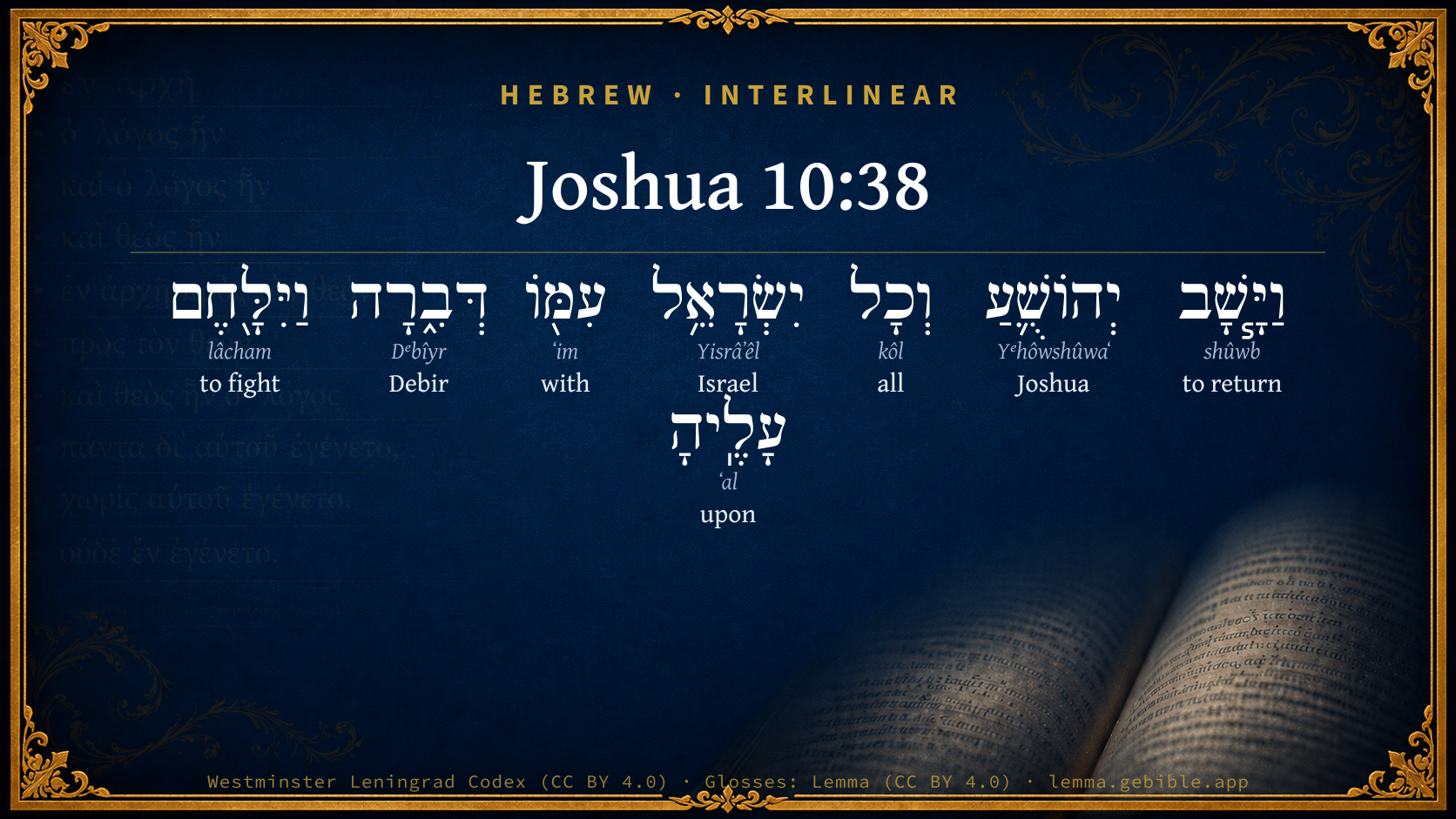
  1. וַיָּ֧שָׁב shûwb H7725 “and · to return” Conjunction + Verb, Qal, Sequential Imperfect, 3rd Person, Masculine, Singular
  2. יְהוֹשֻׁ֛עַ Yᵉhôwshûwaʻ H3091 “Joshua” Noun, Proper
  3. וְכָל kôl H3605 “and · all of” Conjunction + Noun, Common, Masculine, Singular, Construct
  4. יִשְׂרָאֵ֥ל Yisrâʼêl H3478 “Israel” Noun, Proper
  5. עִמּ֖וֹ ʻim H5973 “with · him” Preposition + Suffix, Personal, 3rd Person, Masculine, Singular
  6. וַיִּלָּ֖חֶם lâcham H3898 “and · to fight” Conjunction + Verb, Niphal, Sequential Imperfect, 3rd Person, Masculine, Singular
  7. עָלֶֽיהָ ʻal H5921 “upon · her” Preposition + Suffix, Personal, 3rd Person, Feminine, Singular

About this verse

These counts appear in no published source. They are computed here, from the morphology-tagged text and Lemma’s own curated glosses. What Lemma adds →

8
words
8
distinct lemmas
Historical
section

Notable vocabulary

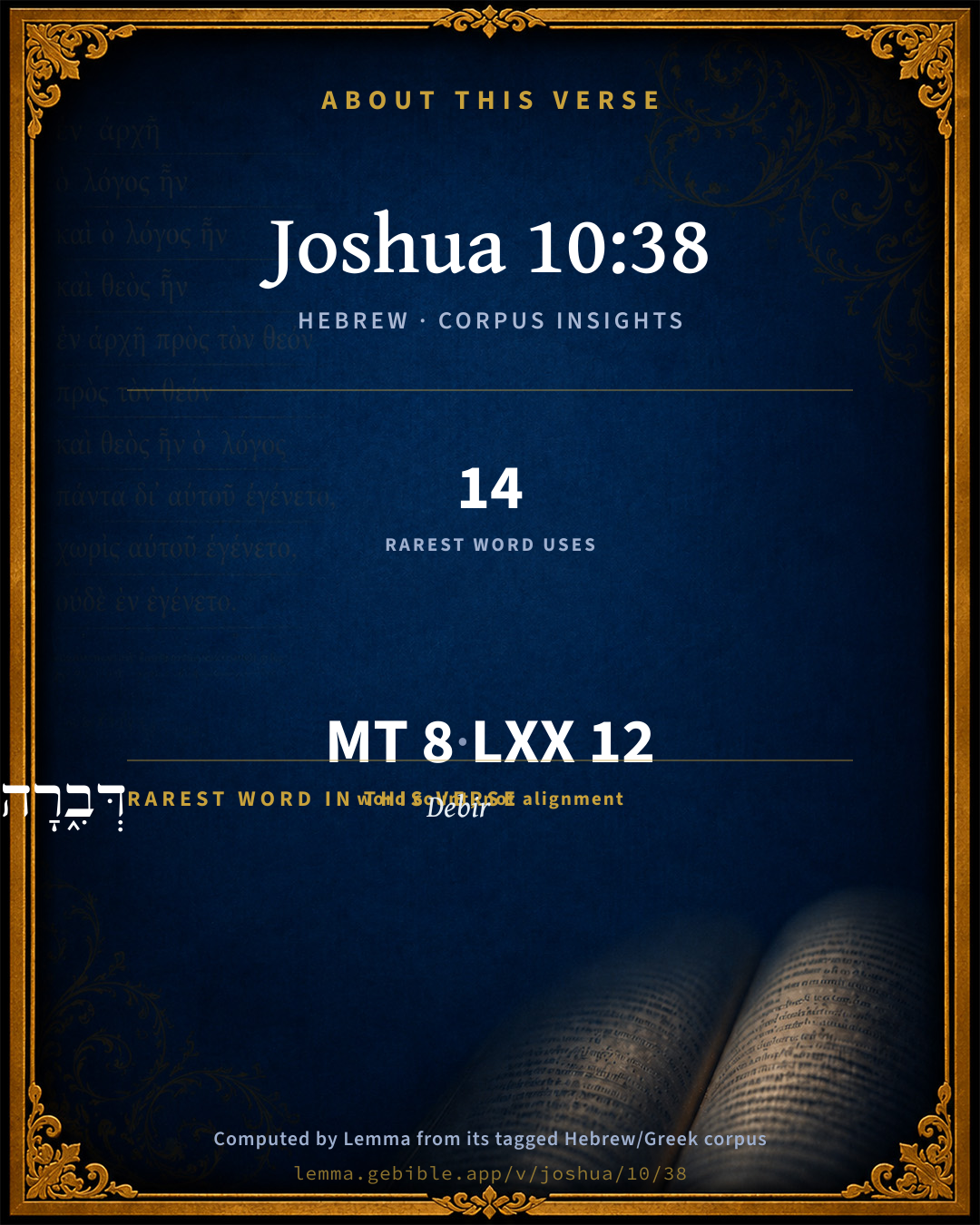
The rarest word here is דְּבִ֑רָה Debir H1688 — appearing just 14 times in the whole Hebrew Bible.

Shared distinctive vocabulary

דְּבִ֑רָה Debir H1688 occurs in 12 verses of the Hebrew Bible. Also found in:

Grammatical profile

  • 2 verbs
  • 4 nouns
  • 2 prepositions

Verb forms

  • וַיָּ֧שָׁב Qal · Sequential Imperfect
  • וַיִּלָּ֖חֶם Niphal · Sequential Imperfect

Hebrew & Septuagint length

In English translation the verse runs 13 words from the Hebrew and 13 from the Septuagint (LXX English) — the same length.

A rough comparison of the two English renderings, which tokenize alike — not a word-level alignment.

Word counts can differ between the Hebrew and the Greek without any difference in meaning — e.g. the Hebrew direct-object marker אֵת has no separate Greek word, and Greek often adds the article ὁ.

In the original languages it is 8 Hebrew tokens and 12 Greek tokens — but the two are counted differently (Hebrew bundles its prefixes and suffixes into one token; the Greek is in lemma form), so that isn’t a like-for-like length.

Cross-references

5

Topical passages linked to Joshua 10:38 in the Treasury of Scripture Knowledge — connected by theme and wording, ordered by reader-vote popularity; previews shown in the World English Bible.

  • Joshua 15:15 He went up there against the inhabitants of Debir: now the name of Debir before was Kiriath Sepher.
  • Joshua 12:13 the king of Debir, one; the king of Geder, one;
  • Joshua 15:49 and Dannah, and Kiriath Sannah (the same is Debir),
  • Joshua 21:15 and Holon with its suburbs, and Debir with its suburbs,
  • Judges 1:11–15 From there he went against the inhabitants of Debir. (Now the name of Debir before was Kiriath Sepher.)

Cross-references courtesy of OpenBible.info (CC BY 4.0).

Hebrew and Greek witnesses Masoretic Hebrew ↔ Greek Septuagint

The same verse in the two great witnesses to the Old Testament, shown verse-for-verse.

These are two independent witnesses, not word-aligned to each other, and the Septuagint is shown in lemma (dictionary) form.

Hebrew Joshua 10:38 Masoretic · Westminster Leningrad Codex

וַיָּ֧שָׁב יְהוֹשֻׁ֛עַ וְכָל יִשְׂרָאֵ֥ל עִמּ֖וֹ דְּבִ֑רָה וַיִּלָּ֖חֶם עָלֶֽיהָ

Joshua returned, and all Israel with him, to Debir, and fought against it:

World English Bible · Public Domain

Greek LXX Joshua 10:38 Septuagint · lemma form

καί ἀποστρέφω ἰησοῦς καί πᾶς ἰσραήλ εἰς δαβιρ καί περι καταἵζω αὐτός

And Joshua and all Israel returned to Dabir; and they encamped about it;

LXX2012 (modern English Septuagint) · Public Domain

Hebrew: Westminster Leningrad Codex (CC BY 4.0). Greek: Septuagint (public domain); English from LXX2012 (modern English Septuagint) (Public Domain). How the Septuagint differs from the Hebrew →

Targum (Aramaic paraphrase)

1

The Targum is the ancient Jewish Aramaic paraphrase of the Hebrew Scriptures — an interpretive translation, not the Hebrew text itself. Onkelos (literal) and Pseudo-Jonathan (expansive) render the Torah, and Jonathan the Prophets. Coverage is partial: where no permissively-licensed English translation exists for a verse, only the Aramaic is shown. This is verse-level text, not a word-by-word alignment to the Hebrew.

  1. Targum Jonathan Prophets (Joshua–Malachi)
    וְתַב יְהוֹשֻׁעַ וְכָל יִשְׂרָאֵל עִמֵיהּ לִדְבִיר וְאַגִיחַ קְרָבָא עֲלָהּ:

    (no public-domain English translation for this verse)

    Targum Jonathan — Aramaic: “Mikraot Gedolot” (public domain). English: “Sefaria Community Translation” (CC0 1.0 (public-domain dedication)); “London "Chaldee Paraphrase," 1871” (public domain). Text via Sefaria.

Commentary

Notes on Joshua 10:38 from classic Christian and Jewish commentators (each source and its license shown beneath its notes). The classic Christian expositions comment on the surrounding passage and are grouped to its opening verse, so a note may address several verses; the Jewish commentaries on the Tanakh (Rashi and others) are per-verse, so they appear only where the commentator wrote on this verse.

Lemma curates 59 commentaries, every one of them public domain or Creative Commons licensed, each selected and text-cleaned for this edition rather than reprinted as found. About our sources →

Trapp's Complete Commentary

John Trapp

Jos 10:38 And Joshua returned, and all Israel with him, to Debir; and fought against it:

Ver. 38. To Debir.] Formerly called Kirjathsepher. {Jdg 1:12}

John Trapp, A Commentary or Exposition upon All the Books of the Old and New Testament (1647–1656) — public domain. Text from a community e-Sword module.

Joseph Benson's Commentary

Jos 10:38. Joshua returned — to Debir — Joshua had not been there before, but having advanced as far south and west as he thought expedient, even as far as Gaza, which was in the western coast, (Jos 10:41,) he now returned toward the camp at Gilgal, which was north-east from him, and in his march thither took Debir, which afterward was a city of Judah, (Jos 15:49,) and one of the cities of the priests, Jos 21:15.

Joseph Benson's Commentary on the Old and New Testaments (1811–1818) — public domain. Text from a community e-Sword module.

Tyndale Open Study Notes

Tyndale Open Resources

10:38-39 Because settlement in the hill country was sparse, the surrounding villages—walled towns that could not maintain their independence—depended on the kingdoms of the dominant cities for protection.

Tyndale Open Study Notes — © Tyndale Open Resources, licensed CC BY-SA 4.0. Text via the HelloAO Bible API.

Ellicott's Commentary for English Readers

(38) Debir is not identified.

A Bible Commentary for English Readers, edited by Charles John Ellicott (1878–1897) — public domain. Text from a community e-Sword module.

The Cambridge Bible for Schools and Colleges

gen. ed. J. J. S. Perowne

38. returned] or turned. “Turnyde in,” Wyclif. The words indicate a change in the direction of the march. Comp. Exo_5:22, “and Moses returned unto the Lord,” From Hebron he turned in to the south-west, and attacked Debir.

Debir] The early name of this city was Kirjath-sepher = “the town of the book” (Jos_15:15; Jdg_1:11), or Kirjath-sannah = “the town of palm” (“of the law”?) (Jos_15:49). We find it afterwards given with its “suburbs” to the priests (Jos_21:15; 1Ch_6:58). “About three miles to the west of Hebron is a deep and secluded valley called the Wady Nunkûr, enclosed on the north by hills, of which one bears a name certainly suggestive of Debir, Dewîr-ban. The name supplies some evidence that the Canaanites were acquainted with writing and books. The town probably contained a noted school, or was the site of an oracle, and the residence of some learned priests.” This accounts for the Hebrew name, Debir, which Jerome renders “oraculum.” The same term was used to denote the adytum of Solomon’s temple.

The Cambridge Bible for Schools and Colleges (gen. ed. J. J. S. Perowne; Cambridge University Press, 1878–1918) — public domain. Text from a community e-Sword module.

John Gill's Exposition

And he took it, and the king thereof, and all the cities thereof,.... For this also was a royal city, and had others dependent on it; and therefore must lie further from Hebron than before suggested; and indeed Burchard (k) says it was five or six miles from it, and another writer (l) says ten miles:

and they smote them with the edge of the sword; the inhabitants of Debir, and the other cities adjacent to it:

and utterly destroyed all the souls that were therein, he left none remaining; and yet it seems this city recovered again, and was reinhabited, and after the death of Joshua was taken by Othniel, Jdg 1:11; unless, as before observed, with respect to Hebron, there is there a more particular account of the taking of it at this time:

as he had done to Hebron, so did he to Debir, and to the king thereof,

as he had done also to Libnah and her king; that is, slew them.

(k) Apud Masium in loc. (l) Fuller's Pisgah Sight of Palestine, B. 2. c. 13. p. 276.

John Gill's Exposition of the Whole Bible (1746–1763) — public domain (CC PDM 1.0). Text via the HelloAO Bible API.

Albert Barnes' Notes on the Bible

Joshua returned - The words mark a change in the direction of the march. Joshua from Hebron turned to the southwest, and attacked Debir or Kirjath-sepher and its dependencies Jos 15:15.

Albert Barnes' Notes on the Bible (1834–1885) — public domain. Text from a community e-Sword/MySword module.

Haydock's Catholic Bible Commentary

Dabir, which was formerly called Cariath sepher, "the city of the book," (chap. xv. 15,) or of Senna, (chap. xv. 45,) near Hebron. It was taken again by Othoniel and Caleb.

George Leo Haydock (1774–1849), Haydock's Catholic Family Bible and Commentary, 1859 edition — public domain. Excludes Psalms (Douay-Rheims chapter numbering differs from Protestant) and Deuterocanonical books (Catholic canon only).

Matthew Poole's English Annotations

He is said to return thither, not as if he had been there before, but because having gone as far westward and southward as he thought fit, even as far as Gaza, Jos 10:41, he now returned towards Gilgal, which lay northward and eastward from him, and in his return fell upon Debir: See Poole "Jos 15:15".

Matthew Poole's English Annotations on the Holy Bible (1683–1685) — public domain. Text from a community e-Sword/MySword module.

Whedon's Commentary on the Bible

Daniel D. Whedon

38. Hebron — See on Jos_10:3. As the king of Hebron had been executed at Makkedah, his successor is probably referred to as killed in this siege.

[38. And Joshua returned… to Debir — Debir has not been with certainty identified with any modern name. Van de Velde finds it in a place called Dilbeh, six miles southwest of Hebron. Compare Stanley’s note at Jos_15:18. Others suppose it to have been nearer Hebron, on the west. Dr. Rosen places it, with much probability, at Dewirban. Its earlier name was Kirjath-sepher, (Jos_15:15,) which means book city, and intimates that the original Canaanitish inhabitants were acquainted with writing and books, and that their city became noted for learning. The same place is called Kirjath-sannah in Jos_15:49, a name of similar meaning.]

Daniel D. Whedon (gen. ed.), Commentary on the Old and New Testaments (1874–1909) — public domain. Text from a community e-Sword module.

The Pulpit Commentary

And Joshua returned. Rather, Joshua turned. Debir was not on the way back from Hebron to Eglon, but in a different direction. His march was now southward instead of eastward. Debir. A city of importance, since only Hebron and it are mentioned in the history of the campaign as having cities dependent on them. It is also called Kirjath-Sepher, (Jos_15:15 Jud_1:11) and Kirjath-Sannah. (Jos_15:49) The first name signifies "the city of the hook," from whence it has been argued that it was the seat of what we should now call an university. Recent discoveries have rendered this supposition by no means improbable. The Hittite remains have proved that people to have been a more influential and intellectual people in early times than had ever been supposed until lately. Others have suggested that it was the abode of an oracle, which is rendered probable if Debir be connected with rbd word. The meaning of Kirjath-Sannah is by no means clear. Some have derived it from the Arabic "sunna," law, or doctrine (whence the Sunnite sect among the Mohammedans), and some from hNs or hns, a palm branch, or more probably a thorn bush. Ritter thinks that both Kirjath-Sepher and Kirjath-Sannah imply the place where the public records were kept. Perhaps what is meant is that, like Mona or Anglesea to the Druids, Debir was the home of the Canaanitish religious traditions. Debir appears as Dapur in the list of fortified cities in Canaan captured by Seti I and Rameses II of Egypt. They are depicted on the monumental records. See Tomkins, "Studies of the Time of Abraham," p. 84. Debir has lately been identified by the Palestine Survey. Lieut. Conder ("Quarterly Paper," Jan., 1875, p. 48) fixes it at El Dho-heriyeh or Dhaheriyeh. The identification depends upon the passages Jos_15:19, and Jud_1:15. See note on the former. The grounds of the identification are as follows:

1. Debir (see last note) was southward of Hebron.

2. The circumstances require an arid locality, but within a moderate distance two sets of springs, or pools of water.

3. There must be signs of ancient dwellings, and, as Debir was a royal city, it must be the converging point of the various roads. All these conditions are fulfilled by El Dhaheriyeh. The rock excavations, the sign of the most ancient dwellings, are plentiful there; ancient roads are found converging in all directions. And six miles and a half north of the village fourteen springs, or pools, are found, some at the head of the valley, some lower down, and some at a lower level still. The distance of these from Debit is in exact accordance with the narrative. They are too far off to be included as a matter of course within the boundaries of Debit, and would naturally enough become the object of such a petition as Achsah is said to have preferred in the passage above cited. Wilson"s "Lands of the Bible," 1:351, speaks of the excavations here, but does not appear to have been aware of their antiquity. He describes the inhabitants as living in them. But he remarks and it is a singular confirmation of Lieut. Conder"s subsequent discovery that the sites of five out of the ten cities mentioned in conjunction with Debir in Jos_15:48-51, are to be found in the immediate neighbourhood of Dhaheriyeh (ibid. p. 353). From this passage and some others, however, Knobel has anticipated Lieut. Conder"s suggestion. He describes Thaharijeh, as he calls it, as on the high road from Gaza, with ruins of great antiquity, situated in the midst of a country which, though barren in appearance and destitute of trees and arable land, is yet rich in pasture. But he says nothing of the springs, the only thing wanting to make the evidence complete. Ritter"s description of the place as the "first place of importance" on arriving in Palestine from the south, and as the meeting place of the roads from Beersheba, from Gaza and Egypt, and from Petra and Sinai, confirm Lieut. Conder"s view, but Bitter does not seem to have identified it with Debir, though he regards it as "one of a series of fortresses designed to protect the southern frontier of Judaea" (3:193, 288). It became a Levitical city. (Jos_21:15 1Ch_6:58)

The Pulpit Commentary (1880–1919), ed. H.D.M. Spence-Jones & Joseph S. Exell — public domain. Text from a community e-Sword module.

John Wesley's Explanatory Notes

Joshua returned - He is said to return thither, not as if he had been there before, but because having gone as far westward and southward as he thought fit, even as far as Gaza, ver. 41, he now returned towards Gilgal, which lay north-ward and eastward from him, and in his return fell upon Debir.

John Wesley, Explanatory Notes Upon the Whole Bible (1754–1765) — public domain. Text via the GEBible commentary corpus.

unfoldingWord translationNotes

Door43 World Missions Community

Debir ... Libnah

These are the names of cities. (See: How to Translate Names)

They struck them with the edge of the sword

The sword represents the army of Israel and striking expresses the idea of slaughter and destruction. AT: "They killed and destroyed them" (See: Metonymy)

translationWords

Joshua

Israel

king

sword

creature

Hebron

unfoldingWord translationNotes — © Distant Shores Media and the Door43 World Missions Community, licensed CC BY-SA 4.0. Source: git.door43.org/Door43/en_tn.

Lesson kit

Teaching starters — assembled from the data on this page, not authored interpretation. Every prompt links to the verse data it draws on. Edit before teaching.

Joshua, in the Historical, opens this verse with 8 words (8 distinct Hebrew lemmas). Its most distinctive word is Dᵉbîyr (“Debir”). A historical commentator’s framing appears above. Read the whole chapter for the surrounding context.

Discussion questions

  1. The word Dᵉbîyr carries the sense “Debir.” How does it shape the verse?
  2. Joshua 10:3 shares the word «Debir» with this verse. How do the two illuminate each other?
  3. These translations render this verse differently; the difference is in the English rendering, not the original. What questions does that raise?
  4. The verb «וַיָּ֧שָׁב» is Qal Sequential Imperfect. How does its form color the action?
  5. Reading how Trapp's Complete Commentary and Joseph Benson's Commentary read this verse, where do the two commentators agree and where do they part?

Things to notice

Reading settings

Reading text

Shown beneath each verse's original-language words.

Old Testament
Old Testament edition

Read the OT as the Masoretic Hebrew (MT) or the Greek Septuagint (LXX).

English shown for the Greek Septuagint (in the Hebrew ↔ Greek comparison).

Comparing translations? Open the Compare panel on any verse page to stack up to four side by side.