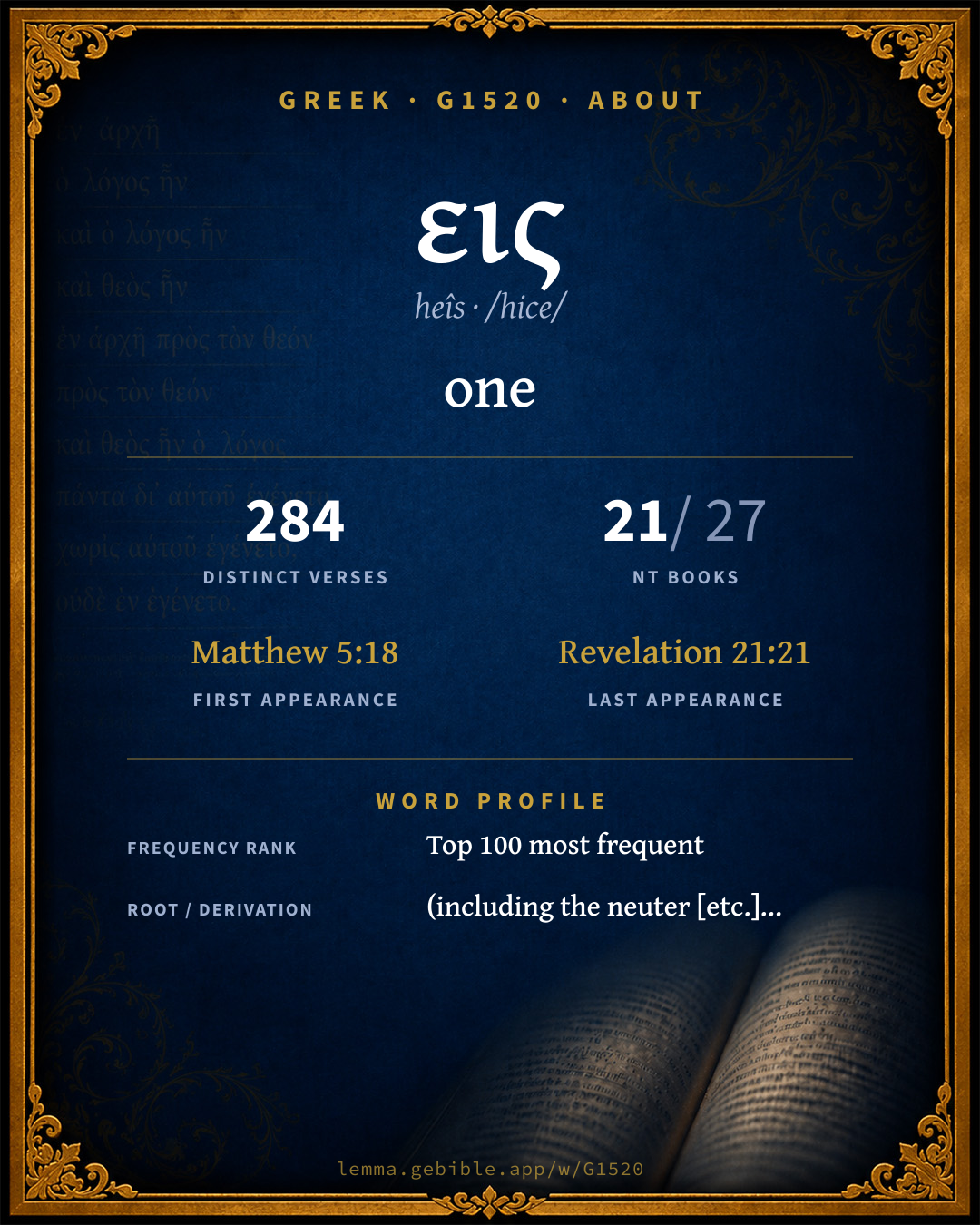
εἷς
one
Full lexicon entry — Thayer's Greek Lexicon
From Thayer's Greek Lexicon
Where this word appears
See every Accusative-case word in the Greek New Testament →
Grammar key — what these labels mean
Part of speech
- Adjective
- A word that describes or qualifies a noun.
Case
- Nominative
- The case of the subject (and the predicate nominative).
- Accusative
- The case of the direct object and of extent.
- Genitive
- The case of source, possession, or “of” — answers “whose / from what.”
- Dative
- The case of the indirect object, means, or location — “to / for / with / in.”
Gender
- Masculine
- Grammatically masculine.
- Neuter
- Grammatically neuter.
- Feminine
- Grammatically feminine.
Number
- Singular
- One.
Every verse where G1520 appears in the Book of Luke — 39 distinct verses. Click any verse to open its interlinear word-by-word view. Verse text shown in the World English Bible for context — . Each verse’s Greek form is shown with its reference; the English is not keyword-highlighted, since the data carries no word-level English alignment. Use “Compare translations” on any verse to read it across multiple English versions. This concordance covers the Greek New Testament; Septuagint (Greek Old Testament) occurrences of this word are not indexed here.
Luke
- Luke 4:40 ἑνὶ adj dat sg masc When the sun was setting, all those who had any sick with various diseases brought them to him; and he laid his hands on every one of them, and healed them.
- Luke 5:3 ἓν adj acc sg neut He entered into one of the boats, which was Simon's, and asked him to put out a little from the land. He sat down and taught the multitudes from the boat.
- Luke 5:12 μιᾷ adj dat sg fem It happened, while he was in one of the cities, behold, there was a man full of leprosy. When he saw Jesus, he fell on his face, and begged him, saying, "Lord, if you want to, you can make me clean."
- Luke 5:17 μιᾷ adj dat sg fem It happened on one of those days, that he was teaching; and there were Pharisees and teachers of the law sitting by, who had come out of every village of Galilee, Judea, and Jerusalem. The power of the Lord was with him to heal them.
- Luke 7:41 εἷς adj nom sg masc "A certain lender had two debtors. The one owed five hundred denarii, and the other fifty.
- Luke 8:22 μιᾷ adj dat sg fem Now it happened on one of those days, that he entered into a boat, himself and his disciples, and he said to them, "Let's go over to the other side of the lake." So they launched out.
- Luke 9:33 μίαν μίαν μίαν adj acc sg fem adj acc sg fem adj acc sg fem It happened, as they were parting from him, that Peter said to Jesus, "Master, it is good for us to be here. Let's make three tents: one for you, and one for Moses, and one for Elijah," not knowing what he said.
- Luke 10:42 ἑνὸς adj gen sg neut but one thing is needed. Mary has chosen the good part, which will not be taken away from her."
- Luke 11:46 ἑνὶ adj dat sg masc He said, "Woe to you lawyers also! For you load men with burdens that are difficult to carry, and you yourselves won't even lift one finger to help carry those burdens.
- Luke 12:6 ἓν adj nom sg neut "Aren't five sparrows sold for two assaria coins? Not one of them is forgotten by God.
- Luke 12:27 ἓν adj acc sg neut Consider the lilies, how they grow. They don't toil, neither do they spin; yet I tell you, even Solomon in all his glory was not arrayed like one of these.
- Luke 12:52 ἑνὶ adj dat sg masc For from now on, there will be five in one house divided, three against two, and two against three.
- Luke 13:10 μιᾷ adj dat sg fem He was teaching in one of the synagogues on the Sabbath day.
- Luke 14:18 μιᾶς adj gen sg fem They all as one began to make excuses. "The first said to him, 'I have bought a field, and I must go and see it. Please have me excused.'
- Luke 15:4 ἓν adj acc sg neut "Which of you men, if you had one hundred sheep, and lost one of them, wouldn't leave the ninety-nine in the wilderness, and go after the one that was lost, until he found it?
- Luke 15:7 ἑνὶ adj dat sg masc I tell you that even so there will be more joy in heaven over one sinner who repents, than over ninety-nine righteous people who need no repentance.
- Luke 15:8 μίαν adj acc sg fem Or what woman, if she had ten drachma coins, if she lost one drachma coin, wouldn't light a lamp, sweep the house, and seek diligently until she found it?
- Luke 15:10 ἑνὶ adj dat sg masc Even so, I tell you, there is joy in the presence of the angels of God over one sinner repenting."
- Luke 15:15 ἑνὶ adj dat sg masc He went and joined himself to one of the citizens of that country, and he sent him into his fields to feed pigs.
- Luke 15:19 ἕνα adj acc sg masc I am no more worthy to be called your son. Make me as one of your hired servants."'
- Luke 15:26 ἕνα adj acc sg masc He called one of the servants to him, and asked what was going on.
- Luke 16:5 ἕνα adj acc sg masc Calling each one of his lord's debtors to him, he said to the first, 'How much do you owe to my lord?'
- Luke 16:13 ἕνα ἑνὸς adj acc sg masc adj gen sg masc No servant can serve two masters, for either he will hate the one, and love the other; or else he will hold to one, and despise the other. You aren't able to serve God and mammon."
- Luke 16:17 μίαν adj acc sg fem But it is easier for heaven and earth to pass away, than for one tiny stroke of a pen in the law to fall.
- Luke 17:2 ἕνα adj acc sg masc It would be better for him if a millstone were hung around his neck, and he were thrown into the sea, rather than that he should cause one of these little ones to stumble.
- Luke 17:15 εἷς adj nom sg masc One of them, when he saw that he was healed, turned back, glorifying God with a loud voice.
- Luke 17:22 μίαν adj acc sg fem He said to the disciples, "The days will come, when you will desire to see one of the days of the Son of Man, and you will not see it.
- Luke 17:34 μιᾶς εἷς adj gen sg fem adj nom sg masc I tell you, in that night there will be two people in one bed. The one will be taken, and the other will be left.
- Luke 17:35 μία adj nom sg fem There will be two grinding grain together. One will be taken, and the other will be left."
- Luke 18:10 εἷς adj nom sg masc "Two men went up into the temple to pray; one was a Pharisee, and the other was a tax collector.
- Luke 18:19 εἷς adj nom sg masc Jesus asked him, "Why do you call me good? No one is good, except one--God.
- Luke 18:22 ἕν adj nom sg neut When Jesus heard these things, he said to him, "You still lack one thing. Sell all that you have, and distribute it to the poor. You will have treasure in heaven. Come, follow me."
- Luke 20:1 μιᾷ adj dat sg fem It happened on one of those days, as he was teaching the people in the temple and preaching the Gospel, that the priests and scribes came to him with the elders.
- Luke 22:47 εἷς adj nom sg masc While he was still speaking, behold, a multitude, and he who was called Judas, one of the twelve, was leading them. He came near to Jesus to kiss him.
- Luke 22:50 εἷς adj nom sg masc A certain one of them struck the servant of the high priest, and cut off his right ear.
- Luke 22:59 μιᾶς adj gen sg fem After about one hour passed, another confidently affirmed, saying, "Truly this man also was with him, for he is a Galilean!"
- Luke 23:39 Εἷς adj nom sg masc One of the criminals who was hanged insulted him, saying, "If you are the Christ, save yourself and us!"
- Luke 24:1 μιᾷ adj dat sg fem But on the first day of the week, at early dawn, they and some others came to the tomb, bringing the spices which they had prepared.
- Luke 24:18 εἷς adj nom sg masc One of them, named Cleopas, answered him, "Are you the only stranger in Jerusalem who doesn't know the things which have happened there in these days?"
About this entry
At a glance — auto-summarized from this page’s data, not written by a person. Every figure links to its source below. This summary describes the numbers; it doesn’t interpret them.
εις — transliterated heîs — is a Greek word carrying the sense “one.” It first appears in Matthew 5:18. The Greek New Testament uses it across 284 verses — common. Related forms include εις καθ' εις, ενδεκα and ενοτης. See the sense tree, 284-verse concordance, and the renderings breakdown below.
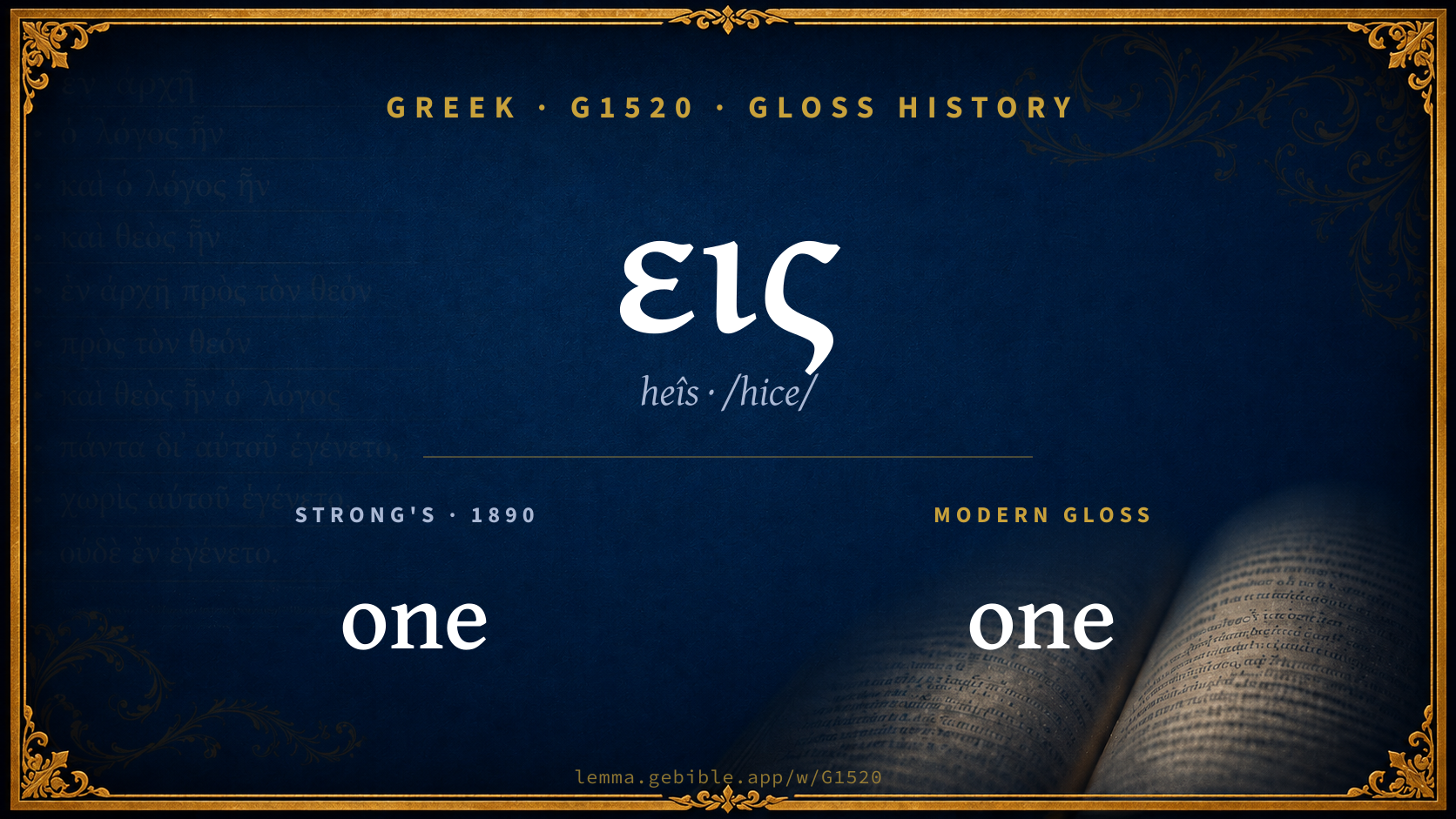
Gloss history
Strong's 1890 vs modern scholarship
About this word
Strong's G1520 catalogs a Greek word from the Greek New Testament.
These counts are not copied from any lexicon or concordance. They are computed here, from the morphology-tagged Greek New Testament. What Lemma adds →
- 284
- distinct verses
- The word appears in 284 distinct verses.
- 21 / 27
- NT books
- The word appears in 21 of 27 New Testament books.
- #53
- by frequency
- Top 100 most frequent Greek words (rank 53 of 5,347 Greek words by occurrence).
View all 284 occurrences in the concordance →
By section of the New Testament
By traditional corpus
Conventional, traditional groupings — biblical authorship is debated, so this is a traditional corpus grouping, not an authorship claim. Some books belong to more than one corpus (Luke is in both the Gospels and the Lukan corpus, and so on), so these shares overlap and need not total 100%. Each figure is a share of the word’s 284 distinct verses.
- Gospels 163 verses · 57%
- Pauline corpus 69 verses · 24%
- Lukan (Luke–Acts) 59 verses · 21%
- Johannine 57 verses · 20%
- Revelation 22 verses · 8%
- Hebrews 5 verses · 2%
- General (Catholic) Epistles 5 verses · 2%
How translations render this word
Counts come from each version’s own published word-to-Strong’s tagging or interlinear alignment — an approximate guide to how each version renders this word, not a word-level alignment the data otherwise carries. Because each total is that version’s own tagged count, the per-version totals vary from one another and need not match the appearance or distinct-verse counts above. These counts may also differ from a printed concordance because Lemma counts each distinctly tagged rendering and does not collapse phrase taggings into a single head-word total. This is a fixed set of word-tagged versions (KJV, ASV, BSB, ULT) and does not change with the reading translation you choose elsewhere. Each version’s license is shown beside its name below (and on Sources).
- King James Version: One 213×, A 7×, Other 6×
- American Standard Version: One 269×, A 12×, First 9×
- Berean Standard Bible: One 236×, A 18×, Single 13×
- unfoldingWord Literal Text: One 299×, First 8×, Is one 6×
King James Version Public Domain
Renders G1520 across 263 tagged occurrences — most commonly:
Plus 14 renderings that appear only once — usually multi-word phrases or single function words the recovered tagging swept in, not distinct renderings. Not rendered by a distinct English word in 9 further occurrences.
American Standard Version Public Domain
Renders G1520 across 340 tagged occurrences — most commonly:
Plus 25 renderings that appear only once — usually multi-word phrases or single function words the recovered tagging swept in, not distinct renderings. Not rendered by a distinct English word in 2 further occurrences.
Berean Standard Bible Public Domain
Renders G1520 across 312 tagged occurrences — most commonly:
Plus 14 renderings that appear only once — usually multi-word phrases or single function words the recovered tagging swept in, not distinct renderings. Not rendered by a distinct English word in 27 further occurrences.
unfoldingWord Literal Text CC BY-SA 4.0
Renders G1520 across 345 tagged occurrences — most commonly:
Plus 12 renderings that appear only once — usually multi-word phrases or single function words the recovered tagging swept in, not distinct renderings.
Senses in Thayer's
The 1 sense Thayer's distinguishes for this word, in lexicon order (not ranked by frequency or importance). The full entry — with sub-senses — is in the Lexicon Entry tab.
- one
Word origin
Origin: (including the neuter [etc.] hen)
Forms in the corpus
The 13 distinct written forms G1520 takes in the Greek New Testament, most frequent first — each parse links to that case’s occurrences in the concordance.
| Form | Parsing | Example | Uses |
|---|---|---|---|
| εἷς heîs | Adjective, Nominative, Singular, Masculine | Matthew 8:19 | 97 |
| ἓν hèn | Adjective, Nominative, Singular, Neuter | Matthew 5:18 | 47 |
| ἕνα héna | Adjective, Accusative, Singular, Masculine | Matthew 6:24 | 42 |
| μίαν mían | Adjective, Accusative, Singular, Feminine | Matthew 5:19 | 36 |
| ἑνὸς henòs | Adjective, Genitive, Singular, Masculine | Matthew 6:24 | 30 |
| ἑνὶ henì | Adjective, Dative, Singular, Masculine | Matthew 20:13 | 21 |
| μιᾷ miâ | Adjective, Dative, Singular, Feminine | Mark 16:2 | 18 |
| μία mía | Adjective, Nominative, Singular, Feminine | Matthew 5:18 | 17 |
| ἕν hén | Adjective, Nominative, Singular, Neuter | Mark 10:21 | 15 |
| μιᾶς miâs | Adjective, Genitive, Singular, Feminine | Luke 14:18 | 8 |
| ἑνός henós | Adjective, Genitive, Singular, Masculine | Romans 3:12 | 3 |
| Εἷς Heîs | Adjective, Nominative, Singular, Masculine | Luke 23:39 | 1 |
| ἑνί hení | Adjective, Dative, Singular, Masculine | James 2:10 | 1 |
Same root — word family
Other Thayer's entries built from the same root as G1520, grouped by Strong’s listed origin. These share a root / origin per the lexicon — not necessarily a shared meaning. Each links to that word’s own entry.
Derived from this word
- εις καθ' εις heîs kath’ heîs G1527 one after another
- ενδεκα héndeka G1733 eleven
- ενοτης henótēs G1775 unity
- μια mía G3391 one
Compare all same-root words → Showing 4 of 5 — not the complete family. They share a root, not necessarily a meaning.
Septuagint usage
The same Greek word εις appears 845 times in the Greek Old Testament (Septuagint), across 685 verses in 33 books.
- 845
- LXX occurrences
- Tagged occurrences of this Greek word in the Septuagint.
- 685
- verses
- Distinct Septuagint verses containing this word.
- 33 / 39
- OT books
- The word appears in 33 of the 39 Old Testament books.
Sample Septuagint occurrences
- Genesis 1:5 εἷς
- Exodus 1:15 εἷς
- Leviticus 4:2 εἷς
- Numbers 1:1 εἷς
- Deuteronomy 1:3 εἷς
- Joshua 3:12 εἷς
- Judges 4:16 εἷς
- Ruth 1:4 εἷς
- 1 Samuel 1:2 εἷς
- 2 Samuel 1:15 εἷς
- 1 Kings 2:16 εἷς
- 2 Kings 2:16 εἷς
Septuagint occurrences (same lexeme)
Every verse where the same Strong’s number (G1520) appears in the Greek Septuagint — showing the first 50 of 685. Verse text shown in the World English Bible for context; the Greek form is the matched word — the English is not keyword-highlighted.
- Genesis 1:5 εἷς God called the light Day, and the darkness he called Night. There was evening and there was morning, one day.
- Genesis 1:9 εἷς God said, "Let the waters under the sky be gathered together to one place, and let the dry land appear," and it was so.
- Genesis 2:11 εἷς The name of the first is Pishon: this is the one which flows through the whole land of Havilah, where there is gold;
- Genesis 2:21 εἷς Yahweh God caused a deep sleep to fall on the man, and he slept; and he took one of his ribs, and closed up the flesh in its place.
- Genesis 2:24 εἷς Therefore a man will leave his father and his mother, and will join with his wife, and they will be one flesh.
- Genesis 3:22 εἷς Yahweh God said, "Behold, the man has become like one of us, knowing good and evil. Now, lest he put forth his hand, and also take of the tree of life, and eat, and live forever..."
- Genesis 4:19 εἷς Lamech took two wives: the name of the one was Adah, and the name of the other Zillah.
- Genesis 8:13 εἷς It happened in the six hundred first year, in the first month, the first day of the month, the waters were dried up from off the earth. Noah removed the covering of the ark, and looked. He saw that the surface of the ground was dried.
- Genesis 10:25 εἷς To Eber were born two sons. The name of the one was Peleg, for in his days was the earth divided. His brother's name was Joktan.
- Genesis 11:1 εἷς The whole earth was of one language and of one speech.
- Genesis 11:6 εἷς Yahweh said, "Behold, they are one people, and they have all one language; and this is what they begin to do. Now nothing will be withheld from them, which they intend to do.
- Genesis 19:9 εἷς They said, "Stand back!" They said, "This one fellow came in to live as a foreigner, and he appoints himself a judge. Now will we deal worse with you, than with them!" They pressed hard on the man, even Lot, and drew near to break the door.
- Genesis 21:15 εἷς The water in the bottle was spent, and she cast the child under one of the shrubs.
- Genesis 22:2 εἷς He said, "Now take your son, your only son, whom you love, even Isaac, and go into the land of Moriah. Offer him there for a burnt offering on one of the mountains which I will tell you of."
- Genesis 22:13 εἷς Abraham lifted up his eyes, and looked, and saw that behind him was a ram caught in the thicket by his horns. Abraham went and took the ram, and offered him up for a burnt offering instead of his son.
- Genesis 24:36 εἷς Sarah, my master's wife, bore a son to my master when she was old. He has given all that he has to him.
- Genesis 27:38 εἷς Esau said to his father, "Have you but one blessing, my father? Bless me, even me also, my father." Esau lifted up his voice, and wept.
- Genesis 27:45 εἷς until your brother's anger turn away from you, and he forgets what you have done to him. Then I will send, and get you from there. Why should I be bereaved of you both in one day?"
- Genesis 32:9 εἷς Jacob said, "God of my father Abraham, and God of my father Isaac, Yahweh, who said to me, 'Return to your country, and to your relatives, and I will do you good.'
- Genesis 33:13 εἷς Jacob said to him, "My lord knows that the children are tender, and that the flocks and herds with me have their young, and if they overdrive them one day, all the flocks will die.
- Genesis 34:16 εἷς then will we give our daughters to you, and we will take your daughters to us, and we will dwell with you, and we will become one people.
- Genesis 34:22 εἷς Only on this condition will the men consent to us to dwell with us, to become one people, if every male among us be circumcised, as they are circumcised.
- Genesis 37:20 εἷς Come now therefore, and let's kill him, and cast him into one of the pits, and we will say, 'An evil animal has devoured him.' We will see what will become of his dreams."
- Genesis 38:28 εἷς It happened, when she travailed, that one put out a hand: and the midwife took and tied a scarlet thread on his hand, saying, "This came out first."
- Genesis 40:5 εἷς They both dreamed a dream, each man his dream, in one night, each man according to the interpretation of his dream, the cupbearer and the baker of the king of Egypt, who were bound in the prison.
- Genesis 41:5 εἷς He slept and dreamed a second time: and, behold, seven heads of grain came up on one stalk, healthy and good.
- Genesis 41:11 εἷς We dreamed a dream in one night, I and he. We dreamed each man according to the interpretation of his dream.
- Genesis 41:22 εἷς I saw in my dream, and, behold, seven heads of grain came up on one stalk, full and good:
- Genesis 41:25 εἷς Joseph said to Pharaoh, "The dream of Pharaoh is one. What God is about to do he has declared to Pharaoh.
- Genesis 41:26 εἷς The seven good cattle are seven years; and the seven good heads of grain are seven years. The dream is one.
- Genesis 42:11 εἷς We are all one man's sons; we are honest men. Your servants are not spies."
- Genesis 42:16 εἷς Send one of you, and let him get your brother, and you shall be bound, that your words may be tested, whether there is truth in you, or else by the life of Pharaoh surely you are spies."
- Genesis 42:19 εἷς If you are honest men, then let one of your brothers be bound in your prison-house; but you go, carry grain for the famine of your houses.
- Genesis 42:27 εἷς As one of them opened his sack to give his donkey food in the lodging-place, he saw his money. Behold, it was in the mouth of his sack.
- Genesis 42:32 εἷς We are twelve brothers, sons of our father; one is no more, and the youngest is this day with our father in the land of Canaan.'
- Genesis 42:33 εἷς The man, the lord of the land, said to us, 'Hereby will I know that you are honest men. Leave one of your brothers with me, and take grain for the famine of your houses, and go your way.
- Genesis 43:14 εἷς May God Almighty give you mercy before the man, that he may release to you your other brother and Benjamin. If I am bereaved of my children, I am bereaved."
- Genesis 44:28 εἷς and the one went out from me, and I said, "Surely he is torn in pieces;" and I haven't seen him since.
- Genesis 49:16 εἷς "Dan will judge his people, As one of the tribes of Israel.
- Exodus 1:15 εἷς The king of Egypt spoke to the Hebrew midwives, of whom the name of the one was Shiphrah, and the name of the other Puah,
- Exodus 10:19 εἷς Yahweh turned an exceeding strong west wind, which took up the locusts, and drove them into the Red Sea. There remained not one locust in all the borders of Egypt.
- Exodus 11:1 εἷς Yahweh said to Moses, "Yet one plague more will I bring on Pharaoh, and on Egypt; afterwards he will let you go. When he lets you go, he will surely thrust you out altogether.
- Exodus 12:18 εἷς In the first month, on the fourteenth day of the month at evening, you shall eat unleavened bread, until the twenty first day of the month at evening.
- Exodus 12:46 εἷς In one house shall it be eaten; you shall not carry forth anything of the flesh abroad out of the house; neither shall you break a bone of it.
- Exodus 12:49 εἷς One law shall be to him who is born at home, and to the stranger who lives as a foreigner among you."
- Exodus 14:28 εἷς The waters returned, and covered the chariots and the horsemen, even all Pharaoh's army that went in after them into the sea. There remained not so much as one of them.
- Exodus 16:22 εἷς It happened that on the sixth day they gathered twice as much bread, two omers for each one, and all the rulers of the congregation came and told Moses.
- Exodus 16:33 εἷς Moses said to Aaron, "Take a pot, and put an omer-full of manna in it, and lay it up before Yahweh, to be kept throughout your generations."
- Exodus 17:12 εἷς But Moses' hands were heavy; and they took a stone, and put it under him, and he sat on it. Aaron and Hur held up his hands, the one on the one side, and the other on the other side. His hands were steady until sunset.
- Exodus 18:3 εἷς and her two sons. The name of one son was Gershom, for Moses said, "I have lived as a foreigner in a foreign land".
These are occurrences of the same Greek lexeme (G1520) in the Septuagint — not a translation of any one Hebrew word. The store carries no word-level Hebrew↔Greek alignment, so no Hebrew original is asserted here. Counts come from the recovered LXX Strong's tagging — high-frequency vocabulary is well covered, while rare or late forms may be untagged — so they reflect tagged occurrences and may slightly undercount.