

Job 13:3

Hebrew (Westminster Leningrad Codex) Job 13:3 appears in the Hebrew Old Testament. The text above is from the Westminster Leningrad Codex. Each word links to its Strong’s number, a concise gloss, and parsing drawn from the Open Scriptures Hebrew Bible morphology. Click any word for its full Brown-Driver-Briggs (BDB) entry.
Download image
Cite this verse

Job 13:3 (World English Bible). Public Domain. Lemma interlinear Bible study tool, https://lemma.gebible.app/v/job/13/3.

Show BibTeX & RIS
BibTeX
RIS
English Translation
"Surely I would speak to the Almighty. I desire to reason with God.
World English Bible · Public Domain
Download a study sheet

One document with this verse’s original text, its word-by-word gloss line, the meaning frame, cross-references with their text, attributed commentary, and full source and license credits — printable, and it pastes into notes with its structure intact.

This verse Autodidact and up

Study sheet (.html) Plain text (.txt)

A passage Seminary Student

Up to 50 verses in one chapter. A passage sheet keeps up to 6 commentary sources and 12 cross-references per verse, in the order this page ranks them, and says so on the sheet whenever that leaves anything out. Ask for a single verse and you get the Autodidact verse sheet above.

Everything on this page stays free to read, with no account — the sheet is a download of what is already on screen, not access to it.

Want to remove ads? Support Godless Engineer
Compare translations 3

The same verse in 3 English versions, stacked beneath the original-language interlinear above. Click any original word for its lexicon entry.

Each is an independent rendering of the whole verse — the interlinear is not word-aligned to these translations.

Highlighted words mark where these versions differ — a whole-verse word diff, not a word-by-word alignment.

  • World English Bible Public Domain
    "Surely I would speak to the Almighty. I desire to reason with God.
  • King James Version Public Domain
    Surely I would speak to the Almighty, and I desire to reason with God.
  • unfoldingWord Literal Text CC BY-SA 4.0
    But I will speak with the Almighty, and to plead with God I desire.

unfoldingWord Literal Text — © unfoldingWord, licensed CC BY-SA 4.0. Word-aligned USFM3 via Door43 (git.door43.org/unfoldingWord/en_ult).

Versions to compare (up to 4)

3 of 4 selected

Show all 18 translations

Every available English version of this verse, each an independent rendering of the whole verse.

  • World English Bible Public Domain
    "Surely I would speak to the Almighty. I desire to reason with God.
  • Berean Standard Bible Public Domain
    Yet I desire to speak to the Almighty and argue my case before God.
  • Majority Standard Bible Public Domain
    Yet I desire to speak to the Almighty and argue my case before God.
  • King James Version Public Domain
    Surely I would speak to the Almighty, and I desire to reason with God.
  • American Standard Version (1901) Public Domain
    Surely I would speak to the Almighty, And I desire to reason with God.
  • Revised Version (1885) Public Domain
    Surely I would speak to the Almighty, and I desire to reason with God.
  • Geneva Bible (1599) Public Domain
    But I will speake to the Almightie, and I desire to dispute with God.
  • Douay-Rheims (1899) Public Domain
    But yet I will speak to the Almighty, and I desire to reason with God.
  • Young's Literal Translation Public Domain
    Yet I for the Mighty One do speak, And to argue for God I delight.
  • Literal Standard Version CC BY-SA 4.0
    Yet I speak for the Mighty One, || And I delight to argue for God.
  • Unlocked Literal Bible CC BY-SA 4.0
    However, I would rather speak with the Almighty; I wish to reason with God.
  • unfoldingWord Literal Text CC BY-SA 4.0
    But I will speak with the Almighty, and to plead with God I desire.
  • Darby Bible Public Domain
    But I will speak to the Almighty, and will find pleasure in reasoning with ùGod;
  • World Messianic Bible Public Domain
    “Surely I would speak to the Almighty. I desire to reason with God.
  • Webster's Bible Public Domain
    Surely I would speak to the Almighty, and I desire to reason with God.
  • Free Bible Version CC BY-SA 4.0
    But I would still like to speak to the Almighty: I want to prove myself to God!
  • Bible in Basic English Public Domain
    But I would have talk with the Ruler of all, and my desire is to have an argument with God.
  • JPS Tanakh (1917) Public Domain
    Notwithstanding I would speak to the Almighty, and I desire to reason with God.

Literal Standard Version (2020), Covenant Press — licensed CC BY-SA 4.0. Text via the HelloAO Bible API (eBible.org). Unlocked Literal Bible (unfoldingWord) — licensed CC BY-SA 4.0. Text via the HelloAO Bible API (eBible.org). unfoldingWord Literal Text — © unfoldingWord, licensed CC BY-SA 4.0. Word-aligned USFM3 via Door43 (git.door43.org/unfoldingWord/en_ult). Free Bible Version, Dr. Jonathan Gallagher — licensed CC BY-SA 4.0. Text via the HelloAO Bible API (eBible.org).

Word by word

More ways to search: Search by grammar → Find every occurrence → Compare this word →

Practice this passage: Drill this verse → Learn its vocabulary →

About this verse

These counts appear in no published source. They are computed here, from the morphology-tagged text and Lemma’s own curated glosses. What Lemma adds →

9
words
8
distinct lemmas
Wisdom
section

Notable vocabulary

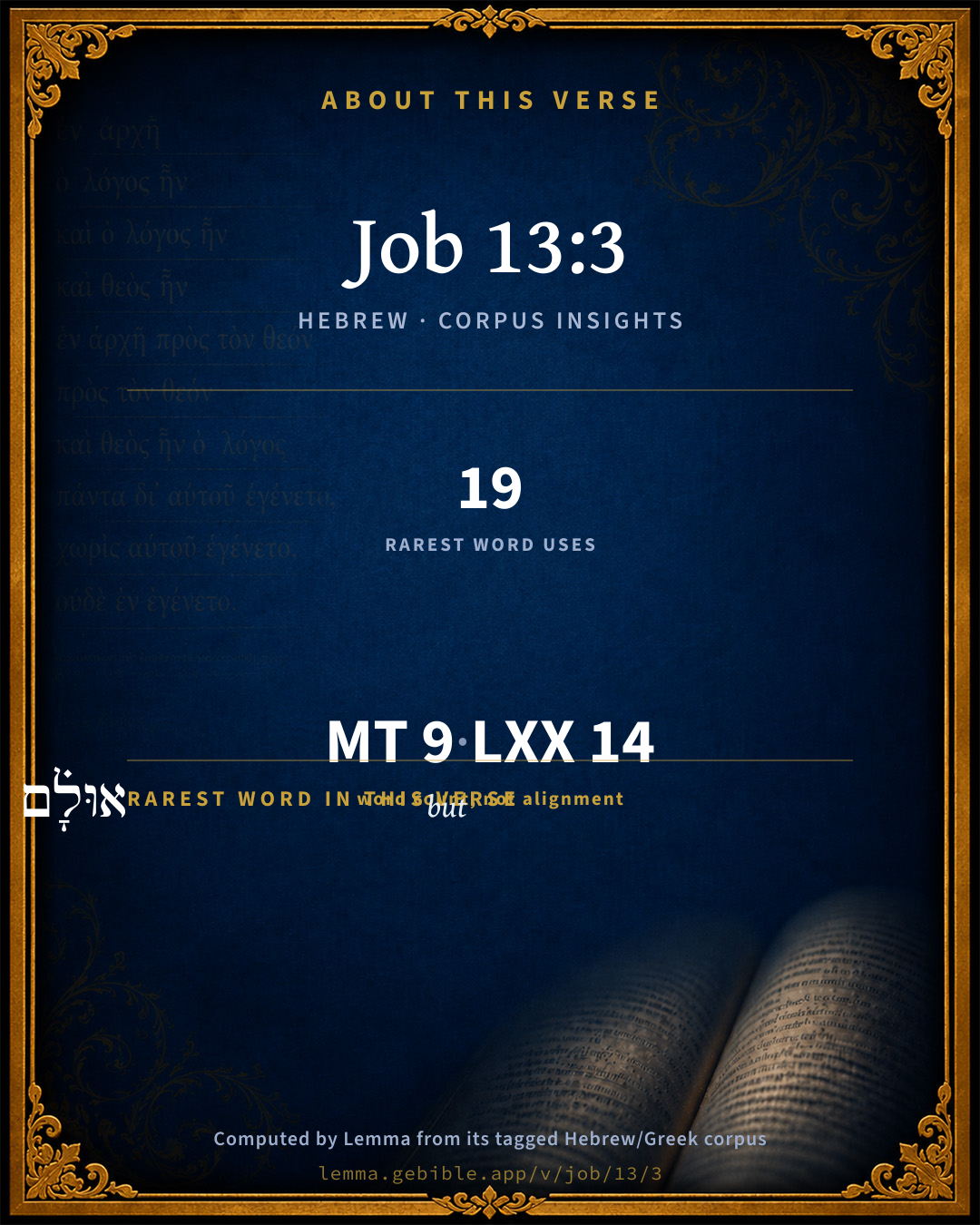
The rarest word here is אוּלָ֗ם but H199 — appearing just 19 times in the whole Hebrew Bible.

Shared distinctive vocabulary

אוּלָ֗ם but H199 occurs in 19 verses of the Hebrew Bible. Also found in:

Grammatical profile

  • 3 verbs
  • 2 nouns
  • 1 pronoun
  • 2 prepositions
  • 1 adverb

Verb forms

  • אֲדַבֵּ֑ר Piel · Imperfect
  • וְהוֹכֵ֖חַ Hiphil · Infinitive Absolute
  • אֶחְפָּֽץ Qal · Imperfect

Repetition

A word recurs within this verse — often emphatic in Hebrew:

  • אֶל to H413 ×2

Hebrew & Septuagint length

In English translation the verse runs 13 words from the Hebrew and 16 from the Septuagint (LXX English) — closely comparable.

A rough comparison of the two English renderings, which tokenize alike — not a word-level alignment.

Word counts can differ between the Hebrew and the Greek without any difference in meaning — e.g. the Hebrew direct-object marker אֵת has no separate Greek word, and Greek often adds the article ὁ.

In the original languages it is 9 Hebrew tokens and 14 Greek tokens — but the two are counted differently (Hebrew bundles its prefixes and suffixes into one token; the Greek is in lemma form), so that isn’t a like-for-like length.

Cross-references

12

Topical passages linked to Job 13:3 in the Treasury of Scripture Knowledge — connected by theme and wording, ordered by reader-vote popularity; previews shown in the World English Bible.

  • Isaiah 41:21 Produce your cause, says Yahweh; bring forth your strong reasons, says the King of Jacob.
  • Job 9:3 If he is pleased to contend with him, He can't answer him one time in a thousand.
  • Job 13:22 Then call, and I will answer; Or let me speak, and you answer me.
  • Job 31:35 Oh that I had one to hear me! (Behold, here is my signature, let the Almighty answer me); Let the accuser write my indictment!
  • Isaiah 1:18–20 "Come now, and let us reason together," says Yahweh: "Though your sins be as scarlet, they shall be as white as snow. Though they be red like crimson, they shall be as wool.
  • Job 9:14–15 How much less shall I answer him, Choose my words to argue with him?
  • Job 9:34–35 Let him take his rod away from me, Let his terror not make me afraid:
  • Job 11:5 But oh that God would speak, And open his lips against you,
  • Job 13:15 Behold, he will kill me; I have no hope. Nevertheless, I will maintain my ways before him.
  • Job 23:3–7 Oh that I knew where I might find him! That I might come even to his seat!
  • Jeremiah 12:1–2 Righteous are you, Yahweh, when I contend with you; yet would I reason the cause with you: why does the way of the wicked prosper? why are all they at ease who deal very treacherously?
  • Micah 6:2 Hear, you mountains, Yahweh's controversy, And you enduring foundations of the earth; For Yahweh has a controversy with his people, And he will contend with Israel.

Cross-references courtesy of OpenBible.info (CC BY 4.0).

Hebrew and Greek witnesses Masoretic Hebrew ↔ Greek Septuagint

The same verse in the two great witnesses to the Old Testament, shown verse-for-verse.

These are two independent witnesses, not word-aligned to each other, and the Septuagint is shown in lemma (dictionary) form.

Hebrew Job 13:3 Masoretic · Westminster Leningrad Codex

אוּלָ֗ם אֲ֭נִי אֶל שַׁדַּ֣י אֲדַבֵּ֑ר וְהוֹכֵ֖חַ אֶל אֵ֣ל אֶחְפָּֽץ

"Surely I would speak to the Almighty. I desire to reason with God.

World English Bible · Public Domain

Greek LXX Job 13:3 Septuagint · lemma form

οὐ μήν δέ ἀλλά ἐγώ πρός κύριος λαλέω ἐλέγχω δέ ἐναντίον αὐτός ἐάν βούλομαι

Nevertheless I will speak to the Lord, and I will reason before him, if he will.

LXX2012 (modern English Septuagint) · Public Domain

On this verse, Trapp's Complete Commentary discusses the Septuagint’s reading. Read the note in Commentary ↓

Hebrew: Westminster Leningrad Codex (CC BY 4.0). Greek: Septuagint (public domain); English from LXX2012 (modern English Septuagint) (Public Domain). How the Septuagint differs from the Hebrew →

Commentary

Notes on Job 13:3 from classic Christian and Jewish commentators (each source and its license shown beneath its notes). The classic Christian expositions comment on the surrounding passage and are grouped to its opening verse, so a note may address several verses; the Jewish commentaries on the Tanakh (Rashi and others) are per-verse, so they appear only where the commentator wrote on this verse.

Lemma curates 59 commentaries, every one of them public domain or Creative Commons licensed, each selected and text-cleaned for this edition rather than reprinted as found. About our sources →

Trapp's Complete Commentary

John Trapp

Job 13:3 Surely I would speak to the Almighty, and I desire to reason with God.

Ver. 3. Surely I would speak to the Almighty] It were far better for me to speak to God than to you, and much fairer dealing from him I might expect. "A God of truth and without iniquity, just and right is he," Deu 32:4; but ye are forgers of lies, and ye load me with false accusations, depraving my speeches, as thou, Zophar, especially hast done, wishing withal that God himself would speak with me face to face; which, if it should come to pass, thou saidst my misery and affliction would be redoubled. But oh that I might commune with the Almighty! surely and seriously I would rather do it than with you, my friends; and should hope so to defend mine innocence against your slanderous accusations; yea, to maintain God’s justice against you, in the presence and judgment of God himself. Oh the confidence of a good conscience! see it in Abimelech, Gen 20:5, but much more in David, Psa 7:8; Psa 7:4; Psa 139:23-24; Jer 12:1; in every strong believer, 1Pe 3:21; those that walk uprightly, and speak uprightly, Isa 33:15. Not so every ungirt Christian or profligate professor, Job 13:14. The sinners in Sion are afraid, fearfulness surpriseth the hypocrites, &c., but good Job was none such; and God knew it to be so; what if to the wicked he be a devouring fire? yet to those that fear his name he is a reviving sun, Mal 4:1-2. And upright Job feareth not to reason with him. Upon the same ground John Huss, and other martyrs, cited their persecutors to answer them by such a time before God’s tribunal.

And I desire to reason with God] If he please ( Si voluerit). So the Septuagint adds, and makes out Job’s meaning; as if he had used the like modesty and humility as Nehemiah, and after him Esther, did in their suits unto the king of Persia, when they said, If it seem good to the king, and if I have found favour in his sight, Neh 2:5 Est 5:4. Others think that Job here desireth to plead with God as with a party that had dealt too hardly with him, &c.; that he challengeth God into the schools, as it were, there to crack an argument with him, and by reason to reduce him to milder dealing. And, indeed, the Hebrew word here used signifieth to dispute or argue, and from it the Rabbis call logic the art of arguing. This boldness is that, say our large annotations, which both Elihu and God blame Job for in the end of the Book, though neither of them condemn him for a hypocrite; and that shows that Job did speak amiss of God in his passion, and is not altogether to be excused; much less in everything to be commended.

John Trapp, A Commentary or Exposition upon All the Books of the Old and New Testament (1647–1656) — public domain. Text from a community e-Sword module.

The Biblical Illustrator

Joseph S. Exell

Job_13:3-4

Surely I would speak to the Almighty.

Man speaking to God

There is a great deal of human speaking that has to do with God. Most speak about God, many speak against God, and some speak to God. Of these there are two classes--Those who occasionally speak to Him under the pressure of trial; those who regularly speak to Him as the rule of their life. These last are the true Christ-like men.

I. Speaking to God shows the highest practical recognition of the Divine presence. It indicates--

1. A heart belief in the fact of the Divine existence.

2. A heart belief in the personality of the Divine existence. What rational soul would speak to a vain impersonality? Man may justly infer the personality of God from his own personality.

3. A heart belief in the nearness of the Divine existence. It feels that He is present.

4. A heart belief in the impressibility of the Divine existence. It has no question about the Divine susceptibility.

II. Speaking to God shows the truest relief of our social nature. Social relief consists principally in the free and full communication to others of all the thoughts and emotions that must affect the heart. Before a man will fully unbosom his soul to another, he must be certified of three things--

1. That the other feels the deepest interest in him. Who has such an interest in us as God?

2. That the other will make full allowance for the infirmities of his nature. Who is so acquainted with our infirmities as God?

3. That the other will be disposed and able to assist in our trials. Who can question the willingness and capability of God?

III. Speaking to God shows the most effective method of spiritual discipline.

1. The effort of speaking to God is most quickening to the soul.

2. The effort of speaking to God is most humbling to a soul.

3. The effort of speaking to God is most spiritualising to the soul. It breaks the spell of the world upon us; it frees us from secular associations; it detaches us from earth; and it makes us feel that there is nothing real but spirit, nothing great but God, and nothing worthy of man but assimilation to and fellowship with the Infinite.

IV. Speaking to God shows the highest honour of a created spirit. The act implies a great capacity. What can show the greatness of the human soul so much as this exalted communion? (Homilist.)

But ye are forgers of lies.--

Lies easily forged

Lying is so easy that it is within the capacity of everyone. It is proverbially easy. It is as easy as lying, says Hamlet, when speaking of something not difficult. You can do it as you work or as you walk. You can do it as you sit in your easy chair. You can do it without any help, even in extreme debility. You lie, and it does not blister your tongue or give you a headache. It is not attended with any wear and tear of constitution. It does not throw you into a consumption--not even into a perspiration. It is the cheapest of sins. It requires no outlay of money to gratify this propensity. There is no tax to pay. The poorest can afford it, and the rich do not despise it because it is cheap. Neither does it cost any expenditure of time. After the hesitancy of the first few lies you can make them with the greatest ease. You soon get to extemporise them without the trouble of forethought. The facilities for committing this sin are greater than for any other. You may indulge in it anywhere. You cannot very well steal on a common, or swear in a drawing room, or get drunk in a workhouse; but in what place or at what time can you not lie? You have to sneak, and skulk, and look over your shoulders, and peep, and listen, before you can commit many sins; but this can be practised in open day, and in the market place. You can look a man in the face and do it. You can rub your hands and smile and be very pleasant whilst doing it. (J. Teasdale.)

The Biblical Illustrator, edited by Joseph S. Exell (c. 1880s–1900s) — public domain. Text from a community e-Sword module.

Joseph Benson's Commentary

Job 13:3. Surely I would speak to the Almighty — I had rather debate the matter with God than with you. I am not afraid of presenting my person and cause before him, who is a witness of my integrity, and would not deal so unmercifully with me as you do.

Joseph Benson's Commentary on the Old and New Testaments (1811–1818) — public domain. Text from a community e-Sword module.

Keil & Delitzsch

C. F. Keil & F. Delitzsch

3 But I would speak to the Almighty,

And I long to reason with God.

4 And ye however are forgers of lies,

Physicians of no value are ye all.

5 Oh that ye would altogether hold your peace,

It would be accounted to you as wisdom.

6 Hear now my instruction,

Ando hearken to the answers of my lips!

He will no longer dispute with the friends; the more they oppose him, the more earnestly he desires to be able to argue his cause before God. אוּלם (Job 13:3) is disjunctive, like ἀλλά, and introduces a new range of thoughts; lxx ου ̓ μήν δὲ ἀλλά, verum enim vero. True, he has said in Job 9 that no one can maintain his cause before God; but his confidence in God grows in proportion as his distrust of the friends increases; and at the same time, the hope is begotten that God will grant him that softening of the terror of His majesty which he has reserved to himself in connection with this declaration (Job 9:34, comp. Job 13:20.). The infin. absol. הוכח, which in Job 6:25 is used almost as a substantive, and indeed as the subject, is here in the place of the object, as e.g., Isa 5:5; Isa 58:6 : to prove, i.e., my cause, to God (אל־אל, like Job 13:15, אל־פּניו) I long. With ואוּלם (Job 13:4) the antithesis is introduced anew: I will turn to God, you on the contrary (καὶ ὑμεῖς δὲ). Since the verb טפל, from its primary meaning to spread on, smear on (whence e.g., Talmudic טפלה, the act of throwing on, as when plastering up the cracks of an oven), cogn. תּפל (whence תּפל, plaster, and perhaps also in the signification tasteless, Job 6:6 = sticky, greasy, slimy), does not signify, at least not at first, consuere, but assuere (without any relation of root with תּפר), we explain, not with Olshausen and others, concinnatores mendacii, such as sew together lies as patchwork; but with Hirzel and others, assutores mendacii, such as patch on lies, i.e., charge falsely, since they desire throughout to make him out to be a sinner punished according to his desert. This explanation is also confirmed by Job 14:17. Another explanation is given by Hupfeld: sarcinatores false = inanes, inutiles, so that שׁקר signifies what lies = what deceives, as in the parallel member of the verse אלל,

(Note: In the Talmudic, the jugular vein, the cutting of which produces death, is called אלל (later עצב, Arab. ‛ṣb), according to which (b. Chullin 121a) it is explained: healer of the jugular artery, i.e., those who try to heal what is incurable, therefore charlatans, - a strange idea, which has arisen from the defective form of writing אלל. The lxx translates ἰαταὶ κακῶν.)

nothingness, and also עמל (Job 16:2) in a similar connection, is not an objective but attributive genitive; but Psa 119:69 is decisive against this interpretation of שׁקר טפלי. The parallelism is not so exactly adjusted, as e.g., even רפאי does not on account of the parallel with טפלי signify patchers, ῥάπται, but: they are not able to heal Job's wounds with the medicine of consolation; they are medici nihili, useless physicians. Pro 17:28, "Even a fool, when he holdeth his peace, is counted wise," applies to them, si tacuisses, sapiens mansisses; or, as a rabbinical proverb of similar meaning, quoted by Heidenheim, says, השׂגה בהשׂגה הלאות, "the fatigue of comprehension is comprehension," i.e., the silent pause before a problem is half the solution. The jussive form וּתהי, it would be (Ges. 128, 2), is used in the conclusion of the wish. Thus he challenges them to hear his תּוכחת (תּוכחה) and his רבוה. Hirzel is quite right when he says the former does not mean defence (justification), nor the latter proofs (counter-evidence); תוכחת is, according to his signification (significatus, in distinction from sensus), ἔλεγχος, correptio (lxx, Vulg.), and here not so much refutation and answer, as correction in an ethical sense, in correspondence with which רבות is also intended of reproaches, reproofs, or reprimands.

Keil & Delitzsch — Biblical Commentary on the Old Testament (1861–1891) — public domain (CC PDM 1.0). Text via the HelloAO Bible API. (Old Testament only.)

Geneva Bible (1599)

Geneva Bible translators

For although he knew that God had a justice, which was manifest in his ordinary working and another in his secret counsel, yet he would utter his affection to God, because he was not able to understand the cause why he did thus punish him.

Geneva Bible (1599) marginal notes — public domain. Text via Bolls.life.

Jamieson, Fausset & Brown

Robert Jamieson, A. R. Fausset & David Brown

Job wishes to plead his cause before God (Job 9:34-35), as he is more and more convinced of the valueless character of his would-be "physicians" (Job 16:2).

Jamieson, Fausset & Brown — Commentary Critical and Explanatory on the Whole Bible (1871) — public domain (CC PDM 1.0). Text via the HelloAO Bible API.

Adam Clarke's Commentary

Verse 3. Surely I would speak to the Almighty] אולם ulam, O that: - I wish I could speak to the Almighty!

I desire to reason with God.] He speaks here to reference to the proceedings in a court of justice. Ye pretend to be advocates for God, but ye are forgers of lies: O that God himself would appear! Before him I could soon prove my innocence of the evils with which ye charge me.

Adam Clarke's Commentary on the Bible (1810–1826) — public domain. Text from a community e-Sword/MySword module.

The Cambridge Bible for Schools and Colleges

gen. ed. J. J. S. Perowne

3. But this knowledge neither helps nor hinders him. In spite of this knowledge, if not because of it, he desires to reason with God.

surely I would speak] Rather, but I would (same word in Job_13:4).

The Cambridge Bible for Schools and Colleges (gen. ed. J. J. S. Perowne; Cambridge University Press, 1878–1918) — public domain. Text from a community e-Sword module.

John Gill's Exposition

Surely I would speak to the Almighty,.... Or "therefore I would speak" (l), since he knew as much as his friends, and they knew no more than he, if so much, he would have no more to do with them, they should not be his judges; nor would he be determined by them, but would appeal to God, and plead his own cause before him, by whom he doubted not he should be candidly heard; he knew that he was the Judge of all the earth, and would do right; and that he sat on a throne judging righteously, and would maintain his right and his cause; that he would judge him according to his righteousness and integrity, of which he was conscious, and would pass a just decisive sentence in his favour, and give the cause for him against his friends, as he afterwards did; for this is not to be understood of speaking to him in prayer, though that is a speech either of the heart or of the tongue, or of both, to God; and which he allows of, yea, delights in, and which is a wonderful condescension; and therefore it may be used with boldness and freedom, and which gracious souls are desirous of; and the consideration of God being "almighty", or "all sufficient", is an argument, motive, and inducement to them to speak or pray unto him, since he is able to do all things for them they want or desire of him; but here it is to be understood of speaking to him, or before him, in a judicial way, at his bar, before his tribunal, he sitting as a Judge to hear the cause, and decide the controversy between Job and his friends. So, he render it, "I would speak for the Almighty, and desire to reason for God" (m); seeing he knew so much of him; not speak against him, as his friends suggested he had, but for him, on behalf of his sovereignty, justice, holiness, wisdom, and strength, as he had done, and would do yet more; by which he would have it known, that as he had as much knowledge as they, he was as zealous as any of them to plead for God, and defend him, and promote his honour and glory to the uttermost; but the other sense is best:

and I desire to reason with God: not at the bar of his justice, with respect to the justification of his person by his own righteousness; so no man can reason with God, as to approve himself just with him; nor will any sensible man desire to enter into judgment with him on that foot; a poor sensible sinner may reason with God at the throne of grace, and plead for pardoning mercy and justifying grace through the blood and righteousness of Christ, and from the declarations, proclamations, and promises of grace through him; but of neither of these sorts of reasoning, are the words to be understood, but of debating the matter in controversy between Job and his friends before God, that he might hear it, and decide it; this was what Job was desirous of, of having the cause brought before him, the case stated and pleaded, and reasoned on in his presence; this he signifies would be a pleasure to him; he "should delight" to have it so, as the word (n) here used may be interpreted.

(l) "ideo, propterea", Pineda. (m) "pro Omnipotente--pro Deo", Junius & Tremellius. (n) "lubet", Schultens.

John Gill's Exposition of the Whole Bible (1746–1763) — public domain (CC PDM 1.0). Text via the HelloAO Bible API.

Albert Barnes' Notes on the Bible

Surely I would speak to the Almighty - I would desire to carry my cause directly up to God, and spread out my reasons before him. This Job often professed to desire; see Job 9:34-35. He felt that God would appreciate the arguments which he would urge, and would do justice to them. His friends he felt were censorious and severe. They neither did justice to his feelings, nor to his motives. They perverted his words and arguments; and instead of consoling him, they only aggravated his trials, and caused him to sink into deeper sorrows. But he felt if he could carry his cause to God, he would do ample justice to him and his cause. The views which he entertained of his friends he proceeds to state at considerable length, and without much reserve, in the following verses.

Albert Barnes' Notes on the Bible (1834–1885) — public domain. Text from a community e-Sword/MySword module.

Haydock's Catholic Bible Commentary

Reason. Hebrew, "to dispute with, or before God," concerning the matter which we have in hand. He appeals to God, as to the judge of all.

George Leo Haydock (1774–1849), Haydock's Catholic Family Bible and Commentary, 1859 edition — public domain. Excludes Psalms (Douay-Rheims chapter numbering differs from Protestant) and Deuterocanonical books (Catholic canon only).

Matthew Poole's English Annotations

According to thy wish, Job 11:5, I had rather debate the matter with God than with you. I am not afraid of presenting my person and cause before him, who is a witness of my integrity, and would not deal so unmercifully with me as you do.

Matthew Poole's English Annotations on the Holy Bible (1683–1685) — public domain. Text from a community e-Sword/MySword module.

Whedon's Commentary on the Bible

Daniel D. Whedon

3. Zophar (Job_11:5) had thought to silence Job by calling upon God to appear against him. Job now takes Zophar at his word, by a summons for God to the controversy. This furnishes the clew to this chapter. God, and he alone, can arbitrate upon the cold, cruel judgments of men.

Daniel D. Whedon (gen. ed.), Commentary on the Old and New Testaments (1874–1909) — public domain. Text from a community e-Sword module.

The Pulpit Commentary

Vers. 3-13. The second section of Job"s argument is prefaced, (Job_12:2-5) with a complaint with respect to the conduct of his opponents. He taxes them with the fabrication of lies (ver 4), with want of skill as physicians of souls (ver. 4), with vindicating God by reasonings in which they do not themselves believe (vers. 7, 8), and consequently with really mocking him (ver. 9). Having warned them that they are more likely to offend God than to please him by such arguments as those that they have urged (vers. 10-12), he calls on them to hold their peace, and allow him to plead his cause with God (ver. 13).

Ver. 3. Surely I would speak to the Almighty. It is not Job"s wish to argue his ease with his three friends, but to reason it out with God. His friends, however, interfere with this design, check it, thwart it, prevent him from carrying it out. He must therefore first speak a few words to them. And I desire to reason with God. Compare God"s own invitation to his people, "Come now, and let us reason together, saith the Lord", (Isa_1:18) and again, "Put me in remembrance, let us plead together; declare thou, that thou mayest be justified"; (Isa_43:26) which indicate God"s gracious willingness to allow men to plead on their own behalf before him, and do their best to justify themselves.

The Pulpit Commentary (1880–1919), ed. H.D.M. Spence-Jones & Joseph S. Exell — public domain. Text from a community e-Sword module.

John Wesley's Explanatory Notes

Surely - I had rather debate the matter with God than with you. I am not afraid of presenting my person and cause before him, who is a witness of my integrity.

John Wesley, Explanatory Notes Upon the Whole Bible (1754–1765) — public domain. Text via the GEBible commentary corpus.

unfoldingWord translationNotes

Door43 World Missions Community

Connecting Statement:

Job continues to speak to his friends.

I wish to reason with God

Job's friends are judging him, but they not speaking the truth. Job would rather argue with God alone about his complaint.

you whitewash the truth with lies

Putting whitewash or plaster on the truth represents ignoring the truth. AT: "you hide the truth with lies" or "you lie and ignore the truth" (See: Metaphor)

you are all physicians of no value

Being a physician represents being a person who comforts others. Being of no value means that they do not know how to do what they should. AT: "you are all like physicians who do not know how to heal people" or "you all come to comfort me, but you do not know how, like unskilled physicians" (See: Metaphor)

hold your peace

This expression means "be quiet" or "stop talking." (See: Idiom)

That would be your wisdom

They thought that they were saying wise things, but Job was saying that they would be wiser if they would stop talking. The abstract noun "wisdom" can be expressed with the word "wise." AT: "If you were to do that, you would be wise" or "If you were to stop talking, you would appear wise" (See: Abstract Nouns)

translationWords

Almighty

God

true

wise

unfoldingWord translationNotes — © Distant Shores Media and the Door43 World Missions Community, licensed CC BY-SA 4.0. Source: git.door43.org/Door43/en_tn.

Rashi

Rabbi Shlomo Yitzchaki (Rashi)

But I would speak I wish only to speak to Him and I wish to debate with Him.

Rashi on the Tanakh — English translations: “The Judaica Press complete Tanach with Rashi, translated by A. J. Rosenberg” (CC BY 4.0); “Pentateuch with Rashi's commentary by M. Rosenbaum and A.M. Silbermann, 1929-1934” (public domain); “The Metsudah Tanach series, Lakewood, N.J” (CC BY 4.0); and “The Book of Joshua, Metsudah Publications, 1997” (CC BY 4.0). Text via Sefaria.

Lesson kit

Teaching starters — assembled from the data on this page, not authored interpretation. Every prompt links to the verse data it draws on. Edit before teaching.

Job, in the Wisdom, opens this verse with 9 words (8 distinct Hebrew lemmas). Its most distinctive word is ʼûwlâm (“but”). A historical commentator’s framing appears above. Read the whole chapter for the surrounding context.

Discussion questions

  1. What does “but” (ʼûwlâm) contribute to the verse as a whole?
  2. Genesis 28:19 shares the word «but» with this verse. How do the two illuminate each other?
  3. “to” occurs 2× in this one verse. What is the effect of the repetition?
  4. These translations render this verse differently. What is at stake in choosing one wording over another?
  5. The verb «אֲדַבֵּ֑ר» is Piel Imperfect. How does its form color the action?
  6. Reading how Trapp's Complete Commentary and The Biblical Illustrator read this verse, where do the two commentators agree and where do they part?

Things to notice

Reading settings

Reading text

Shown beneath each verse's original-language words.

Old Testament
Old Testament edition

Read the OT as the Masoretic Hebrew (MT) or the Greek Septuagint (LXX).

English shown for the Greek Septuagint (in the Hebrew ↔ Greek comparison).

Comparing translations? Open the Compare panel on any verse page to stack up to four side by side.