
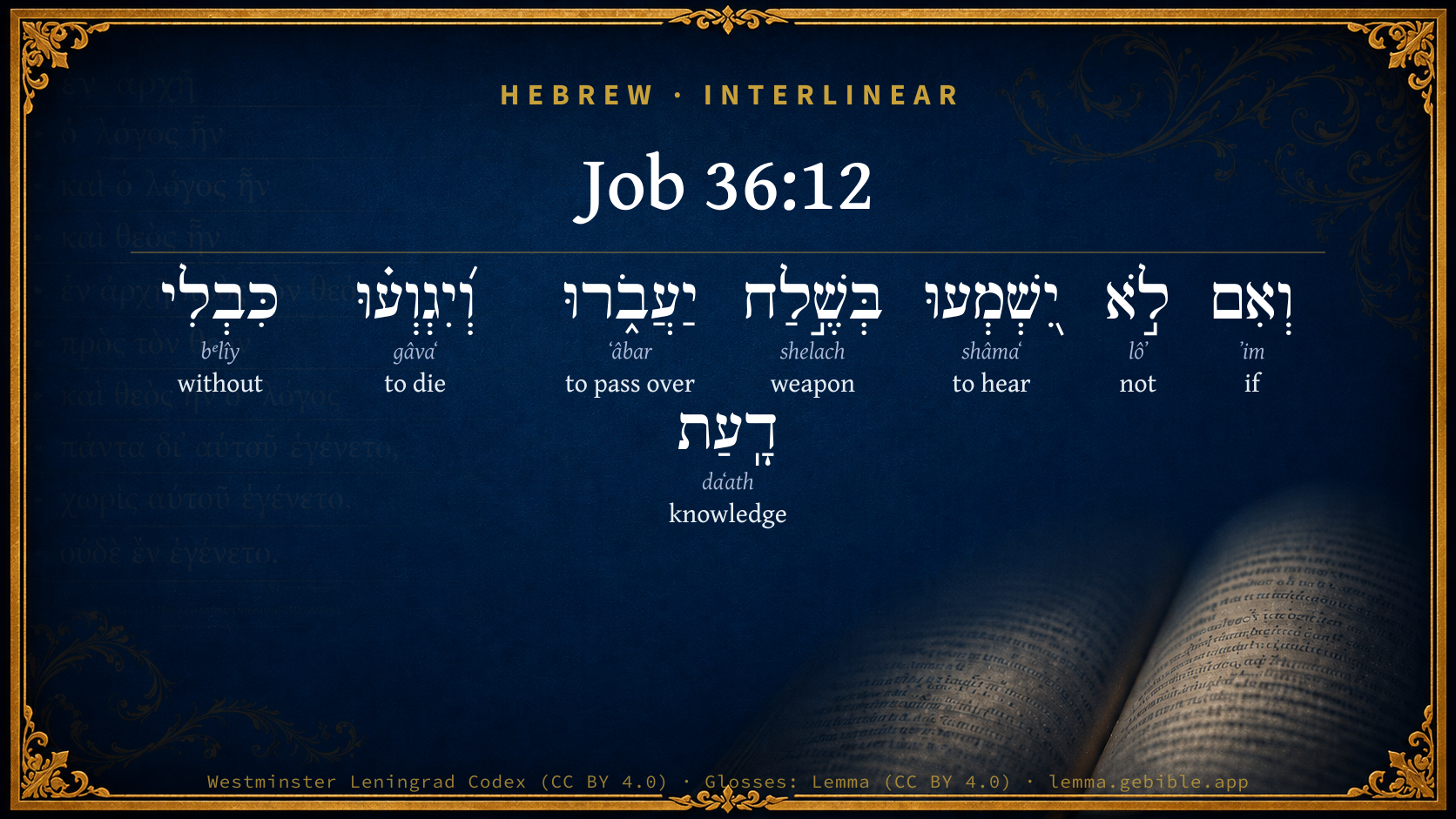
Job 36:12

Hebrew (Westminster Leningrad Codex) Job 36:12 appears in the Hebrew Old Testament. The text above is from the Westminster Leningrad Codex. Each word links to its Strong’s number, a concise gloss, and parsing drawn from the Open Scriptures Hebrew Bible morphology. Click any word for its full Brown-Driver-Briggs (BDB) entry.
Download image
Cite this verse

Job 36:12 (World English Bible). Public Domain. Lemma interlinear Bible study tool, https://lemma.gebible.app/v/job/36/12.

Show BibTeX & RIS
BibTeX
RIS
English Translation
But if they don't listen, they shall perish by the sword; They shall die without knowledge.
World English Bible · Public Domain
Download a study sheet

One document with this verse’s original text, its word-by-word gloss line, the meaning frame, cross-references with their text, attributed commentary, and full source and license credits — printable, and it pastes into notes with its structure intact.

This verse Autodidact and up

Study sheet (.html) Plain text (.txt)

A passage Seminary Student

Up to 50 verses in one chapter. A passage sheet keeps up to 6 commentary sources and 12 cross-references per verse, in the order this page ranks them, and says so on the sheet whenever that leaves anything out. Ask for a single verse and you get the Autodidact verse sheet above.

Everything on this page stays free to read, with no account — the sheet is a download of what is already on screen, not access to it.

Want to remove ads? Support Godless Engineer
Compare translations 3

The same verse in 3 English versions, stacked beneath the original-language interlinear above. Click any original word for its lexicon entry.

Each is an independent rendering of the whole verse — the interlinear is not word-aligned to these translations.

Highlighted words mark where these versions differ — a whole-verse word diff, not a word-by-word alignment.

  • World English Bible Public Domain
    But if they don't listen, they shall perish by the sword; They shall die without knowledge.
  • King James Version Public Domain
    But if they obey not, they shall perish by the sword, and they shall die without knowledge.
  • unfoldingWord Literal Text CC BY-SA 4.0
    But if they do not hear, they will cross over by a weapon, and they will expire as without knowledge.

unfoldingWord Literal Text — © unfoldingWord, licensed CC BY-SA 4.0. Word-aligned USFM3 via Door43 (git.door43.org/unfoldingWord/en_ult).

Versions to compare (up to 4)

3 of 4 selected

Show all 18 translations

Every available English version of this verse, each an independent rendering of the whole verse.

  • World English Bible Public Domain
    But if they don't listen, they shall perish by the sword; They shall die without knowledge.
  • Berean Standard Bible Public Domain
    But if they do not obey, then they perish by the sword and die without knowledge.
  • Majority Standard Bible Public Domain
    But if they do not obey, then they perish by the sword and die without knowledge.
  • King James Version Public Domain
    But if they obey not, they shall perish by the sword, and they shall die without knowledge.
  • American Standard Version (1901) Public Domain
    But if they hearken not, they shall perish by the sword, And they shall die without knowledge.
  • Revised Version (1885) Public Domain
    But if they hearken not, they shall perish by the sword, and they shall die without knowledge.
  • Geneva Bible (1599) Public Domain
    But if they wil not obey, they shall passe by the sworde, and perish without knowledge.
  • Douay-Rheims (1899) Public Domain
    But if they hear not, they shall pass by the sword, and shall be consumed in folly.
  • Young's Literal Translation Public Domain
    And if they do not hearken, By the dart they pass away, And expire without knowledge.
  • Literal Standard Version CC BY-SA 4.0
    And if they do not listen, || They pass away by the dart, || And expire without knowledge.
  • Unlocked Literal Bible CC BY-SA 4.0
    However, if they do not listen, they will perish by the sword; they will die because they have no knowledge.
  • unfoldingWord Literal Text CC BY-SA 4.0
    But if they do not hear, they will cross over by a weapon, and they will expire as without knowledge.
  • Darby Bible Public Domain
    But if they hearken not, they shall pass away by the sword, and expire without knowledge.
  • World Messianic Bible Public Domain
    But if they don’t listen, they will perish by the sword; they will die without knowledge.
  • Webster's Bible Public Domain
    But if they obey not, they shall perish by the sword, and they shall die without knowledge.
  • Free Bible Version CC BY-SA 4.0
    But if they do not listen they will die a violent death, ignorant of God.
  • Bible in Basic English Public Domain
    But if not, they come to their end, and give up their breath without knowledge.
  • JPS Tanakh (1917) Public Domain
    But if they hearken not, they shall perish by the sword, and they shall die without knowledge.

Literal Standard Version (2020), Covenant Press — licensed CC BY-SA 4.0. Text via the HelloAO Bible API (eBible.org). Unlocked Literal Bible (unfoldingWord) — licensed CC BY-SA 4.0. Text via the HelloAO Bible API (eBible.org). unfoldingWord Literal Text — © unfoldingWord, licensed CC BY-SA 4.0. Word-aligned USFM3 via Door43 (git.door43.org/unfoldingWord/en_ult). Free Bible Version, Dr. Jonathan Gallagher — licensed CC BY-SA 4.0. Text via the HelloAO Bible API (eBible.org).

Word by word

More ways to search: Search by grammar → Find every occurrence → Compare this word →

Practice this passage: Drill this verse → Learn its vocabulary →

About this verse

These counts appear in no published source. They are computed here, from the morphology-tagged text and Lemma’s own curated glosses. What Lemma adds →

8
words
8
distinct lemmas
Wisdom
section

Notable vocabulary

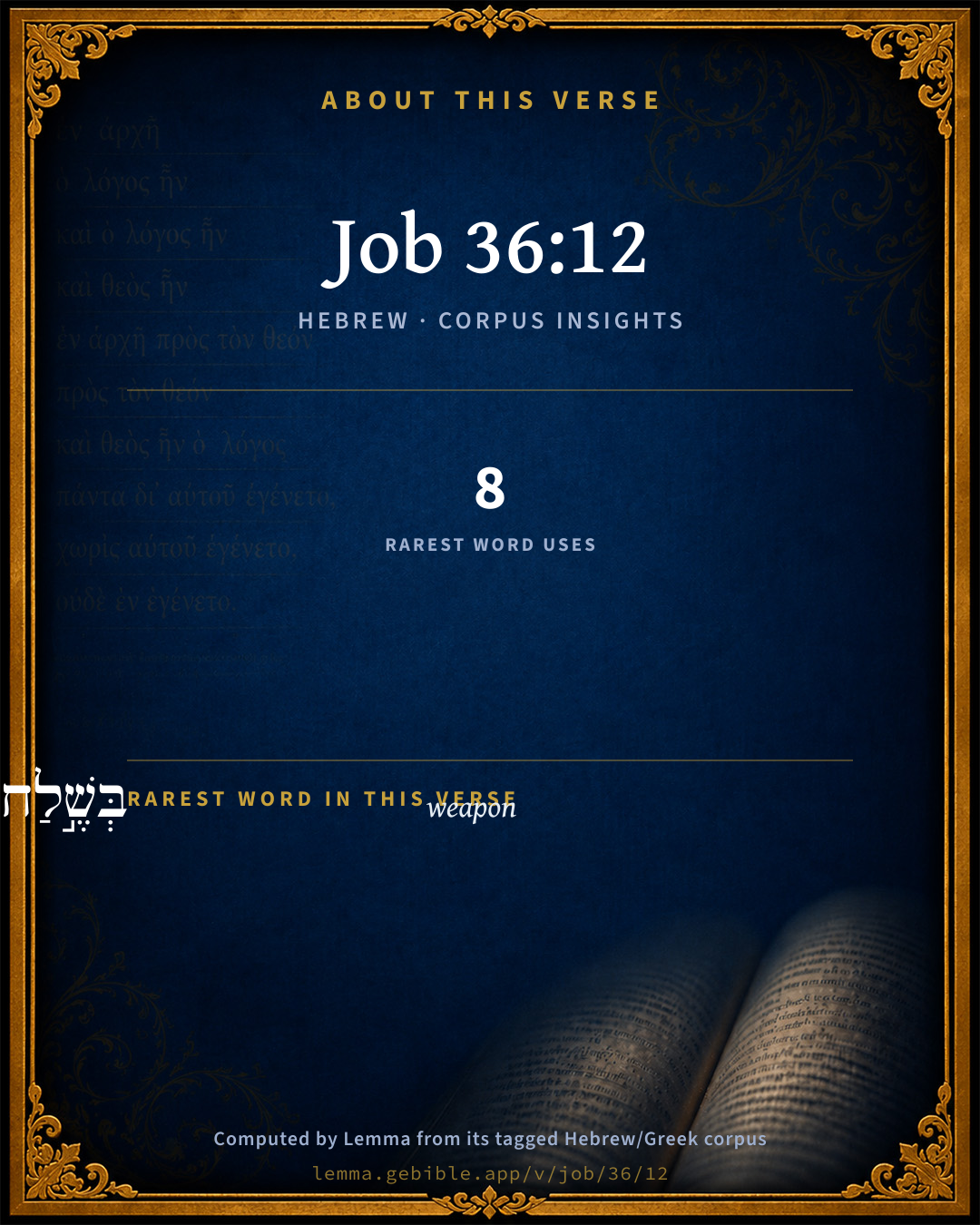
The rarest word here is בְּשֶׁ֣לַח weapon H7973 — appearing just 8 times in the whole Hebrew Bible.

Shared distinctive vocabulary

בְּשֶׁ֣לַח weapon H7973 occurs in 8 verses of the Hebrew Bible. Also found in:

Grammatical profile

  • 3 verbs
  • 2 nouns
  • 1 conjunction
  • 2 particles

Verb forms

  • יִ֭שְׁמְעוּ Qal · Imperfect
  • יַעֲבֹ֑רוּ Qal · Imperfect
  • וְ֝יִגְוְע֗וּ Qal · Imperfect

Hebrew & Septuagint length

In English translation the verse runs 16 words from the Hebrew and 22 from the Septuagint (LXX English) — closely comparable.

A rough comparison of the two English renderings, which tokenize alike — not a word-level alignment.

Word counts can differ between the Hebrew and the Greek without any difference in meaning — e.g. the Hebrew direct-object marker אֵת has no separate Greek word, and Greek often adds the article ὁ.

Cross-references

8

Topical passages linked to Job 36:12 in the Treasury of Scripture Knowledge — connected by theme and wording, ordered by reader-vote popularity; previews shown in the World English Bible.

  • Job 4:21 Isn't their tent-cord plucked up within them? They die, and that without wisdom.'
  • Isaiah 3:11 Woe to the wicked! Disaster is upon them; For the deeds of his hands will be paid back to him.
  • Romans 2:8–9 but to those who are self-seeking, and don't obey the truth, but obey unrighteousness, will be wrath and indignation,
  • Deuteronomy 18:15–22 Yahweh your God will raise up to you a prophet from the midst of you, of your brothers, like me; to him you shall listen;
  • Deuteronomy 29:15–20 but with him who stands here with us this day before Yahweh our God, and also with him who is not here with us this day
  • Isaiah 1:20 But if you refuse and rebel, you shall be devoured with the sword; For the mouth of Yahweh has spoken it."
  • John 8:21–24 Jesus said therefore again to them, "I am going away, and you will seek me, and you will die in your sins. Where I go, you can't come."
  • Job 15:22 He doesn't believe that he shall return out of darkness, He is waited for by the sword.

Cross-references courtesy of OpenBible.info (CC BY 4.0).

Hebrew and Greek witnesses Masoretic Hebrew ↔ Greek Septuagint

The same verse in the two great witnesses to the Old Testament, shown verse-for-verse.

These are two independent witnesses, not word-aligned to each other, and the Septuagint is shown in lemma (dictionary) form.

Hebrew Job 36:12 Masoretic · Westminster Leningrad Codex

וְאִם לֹ֣א יִ֭שְׁמְעוּ בְּשֶׁ֣לַח יַעֲבֹ֑רוּ וְ֝יִגְוְע֗וּ כִּבְלִי דָֽעַת

But if they don't listen, they shall perish by the sword; They shall die without knowledge.

World English Bible · Public Domain

Greek LXX Job 36:12 Septuagint · lemma form

ἀσεβής δέ οὐ διασώζω παρά ὁ μή βούλομαι οἶδα αὐτός ὁ κύριος καί διότι νουθετέω ἀνήκοος εἰμί

But he preserves not the ungodly; because they are not willing to know the Lord, and because when reproved they were disobedient.

LXX2012 (modern English Septuagint) · Public Domain

Hebrew: Westminster Leningrad Codex (CC BY 4.0). Greek: Septuagint (public domain); English from LXX2012 (modern English Septuagint) (Public Domain). How the Septuagint differs from the Hebrew →

Commentary

Notes on Job 36:12 from classic Christian and Jewish commentators (each source and its license shown beneath its notes). The classic Christian expositions comment on the surrounding passage and are grouped to its opening verse, so a note may address several verses; the Jewish commentaries on the Tanakh (Rashi and others) are per-verse, so they appear only where the commentator wrote on this verse.

Lemma curates 59 commentaries, every one of them public domain or Creative Commons licensed, each selected and text-cleaned for this edition rather than reprinted as found. About our sources →

Trapp's Complete Commentary

John Trapp

Job 36:12 But if they obey not, they shall perish by the sword, and they shall die without knowledge.

Ver. 12. But if they obey not, they shall perish by the sword] In gladium transibunt, they shall pass away by the sword; that is, some evil end shall befall them, and worthily, because they would not be warned, which is both a presage and desert of utter ruin. Lesser and lighter judgments (where they work not) are foretokens of greater and heavier at the heels of them; as the black horse in the Revelation followeth the red. And as clouds cluster against a storm, one following in the neck of the other, unless the sun break forth and scatter them; so do God’s judgments usher in one another and every less a greater, unless repentance and better obedience take up the matter.

And they shall die without knowledge] Heb. because they were without knowledge; and wilfully so. It was not a bare nescience, but an affected ignorance, that undid them. Some render it, Non praesentientes, they shall die suddenly, and before they have bethought themselves. It should be our care that death do not suddenly surprise us. No guest comes unawares to him who keeps a constant table. Every sharp affliction is a warning piece, and let us so conceive of it, Stillicidia praecedunt ruinam.

John Trapp, A Commentary or Exposition upon All the Books of the Old and New Testament (1647–1656) — public domain. Text from a community e-Sword module.

Tyndale Open Study Notes

Tyndale Open Resources

36:12 dying from lack of understanding: See also 4:21; Prov 5:23; 10:21.

Tyndale Open Study Notes — © Tyndale Open Resources, licensed CC BY-SA 4.0. Text via the HelloAO Bible API.

Geneva Bible (1599)

Geneva Bible translators

That is, in their folly or obstination, and so shall be cause of their own destruction.

Geneva Bible (1599) marginal notes — public domain. Text via Bolls.life.

Jamieson, Fausset & Brown

Robert Jamieson, A. R. Fausset & David Brown

(Job 33:18).

without knowledge--that is, on account of their foolishness (Job 4:20-21).

Jamieson, Fausset & Brown — Commentary Critical and Explanatory on the Whole Bible (1871) — public domain (CC PDM 1.0). Text via the HelloAO Bible API.

Adam Clarke's Commentary

Verse 12. But if they obey not] This also is a general rule, from which, in the course of Providence, there are only few, and those only apparent, deviations. Instead of they shall perish by the sword, the meaning of the Hebrew בשלח יעברו beshelach yaaboru, is, "By a dart they shall pass by." They shall be in continual dangers, and often fall before they have lived out half their days. Mr. Good translates: They pass by as an arrow. The VULGATE: Transibunt per gladium. "They shall pass away by the sword."

Adam Clarke's Commentary on the Bible (1810–1826) — public domain. Text from a community e-Sword/MySword module.

John Gill's Exposition

But if they obey not,.... Who seem to be righteous and are not; and when afflicted are not submissive to the will of God; attend not to the voice of his providence; receive no instruction thereby; but kick against the pricks, and rebel, against God; complain of him, and murmur at his dealings with them:

they shall perish by the sword; or they shall pass away out of the world by it, or by some missive weapon: they shall die a violent death, by the sword of justice, of the civil magistrate, or by the sword of men; or, as a Jewish commentator (r) paraphrases it, by the dart of death, by the sword of Satan, they shall pass out of this world;

and they shall die without knowledge; without knowledge of their death being near, it coming upon them suddenly and at unawares; or without knowledge of themselves and of their miserable and lost estate; and without knowledge of Christ, and of God in Christ, and of the way of salvation by him. Or they shall perish for lack of knowledge; because they have none; through ignorance and that affected; they know not nor will they understand, but despise the means of knowledge, and hate instruction.

(r) R. Simeon, Bar Tzemach.

John Gill's Exposition of the Whole Bible (1746–1763) — public domain (CC PDM 1.0). Text via the HelloAO Bible API.

Albert Barnes' Notes on the Bible

But if they obey not - If those who are afflicted do not turn to God, and yield him obedience, they must expect that he will continue their calamities until they are cut off.

They shall perish by the sword - Margin, as in Hebrew “pass away.” The word rendered “sword” (שׁלח shelach) means properly “anything sent” - as a spear or an arrow - “a missile” - and then an instrument of war in general. It may be applied to any weapon that is used to produce death. The idea here is, that the man who was afflicted on account of the sins which he had committed, and who did not repent of them and turn to God, would be cut off. God would not withdraw his hand unless he acknowledged his offences. As he had undertaken the work of discipline, he could not consistently do it, for it would be in fact “yielding” the point to him whom he chastised. This “may” be the case now, and the statement here made by Elihu may involve a principle which will explain the cause of the death of many persons, even of the professedly pious. They are devoted to gain or amusement; they seek the honors of the world for their families or themselves, and in fact they make no advances in piety, and are doing nothing for the cause of religion. God lays his hand upon them at first gently. They lose their health, or a part of their property. But the discipline is not effectual. He then lays his band on them with more severity, and takes from them an endeared child. Still, all is ineffectual. The sorrow of the affliction passes away, and they mingle again in the frivolous and busy scenes of life as worldly as ever, and exert no influence in favor of religion. Another blow is needful, and blow after blow is struck; but nothing overcomes their worldliness, nothing makes them devotedly and sincerely useful, and it becomes necessary to remove them from the world.

They shall die without knowledge - That is, without any true knowledge of the plans and government of God, or of the reasons why he brought these afflictions upon them. In all their sufferings they never “saw” the design. They complained, and murmured, and charged God with severity, but they never understood that the affliction was intended for their own benefit.

Albert Barnes' Notes on the Bible (1834–1885) — public domain. Text from a community e-Sword/MySword module.

Haydock's Catholic Bible Commentary

Folly. Hebrew, "without knowledge." He speaks of princes, (Calmet) and of all the wicked, who have not known the day of their visitation. (Haydock) --- They shall suffer the punishment prepared for fools or wicked men. (Menochius)

George Leo Haydock (1774–1849), Haydock's Catholic Family Bible and Commentary, 1859 edition — public domain. Excludes Psalms (Douay-Rheims chapter numbering differs from Protestant) and Deuterocanonical books (Catholic canon only).

Matthew Poole's English Annotations

If they; the righteous, spoken of Job 35:7, opposed to the hypocrites here following, Job 35:13; for even good men may sometimes be disobedient to Divine admonitions, and may suffer deeply, yea, even death itself, for their folly: see 1Co 11:30.

Without knowledge; in or for their ignorance, or inadvertency, or folly. Or, because they are without knowledge; because they are foolish, or brutish, and will not learn the lessons which God so plainly teacheth them.

Matthew Poole's English Annotations on the Holy Bible (1683–1685) — public domain. Text from a community e-Sword/MySword module.

Whedon's Commentary on the Bible

Daniel D. Whedon

12. Without knowledge — See note on Job_4:21. They die without that knowledge of God which is the eternal weal of the soul. Or it may refer to the stupor which sin brings, an unconsciousness of deep guilt that in general beclouds the wicked when dying. “For there are no bands in their death.” Psa_73:4. (See MERCEIN, Natural Goodness, see. 2.)

Daniel D. Whedon (gen. ed.), Commentary on the Old and New Testaments (1874–1909) — public domain. Text from a community e-Sword module.

The Pulpit Commentary

But if they obey not, they shall perish by the sword. Not, necessarily, by a material sword, but by the sword of God"s vengeance, which slays in a thousand different manners, piercing through all obstacles, and reaching to the heart and spirit. And they shall die without knowledge. Either without knowing that they are about to die, or in their wilful ignorance of God"s intentions in chastising them.

The Pulpit Commentary (1880–1919), ed. H.D.M. Spence-Jones & Joseph S. Exell — public domain. Text from a community e-Sword module.

Lesson kit

Teaching starters — assembled from the data on this page, not authored interpretation. Every prompt links to the verse data it draws on. Edit before teaching.

Job, in the Wisdom, opens this verse with 8 words (8 distinct Hebrew lemmas). Its most distinctive word is shelach (“weapon”). A historical commentator’s framing appears above. Read the whole chapter for the surrounding context.

Discussion questions

  1. The word shelach carries the sense “weapon.” How does it shape the verse?
  2. How does 2 Chronicles 23:10, which shares the word «weapon», read alongside this verse?
  3. These translations render this verse differently. What is at stake in choosing one wording over another?
  4. «יִ֭שְׁמְעוּ» is a Qal Imperfect verb. How does that grammatical form shape the action described?
  5. Compare how Trapp's Complete Commentary and Tyndale Open Study Notes read this verse. Where do they agree or differ?

Things to notice

Reading settings

Reading text

Shown beneath each verse's original-language words.

Old Testament
Old Testament edition

Read the OT as the Masoretic Hebrew (MT) or the Greek Septuagint (LXX).

English shown for the Greek Septuagint (in the Hebrew ↔ Greek comparison).

Comparing translations? Open the Compare panel on any verse page to stack up to four side by side.