
2 John 1:12

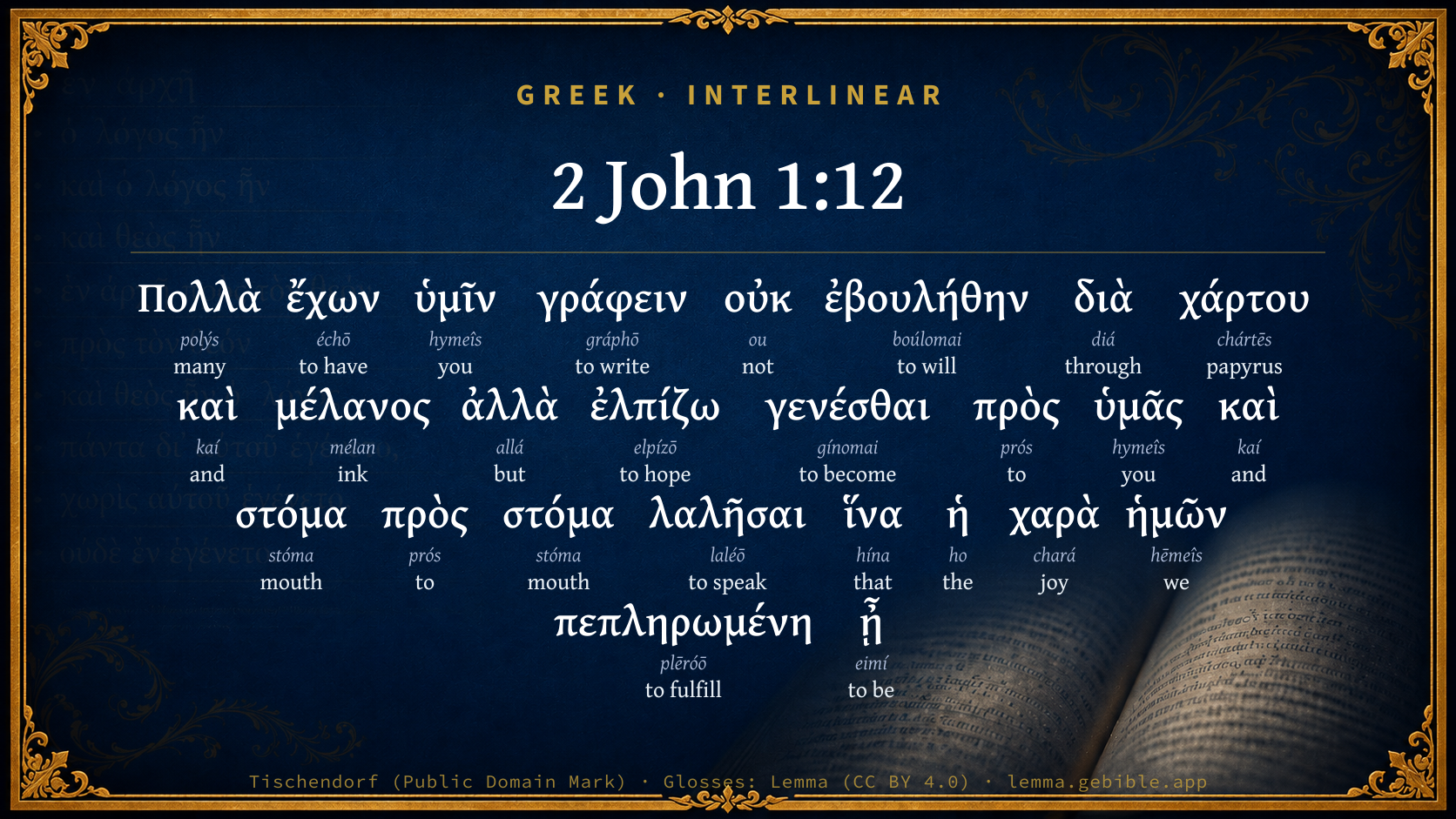
Greek (Tischendorf 8th ed.) 2 John 1:12 appears in the Greek New Testament. The text above is from the Tischendorf 8th edition. Each word links to its Strong’s number and a concise gloss. Click any word for its full Thayer’s Greek Lexicon entry.
Download image
Cite this verse

2 John 1:12 (World English Bible). Public Domain. Lemma interlinear Bible study tool, https://lemma.gebible.app/v/2-john/1/12.

Show BibTeX & RIS
BibTeX
RIS
English Translation
Having many things to write to you, I don't want to do so with paper and ink, but I hope to come to you, and to speak face to face, that our joy may be made full.
World English Bible · Public Domain
Highlights
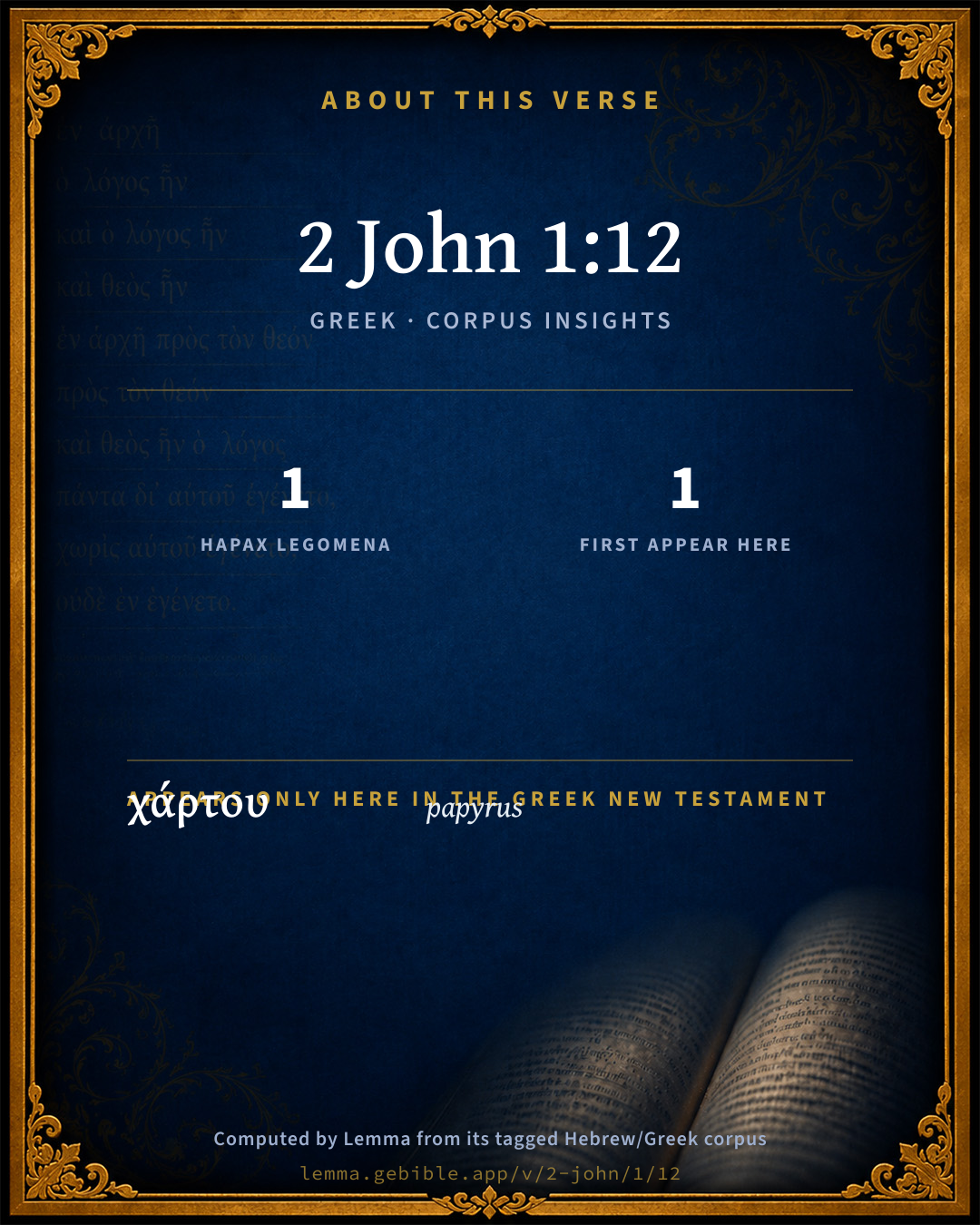
  • 1 hapax legomenon — only here in the Greek New Testament
  • 1 first appearance in the Greek New Testament
Full analysis ↓
Download a study sheet

One document with this verse’s original text, its word-by-word gloss line, the meaning frame, cross-references with their text, attributed commentary, and full source and license credits — printable, and it pastes into notes with its structure intact.

This verse Autodidact and up

Study sheet (.html) Plain text (.txt)

A passage Seminary Student

Up to 50 verses in one chapter. A passage sheet keeps up to 6 commentary sources and 12 cross-references per verse, in the order this page ranks them, and says so on the sheet whenever that leaves anything out. Ask for a single verse and you get the Autodidact verse sheet above.

Everything on this page stays free to read, with no account — the sheet is a download of what is already on screen, not access to it.

Want to remove ads? Support Godless Engineer
Compare translations 3

The same verse in 3 English versions, stacked beneath the original-language interlinear above. Click any original word for its lexicon entry.

Each is an independent rendering of the whole verse — the interlinear is not word-aligned to these translations.

Highlighted words mark where these versions differ — a whole-verse word diff, not a word-by-word alignment.

  • World English Bible Public Domain
    Having many things to write to you, I don't want to do so with paper and ink, but I hope to come to you, and to speak face to face, that our joy may be made full.
  • King James Version Public Domain
    Having many things to write unto you, I would not write with paper and ink: but I trust to come unto you, and speak face to face, that our joy may be full.
  • unfoldingWord Literal Text CC BY-SA 4.0
    Having much to write to you, I did not want with paper and ink. However, I hope to come to you and to speak mouth to mouth, so that your joy might be made complete.

unfoldingWord Literal Text — © unfoldingWord, licensed CC BY-SA 4.0. Word-aligned USFM3 via Door43 (git.door43.org/unfoldingWord/en_ult).

Versions to compare (up to 4)

3 of 4 selected

Show all 19 translations

Every available English version of this verse, each an independent rendering of the whole verse.

  • World English Bible Public Domain
    Having many things to write to you, I don't want to do so with paper and ink, but I hope to come to you, and to speak face to face, that our joy may be made full.
  • Berean Standard Bible Public Domain
    I have many things to write to you, but I would prefer not to do so with paper and ink. Instead, I hope to come and speak with you face to face, so that our joy may be complete.
  • Majority Standard Bible Public Domain
    I have many things to write to you, but I would prefer not to do so with paper and ink. Instead, I hope to come and speak with you face to face, so that our joy may be complete.
  • King James Version Public Domain
    Having many things to write unto you, I would not write with paper and ink: but I trust to come unto you, and speak face to face, that our joy may be full.
  • American Standard Version (1901) Public Domain
    Having many things to write unto you, I would not `write them' with paper and ink: but I hope to come unto you, and to speak face to face, that your joy may be made full.
  • Revised Version (1885) Public Domain
    Having many things to write unto you, I would not write them with paper and ink: but I hope to come unto you, and to speak face to face, that your joy may be fulfilled.
  • Geneva Bible (1599) Public Domain
    The sonnes of thine elect sister greete thee, Amen.
  • Douay-Rheims (1899) Public Domain
    Having more things to write unto you, I would not by paper and ink: for I hope that I shall be with you, and speak face to face: that your joy may be full.
  • Young's Literal Translation Public Domain
    Many things having to write to you, I did not intend through paper and ink, but I hope to come unto you, and speak mouth to mouth, that our joy may be full;
  • Literal Standard Version CC BY-SA 4.0
    Having many things to write to you, I did not intend [it] with paper and ink, but I hope to come to you, and speak mouth to mouth, that our joy may be full.
  • Unlocked Literal Bible CC BY-SA 4.0
    I have many things to write to you, but I did not wish to write them with paper and ink. However, I expect to come to you and speak face to face, so that our joy will be complete.
  • unfoldingWord Literal Text CC BY-SA 4.0
    Having much to write to you, I did not want with paper and ink. However, I hope to come to you and to speak mouth to mouth, so that your joy might be made complete.
  • Darby Bible Public Domain
    Having many things to write to you, I would not with paper and ink; but hope to come to you, and to speak mouth to mouth, that our joy may be full.
  • World Messianic Bible Public Domain
    Having many things to write to you, I don’t want to do so with paper and ink, but I hope to come to you and to speak face to face, that our joy may be made full.
  • Webster's Bible Public Domain
    Having many things to write to you, I would not write with paper and ink: but I trust to come to you, and speak face to face, that our joy may be full.
  • Free Bible Version CC BY-SA 4.0
    I have so many things to tell you that I won't write any more with paper and ink, for I hope to visit you and talk with you face to face. How happy that would make us!
  • Bible in Basic English Public Domain
    Having much to say to you, it is not my purpose to put it all down with paper and ink: but I am hoping to come to you, and to have talk with you face to face, so that your joy may be full.
  • Text-Critical English NT CC BY 4.0
    Although I have much to write to you, I would rather not use paper and ink. Instead, I hope to come to you and speak face to face, so that our joy may be full.
  • Tyndale New Testament (1534) Public Domain
    I had many thinges to wryte vnto you neverthelesse I wolde not wryte with paper and ynke: but I trust to come vnto you and speake with you mouth to mouth that oure ioye maye be full.

Literal Standard Version (2020), Covenant Press — licensed CC BY-SA 4.0. Text via the HelloAO Bible API (eBible.org). Unlocked Literal Bible (unfoldingWord) — licensed CC BY-SA 4.0. Text via the HelloAO Bible API (eBible.org). unfoldingWord Literal Text — © unfoldingWord, licensed CC BY-SA 4.0. Word-aligned USFM3 via Door43 (git.door43.org/unfoldingWord/en_ult). Free Bible Version, Dr. Jonathan Gallagher — licensed CC BY-SA 4.0. Text via the HelloAO Bible API (eBible.org).

Word by word

More ways to search: Search by grammar → Find every occurrence → Compare this word →

Practice this passage: Drill this verse → Learn its vocabulary →

χάρτου
chártēs
G5489
“papyrus”
Noun, Genitive, Singular, Masculine
Part of Speech
Noun
Case
Genitive
Number
Singular
Gender
Masculine
Full Thayer's Definition

Origin: from the same as G5482

TDNT: None

1. paper
  1. Πολλὰ polýs G4183 “many” Adjective, Accusative, Plural, Neuter
  2. ἔχων échō G2192 “to have” Verb, Present, Active, Participle, Nominative, Singular, Masculine
  3. ὑμῖν hymeîs G5210 “you” Personal pronoun, 2nd person, Dative, Plural
  4. γράφειν gráphō G1125 “to write” Verb, Present, Active, Infinitive
  5. οὐκ ou G3756 “not” Particle, Negative
  6. ἐβουλήθην boúlomai G1014 “to will” Verb, Aorist, Passive deponent, Indicative, 1st person, Singular
  7. διὰ diá G1223 “through” Preposition
  8. καὶ kaí G2532 “and” Conjunction
  9. μέλανος mélan G3188 “ink” Noun, Genitive, Singular, Neuter
  10. ἀλλὰ allá G235 “but” Conjunction
  11. ἐλπίζω elpízō G1679 “to hope” Verb, Present, Active, Indicative, 1st person, Singular
  12. γενέσθαι gínomai G1096 “to become” Verb, Aorist, Middle deponent, Infinitive
  13. πρὸς prós G4314 “to” Preposition
  14. ὑμᾶς hymeîs G5210 “you” Personal pronoun, 2nd person, Accusative, Plural
  15. καὶ kaí G2532 “and” Conjunction
  16. στόμα stóma G4750 “mouth” Noun, Accusative, Singular, Neuter
  17. πρὸς prós G4314 “to” Preposition
  18. στόμα stóma G4750 “mouth” Noun, Accusative, Singular, Neuter
  19. λαλῆσαι laléō G2980 “to speak” Verb, Aorist, Active, Infinitive
  20. ἵνα hína G2443 “that” Conjunction
  21. ἡ ho G3588 “the” Article, Nominative, Singular, Feminine
  22. χαρὰ chará G5479 “joy” Noun, Nominative, Singular, Feminine
  23. ἡμῶν hēmeîs G2249 “we” Personal pronoun, 1st person, Genitive, Plural
  24. πεπληρωμένη plēróō G4137 “to fulfill” Verb, Perfect, Passive, Participle, Nominative, Singular, Feminine
  25. ᾖ eimí G1510 “to be” Verb, Present, Active, Subjunctive, 3rd person, Singular

About this verse

These counts appear in no published source. They are computed here, from the morphology-tagged text and Lemma’s own curated glosses. What Lemma adds →

26
words
22
distinct lemmas
General Epistles
section

Notable vocabulary

1 hapax legomenon — a word that appears only here in the entire Greek New Testament:

  • χάρτου papyrus G5489

First appearance in Scripture

This word makes its first canonical appearance in the Greek New Testament here:

  • χάρτου papyrus G5489

Shared distinctive vocabulary

μέλανος ink G3188 occurs in 3 verses of the Greek New Testament. Also found in:
Repetition

Words recur within this verse:

Cross-references

13

Topical passages linked to 2 John 1:12 in the Treasury of Scripture Knowledge — connected by theme and wording, ordered by reader-vote popularity; previews shown in the World English Bible.

  • John 16:12 "I have yet many things to tell you, but you can't bear them now.
  • 3 John 1:13–14 I had many things to write to you, but I am unwilling to write to you with ink and pen;
  • Numbers 12:8 with him will I speak mouth to mouth, even manifestly, and not in dark speeches; and the form of Yahweh shall he see: why then were you not afraid to speak against my servant, against Moses?
  • John 15:11 I have spoken these things to you, that my joy may remain in you, and that your joy may be made full.
  • John 17:13 But now I come to you, and I say these things in the world, that they may have my joy made full in themselves.
  • Romans 15:24 whenever I journey to Spain, I will come to you. For I hope to see you on my journey, and to be helped on my way there by you, if first I may enjoy your company for a while.
  • 1 Corinthians 16:5–7 But I will come to you when I have passed through Macedonia, for I am passing through Macedonia.
  • 1 John 1:4 And we write these things to you, that our joy may be fulfilled.
  • John 16:24 Until now, you have asked nothing in my name. Ask, and you will receive, that your joy may be made full.
  • 2 Timothy 1:4 longing to see you, remembering your tears, that I may be filled with joy;
  • Hebrews 13:19 I strongly urge you to do this, that I may be restored to you sooner.
  • Philemon 1:22 Also, prepare a guest room for me, for I hope that through your prayers I will be restored to you.
  • Hebrews 13:23 Know that our brother Timothy has been freed, with whom, if he comes shortly, I will see you.

Cross-references courtesy of OpenBible.info (CC BY 4.0).

Where the printed editions differ

1 variant

Places in this verse where the major printed Greek editions disagree on the wording in a way that affects the translation — a comparison of editions, not a manuscript-by-manuscript collation. The editions are the modern critical texts (Nestlé-Aland 28/27, SBL, Westcott-Hort, Tregelles, Tyndale House) and the traditional texts behind the KJV (the Textus Receptus and the Byzantine/Majority text). It is not a claim about which reading is original.

  1. Different wording
    ἡμῶν

    “of us”

    In NA28NA27TynTRByz Not in SBLWHTreg

    ὑμῶν (humōn) 'of you' occurs in a few manuscripts (SBL+WH+Treg) instead of ἡμῶν (hēmōn) 'of us' in older manuscripts (NA28+NA27+Tyn+TR+Byz)

Textual data: Translators Amalgamated Greek New Testament (STEPBible TAGNT) · CC BY 4.0.

Commentary

Notes on 2 John 1:12 from classic Christian and Jewish commentators (each source and its license shown beneath its notes). The classic Christian expositions comment on the surrounding passage and are grouped to its opening verse, so a note may address several verses; the Jewish commentaries on the Tanakh (Rashi and others) are per-verse, so they appear only where the commentator wrote on this verse.

Lemma curates 59 commentaries, every one of them public domain or Creative Commons licensed, each selected and text-cleaned for this edition rather than reprinted as found. About our sources →

Matthew Henry's Commentary

The apostle concludes this letter, 1. With an adjournment of many things to personal conference: Having many things to write unto you I would not write with paper and ink; but I trust to come unto you, and speak face to face, that our joy may be full. Here it is supposed that some things are better spoken than written. The use of pen and ink may be a mercy and a pleasure; but a personal interview may be more so. The apostle was not yet too old for travel, nor consequently for travelling service. The communion of saints should be by all methods maintained; and their communion should tend to their mutual joy. Excellent ministers may have their joy advanced by their Christian friends. That I may be comforted together with you by the mutual faith both of you and me, Rom 1:12. 2. With the presentation of service and salutation from some near relations to the lady: The children of thy elect sister greet thee. Grace was abundant towards this family; here are two elect sisters, and probably their elect children. How will they admire this grace in heaven! The apostle condescends to insert the nieces' duty (as we should call it), or dutiful salutation, to their aunt. The duty of inferior relations is to be cherished. Doubtless the apostle was easy of access, and would admit all friendly and pious communication, and was ready to enhance the good lady's joy in her nieces as well as in her children. May there by many such gracious ladies rejoicing in their gracious descendants and other relations! Amen.

Matthew Henry's Commentary on the Whole Bible (1708–1710) — public domain (CC PDM 1.0). Text via the HelloAO Bible API.

Ellicott's Commentary for English Readers

(3) Conclusion (2Jn_1:12-13).

(12) Having many things to write unto you.—This verse shows that the Letter to the matron and her family was not a mere accompaniment of a copy of the First Epistle. His heart is full of things to write, but he hopes soon to have unlimited conversation.

Paper.—The Egyptian papyrus.

Ink.—A mixture of soot, water, and gum. The papyrus-tree grows in the swamps of the Nile to the height of ten feet and more. Paper was prepared from the thin coats that surround the plant. Pliny describes the method (xiii. 23). The different pieces were joined together by the turbid Nile water, as it has a kind of glutinous property. One layer of papyrus was laid flat on a board, and a cross layer put over it; these were pressed, and afterwards dried in the sun. The sheets were then fastened or pasted together. There were never more than twenty of these sheets fastened together in a roll; but of course the length could be increased to any extent. The writing was in columns, with a blank slip between them; it was only on one side. When the work was finished, it was rolled on a staff, and sometimes wrapped in a parchment case (Smith, Dictionary of Greek and Roman Antiquities, p. 567).

Of the ink used by the Romans, Pliny says that it was made of soot in various ways, with burnt resin or pitch. “For this purpose they have built furnaces which do not allow the smoke to escape. The kind most commended is made in this way from pine-wood: it is mixed with soot from the furnaces or baths; and this they use for writing on rolls. Some also make a kind of ink by boiling and straining the lees of wine.” The black matter of the cuttle-fish was also sometimes used for writing (Smith, Dictionary of Greek and Roman Antiquities, p. 110).

The pen was a reed, sharpened with a knife, and split like a quill-pen.

The Jews seem to have used lamp-black dissolved in gall-juice, or lamp-black and vitriol, for ink. The modern scribes “have an apparatus consisting of a metal or ebony tube for their reed-pens, with a cup or bulb of the same material attached to the upper end for ink. This they thrust through the girdle, and carry with them at all times” (Thomson, The Land and the Book, p. 131; Smith’s Dictionary of the Bible, p. 1802).

Speak face to face.—Not that there was any oral tradition which he would not write down. His Gospel and First Epistle would contain the outline of all his teaching. But on this occasion there was no need for writing. (Comp. 1Co_13:12.)

That our joy may be full.—Comp. 1Jn_1:4. It would be the deep satisfaction of the interchange of spiritual thoughts and aspirations without the limitations of a monologue or of writing materials.

(13) The children of thy elect sister.—He may have been staying at this second matron’s house; at any rate, the family knew he was writing. The simplicity of the great Apostle, the personal friend of the risen Lord, the last of the great pillars of the Church of Christ—in transmitting this familiar message, makes a most instructive finish to what is throughout a beautiful picture.

A Bible Commentary for English Readers, edited by Charles John Ellicott (1878–1897) — public domain. Text from a community e-Sword module.

The Cambridge Bible for Schools and Colleges

gen. ed. J. J. S. Perowne

12. Having many things to write] The First Epistle will give us some idea of what these were.

I would not write with paper and ink] There is here no ‘write’ in the Greek; and in the first clause ‘write’ is almost too limited in meaning for γράφειν, which like our ‘say’ covers a variety of methods of communication. Having many things to say to you, I would not (say them) by means of paper and ink. Perhaps we may here trace a sign of the failing powers of an old man, to whom writing is serious fatigue.

‘Paper’ (χάρτης) occurs nowhere else in N.T.; but it occurs in LXX. of Jer_36:23; and its diminutive (χαρτίον) is frequent in that chapter. In 3Ma_4:20 we have a cognate word (χαρτήρια), which probably, like ‘paper’ here, means Egyptian papyrus, as distinct from the more expensive ‘parchment’ (μεμβράναι) mentioned 2Ti_4:13. But both papyrus and parchment were costly, which may account for the Apostle’s brevity. See Dict. of the Bible, writing, and Dict. of Antiquities, liber.

‘Ink’ (μέλαν) is mentioned again 3Jn_1:13; elsewhere in N.T. only 2Co_3:3 : comp. LXX. of Jer_36:18. It was made of lampblack and gall-juice, or more simply of soot and water.

but I trust] Or, as R. V., but I hope: the verb (ἐλπίζω) is frequent in N.T., and there seems to be no reason for changing the usual rendering: comp. 1Ti_3:14; Php_2:19; Php_2:23. A.V. wavers needlessly between ‘hope’ and ‘trust’.

to come unto you] More exactly, according to the true reading (γένεσθαι πρὸς ὑμᾶς), to appear before you: literally, ‘to come to be in your presence’. Comp. 1Co_2:3; 1Co_16:10. The phrase is used of words as well as of persons: Joh_10:35; Act_10:13, and as a various reading, Act_7:31. In all these cases the coming is expressed with a certain amount of solemnity.

The ‘you’ (ὑμῖν, ὑμᾶς) in this verse includes the children mentioned in 2Jn_1:1. This, when contrasted with ‘thee’ (σε, σοι) in 2Jn_1:5, seems to be in favour of understanding the ‘lady’ literally. The change from ‘thee’ to ‘you’ seems more in harmony with a matron and her family than with a Church and its members.

face to face] Literally, mouth to mouth: it is not the phrase which is used in 1Co_13:12 and Gen_32:31. Comp. Num_12:8; Jeremiah 39 (32):4.

that our joy may be full] Better, as R. V., that your (AB and Vulgate) joy may be fulfilled: see on 1Jn_1:4. “The high associations with which” the phrase “is connected lead us to suppose that it would scarcely have been applied by S. John to any meeting but one of peculiar solemnity after a cruel and prolonged separation which had threatened to be eternal” (Bishop Alexander). Comp. Rom_1:12.

12, 13. Conclusion

12, 13. The strong resemblance to the Conclusion of the Third Epistle seems to shew that the two letters are nearly contemporaneous.

The Cambridge Bible for Schools and Colleges (gen. ed. J. J. S. Perowne; Cambridge University Press, 1878–1918) — public domain. Text from a community e-Sword module.

The Biblical Illustrator

Joseph S. Exell

2Jn_1:12

Having many things to write unto you.

Christian intercourse

I. The fulness of Johns heart. His heart, doubtless, was full of what concerned the fruits of his ministry in the Church of Christ; of what he had seen and heard, of the results of his long-continued and laborious exertions for the salvation of men; of his own feelings and prospects in his advanced stage of life, and of his cheering hopes of soon being in a better world, where he would have a sight of Christ. And his heart might be full of those tender emotions which would express themselves in sacred admonitions and directions, which he designed to give to the pious family whom he was shortly to visit.

1. What are those things which should fill our hearts? We may be afraid, if our hearts are not full of good things, it is not because there is any scantiness in the word or works of God; but because the ground is already preoccupied, or because there is in us too little relish for what is good and profitable.

2. Religion is social and communicative. Selfishness and exclusiveness are as unchristian as they are unamiable.

II. John expresses his deference to and reliance on the Divine Providence for the accomplishment of his intended visit.

1. We are, in all things, dependent on God. We may propose, but should ever remember there is one that disposes of us, and of all things, according to His good pleasure.

2. Trusting in God for the fulfilment of our designs is justifiable only on the supposition that such designs are well-pleasing in His sight.

III. John, in the expectation of an interview with his pious friends, looked for mutual and ample joy.

1. Inquire into the nature of that joy which he expected in his visit. We doubt not it was a religious joy. There John expected to witness Christian order and decorum, reciprocal proofs of affection, and lovely demeanour. There he would expect to find that humbleness of mind, that holy walking, that devotedness of heart and life to God, and that active piety which so finely illustrate the gospel. He would also expect to have an interchange of feeling on the sublimest and most interesting of all subjects, relative to the redemption of the world by the Lord Jesus Christ, and to find in the hearts of all in that family a response to what he felt in his own, in reference to the progress then making or made of the gospel in the world by the instrumentality of his fellow apostles; and thus heart would kindle heart, and Christian, holy fellowship would produce joy with which a stranger to such themes could never intermeddle.

2. We see how mistaken many are in their view of religion as incapable of affording joy. This must arise either from their disbelieving the word of God, or because, irrespective of its testimony, they form their judgment from their own inability to feel any pleasure in it. (Essex Congregational Remembrancer.)

Face to face

The social feeling is a vital element of our nature, and fit society is indispensable to the perfection of happiness. Indeed it would seem that this is necessary not only for beings constituted and related as we are, but for every intelligent being. There is society among the angels of heaven; there is society in the being of God Himself. Conceive of the creation of one solitary being to occupy the vast physical universe. He finds himself surrounded with the grandeur and the ever-varying beauty of the material creation.

1. This view of the necessity of Christian communion to the perfection of religious joy teaches us that a monkish seclusion from the world is contrary to the whole genius of the gospel.

2. This view of Christian communion suggests the wisdom and the desirableness of those ordinances and arrangements that are designed to facilitate that communion.

3. This view of Christian communion suggests delightful anticipations of the blessedness of heaven. (J. P. Thompson.)

The Biblical Illustrator, edited by Joseph S. Exell (c. 1880s–1900s) — public domain. Text from a community e-Sword module.

Joseph Benson's Commentary

2Jn 1:12-13. Having many things to write — Concerning these and other subjects; I would not — Ουκ εβουληθην, I was not minded, to communicate them by paper and ink — Probably the apostle meant that he had many things to say concerning the characters and actions of the false teachers; perhaps also he wished to mention to her the names of those that he had principally in view. But these things he did not think it proper to write in a letter; especially as he proposed to visit this matron and her children soon, and to converse with them personally. The children of thy elect — Or Christian sister, greet thee — It seems she was absent, if not dead, when the apostle wrote this. It is justly observed by Macknight, that “the word elect here, as in 2Jn 1:1, doth not signify chosen from eternity to salvation. For the apostle could not know that the matron’s sister was so elected, unless the matter had been made known to him by a particular revelation, which is not alleged to have been the case by any who so interpret election.” But it signifies, as the same expression generally does, in other passages of Scripture, a true believer in Christ, who, as such, is in a state of acceptance with God, and one of his chosen people. See on Eph 1:3-7. It is proper to observe here also, that the salutations which the Christians in the first age gave to each other, were not of the same kind with the salutations of unbelievers, which were wishes of temporal health and felicity only; but they were prayers for the health and happiness of their souls, and expressions of the most sincere love. See 3 John, 2Jn 1:2. The apostle sent this matron the salutation of the children of her sister, to intimate to her that they were all Christians, and that they persevered in the true doctrine of the gospel.

Joseph Benson's Commentary on the Old and New Testaments (1811–1818) — public domain. Text from a community e-Sword module.

Whedon's Commentary on the Bible

Daniel D. Whedon

Conclusion, 2Jn_1:12-13.

12. Many things to write—Compare 3Jn_1:13. Our venerable apostle had a heart full and a head full of matter touching the pure gospel, and the infinite importance of preserving it pure for future time. The reality and saving power of Christianity for ages depended upon such preservation.

Paper—The Egyptian papyrus.

Ink—Made of soot diluted with water, and thickened with gum.

Come unto you—At some near future in his apostolic visitations. Comp. 3Jn_1:14.

Face to face— Literally, mouth to mouth, in Christian conversation.

Daniel D. Whedon (gen. ed.), Commentary on the Old and New Testaments (1874–1909) — public domain. Text from a community e-Sword module.

Lange's Commentary on the Holy Scriptures

THE CONCLUSION

2Jn_1:12-13

12Having many things to write unto you, I would not write24 with paper and ink; but25 I trust to come26 unto you, and speak face to face,27 that our28 joy may be full. 13The children of thy elect sister greet thee.29 Amen.30

EXEGETICAL AND CRITICAL

Breaking off. 2Jn_1:12.

2Jn_1:12. Having many things to write to you.—His heart is full; he had only written very little of what he had in his heart. Hence it is unwarrantable to see, with Ebrard, in most of these verses, simply citations from the First Epistle.

I would not [write them] with paper and ink.—The Infinitive from the preceding clause: πολλὰ ἔχων ὑμῖν γράφειν should, of course, be supplied here. Διὰ χάρτου καὶ μέλανος denotes the written character of his communication; the more common phrase is: διὰ μέλανος—καὶ καλάου, 3Jn_1:13.—Ὁ χάρτης is the Egyptian papyrus, probably the so-called Augustan or Claudian, for letters; τὸ μέλαν, also 2Co_3:3, ink made of soot, water and gum; ὁ κάλαμος, the writing reed, probably split (μεσοσχιδής, μεσότομος). Cf. Lücke on this passage. The Aorist οὐκ ἐβουλήθην, from the standpoint of the readers on receiving the Epistle, because he wished to communicate it personally, orally.

But I hope to come to you and to speak [say it] mouth to mouth.—The antithesis of γράφειν διὰ χάρτου καὶ μέλανος is πρὸς ὑμᾶς γενέσθαι καὶ στόμα πρὸς στόμα λαλῆσαι; because he hopes for the latter, he has broken off the former; but this does not import that he did reserve part of the doctrine necessary to salvation for oral tradition (Barth. Petrus); for he surely spoke only what he had written in the first Epistle. On στόμα πρὸς στόμα λαλῆσαι see Joh_6:21; Joh_6:25; Act_20:16; Act_21:17; Act_25:15; 1Co_16:10; Joh_10:35; Act_10:13=to turn towards a person or place. On στόμα πρὸς στόμα λαλῆσαι, cf. 1Co_13:12; Xenoph. Mem. II., 6, 32; and פֶּח אֶל־פֶּה, Num_12:8.

That our joy may be fulfilled [filled full].—The aim (ἵνα) is to fill up his own and the readers’ joy, and then that of the hearers. Cf. notes on 1Jn_1:4. The object of joy is not the personal presence of the Apostle (Bengel), but the full communication of the truth in oral intercourse.

The greetings, 2Jn_1:13.

2Jn_1:13. There greet thee the children of thy sister, the elect one.—To explain τῆς ἀδελφῆς of a Church, and τέκνα of church-members is not warranted by any thing found here; the reason why the sister herself does not send greetings, may be death, or absence, but “can neither be ascertained, nor is it a proper question” (Düsterdieck versus Huther). Bengel: “Suavissima communitas! Comitas apostoli, minorum verbis salutem nunciantis.”

HOMILETICAL AND PRACTICAL

Starke:—Both what the Apostles wrote and what they spoke is the word of God, and we do well to bear this in mind.—A true reader is he, who not satisfied with the written Epistle or the printer’s work on paper, suffers the Holy Spirit to write in his heart and thus becomes himself an Epistle of the living God.—It is a blessing of God if we have the opportunity given to us of conferring with friends on matters of importance and of enjoying the benefit of their counsel.—The children of the world imagine that the life of the godly consists in nothing but dejected looks and constant sorrowing; but here applies that saying: as sorrowful, yet always rejoicing.—He is the servant of his belly, but not the servant of Christ, who seeks in his office other joy than the salvation of his hearers.—It is and ever will be a beautiful custom to interchange cordial greetings with friends in Epistles and in other ways, and thus to desire for them all temporal and spiritual prosperity.—Happy are those sisters and brothers who besides being united by the ties of nature, are also firmly united by the tie of Divine grace. For it is eternal grace only, which works alliances of eternal friendship.

Heubner:—With us it is often the opposite; we have much to write and little to speak, when we do meet.—When those who are one in faith, meet and converse together of the grace of God, of which they have made experience, they have a foretaste of heavenly joy.

Footnotes:

[24]2Jn_1:12. [German omits “write” supplied in E. V.—M.]

[25]2Jn_1:12. ἀλλα ἐλπίζω is the reading of the best and of most Codices, also of Cod. Sin. A. al. read ἐλπίζωγάρ.

[26]2Jn_1:12. πρὸς ὑμᾶς γενέσθαι is the most authentic reading; ἐλθεῖν lect. rec. supported by G. K.; Coptic version has ἰδεῖν ὑμᾶς according to 3Jn_1:14.

[27]2Jn_1:12. [German: “mouth to mouth;” Alford, Lillie.—M.]

[28]2Jn_1:12. Cod. Sin. G. K.: Χαρὰ ἡμῶν; A. B. ὑμῶν. The former, on account of 1Jn_1:4 is lectio difficilior.

[29]2Jn_1:13. [German: “There greet thee the children of thy sister, the elect one.” Alford; “There greet thee the children of thine elect sister.”—M.]

[30]2Jn_1:13. Ἀμὴν, at the conclusion, is wanting. Cod. Sin. A.B.; Ἰωάννουβ́. Others add ἐπιστολὴ, others τοῦ θεολόγου, and still others καθολική.

Lange's Commentary on the Holy Scriptures (Critical, Doctrinal, and Homiletical), ed. John Peter Lange, English translation edited by Philip Schaff (1864–1880) — public domain. Text from a community e-Sword module.

Tyndale Open Study Notes

Tyndale Open Resources

1:12 Our English idiom face to face has the same meaning as the Greek idiom used here (literally mouth to mouth; see also 3 Jn 1:14). • Then our joy will be complete: Our relationship with Christ is not merely a private experience; we experience the fullest joy in harmonious fellowship with other believers.

Tyndale Open Study Notes — © Tyndale Open Resources, licensed CC BY-SA 4.0. Text via the HelloAO Bible API.

Bengel's Gnomon

Johann Albrecht Bengel

2Jn 1:12. Πολλὰ) many things, of a joyful character. This therefore, which the apostle writes, was especially necessary, and admitted of no delay.—οὐκ ἠβουλήθην, I did not wish) The very task of writing is not always pleasing to a heart full of sacred love.—διὰ χάρτου καὶ μέλανος, with paper and ink) Ταπείνωσις,[7] a lowering of the style. Put in antithesis to face to face. For this short Epistle, the apostle made use of paper, and not parchment.

[7] Ταπείνωσις, as water for baptism, Act 10:47.—T.

Bengel's Gnomon of the New Testament — English translation (T&T Clark, Edinburgh, 1860) — public domain. Text from a community e-Sword module.

Meyer's Critical & Exegetical Commentary

Heinrich August Wilhelm Meyer

2Jn_1:12. Justification of the shortness of the Epistle.

πολλὰ ἔχων ὑμῖν γράφειν] says the apostle, conscious as he was of having only given a few brief hints of that which was agitating his mind.

οὐκ ἐβουλήθην διὰ χάρτου καὶ μέλανος] From the idea γράφειν the more general idea of communication is to be supplied.

χάρτης is the Egyptian paper (papyrus), and probably the finer augustan sort, which served for letters (Hug, Einl. I. 106); de Wette.

μέλαν, besides here, only in 3Jn_1:13; 2Co_3:3. The following words: ἀλλὰ ἐλπίζω, state the reason of οὐκ ἐβουλήθην; by ἀλλά the reason is expressed in the form of an antithesis.

γενέσθαι πρὸς ὑμᾶς] In the phrase: γίγνεσθαι πρός, the ideas of motion and of rest are both included; comp. γιγν. εἰς, Act_21:17; Act_25:15; the construction with πρός: 1Co_16:10; comp. Joh_10:35; Act_10:13, etc.

καὶ στόμα πρὸς στόμα λαλῆσαι] An imitation of the Hebrew פֶּה אֶל־פֶּה, Num_12:8; comp. πρόσωπον πρὸς πρόσωπον, 1Co_13:12. Similar combinations in the classics also; Xen. Mem. ii. 6. 32, στόμα πρὸς στόμα is used of a kiss.

ἵνα ἡ χάρα κ.τ.λ.] comp. 1Jn_1:4. With the reading ἡμῶν (see the critical notes) mutual joy is meant; comp. Rom_1:11-12.

Meyer — Critical and Exegetical Commentary on the New Testament — English translation by Peter Christie, edited by Frederick Crombie (T&T Clark, 1880) — public domain. Text from a community e-Sword module.

Expositor's Greek Testament

ed. W. Robertson Nicoll

2Jn 1:12-13 . The Conclusion. “Though I have many things to write to you, I would not by paper and ink; but I hope to get to you, and talk face to face, that our joy may be fulfilled. The children of thine elect sister salute thee.”

2Jn 1:12 . Explanation of the brevity of the letter. ὑμῖν , i.e. , Kyria, her children, and the church in her house. γράφειν connected ἀπὸ κοινοῦ with ἔχων and ἐβουλήθην . χάρτης , a sheet of papyrus, like those exhumed at Oxyrhynchus (see Deissmann, New Light on the New Test. , pp. 12 ff.), the common material for letter-writing. μέλαν , atramentum ; in N. T. only here, 3Jn 1:13 , 2Co 3:3 . γενέσθαι πρὸς ὑμᾶς ( cf. Joh 10:35 ; Act 10:13 ; 1Co 2:3 ; 1Co 16:10 ): he was planning a visitation (see Introd. p. 155). στόμα πρὸς στόμα , “mouth answering mouth”; cf. LXX. Num 12:8 ; Jer 32:4 (Jer 39:4 ).

Why would he not write all that was in his mind? It was a deliberate decision ere he took pen in hand: this is the force of οὐκ ἐβουλήθην . His heart was full, and writing was a poor medium of communication (Beng.: “Ipsa scribendi opera non juvat semper cor affectu sacro plenum”); he was an old man, and writing was fatiguing to him (Plummer). The reason is deeper. The “many things” which he had in his mind, were hard things like his warning against intercourse with heretics, and he would not write them at a distance but would wait till he was on the spot and had personal knowledge. It is easy to lay down general principles, but their application to particular cases is a delicate task, demanding knowledge, sympathy, charity. (1) The sight of people’s faces appeals to one’s heart and softens one’s speech. (2) When one meets with people and talks with them, one’s judgment of them and their opinions is often modified. Writing from Ephesus, St. John might have condemned a teacher in a neighbouring town whose teaching he knew only by report; but perhaps, if he met the man and heard what he had to say, he might discover that there was nothing amiss, at all events nothing which called for excommunication. Dr. Dale of Birmingham was at first inclined to look with disfavour on Mr. Moody. He went to hear him, and his opinion was altered. He regarded him ever after with profound respect, and considered that he had a right to preach the Gospel, “because he could never speak of a lost soul without tears in his eyes”. St. John shrank from hasty condemnation that there might be no after-regret ἵνα ἡ χαρὰ ἡμῶν πεπληρωμένη ᾖ .

The Expositor's Greek Testament, edited by W. Robertson Nicoll (1897–1910) — public domain. Text from a community e-Sword module.

Cambridge Greek Testament for Schools and Colleges

12, 13. CONCLUSION

12, 13. The strong resemblance to the Conclusion of the Third Epistle seems to shew that the two letters are nearly contemporaneous, and it adds to the probability that both are addressed to individuals.

12. For ἐλθεῖν ([907][908]) read γενέσθαι ([909][910][911]). For ἀλλὰ ἐλπίζω ([912][913][914][915]) [916] and the Vulgate have ἐλπίζω γάρ. For ἡμῶν ([917][918][919]) read ὑμῶν ([920][921]).

[907] 9th century. All three Epistles.

[908] 9th century. All three Epistles.

[909] 4th century. Discovered by Tischendorf in 1859 at the monastery of S. Catherine on Mount Sinai, and now at Petersburg. All three Epistles.

[910] 5th century. Brought by Cyril Lucar, Patriarch of Constantinople, from Alexandria, and afterwards presented by him to Charles I. in 1628. In the British Museum. All three Epistles.

[911] 4th century. Brought to Rome about 1460. It is entered in the earliest catalogue of the Vatican Library, 1475. All three Epistles.

[912] 4th century. Discovered by Tischendorf in 1859 at the monastery of S. Catherine on Mount Sinai, and now at Petersburg. All three Epistles.

[913] 4th century. Brought to Rome about 1460. It is entered in the earliest catalogue of the Vatican Library, 1475. All three Epistles.

[914] 9th century. All three Epistles.

[915] 9th century. All three Epistles.

[916] 5th century. Brought by Cyril Lucar, Patriarch of Constantinople, from Alexandria, and afterwards presented by him to Charles I. in 1628. In the British Museum. All three Epistles.

[917] 4th century. Discovered by Tischendorf in 1859 at the monastery of S. Catherine on Mount Sinai, and now at Petersburg. All three Epistles.

[918] 9th century. All three Epistles.

[919] 9th century. All three Epistles.

[920] 5th century. Brought by Cyril Lucar, Patriarch of Constantinople, from Alexandria, and afterwards presented by him to Charles I. in 1628. In the British Museum. All three Epistles.

[921] 4th century. Brought to Rome about 1460. It is entered in the earliest catalogue of the Vatican Library, 1475. All three Epistles.

12. πολλὰ ἔχων. The First Epistle gives us some idea of what these many things were. Γράφειν is used in the wide sense of ‘to communicate’: just as our ‘say’ or ‘tell’ may include writing, γράφειν includes other modes of communication besides letters. In the οὐκ ἐβουλήθην we may perhaps trace a sign of the failing powers of an old man, to whom writing is serious fatigue. But what follows shews that the Apostle has not yet reached the state of feebleness recorded by Jerome, when he had to be carried to church.

‘Paper’ (χάρτης) occurs nowhere else in N.T.; but it occurs in LXX. of Jer 36:23; and its diminutive (χαρτίον) is frequent in that chapter. In 3Ma 4:20 we have a cognate word (χαρτήρια), which probably, like ‘paper’ here, means Egyptian papyrus, as distinct from the more expensive ‘parchment’ (μεμβράναι) mentioned 2Ti 4:13. But both papyrus and parchment were costly, which may account for the Apostle’s brevity. Augustine writes to Romanianus; “This letter indicates a scarcity of paper (charta) without testifying that parchment is plentiful here. My ivory tablets I used in the letter which I sent to your uncle. You will more readily excuse this scrap of parchment, because what I wrote to him could not be delayed; and I thought it would be absurd not to write to you for want of better material” (Ep. xv.). The very perishable nature of papyrus accounts for the early loss of the Apostolic autographs. See Dict. of the Bible, WRITING, and Dict. of Antiquities, LIBER.

‘Ink’ (μέλαν) is mentioned again 3Jn 1:13; elsewhere in N.T. only 2Co 3:3: comp. LXX. of Jer. 43:18. It was made of lampblack and gall-juice, or more simply of soot and water.

ἀλλὰ ἐλπίζω. As R.V., but I hope: the verb is frequent in N.T., and there seems to be no reason for changing the usual rendering: comp. 1Ti 3:14; Php 2:19; Php 2:23. A.V. wavers needlessly between ‘hope’ and ‘trust’.

γενέσθαι πρὸς ὑμᾶς. To appear before you: literally, ‘to come to be in your presence, to become present with you, to be with you’. Comp. 1Co 2:3; 1Co 16:10. The phrase is used of words as well as of persons: πρὸς οὓς ὁ λόγος τοῦ Θεοῦ ἐγένετο (Joh 10:35); ἐγένετο φωνὴ πρὸς αὐτόν (Act 10:13). In all these cases the coming is expressed with a certain amount of solemnity.

The ‘you’ (ὑμῖν, ὑμᾶς) in this verse includes the children mentioned in 2Jn 1:1. This, when contrasted with ‘thee’ (σε, σοι) in 2Jn 1:5, seems to be in favour of understanding the ‘lady’ literally. The change from ‘thee’ to ‘you’ seems more in harmony with a matron and her family than with a Church and its members.

στόμα πρὸς στόμα. In Num 12:8 we have στόμα κατὰ στόμα λαλήσω αὐτῷ: comp. Jeremiah 39 (32):4. In 1Co 13:12 the phrase is πρόσωπον πρὸς πρόσωπον: comp. Gen 32:31.

ἵνα ἡ χαρὰ ὑμῶν ἦ πεπληρωμένη. As R.V., that your joy may be fulfilled. See on 1Jn 1:4, and comp. Rom 1:12.

Cambridge Greek Testament for Schools and Colleges (Cambridge University Press, 1896; 21 vols, various authors incl. Carr, Maclear, Plummer, Farrar, Lumby, Moule, M. R. James, Simcox) — public domain. Text from a community e-Sword module.

Jamieson, Fausset & Brown

Robert Jamieson, A. R. Fausset & David Brown

I would not write--A heart full of love pours itself out more freely face to face, than by letter.

paper--made of Egyptian papyrus. Pens were then reeds split.

ink--made of soot and water, thickened with gum. Parchment was used for the permanent manuscripts in which the Epistles were preserved. Writing tablets were used merely for temporary purposes, as our slates.

face to face--literally, "mouth to mouth."

full--Greek, "filled full." Your joy will be complete in hearing from me in person the joyful Gospel truths which I now defer communicating till I see you. On other occasions his writing the glad truths was for the same purpose.

Jamieson, Fausset & Brown — Commentary Critical and Explanatory on the Whole Bible (1871) — public domain (CC PDM 1.0). Text via the HelloAO Bible API.

Adam Clarke's Commentary

Verse 12. Having many things to write] That is, I have many things that I might write to thee, but I think it best not to commit them to paper, because I hope to visit thee shortly, and speak fully of those matters, which will be a means of increasing the comfort both of thee and thy family, as well as my own. There is more comfort in mutual interviews among friends than in epistolaty correspondence,

Adam Clarke's Commentary on the Bible (1810–1826) — public domain. Text from a community e-Sword/MySword module.

John Gill's Exposition

Having many things to write unto you,.... Either on a civil, or on a religious account, concerning the state of the churches of Asia, and particularly Ephesus, and of private families and persons, and concerning the truths and doctrines of the Gospel; not that he had any new one, or any other than what they had heard from the beginning, to communicate to them, by word of mouth, for this he denies, Jo2 1:5; wherefore this makes nothing for the unwritten traditions of the Papists, and as if the Scriptures did not contain the whole of doctrine and of the will of God.

I would not write with paper and ink; any more than what was written:

but I trust to come unto you; where they were, but where that was is not known; very likely in some parts of Asia, and it may be not far from Ephesus, since any long journey would not have been fit for the apostle to have taken in this his old age:

and speak face to face; that is, freely and familiarly converse together about things omitted in this epistle:

that our joy may be full; in seeing one another's faces, and through hearing the things that may be talked of; and since the conversation would doubtless turn on divine and evangelic things, so fulness, or a large measure of spiritual joy, may be here intended. Instead of "our joy", the Alexandrian copy, and some others, and the Vulgate Latin and the Ethiopic versions, read, "your joy".

John Gill's Exposition of the Whole Bible (1746–1763) — public domain (CC PDM 1.0). Text via the HelloAO Bible API.

Trapp's Complete Commentary

John Trapp

12 Having many things to write unto you, I would not write with paper and ink: but I trust to come unto you, and speak face to face, that our joy may be full.

Ver. 12. That our joy may be full] See, saith one, an apostle furthered and quickened by the graces of a woman. When such grandees in grace have benefit by communion of saints, how much more they whose measures are less!

John Trapp, A Commentary or Exposition upon All the Books of the Old and New Testament (1647–1656) — public domain. Text from a community e-Sword module.

Albert Barnes' Notes on the Bible

Having many things to write unto you - That I would wish to say. This language is such as would be used by one who was hurried, or who was in feeble health, or who hoped soon to see the person written to. In such a case only the points would be selected which were of most immediate and pressing importance, and the remainder would be reserved for a more free personal interview.

I would not write with paper - The word “paper” here conveys an idea which is not strictly correct. “Paper,” as that term is now understood, was not invented until long after this period. The material designated by the word used by John (χάρτης chartēs) was the Egyptian papyrus, and the particular thing denoted was a leaf made out of that plant. The sheets were made from membranes of the plant closely pressed together. This plant was found also in Syria and Babylon, but it was produced in greater abundance in Egypt, and that was the plant which was commonly used. It was so comparatively cheap, that it in a great measure superseded the earlier materials for writing - plates of lead, or stone, or the skins of animals. It is probable that the books of the New Testament were written on this species of paper. Compare Hug, Introduction, chapter iii., Section 11.

And ink - The ink which was commonly employed in writing was made of soot and water, with a mixture of some species of gum to give it consistency and durability - Lucke. The instrument (pen) was made of a reed.

But I trust to come unto you, and speak face to face - Margin, as in Greek, “mouth to mouth.” The phrase is a common one, to denote conversation with any one, especially free and confidential conversation. Compare Num 12:8; Jer 32:4.

That our joy may be full - Margin, “your.” The marginal reading has arisen from a variation in the Greek copies. The word “our” is best sustained, and accords best with the connection. John would be likely to express the hope that he would find pleasure from such an interview. See the notes at 1Jo 1:4. Compare Rom 1:11-12.

Albert Barnes' Notes on the Bible (1834–1885) — public domain. Text from a community e-Sword/MySword module.

Matthew Poole's English Annotations

The latter write is not in the Greek text; but the words bear this sense, that having many things to write, I would not by

paper and ink impart them to you, (the expression being elliptical), but hope to come, &c.

Matthew Poole's English Annotations on the Holy Bible (1683–1685) — public domain. Text from a community e-Sword/MySword module.

The Pulpit Commentary

Vers. 12, 13. THE CONCLUSION OF THE EPISTLE. It is in their openings and conclusions, and especially in the latter, that the Second and Third Epistles have so strong a resemblance that we are almost compelled to assign them not merely to the same author, but to the same period in the author"s life. St. John had a tenacious memory, as his writings prove; but we may doubt whether so trivial a matter as the mode of beginning and ending a short letter would have remained for years together in his mind. We may reasonably conclude from their similarity that these two Epistles are separated from one another by only a short interval of time.

Having many things to write. This remark is almost conclusive against the supposition that the Second Epistle was sent as a companion-letter to the First. The hypothesis has little or nothing to support it. I would not (do so) by means of paper and ink. It is astonishing that any one should suppose that intercourse on paper is here opposed to spiritual intercourse: obviously it is opposed to conversation. The elder just writes what is of urgent importance to prevent fatal mistakes during the present time, and leaves everything else until he can talk matters over with her. Cariv is mentioned nowhere else in the New Testament, but is found in the Septuagint; (Jer_36:23) it probably means "papyrus." Melan occurs in the parallel passage 3Jn_1:13, and innesqai 2Co_3:3; it was commonly made of lampblack or other soot, and hence the name. But I hope to come unto you; literally, I hope to come to be ge) at your house. Prov uJmav is here very much the same as the French chez vous. So also prov hJmav, Mat_13:56. (comp. 1Co_16:7; Gal_1:18; 1Th_3:4; Phm_1:13) "Face to face" stoma proma is exactly the French bouche a bouche. The phrase occurs only here and 3Jn_1:14 in the New Testament. Inswpon 1Co_13:12 we have pro proswpon; but there the emphatic thing is that the two should see one another. Here the special point is that they should converse with one another; and this is more clearly expressed by "month to mouth" than by "face to face." For the phrase, "that your joy may be fulfilled," see note on 1Jn_1:4, to which passage the apostle may here be consciously referring. That was ever one main purpose of his teaching the perfecting of Christian joy.

Vers. 12, 13.

Communications, written and oral.

many things to write unto you," etc. This is the conclusion of the letter; and it suggests several topics for meditation.

I THE EXCELLENCE OF WRITING AS A MEANS OF COMMUNICATION. St. John speaks of writing "with paper and ink." Paper as we now have it was not invented until long after the date of this Epistle. In our text "paper" means a kind of leaf made from the Egyptian papyrus plant. The ink was made of soot and water, with gum added to thicken it and make it lasting. The pen was made of a reed, and was probably split.

1. How excellent is writing when speech is unattainable! It was well that, when St. John could not visit the elect lady, he was able to communicate with her "with paper and ink." How refreshing it is to get letters from those who are dear to us but distant from us! When a son has left the parental roof, and feels desolate in a large city, how he is cheered by a letter from home! And how eagerly do parents, who are deeply solicitous for the safety and prosperity of their absent child, look for the accustomed letter! How much more so if they are in different countries, separated by the wide ocean!

2. H ow excellent is writing when permanence is desired! The spoken word passes away so quickly. The written word may be preserved. Here is this little letter, nearly two thousand years old, supplying us with themes for profitable meditation today. The Bible is the grandest witness of the excellence and value of writing.

II THE GREATER EXCELLENCE OF SPEECH "FACE TO FACE" AS A MEANS OF COMMUNICATION.

1. Speech is more quick and easy than writing. This is the idea of the apostle here. "Having many things to write unto you, I would not write them with paper and ink," etc. The number of his communications led him to prefer the more expeditious method of communication. The swiftest pen travels too slowly for the utterance of the full heart. The most rapid writer, unless he employ shorthand, falls far behind the fluent speaker.

2. Speech is more expressive than writing. The effect of our words depends not, only upon what is said, but also upon how it is said. You cannot write or print tones or cadences of the voice, glances of the eye, or aspects of the features. When the eloquent John Elias was entreated to allow some of his sermons to be printed, he replied, "You cannot print fire." And Dr. Raleigh says, "There is much in a sermon which cannot be published. If it is true, it is "a building of God" for the time "not made with hands," and neither hands nor pens can preserve it. "The grace of the fashion of it perisheth," or survives only in the memory and the life of the hearer. The elastic obedient words seem cool and hardened on the printed page." This is also true of conversation. In this respect the pen and the printing-press can never even approach the pulpit in power for present impression.

III THE DELIGHT OF FRIENDLY CONVERSE AND COMMUNION. "I hope to come unto you, and to speak face to face, that your joy may be fulfilled." How delightful is the fellowship of kindred minds! For this at least three things are essential.

1. Mutual interests. Good conversation is impossible apart from this. How much more impossible is communion!

2. Mutual sympathies. Where fellow-feeling is absent, social intercourse can never be pleasant.

3. Mutual confidence. Without thorough trust in each other, conversation cannot be free, communion cannot be true and hearty. But where these things are found, how delightful is social intercourse! One of the purest and fullest joys we have in this world is that of really congenial society. It will be a source of rich enjoyment in heaven. Heaven is a great and blessed society.

IV THE PROPRIETY OF FRIENDLY GREETINGS. "The children of thine elect sister salute thee." Although St. John had many things to communicate which he deferred until he saw the elect lady, he did not omit the greetings of her sister"s children. Concerning such salutations the spirit of Christianity authorizes two remarks.

1. Unless kind greetings are true, they should not be tendered. We fear that there is much formality and unreality in many of the salutations of our age.

2. When kind greetings are sent by us we should be careful to communicate them. True and gentle hearts may be pained, and warm affections may be chilled, by our neglecting so to do. W.J.

The Pulpit Commentary (1880–1919), ed. H.D.M. Spence-Jones & Joseph S. Exell — public domain. Text from a community e-Sword module.

John Wesley's Explanatory Notes

Having many things to write, I was not minded to write now - Only of these, which were then peculiarly needful.

John Wesley, Explanatory Notes Upon the Whole Bible (1754–1765) — public domain. Text via the GEBible commentary corpus.

Kretzmann's Popular Commentary

Paul E. Kretzmann

Conclusion:

v. 12. Having many things to write unto you, I would not write with paper and ink; but I trust to come unto you and speak face to face, that our joy may be full.

v. 13. The children of thy elect sister greet thee. Amen.

The apostle here announces his visit, to be expected in the near future: Having much to write to you I did not want to do so by paper and ink; but I hope to get to you and speak to you face and [to] face, that our joy may be complete. St. John has by no means exhausted his fund of doctrine and admonition; his heart was so full that he might have committed many more thoughts to paper. But he felt that writing was a poor medium of communication. It is easy to state general principles, but their application to individual cases is a delicate task, demanding a knowledge of the special circumstances in each case. But when he should see them face to face, he would be able to give them such information as would be of the greatest value to them. In this way both his own joy and theirs would be fulfilled. They would be sure of their proper conduct under all circumstances and would have a perfect joy in the Lord, knowing that they were walking in the paths of His righteousness, in the ways of His will.

In concluding, John sends greetings to the entire family to whom his letter was addressed from the addressee’s own sister, who lived at Ephesus, who desired to be thus remembered to her. The early Christians did not forget the obligations of relationship and of spiritual fellowship, thus affording a lesson to us also in this respect.

Paul E. Kretzmann, Popular Commentary of the Bible (1921–1924) — public domain. Text from a community e-Sword module.

Burkitt's Expository Notes on the New Testament

William Burkitt

Here our apostle concludes his epistle with an apology for the brevity of it, declaring, that he hoped to come shortly to them, and see them.

And though he had many things to write, yet all things were not fit to be written: but, besides, a lively voice affects more than a written letter and he hoped that they should be filled with mutual joy at the sight of, and converse with, each other. Presence of friends, and familiar converse with each other, is preferable to all writing to each other.

By the children of the Elect Sister, some again understand the members of another church, who now sent salutations to them.

The concluding word, Amen, imports his sincerity in what he had written to them, and his hearty wishes for the happiness and welfare of them.

William Burkitt's Expository Notes on the New Testament (1700–1703) — public domain. Text from a community e-Sword module.

The People's New Testament

B. W. Johnson

12, 13. Having many things. Though many more things occurred that he wished to write about, he hopes soon to see her and speak face to face.

B. W. Johnson's The People's New Testament with Notes (1889–1891) — public domain. Electronic text from the Christian Classics Ethereal Library (CCEL) ThML edition.

International Critical Commentary

12, 13. Conclusion

12. ὑμῖν] The position of the pronoun is perhaps emphatic. The writer of these Epistles is clearly well acquainted with the circumstances of those whom he addresses.

οὐκ ἐβουλήθην] One of the more certain instances in the N.T. of the epistolary aorist.

χάρτου καὶ μέλανος] Cf. the similar phrase in 3Jn 1:13, μέλανος καὶ καλάμου, and 2Co 3:3, οὐ μέλανι ἀλλὰ πνεύματι. The material denoted is, of course, papyrus, the usual material for correspondence and for the cheaper kinds of books. Contrast 2Ti 4:13, μάλιστα τὰς μεμβράνας.Cf. Jer_43. (36.) 23, ἐξέλιπεν πᾶς ὁ χάρτης εἰς τὸ πῦρ.γενέσθαι] If there is any difference of meaning between this word and the more usual ἐλθεῖν into which it has been altered in the Textus Receptus, γενέσθαι seems rather to mean to “pay a visit” (cf. 1Co 2:3, 1Co 16:10, ἵνα ἀφόβως γένηται πρὸς ὑμᾶς). The intercourse which the coming makes possible is emphasized rather than the actual fact of coming. But cf. Tebtunis Pap. ii. 298 (p. 421), ἅμα τῷ λαβεῖν σε ταῦτά μου τὰ γράμματα γενοῖ πρὸς μέ, and also Joh 6:21 (ἐγένετο ἐπὶ τῆς γῆς), 25. πότε ὧδε γέγονας;

στόμα πρὸς στόμα] Cf. 3Jn 1:14, and 1Co 13:12, πρόσωπον πρὸς πρόσωπον: Num 12:8, στόμα κατὰ στόμα (פה אל פה).

ἵνα ἡ χαρὰ κ.τ.λ.] Cf. 1Jn 1:4; 3Jn 1:4. The object of the proposed visit is the same as that which the writer had in view in writing the First Epistle. It is generally to be noticed that the closest parallels in the Johannine writings are given some slightly different turn in different circumstances, which suggests that in both cases the writer is using his own favourite expressions rather than copying those of another.

εχων אc A2 B K L P al. pler. cat. vg. etc.] εχω א*A* 27. 29. 61. 64. 180 oscr: ειχον K51 (17) arm. | υμιν] post γραφειν99 Rev_3 scr | γραφειν] γραψαι Α 17. 73 gscr | ουκ] pr. sed arm. | μελανος και χαρτου sah. | αλλα ελπιζω א B K L P al. longe. plur. sah. syrbodl et p Thphyl. Oec.] ελπιζω γαρ A 5. 13 27. 29. 66**. 73 dscr Rev_10 cat. vg. cop. arm. aeth.: ελπιζων68 | γενεσθαι א A B 5. 6. 7. 13 27. 33. 65. 66**. 68. 137. 180 dscr vg. syrp Thphyl. Oeccom (παραγενεσθαι)] ελθειν K L P al. longe. plur. cat. tol. sah. syrbodl arm. aeth. Oectxt: uidere boh-ed. | λαλησαι] λαλησομενIb 396 (-) | ημων א K L P al. pler. cat. syrbodl et p arm. Thphyl. Oec.] υμων A B 5. 13 27. 29. 65. 66**. 68. 69. 73. 101. 104 cscr Rev_8 vg. cop. aeth.: meum sah.: om. 21. 37. 56. Nestle retains ημων in his Greek text, but it is probably a correction into conformity with the common reading in the First Epistle | πεπληρωμενη η א (ην א*) Bvg. (et. fu. demid. harl. tol.) Thphyl.] η πεπληρωμενη A K L P al. omnuid cat. am. Oec.

International Critical Commentary — older volumes (1896–1929), various authors — public domain. Text from a community e-Sword module.

Westcott on Hebrews & the Epistles of John

Brooke Foss Westcott

12. IL. & ὑμῖν yp.] The pronoun (z. Io) stands in a position of emphasis (contrast 3 John 13): the special circumstances of those addressed suggested topics to the apostle.

οὐκ ἐβουλ. nolut V., I would not communicate them.... The aorist regards the letter as complete: the decision is made, Comp. 1 John ii. 14 note. Some general word such as ‘communicate’ must be supplied from ‘ write.’

διὰ x. καὶ μέλ.] per chartam et atramentum V. Jer. xxxvi. 18.

ἀλλὰ ἔλπ. y. mp. ὑ.] spero enim me Suturum apud vos V., but I hope to be present with you. The delay in the communication was to be but XVi. 10.

στόμα πρὸς στόμα] face to face, ABN np (Num. xii. 8, ΣΧ. στόμα κατὰ στόμα). Comp. 1 Cor. xiii. 12.

ἵνα ἡ x. v. πεπλ. ἦ] that your joy may be fulfilled. Comp. 1 John i 4 note.

πεπληρωμένη ἧ. φῆς σου τῆς ἐκλεκτῆς.

Brooke Foss Westcott (1825–1901), The Epistle to the Hebrews (1889) and The Epistles of St John (1883) — public domain (pre-1929). Text recovered from Internet Archive / Google Books OCR scans. Westcott’s Gospel of John commentary is not included (its OCR lost the chapter running-heads required for reliable verse-keying). Some Greek quoted in the Hebrews volume is imperfectly rendered by the OCR.

Lesson kit

Teaching starters — assembled from the data on this page, not authored interpretation. Every prompt links to the verse data it draws on. Edit before teaching.

2 John, in the General Epistles, opens this verse with 26 words (22 distinct Greek lemmas). Its most distinctive word is chártēs (“papyrus”). A historical commentator’s framing appears above. Read the whole chapter for the surrounding context.

Discussion questions

  1. How does “papyrus” (chártēs) shape what this verse is saying?
  2. 1 word here appears nowhere else in the Greek New Testament. Why might the author reach for such rare wording?
  3. This is the first place “papyrus” appears in Scripture (first appears here). What does its debut here establish?
  4. How does 2 Corinthians 3:3, which shares the word «ink», read alongside this verse?
  5. What does the repetition of “mouth” (2× in this one verse) do in this verse?
  6. The translations on this page render this verse differently — a whole-verse word diff, not a word-by-word alignment. What might account for the different wordings?
  7. Compare how Matthew Henry's Commentary and Ellicott's Commentary for English Readers read this verse. Where do they agree or differ?

Things to notice

  • 1 word in this verse appears nowhere else in the Greek New Testament.
  • 1 word makes its first canonical appearance in Scripture here.
  • These translations choose different wording for 18 words in this verse.
  • “mouth” occurs 2× in this single verse.
  • 22 distinct Greek lemmas span 26 words in this verse.

Reading settings

Reading text

Shown beneath each verse's original-language words.

Old Testament
Old Testament edition

Read the OT as the Masoretic Hebrew (MT) or the Greek Septuagint (LXX).

English shown for the Greek Septuagint (in the Hebrew ↔ Greek comparison).

Comparing translations? Open the Compare panel on any verse page to stack up to four side by side.