
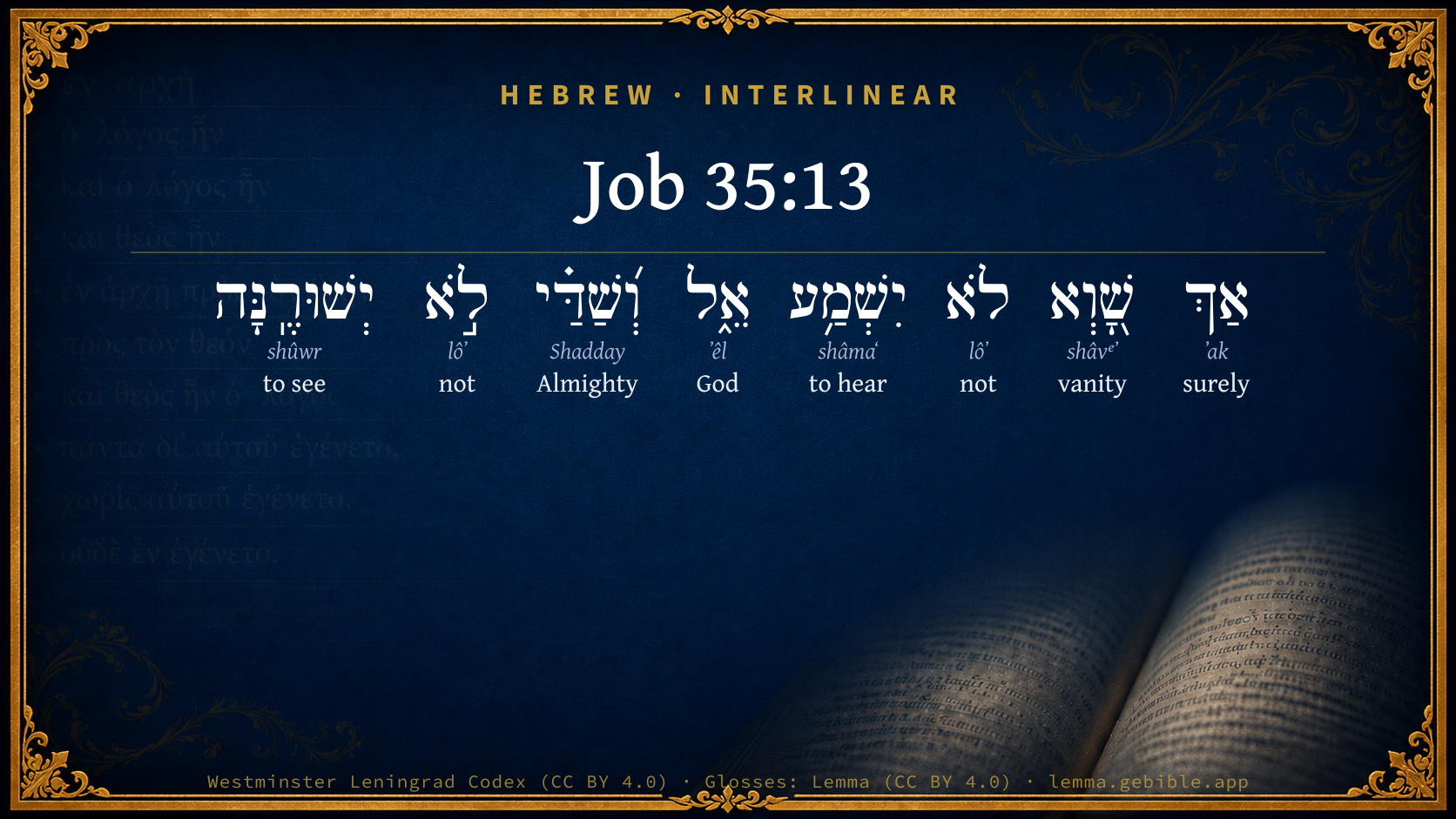
Job 35:13

Hebrew (Westminster Leningrad Codex) Job 35:13 appears in the Hebrew Old Testament. The text above is from the Westminster Leningrad Codex. Each word links to its Strong’s number, a concise gloss, and parsing drawn from the Open Scriptures Hebrew Bible morphology. Click any word for its full Brown-Driver-Briggs (BDB) entry.
Download image
Cite this verse

Job 35:13 (World English Bible). Public Domain. Lemma interlinear Bible study tool, https://lemma.gebible.app/v/job/35/13.

Show BibTeX & RIS
BibTeX
RIS
English Translation
Surely God will not hear an empty cry, Neither will the Almighty regard it.
World English Bible · Public Domain
Download a study sheet

One document with this verse’s original text, its word-by-word gloss line, the meaning frame, cross-references with their text, attributed commentary, and full source and license credits — printable, and it pastes into notes with its structure intact.

This verse Autodidact and up

Study sheet (.html) Plain text (.txt)

A passage Seminary Student

Up to 50 verses in one chapter. A passage sheet keeps up to 6 commentary sources and 12 cross-references per verse, in the order this page ranks them, and says so on the sheet whenever that leaves anything out. Ask for a single verse and you get the Autodidact verse sheet above.

Everything on this page stays free to read, with no account — the sheet is a download of what is already on screen, not access to it.

Want to remove ads? Support Godless Engineer
Compare translations 3

The same verse in 3 English versions, stacked beneath the original-language interlinear above. Click any original word for its lexicon entry.

Each is an independent rendering of the whole verse — the interlinear is not word-aligned to these translations.

Highlighted words mark where these versions differ — a whole-verse word diff, not a word-by-word alignment.

  • World English Bible Public Domain
    Surely God will not hear an empty cry, Neither will the Almighty regard it.
  • King James Version Public Domain
    Surely God will not hear vanity, neither will the Almighty regard it.
  • unfoldingWord Literal Text CC BY-SA 4.0
    Surely God does not hear vanity, and the Almighty does not regard it.

unfoldingWord Literal Text — © unfoldingWord, licensed CC BY-SA 4.0. Word-aligned USFM3 via Door43 (git.door43.org/unfoldingWord/en_ult).

Versions to compare (up to 4)

3 of 4 selected

Show all 18 translations

Every available English version of this verse, each an independent rendering of the whole verse.

  • World English Bible Public Domain
    Surely God will not hear an empty cry, Neither will the Almighty regard it.
  • Berean Standard Bible Public Domain
    Surely God does not listen to empty pleas, and the Almighty does not take note of it.
  • Majority Standard Bible Public Domain
    Surely God does not listen to empty pleas, and the Almighty does not take note of it.
  • King James Version Public Domain
    Surely God will not hear vanity, neither will the Almighty regard it.
  • American Standard Version (1901) Public Domain
    Surely God will not hear an empty `cry', Neither will the Almighty regard it.
  • Revised Version (1885) Public Domain
    Surely God will not hear vanity, neither will the Almighty regard it.
  • Geneva Bible (1599) Public Domain
    Surely God will not heare vanitie, neyther will the Almightie regard it.
  • Douay-Rheims (1899) Public Domain
    God therefore will not hear in vain, and the Almighty will look into the causes of every one.
  • Young's Literal Translation Public Domain
    Surely vanity God doth not hear, And the Mighty doth not behold it.
  • Literal Standard Version CC BY-SA 4.0
    Surely God does not hear vanity, || And the Mighty does not behold it.
  • Unlocked Literal Bible CC BY-SA 4.0
    God will certainly not hear a foolish cry; the Almighty will pay no attention to it.
  • unfoldingWord Literal Text CC BY-SA 4.0
    Surely God does not hear vanity, and the Almighty does not regard it.
  • Darby Bible Public Domain
    Surely ùGod will not hear vanity, neither will the Almighty regard it.
  • World Messianic Bible Public Domain
    Surely God will not hear an empty cry, neither will the Almighty regard it.
  • Webster's Bible Public Domain
    Surely God will not hear vanity, neither will the Almighty regard it.
  • Free Bible Version CC BY-SA 4.0
    God doesn't listen to their empty cries; the Almighty doesn't pay them any attention.
  • Bible in Basic English Public Domain
    But God will not give ear to what is false, or the Ruler of all take note of it;
  • JPS Tanakh (1917) Public Domain
    Surely God will not hear vanity, neither will the Almighty regard it.

Literal Standard Version (2020), Covenant Press — licensed CC BY-SA 4.0. Text via the HelloAO Bible API (eBible.org). Unlocked Literal Bible (unfoldingWord) — licensed CC BY-SA 4.0. Text via the HelloAO Bible API (eBible.org). unfoldingWord Literal Text — © unfoldingWord, licensed CC BY-SA 4.0. Word-aligned USFM3 via Door43 (git.door43.org/unfoldingWord/en_ult). Free Bible Version, Dr. Jonathan Gallagher — licensed CC BY-SA 4.0. Text via the HelloAO Bible API (eBible.org).

Word by word

More ways to search: Search by grammar → Find every occurrence → Compare this word →

Practice this passage: Drill this verse → Learn its vocabulary →

About this verse

These counts appear in no published source. They are computed here, from the morphology-tagged text and Lemma’s own curated glosses. What Lemma adds →

8
words
7
distinct lemmas
Wisdom
section

Notable vocabulary

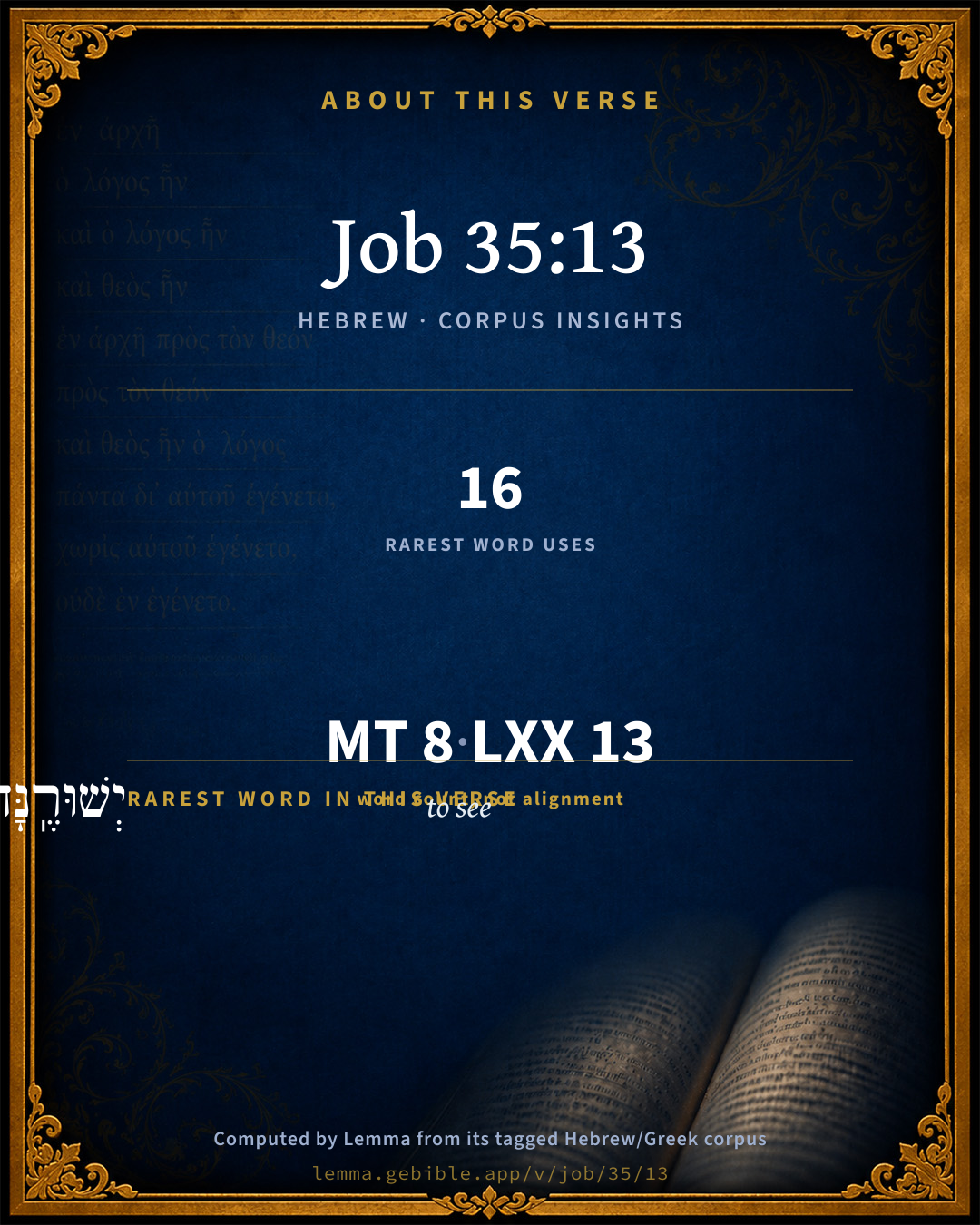
The rarest word here is יְשׁוּרֶֽנָּה to see H7789 — appearing just 16 times in the whole Hebrew Bible.

Shared distinctive vocabulary

יְשׁוּרֶֽנָּה to see H7789 occurs in 16 verses of the Hebrew Bible. Also found in:

Grammatical profile

  • 2 verbs
  • 3 nouns
  • 3 particles

Verb forms

  • יִשְׁמַ֥ע Qal · Imperfect
  • יְשׁוּרֶֽנָּה Qal · Imperfect

Repetition

A word recurs within this verse — often emphatic in Hebrew:

Hebrew & Septuagint length

In English translation the verse runs 14 words from the Hebrew and 15 from the Septuagint (LXX English) — closely comparable.

A rough comparison of the two English renderings, which tokenize alike — not a word-level alignment.

Word counts can differ between the Hebrew and the Greek without any difference in meaning — e.g. the Hebrew direct-object marker אֵת has no separate Greek word, and Greek often adds the article ὁ.

In the original languages it is 8 Hebrew tokens and 13 Greek tokens — but the two are counted differently (Hebrew bundles its prefixes and suffixes into one token; the Greek is in lemma form), so that isn’t a like-for-like length.

Cross-references

16

Topical passages linked to Job 35:13 in the Treasury of Scripture Knowledge — connected by theme and wording, ordered by reader-vote popularity; previews shown in the World English Bible.

  • Proverbs 15:29 Yahweh is far from the wicked, But he hears the prayer of the righteous.
  • Isaiah 1:15 When you spread forth your hands, I will hide my eyes from you; Yes, when you make many prayers, I will not hear. Your hands are full of blood.
  • Jeremiah 11:11 Therefore thus says Yahweh, Behold, I will bring evil on them, which they shall not be able to escape; and they shall cry to me, but I will not listen to them.
  • James 4:3 You ask, and don't receive, because you ask with wrong motives, so that you may spend it for your pleasures.
  • Proverbs 15:8 The sacrifice made by the wicked is an abomination to Yahweh, But the prayer of the upright is his delight.
  • Job 22:22–27 Please receive instruction from his mouth, And lay up his words in your heart.
  • Job 27:8–9 For what is the hope of the godless, when he is cut off, When God takes away his life?
  • Job 30:20 I cry to you, and you do not answer me. I stand up, and you gaze at me.
  • Psalms 102:17 He has responded to the prayer of the destitute, And has not despised their prayer.
  • Proverbs 28:9 He who turns away his ear from hearing the law, Even his prayer is an abomination.
  • Ecclesiastes 5:1–3 Guard your steps when you go to God's house; for to draw near to listen is better than to give the sacrifice of fools, for they don't know that they do evil.
  • Hosea 7:14 They haven't cried to me with their heart, But they howl on their beds. They assemble themselves for grain and new wine. They turn away from me.
  • Hosea 8:2–3 They cry to me, 'My God, we Israel acknowledge you!'
  • Amos 5:22 Yes, though you offer me your burnt offerings and meal-offerings, I will not accept them; Neither will I regard the peace offerings of your fat animals.
  • Matthew 6:7 In praying, don't use vain repetitions, as the Gentiles do; for they think that they will be heard for their much speaking.
  • Matthew 20:21–22 He said to her, "What do you want?" She said to him, "Command that these, my two sons, may sit, one on your right hand, and one on your left hand, in your Kingdom."

Cross-references courtesy of OpenBible.info (CC BY 4.0).

Hebrew and Greek witnesses Masoretic Hebrew ↔ Greek Septuagint

The same verse in the two great witnesses to the Old Testament, shown verse-for-verse.

These are two independent witnesses, not word-aligned to each other, and the Septuagint is shown in lemma (dictionary) form.

Hebrew Job 35:13 Masoretic · Westminster Leningrad Codex

אַךְ שָׁ֭וְא לֹא יִשְׁמַ֥ע אֵ֑ל וְ֝שַׁדַּ֗י לֹ֣א יְשׁוּרֶֽנָּה

Surely God will not hear an empty cry, Neither will the Almighty regard it.

World English Bible · Public Domain

Greek LXX Job 35:13 Septuagint · lemma form

ἄτοπος γάρ οὐ βούλομαι ὁ κύριος ὁράω αὐτός γάρ ὁ παντοκράτωρ ὁρατής εἰμί

For the Lord desires not to look on error, for he is the Almighty One.

LXX2012 (modern English Septuagint) · Public Domain

Hebrew: Westminster Leningrad Codex (CC BY 4.0). Greek: Septuagint (public domain); English from LXX2012 (modern English Septuagint) (Public Domain). How the Septuagint differs from the Hebrew →

Commentary

Notes on Job 35:13 from classic Christian and Jewish commentators (each source and its license shown beneath its notes). The classic Christian expositions comment on the surrounding passage and are grouped to its opening verse, so a note may address several verses; the Jewish commentaries on the Tanakh (Rashi and others) are per-verse, so they appear only where the commentator wrote on this verse.

Lemma curates 59 commentaries, every one of them public domain or Creative Commons licensed, each selected and text-cleaned for this edition rather than reprinted as found. About our sources →

Trapp's Complete Commentary

John Trapp

Job 35:13 Surely God will not hear vanity, neither will the Almighty regard it.

Ver. 13. Surely God will not hear vanity] Prayer without faith is but an empty ring, a tinkling cymbal. Neque enim omnes qui citharam habent, sunt citharaedi, Every sound is not music, neither is every complaint and outcry of men in extremity an effectual prayer. Those in Hosea, when pined almost, howled as dogs, growled as swine, bellowed as bulls, screeched horribly as the ravens of Arabia, Hos 7:14, but because they cried not to God with their hearts he heard them not. It is not the labour of the lips or the loudness of the voice, but the travail of the heart, and truth in the inward parts, that he regardeth, Psa 51:6. Wilt thou not know, O vain (or empty) man, that faith without works is dead? saith St James, Jas 2:20; so that prayer without faith is to no purpose. Men may cry aloud in distress, and make their voices to be heard on high; they may chatter out a charm when God’s chastening is upon them, yea, be with child, as it were, of a prayer, yet bring forth nothing better than wind, work no deliverance at all in the earth, Isa 26:16-18. God may turn them off, and justly, with, Depart, ye workers of iniquity; get you to the gods whom ye have chosen, let them deliver you in the time of your tribulation; for I will deliver you no more, Jdg 10:13-14.

Neither will the Almighty regard it] Heb. Look intently into it. It is other and better fruit of affliction that he looketh for. Whereof missing, he looketh another way, as it were, and taketh no notice of their prayers or pressures. Hence they deny, or at least doubt, the Divine providence; and are ready to let fly at God, as the Chinese whip their gods if they help them not at a call.

John Trapp, A Commentary or Exposition upon All the Books of the Old and New Testament (1647–1656) — public domain. Text from a community e-Sword module.

Joseph Benson's Commentary

Job 35:13. Surely God will not hear vanity — Either, 1st, Vain and light persons, that have no true wisdom nor solid piety in them: but are wholly addicted to vain and worldly things, rejoicing immoderately when they have them, and crying out in distress when they have them not. Or, 2d, Vain cries; which proceed not from true penitence, faith, or piety, but only from self-love, and such a sense of misery as is common to men with brute beasts. Neither will the Almighty regard it — Though God be able to help them, as this title of God, the Almighty, implies; and though he be the Judge of the world, as the former name of God, אל, eel, signifies, to whom therefore it belongs to right the oppressed against the oppressor; yet, in this case, he justly refuseth to help them.

Joseph Benson's Commentary on the Old and New Testaments (1811–1818) — public domain. Text from a community e-Sword module.

Jamieson, Fausset & Brown

Robert Jamieson, A. R. Fausset & David Brown

vanity--that is, cries uttered in an unhumbled spirit, Job 35:12, which applies in some degree to Job's cries; still more to those of the wicked (Job 27:9; Pro 15:29).

Jamieson, Fausset & Brown — Commentary Critical and Explanatory on the Whole Bible (1871) — public domain (CC PDM 1.0). Text via the HelloAO Bible API.

Adam Clarke's Commentary

Verse 13. Surely God will not hear vanity] He will not attend to such vain cries; they cry from their oppressions, but they cry not to God.

Adam Clarke's Commentary on the Bible (1810–1826) — public domain. Text from a community e-Sword/MySword module.

Ellicott's Commentary for English Readers

(13) God will not hear vanity.—Some understand this as part of the cry in Job_35:12 : “Seeing it is all in vain, God doth not hear, neither doth the Almighty regard it.”

A Bible Commentary for English Readers, edited by Charles John Ellicott (1878–1897) — public domain. Text from a community e-Sword module.

John Gill's Exposition

Surely God will not hear vanity,.... Or "a lie" (z), than which nothing is more an abomination to him; if men come to him with a lie in their mouths, they cannot expect to be heard by him; he is only nigh to those who call upon him in truth: or that which is "rash" (a); which is rashly uttered, and in a passionate wrathful manner, savouring of a revengeful spirit, too often the case of those that cry under oppression; see Ecc 5:2; or vain and empty prayers, a speech of vanity, as Aben Ezra; which as to the matter of them are about vain and empty things; only for outward mercies, worldly goods; and not for spiritual mercies, or such things as are according to the will of God; but what are pleasing to the flesh, and sought for to consume on the lusts of it, and therefore such prayers are not heard, Psa 4:6; and as to the manner of them, they are not put up in the name of Christ, nor under the influence of the spirit of Christ, nor in the exercise of any grace, nor with reverence of God, nor with sincerity of soul, not in faith, nor with fervency: or "vanity" is put for vain men, as sin for sinners; such as are proud men, and are vainly puffed up in their fleshly mind. God hears humble penitent sinners, who find mercy with him; and humble saints, to whom he gives more grace; but not proud Pharisees, or men not humbled by afflictions; see Luk 18:11; nor light and empty persons, who are without God and Christ, destitute of the spirit, devoid of all grace, and full of all unrighteousness; unstable ones, who are vanity itself, and lighter than vanity, tossed to and fro like a wave of the sea, and double minded, Jam 1:6; nor men of vain conversations, that walk in the vanity of their minds, whose words are vain, and especially such as take the name of God in vain; and all whose actions are vain, or such that live a vain and sinful course of life; God hears not sinners, Joh 9:31;

neither will the Almighty regard it; vanity, vain prayers and vain persons; he regards the prayer of the destitute, the lowly, and the humble, but not the prayer of such as before described; he cannot "look" at, it (b), nor at them: he looks to the poor and contrite, and desires to see their countenance and hear their voice in prayer; but he is of purer eyes thou to look on vain persons and their vain prayers; and a greater contempt cannot be shown to petitioners and their petitions than when those to whom they apply will not so much as look at them, but turn both a deaf ear to them, and their eyes away from them.

(z) "falsitatem", Beza; "mendacium", Pagninus, Montanus. (a) "Quod temerarium est", Cocceius. (b) "non intuatur illud", Pagninus, Montanus; "non videt illud", Cocceius; so Michaelis and Schultens.

John Gill's Exposition of the Whole Bible (1746–1763) — public domain (CC PDM 1.0). Text via the HelloAO Bible API.

Albert Barnes' Notes on the Bible

Surely God will not hear vanity - A vain, hollow, heartless petition. The object of Elihu here is to account for the reason why sufferers are not relieved - having his eye, doubtless, on the case of Job as one of the most remarkable of the kind. The solution which he here gives of the difficulty is, that it is not consistent for God to hear a prayer where there is no sincerity. Of the “truth” of the remark there can be no doubt, but he seems to have taken it for granted that all prayers offered by unrelieved sufferers are thus insincere and hollow. This was needfull in his view to account for the fact under consideration, and this he “assumes” as being unquestionable. Yet the very point indispensable to make out his case was, that “in fact” the prayers offered by such persons were insincere.

Albert Barnes' Notes on the Bible (1834–1885) — public domain. Text from a community e-Sword/MySword module.

Haydock's Catholic Bible Commentary

Vain. Hebrew, "falsehood." He will not relieve the hypocrite, who does not cry to him with sincerity. This conduct shews that God acts with discretion, and hears people according to their deserts. (Calmet)

George Leo Haydock (1774–1849), Haydock's Catholic Family Bible and Commentary, 1859 edition — public domain. Excludes Psalms (Douay-Rheims chapter numbering differs from Protestant) and Deuterocanonical books (Catholic canon only).

Matthew Poole's English Annotations

Either,

1. Vain and light persons, that have no true wisdom or solid piety in them, but are wholly addicted to vain and worldly things, rejoicing immoderately when they have them, and crying out for want of them, as here they do. Or,

2. Vain cries, which proceed not from faith or piety, but only from self-love and a natural sense of their misery; which is common to them with brute beasts. The abstract is here put for the concrete, as wickedness is oft put for wicked men, and pride for proud persons, and the like.

Neither will the Almighty regard it: though God be able to help them, as this title of God implies, and though he be the Judge of the world, as the former name of God signifies, to whom therefore it belongs to right the oppressed against the oppressor, yet in this case he justly refuseth to help them.

Matthew Poole's English Annotations on the Holy Bible (1683–1685) — public domain. Text from a community e-Sword/MySword module.

Whedon's Commentary on the Bible

Daniel D. Whedon

13. Vanity — That is, a vain and empty cry, one that has no spiritual element.

Daniel D. Whedon (gen. ed.), Commentary on the Old and New Testaments (1874–1909) — public domain. Text from a community e-Sword module.

The Pulpit Commentary

Surely God will not hear vanity. God will not hear prayers that are rendered "vain" by sin or defect in those who offer them, as by a want of faith, piety, humility, or resignation. Neither will the Almighty regard any such petitions.

The Pulpit Commentary (1880–1919), ed. H.D.M. Spence-Jones & Joseph S. Exell — public domain. Text from a community e-Sword module.

John Wesley's Explanatory Notes

Vanity - Vain persons, that have no wisdom or piety in them.

John Wesley, Explanatory Notes Upon the Whole Bible (1754–1765) — public domain. Text via the GEBible commentary corpus.

Rashi

Rabbi Shlomo Yitzchaki (Rashi)

Indeed, God will not hear vanity immediately.

neither will the Almighty see it to avenge it immediately, but He is longsuffering.

Rashi on the Tanakh — English translations: “The Judaica Press complete Tanach with Rashi, translated by A. J. Rosenberg” (CC BY 4.0); “Pentateuch with Rashi's commentary by M. Rosenbaum and A.M. Silbermann, 1929-1934” (public domain); “The Metsudah Tanach series, Lakewood, N.J” (CC BY 4.0); and “The Book of Joshua, Metsudah Publications, 1997” (CC BY 4.0). Text via Sefaria.

Lesson kit

Teaching starters — assembled from the data on this page, not authored interpretation. Every prompt links to the verse data it draws on. Edit before teaching.

Job, in the Wisdom, opens this verse with 8 words (7 distinct Hebrew lemmas). Its most distinctive word is shûwr (“to see”). A historical commentator’s framing appears above. Read the whole chapter for the surrounding context.

Discussion questions

  1. How does “to see” (shûwr) shape what this verse is saying?
  2. How does Numbers 23:9, which shares the word «to see», read alongside this verse?
  3. What does the repetition of “not” (2× in this one verse) do in this verse?
  4. These translations render this verse differently. What is at stake in choosing one wording over another?
  5. «יִשְׁמַ֥ע» is a Qal Imperfect verb. How does that grammatical form shape the action described?
  6. Compare how Trapp's Complete Commentary and Joseph Benson's Commentary read this verse. Where do they agree or differ?

Things to notice

Reading settings

Reading text

Shown beneath each verse's original-language words.

Old Testament
Old Testament edition

Read the OT as the Masoretic Hebrew (MT) or the Greek Septuagint (LXX).

English shown for the Greek Septuagint (in the Hebrew ↔ Greek comparison).

Comparing translations? Open the Compare panel on any verse page to stack up to four side by side.