
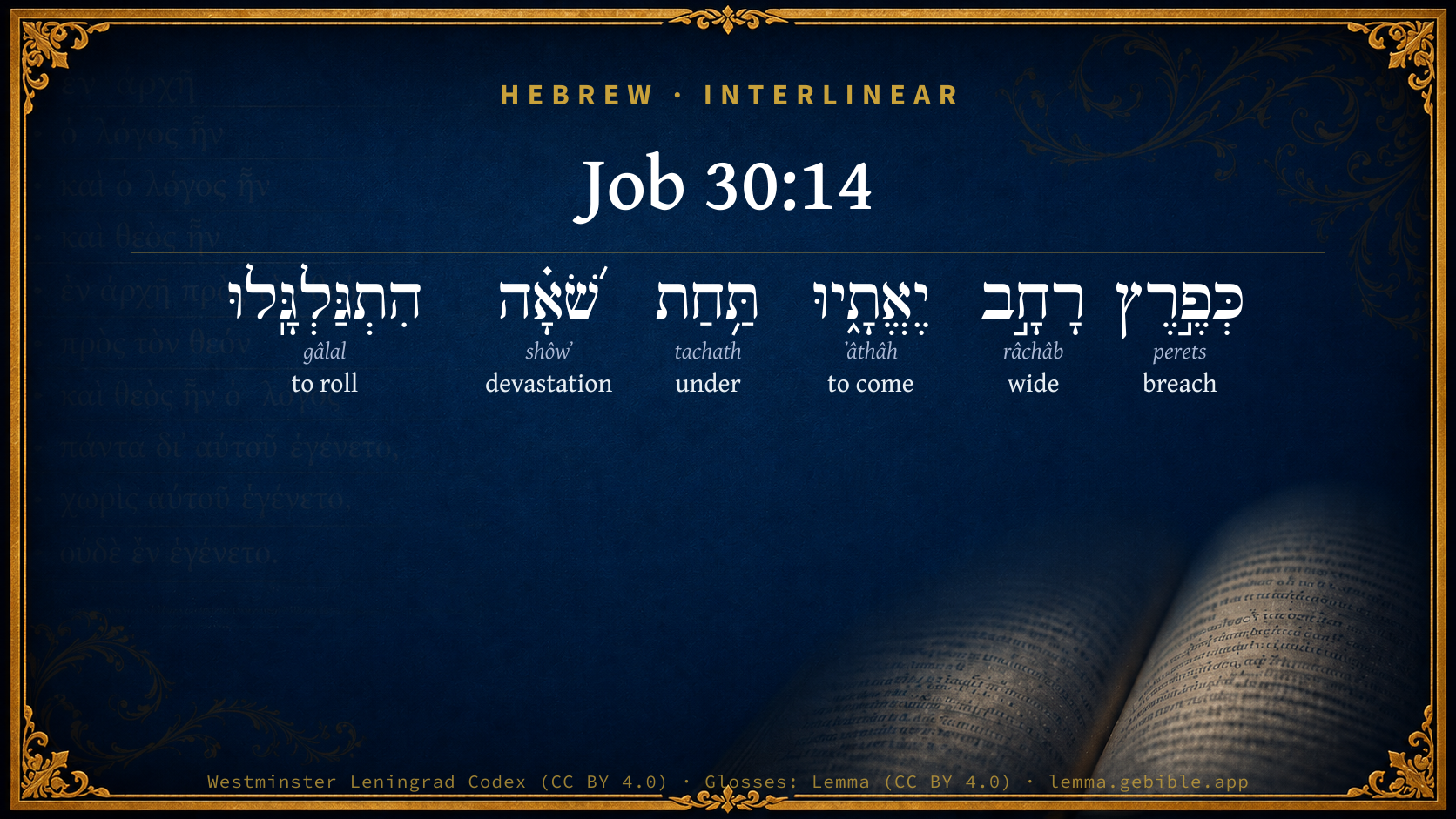
Job 30:14

Hebrew (Westminster Leningrad Codex) Job 30:14 appears in the Hebrew Old Testament. The text above is from the Westminster Leningrad Codex. Each word links to its Strong’s number, a concise gloss, and parsing drawn from the Open Scriptures Hebrew Bible morphology. Click any word for its full Brown-Driver-Briggs (BDB) entry.
Download image
Cite this verse

Job 30:14 (World English Bible). Public Domain. Lemma interlinear Bible study tool, https://lemma.gebible.app/v/job/30/14.

Show BibTeX & RIS
BibTeX
RIS
English Translation
As through a wide breach they come, In the midst of the ruin they roll themselves in.
World English Bible · Public Domain
Download a study sheet

One document with this verse’s original text, its word-by-word gloss line, the meaning frame, cross-references with their text, attributed commentary, and full source and license credits — printable, and it pastes into notes with its structure intact.

This verse Autodidact and up

Study sheet (.html) Plain text (.txt)

A passage Seminary Student

Up to 50 verses in one chapter. A passage sheet keeps up to 6 commentary sources and 12 cross-references per verse, in the order this page ranks them, and says so on the sheet whenever that leaves anything out. Ask for a single verse and you get the Autodidact verse sheet above.

Everything on this page stays free to read, with no account — the sheet is a download of what is already on screen, not access to it.

Want to remove ads? Support Godless Engineer
Compare translations 3

The same verse in 3 English versions, stacked beneath the original-language interlinear above. Click any original word for its lexicon entry.

Each is an independent rendering of the whole verse — the interlinear is not word-aligned to these translations.

Highlighted words mark where these versions differ — a whole-verse word diff, not a word-by-word alignment.

  • World English Bible Public Domain
    As through a wide breach they come, In the midst of the ruin they roll themselves in.
  • King James Version Public Domain
    They came upon me as a wide breaking in of waters: in the desolation they rolled themselves upon me.
  • unfoldingWord Literal Text CC BY-SA 4.0
    As a wide breach they come; amid the ruin they roll on.

unfoldingWord Literal Text — © unfoldingWord, licensed CC BY-SA 4.0. Word-aligned USFM3 via Door43 (git.door43.org/unfoldingWord/en_ult).

Versions to compare (up to 4)

3 of 4 selected

Show all 18 translations

Every available English version of this verse, each an independent rendering of the whole verse.

  • World English Bible Public Domain
    As through a wide breach they come, In the midst of the ruin they roll themselves in.
  • Berean Standard Bible Public Domain
    They advance as through a wide breach; through the ruins they keep rolling in.
  • Majority Standard Bible Public Domain
    They advance as through a wide breach; through the ruins they keep rolling in.
  • King James Version Public Domain
    They came upon me as a wide breaking in of waters: in the desolation they rolled themselves upon me.
  • American Standard Version (1901) Public Domain
    As through a wide breach they come: In the midst of the ruin they roll themselves `upon me'.
  • Revised Version (1885) Public Domain
    As through a wide breach they come: in the midst of the ruin they roll themselves upon me.
  • Geneva Bible (1599) Public Domain
    They came as a great breach of waters, and vnder this calamitie they come on heapes.
  • Douay-Rheims (1899) Public Domain
    They have rushed in upon me, as when a wall is broken, and a gate opened, and have rolled themselves down to my miseries.
  • Young's Literal Translation Public Domain
    As a wide breach they come, Under the desolation have rolled themselves.
  • Literal Standard Version CC BY-SA 4.0
    They come as a wide breach, || Under the desolation have rolled themselves.
  • Unlocked Literal Bible CC BY-SA 4.0
    They come against me like an army through a wide hole in a city wall; in the midst of the destruction they roll themselves in on me.
  • unfoldingWord Literal Text CC BY-SA 4.0
    As a wide breach they come; amid the ruin they roll on.
  • Darby Bible Public Domain
    They come in as through a wide breach: amid the confusion they roll themselves onward.
  • World Messianic Bible Public Domain
    As through a wide breach they come. They roll themselves in amid the ruin.
  • Webster's Bible Public Domain
    They came upon me as a wide breaking in of waters: in the desolation they rolled themselves upon me.
  • Free Bible Version CC BY-SA 4.0
    They come in through a wide breach; they rush in as the wall comes tumbling down.
  • Bible in Basic English Public Domain
    As through a wide broken place in the wall they come on, I am overturned by the shock of their attack.
  • JPS Tanakh (1917) Public Domain
    As through a wide breach they come; in the midst of the ruin they roll themselves upon me.

Literal Standard Version (2020), Covenant Press — licensed CC BY-SA 4.0. Text via the HelloAO Bible API (eBible.org). Unlocked Literal Bible (unfoldingWord) — licensed CC BY-SA 4.0. Text via the HelloAO Bible API (eBible.org). unfoldingWord Literal Text — © unfoldingWord, licensed CC BY-SA 4.0. Word-aligned USFM3 via Door43 (git.door43.org/unfoldingWord/en_ult). Free Bible Version, Dr. Jonathan Gallagher — licensed CC BY-SA 4.0. Text via the HelloAO Bible API (eBible.org).

Word by word

More ways to search: Search by grammar → Find every occurrence → Compare this word →

Practice this passage: Drill this verse → Learn its vocabulary →

About this verse

These counts appear in no published source. They are computed here, from the morphology-tagged text and Lemma’s own curated glosses. What Lemma adds →

6
words
6
distinct lemmas
Wisdom
section

Notable vocabulary

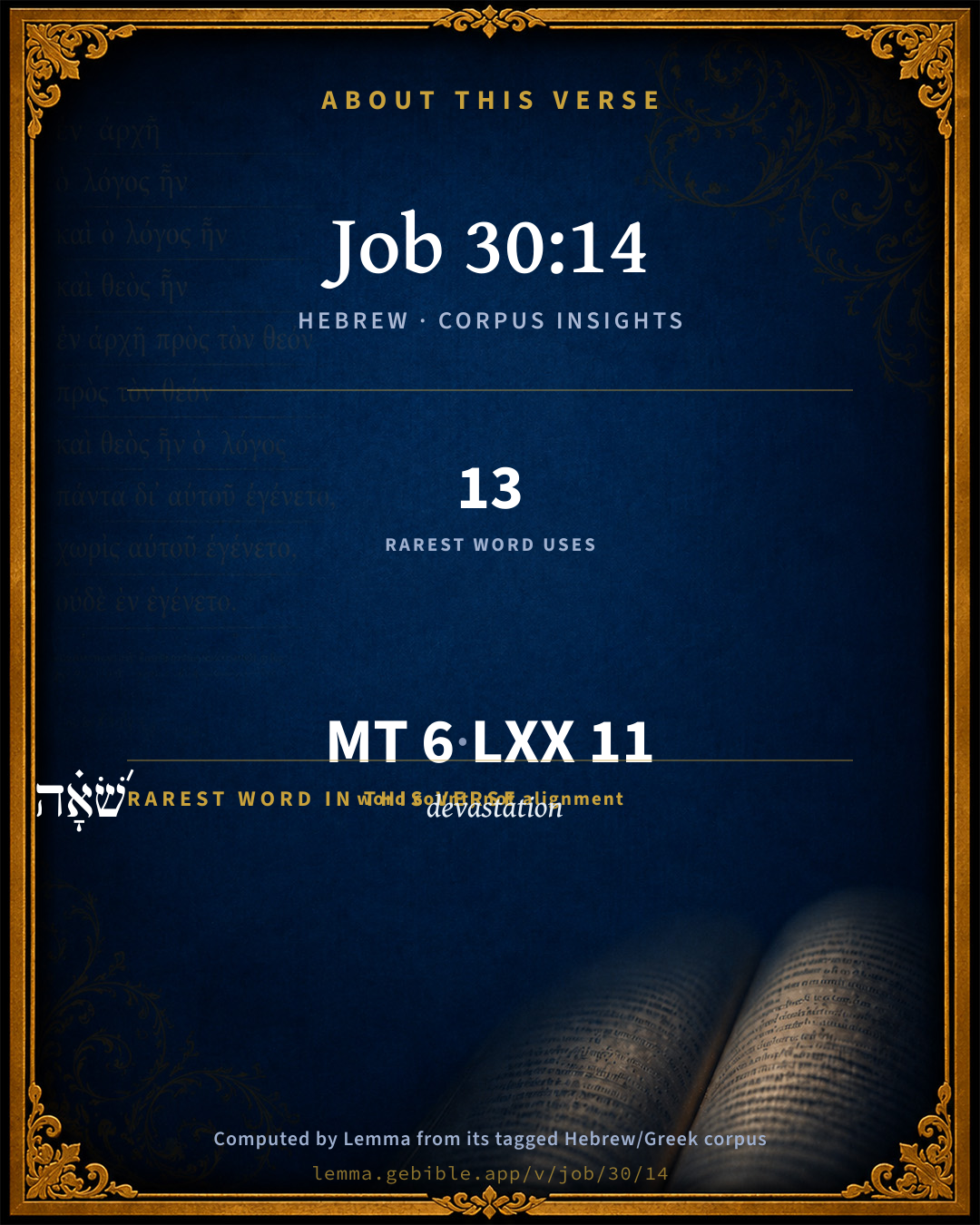
The rarest word here is שֹׁ֝אָ֗ה devastation H7722 — appearing just 13 times in the whole Hebrew Bible.

Shared distinctive vocabulary

שֹׁ֝אָ֗ה devastation H7722 occurs in 12 verses of the Hebrew Bible. Also found in:

Grammatical profile

  • 2 verbs
  • 2 nouns
  • 1 adjective
  • 1 preposition

Verb forms

  • יֶאֱתָ֑יוּ Qal · Imperfect
  • הִתְגַּלְגָּֽלוּ Hithpalpel · Perfect

Hebrew & Septuagint length

In English translation the verse runs 17 words from the Hebrew and 14 from the Septuagint (LXX English) — closely comparable.

A rough comparison of the two English renderings, which tokenize alike — not a word-level alignment.

Word counts can differ between the Hebrew and the Greek without any difference in meaning — e.g. the Hebrew direct-object marker אֵת has no separate Greek word, and Greek often adds the article ὁ.

In the original languages it is 6 Hebrew tokens and 11 Greek tokens — but the two are counted differently (Hebrew bundles its prefixes and suffixes into one token; the Greek is in lemma form), so that isn’t a like-for-like length.

Cross-references

4

Topical passages linked to Job 30:14 in the Treasury of Scripture Knowledge — connected by theme and wording, ordered by reader-vote popularity; previews shown in the World English Bible.

  • Job 22:16 Who were snatched away before their time, Whose foundation was poured out as a stream,
  • Psalms 18:4 The cords of death surrounded me. The floods of ungodliness made me afraid.
  • Psalms 69:14–15 Deliver me out of the mire, and don't let me sink. Let me be delivered from those who hate me, and out of the deep waters.
  • Isaiah 8:7–8 now therefore, behold, the Lord brings up on them the waters of the River, strong and many, [even] the king of Assyria and all his glory: and it shall come up over all its channels, and go over all its banks;

Cross-references courtesy of OpenBible.info (CC BY 4.0).

Hebrew and Greek witnesses Masoretic Hebrew ↔ Greek Septuagint

The same verse in the two great witnesses to the Old Testament, shown verse-for-verse.

These are two independent witnesses, not word-aligned to each other, and the Septuagint is shown in lemma (dictionary) form.

Hebrew Job 30:14 Masoretic · Westminster Leningrad Codex

כְּפֶ֣רֶץ רָחָ֣ב יֶאֱתָ֑יוּ תַּ֥חַת שֹׁ֝אָ֗ה הִתְגַּלְגָּֽלוּ

As through a wide breach they come, In the midst of the ruin they roll themselves in.

World English Bible · Public Domain

Greek LXX Job 30:14 Septuagint · lemma form

βέλος αὐτός καταἀκοντίζω ἐγώ χράομαι ἐγώ ὡς βούλομαι ἐν ὀδύνη φύρομαι

And he has pleaded against me as he will: I am overwhelmed with pains.

LXX2012 (modern English Septuagint) · Public Domain

Hebrew: Westminster Leningrad Codex (CC BY 4.0). Greek: Septuagint (public domain); English from LXX2012 (modern English Septuagint) (Public Domain). How the Septuagint differs from the Hebrew →

Commentary

Notes on Job 30:14 from classic Christian and Jewish commentators (each source and its license shown beneath its notes). The classic Christian expositions comment on the surrounding passage and are grouped to its opening verse, so a note may address several verses; the Jewish commentaries on the Tanakh (Rashi and others) are per-verse, so they appear only where the commentator wrote on this verse.

Lemma curates 59 commentaries, every one of them public domain or Creative Commons licensed, each selected and text-cleaned for this edition rather than reprinted as found. About our sources →

Trapp's Complete Commentary

John Trapp

Job 30:14 They came [upon me] as a wide breaking in [of waters]: in the desolation they rolled themselves [upon me].

Ver. 14. They came upon me as a wide breaking in of waters] Quasi irruptione lata invadunt me. As soldiers when they have made a breach in a wall, come tumbling in upon the town, and sack and ransack it, yea, raze it, and harass it; so have these dealt with me.

They rolled themselves upon me] Labouring wholly to suppress me, Gen 43:18. Taking occasion by this my downfall, which they ought rather to have lamented and pitied, they unmercifully fell upon me, as if they themselves had lived out of the reach of God’s rod.

John Trapp, A Commentary or Exposition upon All the Books of the Old and New Testament (1647–1656) — public domain. Text from a community e-Sword module.

Joseph Benson's Commentary

Job 30:14. They came as a wide breaking in of waters — As fiercely and violently as a river doth when a great breach is made in the bank which kept it in. Hebrew, כפרצ רחב, cheperetz rachab, as at a wide breach, as a besieging army, having made a breach in the walls of the city, do suddenly and forcibly rush into it. The word waters, the reader will observe, is not in the Hebrew. In the desolation they rolled themselves upon me — As the waters or soldiers come tumbling in at the breach, they poured themselves upon me, that they might utterly destroy and make me desolate.

Joseph Benson's Commentary on the Old and New Testaments (1811–1818) — public domain. Text from a community e-Sword module.

Geneva Bible (1599)

Geneva Bible translators

By my calamity they took an occasion against me.

Geneva Bible (1599) marginal notes — public domain. Text via Bolls.life.

Jamieson, Fausset & Brown

Robert Jamieson, A. R. Fausset & David Brown

waters--(So Sa2 5:20). But it is better to retain the image of Job 30:12-13. "They came [upon me] as through a wide breach," namely, made by the besiegers in the wall of a fortress (Isa 30:13) [MAURER].

in the desolation--"Amidst the crash" of falling masonry, or "with a shout like the crash" of, &c.

Jamieson, Fausset & Brown — Commentary Critical and Explanatory on the Whole Bible (1871) — public domain (CC PDM 1.0). Text via the HelloAO Bible API.

Adam Clarke's Commentary

Verse 14. They came upon me as a wide breaking in] They storm me on every side.

In the desolation they rolled themselves] When they had made the breach, they rolled in upon me as an irresistible torrent. There still appears to be an allusion to a besieged city: the sap, the breach, the storm, the flight, the pursuit, and the slaughter. See the following verse.

Adam Clarke's Commentary on the Bible (1810–1826) — public domain. Text from a community e-Sword/MySword module.

Ellicott's Commentary for English Readers

(14) As a wide breaking in of waters.—Or, as through a wide breach they come. “In the midst of the crash they roll themselves upon me;” or, “instead of a tempest” (i.e., like a tempest) “they roll themselves upon me.”

A Bible Commentary for English Readers, edited by Charles John Ellicott (1878–1897) — public domain. Text from a community e-Sword module.

The Cambridge Bible for Schools and Colleges

gen. ed. J. J. S. Perowne

14. The verse reads,

They come in as through a wide breach,

Amidst the crash they roll themselves upon me.

The figure is that of a stormed fastness. The “crash” is that of the falling walls.

The Cambridge Bible for Schools and Colleges (gen. ed. J. J. S. Perowne; Cambridge University Press, 1878–1918) — public domain. Text from a community e-Sword module.

John Gill's Exposition

They came upon me as a wide breaking in of waters,.... As when a wide breach is made in the banks of a river, or of the sea, the waters rush through in great abundance, with great rapidity and swiftness; and with a force irresistible; and in like manner did Job's enemies rush in upon him in great numbers, overwhelming him in an instant, and he not able to oppose them; or as, when a wide breach is made in the wall of a city besieged, the besiegers pour themselves in, and bear down all before them: and thus Job in a like violent manner was run upon, and bore down by the persons before described:

in the desolation they rolled themselves upon me; as when a breach is made in a bank of a river, or of the sea, the waters roll themselves, one wave and flood over another; or, as when a breach is made in a wall, "in the broken place they tumble"; as Mr. Broughton renders it; the soldiers tumble one over another in haste, to get possession and seize the plunder: in such like manner did Job's enemies roll themselves on him, in order to crush and destroy him; and it may be rendered, "because of the desolation" (r), because of bringing calamity on him in order to make him desolate; they came pouring in upon him with all their numbers, force, and strength, to bear him down, and crush him to the earth, as grass may be rolled upon, and beaten down by heavy bodies.

(r) "pro desolatione", Pagninus, Montanus; "propter vestalionem", Noldius, p. 3. No. 1864.

John Gill's Exposition of the Whole Bible (1746–1763) — public domain (CC PDM 1.0). Text via the HelloAO Bible API.

Albert Barnes' Notes on the Bible

They came upon me as a wide breaking-in of waters - The Hebrew here is simply, “Like a wide breach they came,” and the reference may be, not to an inundation, as our translators supposed, but to an irruption made by a foe through a breach made in a wall. When such a wall fell, or when a breach was made in it, the besieging army would pour in in a tumultuous manner, and cut down all before them; compare Isa 30:13. This seems to be the idea here. The enemies of Job poured in upon him as if a breach was made in a wall. Formerly they were restrained by his rank and office, as a besieging army was by lofty walls; but now all these restraints were broken down, and they poured in upon him like a tumultuous army.

In the desolation they rolled themselves upon me - Among the ruins they rolled tumultuous along; or they came pitching and tumbling in with the ruins of the wall. The image is taken from the act of sacking a city, where the besieging army, having made a breach in the wall, would seem to come tumbling into the heart of the city with the ruins of the wall. No time would be wasted, but they would follow suddenly and tumultuously upon the breach, and roll tumultuously along. The Chaldee renders this as if it referred to the rolling and tumultuous waves of the sea, and the Hebrew would admit of such a construction, but the above seems better to accord with the image which Job would be likely to use.

Albert Barnes' Notes on the Bible (1834–1885) — public domain. Text from a community e-Sword/MySword module.

Haydock's Catholic Bible Commentary

Down, (devoluti sunt.) They have proceeded to aggravate my misfortunes. (Haydock) --- "They came upon me as a wide breaking in of waters: in the desolation they rolled themselves upon me.["] (Protestants)

George Leo Haydock (1774–1849), Haydock's Catholic Family Bible and Commentary, 1859 edition — public domain. Excludes Psalms (Douay-Rheims chapter numbering differs from Protestant) and Deuterocanonical books (Catholic canon only).

Matthew Poole's English Annotations

As a wide breaking in of waters; as fiercely and violently as a river doth when a great breach is made in the bank which kept it in. Heb. as at a wide breach; as a besieging army, having made a breach in the walls of the city, do suddenly and forcibly rush into it. In the desolation; or, for or instead of a desolation, i.e. that they might utterly destroy me, and make me desolate. Or, in the waste place, i. e. in that part of the bank or wall which was wasted or broken down.

They rolled themselves upon me; as the waters or soldiers come rolling or tumbling in at the breach.

Matthew Poole's English Annotations on the Holy Bible (1683–1685) — public domain. Text from a community e-Sword/MySword module.

Whedon's Commentary on the Bible

Daniel D. Whedon

14. A wide breaking in — A wide breach. See “breach upon breach,” Job_16:14. By a figure common in the Scriptures, (like that of “cup” for its contents,) breach stands for the inrushing soldiers.

In the desolation — Literally, Beneath the crash they roll on. (Delitzsch.) A vivid description of the storming of a fortress: the walls crash as the infuriated soldiery rush through the breach. Hitzig agrees with the English version except in the second clause, which he renders “like a plunging stream they roll on.”

Daniel D. Whedon (gen. ed.), Commentary on the Old and New Testaments (1874–1909) — public domain. Text from a community e-Sword module.

The Pulpit Commentary

They came upon me as a wide breaking in of waters; i.e. with a force like that of water when it has burst through a bank or dam. In the desolation they relied themselves upon me. Like the waves of the sea, which follow one after another.

The Pulpit Commentary (1880–1919), ed. H.D.M. Spence-Jones & Joseph S. Exell — public domain. Text from a community e-Sword module.

John Wesley's Explanatory Notes

Waste place - In the waste place; in that part of the bank which was broken down. They rolled - As the waters, come rolling in at the breach.

John Wesley, Explanatory Notes Upon the Whole Bible (1754–1765) — public domain. Text via the GEBible commentary corpus.

unfoldingWord translationNotes

Door43 World Missions Community

Connecting Statement:

Job continues to speak about the people who were mocking him.

General Information:

Job speaks about the mockers treating him cruelly as if they were an army attacking him. (See: Metaphor)

They come against me like an army through a wide hole in a city wall

This represents attacking Job forcefully. (See: Simile)

they roll themselves in on me

This represents many coming to attack him at once, like giant ocean waves rolling in on him. (See: Metaphor)

Terrors are turned upon me

Possible meanings are 1) Job has become terrified or 2) things are happening to Job that make him afraid. (See: Metaphor)

my honor is driven away as if by the wind

Job speaks of suddenly having no honor as if the wind had blown it from him. AT: "Nobody honors me" or "I am now a person that people do not honor" (See: Simile)

my prosperity passes away as a cloud

Job speaks of his prosperity ending as if it were a cloud that was blown away. Here "prosperity" may refer to well-being or safety. AT: "I no longer prosper at all" or "I am no longer safe" (See: Simile)

translationWords

terror

honor

unfoldingWord translationNotes — © Distant Shores Media and the Door43 World Missions Community, licensed CC BY-SA 4.0. Source: git.door43.org/Door43/en_tn.

Rashi

Rabbi Shlomo Yitzchaki (Rashi)

As [through] a wide breach in a fence, through which everyone comes and passes through, so they come together against me to embarrass me.

under darkness they roll i.e., they come rolling along in secret until they reach me, to provoke me, so that I should not be able to escape from them.

Rashi on the Tanakh — English translations: “The Judaica Press complete Tanach with Rashi, translated by A. J. Rosenberg” (CC BY 4.0); “Pentateuch with Rashi's commentary by M. Rosenbaum and A.M. Silbermann, 1929-1934” (public domain); “The Metsudah Tanach series, Lakewood, N.J” (CC BY 4.0); and “The Book of Joshua, Metsudah Publications, 1997” (CC BY 4.0). Text via Sefaria.

Lesson kit

Teaching starters — assembled from the data on this page, not authored interpretation. Every prompt links to the verse data it draws on. Edit before teaching.

Job, in the Wisdom, opens this verse with 6 words (6 distinct Hebrew lemmas). Its most distinctive word is shôwʼ (“devastation”). A historical commentator’s framing appears above. Read the whole chapter for the surrounding context.

Discussion questions

  1. The word shôwʼ carries the sense “devastation.” How does it shape the verse?
  2. How does Job 30:3, which shares the word «devastation», read alongside this verse?
  3. The translations on this page render this verse differently — a whole-verse word diff, not a word-by-word alignment. What might account for the different wordings?
  4. «יֶאֱתָ֑יוּ» is a Qal Imperfect verb. How does that grammatical form shape the action described?
  5. Compare how Trapp's Complete Commentary and Joseph Benson's Commentary read this verse. Where do they agree or differ?

Things to notice

Reading settings

Reading text

Shown beneath each verse's original-language words.

Old Testament
Old Testament edition

Read the OT as the Masoretic Hebrew (MT) or the Greek Septuagint (LXX).

English shown for the Greek Septuagint (in the Hebrew ↔ Greek comparison).

Comparing translations? Open the Compare panel on any verse page to stack up to four side by side.