

Hebrews 6:17
Greek (Tischendorf 8th ed.) Hebrews 6:17 appears in the Greek New Testament. The text above is from the Tischendorf 8th edition. Each word links to its Strong’s number and a concise gloss. Click any word for its full Thayer’s Greek Lexicon entry.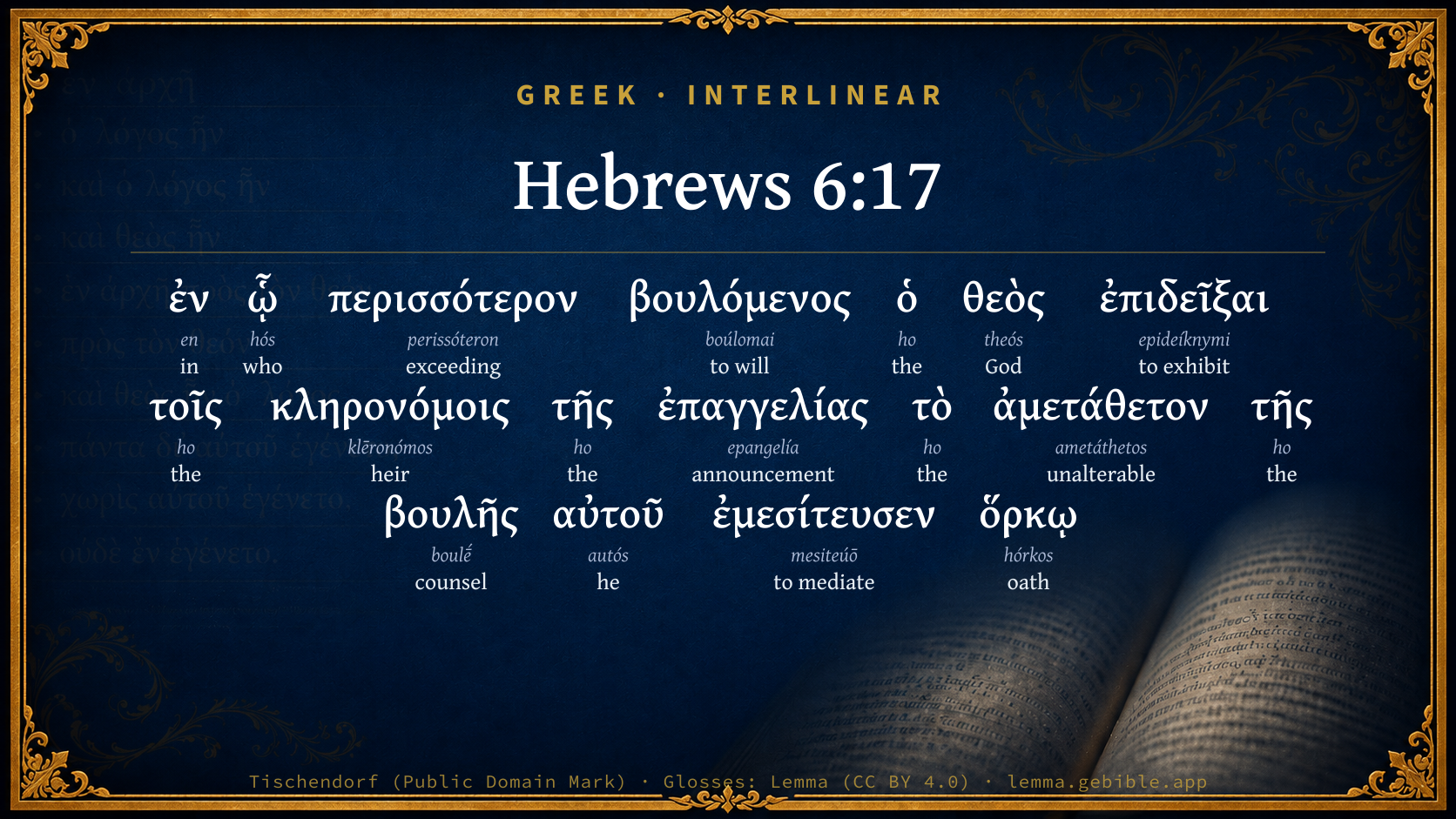
In this way God, being determined to show more abundantly to the heirs of the promise the immutability of his counsel, interposed with an oath;
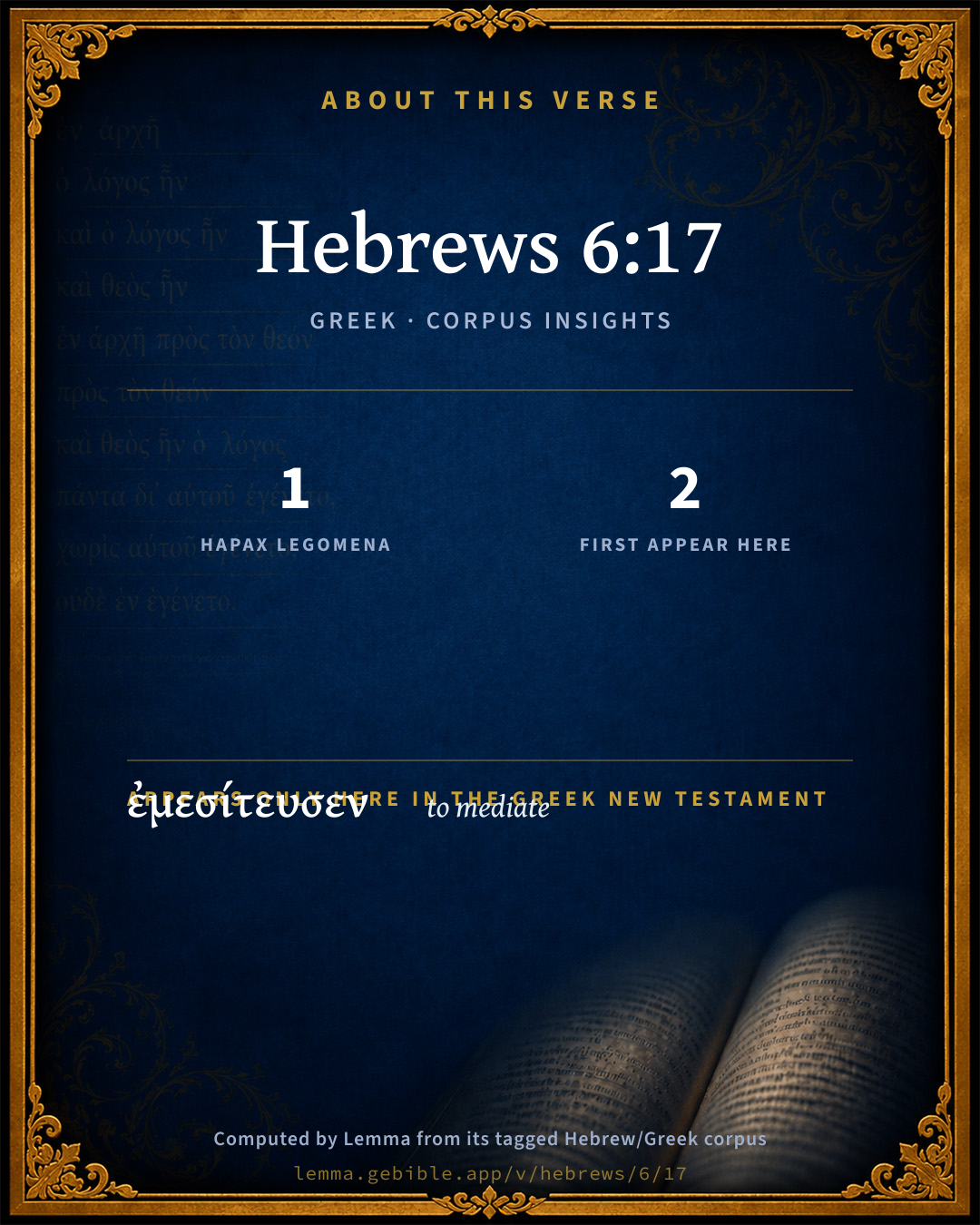
- 1 hapax legomenon — only here in the Greek New Testament
- 2 first appearances in the Greek New Testament
Download a study sheet
One document with this verse’s original text, its word-by-word gloss line, the meaning frame, cross-references with their text, attributed commentary, and full source and license credits — printable, and it pastes into notes with its structure intact.
This verse Autodidact and up
A passage Seminary Student
Up to 50 verses in one chapter. A passage sheet keeps up to 6 commentary sources and 12 cross-references per verse, in the order this page ranks them, and says so on the sheet whenever that leaves anything out. Ask for a single verse and you get the Autodidact verse sheet above.
Everything on this page stays free to read, with no account — the sheet is a download of what is already on screen, not access to it.
Compare translations 3
The same verse in 3 English versions, stacked beneath the original-language interlinear above. Click any original word for its lexicon entry.
Each is an independent rendering of the whole verse — the interlinear is not word-aligned to these translations.
Highlighted words mark where these versions differ — a whole-verse word diff, not a word-by-word alignment.
-
World English Bible Public Domain
In this way God, being determined to show more abundantly to the heirs of the promise the immutability of his counsel, interposed with an oath;
-
King James Version Public Domain
Wherein God, willing more abundantly to shew unto the heirs of promise the immutability of his counsel, confirmed it by an oath:
-
unfoldingWord Literal Text CC BY-SA 4.0
in which God, intending even more to show to the heirs of the promise the unchangeable quality of his purpose, mediated with an oath
unfoldingWord Literal Text — © unfoldingWord, licensed CC BY-SA 4.0. Word-aligned USFM3 via Door43 (git.door43.org/unfoldingWord/en_ult).
Show all 19 translations
Every available English version of this verse, each an independent rendering of the whole verse.
-
World English Bible Public Domain
In this way God, being determined to show more abundantly to the heirs of the promise the immutability of his counsel, interposed with an oath;
-
Berean Standard Bible Public Domain
So when God wanted to make the unchanging nature of His purpose very clear to the heirs of the promise, He guaranteed it with an oath.
-
Majority Standard Bible Public Domain
So when God wanted to make the unchanging nature of His purpose very clear to the heirs of the promise, He guaranteed it with an oath.
-
King James Version Public Domain
Wherein God, willing more abundantly to shew unto the heirs of promise the immutability of his counsel, confirmed it by an oath:
-
American Standard Version (1901) Public Domain
Wherein God, being minded to show more abundantly unto the heirs of the promise the immutability of his counsel, interposed with an oath;
-
Revised Version (1885) Public Domain
Wherein God, being minded to shew more abundantly unto the heirs of the promise the immutability of his counsel, interposed with an oath:
-
Geneva Bible (1599) Public Domain
So God, willing more aboundantly to shew vnto the heires of promise the stablenes of his counsell, bound himselfe by an othe,
-
Douay-Rheims (1899) Public Domain
Wherein God, meaning more abundantly to shew to the heirs of the promise the immutability of his counsel, interposed an oath:
-
Young's Literal Translation Public Domain
in which God, more abundantly willing to shew to the heirs of the promise the immutability of his counsel, did interpose by an oath,
-
Literal Standard Version CC BY-SA 4.0
in which God, more abundantly willing to show to the heirs of the promise the immutability of His counsel, interposed by an oath,
-
Unlocked Literal Bible CC BY-SA 4.0
When God decided to show more clearly to the heirs of the promise the unchangeable quality of his purpose, he guaranteed it with an oath.
-
unfoldingWord Literal Text CC BY-SA 4.0
in which God, intending even more to show to the heirs of the promise the unchangeable quality of his purpose, mediated with an oath
-
Darby Bible Public Domain
Wherein God, willing to shew more abundantly to the heirs of the promise the unchangeableness of his purpose, intervened by an oath,
-
World Messianic Bible Public Domain
In this way God, being determined to show more abundantly to the heirs of the promise the immutability of his counsel, interposed with an oath,
-
Webster's Bible Public Domain
Wherein God, willing more abundantly to show to the heirs of promise the immutability of his counsel, confirmed it by an oath:
-
Free Bible Version CC BY-SA 4.0
That's why God wanted to demonstrate more clearly to those who would inherit the promise that he would never ever change his mind.
-
Bible in Basic English Public Domain
So that when it was God's desire to make it specially clear to those who by his word were to have the heritage, that his purpose was fixed, he made it more certain with an oath;
-
Text-Critical English NT CC BY 4.0
So when God wanted to show the unchangeable nature of his purpose even more clearly to the heirs of the promise, he guaranteed it with an oath,
-
Tyndale New Testament (1534) Public Domain
So god willynge very aboundanly to shewe vnto the heyres of promes the stablenes of his counsayle he added an othe
Literal Standard Version (2020), Covenant Press — licensed CC BY-SA 4.0. Text via the HelloAO Bible API (eBible.org). Unlocked Literal Bible (unfoldingWord) — licensed CC BY-SA 4.0. Text via the HelloAO Bible API (eBible.org). unfoldingWord Literal Text — © unfoldingWord, licensed CC BY-SA 4.0. Word-aligned USFM3 via Door43 (git.door43.org/unfoldingWord/en_ult). Free Bible Version, Dr. Jonathan Gallagher — licensed CC BY-SA 4.0. Text via the HelloAO Bible API (eBible.org).
Word by word
More ways to search: Search by grammar → Find every occurrence → Compare this word →
Practice this passage: Drill this verse → Learn its vocabulary →
- Appears 1× in the Greek New Testament
- First appears here
- Part of Speech
- Verb
- Tense
- Aorist
- Voice
- Active
- Mood
- Indicative
- Person
- 3rd person
- Number
- Singular
Full Thayer's Definition
- ἐν en G1722 “in” Preposition
- ᾧ hós G3739 “who” Relative pronoun, Dative, Singular, Masculine
- περισσότερον perissóteron G4054 “exceeding” Adverb, Comparative
- βουλόμενος boúlomai G1014 “to will” Verb, Present, Middle or Passive deponent, Participle, Nominative, Singular, Masculine
- ὁ ho G3588 “the” Article, Nominative, Singular, Masculine
- θεὸς theós G2316 “God” Noun, Nominative, Singular, Masculine
- ἐπιδεῖξαι epideíknymi G1925 “to exhibit” Verb, Aorist, Active, Infinitive
- τοῖς ho G3588 “the” Article, Dative, Plural, Masculine
- κληρονόμοις klēronómos G2818 “heir” Noun, Dative, Plural, Masculine
- τῆς ho G3588 “the” Article, Genitive, Singular, Feminine
- ἐπαγγελίας epangelía G1860 “announcement” Noun, Genitive, Singular, Feminine
- τὸ ho G3588 “the” Article, Accusative, Singular, Neuter
- ἀμετάθετον ametáthetos G276 “unalterable” Adjective, Accusative, Singular, Neuter
- τῆς ho G3588 “the” Article, Genitive, Singular, Feminine
- βουλῆς boulḗ G1012 “counsel” Noun, Genitive, Singular, Feminine
- αὐτοῦ autós G846 “he” Personal pronoun, Genitive, Singular, Masculine
- ἐμεσίτευσεν mesiteúō G3315 “to mediate” Verb, Aorist, Active, Indicative, 3rd person, Singular
- ὅρκῳ hórkos G3727 “oath” Noun, Dative, Singular, Masculine
About this verse
These counts appear in no published source. They are computed here, from the morphology-tagged text and Lemma’s own curated glosses. What Lemma adds →
- 18
- words
- 14
- distinct lemmas
- General Epistles
- section
Notable vocabulary
1 hapax legomenon — a word that appears only here in the entire Greek New Testament:
- ἐμεσίτευσεν to mediate G3315
First appearance in Scripture
These words make their first canonical appearance in the Greek New Testament here:
Shared distinctive vocabulary
ἀμετάθετον unalterable G276 occurs in 2 verses of the Greek New Testament. Also found in:
Repetition
A word recurs within this verse:
- ὁ the G3588 ×5
Cross-references
30Topical passages linked to Hebrews 6:17 in the Treasury of Scripture Knowledge — connected by theme and wording, ordered by reader-vote popularity; previews shown in the World English Bible.
- Proverbs 19:21 There are many plans in a man's heart, But Yahweh's counsel will prevail.
- Hebrews 6:18 that by two immutable things, in which it is impossible for God to lie, we may have a strong encouragement, who have fled for refuge to take hold of the hope set before us.
- Isaiah 55:11 so shall my word be that goes forth out of my mouth: it shall not return to me void, but it shall accomplish that which I please, and it shall prosper in the thing whereto I sent it.
- Isaiah 14:24 Yahweh of Hosts has sworn, saying, Surely, as I have thought, so shall it happen; and as I have purposed, so shall it stand:
- Hebrews 11:9 By faith, he lived as an alien in the land of promise, as in a land not his own, dwelling in tents, with Isaac and Jacob, the heirs with him of the same promise.
- Psalms 110:4 Yahweh has sworn, and will not change his mind: "You are a priest forever in the order of Melchizedek."
- Psalms 33:11 The counsel of Yahweh stands fast forever, The thoughts of his heart to all generations.
- John 10:10 The thief only comes to steal, kill, and destroy. I came that they may have life, and may have it abundantly.
- Job 23:13–14 But he stands alone, and who can oppose him? What his soul desires, even that he does.
- Isaiah 55:7 let the wicked forsake his way, and the unrighteous man his thoughts; and let him return to Yahweh, and he will have mercy on him; and to our God, for he will abundantly pardon.
- Malachi 3:6 "For I, Yahweh, don't change; therefore you, sons of Jacob, are not consumed.
- Romans 11:29 For the gifts and the calling of God are irrevocable.
- Galatians 3:29 If you are Christ's, then you are Abraham's seed and heirs according to promise.
- Hebrews 6:12 that you won't be sluggish, but imitators of those who through faith and patience inherited the promises.
- Hebrews 6:16 For men indeed swear by a greater one, and in every dispute of theirs the oath is final for confirmation.
- James 1:17 Every good gift and every perfect gift is from above, coming down from the Father of lights, with whom can be no variation, nor turning shadow.
- 1 Peter 1:3 Blessed be the God and Father of our Lord Jesus Christ, who according to his great mercy became our father again to a living hope through the resurrection of Jesus Christ from the dead,
- 1 Peter 3:7 You husbands, in like manner, live with your wives according to knowledge, giving honor to the woman, as to the weaker vessel, as being also joint heirs of the grace of life; that your prayers may not be hindered.
- Exodus 22:11 the oath of Yahweh shall be between them both, whether he hasn't put his hand to his neighbor's goods; and the owner of it shall accept it, and he shall not make restitution.
- Song of Solomon 5:1 I have come into my garden, my sister, my bride. I have gathered my myrrh with my spice; I have eaten my honeycomb with my honey; I have drunk my wine with my milk. Friends Eat, friends! Drink, yes, drink abundantly, beloved. Beloved
- Isaiah 14:26–27 This is the purpose that is purposed on the whole earth; and this is the hand that is stretched out on all the nations.
- Isaiah 46:10 declaring the end from the beginning, and from ancient times things that are not [yet] done; saying, My counsel shall stand, and I will do all my pleasure;
- Isaiah 54:9–10 For this is [as] the waters of Noah to me; for as I have sworn that the waters of Noah shall no more go over the earth, so have I sworn that I will not be angry with you, nor rebuke you.
- Jeremiah 33:20–21 Thus says Yahweh: If you can break my covenant of the day, and my covenant of the night, so that there shall not be day and night in their season;
- Jeremiah 33:25–26 Thus says Yahweh: If my covenant of day and night fails, if I have not appointed the ordinances of heaven and earth;
- Romans 8:17 and if children, then heirs; heirs of God, and joint-heirs with Christ; if indeed we suffer with him, that we may also be glorified with him.
- Hebrews 11:7 By faith, Noah, being warned about things not yet seen, moved with godly fear, prepared an ark for the saving of his house, through which he condemned the world, and became heir of the righteousness which is according to faith.
- Genesis 26:28 They said, "We saw plainly that Yahweh was with you. We said, 'Let there now be an oath between us, even between us and you, and let us make a covenant with you,
- Psalms 36:8 They shall be abundantly satisfied with the abundance of your house. You will make them drink of the river of your pleasures.
- James 2:5 Listen, my beloved brothers. Didn't God choose those who are poor in this world to be rich in faith, and heirs of the Kingdom which he promised to those who love him?
Cross-references courtesy of OpenBible.info (CC BY 4.0).
Lesson kit
Teaching starters — assembled from the data on this page, not authored interpretation. Every prompt links to the verse data it draws on. Edit before teaching.
Hebrews, in the General Epistles, opens this verse with 18 words (14 distinct Greek lemmas). Its most distinctive word is mesiteúō (“to mediate”). A historical commentator’s framing appears above. Read the whole chapter for the surrounding context.
Discussion questions
- The word mesiteúō carries the sense “to mediate.” How does it shape the verse?
- This verse holds 1 word here found nowhere else in the Greek New Testament. What might the rare word draw attention to?
- 2 words here appear for the first time in Scripture. What is being introduced at this debut?
- Hebrews 6:18 shares the word «unalterable» with this verse. How do the two illuminate each other?
- “the” occurs 5× in this one verse. What is the effect of the repetition?
- These translations render this verse differently; the difference is in the English rendering, not the original. What questions does that raise?
- Reading how The Biblical Illustrator and Tyndale Open Study Notes read this verse, where do the two commentators agree and where do they part?
Things to notice
- 1 word in this verse appears nowhere else in the Greek New Testament.
- 2 words make their first canonical appearance in Scripture here.
- These translations choose different wording for 19 words in this verse.
- “the” occurs 5× in this single verse.
- 14 distinct Greek lemmas span 18 words in this verse.
Commentary
Notes on Hebrews 6:17 from classic Christian and Jewish commentators (each source and its license shown beneath its notes). The classic Christian expositions comment on the surrounding passage and are grouped to its opening verse, so a note may address several verses; the Jewish commentaries on the Tanakh (Rashi and others) are per-verse, so they appear only where the commentator wrote on this verse.
Lemma curates 59 commentaries, every one of them public domain or Creative Commons licensed, each selected and text-cleaned for this edition rather than reprinted as found. About our sources →
The Biblical Illustrator
Joseph S. Exell
The Biblical Illustrator, edited by Joseph S. Exell (c. 1880s–1900s) — public domain. Text from a community e-Sword module.
Tyndale Open Study Notes
Tyndale Open Resources
Tyndale Open Study Notes — © Tyndale Open Resources, licensed CC BY-SA 4.0. Text via the HelloAO Bible API.
Bengel's Gnomon
Johann Albrecht Bengel
Bengel's Gnomon of the New Testament — English translation (T&T Clark, Edinburgh, 1860) — public domain. Text from a community e-Sword module.
Meyer's Critical & Exegetical Commentary
Heinrich August Wilhelm Meyer
Meyer — Critical and Exegetical Commentary on the New Testament — English translation by Peter Christie, edited by Frederick Crombie (T&T Clark, 1880) — public domain. Text from a community e-Sword module.
Expositor's Greek Testament
ed. W. Robertson Nicoll
The Expositor's Greek Testament, edited by W. Robertson Nicoll (1897–1910) — public domain. Text from a community e-Sword module.
Geneva Bible (1599)
Geneva Bible translators
Geneva Bible (1599) marginal notes — public domain. Text via Bolls.life.
Jamieson, Fausset & Brown
Robert Jamieson, A. R. Fausset & David Brown
Jamieson, Fausset & Brown — Commentary Critical and Explanatory on the Whole Bible (1871) — public domain (CC PDM 1.0). Text via the HelloAO Bible API.
Adam Clarke's Commentary
Adam Clarke's Commentary on the Bible (1810–1826) — public domain. Text from a community e-Sword/MySword module.
John Calvin's Commentaries
John Calvin's Commentaries (1540-1563) — public domain. Text from the Calvin Translation Society English edition (1840s-50s) via the Christian Classics Ethereal Library (ccel.org). Calvin's coverage is partial (roughly two-thirds of the Bible); uncommented books and verses are honest gaps, never fabricated. The 19th-century editor's footnotes and remarks are omitted so the notes are faithfully Calvin's own voice.
Ellicott's Commentary for English Readers
A Bible Commentary for English Readers, edited by Charles John Ellicott (1878–1897) — public domain. Text from a community e-Sword module.
The Cambridge Bible for Schools and Colleges
gen. ed. J. J. S. Perowne
The Cambridge Bible for Schools and Colleges (gen. ed. J. J. S. Perowne; Cambridge University Press, 1878–1918) — public domain. Text from a community e-Sword module.
John Gill's Exposition
John Gill's Exposition of the Whole Bible (1746–1763) — public domain (CC PDM 1.0). Text via the HelloAO Bible API.
Trapp's Complete Commentary
John Trapp
John Trapp, A Commentary or Exposition upon All the Books of the Old and New Testament (1647–1656) — public domain. Text from a community e-Sword module.
Albert Barnes' Notes on the Bible
Albert Barnes' Notes on the Bible (1834–1885) — public domain. Text from a community e-Sword/MySword module.
Matthew Poole's English Annotations
Matthew Poole's English Annotations on the Holy Bible (1683–1685) — public domain. Text from a community e-Sword/MySword module.
Whedon's Commentary on the Bible
Daniel D. Whedon
Daniel D. Whedon (gen. ed.), Commentary on the Old and New Testaments (1874–1909) — public domain. Text from a community e-Sword module.
The Pulpit Commentary
The Pulpit Commentary (1880–1919), ed. H.D.M. Spence-Jones & Joseph S. Exell — public domain. Text from a community e-Sword module.
John Wesley's Explanatory Notes
John Wesley, Explanatory Notes Upon the Whole Bible (1754–1765) — public domain. Text via the GEBible commentary corpus.
Burkitt's Expository Notes on the New Testament
William Burkitt
William Burkitt's Expository Notes on the New Testament (1700–1703) — public domain. Text from a community e-Sword module.
The People's New Testament
B. W. Johnson
B. W. Johnson's The People's New Testament with Notes (1889–1891) — public domain. Electronic text from the Christian Classics Ethereal Library (CCEL) ThML edition.
Cambridge Greek Testament for Schools and Colleges
Cambridge Greek Testament for Schools and Colleges (Cambridge University Press, 1896; 21 vols, various authors incl. Carr, Maclear, Plummer, Farrar, Lumby, Moule, M. R. James, Simcox) — public domain. Text from a community e-Sword module.
Alford’s Greek Testament
Henry Alford
Henry Alford, The Greek Testament (1849–1861) — public domain. Text from a community e-Sword module.
Vincent's Word Studies in the New Testament
Marvin R. Vincent
Marvin R. Vincent, Word Studies in the New Testament (1887–1900) — public domain. Text from a community e-Sword/MySword module.
Westcott on Hebrews & the Epistles of John
Brooke Foss Westcott
Brooke Foss Westcott (1825–1901), The Epistle to the Hebrews (1889) and The Epistles of St John (1883) — public domain (pre-1929). Text recovered from Internet Archive / Google Books OCR scans. Westcott’s Gospel of John commentary is not included (its OCR lost the chapter running-heads required for reliable verse-keying). Some Greek quoted in the Hebrews volume is imperfectly rendered by the OCR.