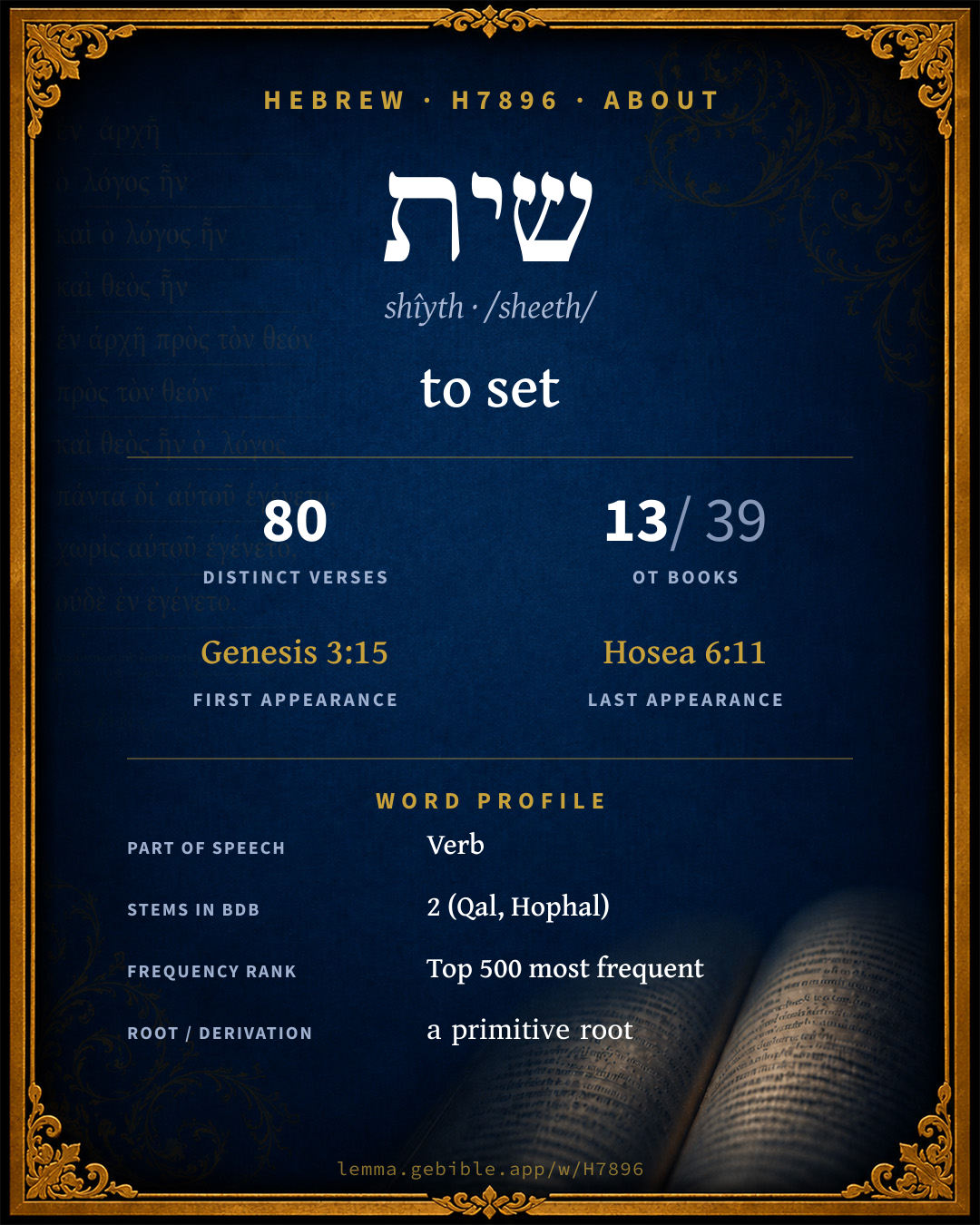
שִׁית
to set
‘to set’ is one of 2 main senses fuller range ↓
Full lexicon entry — Brown-Driver-Briggs (BDB)
From Brown-Driver-Briggs (BDB)
Where this word appears
Grammar key — what these labels mean
Part of speech
- Verb
- An action or state-of-being word.
Stem
- Qal
- The basic, simple active stem — the plain form of the verb (“he wrote”). Here: ‘put’
- Hophal
- The passive counterpart of the Hiphil (“he was caused to…”).
Form
- Imperfect
- An incomplete, ongoing, or future action (“he will / would write”).
- Sequential Imperfect
- An imperfect with prefixed waw — the standard past-narrative form (waw-consecutive imperfect).
- Perfect
- A completed action or state — Hebrew marks aspect (completeness) more than strict tense (“he wrote”).
- Imperative
- A direct command (“write!”).
- Jussive
- A third- or second-person volitional form expressing wish or command (“let him write”).
- Infinitive Construct
- A bound verbal noun, frequently with prepositions (“to write / in writing”).
- Sequential Perfect
- A perfect with prefixed waw continuing a preceding imperfect or command (waw-consecutive perfect).
- Infinitive Absolute
- An unbound verbal noun, often intensifying or standing in for a finite verb.
Person
- 1st Person
- The speaker (“I / we”).
- 3rd Person
- The one spoken about (“he / she / it / they”).
- 2nd Person
- The one addressed (“you”).
Gender
- Common
- Either gender — not distinguished for this form.
- Masculine
- Grammatically masculine.
- Feminine
- Grammatically feminine.
Number
- Singular
- One.
- Plural
- More than one (in Hebrew, generally three or more).
Every verse where H7896 appears in the Book of Psalms — 30 distinct verses. Click any verse to open its interlinear word-by-word view. Verse text shown in the World English Bible for context — . Each verse’s Hebrew form is shown with its reference; the English is not keyword-highlighted, since the data carries no word-level English alignment. Use “Compare translations” on any verse to read it across multiple English versions. This concordance covers the Hebrew Bible; Septuagint (Greek Old Testament) occurrences are not indexed here.
Psalms
- Psalms 3:6 שָׁ֣תוּ Qal pf 3cp I will not be afraid of tens of thousands of people Who have set themselves against me on every side.
- Psalms 8:6 שַׁ֣תָּה Qal pf 2ms You make him ruler over the works of your hands. You have put all things under his feet:
- Psalms 9:20 שִׁ֘יתָ֤/ה Qal impv 2ms + sfx h Put them in fear, Yahweh. Let the nations know that they are only men. Selah.
- Psalms 12:5 אָשִׁ֥ית Qal impf 1cs "Because of the oppression of the weak and because of the groaning of the needy, I will now arise," says Yahweh; "I will set him in safety from those who malign him."
- Psalms 13:2 אָשִׁ֪ית Qal impf 1cs How long shall I take counsel in my soul, Having sorrow in my heart every day? How long shall my enemy triumph over me?
- Psalms 17:11 יָ֝שִׁ֗יתוּ Qal impf 3mp They have now surrounded us in our steps. They set their eyes to cast us down to the earth.
- Psalms 18:11 יָ֤שֶׁת Qal impf 3ms He made darkness his hiding-place, his pavilion around him, Darkness of waters, thick clouds of the skies.
- Psalms 21:3 תָּשִׁ֥ית Qal impf 2ms For you meet him with the blessings of goodness; You set a crown of fine gold on his head.
- Psalms 21:6 תְשִׁיתֵ֣/הוּ Qal impf 2ms + sfx pers 3ms For you make him most blessed forever. You make him glad with joy in your presence.
- Psalms 21:9 תְּשִׁיתֵ֤/מוֹ Qal impf 2ms + sfx pers 3mp You will make them as a fiery furnace in the time of your anger. Yahweh will swallow them up in his wrath. The fire shall devour them.
- Psalms 21:12 תְּשִׁיתֵ֣/מוֹ Qal impf 2ms + sfx pers 3mp For you will make them turn their back, When you aim drawn bows at their face.
- Psalms 45:16 תְּשִׁיתֵ֥/מוֹ Qal impf 2ms + sfx pers 3mp Your sons will take the place of your fathers. You shall make them princes in all the earth.
- Psalms 48:13 שִׁ֤יתוּ Qal impv 2mp Mark well her bulwarks. Consider her palaces, That you may tell it to the next generation.
- Psalms 62:10 תָּשִׁ֥יתוּ Qal juss 2mp Don't trust in oppression. Don't become vain in robbery. If riches increase, Don't set your heart on them.
- Psalms 73:18 תָּשִׁ֣ית Qal impf 2ms Surely you set them in slippery places. You throw them down to destruction.
- Psalms 73:28 שַׁתִּ֤י Qal pf 1cs But it is good for me to come close to God. I have made the Lord Yahweh my refuge, That I may tell of all your works.
- Psalms 83:11 שִׁיתֵ֣/מוֹ Qal impv 2ms + sfx pers 3mp Make their nobles like Oreb and Zeeb; Yes, all their princes like Zebah and Zalmunna;
- Psalms 83:13 שִׁיתֵ֥/מוֹ Qal impv 2ms + sfx pers 3mp My God, make them like tumbleweed; Like chaff before the wind.
- Psalms 84:3 שָׁ֪תָה Qal pf 3fs Yes, the sparrow has found a home, And the swallow a nest for herself, where she may have her young, Near your altars, Yahweh of Hosts, my King, and my God.
- Psalms 84:6 יְשִׁית֑וּ/הוּ Qal impf 3mp + sfx pers 3ms Passing through the valley of Weeping, they make it a place of springs. Yes, the autumn rain covers it with blessings.
- Psalms 88:6 שַׁ֭תַּ/נִי Qal pf 2ms + sfx pers 1cs You have laid me in the lowest pit, In the darkest depths.
- Psalms 88:8 שַׁתַּ֣/נִי Qal pf 2ms + sfx pers 1cs You have taken my friends from me. You have made me an abomination to them. I am confined, and I can't escape.
- Psalms 90:8 שת שַׁתָּ֣ה Qal pf 2ms Qal pf 2ms You have set our iniquities before you, Our secret sins in the light of your presence.
- Psalms 101:3 אָשִׁ֨ית Qal impf 1cs I will set no vile thing before my eyes. I hate the deeds of faithless men. They will not cling to me.
- Psalms 104:20 תָּֽשֶׁת Qal impf 2ms You make darkness, and it is night, In which all the animals of the forest prowl.
- Psalms 110:1 אָשִׁ֥ית Qal impf 1cs Yahweh says to my Lord, "Sit at my right hand, Until I make your enemies your footstool for your feet."
- Psalms 132:11 אָ֝שִׁ֗ית Qal impf 1cs Yahweh has sworn to David in truth. He will not turn from it: "I will set the fruit of your body on your throne.
- Psalms 139:5 וַ/תָּ֖שֶׁת conj + Qal wimpf 2ms You hem me in behind and before. You laid your hand on me.
- Psalms 140:5 שָֽׁתוּ Qal pf 3cp The proud have hidden a snare for me, They have spread the cords of a net by the path. They have set traps for me. Selah.
- Psalms 141:3 שִׁיתָ֣/ה Qal impv 2ms + sfx h Set a watch, Yahweh, before my mouth. Keep the door of my lips.
About this entry
At a glance — auto-summarized from this page’s data, not written by a person. Every figure links to its source below. This summary describes the numbers; it doesn’t interpret them.
שית — transliterated shîyth — is a Hebrew verb carrying the sense “to set.” Its English rendering has broadened — “laid” classically, “put” (unfoldingWord Literal Text) in modern versions; see the renderings breakdown. Spanning 80 verses in 13 books, it ranks among the moderately common words of the Hebrew Bible. Its uses concentrate in Psalms (38% of all occurrences). Across 2 stems, its meaning turns on the binyan (Qal, Hophal). See the sense tree, 80-verse concordance, and the renderings breakdown below.
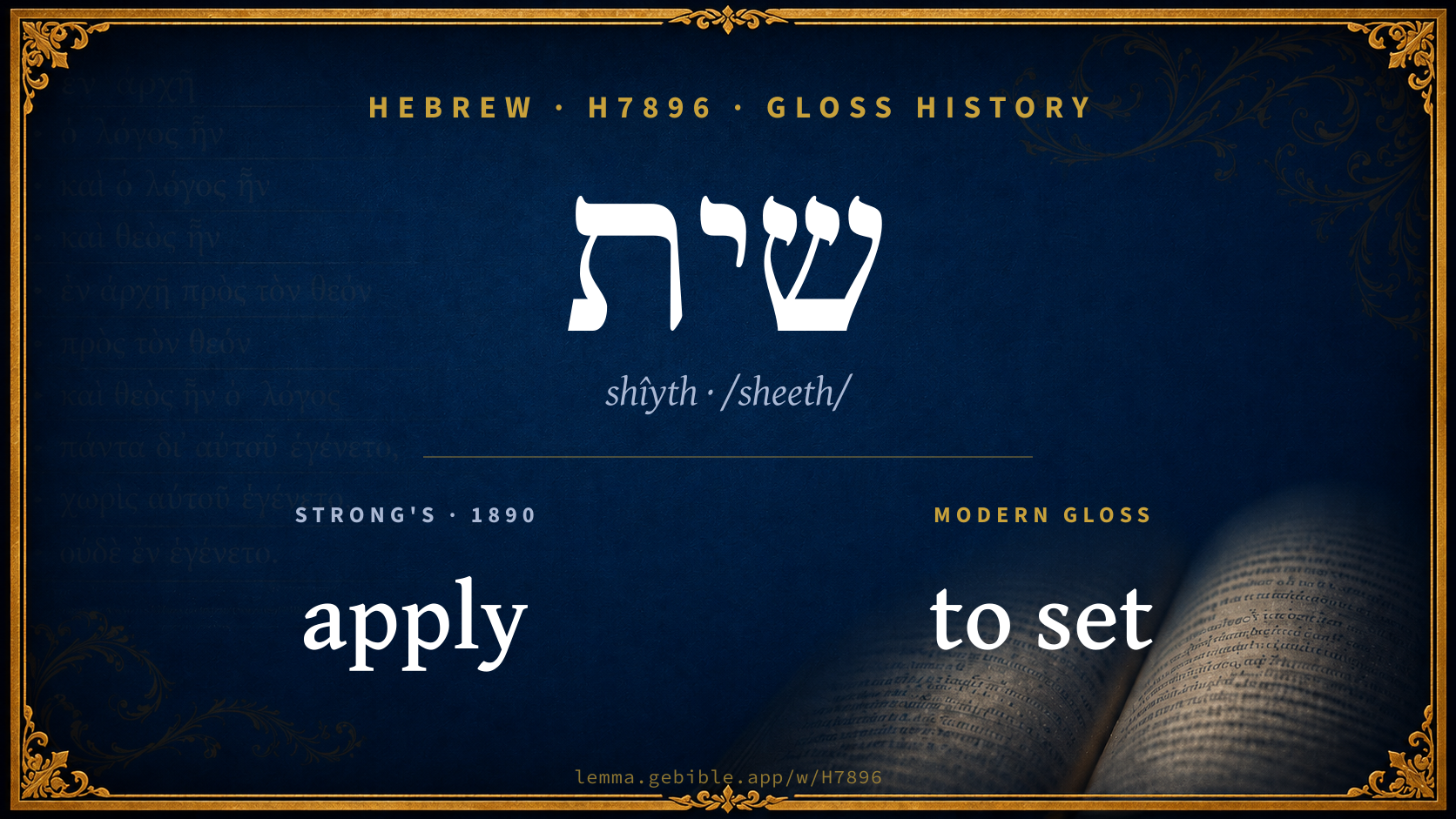
Gloss history
Strong's 1890 vs modern scholarship
About this word
Strong's H7896 catalogs a Hebrew word from the Hebrew Old Testament.
These counts are not copied from any lexicon or concordance. They are computed here, from the morphology-tagged Hebrew Old Testament. What Lemma adds →
- 80
- distinct verses
- The word appears in 80 distinct verses.
- 13 / 39
- OT books
- The word appears in 13 of 39 Old Testament books.
- #475
- by frequency
- Top 500 most frequent Hebrew words (rank 475 of 8,640 Hebrew words by occurrence).
View all 80 occurrences in the concordance →
By section of the Old Testament
By traditional corpus
Conventional, traditional groupings — biblical authorship is debated, so this is a traditional corpus grouping, not an authorship claim. Each share is this word’s portion of its verses in that division of the Hebrew canon. Each figure is a share of the word’s 80 distinct verses.
- Writings (Ketuvim) 44 verses · 55%
- Prophets (Nevi'im) 20 verses · 25%
- Torah (Pentateuch) 16 verses · 20%
How translations render this word
Counts come from each version’s own published word-to-Strong’s tagging or interlinear alignment — an approximate guide to how each version renders this word, not a word-level alignment the data otherwise carries. Because each total is that version’s own tagged count, the per-version totals vary from one another and need not match the appearance or distinct-verse counts above. These counts may also differ from a printed concordance because Lemma counts each distinctly tagged rendering and does not collapse phrase taggings into a single head-word total. This is a fixed set of word-tagged versions (KJV, ASV, BSB, ULT) and does not change with the reading translation you choose elsewhere. Each version’s license is shown beside its name below (and on Sources).
BDB lists this Strong’s number as 2 distinct words (homographs). Each count above pools all of them and is not split by sense — see the Senses section below. A low-frequency rendering may belong to a different one of those words, not the primary meaning.
- King James Version†: Laid 5×, Make 5×, Set 5×
- American Standard Version†: Set 7×, Laid 5×, Make 4×
- Berean Standard Bible†: Set 4×, He made 2×, I will bring 2×
- unfoldingWord Literal Text†: Put 9×, Set 8×, Do 3×
King James Version Public Domain
Renders H7896 across 83† tagged occurrences — most commonly:
Plus 51 renderings that appear only once — usually multi-word phrases or single function words the recovered tagging swept in, not distinct renderings. Not rendered by a distinct English word in 2 further occurrences.
American Standard Version Public Domain
Renders H7896 across 83† tagged occurrences — most commonly:
Plus 51 renderings that appear only once — usually multi-word phrases or single function words the recovered tagging swept in, not distinct renderings. Not rendered by a distinct English word in 1 further occurrence.
Berean Standard Bible Public Domain
Renders H7896 across 80† tagged occurrences — most commonly:
Plus 64 renderings that appear only once — usually multi-word phrases or single function words the recovered tagging swept in, not distinct renderings. Not rendered by a distinct English word in 3 further occurrences.
unfoldingWord Literal Text CC BY-SA 4.0
Renders H7896 across 95† tagged occurrences — most commonly:
Plus 55 renderings that appear only once — usually multi-word phrases or single function words the recovered tagging swept in, not distinct renderings.
8 senses and sub-senses in the full BDB
Hebrew verbs can shift meaning by stem (binyan): Qal is the basic action, Niphal is often passive or reflexive, Piel often intensifies or makes it factitive, and Hiphil is typically causative. The senses below are grouped under the stem BDB assigns to each. This entry also uses Hophal (the passive of Hiphil).
What do BDB’s symbols mean?
BDB uses these scholarly abbreviations:
| Symbol | Meaning |
|---|---|
| 𝔊 | the Septuagint (the ancient Greek translation, LXX) |
| 𝔙 | the Vulgate (the Latin translation) |
| 𝔖 | the Syriac version (the Peshitta) |
| 𝔗 | the Targum (the Aramaic translation) |
| ψ | the Psalms |
| √ | root (the underlying root or stem) |
| ‖ | parallel passage (a synonymous or contrasted parallel) |
| † | the dagger: every passage where the word occurs is cited |
The 8 senses and sub-senses the full Brown-Driver-Briggs lexicon distinguishes for this word, in lexicon order (not ranked by frequency), with BDB’s own verbatim wording and sub-sense lettering. Shown in Hebrew script with BDB’s own scholarly abbreviations. The condensed entry is in the Lexicon Entry tab. See also the Forms in the corpus table below.
שית I put, set (NöBeitr. z. Sem. Sprachwiss. 39 f.
Qal
- Pf. 3 ms. שָׁת Gn 4:25 +, 3 fs. שָׁ֫תָה 1 S 4:20 +, 2 ms. שַׁ֫תָּה ψ 8:7, שַׁ֫תָּ 90:8, sf. שַׁתַּ֫נִי 88:7, 9, 1 s. שַׁ֫תִּי 73:28 +; 3 pl. שָּׁ֫תוּ Ex 33:4 + 3 times, metapl. שַׁתּוּ ψ 49:15; 73:9 (other forms not found); Impf. 3 ms. יָשִׁית Ex 21:22 +, juss. יָשֵׁת Jb 9:33, וַיָּ֫שֶׁת Gn 30:40 +; 3 fs. sf. וַתְּשִׁתֵ֫הוּ Ru 4:16, תִּשִׁיתֵ֫מוֹ ψ 21:10 +, 1 s. sf. אֲשִׁתֶ֫נּוּ 1 K 11:34; Imv. ms. שִׁית Pr 27:23, שִׁיתָ֫ה ψ 9:21; 141:3; fs. שִׁ֫תִי Je 31:21, etc.; Inf. abs. שֹׁת Is 22:7; cstr. שִׁית Jb 30:1 +; Pt. pass. וְשִׁית (Je 13:16 Qr, but read Kt יָשִׁית); sf. שִׁתִי Ex 10:1;— e.g. Genesis 4:25
- 1. put, lay hand upon, עַל, Gn 46:4 (E), 48:14, 17 (J), Jb 9:33 ψ 139:5; c. עִם in evil partnership, Ex 23:1 (E); put ornaments, עַל pers., 33:4 (J); cf. 1 S 2:8 Is 15:9 Jb 22:24 Ru 3:15; lay child into (ב) bosom Ru 4:16; put wisdom, ב loc., Jb 38:36, cf. Pr 26:24; אָשִׁית עֵצוֹת בְּנַפְשִׁי ψ 13:3, i.e. take counsel, plan; מַחְסִי בי׳ ψ 73:28; put things תַּחַת רַגְלָיו 8:7; lay (penalty) עַל pers. Ex 21:22 (E), sin Nu 12:11 (E), cf. (c. אֲשֶׁר = where) ψ 84:4; nearly = give (נתן), acc. + ל pers. Gn 4:25 (J; explan. of name שֵׁת), appoint ψ 9:21. e.g. Genesis 46:4
- 2.
- a. set, station, sheep לְבַדּוֹ Gn 30:40, cf. לֹא שָׁתָם עַל v 40 (J); acc. pers. = appoint (עַל over) 41:33 (E); set לָמוֹ pers. (ל 3 b) + ב loc. ψ 73:18, so (acc.) 88:7 and (obj. pers. om.) 12:6, set crown לְרֹאשׁוֹ 21:4, set one (מִן partit.) לְכִסֵּא 132:11; set pers. among (ב pers.) 2 S 19:29; Je 3:19, cf. (עִם) Jb 30:1; set watch לְפִי ψ 141:3, snares לִי 140:6, enmity, בֵּין pers. Gn 3:15 (J); iniquities לְנֶגְדֶּ֑ךָ ψ 90:8, cf. 101:3; set, direct face, אֶל loc. Nu 24:1 (J), eyes לִנְטוֹת בָּאָרֶץ ψ 17:11. e.g. Genesis 30:40
- b. in phr. שׁ׳ לֵב לְ set one’s mind to, give heed, attention (cf. שׂוּם 2 b), Ex 7:23 (E), 2 S 13:20; Je 31:21 ψ 48:14 Pr 22:17; 27:23, c. אֶל Jb 7:17, abs. 1 S 4:20 ψ 62:11; Pr 24:32 I reflected. e.g. Exodus 7:23
- c. set, fix, גְּבוּל Ex 23:31 (E; c. מִן … עַד), תָּשִׁית לִי הֹק Jb 14:13 wouldst fix me a limit, 38:11 (וּפֹא יָשִׁית בִּגְאוֹן גַּלָּיךָ De al. here shall one fix it [the boundary, חֹק, v 10] = it shall be fixed against, etc.: but explan. very forced: Me Kau יִשָּׁבֵר ג׳, Bi Bu יִשְׁבֹּת ג׳). e.g. Exodus 23:31
- 3. constitute, make one something, 2 acc., 1 K 11:34 I will make him prince, Is 5:6; 26:1; Je 22:6 ψ 21:7; 84:7; 88:9 (+ למוֹ ind. obj.), 110:1 2 S 22:12 ‖ ψ 18:12; תְּשִׁיתֵמוֹ שֶׁ֑כֶם 21:13 = thou wilt make them (all) shoulder, make them turn their back, flee (cf. 18:41); acc. + ל make something into Je 2:15 = 50:3; 13:16 ψ 45:17 (+ ב loc.); acc. + ב comp. make one like Ho 2:5 (‖ שִׂים), Is 16:3 ψ 21:10; 83:12, 14; acc. only, make, prepare, feast Je 51:39, cf. שָׁת קָצִיר לָךְ Ho 6:11 (read poss. שִׁית, pt. pass.), make darkness ψ 104:20; = perform signs, ב loc. Ex 10:1 (J). e.g. 1 Kings 11:34
- 4. internally trans., = take one’s stand (cf. שִׂים 4 a) הַפָּרָשִׁים שֹׁת שָׁתוּ הַשָּׁ֑עְרָה Is 22:7; c. עָלָֽי (against) ψ 3:7.—יָשִׁית מִמֶּנִּי Jb 10:20 (Kt; > Qr Imv. וְשִׁית) is dub., יָשִׁית = יָשֵׁת: De direct (attention) away from me, cf. Di (ellipsis of יָד, פָּנִים, or לֵב), Du (sc. יָד; reads Imv.); Lag (so Bu) proposes יִשְׁבֹּת, Siegf (יָדוֹ) יָשֵׁב, 𝔊 Beer (best) שְׁעֵה (7:19), with יְמֵי חֶלְדִּי (𝔊 Bu Be Du) for יָמַי יחדל prob. rightly. e.g. Isaiah 22:7
Hophal
- (or Qal pass. Ges§ 53 u), Impf. 3 ms. יוּשַׁת Ex 21:30 (E) if a ransom be imposed עָלָיו, v. 30. e.g. Exodus 21:30
שית II garment (NöBeitrlige, 41 f., cp. Syriac ܫܺܝܽܘܬܳܐ appearance, and qu. שִׁיֻּת?)
Senses from the full Brown-Driver-Briggs lexicon (Brown, Driver, Briggs; Oxford 1906 — public domain), digitized via Sefaria, supplemented by the OpenScriptures HebrewLexicon (CC BY 4.0). Full attribution on Sources.
Word origin
I. vb. put, set (NöBeitr. z. Sem. Sprachwiss. 39 f.; cf. Ph. שת Lzb 375; Ecclus שית Pt. pass. 31:27 (?); v. also (Nöl.c. 41) Syriac ܫܺܝܽܘܬܳܐ quality, appearance);—
II. n.m. garment (NöBeitrlige, 41 f., cp. Syriac ܫܺܝܽܘܬܳܐ appearance, and qu. שִׁיֻּת?);—cstr. שִׁית זוֹנָה Pr 7:10; fig. שׁ׳ חָמָס ψ 73:6 (v. II. עטף).
— Brown-Driver-Briggs (Oxford 1906, public domain), digitized via Sefaria, supplemented by the OpenScriptures HebrewLexicon (CC BY 4.0). See Sources.
Origin: a primitive root
Jastrow Dictionary
A second Hebrew/Aramaic lexicon for comparison, covering Aramaic and post-biblical (Talmudic, Targumic, Midrashic) usage that the biblical-Hebrew BDB does not. Matched by lemma rather than by Strong’s number, so a lemma may carry more than one Jastrow headword (shown separately below), and the entries cover usage well beyond the Bible.
מַשְׁתִּית
- (denom. of שָׁת, pl. שָׁתוֹת; שִׁית) foundation. Gen. R. s. 71 (play on ב̇ג̇ד̇, Gen. XXX, 11) ב̇א מי שעתיד לג̇ד̇ד מַשְׁתִּיתָן וכ׳ he is coming who is destined to cut down the foundation (idolatry) of the gentiles (Ellijah the Gadite). v. מִשְׁתּוּיִין; Midr. Till. to Ps. XC, 1 מַשְׁתִּיתוֹ של עכ"ום the foundation of idolatry. Gen. R. s. 75 (ref. to השתות, Ps. XI, 3) Jacob שהוא מַשְׁתִּיתוֹ ויסודו וכ׳ who is the foundation and basis of the world; (Yalk. Ps. 653 שְׁתִיַּית עולם, v. שְׁתִיָּה). Koh. R. to II, 5 מַשְׁתִּיתָהּ של ארץ the foundation (centre) of the earth. Ib. to II, 12. Midr. Sam. ch. XXVI. e.g. Genesis 30:11
שִׁית I
- to place, set, make.
- same. Snh. 27ᵃ (ref. to Ex. XXIII, 1) אל תָּשֶׁת רשע עד make not a wicked man a witness (disqualify him); אל תשת חמס עד allow not violence (robbers) to testify; Mekh. Mishp., s. 20; Yalk. Ex. 352.—[Yalk. Ps. 620 השיתיו, v. שָׁתָה II.] e.g. Exodus 23:1
שִׁית II
- (שָׁתַת II) foundation; (cmp. יְסוֹד) bottom, esp. Shith, a pit by the side of the altar into which the remainder of libations was poured. Midd. III, 3 שבו יורדין לש׳ וכ׳ by which men went down the Sh. to cleanse it. Tosef. Succ. III, 15 יורדין לש׳ וכ׳ the wine goes down into the pit and is swallowed up there. Ib. (ref. to וגם יקב, Is. V, 2) זה הש׳ this refers to the Sh.; Y. ib. IV, 54ᵈ top; Bab. ib. 49ᵃ השִׁיתִּין (pl.).—Pl. שִׁיתִּין. Ib. ש׳ מששת ימי וכ׳ the Shittin have existed from the six days of creation (are a natural cavity). Ib. 53ᵃ בשעה שכרה דוד ש׳ when David began to dig the pits (for the Temple); Macc. 11ᵃ; Yalk. Ps. 878 שִׁתִּין. Meïl. III, 3 (11ᵃ) (ירדו) יצאו לש׳ וכ׳ so soon as the wine is let down into the pits &c. Yalk. Ps. 653, v. פָּגַר. e.g. Isaiah 5:2
שִׁית III
- wild fig.—Pl. שִׁיתִין (or שִׁיתִּין). Dem. I, 1; Tosef. ib. I, 1; Erub. 18ᵃ; Ber. 40ᵇ (expl. מין תאנים).
שִׁית
- = h. שֵׁשׁ, six. Targ. Gen. VII, 6 (O. ed. Berl. שֵׁית; ed. Vien. שִׁתְּ). Ib. XXX, 20 (O. ed. Berl. שיתה); a. v. fr.—Pes. 94ᵃ ש׳ אלפי וכ׳ the world (distance from sunrise to sunset) is six thousand parasangs. Snh. 97ᵃ ש׳ אלפי שני הוי וכ׳ the world will exist six thousand years; a. fr.—Pl. שִׁיתִּין, שִׁתִּ׳ sixty. Targ. Gen. XXV, 26; a. fr.—B. Kam. 92ᵇ ש׳ תכלי, v. כַּכָּא. Ib. ש׳ רהוטי, v. צַפְרָא. Ab. Zar. 69ᵃ בש׳ requires sixty portions to be neutralized; a. e.—שִׁיתַּת עֲשַׂר, שֵׁיתֵיסַר, שֵׁיתְסַר, שֵׁיתְסְרֵי, שִׁיתְ׳ sixteen; sixteenth. Targ. Ex. XXVI, 25. Targ. Y. Deut. XXXIV, 8 (ed. Vien. שֵׁתֵיסַר); a. fr.—שֵׁיתְסְרָאָה m. the sixteenth. Targ. I Chr. XXIV, 14 (ed. Lag. שִׁיסְרָאָה).
A Dictionary of the Targumim, the Talmud Babli and Yerushalmi, and the Midrashic Literature (Marcus Jastrow; London, Luzac, 1903) — Public Domain. Digitized via Sefaria. Digitized via Sefaria. Full attribution on Sources.
Forms in the corpus
The 76 distinct written forms H7896 takes in the Hebrew Bible, most frequent first — each parse links to that stem’s occurrences in the concordance. Hebrew forms include their vowel points and cantillation, so a single lemma takes many written forms.
The 60 most common forms are shown; 16 rarer forms follow in the full concordance.
Same root — word family
Other BDB entries built from the same root as H7896, grouped by Strong’s listed origin. These share a root / origin per the lexicon — not necessarily a shared meaning. Each links to that word’s own entry.
Derived from this word
- שית shîyth H7897 garment
- שית shayith H7898 thorn bushes
- שתה shâthâh H8356 foundation
- שתה shêthâh H8357 buttocks
- שתי shᵉthîy H8359 woven material
Proper names from this root
People and places named from this root — a name, not an additional meaning of the word.
Compare all same-root words → Showing 4 of 7 — not the complete family. 1 of the same-root words is a proper name (a person or place). They share a root, not necessarily a meaning.
Septuagint verse parallels
This word appears in 76 verses that also exist in the Greek Old Testament (Septuagint), out of the 80 Hebrew verses it occurs in. You can read those verses in Greek by switching the Old Testament edition to the Septuagint.
Read these verses in the Septuagint
- Genesis 3:15
- Exodus 7:23
- Numbers 12:11
- Ruth 3:15
- 1 Samuel 2:8
- 2 Samuel 13:20
- 1 Kings 11:34
- Job 7:17
- Psalms 3:6
- Proverbs 22:17
- Isaiah 5:6
- Jeremiah 2:15
This is a verse-level parallel only — the same verses exist in both the Hebrew and Greek Old Testaments. No word-level Hebrew↔Greek correspondence is claimed: the data carries no such alignment, so no Greek word is shown as this Hebrew word’s translation. Coverage is not total — the Septuagint omits the deuterocanon and renumbers the Psalms, so some Hebrew verses have no direct Greek parallel.