
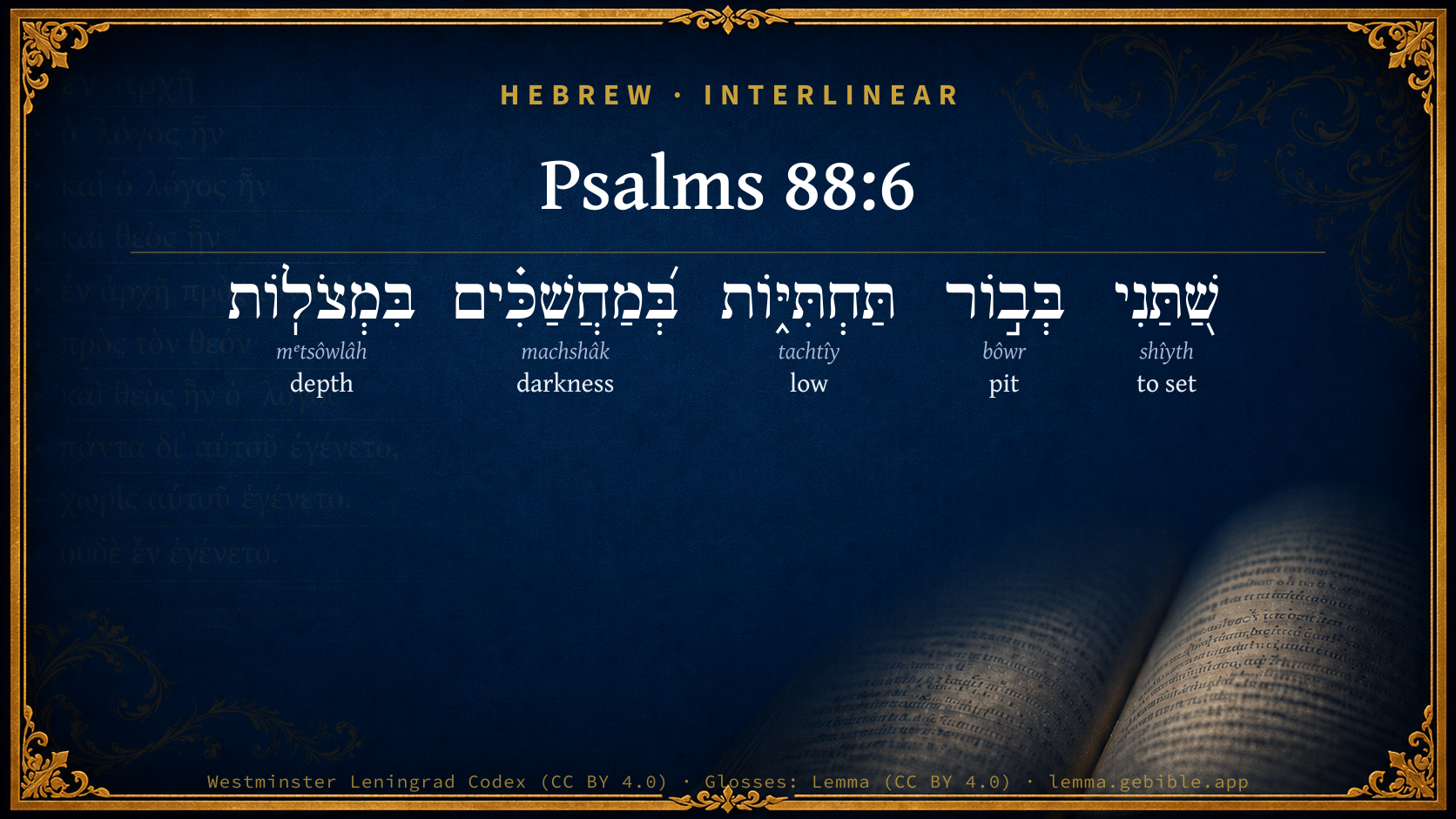
Psalms 88:6

Hebrew (Westminster Leningrad Codex) Psalms 88:6 appears in the Hebrew Old Testament. The text above is from the Westminster Leningrad Codex. Each word links to its Strong’s number, a concise gloss, and parsing drawn from the Open Scriptures Hebrew Bible morphology. Click any word for its full Brown-Driver-Briggs (BDB) entry.
Download image
Cite this verse

Psalms 88:6 (World English Bible). Public Domain. Lemma interlinear Bible study tool, https://lemma.gebible.app/v/psalms/88/6.

Show BibTeX & RIS
BibTeX
RIS
English Translation
You have laid me in the lowest pit, In the darkest depths.
World English Bible · Public Domain
Download a study sheet

One document with this verse’s original text, its word-by-word gloss line, the meaning frame, cross-references with their text, attributed commentary, and full source and license credits — printable, and it pastes into notes with its structure intact.

This verse Autodidact and up

Study sheet (.html) Plain text (.txt)

A passage Seminary Student

Up to 50 verses in one chapter. A passage sheet keeps up to 6 commentary sources and 12 cross-references per verse, in the order this page ranks them, and says so on the sheet whenever that leaves anything out. Ask for a single verse and you get the Autodidact verse sheet above.

Everything on this page stays free to read, with no account — the sheet is a download of what is already on screen, not access to it.

Want to remove ads? Support Godless Engineer
Compare translations 3

The same verse in 3 English versions, stacked beneath the original-language interlinear above. Click any original word for its lexicon entry.

Each is an independent rendering of the whole verse — the interlinear is not word-aligned to these translations.

Highlighted words mark where these versions differ — a whole-verse word diff, not a word-by-word alignment.

  • World English Bible Public Domain
    You have laid me in the lowest pit, In the darkest depths.
  • King James Version Public Domain
    Thou hast laid me in the lowest pit, in darkness, in the deeps.
  • unfoldingWord Literal Text CC BY-SA 4.0
    You have set me in the pit of the depths, in dark places, in deep places.

unfoldingWord Literal Text — © unfoldingWord, licensed CC BY-SA 4.0. Word-aligned USFM3 via Door43 (git.door43.org/unfoldingWord/en_ult).

Versions to compare (up to 4)

3 of 4 selected

Show all 18 translations

Every available English version of this verse, each an independent rendering of the whole verse.

  • World English Bible Public Domain
    You have laid me in the lowest pit, In the darkest depths.
  • Berean Standard Bible Public Domain
    You have laid me in the lowest Pit, in the darkest of the depths.
  • Majority Standard Bible Public Domain
    You have laid me in the lowest Pit, in the darkest of the depths.
  • King James Version Public Domain
    Thou hast laid me in the lowest pit, in darkness, in the deeps.
  • American Standard Version (1901) Public Domain
    Thou hast laid me in the lowest pit, In dark places, in the deeps.
  • Revised Version (1885) Public Domain
    Thou hast laid me in the lowest pit, in dark places, in the deeps.
  • Geneva Bible (1599) Public Domain
    Thou hast layde me in the lowest pit, in darkenes, and in the deepe.
  • Douay-Rheims (1899) Public Domain
    free among the dead. Like the slain sleeping in the sepulchres, whom thou rememberest no more: and they are cast off from thy hand.
  • Young's Literal Translation Public Domain
    Thou hast put me in the lowest pit, In dark places, in depths.
  • Literal Standard Version CC BY-SA 4.0
    You have put me in the lowest pit, || In dark places, in depths.
  • Unlocked Literal Bible CC BY-SA 4.0
    You place me in the lowest part of the pit, in the dark and deep places.
  • unfoldingWord Literal Text CC BY-SA 4.0
    You have set me in the pit of the depths, in dark places, in deep places.
  • Darby Bible Public Domain
    Thou hast laid me in the lowest pit, in dark places, in the deeps.
  • World Messianic Bible Public Domain
    You have laid me in the lowest pit, in the darkest depths.
  • Webster's Bible Public Domain
    \\88:5\\Free among the dead, like the slain that lie in the grave, whom thou rememberest no more: and they are cut off from thy hand.
  • Free Bible Version CC BY-SA 4.0
    You have placed me in a deep pit, in the depths of darkness.
  • Bible in Basic English Public Domain
    You have put me in the lowest deep, even in dark places.
  • JPS Tanakh (1917) Public Domain
    (88-7) Thou hast laid me in the nethermost pit, in dark places, in the deeps.

Literal Standard Version (2020), Covenant Press — licensed CC BY-SA 4.0. Text via the HelloAO Bible API (eBible.org). Unlocked Literal Bible (unfoldingWord) — licensed CC BY-SA 4.0. Text via the HelloAO Bible API (eBible.org). unfoldingWord Literal Text — © unfoldingWord, licensed CC BY-SA 4.0. Word-aligned USFM3 via Door43 (git.door43.org/unfoldingWord/en_ult). Free Bible Version, Dr. Jonathan Gallagher — licensed CC BY-SA 4.0. Text via the HelloAO Bible API (eBible.org).

Word by word

More ways to search: Search by grammar → Find every occurrence → Compare this word →

Practice this passage: Drill this verse → Learn its vocabulary →

About this verse

These counts appear in no published source. They are computed here, from the morphology-tagged text and Lemma’s own curated glosses. What Lemma adds →

5
words
5
distinct lemmas
Wisdom
section

Notable vocabulary

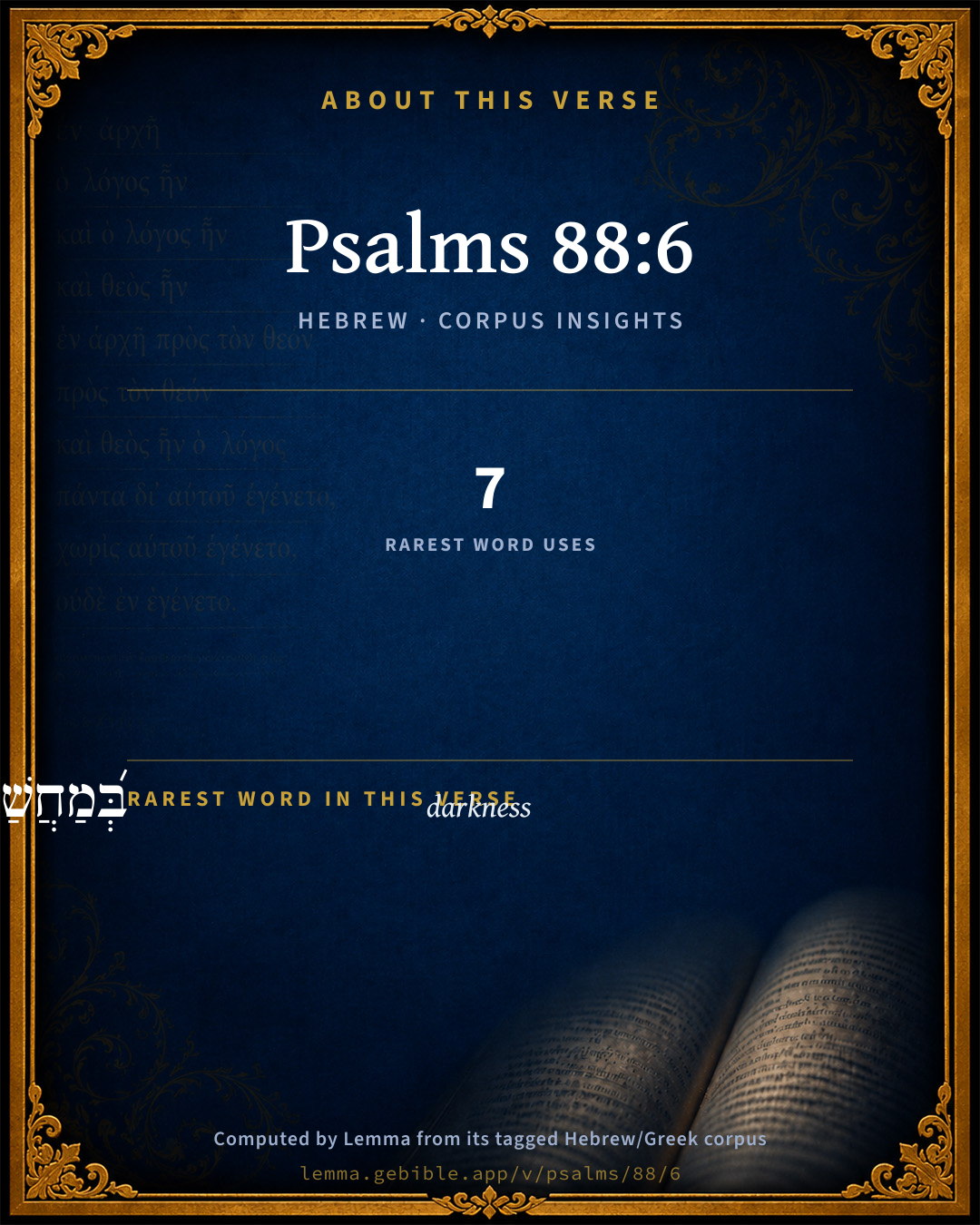
The rarest word here is בְּ֝מַחֲשַׁכִּ֗ים darkness H4285 — appearing just 7 times in the whole Hebrew Bible.

Shared distinctive vocabulary

בְּ֝מַחֲשַׁכִּ֗ים darkness H4285 occurs in 7 verses of the Hebrew Bible. Also found in:

Grammatical profile

  • 1 verb
  • 3 nouns
  • 1 adjective

Verb forms

  • שַׁ֭תַּנִי Qal · Perfect

Hebrew & Septuagint length

In English translation the verse runs 12 words from the Hebrew and 16 from the Septuagint (LXX English) — closely comparable.

A rough comparison of the two English renderings, which tokenize alike — not a word-level alignment.

Word counts can differ between the Hebrew and the Greek without any difference in meaning — e.g. the Hebrew direct-object marker אֵת has no separate Greek word, and Greek often adds the article ὁ.

Cross-references

12

Topical passages linked to Psalms 88:6 in the Treasury of Scripture Knowledge — connected by theme and wording, ordered by reader-vote popularity; previews shown in the World English Bible.

  • Psalms 69:15 Don't let the flood waters overwhelm me, Neither let the deep swallow me up. Don't let the pit shut its mouth on me.
  • Psalms 86:13 For your loving kindness is great toward me. You have delivered my soul from the lowest Sheol.
  • Psalms 40:2 He brought me up also out of a horrible pit, Out of the miry clay. He set my feet on a rock, And gave me a firm place to stand.
  • Psalms 143:3 For the enemy pursues my soul. He has struck my life down to the ground. He has made me live in dark places, as those who have been long dead.
  • Lamentations 3:2 He has led me and caused me to walk in darkness, and not in light.
  • John 12:46 I have come as a light into the world, that whoever believes in me may not remain in the darkness.
  • Deuteronomy 32:22 For a fire is kindled in my anger, Burns to the lowest Sheol, Devours the earth with its increase, Sets on fire the foundations of the mountains.
  • Psalms 130:1 Out of the depths I have cried to you, Yahweh.
  • Proverbs 4:19 The way of the wicked is like darkness. They don't know what they stumble over.
  • Lamentations 3:55 I called on your name, Yahweh, out of the lowest dungeon.
  • Jude 1:6 Angels who didn't keep their first domain, but deserted their own dwelling place, he has kept in everlasting bonds under darkness for the judgment of the great day.
  • Jude 1:13 wild waves of the sea, foaming out their own shame; wandering stars, for whom the blackness of darkness has been reserved forever.

Cross-references courtesy of OpenBible.info (CC BY 4.0).

Hebrew and Greek witnesses Masoretic Hebrew ↔ Greek Septuagint

The same verse in the two great witnesses to the Old Testament, shown verse-for-verse.

You’re reading Greek Psalm 87 (Hebrew Psalm 88). The Septuagint counts the superscription, so verse numbers can differ from the Hebrew — chapter-level alignment, not verse-by-verse. Numbering follows Rahlfs.

These are two independent witnesses, not word-aligned to each other, and the Septuagint is shown in lemma (dictionary) form.

Hebrew Psalms 88:6 Masoretic · Westminster Leningrad Codex

שַׁ֭תַּנִי בְּב֣וֹר תַּחְתִּיּ֑וֹת בְּ֝מַחֲשַׁכִּ֗ים בִּמְצֹלֽוֹת

You have laid me in the lowest pit, In the darkest depths.

World English Bible · Public Domain

Greek LXX Greek Psalm 87:6 Septuagint · lemma form

ὡσεί τραυματίας ῥίπτω καταεὕδω ἐν τάφος ὅς οὐ μιμνήσκω ἔτι καί αὐτός ἐκ ὁ χείρ σύ ἀποὠθέω

They laid me in the lowest pit, in dark places, and in the shadow of death.

LXX2012 (modern English Septuagint) · Public Domain

On this verse, The Cambridge Bible for Schools and Colleges discusses the Septuagint’s reading. Read the note in Commentary ↓

Hebrew: Westminster Leningrad Codex (CC BY 4.0). Greek: Septuagint (public domain); English from LXX2012 (modern English Septuagint) (Public Domain). How the Septuagint differs from the Hebrew →

Commentary

Notes on Psalms 88:6 from classic Christian and Jewish commentators (each source and its license shown beneath its notes). The classic Christian expositions comment on the surrounding passage and are grouped to its opening verse, so a note may address several verses; the Jewish commentaries on the Tanakh (Rashi and others) are per-verse, so they appear only where the commentator wrote on this verse.

Lemma curates 59 commentaries, every one of them public domain or Creative Commons licensed, each selected and text-cleaned for this edition rather than reprinted as found. About our sources →

Trapp's Complete Commentary

John Trapp

Psa 88:6 Thou hast laid me in the lowest pit, in darkness, in the deeps.

Ver. 6. Thou hast laid me in the lowest pit] In cisterna infimorum, in the deepest dungeon, in lutoso lacu, such as Jeremiah was cast into, Jer 37:15-16

In the deeps] In voraginibus, out of which none escapes, nothing can be buoyed up, as they call it.

John Trapp, A Commentary or Exposition upon All the Books of the Old and New Testament (1647–1656) — public domain. Text from a community e-Sword module.

Joseph Benson's Commentary

Psa 88:6-7. Thou hast laid me in the lowest pit, &c. — In hopeless and remediless calamities. Thus greatly may good men be afflicted, and such dismal apprehensions may they have concerning their afflictions, and such dark conclusions may they sometimes be ready to make concerning the issue of them, through the power of melancholy, and the weakness of faith. Thy wrath lieth hard upon me — The sense of thy wrath, or rather, the effects of it, as the next clause explains it. Thou hast afflicted me with all thy waves — With thy judgments breaking in furiously upon me, like the waves of the sea.

Joseph Benson's Commentary on the Old and New Testaments (1811–1818) — public domain. Text from a community e-Sword module.

J. A. Alexander on Psalms

Joseph Addison Alexander

7. (Psa 88:6) Thou hast placed me in a deep pit, in dark places, in abysses. A deep pit, literally a pit of low or under places. See above, on Psa 63:9; Psa 86:13, and compare Eze 26:20. The dark places are those of the invisible and lower world. Abysses, deeps, or depths of water. See above, on Psa 69:2

Joseph Addison Alexander, The Psalms Translated and Explained (1850) — public domain. Text from a community e-Sword module.

Tyndale Open Study Notes

Tyndale Open Resources

88:6-7 In his first charge, the psalmist blames the Lord for his demise. God’s overpowering anger did not make sense. • The phrase the darkest depths implies the place of the dead (143:3; see Lam 3:6) or the depths of the sea (Pss 68:22; 69:1-2).

Tyndale Open Study Notes — © Tyndale Open Resources, licensed CC BY-SA 4.0. Text via the HelloAO Bible API.

John Calvin's Commentaries

6 Thou hast laid me in the lowest pit. The Psalmist now acknowledges more distinctly, that whatever adversities he endured proceeded from the Divine hand. Nor indeed will any man sincerely betake himself to God to seek relief without a previous persuasion that it is the Divine hand which smites him, and that nothing happens by chance. It is observable that the nearer the prophet approaches God the more is his grief embittered; for nothing is more dreadful to the saints than the judgment of God.

John Calvin's Commentaries (1540-1563) — public domain. Text from the Calvin Translation Society English edition (1840s-50s) via the Christian Classics Ethereal Library (ccel.org). Calvin's coverage is partial (roughly two-thirds of the Bible); uncommented books and verses are honest gaps, never fabricated. The 19th-century editor's footnotes and remarks are omitted so the notes are faithfully Calvin's own voice.

Ellicott's Commentary for English Readers

(6) Lowest pit.—See Note, Psa_86:13.

A Bible Commentary for English Readers, edited by Charles John Ellicott (1878–1897) — public domain. Text from a community e-Sword module.

The Cambridge Bible for Schools and Colleges

gen. ed. J. J. S. Perowne

6. Thou hast laid me] God is treating him as though he were actually dead. The same word is used in the same connexion in Psa_49:14.

in the lowest pit] The nether world in the depths of the earth. Cp. Psa_86:13; Psa_63:9; Lam_3:55. The Targum explains it allegorically of the Exile. “Thou hast placed me in exile which is like the nether pit.” in darkness] R.V. in dark places. So Sheol is described in Psa_143:3; Lam_3:6. Cp. Job_10:21-22.

in the deeps] A word generally used of the depths of the sea: here metaphorically of the depths of misery (Psa_69:15; cp. Lam_3:54), or as another synonym for Sheol, which was supposed to be situated below the sea. Cp. Psa_71:20; Job_26:5.

The LXX and Syr. however read ‘shadow of death’ or ‘deep gloom’ (Psa_44:19, note). This reading only implies a transposition of the consonants in the Heb. text, and is supported by the parallel passage in Job_10:21-22, which seems to be in the Psalmist’s mind.

The Cambridge Bible for Schools and Colleges (gen. ed. J. J. S. Perowne; Cambridge University Press, 1878–1918) — public domain. Text from a community e-Sword module.

John Gill's Exposition

Thou hast laid me in the lowest pit,.... The Targum interprets it of

"captivity which was like unto the lowest pit;''

and so Jarchi and Kimchi. Some understand it of a prison or dungeon, into which the psalmist was put; it may be interpreted of the pit of the grave, into which Christ was laid; though he continued in it not so long as to see corruption; from that prison and judgment he was quickly taken, Psa 16:10, "in darkness"; both corporeal and spiritual, Mat 27:45, and it is in the Hebrew text "in darknesses" (k), denoting both:

in the deeps; in the deep waters of affliction, sorrows, and sufferings; see Psa 69:1. The allusion is to a dark and deep pit, under ground, such as in the eastern countries they used to put their captives and prisoners into in the night, and take them out in the morning; and which custom continues still among the Turks. Leo Africanus (l) says he has seen three thousand Christian captives together, clothed in a woollen sack, and chained to one another; and in the night put into pits or ditches under ground; see Zac 9:11.

(k) "in loca tenebrosa", Tigurine version, Musculus; "in tenebrosissimis", Junius & Tremellius; "in densis tenebris", Piscator; "in caligines, vel obscuritates", Gejerus. (l) Descriptio Africae, l. 3. p. 413.

John Gill's Exposition of the Whole Bible (1746–1763) — public domain (CC PDM 1.0). Text via the HelloAO Bible API.

Albert Barnes' Notes on the Bible

Thou hast laid me in the lowest pit - That is, I am as if I were thus laid; the deep grave seems now to lie so certainly before me, that it may be spoken of as if it were already my abode. The words rendered “lowest pit” mean literally the pit under, or beneath. The reference is to the sepulchre, as in Psa 88:4.

In darkness - The dark grave; the realms of the dead. See the notes at Job 10:21-22.

In the deeps - The caverns; the deep places of the earth or the sea. All these expressions are designed to convey the idea that he was near the grave; that there was no hope for him; that he must die. Perhaps also there is connected with this the idea of trouble, of anguish, of sorrow; of that mental darkness of which the grave was an image, and into which he was plunged by the prospect of death. The whole scene was a sad one, and he was overwhelmed with grief, and saw only the prospect of continued sorrow and gloom. Even a good man may be made afraid - may have his mind made sad and sorrowful - by the prospect of dying. See Isa. 38. Death is naturally gloomy; and when the light of religion does not shine upon the soul, and its comforts do not fill the heart, it is but natural that the mind should be full of gloom.

Albert Barnes' Notes on the Bible (1834–1885) — public domain. Text from a community e-Sword/MySword module.

Matthew Poole's English Annotations

Either, first, in the grave; the same thing being expressed in divers words; or, secondly, in hopeless and remediless calamities.

Matthew Poole's English Annotations on the Holy Bible (1683–1685) — public domain. Text from a community e-Sword/MySword module.

The Treasury of David

Charles H. Spurgeon

Ver. 6. Thou hast laid me in the lowest pit, in darkness, in the deeps. What a collection of forcible metaphors, each one expressive of the utmost grief. Heman compared his forlorn condition to an imprisonment in a subterranean dungeon, to confinement in the realms of the dead, and to a plunge into the abyss. None of the similes are strained. The mind can descend far lower than the body, for it there are bottomless pits. The flesh can bear only a certain number of wounds and no more, but the soul can bleed in ten thousand ways, and die over and over again each hour. It is grievous to the good man to see the Lord whom he loves laying him in the sepulchre of despondency; piling nightshade upon him, putting out all his candles, and heaping over him solid masses of sorrow; evil from so good a hand seems evil indeed, and yet if faith could but be allowed to speak she would remind the depressed spirit that it is better to fall into the hand of the Lord than into the hands of man, and moreover she would tell the despondent heart that God never placed a Joseph in a pit without drawing him up again to fill a throne; that he never caused a horror of great darkness to fall upon an Abraham without revealing his covenant to him; and never cast even a Jonah into the deeps without preparing the means to land him safely on dry land. Alas, when under deep depression the mind forgets all this, and is only conscious of its unutterable misery; the man sees the lion but not the honey in its carcass, he feels the thorns but he cannot smell the roses which adorn them. He who now feebly expounds these words knows within himself more than he would care or dare to tell of the abysses of inward anguish. He has sailed round the Cape of Storms, and has drifted along by the dreary headlands of despair. He has groaned out with one of old"My bones are pierced in me in the night season; and my sinews take no rest. I go morning without the sun. Terrors are turned upon me, they pursue my soul as the wind." Those who know this bitterness by experience will sympathise, but from others it would be idle to expect pity, nor would their pity be worth the having if it could be obtained. It is an unspeakable consolation that our Lord Jesus knows this experience, right well, having, with the exception of the sin of it, felt it all and more than all in Gethsemane when he was exceeding sorrowful even unto death.

Ver. 6. Thou hast laid me in the lowest pit, etc. He expands his meaning by another similitude. For he compares himself to a captive who has been cast into a deep, foul, dark, and slimy pit, where he is shut up and plunged in filth and darkness, having not a remnant of hope and life; after the manner of Jeremiah's sufferings. Jer 37:1-21. By this simile he means that he was in the greatest anxieties and sorrows of mind, destitute of every hope and sense of consolation, and that the terrors of death continually increased and augmented. Mollerus.

Ver. 6. When a saint is under terrible impressions of Jehovah's infinite wrath, he cannot but be under great horror of conscience, and in perplexing depths of mental trouble. The sense which he hath of avenging wrath, occasions a conflict in his spirit, inexpressibly agonizing and terrible. When his troubled conscience is inflamed, by a sense of the fiery indignation of God Almighty, the more be thinks of him as his infinite enemy, the more he is dismayed: every thought of Him, brings doleful tidings, and pours oil upon the raging flame. Trouble of conscience for sin, is indeed very disquieting; but, a sense of the vindictive wrath of God, kindled in the conscience, is still more dreadful. No words can express the direful anguish, which the disconsolate soul then feels. The Christian cannot at that time think so much as one quiting, one cheering thought. What he first thinks of is tormenting to his wounded spirit: he changes that thought for another, and that is still more tormenting. He finds himself entangled, as in the midst of a thicket of thorns so that, which way soever he turns himself, he is pierced and grieved afresh. This dismal thought often arises in his troubled mind, That if death were, in his present condition, to surprise and cut him off, he should sink forever and ever, under the intolerable wrath of the infinite Jehovah. The most exquisite torment of body is almost nothing, in comparison of the anguish of his spirit at such times. Oh! how inconceivable is the anguish, the agony, especially of a holy soul, when it is conflicting with the tremendous wrath of the eternal God! The bodily torture even of crucifixion, could not extort from the holy Jesus the smallest sigh or complaint; but the sense of his Father's wrath in his soul, wrung from him that doleful outcry, "My God, my God, why hast thou forsaken me!" John Colquhoun, in "A Treatise on Spiritual Comfort." 1814.

Ver. 6-7.

1. What the afflictions of the people of God appear to be to themselves.

(a) Extreme, "laid me in the lowest pit."

(b) Inexplicable, "in darkness."

(c) Humiliating, "in the deeps."

(d) Severe, "thy wrath lieth hard."

(e) Exhaustive, "afflicted with all thy waves."

2. What they are in reality.

(a) Not extreme but light.

(b) Not inexplicable, but according to the will of God.

(c) Not humiliating, but elevating. "Humble yourselves

under", etc.

(d) Not severe but gentle. Not in anger but in love.

(e) Not exhaustive but partial. Not all thy waves, but a

few ripples only. The slight motion in the harbour

when there is a boisterous ocean beyond. G.R.

Psalms 88:7*

Charles H. Spurgeon's The Treasury of David (1869–1885) — public domain. Psalms only. Text from a community e-Sword/MySword module.

Whedon's Commentary on the Bible

Daniel D. Whedon

6. Thou hast laid me in the lowest pit—In Psa_88:4-5, he was already in the pit and in sheol. Here, in the “lowest” or deepest pit.

In darkness— The pit is so deep that the daylight is shut out.

In the deeps—The depths of the ocean are intended, (as in Neh_9:11; Job_41:31; Psa_107:24,) to the Hebrew always a mystery and a terror. But the psalmist might have comforted himself by the promise of Psa_68:22. Compare “lowest sheol” and “lower parts of the earth.” Psalm 67:9; Psa_86:13

Daniel D. Whedon (gen. ed.), Commentary on the Old and New Testaments (1874–1909) — public domain. Text from a community e-Sword module.

The Pulpit Commentary

Thou hast laid me in the lowest pit. The affliction whereof the psalmist complains has come direct from the hand of Cod. It is some severe stroke of illness which has brought him to his last gasp. The "lowest pit" is here metaphorical the deepest depth of calamity. In darkness; literally, in darknesses, where no ray of thy favour shines upon me. In the deeps. (comp. Psa_69:2, "deep waters, where the floods overflow him

The Pulpit Commentary (1880–1919), ed. H.D.M. Spence-Jones & Joseph S. Exell — public domain. Text from a community e-Sword module.

Rashi

Rabbi Shlomo Yitzchaki (Rashi)

among the dead, who are free I am among the dead, free from the world, and like the slain, who are free from the world.

and who were cut off by Your hand By Your blows, they were cut off from the world.

Rashi on the Tanakh — English translations: “The Judaica Press complete Tanach with Rashi, translated by A. J. Rosenberg” (CC BY 4.0); “Pentateuch with Rashi's commentary by M. Rosenbaum and A.M. Silbermann, 1929-1934” (public domain); “The Metsudah Tanach series, Lakewood, N.J” (CC BY 4.0); and “The Book of Joshua, Metsudah Publications, 1997” (CC BY 4.0). Text via Sefaria.

Lesson kit

Teaching starters — assembled from the data on this page, not authored interpretation. Every prompt links to the verse data it draws on. Edit before teaching.

Psalms, in the Wisdom, opens this verse with 5 words (5 distinct Hebrew lemmas). Its most distinctive word is machshâk (“darkness”). A historical commentator’s framing appears above. Read the whole chapter for the surrounding context.

Discussion questions

  1. How does “darkness” (machshâk) shape what this verse is saying?
  2. Psalms 74:20 shares the word «darkness» with this verse. How do the two illuminate each other?
  3. These translations render this verse differently; the difference is in the English rendering, not the original. What questions does that raise?
  4. The verb «שַׁ֭תַּנִי» is Qal Perfect. How does its form color the action?
  5. Reading how Trapp's Complete Commentary and Joseph Benson's Commentary read this verse, where do the two commentators agree and where do they part?

Things to notice

Reading settings

Reading text

Shown beneath each verse's original-language words.

Old Testament
Old Testament edition

Read the OT as the Masoretic Hebrew (MT) or the Greek Septuagint (LXX).

English shown for the Greek Septuagint (in the Hebrew ↔ Greek comparison).

Comparing translations? Open the Compare panel on any verse page to stack up to four side by side.