Psalms 140:5

Hebrew (Westminster Leningrad Codex) Psalms 140:5 appears in the Hebrew Old Testament. The text above is from the Westminster Leningrad Codex. Each word links to its Strong’s number, a concise gloss, and parsing drawn from the Open Scriptures Hebrew Bible morphology. Click any word for its full Brown-Driver-Briggs (BDB) entry.
Download image
Cite this verse

Psalms 140:5 (World English Bible). Public Domain. Lemma interlinear Bible study tool, https://lemma.gebible.app/v/psalms/140/5.

Show BibTeX & RIS
BibTeX
RIS
English Translation
The proud have hidden a snare for me, They have spread the cords of a net by the path. They have set traps for me. Selah.
World English Bible · Public Domain
Download a study sheet

One document with this verse’s original text, its word-by-word gloss line, the meaning frame, cross-references with their text, attributed commentary, and full source and license credits — printable, and it pastes into notes with its structure intact.

This verse Autodidact and up

Study sheet (.html) Plain text (.txt)

A passage Seminary Student

Up to 50 verses in one chapter. A passage sheet keeps up to 6 commentary sources and 12 cross-references per verse, in the order this page ranks them, and says so on the sheet whenever that leaves anything out. Ask for a single verse and you get the Autodidact verse sheet above.

Everything on this page stays free to read, with no account — the sheet is a download of what is already on screen, not access to it.

Want to remove ads? Support Godless Engineer
Compare translations 3

The same verse in 3 English versions, stacked beneath the original-language interlinear above. Click any original word for its lexicon entry.

Each is an independent rendering of the whole verse — the interlinear is not word-aligned to these translations.

Highlighted words mark where these versions differ — a whole-verse word diff, not a word-by-word alignment.

  • World English Bible Public Domain
    The proud have hidden a snare for me, They have spread the cords of a net by the path. They have set traps for me. Selah.
  • King James Version Public Domain
    The proud have hid a snare for me, and cords; they have spread a net by the wayside; they have set gins for me. Selah.
  • unfoldingWord Literal Text CC BY-SA 4.0
    The proud have hidden a snare for me, and cords; they have spread out a net to the hand of the path; traps they have set for me. Selah ts\*

unfoldingWord Literal Text — © unfoldingWord, licensed CC BY-SA 4.0. Word-aligned USFM3 via Door43 (git.door43.org/unfoldingWord/en_ult).

Versions to compare (up to 4)

3 of 4 selected

Show all 18 translations

Every available English version of this verse, each an independent rendering of the whole verse.

  • World English Bible Public Domain
    The proud have hidden a snare for me, They have spread the cords of a net by the path. They have set traps for me. Selah.
  • Berean Standard Bible Public Domain
    The proud hide a snare for me; the cords of their net are spread along the path, and lures are set out for me. Selah
  • Majority Standard Bible Public Domain
    The proud hide a snare for me; the cords of their net are spread along the path, and lures are set out for me. Selah
  • King James Version Public Domain
    The proud have hid a snare for me, and cords; they have spread a net by the wayside; they have set gins for me. Selah.
  • American Standard Version (1901) Public Domain
    The proud have hid a snare for me, and cords; They have spread a net by the wayside; They have set gins for me. Selah
  • Revised Version (1885) Public Domain
    The proud have hid a snare for me, and cords; they have spread a net by the way side; they have set gins for me. Selah
  • Geneva Bible (1599) Public Domain
    The proude haue layde a snare for me, and spred a nette with cordes in my pathway, and set grennes for me. Selah.
  • Douay-Rheims (1899) Public Domain
    Behold, O Lord, thou hast known all things, the last and those of old: thou hast formed me, and hast laid thy hand upon me.
  • Young's Literal Translation Public Domain
    The proud hid a snare for me -- and cords, They spread a net by the side of the path, Snares they have set for me. Selah.
  • Literal Standard Version CC BY-SA 4.0
    The proud hid a snare for me—and cords, || They spread a net by the side of the path, || They have set snares for me. Selah.
  • Unlocked Literal Bible CC BY-SA 4.0
    The proud have set a trap for me; they have spread a net; they have set a snare for me. Selah
  • unfoldingWord Literal Text CC BY-SA 4.0
    The proud have hidden a snare for me, and cords; they have spread out a net to the hand of the path; traps they have set for me. Selah ts\*
  • Darby Bible Public Domain
    The proud have hidden a snare for me, and cords; they have spread a net by the way-side; they have set traps for me. Selah.
  • World Messianic Bible Public Domain
    The proud have hidden a snare for me, they have spread the cords of a net by the path. They have set traps for me. Selah.
  • Webster's Bible Public Domain
    \\140:4\\Keep me, O LORD, from the hands of the wicked; preserve me from the violent man; who have purposed to overthrow my goings.
  • Free Bible Version CC BY-SA 4.0
    Proud people have hidden a trap for me—they have strung out a net on the path, they have set snares to catch me. Selah.
  • Bible in Basic English Public Domain
    The men of pride have put secret cords for my feet; stretching nets in my way, so that they may take me with their tricks. (Selah.)
  • JPS Tanakh (1917) Public Domain
    (140-6) The proud have hid a snare for me, and cords; they have spread a net by the wayside; they have set gins for me. Selah

Literal Standard Version (2020), Covenant Press — licensed CC BY-SA 4.0. Text via the HelloAO Bible API (eBible.org). Unlocked Literal Bible (unfoldingWord) — licensed CC BY-SA 4.0. Text via the HelloAO Bible API (eBible.org). unfoldingWord Literal Text — © unfoldingWord, licensed CC BY-SA 4.0. Word-aligned USFM3 via Door43 (git.door43.org/unfoldingWord/en_ult). Free Bible Version, Dr. Jonathan Gallagher — licensed CC BY-SA 4.0. Text via the HelloAO Bible API (eBible.org).

Word by word

More ways to search: Search by grammar → Find every occurrence → Compare this word →

Practice this passage: Drill this verse → Learn its vocabulary →

גֵאִ֨ים
gêʼeh
H1343
“proud”
Adjective, Adjective, Masculine, Plural, Absolute
Part of Speech
Adjective
Type
Adjective
Gender
Masculine
Number
Plural
State
Absolute
Full BDB Definition

Origin: from H1342

TWOT: 299b

proud
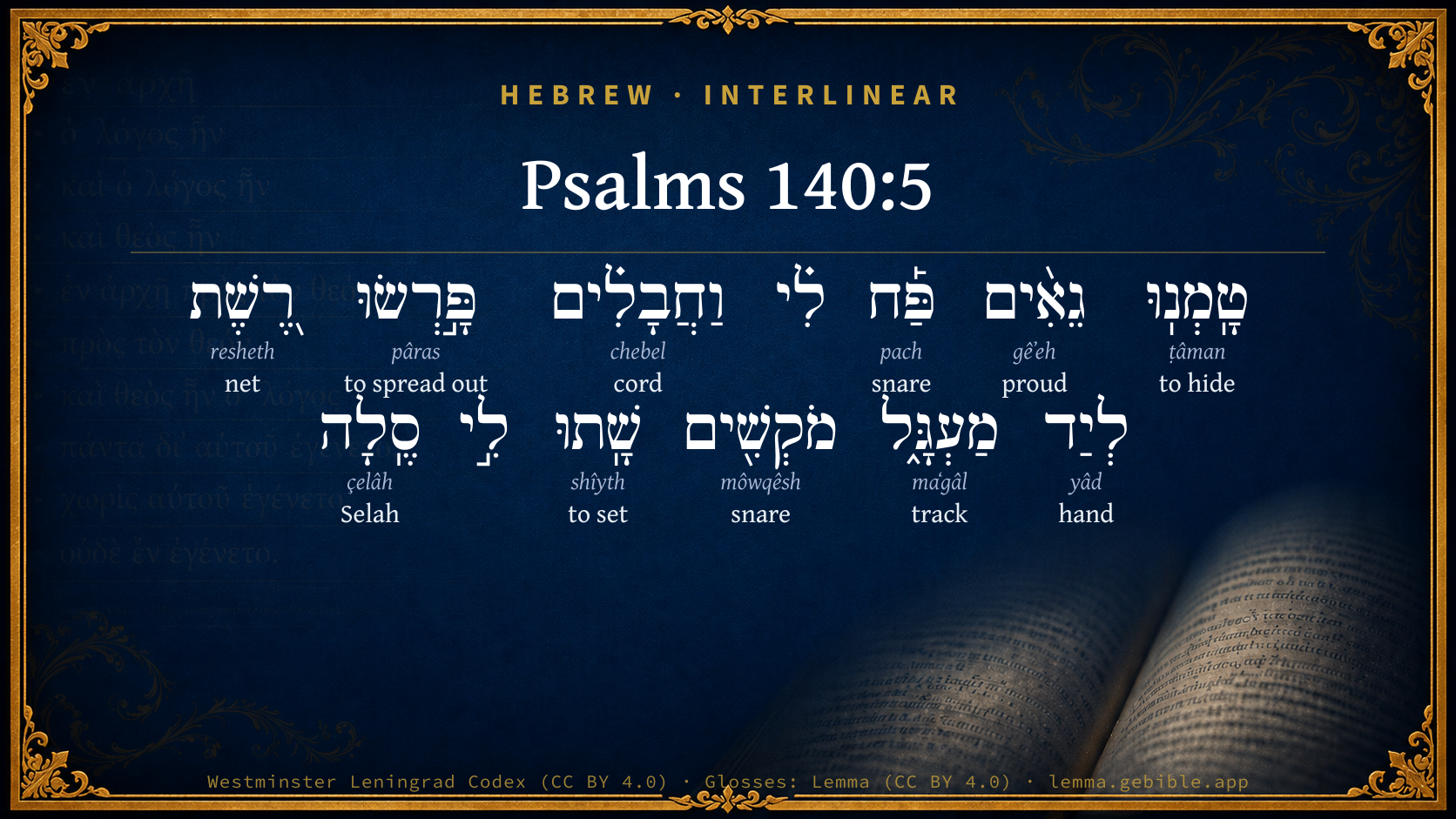
  1. טָֽמְנֽוּ ṭâman H2934 “to hide” Verb, Qal, Perfect, 3rd Person, Common, Plural
  2. פַּ֡ח pach H6341 “snare” Noun, Common, Masculine, Singular, Absolute
  3. וַחֲבָלִ֗ים chebel H2256 “and · cords” Conjunction + Noun, Common, Both, Plural, Absolute
  4. פָּ֣רְשׂוּ pâras H6566 “to spread out” Verb, Qal, Perfect, 3rd Person, Common, Plural
  5. רֶ֭שֶׁת resheth H7568 “net” Noun, Common, Feminine, Singular, Absolute
  6. לְיַד yâd H3027 “to/for · hand of” Preposition + Noun, Common, Both, Singular, Construct
  7. מַעְגָּ֑ל maʻgâl H4570 “track” Noun, Common, Masculine, Singular, Absolute
  8. מֹקְשִׁ֖ים môwqêsh H4170 “snares” Noun, Common, Masculine, Plural, Absolute
  9. שָֽׁתוּ shîyth H7896 “to set” Verb, Qal, Perfect, 3rd Person, Common, Plural
  10. סֶֽלָה çelâh H5542 “Selah” Particle, Interjection

About this verse

These counts appear in no published source. They are computed here, from the morphology-tagged text and Lemma’s own curated glosses. What Lemma adds →

13
words
11
distinct lemmas
Wisdom
section

Notable vocabulary

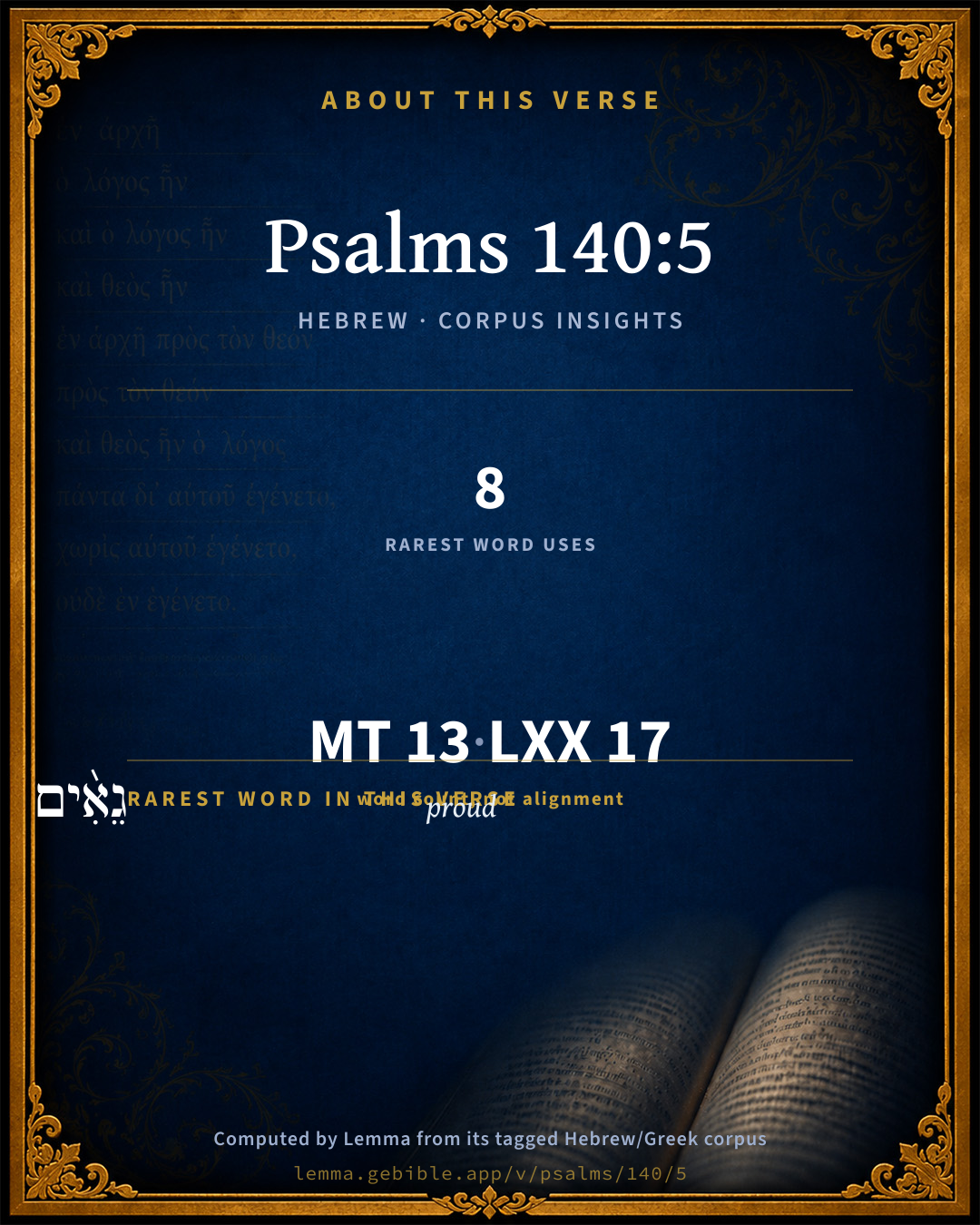
The rarest word here is גֵאִ֨ים proud H1343 — appearing just 8 times in the whole Hebrew Bible.

Shared distinctive vocabulary

גֵאִ֨ים proud H1343 occurs in 8 verses of the Hebrew Bible. Also found in:

Grammatical profile

  • 3 verbs
  • 6 nouns
  • 1 adjective
  • 2 prepositions
  • 1 particle

Verb forms

  • טָֽמְנֽוּ Qal · Perfect
  • פָּ֣רְשׂוּ Qal · Perfect
  • שָֽׁתוּ Qal · Perfect

Hebrew & Septuagint length

In English translation the verse runs 26 words from the Hebrew and 29 from the Septuagint (LXX English) — closely comparable.

A rough comparison of the two English renderings, which tokenize alike — not a word-level alignment.

Word counts can differ between the Hebrew and the Greek without any difference in meaning — e.g. the Hebrew direct-object marker אֵת has no separate Greek word, and Greek often adds the article ὁ.

In the original languages it is 13 Hebrew tokens and 17 Greek tokens — but the two are counted differently (Hebrew bundles its prefixes and suffixes into one token; the Greek is in lemma form), so that isn’t a like-for-like length.

Cross-references

19

Topical passages linked to Psalms 140:5 in the Treasury of Scripture Knowledge — connected by theme and wording, ordered by reader-vote popularity; previews shown in the World English Bible.

  • Psalms 35:7 For without cause they have hidden their net in a pit for me. Without cause they have dug a pit for my soul.
  • Psalms 142:3 When my spirit was overwhelmed within me, You knew my path. In the way in which I walk, They have hidden a snare for me.
  • Jeremiah 18:22 Let a cry be heard from their houses, when you shall bring a troop suddenly on them; for they have dug a pit to take me, and hid snares for my feet.
  • Psalms 57:6 They have prepared a net for my steps. My soul is bowed down. They dig a pit before me. They fall into the midst of it themselves. Selah.
  • Psalms 119:85 The proud have dug pits for me, Contrary to your law.
  • Psalms 123:3–4 Have mercy on us, Yahweh, have mercy on us, For we have endured much contempt.
  • Jeremiah 18:20 Shall evil be recompensed for good? for they have dug a pit for my soul. Remember how I stood before you to speak good for them, to turn away your wrath from them.
  • Luke 20:20–23 They watched him, and sent out spies, who pretended to be righteous, that they might trap him in something he said, so as to deliver him up to the power and authority of the governor.
  • Job 18:9 A snare shall take him by the heel; A trap shall lay hold on him.
  • Psalms 10:4–12 The wicked, in the pride of his face, Has no room in his thoughts for God.
  • Psalms 17:8–13 Keep me as the apple of your eye; Hide me under the shadow of your wings,
  • Psalms 31:4 Pluck me out of the net that they have laid secretly for me, For you are my stronghold.
  • Psalms 36:11 Don't let the foot of pride come against me. Don't let the hand of the wicked drive me away.
  • Psalms 119:69 The proud have smeared a lie upon me. With my whole heart, I will keep your precepts.
  • Psalms 119:110 The wicked have laid a snare for me, Yet I haven't gone astray from your precepts.
  • Psalms 141:9–10 Keep me from the snare which they have laid for me, From the traps of the workers of iniquity.
  • Proverbs 29:5 A man who flatters his neighbor, Spreads a net for his feet.
  • Luke 11:53–54 As he said these things to them, the scribes and the Pharisees began to be terribly angry, and to draw many things out of him;
  • Jeremiah 18:18 Then said they, Come, and let us devise devices against Jeremiah; for the law shall not perish from the priest, nor counsel from the wise, nor the word from the prophet. Come, and let us strike him with the tongue, and let us not give heed to any of his words.

Cross-references courtesy of OpenBible.info (CC BY 4.0).

Hebrew and Greek witnesses Masoretic Hebrew ↔ Greek Septuagint

The same verse in the two great witnesses to the Old Testament, shown verse-for-verse.

You’re reading Greek Psalm 139 (Hebrew Psalm 140). The Septuagint counts the superscription, so verse numbers can differ from the Hebrew — chapter-level alignment, not verse-by-verse. Numbering follows Rahlfs.

These are two independent witnesses, not word-aligned to each other, and the Septuagint is shown in lemma (dictionary) form.

Hebrew Psalms 140:5 Masoretic · Westminster Leningrad Codex

טָֽמְנֽוּ גֵאִ֨ים פַּ֡ח לִ֗י וַחֲבָלִ֗ים פָּ֣רְשׂוּ רֶ֭שֶׁת לְיַד מַעְגָּ֑ל מֹקְשִׁ֖ים שָֽׁתוּ לִ֣י סֶֽלָה

The proud have hidden a snare for me, They have spread the cords of a net by the path. They have set traps for me. Selah.

World English Bible · Public Domain

Greek LXX Greek Psalm 139:5 Septuagint · lemma form

φυλάσσω ἐγώ κύριος ἐκ χείρ ἁμαρτωλός ἀπό ἄνθρωπος ἄδικος ἐκαἱρέω ἐγώ ὅστις λογίζομαι ὑποσκελίζω ὁ διάβημα ἐγώ

The proud have hid a snare for me, and have stretched out ropes for snares for my feet; they set a stumbling block for me near the path. Pause.

LXX2012 (modern English Septuagint) · Public Domain

On this verse, The Cambridge Bible for Schools and Colleges discusses the Septuagint’s reading. Read the note in Commentary ↓

Hebrew: Westminster Leningrad Codex (CC BY 4.0). Greek: Septuagint (public domain); English from LXX2012 (modern English Septuagint) (Public Domain). How the Septuagint differs from the Hebrew →

Commentary

Notes on Psalms 140:5 from classic Christian and Jewish commentators (each source and its license shown beneath its notes). The classic Christian expositions comment on the surrounding passage and are grouped to its opening verse, so a note may address several verses; the Jewish commentaries on the Tanakh (Rashi and others) are per-verse, so they appear only where the commentator wrote on this verse.

Lemma curates 59 commentaries, every one of them public domain or Creative Commons licensed, each selected and text-cleaned for this edition rather than reprinted as found. About our sources →

Trapp's Complete Commentary

John Trapp

Psa 140:5 The proud have hid a snare for me, and cords; they have spread a net by the wayside; they have set gins for me. Selah.

Ver. 5. The proud have hid a snare, &c] They are restless to ruin me, adding all kind of craft to their cruelty.

John Trapp, A Commentary or Exposition upon All the Books of the Old and New Testament (1647–1656) — public domain. Text from a community e-Sword module.

J. A. Alexander on Psalms

Joseph Addison Alexander

6. (Psa 140:5) High (ones) have hid a snare for me, and cords—they have spread out a net by the side of the road—traps have they laid for me, Selah. This is little more than an accumulation of the various terms in which David elsewhere clothes one of his favourite figures, as if he saw his own perils reappearing in the future. High ones, i.e. proud or haughty men. By the side, literally the hand, as we say on either hand. The word translated road, according to its etymology, denotes a waggon-road, a track worn by wheels.

Joseph Addison Alexander, The Psalms Translated and Explained (1850) — public domain. Text from a community e-Sword module.

Adam Clarke's Commentary

Verse 5. Have hid a snare for me] They hunted David as they would a dangerous wild beast: one while striving to pierce him with the spear; another to entangle him in their snares, so as to take and sacrifice him before the people, on pretense of his being an enemy to the state.

Selah] This is the truth.

Adam Clarke's Commentary on the Bible (1810–1826) — public domain. Text from a community e-Sword/MySword module.

Ellicott's Commentary for English Readers

(5) Net.—An elaboration of the favourite image of the net. (Psa_9:15.) The frequent occurrence of this figure well indicates the dangers to which Israel was subjected through the leaning of many of the nation itself to foreign influences.

A Bible Commentary for English Readers, edited by Charles John Ellicott (1878–1897) — public domain. Text from a community e-Sword module.

The Cambridge Bible for Schools and Colleges

gen. ed. J. J. S. Perowne

5. For the figures cp. Psa_31:4; Psa_119:110; Psa_141:9; Psa_142:3. The hunter sets his snares in the ‘run’ of the animal he wishes to catch, and the Psalmist’s enemies are scheming to ruin him as he goes about his daily duties. Cp. Mat_22:15, “how they might ensnare (παγιδεύσωσιν, cp. LXX παγίδα here) him in talk.” He calls them proud, for their hostility to God’s servant is virtually a defiance of God (Psa_10:2).

grins] More properly, baits or lures, to entice him to his ruin. Grins, the original reading of the A.V. of 1611, restored by Scrivener, is an obsolete word of the same meaning as gins, which has been substituted for it in modern editions of the A.V. here and in Psa_141:9. For examples of its use see Wright’s Bible Word Book.

The Cambridge Bible for Schools and Colleges (gen. ed. J. J. S. Perowne; Cambridge University Press, 1878–1918) — public domain. Text from a community e-Sword module.

John Gill's Exposition

The proud have hid a snare for me, and cords,.... These were the Ziphites, according to Arama; see Psa 119:85; the character well agrees with the Scribes and Pharisees, who were proud boasters, and despised others, and often laid snares for Christ to take away his life; and with the enemies of the church and people of God; who, through their pride, persecute them, and are insidious, and use artful methods to ensnare them; as the fowler lays his snare for the bird, and has his cords to draw it to him when it is taken in the snare, to which the allusion is;

they have spread a net by the wayside: they waylaid him; knowing the way he would go, they lay in wait for him, to seize him at once as he went along; see Joh 18:1; the word "cords" in the preceding clause should be connected with this, and be read, "and with cords they have spread a net by the wayside": it being usual, as Jarchi observes, to fasten a long cord at the top of the net; and when the fowler sees the birds under the net, he draws the cord, and the net falls upon the fowls;

they have set gins for me; all these expressions design the insidiousness, and the private, secret, artful methods, the enemies of David, of Christ and his people, took and do take to ensnare them. Arama interprets the "snare and cords" of the watching of David's house; the "net by the wayside" of posting themselves at the gates of the city, and surrounding it; and gins of spies; see Sa1 19:11.

Selah; on this word; see Gill on Psa 3:2.

John Gill's Exposition of the Whole Bible (1746–1763) — public domain (CC PDM 1.0). Text via the HelloAO Bible API.

Albert Barnes' Notes on the Bible

The proud have hid a snare for me - Haughty; arrogant; oppressive men. See Psa 35:7, note; Psa 57:6, note.

And cords - Strings; twine; as those do who lay a net to catch birds, and who design to spring it upon them unawares.

They have spread a net by the wayside - Where I may be expected to walk, and where it may be suddenly sprung upon me.

They have set gins for me - Snares, toils - such as are set for wild beasts. The meaning is, that they had not only made open war upon him, but they had sought to bring him into an ambush - to rush upon him suddenly when he was not on his guard, and did not know that, danger was near.

Albert Barnes' Notes on the Bible (1834–1885) — public domain. Text from a community e-Sword/MySword module.

Matthew Poole's English Annotations

The proud; my insolent enemies, who despise me for my meanness, and exalt themselves against thee.

By the wayside; in which I used to walk.

Matthew Poole's English Annotations on the Holy Bible (1683–1685) — public domain. Text from a community e-Sword/MySword module.

The Treasury of David

Charles H. Spurgeon

Ver. 5. The proud have hid a snare for me. Proud as they are, they stoop to this mean action: they use a snare, and they hide it away, that their victim may be taken like a poor hare who is killed without warningkilled in its usual run, by a snare which it could not see. David's enemies wished to snare him in his path of service, the usual way of his life. Saul laid many snares for David, but the Lord preserved him. All around us there are snares of one sort or another, and he will be well kept, aye, divinely kept, who never falls into one of them. And cords. With these they pull the net together and with these they bind their captive. Thus fowlers do, and trappers of certain large animals. The cords of love are pleasant, but the cords of hate are cruel as death itself. They have spread a net by the wayside. Where it will be near their prey; where the slightest divergence from the path will bring the victim into it. Surely the common wayside ought to be safe: men who go out of the way may well be taken in a net, but the path of duty is proverbially the path of safety; yet it is safe nowhere when malicious persons are abroad. Birds are taken in nets, and men are taken by deceit. Satan instructs his children in the art of fowling, and they right speedily learn how to spread nets: perhaps they have been doing that for us already; let us make our appeal to God concerning it. They have set gins for me. One instrument of destruction is not enough; they are so afraid of missing their prey that they multiply their traps, using differing devices, so that one way or another they may take their victim. Those who avoid the snare and the net may yet be caught in a gin, and accordingly gins are placed in all likely places. If a godly man can be cajoled, or bribed, or cowed, or made angry, the wicked will make the attempt. Ready are they to twist his words, misread his intentions, and misdirect his efforts; ready to fawn, and lie, and make themselves mean to the last degree so that they may accomplish their abominable purpose. Selah. The harp needs tuning after such a strain, and the heart needs lifting up towards God.

Ver. 5. The proud have hid a snare for me, and cords. The following story illustrates how cords have been used by thieves so lately as the year 1822: "Two skilful leaders of Dacoits, having collected some forty followers, and distributed among them ten matchlocks, ten swords, and twenty-five spears, waylaid a treasure going from the native Collector's treasury at Budrauna to Goruckpore. The prize consisted of 1,200 pounds of sterling, and was guarded by a Naik, or corporal, with four sepoys and five troopers. It had to pass through a dense jungle, and it was settledsaid one of them in after yearsthat the attack should take place there; that we should have strong ropes tied across the road in front and festooned to trees on both sides, and, at a certain distance behind, similar ropes festooned to trees on one side, and ready to be fastened on the other, as soon as the escort of horse and foot should get well in between them. Having completed these preparations the gang laid down on either side of the road patiently awaiting their prey. `About five in the morning, 'continued the narrator, `we heard a voice as if calling upon the name of God (Allah), and one of the gang started up at the sound, and said, "Here comes the treasure!" We put five men in front with their match locks loadednot with ball but shot, that we might, if possible, avoid killing anybody. When we got the troopers, infantry, and treasure all within the space, the hind ropes were run across the road, and made fast to the trees on the opposite side, and we opened a fire in upon the party from all sides. The foot soldiers got into the jungle at the sides of the road, and the troopers tried to get over the ropes at both ends, but in vain.' The corporal and a horse were killed; two troopers wounded, and the treasure carried off in spite of a hot pursuit." From James Hutton's "Popular Account of the Thugs and Dacoits of India", 1857.

Ver. 5. The proud have hid a snare for me, and cords. There was "a trap hidden for him with cords"; a trap being sunk into some frequented hath, and always covered over with grass or brushwood, and having long cords attached to each side, by which the hunter, lurking at a little distance, might close it whenever he saw the game stepping on the spot. But the net spread for him by his enemies extended to the very "side of the encampment", which indicates, that even among the soldiers lying around him, there were some who had been bribed and persuaded to watch and betray him. Benjamin Weiss, in "A New Translation of the Psalms, with Notes", 1858.

Ver. 5. Snare. Net. Gins. The several uses to which the contrivances denoted by the Hebrew words thus rendered were respectively applied, do not appear to be well ascertained. In general the Psalmist alludes to the artifices employed for capturing birds or beasts. It is, however, a curious circumstance, as noticed by Thevenot, that artifices of this kind are literally employed against men as well as other animals by some of the Orientals. "The most cunning robbers in the world", says he, "are in this country. They use a certain slip with a running noose, which they cast with so much sleight about a man's neck when they are within reach of him, that they never fail, so that they strangle him in a trice." Richard Mast.

Ver. 5. The Dangers of Society.

1. The secrecy of the attacks of the ungodly: "hid a snare."

2. The variety of their weapons: "and cords."

3. The cunning choice of position: "by the wayside."

4. The object of their designs: "for me": they desire to destroy the man himself.

Ver. 5. The Net by the Wayside, or, covert temptations; temptations brought near, and made applicable to daily life.

Psalms 140:6*

Charles H. Spurgeon's The Treasury of David (1869–1885) — public domain. Psalms only. Text from a community e-Sword/MySword module.

Whedon's Commentary on the Bible

Daniel D. Whedon

5. Have hid a snare—Four different words are used to set forth the deceitful artifices of the psalmist’s enemies: “a snare,”—trap; “cords,”-nooses; “net” and “gins,”—toils. The number and variety indicate the prolific inventions of his enemies to decoy, deceive, and take him.

By the way-side—Whatever path he took, close to his steps was prepared a trap. See Psa_141:9; Psa_142:3

Daniel D. Whedon (gen. ed.), Commentary on the Old and New Testaments (1874–1909) — public domain. Text from a community e-Sword module.

The Pulpit Commentary

The proud have hid a snare for me, and cords. An instance of the figure hendiadys. What is meant is a snare composed of cords. Such snares, when laid for animals, were "hidden" in long grass, or low shrubs, or rough ground. They have spread a net by the wayside; they have set gins for me. (comp. Psa_31:4 Psa_35:7 Psa_57:6 Psa_119:10 Psa_141:9 Psa_142:3) A second pause-sign marks off a second stanza.

The Pulpit Commentary (1880–1919), ed. H.D.M. Spence-Jones & Joseph S. Exell — public domain. Text from a community e-Sword module.

Lesson kit

Teaching starters — assembled from the data on this page, not authored interpretation. Every prompt links to the verse data it draws on. Edit before teaching.

Psalms, in the Wisdom, opens this verse with 13 words (11 distinct Hebrew lemmas). Its most distinctive word is gêʼeh (“proud”). A historical commentator’s framing appears above. Read the whole chapter for the surrounding context.

Discussion questions

  1. What does “proud” (gêʼeh) contribute to the verse as a whole?
  2. Job 40:11 shares the word «proud» with this verse. How do the two illuminate each other?
  3. These translations render this verse differently; the difference is in the English rendering, not the original. What questions does that raise?
  4. The verb «טָֽמְנֽוּ» is Qal Perfect. How does its form color the action?
  5. Reading how Trapp's Complete Commentary and J. A. Alexander on Psalms read this verse, where do the two commentators agree and where do they part?

Things to notice

Reading settings

Reading text

Shown beneath each verse's original-language words.

Old Testament
Old Testament edition

Read the OT as the Masoretic Hebrew (MT) or the Greek Septuagint (LXX).

English shown for the Greek Septuagint (in the Hebrew ↔ Greek comparison).

Comparing translations? Open the Compare panel on any verse page to stack up to four side by side.