Psalms 12:5

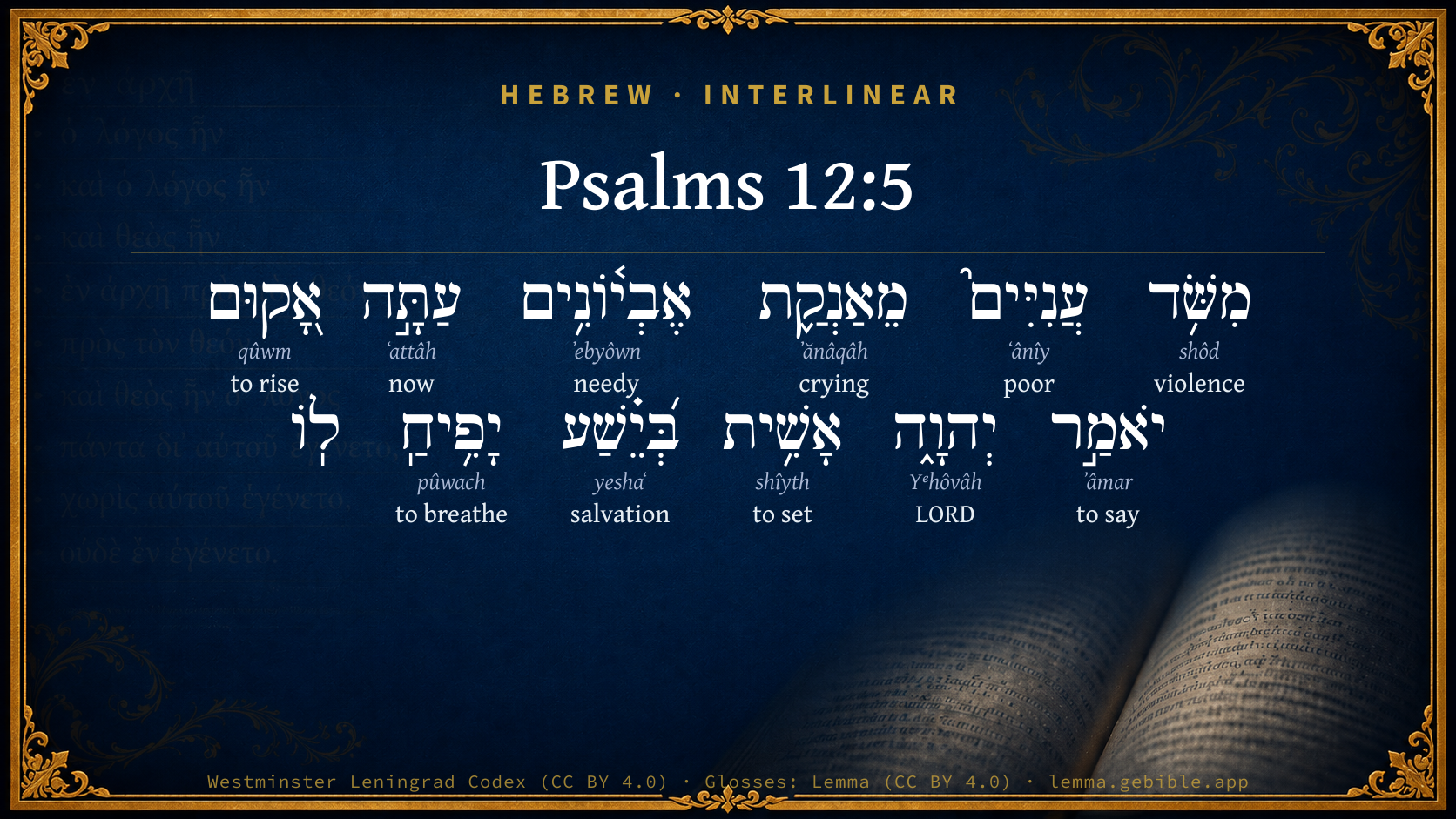
Hebrew (Westminster Leningrad Codex) Psalms 12:5 appears in the Hebrew Old Testament. The text above is from the Westminster Leningrad Codex. Each word links to its Strong’s number, a concise gloss, and parsing drawn from the Open Scriptures Hebrew Bible morphology. Click any word for its full Brown-Driver-Briggs (BDB) entry.
Download image
Cite this verse

Psalms 12:5 (World English Bible). Public Domain. Lemma interlinear Bible study tool, https://lemma.gebible.app/v/psalms/12/5.

Show BibTeX & RIS
BibTeX
RIS
English Translation
"Because of the oppression of the weak and because of the groaning of the needy, I will now arise," says Yahweh; "I will set him in safety from those who malign him."
World English Bible · Public Domain
Highlights
  • 1 first appearance in the Hebrew Bible
Full analysis ↓
Download a study sheet

One document with this verse’s original text, its word-by-word gloss line, the meaning frame, cross-references with their text, attributed commentary, and full source and license credits — printable, and it pastes into notes with its structure intact.

This verse Autodidact and up

Study sheet (.html) Plain text (.txt)

A passage Seminary Student

Up to 50 verses in one chapter. A passage sheet keeps up to 6 commentary sources and 12 cross-references per verse, in the order this page ranks them, and says so on the sheet whenever that leaves anything out. Ask for a single verse and you get the Autodidact verse sheet above.

Everything on this page stays free to read, with no account — the sheet is a download of what is already on screen, not access to it.

Want to remove ads? Support Godless Engineer
Compare translations 3

The same verse in 3 English versions, stacked beneath the original-language interlinear above. Click any original word for its lexicon entry.

Each is an independent rendering of the whole verse — the interlinear is not word-aligned to these translations.

Highlighted words mark where these versions differ — a whole-verse word diff, not a word-by-word alignment.

  • World English Bible Public Domain
    "Because of the oppression of the weak and because of the groaning of the needy, I will now arise," says Yahweh; "I will set him in safety from those who malign him."
  • King James Version Public Domain
    For the oppression of the poor, for the sighing of the needy, now will I arise, saith the LORD; I will set him in safety from him that puffeth at him.
  • unfoldingWord Literal Text CC BY-SA 4.0
    “Because of oppression of the poor, because of groaning of the needy, Now I will arise,” says Yahweh. “I will place in safety he pants for it.”

unfoldingWord Literal Text — © unfoldingWord, licensed CC BY-SA 4.0. Word-aligned USFM3 via Door43 (git.door43.org/unfoldingWord/en_ult).

Versions to compare (up to 4)

3 of 4 selected

Show all 18 translations

Every available English version of this verse, each an independent rendering of the whole verse.

  • World English Bible Public Domain
    "Because of the oppression of the weak and because of the groaning of the needy, I will now arise," says Yahweh; "I will set him in safety from those who malign him."
  • Berean Standard Bible Public Domain
    “For the cause of the oppressed and for the groaning of the needy, I will now arise,” says the LORD. “I will bring safety to him who yearns.”
  • Majority Standard Bible Public Domain
    “For the cause of the oppressed and for the groaning of the needy, I will now arise,” says the LORD. “I will bring safety to him who yearns.”
  • King James Version Public Domain
    For the oppression of the poor, for the sighing of the needy, now will I arise, saith the LORD; I will set him in safety from him that puffeth at him.
  • American Standard Version (1901) Public Domain
    Because of the oppression of the poor, because of the sighing of the needy, Now will I arise, saith Jehovah; I will set him in the safety he panteth for.
  • Revised Version (1885) Public Domain
    For the spoiling of the poor, for the sighing of the needy, now will I arise, saith the LORD; I will set him in safety at whom they puff.
  • Geneva Bible (1599) Public Domain
    Now for the oppression of the needy, and for the sighes of the poore, I will vp, sayeth the Lord, and will set at libertie him, whom the wicked hath snared.
  • Douay-Rheims (1899) Public Domain
    Who have said: We will magnify our tongue; our lips are our own; who is Lord over us?
  • Young's Literal Translation Public Domain
    Because of the spoiling of the poor, Because of the groaning of the needy, Now do I arise, saith Jehovah, I set in safety `him who' doth breathe for it.
  • Literal Standard Version CC BY-SA 4.0
    Because of the spoiling of the poor, || Because of the groaning of the needy, || Now I arise, says YHWH, || I set in safety [him who] breathes for it.
  • Unlocked Literal Bible CC BY-SA 4.0
    “Because of violence against the poor, because of the groans of the needy, I will arise,” says Yahweh. “I will provide the safety for which they long.”
  • unfoldingWord Literal Text CC BY-SA 4.0
    “Because of oppression of the poor, because of groaning of the needy, Now I will arise,” says Yahweh. “I will place in safety he pants for it.”
  • Darby Bible Public Domain
    Because of the oppression of the afflicted, because of the sighing of the needy, now will I arise, saith Jehovah, I will set [him] in safety, at whom they puff.
  • World Messianic Bible Public Domain
    “Because of the oppression of the weak and because of the groaning of the needy, I will now arise,” says the LORD; “I will set him in safety from those who malign him.”
  • Webster's Bible Public Domain
    \\12:4\\Who have said, With our tongue will we prevail; our lips are our own: who is lord over us?
  • Free Bible Version CC BY-SA 4.0
    “Because of the violence the helpless have suffered, and because of the groans of the poor, I will rise up to defend them,” says the Lord. “I will give them the protection they have been longing for.”
  • Bible in Basic English Public Domain
    Because of the crushing of the poor and the weeping of those in need, now will I come to his help, says the Lord; I will give him the salvation which he is desiring.
  • JPS Tanakh (1917) Public Domain
    (12-6) 'For the oppression of the poor, for the sighing of the needy, now will I arise', saith the LORD; 'I will set him in safety at whom they puff.'

Literal Standard Version (2020), Covenant Press — licensed CC BY-SA 4.0. Text via the HelloAO Bible API (eBible.org). Unlocked Literal Bible (unfoldingWord) — licensed CC BY-SA 4.0. Text via the HelloAO Bible API (eBible.org). unfoldingWord Literal Text — © unfoldingWord, licensed CC BY-SA 4.0. Word-aligned USFM3 via Door43 (git.door43.org/unfoldingWord/en_ult). Free Bible Version, Dr. Jonathan Gallagher — licensed CC BY-SA 4.0. Text via the HelloAO Bible API (eBible.org).

Word by word

More ways to search: Search by grammar → Find every occurrence → Compare this word →

Practice this passage: Drill this verse → Learn its vocabulary →

מֵאַנְקַ֪ת
ʼănâqâh
H603
“from · crying of”
Preposition + Noun, Common, Feminine, Singular, Construct
Part of Speech
Preposition + Noun
Type
Common
Gender
Feminine
Number
Singular
State
Construct
Full BDB Definition

Origin: from H602

TWOT: 134a

crying, groaning, lamentation
  1. מִשֹּׁ֥ד shôd H7701 “from · violence of” Preposition + Noun, Common, Masculine, Singular, Construct
  2. עֲנִיִּים֮ ʻânîy H6041 “poor” Adjective, Adjective, Masculine, Plural, Absolute
  3. אֶבְי֫וֹנִ֥ים ʼebyôwn H34 “needy” Adjective, Adjective, Masculine, Plural, Absolute
  4. עַתָּ֣ה ʻattâh H6258 “now” Adverb
  5. אָ֭קוּם qûwm H6965 “to rise” Verb, Qal, Imperfect, 1st Person, Common, Singular
  6. יֹאמַ֣ר ʼâmar H559 “to say” Verb, Qal, Imperfect, 3rd Person, Masculine, Singular
  7. יְהוָ֑ה Yᵉhôvâh H3068 “LORD” Noun, Proper
  8. אָשִׁ֥ית shîyth H7896 “to set” Verb, Qal, Imperfect, 1st Person, Common, Singular
  9. בְּ֝יֵ֗שַׁע yeshaʻ H3468 “in/at · salvation” Preposition + Noun, Common, Masculine, Singular, Absolute
  10. יָפִ֥יחַֽ pûwach H6315 “to breathe” Verb, Hiphil, Imperfect, 3rd Person, Masculine, Singular

About this verse

These counts appear in no published source. They are computed here, from the morphology-tagged text and Lemma’s own curated glosses. What Lemma adds →

12
words
11
distinct lemmas
Wisdom
section

Notable vocabulary

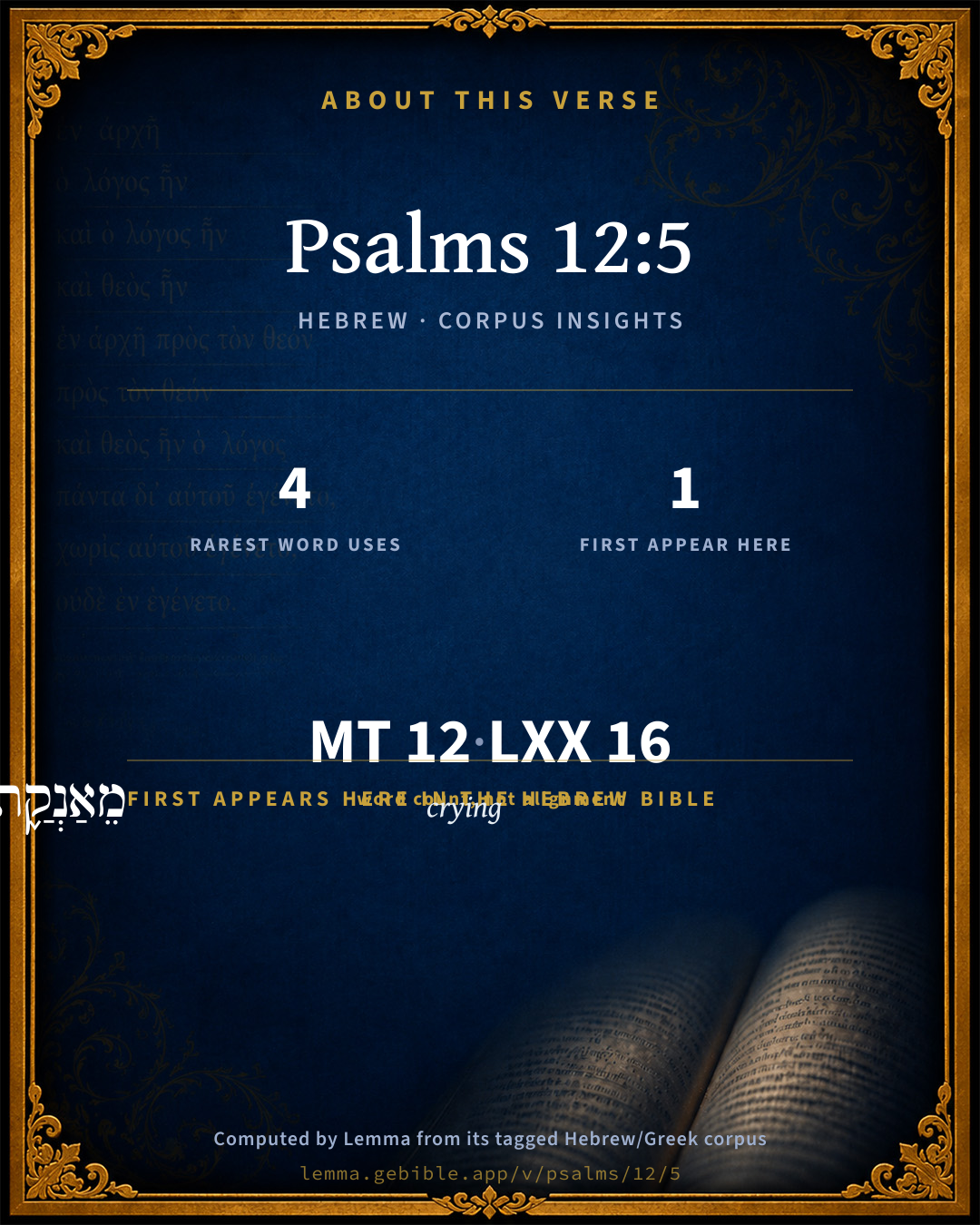
The rarest word here is מֵאַנְקַ֪ת crying H603 — appearing just 4 times in the whole Hebrew Bible.

First appearance in Scripture

This word makes its first canonical appearance in the Hebrew Bible here:

  • מֵאַנְקַ֪ת crying H603

Shared distinctive vocabulary

מֵאַנְקַ֪ת crying H603 occurs in 4 verses of the Hebrew Bible. Also found in:

Grammatical profile

  • 4 verbs
  • 4 nouns
  • 2 adjectives
  • 1 preposition
  • 1 adverb

Verb forms

  • אָ֭קוּם Qal · Imperfect
  • יֹאמַ֣ר Qal · Imperfect
  • אָשִׁ֥ית Qal · Imperfect
  • יָפִ֥יחַֽ Hiphil · Imperfect

Hebrew & Septuagint length

In English translation the verse runs 32 words from the Hebrew and 35 from the Septuagint (LXX English) — closely comparable.

A rough comparison of the two English renderings, which tokenize alike — not a word-level alignment.

Word counts can differ between the Hebrew and the Greek without any difference in meaning — e.g. the Hebrew direct-object marker אֵת has no separate Greek word, and Greek often adds the article ὁ.

In the original languages it is 12 Hebrew tokens and 16 Greek tokens — but the two are counted differently (Hebrew bundles its prefixes and suffixes into one token; the Greek is in lemma form), so that isn’t a like-for-like length.

Cross-references

22

Topical passages linked to Psalms 12:5 in the Treasury of Scripture Knowledge — connected by theme and wording, ordered by reader-vote popularity; previews shown in the World English Bible.

  • Psalms 34:6 This poor man cried, and Yahweh heard him, And saved him out of all his troubles.
  • Proverbs 14:31 He who oppresses the poor shows contempt for his Maker, But he who is kind to the needy honors him.
  • James 5:4 Behold, the wages of the laborers who mowed your fields, which you have kept back by fraud, cry out, and the cries of those who reaped have entered into the ears of the Lord of Hosts.
  • Psalms 146:7–8 Who executes justice for the oppressed; Who gives food to the hungry. Yahweh frees the prisoners.
  • Isaiah 33:10 Now will I arise, says Yahweh; now will I lift up myself; now will I be exalted.
  • Micah 7:8–9 Don't rejoice against me, my enemy. When I fall, I will arise. When I sit in darkness, Yahweh will be a light to me.
  • Exodus 2:23–24 It happened in the course of those many days, that the king of Egypt died, and the children of Israel sighed because of the bondage, and they cried, and their cry came up to God because of the bondage.
  • Job 5:15 But he saves from the sword of their mouth, Even the needy from the hand of the mighty.
  • Job 5:21 You shall be hidden from the scourge of the tongue, Neither shall you be afraid of destruction when it comes.
  • Psalms 10:12 Arise, Yahweh! God, lift up your hand! Don't forget the helpless.
  • Ezekiel 18:12–13 has wronged the poor and needy, has taken by robbery, has not restored the pledge, and has lifted up his eyes to the idols, has committed abomination,
  • Exodus 3:7–9 Yahweh said, "I have surely seen the affliction of my people who are in Egypt, and have heard their cry because of their taskmasters, for I know their sorrows.
  • Psalms 74:21–22 Don't let the oppressed return ashamed. Let the poor and needy praise your name.
  • Isaiah 19:20 It shall be for a sign and for a witness to Yahweh of Hosts in the land of Egypt; for they shall cry to Yahweh because of oppressors, and he will send them a savior, and a defender, and he will deliver them.
  • Psalms 79:10–11 Why should the nations say, "Where is their God?" Let it be known among the nations, before our eyes, That vengeance for your servants' blood is being poured out.
  • Psalms 10:18 To judge the fatherless and the oppressed, That man who is of the earth may terrify no more.
  • Proverbs 22:22–23 Don't exploit the poor, because he is poor; And don't crush the needy in court;
  • Ezekiel 18:18 As for his father, because he cruelly oppressed, robbed his brother, and did that which is not good among his people, behold, he shall die in his iniquity.
  • Ecclesiastes 4:1 Then I returned and saw all the oppressions that are done under the sun: and, behold, the tears of those who were oppressed, and they had no comforter; and on the side of their oppressors there was power; but they had no comforter.
  • Ecclesiastes 5:8 If you see the oppression of the poor, and the violent taking away of justice and righteousness in a district, don't marvel at the matter: for one official is eyed by a higher one; and there are officials over them.
  • Psalms 10:5 His ways are prosperous at all times; He is haughty, and your laws are far from his sight: As for all his adversaries, he sneers at them.
  • Judges 10:16 They put away the foreign gods from among them, and served Yahweh; and his soul was grieved for the misery of Israel.

Cross-references courtesy of OpenBible.info (CC BY 4.0).

Hebrew and Greek witnesses Masoretic Hebrew ↔ Greek Septuagint

The same verse in the two great witnesses to the Old Testament, shown verse-for-verse.

You’re reading Greek Psalm 11 (Hebrew Psalm 12). The Septuagint counts the superscription, so verse numbers can differ from the Hebrew — chapter-level alignment, not verse-by-verse. Numbering follows Rahlfs.

These are two independent witnesses, not word-aligned to each other, and the Septuagint is shown in lemma (dictionary) form.

Hebrew Psalms 12:5 Masoretic · Westminster Leningrad Codex

מִשֹּׁ֥ד עֲנִיִּים֮ מֵאַנְקַ֪ת אֶבְי֫וֹנִ֥ים עַתָּ֣ה אָ֭קוּם יֹאמַ֣ר יְהוָ֑ה אָשִׁ֥ית בְּ֝יֵ֗שַׁע יָפִ֥יחַֽ לֽוֹ

"Because of the oppression of the weak and because of the groaning of the needy, I will now arise," says Yahweh; "I will set him in safety from those who malign him."

World English Bible · Public Domain

Greek LXX Greek Psalm 11:5 Septuagint · lemma form

ὁ εἶπον ὁ γλῶσσα ἐγώ μεγαλύνω ὁ χεῖλος ἐγώ παρά ἐγώ εἰμί τίς ἐγώ κύριος εἰμί

Because of the misery of the poor, and because of the sighing of the needy, now will I arise, says the Lord, I will set them in safety; I will speak to them thereof openly.

LXX2012 (modern English Septuagint) · Public Domain

Hebrew: Westminster Leningrad Codex (CC BY 4.0). Greek: Septuagint (public domain); English from LXX2012 (modern English Septuagint) (Public Domain). How the Septuagint differs from the Hebrew →

Commentary

Notes on Psalms 12:5 from classic Christian and Jewish commentators (each source and its license shown beneath its notes). The classic Christian expositions comment on the surrounding passage and are grouped to its opening verse, so a note may address several verses; the Jewish commentaries on the Tanakh (Rashi and others) are per-verse, so they appear only where the commentator wrote on this verse.

Lemma curates 59 commentaries, every one of them public domain or Creative Commons licensed, each selected and text-cleaned for this edition rather than reprinted as found. About our sources →

Trapp's Complete Commentary

John Trapp

Psa 12:5 For the oppression of the poor, for the sighing of the needy, now will I arise, saith the LORD; I will set [him] in safety [from him that] puffeth at him.

Ver. 5. For the oppression of the poor] Whose very oppression, though they complain not, hath a voice, and God will hear it, for he is gracious, Exo 22:27. He heard Hagar’s affliction, though she said nothing, Gen 16:11; he heareth the young ravens that cry unto him by implication only.

For the sighing of the needy] If it be but their breathing, Lam 3:56, God can feel it, but the sighs of his people are effectual orators, Exo 2:23-25; Exo 3:7; and their tears he puts in a bottle, Psa 56:9.

Now will I arise] sc. In the nick of time, when all seems to be lost. Man’s extremity is God’s opportunity. Cum duplicarentur lateres, venit Moses. See Isa 33:10, Now, now, now.

Saith the Lord] Dixit mihi per prophetiam, Isa 22:14.

From him that puffeth at him] That defieth him, and thinks he can blow him away at a blast; but if God arise only his enemies shall be scattered, as thistle down is by a puff of wind, Psa 68:1. Some render the text, He will puff at him, that is, the oppressed will now dare to speak freely, who before durst not mute (R. David).

John Trapp, A Commentary or Exposition upon All the Books of the Old and New Testament (1647–1656) — public domain. Text from a community e-Sword module.

The Biblical Illustrator

Joseph S. Exell

Psa_12:5

For the oppression of the poor, for the sighing of the needy, now will I arise, with the Lord; I will set him in safety from him that puffeth at him.

The poor set in safety

Gods family in all ages have resembled each other. Hence the Word of God is rich in consolation.

I. Gods Word deals with and is addressed to characters. Two such are named.

1. The poor--the poor in spirit, conscious that they have no good in themselves. God brings all His people to this state.

2. The oppression of the poor. Poverty gives room for oppression. The rich are not oppressed. And so it is spiritually. Hezekiah, near to death, cries out, Lord, I am oppressed; undertake for me. The law on a mans conscience does this. It strikes the dying dead. Thus the Lord deals with His people to bring them down. But their sighing is a sign of life. The dead in sin feel nothing. They may have alarming fears of hell, but no trouble of conscience; they, as Isaiah says, may cry for sorrow of heart and howl for vexation of spirit, but they do not cry unto God with their heart when they howl upon their beds.

II. For the sighing of the needy. A man may be poor without being needy, without having any desire for what he does not possess; he may be content with his poverty.

1. But the needy are they who are not content, who feel and utter their need. This is true of spiritual things. He is full of needs. He wants more and more of the grace of Jesus.

2. He sighs. He is sighing after God, sighing unto the Lord under the burden of his sins; he wants the light, life, liberty, peace of the Gospel of God.

III. The answer to these cries.

1. Now will I arise. As if the Lord had been looking on but sitting still; as a father may watch his child at play, but let him perceive the child in danger, then will he start up and rush to the rescue. It is this sitting still of the Lord that so puzzles and perplexes Gods family; that He should seem to take no notice of them. But He will not be always so. A time is fixed when He will arise. 2. I will set in safety,. . . puffeth at him. Then poor people are puffed at, not only poor and oppressed. Yes, for Satan in one that puffs at them. Sinners do also. And saints can do it to. Then much of pride and annoyance are to be found in Gods children. But the Lord will set them in safety. Not, perhaps, deliver them, but set them in Himself, a safe spot indeed. And there is the puff of flattery, and of enmity. Through much tribulation we must enter the Kingdom. But thither we shall be brought. (J. C. Philpot.)

Divine interposition in time of great peril

On one occasion, being driven from my station, two teachers and myself escaped for our lives to another missionary station at the other end of the island. We remained there for some time, and one afternoon, tired with watching (for the savages were constantly trying to take our lives) I fell fast asleep. About nine at night a retriever dog, that had been trained to warn me of approaching danger, sprang upon me and awakened me. I jumped up and saw a number of savages approaching; they went to the beautiful new church and set it on fire. I called the other missionary, and told him that in a few moments our house would be in flames. He suggested that we should prepare for the great change, for that night we would be with Jesus. He prayed to God to have mercy upon us. I went out and pulled the fence down that joined the church to the house. I was quickly surrounded by the savages, who lifted their clubs to strike me. Jesus has all power in heaven and earth; no blow could be struck without His permission. I defy you, in the name of Jesus! I shouted; you think I am alone, but my God is here. He will protect me. I defy you, in the name of Jesus! Just as I uttered those words a tornado burst upon us. The wind blew the flames from our house, and the rain soon extinguished the fire. The savages were affrighted. They said, Jehovah God is fighting for them, and then disappeared into the neighbouring wood. The age of miracles has passed, but the God of miracles still lives and reigns. I firmly believe that in answer to prayer God sent that tornado. (J. Paton.)

The Biblical Illustrator, edited by Joseph S. Exell (c. 1880s–1900s) — public domain. Text from a community e-Sword module.

The Treasury of David

Charles H. Spurgeon

Ver. 5. In due season the Lord will hear his elect ones, who cry day and night unto him, and though he bear long with their oppressors, yet will he avenge them speedily. Observe that the mere oppression of saints, however silently they bear it, is in itself a cry to God: Moses was heard at the Red Sea, though he said nothing; and Hagar's affliction was heard despite her silence. Jesus feels with his people, and their smarts are mighty orators with him. By and by, however, they begin to sigh and express their misery, and then relief comes post haste. Nothing moves a father like the cries of his children; he bestirs himself, wakes up his manhood, overthrows the enemy, and sets his beloved in safety. A puff is too much for the child to bear, and the foe is so haughty, that he laughs the little one to scorn; but the Father comes, and then it is the child's turn to laugh, when he is set above the rage of his tormentor. What virtue is there in a poor man's sighs, that they should move the Almighty God to arise from his throne. The needy did not dare to speak, and could only sigh in secret, but the Lord heard, and could rest no longer, but girded on his sword for the battle. It is a fair day when our soul brings God into her quarrel, for when his bare arm is seen, Philistia shall rue the day. The darkest hours of the Church's night are those which precede the break of day. Man's extremity is God's opportunity. Jesus will come to deliver just when his needy ones shall sigh, as if all hope had gone for ever. O Lord, set thy now near at hand, and rise up speedily to our help. Should the afflicted reader be able to lay hold upon the promise of this verse, let him gratefully fetch a fulness of comfort from it. Gurnall says, "As one may draw out the wine of a whole hogshead at one tap, so may a poor soul derive the comfort of the whole covenant to himself through one promise, if he be able to apply it." He who promises to set us in safety, means thereby preservation on earth, and eternal salvation in heaven.

Ver. 5. For the oppression of the poor, etc. When oppressors and persecutors do snuff and puff at the people of God, when they defy them, and scorn them, and think that they can with a blast of their breath blow them away, then God will arise to judgment, as the Chaldee has it; at that very nick of time when all seems to be lost, and when the poor, oppressed, and afflicted people of God can do nothing but sigh and weep, and weep and sigh, then the Lord will arise and ease them of their oppressions, and make their day of extremity a glorious opportunity to work for his own glory, and his people's good. Mt 22:6-7. "And the remnant took his servants, and entreated them spitefully, and slew them. But when the king heard thereof, he was wroth: and he sent forth his armies and destroyed those murderers, and burned up their city." Thomas Brooks.

Ver. 5. Fear ye, whosoever ye be, that do wrong the poor; you have power and wealth, and the favour of the judges, but they have the strongest weapons of all, sighings and groanings, which fetch help from heaven for them. These weapons dig down houses, throw up foundations, overthrow whole nations. Chrysostom.

Ver. 5. For the sighings of the needy, now will I arise, saith the Lord. God is pleased to take notice of every grace, even the least and lowest, and every gracious inclination in any of his servants. To fear his name is no great matter, yet these have a promise. To think on his name less, yet set down in a "book of remembrance." God sets down how many good thoughts a poor soul hath had. As evil thoughts in wicked men are taken notice ofthey are the first fruits of the evil heart (Mt 15:19) so good thoughts are they which lie uppermost, and best discover a good heart. A desire is a small matter, especially of the poor man, yet God regards the desire of the poor, and calls a good desire the greatest kindness; "The desire of a man is his kindness." A tear makes no great noise, yet hath a voice, "God hath heard the voice of my weeping." It is no pleasant water, yet God bottles it up. A groan is a poor thing, yet is the best part of a prayer sometimes (Ro 8:26); a sigh is less, yet God is awakened and raised up by it. Ps 12:5. A look is less than all these, yet this is regarded (Jon 2:4); breathing is less, yet (La 3:56), the church could speak of no more; panting is less than breathing, when one is spent for lack of breath, yet this is all the godly can sometimes boast of. Ps 42:1. The description of a godly man is ofttimes made from his least quod sic. Blessed are the poor, the meek, they that mourn, and they who hunger and thirst. Never did Hannah pray better than when she could get out never a word, but cried, "Hard, hard heart." Nor did the publican, than when he smote his breast and cried, "Lord, be merciful to me a sinner." Nor Mary Magdalene, than when she came behind Christ, sat down, wept, but kept silence. How sweet is music upon the waters! How fruitful are the lowest valleys! Mourning hearts are most musical, lowest most fruitful. The good shepherd ever takes most care of his weak lambs and feeble sheep. The father makes most of the least, and the mother looks most after the sick child. How comfortable is that of our Saviour, "It is not the will of your Father which is in heaven that one of these little ones should perish!" And that heaven is not to be entered but by such as are like the little child. John Sheffield, 1654.

Ver. 5. The oppression of the poor. Insolent and cruel oppressing of the poor is a sin that brings desolating and destroying judgments upon a people. God sent ten wasting judgments one after another upon Pharaoh, his people, and land, to revenge the cruel oppression of his poor people. "Rob not the poor, because he is poor: neither oppress the afflicted in the gate: for the Lord will plead their cause." Pr 22:22-23. To rob and oppress the rich is a great sin; but to rob and oppress the poor is a greater; but to rob and oppress the poor because he is poor, and wants money to buy justice, is the top of all inhumanity and impiety. To oppress anyone is sin; but to oppress the oppressed is the height of sin. Poverty, and want, and misery, should be motives to pity; but oppressors make them the whetstone of their cruelty and severity, and therefore the Lord will plead the cause of his poor oppressed people against their oppressors without fee or fear; yea, he will plead their cause with pestilence, blood, and fire. Gog was a great oppressor of the poor (Eze 38:8-14), and God pleads against him with pestilence, blood, and fire (Eze 38:22); "and I will plead against him, with pestilence and with blood; and I will rain upon him, and upon his bands, and upon the many people that are with him, an overflowing rain, and great hailstones, fire, and brimstone." Thomas Brooks.

Ver. 5. The Lord arousedHow! Why! What to do! When!

Ver. 5. Last clause. Peculiar danger of believers from those who despise them and their special safety. Good practical topic.

Psalms 12:6*

Ver 6. What a contrast between the vain words of man, and the pure words of Jehovah. Man's words are yea and nay, but the Lord's promises are yea and amen. For truth, certainty, holiness, faithfulness, the words of the Lord are pure as well refined silver. In the original there is an allusion to the most severely purifying process known to the ancients, through which silver was passed when the greatest possible purity was desired; the dross was all consumed, and only the bright and precious metal remained; so clear and free from all alloy of error or unfaithfulness is the book of the words of the Lord. The Bible has passed through the furnace of persecution, literary criticism, philosophic doubt, and scientific discovery, and has lost nothing but those human interpretations which clung to it as alloy to precious ore. The experience of saints has tried it in every conceivable manner, but not a single doctrine or promise has been consumed in the most excessive heat. What God's words are, the words of his children should be. If we would be Godlike in conversation, we must watch our language, and maintain the strictest purity of integrity and holiness in all our communications.

Charles H. Spurgeon's The Treasury of David (1869–1885) — public domain. Psalms only. Text from a community e-Sword/MySword module.

Joseph Benson's Commentary

Psa 12:5. For the oppression of the poor — Because the poor that put their trust in me, and send up their prayers to me for help, are thus oppressed; now will I arise, saith the Lord — Speedily, sooner than they imagine or expect. I will set him in safety from him that puffeth at him — That despises him, and hopes to destroy him with a puff of breath. “The beauty and energy of this fine prosopopœia,” says Dr. Dodd, “must be felt by every reader.” When oppressors are in the height of their pride and insolence; when they say, Who is lord over us? then is God’s time to let them know, to their cost, that he is above them. And when the oppressed are in the depth of their distress and despondency; when they are sighing like Israel in Egypt, by reason of the cruel bondage, then is God’s time to appear for them, as he did for Israel when they were dejected, and Pharaoh was most elevated and determined to carry things with a high hand.

Joseph Benson's Commentary on the Old and New Testaments (1811–1818) — public domain. Text from a community e-Sword module.

J. A. Alexander on Psalms

Joseph Addison Alexander

6. (Psa 12:5). From the desolation of the wretched, from the sighing of the poor, now will I arise, shall Jehovah say, I will place in safety him that shall pant for it. The preposition from has a causal meaning, because of, on account of. The wretched, afflicted, sufferers; see above, on Psa 9:13 (12). I will arise; see above, on Psa 3:8 (7). The future, shall Jehovah say, implies that the promise is not yet uttered, much less fulfilled. An analogous use of the same form of the same verb runs through some of the prophecies, and especially the later chapters of Isaiah.—The last clause is obscure, and may also be translated, "from him that puffeth at him,"— "him at whom they puff,"—"him whom they would blow away," etc. The most probable meaning is the one first given, according to which the verse contains a promise of deliverance to those who especially desire and need it.

Joseph Addison Alexander, The Psalms Translated and Explained (1850) — public domain. Text from a community e-Sword module.

Geneva Bible (1599)

Geneva Bible translators

Because the Lord’s word and promise is true and unchangeable, he will perform it and preserve the poor from this wicked generation.

The Lord is moved with the complaints of his, and delivereth in the end from all dangers.

Geneva Bible (1599) marginal notes — public domain. Text via Bolls.life.

Jamieson, Fausset & Brown

Robert Jamieson, A. R. Fausset & David Brown

The writer intimates his confidence by depicting God's actions (compare Psa 9:19; Psa 10:12) as coming to save the poor at whom the wicked sneer (Psa 10:5).

Jamieson, Fausset & Brown — Commentary Critical and Explanatory on the Whole Bible (1871) — public domain (CC PDM 1.0). Text via the HelloAO Bible API.

Adam Clarke's Commentary

Verse 5. For the oppression of the poor] This seems to refer best to the tribulations which the poor Israelites suffered while captives in Babylon. The Lord represents himself as looking on and seeing their affliction; and, hearing their cry, he determines to come forward to their help.

Now will I arise] I alone delivered them into the hands of their enemies, because of their transgressions; I alone can and will deliver them from the hands of their enemies; and the manner of their deliverance shall show the power and influence of their God.

From him that puffeth at him.] Here is much interpolation to make out a sense. Several of the versions read, "I will give him an open salvation." My work shall be manifest.

Adam Clarke's Commentary on the Bible (1810–1826) — public domain. Text from a community e-Sword/MySword module.

John Calvin's Commentaries

5. Because of the spoiling of the needy. David now sets before himself as matter of consolation, the truth that God will not suffer the wicked thus to make havoc without end and measure. The more effectually to establish himself and others in the belief of this truth, he introduces God himself as speaking. The expression is more emphatic when God is represented as coming forward and declaring with his own mouth that he is come to deliver the poor and distressed. There is also great emphasis in the adverb now, by which God intimates that, although our safety is in his hand, and, therefore, in secure keeping, yet he does not immediately grant deliverance from affliction; for his words imply that he had hitherto been, as it were, lying still and asleep, until he was awakened by the calamities and the cries of his people. When, therefore, the injuries, the extortions, and the devastations of our enemies leave us nothing but tears and groans, let us remember that now the time is at hand when God intends to rise up to execute judgment. This doctrine should also serve to produce in us patience, and prevent us from taking it ill, that we are reckoned among the number of the poor and afflicted, whose cause God promises to take into his own hand.

With respect to the meaning of the second clause of the verse, expositors differ. According to some, to set in safety, means the same thing as to give or bring safety, as if the letter ב, beth, which signifies in, were superfluous. But the language rather contains a promise to grant to those who are unjustly oppressed, full restitution. What follows is attended with more difficulty. The word פוה, phuach, which we have rendered to lay snares for, sometimes signifies to blow out, or to puff, — at other times to ensnare, or to lay snares for; and sometimes, also, to speak. Those who think it is here put for to speak also differ among themselves with respect to the meaning. Some render it God will speak to himself; that is to say, God will determine with himself; but as the Psalmist had already declared the determination of God, this would be an unnecessary and vain repetition. Others refer it to the language of the godly, as if David introduced them speaking one to another concerning the faithfulness and stability of the promises of God; for with this word they connect the following sentence, The words of the Lord are pure words, etc But this view is even more strained than the preceding. The opinion of others, who suppose, that to the determination of God to arise, there is subjoined the language which is addressed to the godly, is more admissible. It would not be sufficient for God to determine with himself what he would do for our safety, if he did not speak to us expressly, and by name. It is only when God makes us to understand, by his own voice, that he will be gracious to us, that we can entertain the hope of salvation. God, it is true, speaks also to unbelievers, but without producing any good effect, seeing they are deaf; just as when he treats them with gentleness and liberality, it is without effect, because they are stupid, and devour his benefits without any sense of their coming from him. But as I perceive that under the word יאמר, yomar, will say, the promises of God may be suitably and properly comprehended, to avoid a repetition of the same thing, I adopt without hesitation the sense of the last clause, which I have given in the translation, namely, that God declares he will arise to restore to safety those who seem on all sides to be environed by the snares of their enemies, and even caught in them. The import of the language is this: The ungodly may hold the poor and afflicted entangled in their snares as a prey which they have caught; but I will set them in safety. If it should be replied, that the reading in the Hebrew is not for whom, but for him, I would observe, that it is no new thing for these words, him, for him, to be used instead of whom and for whom. “Et quant a ce qu’on pourroit repliequer qu’il n’y a pas en l’Hebrieu A qui, mais Luy, ce n’est pas chose nouvelle que ces mots Le, Luy se prenent pour Qui et A qui.” — Fr.

“Qu’ils renverseront tout k soufiler seulement.” — Fr. “That they shall overthrow all simply by their breath.”

John Calvin's Commentaries (1540-1563) — public domain. Text from the Calvin Translation Society English edition (1840s-50s) via the Christian Classics Ethereal Library (ccel.org). Calvin's coverage is partial (roughly two-thirds of the Bible); uncommented books and verses are honest gaps, never fabricated. The 19th-century editor's footnotes and remarks are omitted so the notes are faithfully Calvin's own voice.

Ellicott's Commentary for English Readers

(5) For the oppression—i.e., on account of the oppression. Here, as in so many psalms and prophecies, we have an ancient oracle of God introduced. The poet first quotes it, and then in Psa_12:6 contrasts its truth and genuineness with the false speeches of hypocrites.

I will set.—Literally, I will set in safety; he blows at it: which may mean either, “I will ensure him of the safety for which he panteth,” or “I will set him in safety who panteth for it.” This sense is fixed by Hab_2:3 : “it panteth to its end,” i.e., for its accomplishment.

A Bible Commentary for English Readers, edited by Charles John Ellicott (1878–1897) — public domain. Text from a community e-Sword module.

The Cambridge Bible for Schools and Colleges

gen. ed. J. J. S. Perowne

5. Render: Because of the spoiling of the poor, because of the groaning of the needy. Cp. Exo_2:24.

Now will I arise &c.] Cp. Isa_33:10. The moment for action has at length come.

I will set him &c.] An obscure clause. Either (1) as R.V., I will set him in safety at whom they puff. Cp. Psa_10:5. The despised victim will be put beyond the reach of his tormentors. Or (2) as R.V. marg., I will set him in the safety he panteth for. Or perhaps (3) I will set him in safety when they pant for him; i.e. pursue him like wild beasts with gaping jaws ready to devour him. Cp. Psa_56:1-2; Amo_8:4.

5, 6. The Psalmist hears God’s answer, and affirms its trustworthiness.

The Cambridge Bible for Schools and Colleges (gen. ed. J. J. S. Perowne; Cambridge University Press, 1878–1918) — public domain. Text from a community e-Sword module.

John Gill's Exposition

For the oppression of the poor,.... The servants and people of God, who, for the most part, are poor in a temporal sense, and are all of them, and always, so in a spiritual sense, standing continually in need of fresh supplies of grace; and being often afflicted, as the word signifies, are mean and despicable in the eyes of the men of this world, and so oppressed by them, as the poor generally are by the rich; and as the people of Israel were oppressed by the Egyptians, so are the people of God by antichrist, and by his tyrannical laws and edicts, and by such haughty and insolent persons as before described;

for the sighing of the needy; who groan under their oppressions; being stripped of all good things, their friends, and worldly substance, they sigh inwardly, and cry unto the Lord, who sees their oppressions, hears their groans; and though he cannot be moved, as men are, by anything without himself, yet, according to his abundant mercy and sovereign will, he appears and exerts himself on the behalf of his people, and for their relief and assistance;

now will I arise, saith the Lord; to have mercy on the poor and needy, and to avenge them on their oppressors, and free them from them. And this the Lord promises to do "now", speedily, immediately; God arises in the most seasonable time, when his people are in the greatest straits, and in the utmost distress and herein displays his wisdom, power, and goodness. This is an answer to the petition of the psalmist in Psa 12:1;

I will set him in safety from him that puffeth at him; or "in salvation" (i); in Christ the Saviour. All God's people are put into the hands of Christ, and are preserved in him; there they are in safety, for out of his hands none can pluck them; and being built on him, the Rock, they are safe, notwithstanding the waves and winds of temptation, persecution, &c. come with ever so much force upon them. Here it seems to signify, that God would deliver his poor and needy from their oppressions, and put them into a comfortable, prosperous, safe, and happy situation, in which they will be out of the reach of their enemies; as will be the witnesses, when they shall ascend to heaven, Rev 11:11; even out of the reach of him that "puffeth at" them, despises them, and treats them with the utmost scorn and contempt; see Psa 10:5. Or that "breathes", or "let him breathe" (k) threatenings and slaughters; as Saul did against the disciples of Christ, Act 9:1; or that "lays snares for him" (l), as the wicked do for the righteous; or that "speaks unto him" in such haughty and insolent language as before expressed. Some make this clause a proposition of itself, "he puffeth at him"; meaning either that he that is secure, safety puffs at his enemy, despises him, as he has been despised by him; or God, who breathes upon him, and whose breath is as a stream of brimstone, which kindles in him a fire of divine wrath, which is unquenchable; or else the sense is, God will "speak to himself", or "to him" (m); in which sense the word is used Hab 2:4; that is, good and comfortable words to the poor; or "he will give him refreshment", or "rest": which he will determine in himself to speak to him: or "he shall have breathing", or "let him breathe" (n): he shall have times of refreshing from the Lord, and rest from adversity, from the oppositions and persecutions of his enemies.

(i) "in salute", Pagninus, Montanus, Mariana, Vatablus, Junius, & Tremeliius, Piscator; so Ainsworth. (k) "spiret vel spirabit sibi", De Dieu. (l) "Qui ponit ei laqueum", Munster; "qui laqueum injicit illis", Heb. "illi", Muis; so Kimchi. (m) "Loquetur sibi vel ei", Vatablus. (n) "Respirationem dabit illi", Cloppenburgius; so Ainsworth, and some in Michaelis.

John Gill's Exposition of the Whole Bible (1746–1763) — public domain (CC PDM 1.0). Text via the HelloAO Bible API.

Albert Barnes' Notes on the Bible

For the oppression of the poor - That is, on account of the wrong done to the poor in the manner specified above - by the abuse of the power of speech. On account of the slanders uttered against them, or the frauds perpetrated on them by the abuse of this power. The reference is to the wrongs done when no confidence could be placed in men’s words; when they uttered words of “vanity” and “flattery” Psa 12:2; when promises were made only to be broken, and obligations assumed never to be fulfilled. In such a state of things the “poor” were the most likely to suffer. In performing service for others - in daily labor on a farm or in a mechanical employment - they would depend for support, on the promises made by their employers; and when their pay was withheld, they and their families must suffer. Compare Jam 5:4. Rich men, having other resources, would not thus suffer; but the poor must always suffer when there is in the community a disregard of the obligation of promises. In like manner, the poor would be most likely to “be taken in by the acts of unprincipled men, and to be deceived in their small dealings with them. Other classes of the community would be on their guard; but the poor, unacquainted with the arts of cunning men, are always liable - though on a small scale, yet of importance to them - to be wronged by the false statements and promises of those against whom they can have no redress.

For the sighing of the needy ... - The word “needy” here is synonymous with “poor.” It refers to those in humble circumstances, who were especially liable to be wronged by deceitful statements and promises.

I will set him in safety - I will make him safe. I will save him from the evils which they thought to bring upon him. The general idea is, that God is the vindicator of the poor and the oppressed.

From him that puffeth at him - Prof. Alexander renders this, “I will place in safety him that shall pant for it.” Gesenius renders it, “whom they puffed at; that is, the oppressed.” The language in the original is difficult. It may mean either “he pants for it,” or “he puffs at him;” and the meaning can only be determined by the connection. That would rather seem to be what is indicated in our common version; to wit, that the persons referred to as oppressing the poor and needy, “puffed” at them; that is, they looked upon them with contempt, and felt that with a puff of their breath they could blow them away. They regarded them as insignificant and worthless. By this construction, also, the connection with the main statement will be best preserved - that the injury referred to in the psalm was done by “words,” by the breath of the mouth - thus indicating that by a “word” or a “breath” they could destroy them.

Albert Barnes' Notes on the Bible (1834–1885) — public domain. Text from a community e-Sword/MySword module.

Matthew Poole's English Annotations

For the oppression of the poor; oppressed by Saul through the instigation and artifices of his fawning courtiers.

Now; speedily, sooner than they imagine or expect. From him that puffeth at him, i.e. from him that despiseth him, and hopeth to destroy him with a puff of breath, or a parcel of words. See this phrase Psa 10:5. Only there it is construed with beth, and here with lamed; which may make some difference. And the supplement in our translation may seem to be large, and not necessary. And the place is and may be otherwise rendered according to the Hebrew, without any such large supplement,

I will set him (to wit, the needy last mentioned; so it is an ellipsis of the pronoun, which is most frequent)

in safety: he (to wit, the Lord, mentioned before) shall speak (as this verb signifies, Pro 6:19; 14:5; 19:5,9, i.e. shall speak comfortably, by a synecdoche; or shall speak plainly, as this verb is used, Pro 12:17; Hab 2:3) to him, i.e. to the needy here mentioned. Or, he, i.e. God, shall speak (to wit, in his wrath, as it is expressed, Psa 2:5) to him, who is the cause of his oppression, of whom he speaks Psa 12:3,4. Or, shall puff at him, as he used to do at his enemies, Psa 10:5.

Matthew Poole's English Annotations on the Holy Bible (1683–1685) — public domain. Text from a community e-Sword/MySword module.

Whedon's Commentary on the Bible

Daniel D. Whedon

5. For the oppression of the poor— “For” is here causal, because of the oppression, and marks the point where the divine forbearance ends and the work of judgment begins.

Saith the Lord—This is the date of the answer of prayer; Jehovah saith, or will say. The word goes forth, and faith is assured.

From him that putteth at him—Many critics read, “I will set him in safety who panteth after it;” but it seems more in conformity with the connexion to understand פוח, (pooahh,) to breathe, blow, puff, in the contemptuous sense of scorn—see note on Psa_10:5

Daniel D. Whedon (gen. ed.), Commentary on the Old and New Testaments (1874–1909) — public domain. Text from a community e-Sword module.

The Pulpit Commentary

For the oppression of the poor, for the sighing of the needy, now will I arise, saith the Lord. The ungodly having been threatened, a promise of assistance is made to the righteous whom they oppress. God declares that, in response to the many calls made upon him, (Psa_3:7 Psa_7:6 Psa_9:19 Psa_10:12) he will "now," at last, "arise interpose on behalf of the oppressed, and deliver them. (comp. Exo_3:7, Exo_3:8) I will set him in safety from him that puffeth at him. This is a possible meaning; but it is perhaps better to render, with Hengstenberg and Cheyne, "I will place him in the safety for which he sighs," or "pants."

The Pulpit Commentary (1880–1919), ed. H.D.M. Spence-Jones & Joseph S. Exell — public domain. Text from a community e-Sword module.

John Wesley's Explanatory Notes

Puffeth - From him that despises him, and hopes to destroy him with a puff of breath.

John Wesley, Explanatory Notes Upon the Whole Bible (1754–1765) — public domain. Text via the GEBible commentary corpus.

Keil & Delitzsch

C. F. Keil & F. Delitzsch

(Heb.: 12:6-7) In Psa 12:6 the psalmist hears Jahve Himself speak; and in Psa 12:7 he adds his Amen. The two מן in Psa 12:6 denote the motive, עתּה the decisive turning-point from forebearance to the execution of judgment, and ימר the divine determination, which has just now made itself audible; cf. Isaiah's echo of it, Isa 33:10. Jahve has hitherto looked on with seeming inactivity and indifference, now He will arise and place in ישׁע, i.e., a condition of safety (cf. שׂים בּחיּים Psa 66:9), him who languishes for deliverance. It is not to be explained: him whom he, i.e., the boaster, blows upon, which would be expressed by יפיח בּו, cf. Psa 10:5; but, with Ewald, Hengstenberg, Olshausen, and Bttcher, according to Hab 2:3, where הפיח ל occurs in the sense of panting after an object: him who longs for it. יפיח is, however, not a participial adjective = יפח, but the fut., and יפיח לו is therefore a relative clause occupying the place of the object, just as we find the same thing occurring in Job 24:19; Isa 41:2, Isa 41:25, and frequently. Hupfeld's rendering: "in order that he may gain breath (respiret)" leaves אשׁית without an object, and accords more with Aramaic and Arabic than with Hebrew usage, which would express this idea by ינוּח לו or ירוח לו.

In Psa 12:7 the announcement of Jahve is followed by its echo in the heart of the seer: the words (אמרות instead of אמרות by changing the Sheb which closes the syllable into an audible one, as e.g., in אשׁרי) of Jahve are pure words, i.e., intended, and to be fulfilled, absolutely as they run without any admixture whatever of untruthfulness. The poetical אמרה (after the form זמרה) serves pre-eminently as the designation of the divine power-words of promise. The figure, which is indicated in other instances, when God's word is said to be צרוּפה (Psa 18:31; Psa 119:140; Pro 30:5), is here worked out: silver melted and thus purified בּעליל לארץ. עליל signifies either a smelting-pot from עלל, Arab. gll, immittere, whence also על (Hitz.); or, what is more probable since the language has the epithets כוּר and מצרף for this: a workshop, from עלל, Arab. ‛ll, operari (prop. to set about a thing), first that which is wrought at (after the form מעיל, פּסיל, שׁביל), then the place where the work is carried on. From this also comes the Talm. בּעליל = בּעליל manifeste, occurring in the Mishna Rosh ha-Shana 1. 5 and elsewhere, and which in its first meaning corresponds to the French en effet.

(Note: On this word with reference to this passage of the Psalm vid., Steinschneider's Hebr. Bibliographie 1861, S. 83.)

According to this, the ל in לארץ is not the ל of property: in a fining-pot built into the earth, for which לארץ without anything further would be an inadequate and colourless expression. But in accordance with the usual meaning of לארץ as a collateral definition it is: smelted (purified) down to the earth. As Olshausen observes on this subject, "Silver that is purified in the furnace and flows down to the ground can be seen in every smelting hut; the pure liquid silver flows down out of the smelting furnace, in which the ore is piled up." For it cannot be ל of reference: "purified with respect to the earth," since ארץ does not denote the earth as a material and cannot therefore mean an earthy element. We ought then to read לאבץ, which would not mean "to a white brilliancy," i.e., to a pure bright mass (Bttch.), but "with respect to the stannum, lead" (vid., on Isa 1:25). The verb זקק to strain, filter, cause to ooze through, corresponds to the German seihen, seigen, old High German sihan, Greek σακκεῖν (σακκίζειν), to clean by passing through a cloth as a strainer, שׂק. God's word is solid silver smelted and leaving all impurity behind, and, as it were, having passed seven times through the smelting furnace, i.e., the purest silver, entirely purged from dross. Silver is the emblem of everything precious and pure (vid., Bhr, Symbol. i. 284); and seven is the number indicating the completion of any process (Bibl. Psychol. S. 57, transl. p. 71).

Keil & Delitzsch — Biblical Commentary on the Old Testament (1861–1891) — public domain (CC PDM 1.0). Text via the HelloAO Bible API. (Old Testament only.)

unfoldingWord translationNotes

Door43 World Missions Community

groans

These are deep sounds that people make because of pain or some strong emotion.

I will arise," says Yahweh

This means Yahweh will do something to help the people.

unfoldingWord translationNotes — © Distant Shores Media and the Door43 World Missions Community, licensed CC BY-SA 4.0. Source: git.door43.org/Door43/en_tn.

Rashi

Rabbi Shlomo Yitzchaki (Rashi)

With our tongue we will overpower With our tongue we will gain strength.

Rashi on the Tanakh — English translations: “The Judaica Press complete Tanach with Rashi, translated by A. J. Rosenberg” (CC BY 4.0); “Pentateuch with Rashi's commentary by M. Rosenbaum and A.M. Silbermann, 1929-1934” (public domain); “The Metsudah Tanach series, Lakewood, N.J” (CC BY 4.0); and “The Book of Joshua, Metsudah Publications, 1997” (CC BY 4.0). Text via Sefaria.

Lesson kit

Teaching starters — assembled from the data on this page, not authored interpretation. Every prompt links to the verse data it draws on. Edit before teaching.

Psalms, in the Wisdom, opens this verse with 12 words (11 distinct Hebrew lemmas). Its most distinctive word is ʼănâqâh (“crying”). A historical commentator’s framing appears above. Read the whole chapter for the surrounding context.

Discussion questions

  1. How does “crying” (ʼănâqâh) shape what this verse is saying?
  2. The word “crying” first appears here in Scripture. What is being introduced at this debut?
  3. Psalms 79:11 shares the word «crying» with this verse. How do the two illuminate each other?
  4. These translations render this verse differently. What is at stake in choosing one wording over another?
  5. The verb «אָ֭קוּם» is Qal Imperfect. How does its form color the action?
  6. Reading how Trapp's Complete Commentary and The Biblical Illustrator read this verse, where do the two commentators agree and where do they part?

Things to notice

Reading settings

Reading text

Shown beneath each verse's original-language words.

Old Testament
Old Testament edition

Read the OT as the Masoretic Hebrew (MT) or the Greek Septuagint (LXX).

English shown for the Greek Septuagint (in the Hebrew ↔ Greek comparison).

Comparing translations? Open the Compare panel on any verse page to stack up to four side by side.