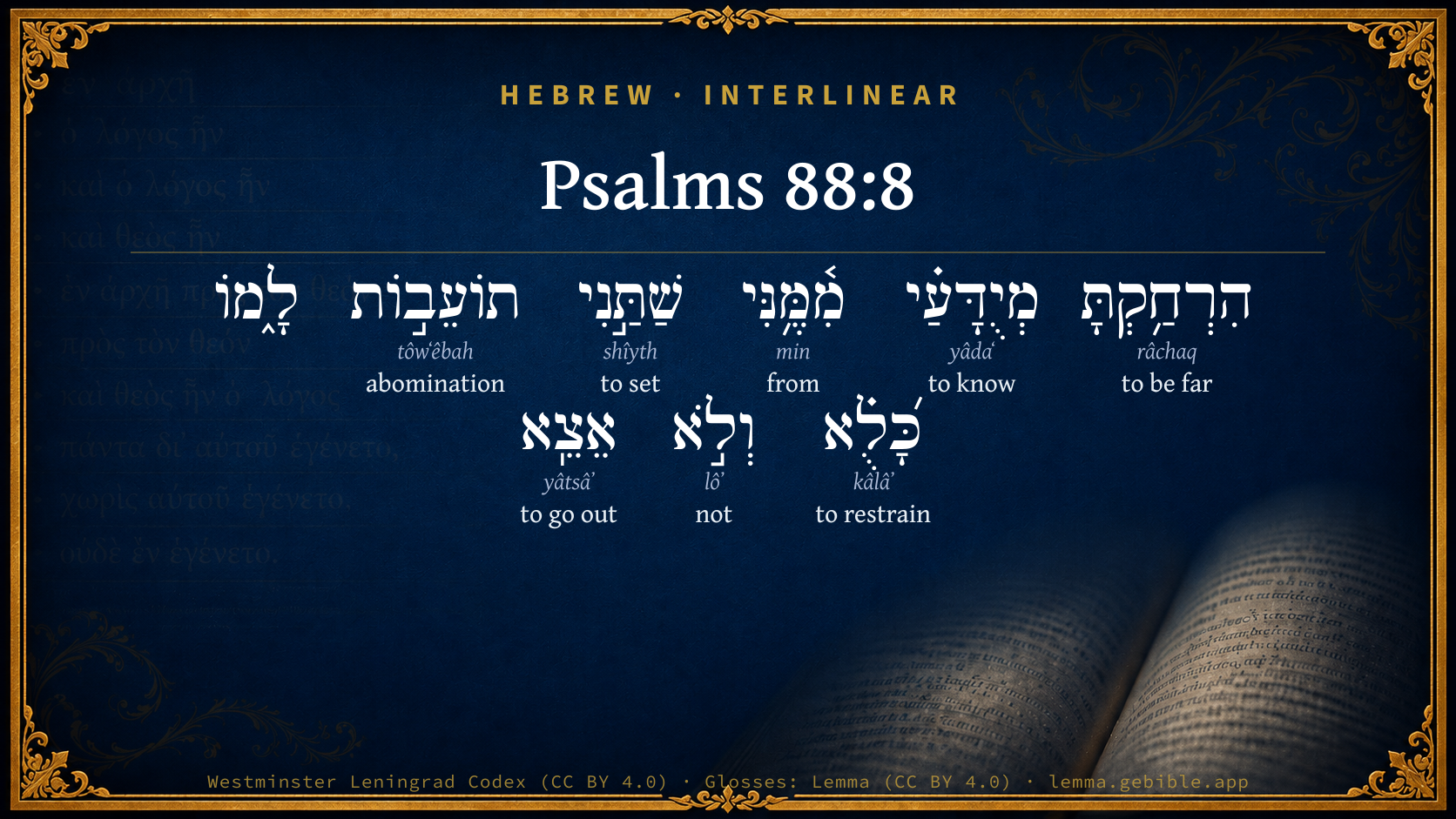
Psalms 88:8

Hebrew (Westminster Leningrad Codex) Psalms 88:8 appears in the Hebrew Old Testament. The text above is from the Westminster Leningrad Codex. Each word links to its Strong’s number, a concise gloss, and parsing drawn from the Open Scriptures Hebrew Bible morphology. Click any word for its full Brown-Driver-Briggs (BDB) entry.
Download image
Cite this verse

Psalms 88:8 (World English Bible). Public Domain. Lemma interlinear Bible study tool, https://lemma.gebible.app/v/psalms/88/8.

Show BibTeX & RIS
BibTeX
RIS
English Translation
You have taken my friends from me. You have made me an abomination to them. I am confined, and I can't escape.
World English Bible · Public Domain
Download a study sheet

One document with this verse’s original text, its word-by-word gloss line, the meaning frame, cross-references with their text, attributed commentary, and full source and license credits — printable, and it pastes into notes with its structure intact.

This verse Autodidact and up

Study sheet (.html) Plain text (.txt)

A passage Seminary Student

Up to 50 verses in one chapter. A passage sheet keeps up to 6 commentary sources and 12 cross-references per verse, in the order this page ranks them, and says so on the sheet whenever that leaves anything out. Ask for a single verse and you get the Autodidact verse sheet above.

Everything on this page stays free to read, with no account — the sheet is a download of what is already on screen, not access to it.

Want to remove ads? Support Godless Engineer
Compare translations 3

The same verse in 3 English versions, stacked beneath the original-language interlinear above. Click any original word for its lexicon entry.

Each is an independent rendering of the whole verse — the interlinear is not word-aligned to these translations.

Highlighted words mark where these versions differ — a whole-verse word diff, not a word-by-word alignment.

  • World English Bible Public Domain
    You have taken my friends from me. You have made me an abomination to them. I am confined, and I can't escape.
  • King James Version Public Domain
    Thou hast put away mine acquaintance far from me; thou hast made me an abomination unto them: I am shut up, and I cannot come forth.
  • unfoldingWord Literal Text CC BY-SA 4.0
    You have distanced my acquaintances from me; you have made me abominations to them. shut in, and I do not go out.

unfoldingWord Literal Text — © unfoldingWord, licensed CC BY-SA 4.0. Word-aligned USFM3 via Door43 (git.door43.org/unfoldingWord/en_ult).

Versions to compare (up to 4)

3 of 4 selected

Show all 18 translations

Every available English version of this verse, each an independent rendering of the whole verse.

  • World English Bible Public Domain
    You have taken my friends from me. You have made me an abomination to them. I am confined, and I can't escape.
  • Berean Standard Bible Public Domain
    You have removed my friends from me; You have made me repulsive to them; I am confined and cannot escape.
  • Majority Standard Bible Public Domain
    You have removed my friends from me; You have made me repulsive to them; I am confined and cannot escape.
  • King James Version Public Domain
    Thou hast put away mine acquaintance far from me; thou hast made me an abomination unto them: I am shut up, and I cannot come forth.
  • American Standard Version (1901) Public Domain
    Thou hast put mine acquaintance far from me; Thou hast made me an abomination unto them: I am shut up, and I cannot come forth.
  • Revised Version (1885) Public Domain
    Thou hast put mine acquaintance far from me; thou hast made me an abomination unto them: I am shut up, and I cannot come forth.
  • Geneva Bible (1599) Public Domain
    Thou hast put away mine acquaintance farre from me, and made mee to be abhorred of them: I am shut vp, and cannot get foorth.
  • Douay-Rheims (1899) Public Domain
    Thy wrath is strong over me: and all thy waves thou hast brought in upon me.
  • Young's Literal Translation Public Domain
    Thou hast put mine acquaintance far from me, Thou hast made me an abomination to them, Shut up -- I go not forth.
  • Literal Standard Version CC BY-SA 4.0
    You have put my acquaintance far from me, || You have made me an abomination to them, || Shut up—I do not go forth.
  • Unlocked Literal Bible CC BY-SA 4.0
    Because of you, my acquaintances avoid me. You have made me a shocking sight to them. I am hemmed in and I cannot escape.
  • unfoldingWord Literal Text CC BY-SA 4.0
    You have distanced my acquaintances from me; you have made me abominations to them. shut in, and I do not go out.
  • Darby Bible Public Domain
    Thou hast put my familiar friends far from me; thou hast made me an abomination unto them: I am shut up, and I cannot come forth.
  • World Messianic Bible Public Domain
    You have taken my friends from me. You have made me an abomination to them. I am confined, and I can’t escape.
  • Webster's Bible Public Domain
    \\88:7\\Thy wrath lieth hard upon me, and thou hast afflicted me with all thy waves. Selah.
  • Free Bible Version CC BY-SA 4.0
    You have made my friends avoid me by making me look repulsive to them. I'm trapped, I can't go out.
  • Bible in Basic English Public Domain
    You have sent my friends far away from me; you have made me a disgusting thing in their eyes: I am shut up, and not able to come out.
  • JPS Tanakh (1917) Public Domain
    (88-9) Thou hast put mine acquaintance far from me; Thou hast made me an abomination unto them; I am shut up, and I cannot come forth.

Literal Standard Version (2020), Covenant Press — licensed CC BY-SA 4.0. Text via the HelloAO Bible API (eBible.org). Unlocked Literal Bible (unfoldingWord) — licensed CC BY-SA 4.0. Text via the HelloAO Bible API (eBible.org). unfoldingWord Literal Text — © unfoldingWord, licensed CC BY-SA 4.0. Word-aligned USFM3 via Door43 (git.door43.org/unfoldingWord/en_ult). Free Bible Version, Dr. Jonathan Gallagher — licensed CC BY-SA 4.0. Text via the HelloAO Bible API (eBible.org).

Word by word

More ways to search: Search by grammar → Find every occurrence → Compare this word →

Practice this passage: Drill this verse → Learn its vocabulary →

כָּ֝לֻ֗א
kâlâʼ
H3607
“restrained”
Verb, Qal, Participle Passive, Masculine, Singular, Absolute
Part of Speech
Verb
Stem
Qal
Form
Participle Passive
Gender
Masculine
Number
Singular
State
Absolute
Full BDB Definition

Origin: a primitive root

TWOT: 980

to restrict, restrain, withhold, shut up, keep back, refrain, forbid - (Qal) - to shut up - to restrain - to withhold - (Niphal) to be restrained - (Piel) to finish
  1. הִרְחַ֥קְתָּ râchaq H7368 “to be far” Verb, Hiphil, Perfect, 2nd Person, Masculine, Singular
  2. מְיֻדָּעַ֗י yâdaʻ H3045 “known · me” Verb, Pual, Participle Passive, Masculine, Plural, Construct + Suffix, Personal, 1st Person, Common, Singular
  3. מִ֫מֶּ֥נִּי min H4480 “from · me” Preposition + Suffix, Personal, 1st Person, Common, Singular
  4. שַׁתַּ֣נִי shîyth H7896 “to set · me” Verb, Qal, Perfect, 2nd Person, Masculine, Singular + Suffix, Personal, 1st Person, Common, Singular
  5. תוֹעֵב֣וֹת tôwʻêbah H8441 “abominations” Noun, Common, Feminine, Plural, Absolute
  6. וְלֹ֣א lôʼ H3808 “and · not” Conjunction + Particle, Negative
  7. אֵצֵֽא yâtsâʼ H3318 “to go out” Verb, Qal, Imperfect, 1st Person, Common, Singular

About this verse

These counts appear in no published source. They are computed here, from the morphology-tagged text and Lemma’s own curated glosses. What Lemma adds →

9
words
8
distinct lemmas
Wisdom
section

Notable vocabulary

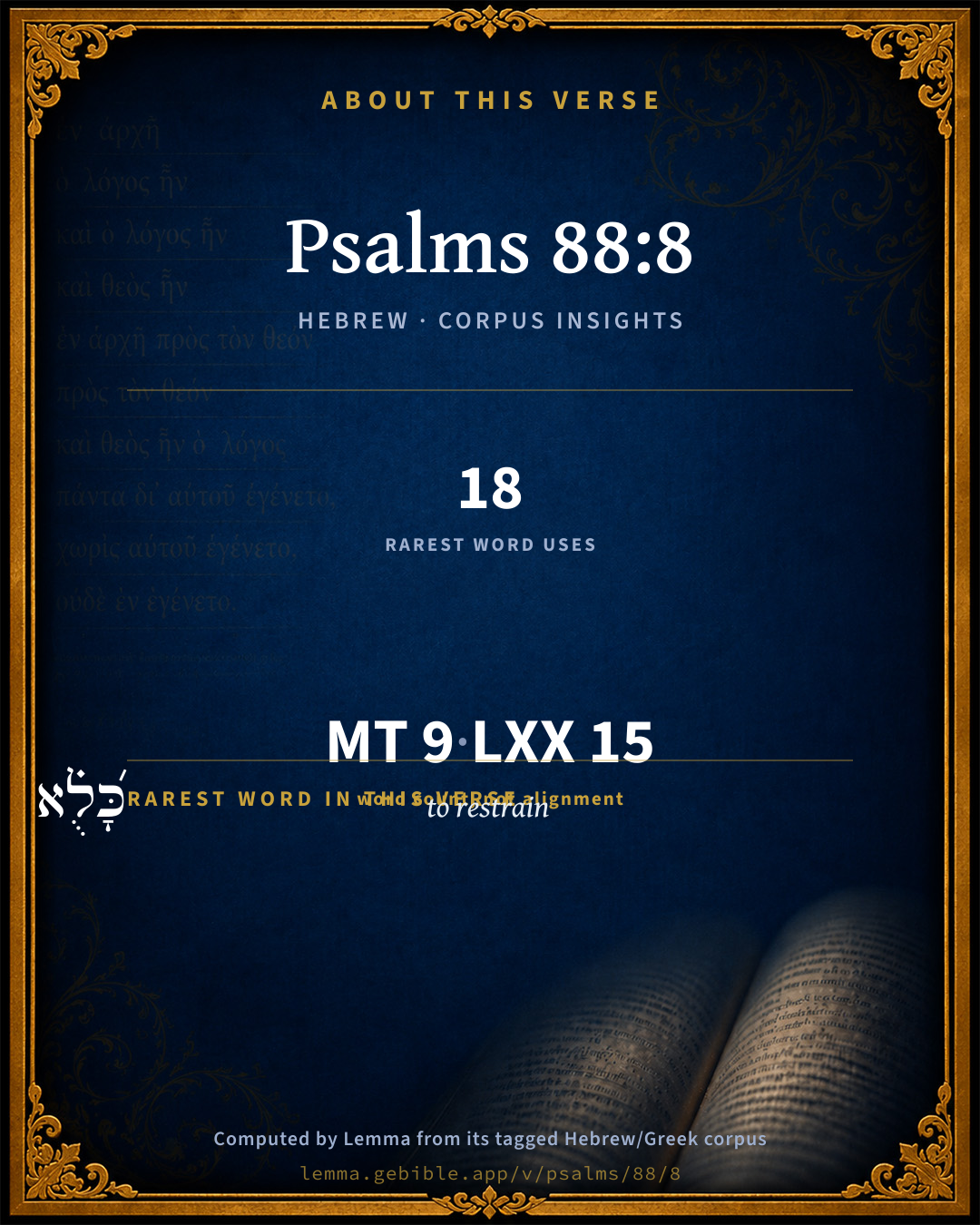
The rarest word here is כָּ֝לֻ֗א to restrain H3607 — appearing just 18 times in the whole Hebrew Bible.

Shared distinctive vocabulary

כָּ֝לֻ֗א to restrain H3607 occurs in 17 verses of the Hebrew Bible. Also found in:

Grammatical profile

  • 5 verbs
  • 1 noun
  • 2 prepositions
  • 1 particle

Verb forms

  • הִרְחַ֥קְתָּ Hiphil · Perfect
  • מְיֻדָּעַ֗י Pual · Participle Passive
  • שַׁתַּ֣נִי Qal · Perfect
  • כָּ֝לֻ֗א Qal · Participle Passive
  • אֵצֵֽא Qal · Imperfect

Hebrew & Septuagint length

In English translation the verse runs 22 words from the Hebrew and 26 from the Septuagint (LXX English) — closely comparable.

A rough comparison of the two English renderings, which tokenize alike — not a word-level alignment.

Word counts can differ between the Hebrew and the Greek without any difference in meaning — e.g. the Hebrew direct-object marker אֵת has no separate Greek word, and Greek often adds the article ὁ.

In the original languages it is 9 Hebrew tokens and 15 Greek tokens — but the two are counted differently (Hebrew bundles its prefixes and suffixes into one token; the Greek is in lemma form), so that isn’t a like-for-like length.

Cross-references

17

Topical passages linked to Psalms 88:8 in the Treasury of Scripture Knowledge — connected by theme and wording, ordered by reader-vote popularity; previews shown in the World English Bible.

  • Psalms 31:11 Because of all my adversaries I have become utterly contemptible to my neighbors, A fear to my acquaintances. Those who saw me on the street fled from me.
  • Job 19:13–19 "He has put my brothers far from me. My acquaintances are wholly estranged from me.
  • Job 30:10 They abhor me, they stand aloof from me, And don't hesitate to spit in my face.
  • Isaiah 49:7 Thus says Yahweh, the Redeemer of Israel, [and] his Holy One, to him whom man despises, to him whom the nation abhors, to a servant of rulers: Kings shall see and arise; princes, and they shall worship; because of Yahweh who is faithful, [even] the Holy One of Israel, who has chosen you.
  • Jeremiah 32:2 Now at that time the king of Babylon's army was besieging Jerusalem; and Jeremiah the prophet was shut up in the court of the guard, which was in the king of Judah's house.
  • Zechariah 11:8 I cut off the three shepherds in one month; for my soul was weary of them, and their soul also loathed me.
  • John 15:23–24 He who hates me, hates my Father also.
  • 1 Samuel 23:18–20 They two made a covenant before Yahweh: and David abode in the wood, and Jonathan went to his house.
  • Job 12:14 Behold, he breaks down, and it can't be built again; He imprisons a man, and there can be no release.
  • Job 19:8 He has walled up my way so that I can't pass, And has set darkness in my paths.
  • Psalms 88:18 You have put lover and friend far from me, And my friends into darkness.
  • Psalms 142:4 Look on my right, and see; For there is no one who is concerned for me. Refuge has fled from me. No one cares for my soul.
  • Psalms 143:4 Therefore my spirit is overwhelmed within me. My heart within me is desolate.
  • Isaiah 63:3 I have trodden the winepress alone; and of the peoples there was no man with me: yes, I trod them in my anger, and trampled them in my wrath; and their lifeblood is sprinkled on my garments, and I have stained all my clothing.
  • Lamentations 3:7–9 He has walled me about, that I can't go forth; he has made my chain heavy.
  • Matthew 27:21–25 But the governor answered them, "Which of the two do you want me to release to you?" They said, "Barabbas!"
  • John 11:57 Now the chief priests and the Pharisees had commanded that if anyone knew where he was, he should report it, that they might seize him.

Cross-references courtesy of OpenBible.info (CC BY 4.0).

Hebrew and Greek witnesses Masoretic Hebrew ↔ Greek Septuagint

The same verse in the two great witnesses to the Old Testament, shown verse-for-verse.

You’re reading Greek Psalm 87 (Hebrew Psalm 88). The Septuagint counts the superscription, so verse numbers can differ from the Hebrew — chapter-level alignment, not verse-by-verse. Numbering follows Rahlfs.

These are two independent witnesses, not word-aligned to each other, and the Septuagint is shown in lemma (dictionary) form.

Hebrew Psalms 88:8 Masoretic · Westminster Leningrad Codex

הִרְחַ֥קְתָּ מְיֻדָּעַ֗י מִ֫מֶּ֥נִּי שַׁתַּ֣נִי תוֹעֵב֣וֹת לָ֑מוֹ כָּ֝לֻ֗א וְלֹ֣א אֵצֵֽא

You have taken my friends from me. You have made me an abomination to them. I am confined, and I can't escape.

World English Bible · Public Domain

Greek LXX Greek Psalm 87:8 Septuagint · lemma form

ἐπί ἐγώ ἐπιστηρίζω ὁ θυμός σύ καί πᾶς ὁ μετεωρισμός σύ ἐπί ἐγώ ἐπιἄγω διάψαλμα

You have removed my acquaintance far from me; they have made me an abomination to themselves; I have been delivered up, and have not gone forth.

LXX2012 (modern English Septuagint) · Public Domain

Hebrew: Westminster Leningrad Codex (CC BY 4.0). Greek: Septuagint (public domain); English from LXX2012 (modern English Septuagint) (Public Domain). How the Septuagint differs from the Hebrew →

Commentary

Notes on Psalms 88:8 from classic Christian and Jewish commentators (each source and its license shown beneath its notes). The classic Christian expositions comment on the surrounding passage and are grouped to its opening verse, so a note may address several verses; the Jewish commentaries on the Tanakh (Rashi and others) are per-verse, so they appear only where the commentator wrote on this verse.

Lemma curates 59 commentaries, every one of them public domain or Creative Commons licensed, each selected and text-cleaned for this edition rather than reprinted as found. About our sources →

Trapp's Complete Commentary

John Trapp

Psa 88:8 Thou hast put away mine acquaintance far from me; thou hast made me an abomination unto them: [I am] shut up, and I cannot come forth.

Ver. 8. Thou hast put away mine acquaintance, &c.] Job and David complain of the like misery. Optimum solatium sodalitium; but woe to him that is alone.

I am shut up] Miserably inclaved in this forlorn comfortless condition, a perpetual prisoner.

John Trapp, A Commentary or Exposition upon All the Books of the Old and New Testament (1647–1656) — public domain. Text from a community e-Sword module.

The Biblical Illustrator

Joseph S. Exell

Psa_88:8

I am shut up, and I cannot come forth.

The imprisoning power of suffering

I. Suffering always shuts us up to ourselves. It does this in two ways, it destroys both the disposition and the capacity to go out into society. Suffering isolates, it throws us back upon Ourselves, and makes us feel our absolute lonelihood. This is often--

1. Spiritually necessary.

2. Spiritually beneficent.

II. Suffering sometimes shuts us up to God. When shut up to ourselves, we are often urged into the conscious presence of God. God is better seen and heard in solitude than in society. I am not alone, the Father is with me. Enter into your closet, and shut your door, etc.

III. Suffering must shut us up to the grave. Elsewhere the writer says, My life draweth nigh unto the grave. (Homilist.)

The Biblical Illustrator, edited by Joseph S. Exell (c. 1880s–1900s) — public domain. Text from a community e-Sword module.

Joseph Benson's Commentary

Psa 88:8-9. Thou hast put away mine acquaintance far from me — I can have no more familiarity or intercourse with my friends than if I were in another world; for thy providence hath removed, or rendered them incapable, or disinclined, to be serviceable to me. Thou hast made me an abomination unto them — They are not only shy, but weary of me; and I am looked upon by them, not only with contempt, but with abhorrence. Reader, do not think it strange if thou should be called to encounter such a trial as this, since Heman, who was so famed for wisdom, was thus neglected when the world frowned upon him, and despised as a broken vessel, in which is no pleasure. I am shut up — A close prisoner under the arrest of the divine wrath; I cannot come forth — There being no way of escape open. He therefore lies down and sinks under his troubles, because he sees not any probability of getting out of them. Mine eye mourneth by reason of affliction — But though I thus give vent to my grief, my troubled spirit receives no relief thereby: nevertheless, I have called daily upon thee — My weeping has not hindered my praying. I have stretched out my hands unto thee — For help and deliverance, though hitherto without effect, for thou dost not hear nor answer me.

Joseph Benson's Commentary on the Old and New Testaments (1811–1818) — public domain. Text from a community e-Sword module.

J. A. Alexander on Psalms

Joseph Addison Alexander

9. (Psa 88:8) Thou hast put far my acquaintances from me; thou hast made me an abomination to them; (I am) shut up and cannot come forth. The circumstance complained of in the first clause, is one often mentioned as an aggravation of distress. See above, on Psa 31:11; Psa 38:11; Psa 69:8, and compare Psa 27:10. The next clause shews that he complains of something more than mere neglect. Made me, literally put or placed me. See above, on Psa 39:8. There may be an allusion to the statement in the history, that the Israelites were an abomination, an object of religious detestation and abhorrence, to their Egyptian masters. See Gen 43:32; Gen 46:34. The last clause is by some understood to mean, I am encompassed by inextricable difficulties. Compare Lam 3:7, Job 3:23. Others, with more probability, connect it with what goes before, and understand the sense to be, that he is not willing to expose himself to this unmerited hatred and contempt. See Job 31:34, and compare Psa 44:13; Psa 80:6.

Joseph Addison Alexander, The Psalms Translated and Explained (1850) — public domain. Text from a community e-Sword module.

Tyndale Open Study Notes

Tyndale Open Resources

88:8-12 In his second charge, the psalmist claims that God has isolated him and caused his loneliness (cp. 31:11; 38:11). Loneliness was a curse in a culture where relationships were more important than personal achievement.

Tyndale Open Study Notes — © Tyndale Open Resources, licensed CC BY-SA 4.0. Text via the HelloAO Bible API.

Geneva Bible (1599)

Geneva Bible translators

He attributeth the loss and displeasure of his friends to God’s providence, whereby he partly punisheth and partly trieth his.

I see none end of my sorrows.

Geneva Bible (1599) marginal notes — public domain. Text via Bolls.life.

Adam Clarke's Commentary

Verse 8. Thou hast made me an abomination] This verse has been supposed to express the state of a leper, who, because of the infectious nature of his disease, is separated from his family - is abominable to all, and at last shut up in a separate house, whence he does not come out to mingle with society.

Adam Clarke's Commentary on the Bible (1810–1826) — public domain. Text from a community e-Sword/MySword module.

John Calvin's Commentaries

8 Thou hast removed my acquaintances from me. He was now destitute of all human aid, and that also he attributes to the anger of God, in whose power it is either to bend the hearts of men to humanity, or to harden them, and render them cruel. This is a point well worthy of our attention; for unless we bear in mind that our destitution of human aid in any case is owing to God’s withdrawing his hand, we agitate ourselves without end or measure. We may indeed justly complain of the ingratitude or cruelty of men whenever they defraud us of the just claims of duty which we have upon them; but still this will avail us nothing, unless we are thoroughly convinced that God, being displeased with us, takes away the means of help which he had destined for us; just as it is easy for him, whenever he pleases, to incline the hearts of all men to stretch forth their hand to succor us. The prophet, as an additional and still more grievous element in his distressed condition, tells us that his friends abhorred him. Finally, he concludes by observing, that he could perceive no way of escape from his calamities: I am shut up that I cannot go forth.

John Calvin's Commentaries (1540-1563) — public domain. Text from the Calvin Translation Society English edition (1840s-50s) via the Christian Classics Ethereal Library (ccel.org). Calvin's coverage is partial (roughly two-thirds of the Bible); uncommented books and verses are honest gaps, never fabricated. The 19th-century editor's footnotes and remarks are omitted so the notes are faithfully Calvin's own voice.

Ellicott's Commentary for English Readers

(8) I am shut up.—Not necessarily an actual imprisonment or incarceration on account of leprosy, but another figurative way of describing great trouble. Job_19:8 seems to have been before the poet.

A Bible Commentary for English Readers, edited by Charles John Ellicott (1878–1897) — public domain. Text from a community e-Sword module.

The Cambridge Bible for Schools and Colleges

gen. ed. J. J. S. Perowne

8. Like Job he is deserted even by his familiar friends (not merely acquaintance, as A.V.), and this is due to the act of God, Who has smitten him with a sickness which makes them loathe even the sight of him. Cp. Psa_31:11; Job_19:13 ff., Job_19:19. He seems to describe himself as a leper like Job. Leprosy was a living death (Num_12:12): more than any other disease it was regarded as the direct ‘stroke’ of God (Job_19:21). The leper was cut off from all society and even from taking part in the public worship of God, and was compelled to live alone (Lev_13:46; 2Ch_26:21). The reference is of course not to the temporary seclusion for the purpose of ascertaining whether a man was really a leper (Lev_13:4 ff.), but to the permanent separation from society, in which the leper was virtually a prisoner, not daring to expose himself to the public gaze (Job_31:34).

Possibly however the last line of the verse is not literal but metaphorical, describing the hopelessness of his condition as a prisoner who cannot escape. Cp. Job_3:23; Job_13:27; Job_19:8; Lam_3:7.

St Luke seems to allude to this verse in his narrative of the Crucifixion, ch. Luk_23:49.

The Cambridge Bible for Schools and Colleges (gen. ed. J. J. S. Perowne; Cambridge University Press, 1878–1918) — public domain. Text from a community e-Sword module.

John Gill's Exposition

Thou hast put away mine acquaintance far from me,.... His familiar friends, who were well known to him, and he to them: it is a mercy and privilege to have good acquaintance, and hearty faithful friends, to converse and advise with, whether about things civil or religious; and it is an affliction to be deprived of them; and oftentimes in distress and adversity they drop and fail, which is an additional trouble: this was the ease of Job and of David, Job 19:13 and here of Heman, who attributes it to God, as done by him; as also Job does, in the place referred to; for as it is the Lord that gives favour in the sight of men, he can take it away when he pleases: this is true of Christ, and the like is said of him, Psa 69:8, and by his "acquaintance", familiars, and friends, may be meant his apostles, who, upon his being apprehended, forsook him, and fled; who, though they were not all alienated in their affections, yet stood at a distance from him; Peter, though he followed him, it was afar off, and at last he denied him; and others of acquaintance and intimates stood afar off, beholding was done to him on the cross; and his familiar friend, Judas, lifted up his heel against him, and basely betrayed him, Mat 26:50,

thou hast made me an abomination unto them; to some of them, as to Judas, and to many that hosanna'd him into Jerusalem, and within a few days cried "Crucify him, crucify him", Mat 21:9 compare with this Isa 53:3.

I am shut up, and I cannot come forth; the Targum renders it,

"shut up in the house of prison,''

in a prison; and so some literally understand it of the author of the psalm being in a prison, or dungeon, in the time of the captivity: but it is rather to be understood of some bodily disease, by which he was detained a prisoner at home, and of his being bound in fetters, and held in the cords of affliction; which was as a prison to him, and in which when the Lord "shuts up a man, there can be no opening", Job 36:8, or else of soul troubles, being in great darkness and desertion; so that his soul was as in a prison, and could not come forth in the free exercise of grace, and needed the free Spirit of God to set him at liberty; see Psa 142:7, this may be applied to Christ, when in the hands of Judas, and the hand of soldiers with him, who took him, and bound him, and led him to the high priest; and when he was encompassed with bulls of Bashan, and enclosed by the assembly of the wicked, as he hung on the cross, Psa 22:12.

John Gill's Exposition of the Whole Bible (1746–1763) — public domain (CC PDM 1.0). Text via the HelloAO Bible API.

Albert Barnes' Notes on the Bible

Thou hast put away mine acquaintance far from me - The same ground of complaint, or expression of the depth of affliction, occurs elsewhere, Psa 31:11; Psa 38:11; Psa 69:8. See also Job 19:13-17.

Thou hast made me an abomination unto them - As something which they would avoid, or from which they would revolt and turn away - as we turn away from the body of a dead man, or from an offensive object. The word means properly an object to be detested or abominated, as things unclean, Gen 43:32; or as idolatry, 1Ki 14:24; 2Ki 16:3; 2Ki 23:13.

I am shut up - As in prison; to wit, by disease, as when one is confined to his house.

And I cannot come forth - I cannot leave my couch, my room, my house. Compare Job 12:14.

Albert Barnes' Notes on the Bible (1834–1885) — public domain. Text from a community e-Sword/MySword module.

Matthew Poole's English Annotations

I am so sad a spectacle of thy vengeance that my friends avoid and detest me, lest by conversing with me they should either be filled with terrors, which men naturally abhor, or be made partakers of my guilt or plagues.

I am shut up; either in the pit or deep, mentioned Psa 88:6, or in my own house or chamber, being afraid or ashamed to go abroad.

Matthew Poole's English Annotations on the Holy Bible (1683–1685) — public domain. Text from a community e-Sword/MySword module.

The Treasury of David

Charles H. Spurgeon

Ver. 8. Thou hast put away mine acquaintance far from me. If ever we need friends it is in the dreary hour of despondency and the weary time of bodily sickness; therefore does the sufferer complain because divine providence had removed his friends. Perhaps his disease was infectious or defiling, so that he was legally separated from his fellow men, perhaps their fears kept them away from his plague stricken house, or else his good name had become so injured that they naturally avoided him. Lost friends require but small excuse for turning their backs on the afflicted. The swallows offer no apology for leaving us to winter by ourselves. Yet it is a piercing pain which arises from the desertion of dear associates; it is a wound which festers and refuses to be healed.

Thou hast made me an abomination unto them. They turned from him as though he had become loathsome and contaminating, and this because of something which the Lord had done to him; therefore, he brings his complaint to the prime mover in his trouble. He who is still flattered by the companions of his pleasure can little guess the wretchedness which will be his portion should he become poor, or slanderously accused, for then one by one the parasites of his prosperity will go their way and leave him to his fate, not without cutting remarks on their part to increase his misery. Men have not so much power to bless by friendship as to curse by treachery. Earth's poisons are more deadly than her medicines are healing. The mass of men who gather around a man and flatter him are like tame leopards; when they lick his hand it is well for him to remember that with equal gusto they would drink his blood. "Cursed is he that trusteth in man."

I am shut up, and I cannot come forth. He was a prisoner in his room, and felt like a leper in the lazaretto, or a condemned criminal in his cell. His mind, too, was bound as with fetters of iron; he felt no liberty of hope, he could take no flights of joy. When God shuts friends out, and shuts us in to pine away alone, it is no wonder if we water our couch with tears.

Ver. 8. There are times when an unspeakable sadness steals upon me, an immense loneliness takes possession of my soul, a longing perchance for some vanished hand and voice to comfort me as of old, a desolation without form and void, that wraps me in its folds, and darkens my inmost being. It was not thus in the first days of my illness. Then all was so new and strange, that a strange spiritual strength filled my soul, and seemed to bear me up as with angel hands. The love and kindness that my sickness called forth, came to me with a sweet surprise; tender solicitude made my very pain into an occasion of joy to me; and hope was strong and recovery was near, only a few brief weeks between me and returning health, with nothing of sickness remaining, but the memory of all that love and sympathy, like a line of light my Saviour's feet had left, as he walked with me on the troubled sea.

But now that hope is deferred, and returning health seems to loiter by the way, and recovery is delayed, and the trial lengthens out like an ever lengthening chain, my soul begins to faint and tire, and the burden to grow heavier. Even to those who love me most, my pain and helplessness is now an accustomed thing, while to me it keeps its keen edge of suffering, but little dulled by use. My ills to them are a tedious oft told tale which comes with something of a dull reiterance. It has become almost a matter of course that in the pleasant plan I should be left out, that in the pleasant walk I should be left behind; a matter of course that the pleasures of life should pass me by with folded hand and averted face; and sickness, and monotonous days, and grey shadows should be my portion...

And O my God, my spirit sometimes faints beneath a nameless dread that this loneliness will grow deeper and deeper, if it be thy will that my sickness should continue, or recovery be long delayed. I can no longer be the companion of those I love; shall I be as dear to them as if I could have kept by their side, and been bound up with all their active interests and pleasures? I have to see others take my place, and do my work for them; shall I not suffer loss in their eyes, and others enter into the heritage of love which might have been mine? Will they not grow weary of me, weary of the same old ills, oft repeated, but ever new, and turn with an unconscious feeling of relief, to brighter hearts, and more joyous lives?

My God, my God, to whom can I turn for comfort but unto thee, thou who didst drink the bitter cup of human loneliness to the dregs that thou mightest make thyself a brother to the lonely, a merciful and faithful High Priest to the desolate soul; thou who alone canst pass within, the doors being shut to all human aid, into that secret place of thunder, where the tempest tossed soul suffers and struggles alone; thou who alone canst command the winds and tempests, and say unto the sea "Be still!" and unto the wind, "Blow not!" and there shall be a great calm.

As a child alone in the dark, my heart cries out for thee, cries for thine embracing arms, for thy voice of comfort, for thy pierced heart on which to rest my aching head, and feel that Love is near. From "Christ the Consoler. A Book of Comfort for the Sick." Anon. 1872.

Ver. 8. Thou hast put away mine acquaintance. This tempest of afflictions is all the heavier, because, First, all my acquaintance departed far from me, like swallows in winter time: Pr 14:20. The poor is hated even of his own neighbour, but, but the rich hath many friends. Seneca wisely admonishes: Flies follow honey, wolves corpses, ants food, the mob follows the pay, not the man. Job said, (Job 19:13), He hath put my brethren far from me, and mine acquaintance are verily estranged from me. My kinsfolk have failed, and my familiar friends have forgotten me. Secondly, not only do they often depart from the afflicted, but they themselves add to his trouble, and precipitate his falling fortune. A rich man beginning to fall is held up by his friends; but a poor man being down, is thrust away by those who once pretended to love him. Le Blanc.

Ver. 8. Thou hast made me an abomination unto them: lit, "abominations", as if I were one great mass of abominations. (Ge 46:34 43:32). As Israel was an abomination to the Egyptians, so Messiah, the antitypical Israel, was to the world. A.R. Fausset.

Ver. 8. An abomination. As one who is unclean, excluded from social intercourse; Ge 46:34. Compare Job 9:31 19:19 30:10. "I cannot come forth." The man suspected of leprosy was "shut up seven days"; Le 13:4. William Kay.

Ver. 8. (last clause). This may describe us when despondency is chronic, when trouble is overwhelming, when sickness detains us at home, when we feel restrained in Christian labour, or hampered in prayer.

Psalms 88:9*

Charles H. Spurgeon's The Treasury of David (1869–1885) — public domain. Psalms only. Text from a community e-Sword/MySword module.

Whedon's Commentary on the Bible

Daniel D. Whedon

8. Mine acquaintance—The neighbouring nations. The psalmist is speaking from the soul of his people. The social aspect of his sufferings now appears.

An abomination unto them—Abominations, the plural form, is intensive—an assemblage of abominations. The hatred and loathing contempt of the neighbouring nations developed fearfully against the Hebrews at the time of their fall by the Chaldeans. See Psa_137:7; Eze_26:2; Zep_2:8-9; Lam_3:14.

I am shut up, and I cannot come forth—An unquestionable description of prison life, fitly applying to King Jehoiachin, who passed thirty-six years of the captivity in a Babylonian prison. 2Ki_24:12; 2Ki_24:15; 2Ki_25:27-30; Jer_52:31-34. See Lam_3:6-9

Daniel D. Whedon (gen. ed.), Commentary on the Old and New Testaments (1874–1909) — public domain. Text from a community e-Sword module.

The Pulpit Commentary

Thou hast put away mine acquaintance far from me. Compare the similar complaint of Job; (Job_19:13, Job_19:14) and see also Psa_31:11; and infra, ver. 18. Thou hast made me an abomination unto them. So Job. (Job_9:31 Job_19:19 Job_30:10) It may be suspected that the psalmist"s affliction was of a kind which made him "unclean." I am shut up. Not in prison, as Jeremiah, (Jer_32:2 Jer_33:1 Jer_36:5) but probably as unclean, or as suspected of Being unclean. (see Lev_13:4-33) And I cannot come forth. I am not allowed to quit my chamber.

The Pulpit Commentary (1880–1919), ed. H.D.M. Spence-Jones & Joseph S. Exell — public domain. Text from a community e-Sword module.

Keil & Delitzsch

C. F. Keil & F. Delitzsch

The octastichs are now followed by hexastichs which belong together in pairs. The complaint concerning the alienation of his nearest relations sounds like Job 19:13., but the same strain is also frequently heard in the earlier Psalms written in times of suffering, e.g., Psa 31:9. He is forsaken by all his familiar friends (not: acquaintances, for מידּע signifies more than that), he is alone in the dungeon of wretchedness, where no one comes near him, and whence he cannot make his escape. This sounds, according to Lev. 13, very much like the complaint of a leper. The Book of Leviticus there passes over from the uncleanness attending the beginning of human life to the uncleanness of the most terrible disease. Disease is the middle stage between birth and death, and, according to the Eastern notion, leprosy is the worst of all diseases, it is death itself clinging to the still living man (Num 12:12), and more than all other evils a stroke of the chastening hand of God (נגע), a scourge of God (צרעת). The man suspected of having leprosy was to be subjected to a seven days' quarantine until the determination of the priest's diagnosis; and if the leprosy was confirmed, he was to dwell apart outside the camp (Lev 13:46), where, though not imprisoned, he was nevertheless separated from his dwelling and his family (cf. Job, at Job 19:19), and if a man of position, would feel himself condemned to a state of involuntary retirement. It is natural to refer the כּלא, which is closely connected with שׁתּני, to this separation. עיני, Psa 88:10, instead of עיני, as in Psa 6:8; Psa 31:10 : his eye has languished, vanished away (דּאב of the same root as tābescere, cognate with the root of דּונג, Psa 68:3), in consequence of (his) affliction. He calls and calls upon Jahve, stretches out (שׁטּח, expandere, according to the Arabic, more especially after the manner of a roof) his hands (palmas) towards Him, in order to shield himself from His wrath and to lead Him compassionately to give ear to him. In Psa 88:11-13 he bases his cry for help upon a twofold wish, viz., to become an object of the miraculous help of God, and to be able to praise Him for it. Neither of these wishes would be realized if he were to die; for that which lies beyond this life is uniform darkness, devoid of any progressive history. With מתים alternates רפאים (sing. רפא), the relaxed ones, i.e., shades (σκιαὶ) of the nether world. With reference to יודוּ instead of להודות, vid., Ewald, 337, b. Beside חשׁך (Job 10:21.) stands ארץ נשׁיּה, the land of forgetfulness (λήθη), where there is an end of all thinking, feeling, and acting (Ecc 9:5-6, Ecc 9:10), and where the monotony of death, devoid of thought and recollection, reigns. Such is the representation given in the Old Testament of the state beyond the present, even in Ecclesiastes, and in the Apocrypha (Sir. 17:27f. after Isa 38:18.; Baruch 2:17f.); and it was obliged to be thus represented, for in the New Testament not merely the conception of the state after death, but this state itself, is become a different one.

Keil & Delitzsch — Biblical Commentary on the Old Testament (1861–1891) — public domain (CC PDM 1.0). Text via the HelloAO Bible API. (Old Testament only.)

unfoldingWord translationNotes

Door43 World Missions Community

my acquaintances

"those who know me"

You have made me a shocking sight to them

"You have made me a disgusting sight to them" or "Because of you, they are shocked when they see me"

I am hemmed in

The writer's physical condition that makes him repulsive to his friends is spoken of as if he were in closed into a confining space. AT: "It is as though I were in a prison" or "I am trapped" (See: Metaphor)

unfoldingWord translationNotes — © Distant Shores Media and the Door43 World Missions Community, licensed CC BY-SA 4.0. Source: git.door43.org/Door43/en_tn.

Rashi

Rabbi Shlomo Yitzchaki (Rashi)

lies hard leans and hangs [sic] on me.

and [with] all Your waves You have afflicted [me] constantly Heb. משבריך, an expression of the waves of the sea. They are all the storms of Your wrath; with all of them have You constantly afflicted me.

Rashi on the Tanakh — English translations: “The Judaica Press complete Tanach with Rashi, translated by A. J. Rosenberg” (CC BY 4.0); “Pentateuch with Rashi's commentary by M. Rosenbaum and A.M. Silbermann, 1929-1934” (public domain); “The Metsudah Tanach series, Lakewood, N.J” (CC BY 4.0); and “The Book of Joshua, Metsudah Publications, 1997” (CC BY 4.0). Text via Sefaria.

Lesson kit

Teaching starters — assembled from the data on this page, not authored interpretation. Every prompt links to the verse data it draws on. Edit before teaching.

Psalms, in the Wisdom, opens this verse with 9 words (8 distinct Hebrew lemmas). Its most distinctive word is kâlâʼ (“to restrain”). A historical commentator’s framing appears above. Read the whole chapter for the surrounding context.

Discussion questions

  1. The word kâlâʼ carries the sense “to restrain.” How does it shape the verse?
  2. Genesis 8:2 shares the word «to restrain» with this verse. How do the two illuminate each other?
  3. These translations render this verse differently; the difference is in the English rendering, not the original. What questions does that raise?
  4. The verb «הִרְחַ֥קְתָּ» is Hiphil Perfect. How does its form color the action?
  5. Reading how Trapp's Complete Commentary and The Biblical Illustrator read this verse, where do the two commentators agree and where do they part?

Things to notice

Reading settings

Reading text

Shown beneath each verse's original-language words.

Old Testament
Old Testament edition

Read the OT as the Masoretic Hebrew (MT) or the Greek Septuagint (LXX).

English shown for the Greek Septuagint (in the Hebrew ↔ Greek comparison).

Comparing translations? Open the Compare panel on any verse page to stack up to four side by side.