
Psalms 73:18

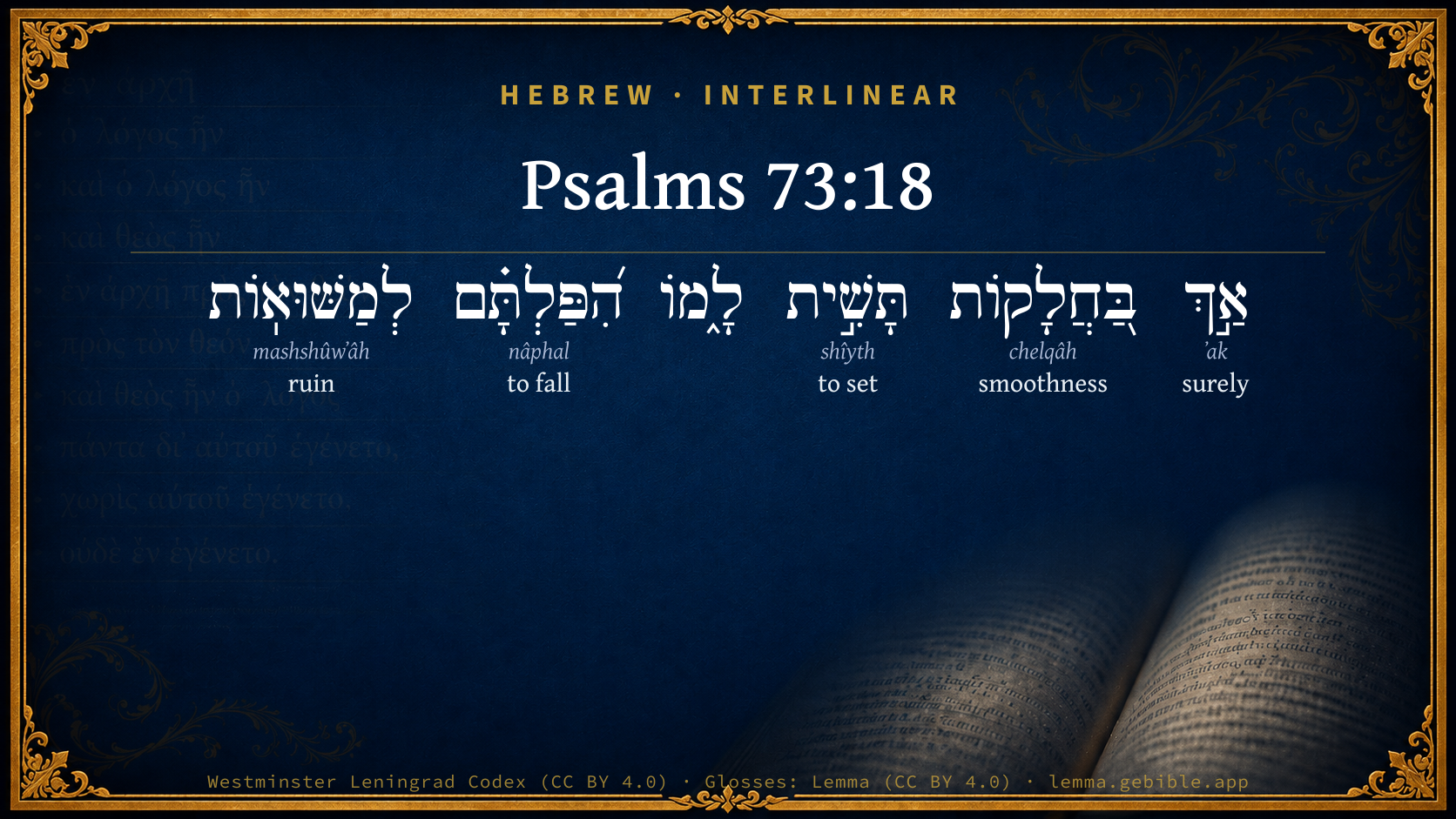
Hebrew (Westminster Leningrad Codex) Psalms 73:18 appears in the Hebrew Old Testament. The text above is from the Westminster Leningrad Codex. Each word links to its Strong’s number, a concise gloss, and parsing drawn from the Open Scriptures Hebrew Bible morphology. Click any word for its full Brown-Driver-Briggs (BDB) entry.
Download image
Cite this verse

Psalms 73:18 (World English Bible). Public Domain. Lemma interlinear Bible study tool, https://lemma.gebible.app/v/psalms/73/18.

Show BibTeX & RIS
BibTeX
RIS
English Translation
Surely you set them in slippery places. You throw them down to destruction.
World English Bible · Public Domain
Highlights
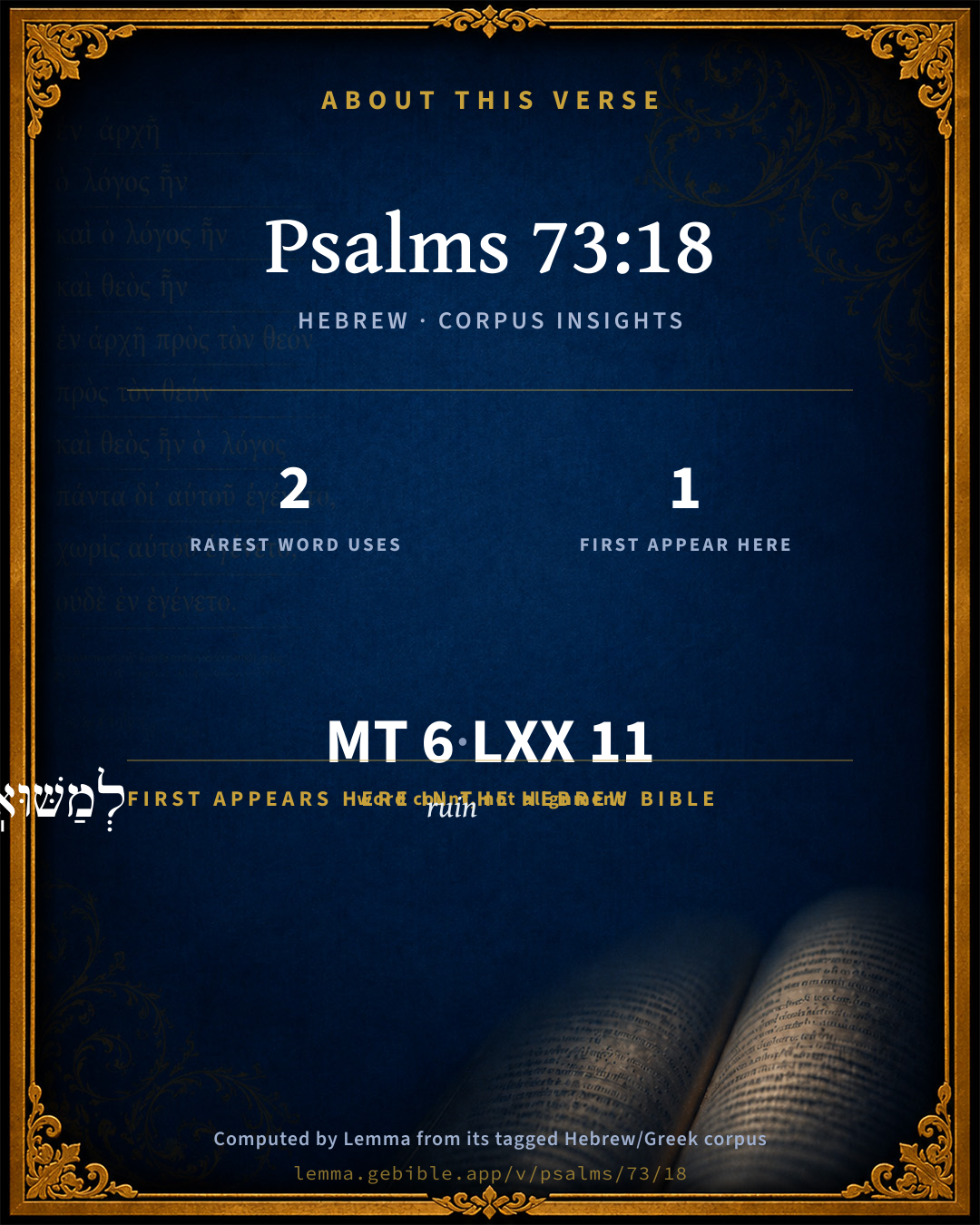
  • 1 first appearance in the Hebrew Bible
Full analysis ↓
Download a study sheet

One document with this verse’s original text, its word-by-word gloss line, the meaning frame, cross-references with their text, attributed commentary, and full source and license credits — printable, and it pastes into notes with its structure intact.

This verse Autodidact and up

Study sheet (.html) Plain text (.txt)

A passage Seminary Student

Up to 50 verses in one chapter. A passage sheet keeps up to 6 commentary sources and 12 cross-references per verse, in the order this page ranks them, and says so on the sheet whenever that leaves anything out. Ask for a single verse and you get the Autodidact verse sheet above.

Everything on this page stays free to read, with no account — the sheet is a download of what is already on screen, not access to it.

Want to remove ads? Support Godless Engineer
Compare translations 3

The same verse in 3 English versions, stacked beneath the original-language interlinear above. Click any original word for its lexicon entry.

Each is an independent rendering of the whole verse — the interlinear is not word-aligned to these translations.

Highlighted words mark where these versions differ — a whole-verse word diff, not a word-by-word alignment.

  • World English Bible Public Domain
    Surely you set them in slippery places. You throw them down to destruction.
  • King James Version Public Domain
    Surely thou didst set them in slippery places: thou castedst them down into destruction.
  • unfoldingWord Literal Text CC BY-SA 4.0
    Surely you set them in slippery places; you make them fall to destruction.

unfoldingWord Literal Text — © unfoldingWord, licensed CC BY-SA 4.0. Word-aligned USFM3 via Door43 (git.door43.org/unfoldingWord/en_ult).

Versions to compare (up to 4)

3 of 4 selected

Show all 18 translations

Every available English version of this verse, each an independent rendering of the whole verse.

  • World English Bible Public Domain
    Surely you set them in slippery places. You throw them down to destruction.
  • Berean Standard Bible Public Domain
    Surely You set them on slick ground; You cast them down into ruin.
  • Majority Standard Bible Public Domain
    Surely You set them on slick ground; You cast them down into ruin.
  • King James Version Public Domain
    Surely thou didst set them in slippery places: thou castedst them down into destruction.
  • American Standard Version (1901) Public Domain
    Surely thou settest them in slippery places: Thou castest them down to destruction.
  • Revised Version (1885) Public Domain
    Surely thou settest them in slippery places: thou castest them down to destruction.
  • Geneva Bible (1599) Public Domain
    Surely thou hast set them in slipperie places, and castest them downe into desolation.
  • Douay-Rheims (1899) Public Domain
    But indeed for deceits thou hast put it to them: when they were lifted up thou hast cast them down.
  • Young's Literal Translation Public Domain
    Only, in slippery places Thou dost set them, Thou hast caused them to fall to desolations.
  • Literal Standard Version CC BY-SA 4.0
    Surely You set them in slippery places, || You have caused them to fall to desolations.
  • Unlocked Literal Bible CC BY-SA 4.0
    Surely you put them in slippery places; you bring them down to ruin.
  • unfoldingWord Literal Text CC BY-SA 4.0
    Surely you set them in slippery places; you make them fall to destruction.
  • Darby Bible Public Domain
    Truly thou settest them in slippery places, thou castest them down in ruins.
  • World Messianic Bible Public Domain
    Surely you set them in slippery places. You throw them down to destruction.
  • Webster's Bible Public Domain
    Surely thou didst set them in slippery places: thou didst cast them down into destruction.
  • Free Bible Version CC BY-SA 4.0
    For you send them on a slippery path; you throw them down to destruction.
  • Bible in Basic English Public Domain
    You put their feet where there was danger of slipping, so that they go down into destruction.
  • JPS Tanakh (1917) Public Domain
    Surely Thou settest them in slippery places; Thou hurlest them down to utter ruin.

Literal Standard Version (2020), Covenant Press — licensed CC BY-SA 4.0. Text via the HelloAO Bible API (eBible.org). Unlocked Literal Bible (unfoldingWord) — licensed CC BY-SA 4.0. Text via the HelloAO Bible API (eBible.org). unfoldingWord Literal Text — © unfoldingWord, licensed CC BY-SA 4.0. Word-aligned USFM3 via Door43 (git.door43.org/unfoldingWord/en_ult). Free Bible Version, Dr. Jonathan Gallagher — licensed CC BY-SA 4.0. Text via the HelloAO Bible API (eBible.org).

Word by word

More ways to search: Search by grammar → Find every occurrence → Compare this word →

Practice this passage: Drill this verse → Learn its vocabulary →

About this verse

These counts appear in no published source. They are computed here, from the morphology-tagged text and Lemma’s own curated glosses. What Lemma adds →

6
words
5
distinct lemmas
Wisdom
section

Notable vocabulary

The rarest word here is לְמַשּׁוּאֽוֹת ruin H4876 — appearing just 2 times in the whole Hebrew Bible.

First appearance in Scripture

This word makes its first canonical appearance in the Hebrew Bible here:

  • לְמַשּׁוּאֽוֹת ruin H4876

Shared distinctive vocabulary

לְמַשּׁוּאֽוֹת ruin H4876 occurs in 2 verses of the Hebrew Bible. Also found in:

Grammatical profile

  • 2 verbs
  • 1 noun
  • 1 adjective
  • 1 preposition
  • 1 particle

Verb forms

  • תָּשִׁ֣ית Qal · Imperfect
  • הִ֝פַּלְתָּ֗ם Hiphil · Perfect

Hebrew & Septuagint length

In English translation the verse runs 13 words from the Hebrew and 22 from the Septuagint (LXX English) — closely comparable.

A rough comparison of the two English renderings, which tokenize alike — not a word-level alignment.

Word counts can differ between the Hebrew and the Greek without any difference in meaning — e.g. the Hebrew direct-object marker אֵת has no separate Greek word, and Greek often adds the article ὁ.

In the original languages it is 6 Hebrew tokens and 11 Greek tokens — but the two are counted differently (Hebrew bundles its prefixes and suffixes into one token; the Greek is in lemma form), so that isn’t a like-for-like length.

Cross-references

10

Topical passages linked to Psalms 73:18 in the Treasury of Scripture Knowledge — connected by theme and wording, ordered by reader-vote popularity; previews shown in the World English Bible.

  • Jeremiah 23:12 Therefore their way shall be to them as slippery places in the darkness: they shall be driven on, and fall therein; for I will bring evil on them, even the year of their visitation, says Yahweh.
  • Psalms 35:6 Let their way be dark and slippery, Yahweh's angel pursuing them.
  • Deuteronomy 32:35 Vengeance is mine, and recompense, At the time when their foot shall slide: For the day of their calamity is at hand, The things that are to come on them shall make haste.
  • Psalms 55:23 But you, God, will bring them down into the pit of destruction. Bloodthirsty and deceitful men shall not live out half their days, But I will trust in you.
  • Psalms 94:23 He has brought on them their own iniquity, And will cut them off in their own wickedness. Yahweh, our God, will cut them off.
  • 2 Thessalonians 1:9 who will pay the penalty: eternal destruction from the face of the Lord and from the glory of his might,
  • Psalms 37:20 But the wicked shall perish. The enemies of Yahweh shall be like the beauty of the fields. They will vanish-- Vanish like smoke.
  • Psalms 37:35–38 I have seen the wicked in great power, Spreading himself like a green tree in its native soil.
  • Psalms 92:7 Though the wicked spring up as the grass, And all the evil-doers flourish, They will be destroyed forever.
  • Psalms 37:24 Though he stumble, he shall not fall, For Yahweh holds him up with his hand.

Cross-references courtesy of OpenBible.info (CC BY 4.0).

Hebrew and Greek witnesses Masoretic Hebrew ↔ Greek Septuagint

The same verse in the two great witnesses to the Old Testament, shown verse-for-verse.

You’re reading Greek Psalm 72 (Hebrew Psalm 73). The Septuagint counts the superscription, so verse numbers can differ from the Hebrew — chapter-level alignment, not verse-by-verse. Numbering follows Rahlfs.

These are two independent witnesses, not word-aligned to each other, and the Septuagint is shown in lemma (dictionary) form.

Hebrew Psalms 73:18 Masoretic · Westminster Leningrad Codex

אַ֣ךְ בַּ֭חֲלָקוֹת תָּשִׁ֣ית לָ֑מוֹ הִ֝פַּלְתָּ֗ם לְמַשּׁוּאֽוֹת

Surely you set them in slippery places. You throw them down to destruction.

World English Bible · Public Domain

Greek LXX Greek Psalm 72:18 Septuagint · lemma form

πλήν διά ὁ δολιότης τίθημι αὐτός καταβάλλω αὐτός ἐν ὁ ἐπιαἴρω

Surely you have appointed judgments to them because of their crafty dealings: you have cast them down when they were lifted up.

LXX2012 (modern English Septuagint) · Public Domain

Hebrew: Westminster Leningrad Codex (CC BY 4.0). Greek: Septuagint (public domain); English from LXX2012 (modern English Septuagint) (Public Domain). How the Septuagint differs from the Hebrew →

Commentary

Notes on Psalms 73:18 from classic Christian and Jewish commentators (each source and its license shown beneath its notes). The classic Christian expositions comment on the surrounding passage and are grouped to its opening verse, so a note may address several verses; the Jewish commentaries on the Tanakh (Rashi and others) are per-verse, so they appear only where the commentator wrote on this verse.

Lemma curates 59 commentaries, every one of them public domain or Creative Commons licensed, each selected and text-cleaned for this edition rather than reprinted as found. About our sources →

Trapp's Complete Commentary

John Trapp

Psa 73:18 Surely thou didst set them in slippery places: thou castedst them down into destruction.

Ver. 18. Surely thou didst set them in slippery places] Where they can have no more certainty than if they went upon the smoothest ice, or walked upon a mine of gunpowder. The Turks, seeing so few of their viziers to die in their beds, have taken up this proverb, He that is even in the greatest office is but a statue of glass.

Thou castedst them down into destruction] Improbos ex magna prosperitate tanquam ex Tarpeia rupe in barathrum perditienis praecipitasti. Haman for instance.

John Trapp, A Commentary or Exposition upon All the Books of the Old and New Testament (1647–1656) — public domain. Text from a community e-Sword module.

Joseph Benson's Commentary

Psa 73:18. Thou didst set them in slippery places — Their happiness hath no firm foundation; it is very unstable, like a man’s standing on very slippery ground. Thou castedst them down into destruction — The same hand which raised them will soon cast them down into utter ruin. “Worldly prosperity,” says Dr. Horne, “is as the narrow and slippery summit of a mountain, on which, to answer the designs of his providence, God permits the wicked, during his pleasure, to take their station; till, at length, the fatal hour arrives, when, by a stroke unseen, they fall from thence, and are lost in the fathomless ocean of sorrow, torment, and despair.”

Joseph Benson's Commentary on the Old and New Testaments (1811–1818) — public domain. Text from a community e-Sword module.

J. A. Alexander on Psalms

Joseph Addison Alexander

Psa 73:18. Only in slippery places thou wilt set them, or art setting them, (and now) thou hast let (or made) them fall into destruction. However honourable and happy their position may appear to themselves, the Psalmist can see nothing but its danger, as implied in his use of the word only. Smoothnesses, smooth or slippery places, where their foothold is precarious and fall inevitable. He sees God, by his providential favours, placing them in this desired but fearful situation, and then allowing them to drop into destruction. The last word in Hebrew occurs only here and in the next psalm, where it means ruins. If this sense be adopted here, we must suppose a change of figure and an allusion to the fall, not of a man from a slippery precipice, but of a building crumbled by decay or violence.

Joseph Addison Alexander, The Psalms Translated and Explained (1850) — public domain. Text from a community e-Sword module.

Adam Clarke's Commentary

Verse 18. Thou didst set them in slippery places] Affluence is a slippery path; few have ever walked in it without falling. It is possible to be faithful in the unrighteous mammon, but it is very difficult. No man should desire riches; for they bring with them so many cares and temptations as to be almost unmanageable. Rich men, even when pious, are seldom happy; they do not enjoy the consolations of religion. A good man, possessed of very extensive estates, unblamable in his whole deportment, once said to me: "There must be some strange malignity in riches thus to keep me in continual bondage, and deprive me of the consolations of the Gospel." Perhaps to a person to whom his estates are a snare, the words of our Lord may be literally applicable: "Sell what thou hast, and give to the poor; and thou shalt have treasure in heaven: and come, take up thy cross, and follow me." But he went away sorrowful, for he had great possessions! May we not then say with the psalmist, Surely thou digest set them in slippery places, &c.?

Adam Clarke's Commentary on the Bible (1810–1826) — public domain. Text from a community e-Sword/MySword module.

John Calvin's Commentaries

18. Surely thou hast set them in slippery places. David, having now gone through his conflicts, begins, if we may use the expression, to be a new man; and he speaks with a quiet and composed mind, being, as it were, elevated on a watchtower, from which he obtained a clear and distinct view of things which before were hidden from him. It was the prophet Habakkuk’s resolution to take such a position, and, by his example, he prescribes this to us as a remedy in the midst of troubles — “I will stand upon my watch,” says he, “and set me upon the tower,” (Habakkuk 2:1.) David, therefore, shows how much advantage is to be derived from approaching God. I now see, says he, how thou proceedest in thy providence; for, although the ungodly continue to stand for a brief season, yet they are, as it were, perched on slippery places, that they may fall ere long into destruction. Both the verbs of this verse are in the past tense; but the first, to set them in slippery places, is to be understood of the present time, as if it had been said, — God for a short period thus lifts them up on high, that when they fall their fall may be the heavier. This, it is true, seems to be the lot of the righteous as well as of the wicked; for everything in this world is slippery, uncertain, and changeable. But as true believers depend upon heaven, or rather, as the power of God is the foundation on which they rest, it is not said of them that they are set in slippery places, notwithstanding the frailty and uncertainty which characterises their condition in this world. What although they stumble or even fall, the Lord has his hand under them to sustain and strengthen them when they stumble, and to raise them up when they are fallen. The uncertainty of the condition of the ungodly, or, as it is here expressed, their slippery condition, proceeds from this, that they take pleasure in contemplating their own power and greatness, and admire themselves on that account, just like a person who would walk at leisure upon ice; and thus by their infatuated presumption, they prepare themselves for falling down headlong. We are not to picture to our imaginations a wheel of fortune, which, as it revolves, embroils all things in confusion; but we must admit the truth to which the prophet here adverts, and which he tells us is made known to all the godly in the sanctuary, that there is a secret providence of God which manages all the affairs of the world. On this subject my readers, if they choose, may peruse the beautiful verses of Claudian in his first book against Ruffinus.

John Calvin's Commentaries (1540-1563) — public domain. Text from the Calvin Translation Society English edition (1840s-50s) via the Christian Classics Ethereal Library (ccel.org). Calvin's coverage is partial (roughly two-thirds of the Bible); uncommented books and verses are honest gaps, never fabricated. The 19th-century editor's footnotes and remarks are omitted so the notes are faithfully Calvin's own voice.

The Cambridge Bible for Schools and Colleges

gen. ed. J. J. S. Perowne

18. Surely in slippery places dost thou appoint their lot:

Suddenly dost thou cast them down into ruin.

Surely, as in Psa_73:1; Psa_73:13, means ‘after all.’ They are set in dangerous places where they will stumble and fall. Cp. Psa_35:6; Jer_23:12. The word for ruin occurs elsewhere only in Psa_74:3.

18–20. The awful fate of the wicked is the negative solution of the problem.

The Cambridge Bible for Schools and Colleges (gen. ed. J. J. S. Perowne; Cambridge University Press, 1878–1918) — public domain. Text from a community e-Sword module.

John Gill's Exposition

Surely thou didst set them in slippery places,.... In which a man cannot stand long, and without danger; and the higher they are the more dangerous, being slippery, and such are places of honour and riches. The phrase denotes the uncertainty and instability of these things, and the danger men are in who are possessed of them of falling into destruction and misery. The Targum is,

"thou didst set them in darkness;''

to be in slippery places, and in the dark, is very uncomfortable, unsafe, and dangerous indeed; See Psa 35:6 and it may be observed, that all this honour, promotion, and riches, are of God; it is he that sets them in these places of honour and profit; and he that sets them up can pull them down, as he does; so it follows,

thou castest them down into destruction: into temporal destruction, by removing them from their high stations into a very low, mean, and contemptible state, as were Shebna and Nebuchadnezzar, Isa 22:15 and into everlasting destruction, from whence there is no recovery; see Psa 55:23.

John Gill's Exposition of the Whole Bible (1746–1763) — public domain (CC PDM 1.0). Text via the HelloAO Bible API.

Albert Barnes' Notes on the Bible

Surely thou didst set them in slippery places - Not in a solid and permanent position; not where their foothold would be secure, but as on smooth and slippery rocks, where they would be liable any moment to fall into the foaming billows. However prosperous their condition may seem to be now, yet it is a condition of uncertainty and danger, from which they must soon fall into ruin. In their prosperity there is nothing of permanence or Stability; and this fact will explain the difficulty.

Thou castedst them down into destruction - They are placed, not in a permanent condition, but in a condition from which they will be cast down to destruction. Ruin is before them; and the end will demonstrate the justice of God. Nothing can be determined from their present condition as to the question which caused so much perplexity, but in order to a proper solution we must wait to see the end. As an illustration of this, see the interesting account of the interview between Solon of Athens, and Croesus, the rich king of Lydia, as given in Herodotus, book i., 30-33.

Albert Barnes' Notes on the Bible (1834–1885) — public domain. Text from a community e-Sword/MySword module.

Matthew Poole's English Annotations

Their happiness hath no firm foundation; it was very unstable, like a man’s standing in very slippery ground. The same hand which raised them will cast them down into the pit of utter destruction.

Matthew Poole's English Annotations on the Holy Bible (1683–1685) — public domain. Text from a community e-Sword/MySword module.

The Treasury of David

Charles H. Spurgeon

Ver. 18. The Psalmist's sorrow had culminated, not in the fact that the ungodly prospered, but that God had arranged it so: had it happened by mere chance, he would have wondered, but could not have complained; but how the arranger of all things could so dispense his temporal favours, was the vexatious question. Here, to meet the case, he sees that the divine hand purposely placed these men in prosperous and eminent circumstances, not with the intent to bless them but the very reverse.

Surely thou didst set them in slippery places. Their position was dangerous, and, therefore, God did not set his friends there but his foes alone. He chose, in infinite love, a rougher but safer standing for his own beloved.

Thou castedst them down into destruction. The same hand which led them up to their Tarpeian rock, hurled them down from it. They were but elevated by judicial arrangement for the fuller execution of their doom. Eternal punishment will be all the more terrible in contrast with the former prosperity of those who are ripening for it. Taken as a whole, the case of the ungodly is horrible throughout; and their worldly joy instead of diminishing the horror, actually renders the effect the more awful, even as the vivid lightning amid the storm does not brighten but intensify the thick darkness which lowers around. The ascent to the fatal gallows of Haman was an essential ingredient in the terror of the sentence--"hang him thereon." If the wicked had not been raised so high they could not have fallen so low.

Ver. 18. Slippery places. The word in the original signifies slick, or smooth, as ice or polished marble, and is from thence by a metaphor used for flattery. Hence, Abenezra renders it, In locis adulationis posuisti eos: thou hast set them in places of flattery. Edward Parry.

Ver. 18. They are but exalted, as the shellfish by the eagle, according to the naturalist, to be thrown down on some rock and devoured. Their most glorious prosperity is but like a rainbow, which showeth itself for a little time in all its gaudy colours, and then vanisheth. The Turks, considering the unhappy end of their viziers, use this proverb, "He that is in the greatest office is but a statue of glass." Wicked men walk on glass or ice, thou hast set them in slippery places; on a sudden their feet slip--they fall, and break their necks. George Swinnock.

Ver. 18,20. Their banqueting house is very slippery, and the feast itself a mere dream. Thomas Adams.

Ver. 18. Thou didst set them in slippery places.

I. It implies that they were always exposed to sudden,

unexpected destruction. As he that walks in

slippery places is every moment liable to fall, he

cannot foresee one moment whether he shall stand or

fall the next; and when he does fall, he falls at

once without warning.

II. They are liable to fall of themselves, without

being thrown down by the hand of another; as he that

stands or walks on slippery ground needs nothing but

his own weight to throw him down.

III. There is nothing that keeps wicked men at any one

moment out of hell but the mere pleasure of God. Jonathan Edwards.

Ver. 18-20. The end of the wicked is,

I. Near: Thou hast set, etc. It may happen at any

time.

II. Judicial: Thou bringest, etc.

III. Sudden: How are they, etc.

IV. Tormenting: They are utterly consumed, etc.

V. Eternal: Left to themselves; gone from the mind of

God; and disregarded as a dream when one awaketh. No

after act respecting them, either for deliverance or

annihilation.

Psalms 73:19*

Ver. 18,20. Their banqueting house is very slippery, and the feast itself a mere dream. Thomas Adams.

Ver. 18-20. The end of the wicked is,

I. Near: Thou hast set, etc. It may happen at any

time.

II. Judicial: Thou bringest, etc.

III. Sudden: How are they, etc.

IV. Tormenting: They are utterly consumed, etc.

V. Eternal: Left to themselves; gone from the mind of

God; and disregarded as a dream when one awaketh. No

after act respecting them, either for deliverance or

annihilation.

Charles H. Spurgeon's The Treasury of David (1869–1885) — public domain. Psalms only. Text from a community e-Sword/MySword module.

Whedon's Commentary on the Bible

Daniel D. Whedon

18-20. In these verses there is a rising climax in the description of the doom of the wicked.

Surely—Answering to verily in New Testament.

Slippery places—The figure is that of a narrow path along mountain crags where the rocks are smooth and treacherous.

Thou castedst them down—The fall of the wicked is not accidental, nor simply consequential. God casts them down. The strong arm of law now interferes.

Daniel D. Whedon (gen. ed.), Commentary on the Old and New Testaments (1874–1909) — public domain. Text from a community e-Sword module.

The Pulpit Commentary

Surely thou didst set them up in slippery places. The wicked have at no time any sure hold on their prosperity. They are a "set in slippery places places from which they may easily slip and fall. Thou castedst them down to destruction. The fall often comes, even in this life. The flourishing cities of the plain are destroyed by fire from heaven; Pharaoh"s land is ruined by the plagues, and his host destroyed in the Red Sea; Sennacherib"s army perishes in a night; Jezebel is devoured by dogs; Athaliah is slain with the sword; Antiochus Epiphanes perishes in a distant expedition; Herod Agrippa is eaten of worms; persecutors, like Nero, Galerius, Julian, come to untimely ends. A signal retribution visits the wicked in hundreds and thousands of instances. When it does not, the question remains Is death the end? This point is not formally brought forward, but it underlies the whole argument; and, unless retribution after death be regarded as certain, a single exception to the general rule of retribution in this life would upset the solution which the psalmist finds satisfactory.

The Pulpit Commentary (1880–1919), ed. H.D.M. Spence-Jones & Joseph S. Exell — public domain. Text from a community e-Sword module.

unfoldingWord translationNotes

Door43 World Missions Community

put them

The word "them" refers to the wicked.

slippery places

"unsafe or unstable ground." See how "slipped" is translated in Psalms 73:2.

How they become a wilderness in a moment

The word "wilderness" is a metaphor for a person who has lost everything good. AT: "How quickly they are destroyed" (See: Metaphor)

like a dream after one wakes up

The wicked will last no longer than what a person sees in a dream. It disappears as soon as the person wakes up. (See: Simile)

translationWords

ruin

desert

terror

lord

dream

unfoldingWord translationNotes — © Distant Shores Media and the Door43 World Missions Community, licensed CC BY-SA 4.0. Source: git.door43.org/Door43/en_tn.

Rashi

Rabbi Shlomo Yitzchaki (Rashi)

Only in slippery places do You set them All the goodness that comes to them, for ultimately, You cast them down to ruin.

Rashi on the Tanakh — English translations: “The Judaica Press complete Tanach with Rashi, translated by A. J. Rosenberg” (CC BY 4.0); “Pentateuch with Rashi's commentary by M. Rosenbaum and A.M. Silbermann, 1929-1934” (public domain); “The Metsudah Tanach series, Lakewood, N.J” (CC BY 4.0); and “The Book of Joshua, Metsudah Publications, 1997” (CC BY 4.0). Text via Sefaria.

Lesson kit

Teaching starters — assembled from the data on this page, not authored interpretation. Every prompt links to the verse data it draws on. Edit before teaching.

Psalms, in the Wisdom, opens this verse with 6 words (5 distinct Hebrew lemmas). Its most distinctive word is mashshûwʼâh (“ruin”). A historical commentator’s framing appears above. Read the whole chapter for the surrounding context.

Discussion questions

  1. How does “ruin” (mashshûwʼâh) shape what this verse is saying?
  2. This is the first place “ruin” appears in Scripture (first appears here). What does its debut here establish?
  3. How does Psalms 74:3, which shares the word «ruin», read alongside this verse?
  4. The translations on this page render this verse differently — a whole-verse word diff, not a word-by-word alignment. What might account for the different wordings?
  5. «תָּשִׁ֣ית» is a Qal Imperfect verb. How does that grammatical form shape the action described?
  6. Compare how Trapp's Complete Commentary and Joseph Benson's Commentary read this verse. Where do they agree or differ?

Things to notice

Reading settings

Reading text

Shown beneath each verse's original-language words.

Old Testament
Old Testament edition

Read the OT as the Masoretic Hebrew (MT) or the Greek Septuagint (LXX).

English shown for the Greek Septuagint (in the Hebrew ↔ Greek comparison).

Comparing translations? Open the Compare panel on any verse page to stack up to four side by side.