
Jeremiah 3:19

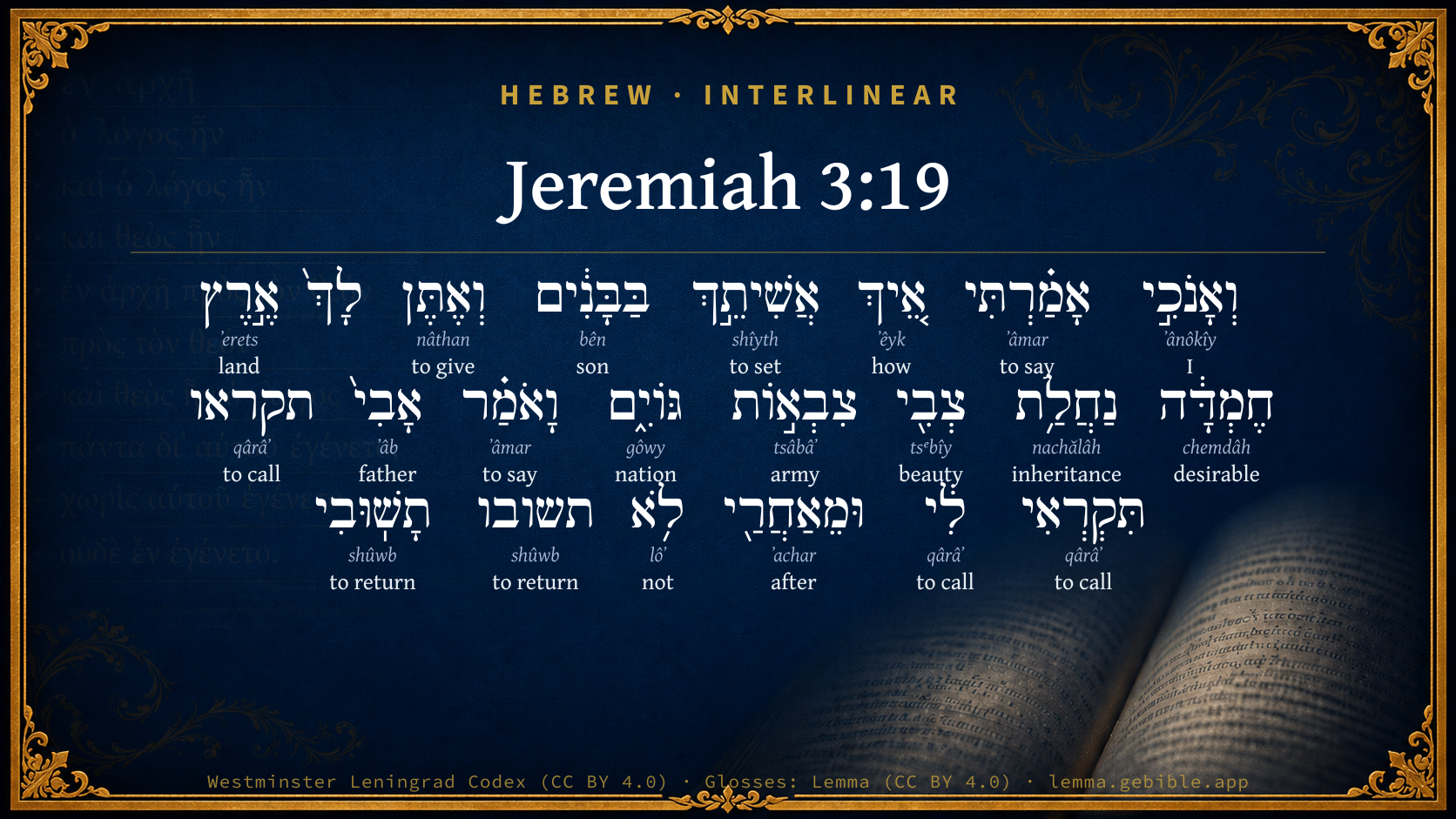
Hebrew (Westminster Leningrad Codex) Jeremiah 3:19 appears in the Hebrew Old Testament. The text above is from the Westminster Leningrad Codex. Each word links to its Strong’s number, a concise gloss, and parsing drawn from the Open Scriptures Hebrew Bible morphology. Click any word for its full Brown-Driver-Briggs (BDB) entry.
Download image
Cite this verse

Jeremiah 3:19 (World English Bible). Public Domain. Lemma interlinear Bible study tool, https://lemma.gebible.app/v/jeremiah/3/19.

Show BibTeX & RIS
BibTeX
RIS
English Translation
But I said, How I will put you among the children, and give you a pleasant land, a goodly heritage of the hosts of the nations! and I said, You shall call me My Father, and shall not turn away from following me.
World English Bible · Public Domain
Download a study sheet

One document with this verse’s original text, its word-by-word gloss line, the meaning frame, cross-references with their text, attributed commentary, and full source and license credits — printable, and it pastes into notes with its structure intact.

This verse Autodidact and up

Study sheet (.html) Plain text (.txt)

A passage Seminary Student

Up to 50 verses in one chapter. A passage sheet keeps up to 6 commentary sources and 12 cross-references per verse, in the order this page ranks them, and says so on the sheet whenever that leaves anything out. Ask for a single verse and you get the Autodidact verse sheet above.

Everything on this page stays free to read, with no account — the sheet is a download of what is already on screen, not access to it.

Want to remove ads? Support Godless Engineer
Compare translations 3

The same verse in 3 English versions, stacked beneath the original-language interlinear above. Click any original word for its lexicon entry.

Each is an independent rendering of the whole verse — the interlinear is not word-aligned to these translations.

Highlighted words mark where these versions differ — a whole-verse word diff, not a word-by-word alignment.

  • World English Bible Public Domain
    But I said, How I will put you among the children, and give you a pleasant land, a goodly heritage of the hosts of the nations! and I said, You shall call me My Father, and shall not turn away from following me.
  • King James Version Public Domain
    But I said, How shall I put thee among the children, and give thee a pleasant land, a goodly heritage of the hosts of nations? and I said, Thou shalt call me, My father; and shalt not turn away from me.
  • unfoldingWord Literal Text CC BY-SA 4.0
    And I myself said, ‘How I would set you among sons and give to you a pleasant land, the most beautiful heritage among the nations!’ And said, ‘You shall call me “my father”.’ and from after me you shall not turn away.

unfoldingWord Literal Text — © unfoldingWord, licensed CC BY-SA 4.0. Word-aligned USFM3 via Door43 (git.door43.org/unfoldingWord/en_ult).

Versions to compare (up to 4)

3 of 4 selected

Show all 18 translations

Every available English version of this verse, each an independent rendering of the whole verse.

  • World English Bible Public Domain
    But I said, How I will put you among the children, and give you a pleasant land, a goodly heritage of the hosts of the nations! and I said, You shall call me My Father, and shall not turn away from following me.
  • Berean Standard Bible Public Domain
    Then I said, ‘How I long to make you My sons and give you a desirable land, the most beautiful inheritance of all the nations!’ I thought you would call Me ‘Father’ and never turn away from following Me.
  • Majority Standard Bible Public Domain
    Then I said, ‘How I long to make you My sons and give you a desirable land, the most beautiful inheritance of all the nations!’ I thought you would call Me ‘Father’ and never turn away from following Me.
  • King James Version Public Domain
    But I said, How shall I put thee among the children, and give thee a pleasant land, a goodly heritage of the hosts of nations? and I said, Thou shalt call me, My father; and shalt not turn away from me.
  • American Standard Version (1901) Public Domain
    But I said, How I will put thee among the children, and give thee a pleasant land, a goodly heritage of the hosts of the nations! and I said, Ye shall call me My Father, and shall not turn away from following me.
  • Revised Version (1885) Public Domain
    But I said, How shall I put thee among the children, and give thee a pleasant land, a goodly heritage of the hosts of the nations? and I said, Ye shall call me My father; and shall not turn away from following me.
  • Geneva Bible (1599) Public Domain
    But I sayde, Howe did I take thee for children and giue thee a pleasant lande, euen the glorious heritage of the armies of the heathen, and saide, Thou shalt call mee, saying, My father, and shalt not turne from me?
  • Douay-Rheims (1899) Public Domain
    But I said: How shall I put thee among the children, and give thee a lovely land, the goodly inheritance of the armies of the Gentiles? And I said: Thou shalt call me father and shalt cease to walk after me.
  • Young's Literal Translation Public Domain
    And I have said, How do I put thee among the sons, And give to thee a desirable land, A beauteous inheritance of the hosts of nations, And I say, My father -- ye do call to Me, And from after Me ye do not turn back.
  • Literal Standard Version CC BY-SA 4.0
    And I have said, How do I put you among the sons, || And give a desirable land to you, || A beautiful inheritance of the hosts of nations, || And I say, You call Me—My Father, || And you do not turn back from after Me.
  • Unlocked Literal Bible CC BY-SA 4.0
    As for me, I said, 'How I want to treat you as my son and give you a pleasant land, an inheritance more beautiful than what is in any other nation!' I would have said, 'You will call me “my father”.' I would have said that you would not turn from following me.
  • unfoldingWord Literal Text CC BY-SA 4.0
    And I myself said, ‘How I would set you among sons and give to you a pleasant land, the most beautiful heritage among the nations!’ And said, ‘You shall call me “my father”.’ and from after me you shall not turn away.
  • Darby Bible Public Domain
    And as for me, I said, How shall I put thee among the children, and give thee the pleasant land, the goodly inheritance of the hosts of the nations? And I said, Thou shalt call me, My father; and shalt not turn away from following me.
  • World Messianic Bible Public Domain
    “But I said, ‘How I desire to put you among the children, and give you a pleasant land, a goodly heritage of the armies of the nations!’ and I said, ‘You shall call me “My Father”, and shall not turn away from following me.’
  • Webster's Bible Public Domain
    But I said, How shall I put thee among the children, and give thee a pleasant land, a goodly heritage of the hosts of nations? and I said, Thou shalt call me, My father; and shalt not turn away from me.
  • Free Bible Version CC BY-SA 4.0
    I said to myself, I really want you to be my children, and to give you the best country, the most beautiful place of any nation. I hoped you would call me “Father,” and never give up following me.
  • Bible in Basic English Public Domain
    But I said, How am I to put you among the children, and give you a desired land, a heritage of glory among the armies of the nations? and I said, You are to say to me, My father; and not be turned away from me.
  • JPS Tanakh (1917) Public Domain
    But I said: 'How would I put thee among the sons, and give thee a pleasant land, the goodliest heritage of the nations!' And I said: 'Thou shalt call Me, My father; and shalt not turn away from following Me.'

Literal Standard Version (2020), Covenant Press — licensed CC BY-SA 4.0. Text via the HelloAO Bible API (eBible.org). Unlocked Literal Bible (unfoldingWord) — licensed CC BY-SA 4.0. Text via the HelloAO Bible API (eBible.org). unfoldingWord Literal Text — © unfoldingWord, licensed CC BY-SA 4.0. Word-aligned USFM3 via Door43 (git.door43.org/unfoldingWord/en_ult). Free Bible Version, Dr. Jonathan Gallagher — licensed CC BY-SA 4.0. Text via the HelloAO Bible API (eBible.org).

Word by word

More ways to search: Search by grammar → Find every occurrence → Compare this word →

Practice this passage: Drill this verse → Learn its vocabulary →

חֶמְדָּ֔ה
chemdâh
H2532
“desirable”
Noun, Common, Feminine, Singular, Absolute
Part of Speech
Noun
Type
Common
Gender
Feminine
Number
Singular
State
Absolute
Full BDB Definition

Origin: from H2531

TWOT: 673b

desire, that which is desirable (noun feminine) - pleasant, precious (adjective)
  1. וְאָנֹכִ֣י ʼânôkîy H595 “and · I” Conjunction + Pronoun, Personal, 1st Person, Common, Singular
  2. אָמַ֗רְתִּי ʼâmar H559 “to say” Verb, Qal, Perfect, 1st Person, Common, Singular
  3. אֵ֚יךְ ʼêyk H349 “how” Particle, Interrogative
  4. אֲשִׁיתֵ֣ךְ shîyth H7896 “to set · you” Verb, Qal, Imperfect, 1st Person, Common, Singular + Suffix, Personal, 2nd Person, Feminine, Singular
  5. בַּבָּנִ֔ים bên H1121 “in/at the · sons” Preposition, Determined + Noun, Common, Masculine, Plural, Absolute
  6. וְאֶתֶּן nâthan H5414 “and · to give” Conjunction + Verb, Qal, Imperfect, 1st Person, Common, Singular
  7. אֶ֣רֶץ ʼerets H776 “land of” Noun, Common, Both, Singular, Construct
  8. נַחֲלַ֥ת nachălâh H5159 “inheritance of” Noun, Common, Feminine, Singular, Construct
  9. צְבִ֖י tsᵉbîy H6643 “beauty” Noun, Common, Masculine, Singular, Absolute
  10. צִבְא֣וֹת tsâbâʼ H6635 “armies of” Noun, Common, Both, Plural, Construct
  11. גּוֹיִ֑ם gôwy H1471 “nations” Noun, Common, Masculine, Plural, Absolute
  12. וָאֹמַ֗ר ʼâmar H559 “and · to say” Conjunction + Verb, Qal, Sequential Imperfect, 1st Person, Common, Singular
  13. אָבִי֙ ʼâb H1 “father · my” Noun, Common, Masculine, Singular, Construct + Suffix, Personal, 1st Person, Common, Singular
  14. תקראו qârâʼ H7121 “to call” Verb, Qal, Imperfect, 2nd Person, Masculine, Plural
  15. תִּקְרְאִי qârâʼ H7121 “to call” Verb, Qal, Imperfect, 2nd Person, Feminine, Singular
  16. לִ֔י qârâʼ H7121 “to/for · me” Preposition + Suffix, Personal, 1st Person, Common, Singular
  17. וּמֵאַחֲרַ֖י ʼachar H310 “and · from · after · me” Conjunction + Preposition + Preposition + Suffix, Personal, 1st Person, Common, Singular
  18. לֹ֥א lôʼ H3808 “not” Particle, Negative
  19. תשובו shûwb H7725 “to return” Verb, Qal, Imperfect, 2nd Person, Masculine, Plural
  20. תָשֽׁוּבִי shûwb H7725 “to return” Verb, Qal, Imperfect, 2nd Person, Feminine, Singular

About this verse

These counts appear in no published source. They are computed here, from the morphology-tagged text and Lemma’s own curated glosses. What Lemma adds →

22
words
17
distinct lemmas
Prophets
section

Notable vocabulary

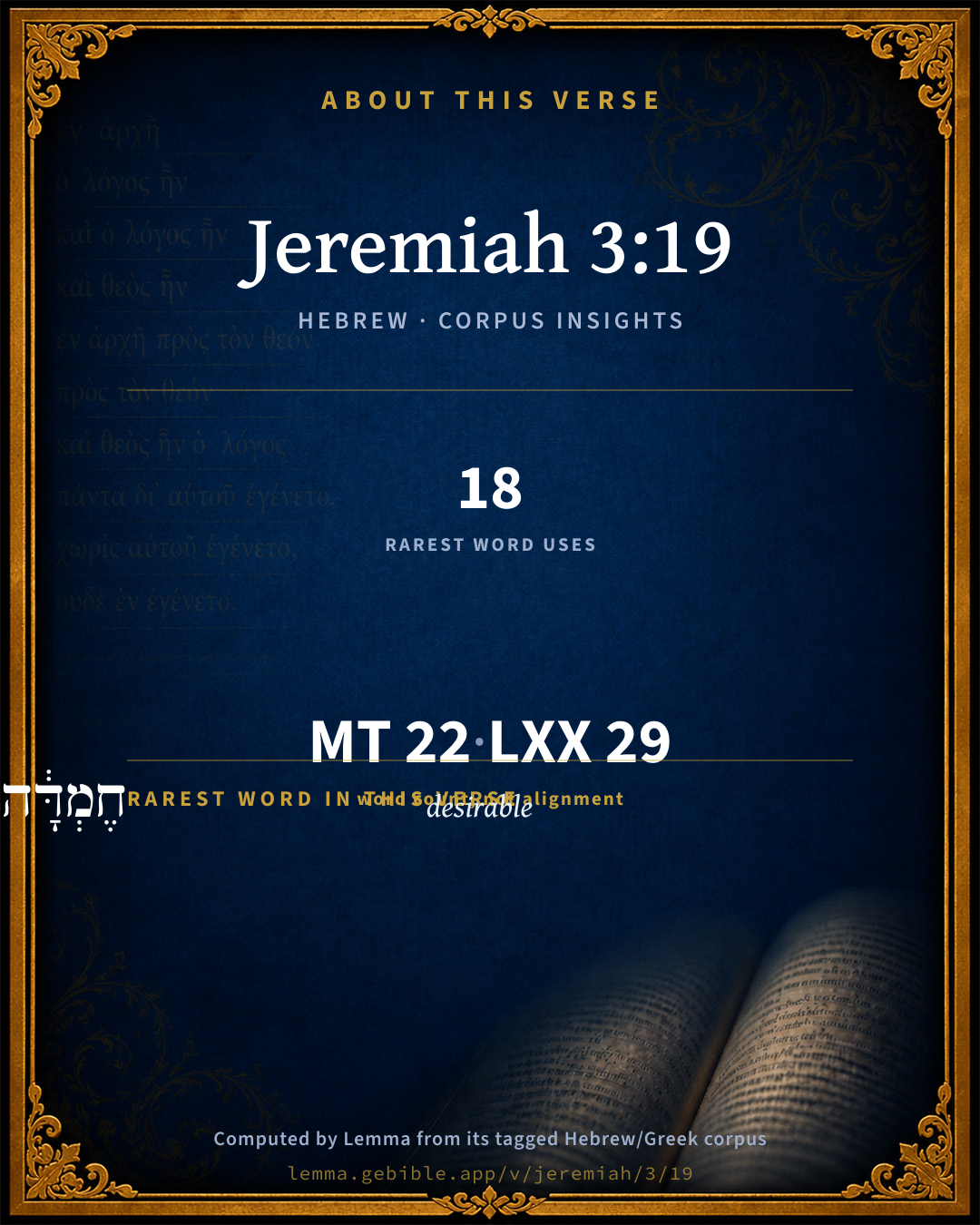
The rarest word here is חֶמְדָּ֔ה desirable H2532 — appearing just 18 times in the whole Hebrew Bible.

Shared distinctive vocabulary

חֶמְדָּ֔ה desirable H2532 occurs in 18 verses of the Hebrew Bible. Also found in:

Grammatical profile

  • 8 verbs
  • 8 nouns
  • 1 pronoun
  • 3 prepositions
  • 2 particles

Verb forms

  • אָמַ֗רְתִּי Qal · Perfect
  • אֲשִׁיתֵ֣ךְ Qal · Imperfect
  • וְאֶתֶּן Qal · Imperfect
  • וָאֹמַ֗ר Qal · Sequential Imperfect
  • תקראו Qal · Imperfect
  • תִּקְרְאִי Qal · Imperfect
  • תשובו Qal · Imperfect
  • תָשֽׁוּבִי Qal · Imperfect

Repetition

Words recur within this verse — often emphatic in Hebrew:

  • תקראו to call H7121 ×3
  • אָמַ֗רְתִּי to say H559 ×2
  • תשובו to return H7725 ×2

Hebrew & Septuagint length

In the original languages it is 22 Hebrew tokens and 29 Greek tokens — but the two are counted differently (Hebrew bundles its prefixes and suffixes into one token; the Greek is in lemma form), so that isn’t a like-for-like length.

Cross-references

26

Topical passages linked to Jeremiah 3:19 in the Treasury of Scripture Knowledge — connected by theme and wording, ordered by reader-vote popularity; previews shown in the World English Bible.

  • Jeremiah 3:4 Will you not from this time cry to me, My Father, you are the guide of my youth?
  • Romans 8:15–17 For you didn't receive the spirit of bondage again to fear, but you received the Spirit of adoption, by whom we cry, "Abba! Father!"
  • Jeremiah 31:9 They shall come with weeping; and with petitions will I lead them: I will cause them to walk by rivers of waters, in a straight way in which they shall not stumble; for I am a father to Israel, and Ephraim is my firstborn.
  • Isaiah 63:16 For you are our Father, though Abraham doesn't know us, and Israel does not acknowledge us: you, Yahweh, are our Father; our Redeemer from everlasting is your name.
  • Jeremiah 32:39–40 and I will give them one heart and one way, that they may fear me forever, for the good of them, and of their children after them:
  • Matthew 6:8–9 Therefore don't be like them, for your Father knows what things you need, before you ask him.
  • 1 John 3:1–3 Behold, how great a love the Father has bestowed on us, that we should be called children of God! For this cause the world doesn't know us, because it didn't know him.
  • Psalms 106:24 Yes, they despised the pleasant land. They didn't believe his word,
  • Proverbs 3:35 The wise will inherit glory, But shame will be the promotion of fools.
  • Isaiah 64:8 But now, Yahweh, you are our Father; we are the clay, and you our potter; and we all are the work of your hand.
  • Jeremiah 5:7 How can I pardon you? your children have forsaken me, and sworn by them that are no gods: when I had fed them to the full, they committed adultery, and assembled themselves in troops at the prostitutes' houses.
  • Jeremiah 12:10 Many shepherds have destroyed my vineyard, they have trodden my portion under foot, they have made my pleasant portion a desolate wilderness.
  • Jeremiah 31:20 Is Ephraim my dear son? is he a darling child? for as often as I speak against him, I do earnestly remember him still: therefore my heart yearns for him; I will surely have mercy on him, says Yahweh.
  • Ezekiel 20:6 in that day I swore to them, to bring them forth out of the land of Egypt into a land that I had searched out for them, flowing with milk and honey, which is the glory of all lands.
  • Daniel 8:9 Out of one of them came forth a little horn, which grew exceeding great, toward the south, and toward the east, and toward the glorious [land].
  • Daniel 11:16 But he who comes against him shall do according to his own will, and none shall stand before him; and he shall stand in the glorious land, and in his hand shall be destruction.
  • Daniel 11:41 He shall enter also into the glorious land, and many [countries] shall be overthrown; but these shall be delivered out of his hand: Edom, and Moab, and the chief of the children of Ammon.
  • Daniel 11:45 He shall plant the tents of his palace between the sea and the glorious holy mountain; yet he shall come to his end, and none shall help him.
  • Hosea 11:8 "How can I give you up, Ephraim? How can I hand you over, Israel? How can I make you like Admah? How can I make you like Zeboiim? My heart is turned within me, My compassion is aroused.
  • John 1:11–13 He came to his own, and those who were his own didn't receive him.
  • 2 Corinthians 6:17–18 Therefore, "'Come out from among them, And be separate,' says the Lord, 'Touch no unclean thing. I will receive you.
  • Galatians 3:26 For you are all children of God, through faith in Christ Jesus.
  • Galatians 4:5–7 that he might redeem those who were under the law, that we might receive the adoption of children.
  • Ephesians 1:5 having predestined us for adoption as children through Jesus Christ to himself, according to the good pleasure of his desire,
  • Hebrews 10:39 But we are not of those who shrink back to destruction, but of those who have faith to the saving of the soul.
  • 1 Peter 1:3–4 Blessed be the God and Father of our Lord Jesus Christ, who according to his great mercy became our father again to a living hope through the resurrection of Jesus Christ from the dead,

Cross-references courtesy of OpenBible.info (CC BY 4.0).

Hebrew and Greek witnesses Masoretic Hebrew ↔ Greek Septuagint

The same verse in the two great witnesses to the Old Testament, shown verse-for-verse.

These are two independent witnesses, not word-aligned to each other, and the Septuagint is shown in lemma (dictionary) form.

Hebrew Jeremiah 3:19 Masoretic · Westminster Leningrad Codex

וְאָנֹכִ֣י אָמַ֗רְתִּי אֵ֚יךְ אֲשִׁיתֵ֣ךְ בַּבָּנִ֔ים וְאֶתֶּן לָךְ֙ אֶ֣רֶץ חֶמְדָּ֔ה נַחֲלַ֥ת צְבִ֖י צִבְא֣וֹת גּוֹיִ֑ם וָאֹמַ֗ר אָבִי֙ תקראו תִּקְרְאִי לִ֔י וּמֵאַחֲרַ֖י לֹ֥א תשובו תָשֽׁוּבִי

But I said, How I will put you among the children, and give you a pleasant land, a goodly heritage of the hosts of the nations! and I said, You shall call me My Father, and shall not turn away from following me.

World English Bible · Public Domain

Greek LXX Structure differs

In the Septuagint, Jeremiah is about an eighth shorter than the Hebrew and arranges its material differently — the Oracles Against the Nations (Hebrew chapters 46–51) appear in the middle of the Greek book, after 25:13. Because the chapter and verse boundaries do not line up, a verse-for-verse comparison with the Hebrew is not shown.

A verse-for-verse comparison isn’t shown here because the chapters and verses don’t line up. Switch to the LXX edition with the MT / LXX toggle above to read the Greek directly.

On this verse, Ellicott's Commentary for English Readers discusses the Septuagint’s reading. Read the note in Commentary ↓

Hebrew: Westminster Leningrad Codex (CC BY 4.0). Greek: Septuagint (public domain); English from a public-domain English Septuagint. How the Septuagint differs from the Hebrew →

Targum (Aramaic paraphrase)

1

The Targum is the ancient Jewish Aramaic paraphrase of the Hebrew Scriptures — an interpretive translation, not the Hebrew text itself. Onkelos (literal) and Pseudo-Jonathan (expansive) render the Torah, and Jonathan the Prophets. Coverage is partial: where no permissively-licensed English translation exists for a verse, only the Aramaic is shown. This is verse-level text, not a word-by-word alignment to the Hebrew.

  1. Targum Jonathan Prophets (Joshua–Malachi)
    וַאֲנָא אֲמָרִית אֵיכְדֵין אַצְלְחִינָךְ בִּבְנַיָא וְאֶתֵּן לִיךְ אֲרַע חֶמְדָתָא אַחֲסָנַת חֶדְוַת תּוּשְׁבְּחַת עַמְמַיָא וַאֲמָרֵית רִבּוֹנִי תְּצַלָן קֳדָמַי וּמִבָּתַר פּוּלְחָנִי לָא תְתוּבִין:

    (no public-domain English translation for this verse)

    Targum Jonathan — Aramaic: “Mikraot Gedolot” (public domain). English: “Sefaria Community Translation” (CC0 1.0 (public-domain dedication)); “London "Chaldee Paraphrase," 1871” (public domain). Text via Sefaria.

Commentary

Notes on Jeremiah 3:19 from classic Christian and Jewish commentators (each source and its license shown beneath its notes). The classic Christian expositions comment on the surrounding passage and are grouped to its opening verse, so a note may address several verses; the Jewish commentaries on the Tanakh (Rashi and others) are per-verse, so they appear only where the commentator wrote on this verse.

Lemma curates 59 commentaries, every one of them public domain or Creative Commons licensed, each selected and text-cleaned for this edition rather than reprinted as found. About our sources →

The Cambridge Bible for Schools and Colleges

gen. ed. J. J. S. Perowne

19. shall … nations] rightly mg. would … nations! Not a question, but the expression of a wish.

children] sons. Cp. Exo_4:22. The point is that as daughters could not as a rule inherit (Num_27:1 ff.; cp. Job_42:15), God desired to treat His people as sons.

goodly heritage of the hosts] heritage of the chief splendour, or, goodliest heritage, mg. the goodliest heritage of the nations, lit. “the heritage of the beauty of the beauties (better than ‘hosts’) of the nations.” Cp. Eze_20:6; Eze_20:15; Dan_11:16; Dan_11:41. The sense is that Israel shall have a more glorious land than any other nation.

19, 20. Jehovah would desire to treat His people as sons in the matter of inheritance. Their conduct precludes this.

Chs. Jer_3:19 to Jer_4:4. The invitation includes the whole nation, on a like condition

This section should follow immediately on Jer_3:5. See introd. note on Jer_3:6-18.

The Cambridge Bible for Schools and Colleges (gen. ed. J. J. S. Perowne; Cambridge University Press, 1878–1918) — public domain. Text from a community e-Sword module.

Trapp's Complete Commentary

John Trapp

Jer 3:19 But I said, How shall I put thee among the children, and give thee a pleasant land, a goodly heritage of the hosts of nations? and I said, Thou shalt call me, My father; and shalt not turn away from me.

Ver. 19. But I said, How shall I put thee among the children?] How, but by my free grace alone, since thou hast so little deserved it? For the causes of our adoption, see Eph 1:5-6.

And give thee a pleasant land.] The heavenly Canaan, which is here fitly called "a land of desire" or "delight," a heritage or possession of godliness, a land of the hosts or desires of the nations.

And I said, Thou shall call me, My Father.] And My Father, affectionately uttered, is an effectual prayer. Ah! Pater brevissima quidem vox est, sed omnia complectitur, saith Luther - i.e., Ah! Father is but a little word, but very comprehensive; it is such a piece of eloquence as far exceedeth the rollings of Demosthenes, Cicero, or whatsoever most excellent orator.

John Trapp, A Commentary or Exposition upon All the Books of the Old and New Testament (1647–1656) — public domain. Text from a community e-Sword module.

The Biblical Illustrator

Joseph S. Exell

Jer_3:19

How shall I put thee among the children.

Put among the children

I. A most delightful condition of privilege and enjoyment.

1. A real and endearing relation, not a mere figure or shadow. Though all worlds wait on His will, Gods heart is a Fathers heart; and its home, its place of joy and singing, is among the children.

2. This relationship implies dependence. The two principles of trust and obedience constitute the great requirements which the Head of the redeemed family urges upon all His children.

3. The relation between child and parent implies solemn obligations. The children of God are required to exhibit a character and conduct in harmony with their illustrious relationship. The glory of the Father, the honour of His name; the welfare of the whole household of faith; the furtherance of sacred truth in the world are interests dear to their hearts. They are partakers of the Divine nature, each one resembles the children of a king.

4. This relation implies the possession of privileges--If children then heirs, etc. All that the Jew possessed in Canaan, all that Adam delighted to see in Paradise, falls short of the expectations of the believer. The inheritance is incorruptible, undefiled, and it fadeth not away.

II. Some formidable difficulties in the way of conferring the blessings of sonship.

1. This relation between God and man is not natural By nature children of wrath, etc.

2. Justice demands the infliction of the penalty of sire Mercy pleads for compassion and forgiveness. In the courts of earthly sovereigns there is no escape from the dilemma. The sovereign can punish, and thus inflict justice; or pardon and show mercy. But in Christ all the requirements of law are satisfied, while the freest manifestation of mercy is made.

3. The character and condition of the sinner himself. Shall the leper be brought into companionship with the pure and the sound? Shall the outcast and the profligate nestle with the virgin and the holy?

III. The solution of the difficulty and the process of attaining the full enjoyment of the privilege. Thou shalt call Me, My Father.

1. Prayer is the birth cry of the soul. Like that first welcome sound by which the mother knows she has a living child. Every kind of sorrow and distress have driven men to their knees, but there are no prayers, for their fervour, like those which are the fruit of conviction of sin.

2. The spirit of adoption. My Father. Not by the thunders of Sinai, or the curses of Mount Ebal, are men preserved in Christ Jesus, but by the all-powerful grace of the Holy Spirit.

3. The salvation of a child of God is evinced by the spirit of perseverance. (W. G. Lewis.)

Among the children

I. A difficult question.

1. As to the Holy Lord.

2. As to the unholy person.

3. As to the family.

4. As to the inheritance.

II. A wonderful answer.

1. It is from God Himself, and is therefore a perfect answer.

2. It is in the Divine style: Thou shalt; and thou shalt not. Omnipotence speaks, and grace reveals its unconditional character.

3. It is concerning a Divine work.

4. It is effectual for its purpose.

III. A matchless privilege.

1. We are indeed made children of God, and joint heirs with Christ.

2. We are as much loved as the children.

3. We are treated as the children.

(1) We are forgiven as a father forgives his children.

(2) We are clothed, fed, and housed as children.

(3) We are taught, ruled, and chastened as children.

(4) We are honoured and enriched as children.

4. We are placed under filial obligations--to love, honour, obey, and serve our Father. This should be regarded as a high honour, not a burden. (C. H. Spurgeon.)

Regeneration

is not a change of the old nature, but an introduction of a new nature. Not Ishmael changed, but Isaac born, is the son of the promise. (C. H. Spurgeon.)

Adoption

Whom God adopts, He anoints; whom He makes sons, He makes saints. (Watson.)

A wonderful change

One of my parishioners at East Hampton, converted after having lived, through three or four revivals, to the age of fifty, and having given up hope, used to exclaim for several weeks after his change, Is it I? Am I the same man who used to think it so hard to be converted, and my case so hopeless? Is it I? Is it I? Oh, wonderful! (Lyman Beecher.)

The true source of salvation

I. How the obstructions to the restoration of the Jews shall be surmounted.

1. God Himself presents to them the formidable difficulty. Jews always obdurate. How restored to favour of God?

(1) Extent of their wickedness forbids it.

(2) Honour of God forbids it. To admit rebels to privileges encourages rebellion.

2. These obstacles, though formidable, shall be surmounted. As God spake the universe into existence, so will He form the new creation.

II. How alone the difficulties in the way of our salvation can ever be overcome.

1. There are immense difficulties. Our wickedness equals or exceeds that of the Jews.

2. But these shall be overcome. God will interfere for us in way of sovereign grace and by the exercise of His almighty power.

Conclusion--

1. To those who question the possibility of their own salvation. God is able.

2. To those who have entertained no such fears. You think salvation easy; but only Christs blood could atone for such sin as yours; only the Divine Spirit could renew your depraved heart.

3. To those who profess to have been brought into the family of God. Obey and trust Him, as your Father; let nothing lead you to turn away from Him. (C. Simeon, M. A.)

The Biblical Illustrator, edited by Joseph S. Exell (c. 1880s–1900s) — public domain. Text from a community e-Sword module.

Joseph Benson's Commentary

Jer 3:19. But I said — Namely, within myself, God is here represented as deliberating with himself, after the manner of men, in what way he might, consistently with his divine attributes, receive the Jewish people into his favour, and admit them into the Christian Church. How shall I put thee among the children, and give thee a pleasant land? — How can it be consistent with my divine holiness and justice to receive such a rebellious people into my favour, to own them for my children, and restore them to the possession of that goodly inheritance which I gave to their fathers. Judea is elsewhere called a pleasant land, the glory of all lands, and the land which God had espied out for his chosen people: see Dan 8:9; and Dan 11:16; Dan 11:45; Eze 20:6. A goodly heritage of the hosts of nations — The Hebrew, צבי צבאות גוים, is literally, the glory of hosts, or, multitudes of nations, that which they esteem glorious, a phrase of the same import with that now quoted from Ezekiel, the glory of all lands. This pleasant land, and glory of the hosts of nations, is here to be taken figuratively, for the Christian Church and the privileges of the gospel covenant. And the condition of adoption into the former, and of enjoying the latter, are expressly stated by Christ and his apostles to be the same as are here prescribed, namely, true faith in God, as our Father, our reconciled Father in Christ, (which faith is always preceded by the repentance required, Jer 3:13,) and uniform obedience for the time to come. Thou shalt call me, My Father, and shalt not turn away from me — On these conditions I will put thee among the children.

Joseph Benson's Commentary on the Old and New Testaments (1811–1818) — public domain. Text from a community e-Sword module.

Whedon's Commentary on the Bible

Daniel D. Whedon

THE CONDITIONS OF RESTORATION, Jer_3:19-25.

19. But — The relation of the thought is completely missed in the English Version. The conjunction is not adversative but continuative — and not “BUT.” How is not interrogative, but exclamatory, marking a declaration of God’s gracious purpose, and not, as in the text, the statement of a theological problem. How gloriously will I distinguish thee by the value and the beauty of thy heritage!

Thou — Hebrew, ye; meaning not Israel collectively, but the individuals thereof.

Daniel D. Whedon (gen. ed.), Commentary on the Old and New Testaments (1874–1909) — public domain. Text from a community e-Sword module.

Keil & Delitzsch

C. F. Keil & F. Delitzsch

The return of Israel to its God. - Jer 3:19. "I thought, O how I will put thee among the sons, and give thee a delightful land, a heritage of the chiefest splendour of the nations! and thought, 'My Father,' ye will cry to me, and not turn yourselves away from me. Jer 3:20. truly as a wife faithlessly forsakes her mate, so are ye become faithless towards me, house of Israel, saith Jahveh. Jer 3:21. A voice upon the bare-topped hills is heard, suppliant weeping of the sons of Israel; for that they have made their way crooked, forsaken Jahveh their God. Jer 3:22. 'Return, ye backsliding sons, I will heal your backsliding,' Behold, we come to thee; for Thou Jahveh art our God. Jer 3:23. Truly the sound from the hills, from the mountains, is become falsehood: truly in Jahveh our God is the salvation of Israel. Jer 3:24. And shame hath devoured the gains of our fathers from our youth on; their sheep and their oxen, their sons and their daughters. Jer 3:25. Let us lie down in our shame, and let our disgrace cover us; for against Jahveh our God have we sinned, we and our fathers, from our youth even unto this day, and have not listened to the voice of our God." Hitz. takes Jer 3:18 and Jer 3:19 together, without giving an opinion on ואנכי אמרתּי. Ew. joins Jer 3:19 to the preceding, and begins a new strophe with Jer 3:21. Neither assumption can be justified. With Jer 3:18 closes the promise which formed the burden of the preceding strophe, and in Jer 3:19 there begins a new train of thought, the announcement as to how Israel comes to a consciousness of sin and returns penitent to the Lord its God (Jer 3:21-25). The transition to this announcement is formed by Jer 3:19 and Jer 3:20, in which the contrast between God's fatherly designs and Israel's faithless bearing towards God is brought prominently forward; and by ואנכי אמרתּי it is attached to the last clause of the 18th verse. His having mentioned the land into which the Israelites would again return, carries the prophet's thoughts back again to the present and the past, to the bliss which Jahveh had designed for them, forfeited by their faithless apostasy, and to be regained only by repentant return (Graf). "I thought," refers to the time when God gave the land to their fathers for an inheritance. Then spake, i.e., thought, I; cf. Psa 31:23. How I will set thee or place thee among the sons! i.e., how I will make thee glorious among the sons (שׁית c. accus. and ב, as in Sa2 19:29). No valid objection against this is founded by Hitz.'s plea that in that case we must read אשׁיתך, and that by Jeremiah, the teacher of morals, no heathen nation, or any but Israel, can ever be regarded as a son of God (Jer 31:9, Jer 31:20). The fem. אשׁיתך is explained by the personification of Judah and Israel as two sisters, extending throughout the whole prophecy. The other objection is erroneous as to the fact. In Jer 31:9 Jahveh calls Ephraim, = Israel, his first-born son, as all Israel is called by God in Exo 4:22. But the conception of first-born has, as necessary correlate, that of other "sons." Inasmuch as Jahveh the God of Israel is creator of the world and of all men, all the peoples of the earth are His בּנים; and from amongst all the peoples He has made choice of Israel as סגלּה, or chosen him for His first-born son. Hitz.'s translation: how will I endow thee with children, is contrary to the usage of the language. - The place which God willed to give Israel amongst His children is specified by the next clause: and I willed to give thee a delightful land (ארץ חמדּה as in Zac 7:14; Psa 106:24). צבי צבאות, ornament of ornaments, i.e., the greatest, most splendid ornament. For there can be no doubt that צבאות does not come from צבא, but, with Kimchi after the Targum, is to be derived from צבי; for the plural צביים from צבי may pass into צבאים, cf. Gesen. 93. 6b, as Ew., too, in 186, c, admits, though he takes our צבאות from צבא, and strains the meaning into: an heirloom-adornment amidst the hosts of heathen. After such proofs of a father's love, God expected that Israel would by a true cleaving to Him show some return of filial affection. To cry, "My father," is a token of a child's love and adherence. The Chet. תּקראוּ and תּשׁוּבוּ are not to be impugned; the Keris are unnecessary alterations.

Jer 3:20-21

But Israel did not meet the expectation. Like a faithless wife from her husband, Israel fell away from its God. The particle of comparison כּאשׁר is omitted before the verb, as in Isa 55:9, cf. Isa 55:10 and Isa 55:11. רע does not precisely mean husband, nor yet paramour, but friend and companion, and so here is equal to wedded husband. בּגד c. מן, withdraw faithlessly from one, faithlessly forsake - c. בּ, be faithless, deal faithlessly with one.

Yet Israel will come to a knowledge of its iniquity, and bitterly repent it, Jer 3:21. From the heights where idolatry was practised, the prophet already hears in spirit the lamentations and supplications of the Israelites entreating for forgiveness. על שׁפיים points back to Jer 3:2, when the naked heights were mentioned as the scenes of idolatry. From these places is heard the supplicating cry for pardon. כּי העווּ, because (for that) they had made their way crooked, i.e., had entered on a crooked path, had forgotten their God.

Jer 3:22

The prophet further overhears in spirit, as answer to the entreaty of the Israelites, the divine invitation and promise: Return, ye backsliding children (cf. Jer 3:14), I will heal your backslidings. ארפּה for ארפּא. Backslidings, i.e., mischief which backsliding has brought, the wounds inflicted by apostasy from God; cf. Hos 14:5, a passage which was in the prophet's mind; and fore the figure of healing, cf. Jer 30:17; Jer 33:6. To this promise they answer: Behold, we come to Thee (אתנוּ for אתאנוּ from אתא, Isa 21:12, for אתה ), for Thou art Jahveh, art our God. Of this confession they further state the cause in Jer 3:23-25.

Jer 3:23

From the false gods they have gained but disgrace; the salvation of Israel is found only in Jahveh their God. The thought now given is clearly expressed in the second clause of the verse; less clear is the meaning of the first clause, which tells what Israel had got from idolatry. The difficulty lies in המון הרים, which the early commentators so joined together as to make המון stat. constr. (המון). Similarly Hitz. and Graf: from the hills the host (or tumult) of the mountains is (for) a delusion; Hitz. understanding by the host of the mountains the many gods, or the numerous statues of them that were erected at the spots where they were worshipped, while Graf takes the tumult of the mountains to mean the turmoil of the pilgrims, the exulting cries of the celebrants. But it is as impossible that "the sound of the hills" should mean the multitude of the gods, as that it should mean the tumult of the pilgrims upon the mountains. Besides, the expression, "the host or tumult of the mountains comes from the hills," would be singularly tautological. These reasons are enough to show that הרים cannot be a genitive dependent on המון, but must be taken as coordinate with מגּבעות, so that the preposition מן will have to be repeated before הרים. But המון must be the subject of the clause, else where would be no subject at all. המון means bustle, eager crowd, tumult, noise, and is also used of the surging mass of earthly possessions or riches, Psa 37:16; Isa 60:5. Schnur., Ros., Maur., de W., have preferred the last meaning, and have put the sense thus: vana est ex collibus, vana ex montibus affluentia, or: delusive is the abundance that comes from the hills, from the mountains. This view is not to be overthrown by Graf's objection, that we cannot here entertain the idea of abundance, however, imaginary, acquired by the Israelites through idolatry, seeing that in the next verses it is declared that the false gods have devoured the wealth which the Israelites had inherited and received from God. For in the present connection the abundance would be not a real but expected or imagined abundance, the delusiveness of which would be shown in the next verse by the statement that the false gods had devoured the acquisitions of Israel. But to take המון in the sense of affluentia seems questionable here, when the context makes no reference to wealth or earthly riches, and where the abundance of the hills and mountains cannot be understood to mean their produce; the abundance is that which the idolatry practised upon the hills and mountains brought or was expected to bring to the people. Hence, along with Ew., we take this word in the sig. tumult or noise, and by it we understand the wild uproarious orgies of idolatry, which, according to Jer 3:2 and Jer 3:6, were practised on the hills and mountains (קל זנוּתהּ, Jer 3:9). Thus we obtain the sense already given by the Targ.: in vanum coluimus super collibus et non in utilitatem congregavimus nos (אתרגישׁנא ( son , prop. tumultuati sumus) super montibus, i.e., delusive and profitless were our idolatrous observances upon the heights.

Jer 3:24

In Jer 3:24 we are told in what particulars idolatry became to them הבּשׁת .לשׁקר, the shame, opprobrious expression for הבּעל, equal to shame-god, cf. Jer 11:13 and Hos 9:10; since the worship of Baal, i.e., of the false gods, resulted in disgrace to the people. He devoured the wealth of our fathers, namely, their sheep and oxen, mentioned as a specimen of their wealth, and their sons and daughters. The idols devoured this wealth, to in respect that sheep and oxen, and, on Moloch's altar, children too, were sacrificed, for sheep and oxen were offered to Jahveh; but because idolatry drew down judgments on the people and brought about the devastation of the land by enemies who devoured the substance of the people, and slew sons and daughters, Deu 28:30, Deu 28:33. From our youth on; - the youth of the people is the period of the judges.

Jer 3:25

The people does not repudiate this shame and disgrace, but is willing to endure it patiently, since by its sin it has fully deserved it. נשׁכּבה, not: we lie, but: we will lay us down in our shame, as a man in pain and grief throws himself on the ground, or on his couch (cf. Sa2 12:16; Sa2 13:31; Kg1 21:4), in order wholly to give way to the feelings that crush him down. And let our disgrace cover us, i.e., enwrap us as a mourning robe or cloak; cf. Psa 35:26; Psa 109:29; Mic 7:10, Oba 1:10.

Keil & Delitzsch — Biblical Commentary on the Old Testament (1861–1891) — public domain (CC PDM 1.0). Text via the HelloAO Bible API. (Old Testament only.)

Tyndale Open Study Notes

Tyndale Open Resources

3:19-20 But: This transitional word emphasizes the contrast between what the Lord wanted and the actual situation. The Lord would love to treat his people as his precious children, but he could not. The covenant marriage between God and his people had been ruptured by the faithless wife. The Lord could not overlook this sin (Isa 48:8).

Tyndale Open Study Notes — © Tyndale Open Resources, licensed CC BY-SA 4.0. Text via the HelloAO Bible API.

Jamieson, Fausset & Brown

Robert Jamieson, A. R. Fausset & David Brown

The good land covenanted to Abraham is to be restored to his seed. But the question arises, How shall this be done?

put . . . among . . . children--the Greek for adoption means, literally, "putting among the sons."

the children--that is, My children. "How shall I receive thee back into My family, after thou hast so long forsaken Me for idols?" The answer is, they would acknowledge Him as "Father," and no longer turn away from Him. God assumes the language of one wondering how so desperate apostates could be restored to His family and its privileges (compare Eze 37:3; CALVIN makes it, How the race of Abraham can be propagated again, being as it were dead); yet as His purpose has decreed it so, He shows how it shall be effected, namely, they shall receive from Him the spirit of adoption to cry, "My Father" (Joh 1:12; Gal 4:6). The elect are "children" already in God's purpose; this is the ground of the subsequent realization of this relationship (Eph 1:5; Heb 2:13).

pleasant land-- (Jer 11:5; Eze 20:6; Dan 11:16, Margin).

heritage of . . . hosts--a heritage the most goodly of all nations [MAURER]; or a "heritage possessed by powerful hosts" (Deu 4:38; Amo 2:9). The rendering "splendors," instead of "hosts," is opposed by the fact that the Hebrew for "splendor" is not found in the plural.

Jamieson, Fausset & Brown — Commentary Critical and Explanatory on the Whole Bible (1871) — public domain (CC PDM 1.0). Text via the HelloAO Bible API.

Adam Clarke's Commentary

Verse 19. How shalt I put thee among the children] As if he had said, How can ye be accounted a holy seed, who are polluted? How can ye be united to the people of God, who walk in the path of sinners? How can ye be taken to heaven, who are unholy within, and unrighteous without?

And I said, Thou shalt call me, My father] This is the answer to the above question. They could not be put among the children unless they became legal members of the heavenly family: and they could not become members of this family unless they abandoned idolatry, and took the Lord for their portion. Nor could they be continued in the privileges of the heavenly family, unless they no more turned away from their heavenly Father.

Adam Clarke's Commentary on the Bible (1810–1826) — public domain. Text from a community e-Sword/MySword module.

John Calvin's Commentaries

It is not my purpose to mention all the expositions of this verse; but it is enough to shew what seems to be the meaning of the Prophet. Whenever I touch on opinions which I disapprove, this I feel constrained to do, because when they present the appearance of truth, readers may be deceived by them: but when the truth itself is sufficiently conspicuous, I am not disposed to spend labor in refuting the opinions of others.

What, then, the words of the Prophet mean is this, — God here asks, How was it possible that the race of Abraham could again be propagated since it was nearly dead? The answer is, It shall be, when thou wilt call me Father, and turn not away from me The question was asked, that the Jews might feel as though their condition was past remedy. And doubtless, since they had so greatly and so obstinately provoked God by their wickedness, they might have seemed to have become wholly lost. God then assumes here the character of one filled with astonishment, as though he had said, “Ye are, indeed, in a state of despair, there is no hope of your salvation; but yet, as it is my purpose again to restore you, I wish now to find out a way, by which your race may again be propagated.” How, then, is this to be done? He shews that the only thing required was, to call him Father, not with the mouth, but really with the heart.

We now, then, perceive the meaning of the Prophet: for he humbles the Israelites by thus ascribing astonishment to God, as though it was a thing very difficult to be done; but at the same time he gives them hope, because salvation was prepared for them, provided they called on God with a sincere heart, and acknowledged him as their Father, and that perseveringly, without ever turning aside from him. In short, God intimates that the Israelites were like dead men, and that their salvation was hopeless, without a resurrection, he yet promises them salvation on this condition, — that they called on him and did this, not with a double heart, nor by a sudden impulse, such as soon vanishes away; for he says, Thou shalt not turn aside from me; that is, “Be always obedient to me, and I will prove that I shall not be called in vain a Father by you.” It follows —

John Calvin's Commentaries (1540-1563) — public domain. Text from the Calvin Translation Society English edition (1840s-50s) via the Christian Classics Ethereal Library (ccel.org). Calvin's coverage is partial (roughly two-thirds of the Bible); uncommented books and verses are honest gaps, never fabricated. The 19th-century editor's footnotes and remarks are omitted so the notes are faithfully Calvin's own voice.

Ellicott's Commentary for English Readers

(19) But I said.—Better, And I said. There is no contrast with what precedes. The speaker is, of course, Jehovah. The How shall I put thee! is an exclamation rather than a question, the utterance of a promise as with an intensity of affirmation. Special stress is laid on the pronoun “I.” The words have been rendered by some commentators, following the Targum, How shall I clothe thee with children?

A pleasant land.—Literally, as in the margin, a land of desire, i.e., desirable.

A goodly heritage of the hosts of nations.—More accurately, a heritage of the beauty of beauties (Hebrew for “chief beauty”) of the nations. The English version rests on the assumption that the word translated “beauties” is the same as that elsewhere rendered “Sabaoth,” or “hosts,” which it closely resembles.

And I said.—Not, as in the English, the answer to a question, but the continuance of the same thought. God will treat repentant Israel as His child: He will lead Israel to trust Him as a father. The days of apostasy (“turning away”) will then be over. The original Hebrew seems, to judge from the LXX. version, to have had the plural “ye shall call,” “ye shall not turn away,” the prophet passing from the collective unity to the individuals that composed it.

A Bible Commentary for English Readers, edited by Charles John Ellicott (1878–1897) — public domain. Text from a community e-Sword module.

John Gill's Exposition

But I said,.... Within himself, in the thoughts of his heart, when he took up a resolution concerning their conversion, open adoption, and return to their own land, as a symbol of the eternal inheritance:

how shall I put thee among the children? among the children of God, who are so by special adopting grace, which is a high and honourable privilege, greater than to be the sons and daughters of the greatest potentate on earth; who as they are high birth, being born of God, so they are brought up, and fed, and clothed as the children of the King of kings; they have great nearness to and freedom with God their Father; they are heirs with God and joint heirs with Christ, and shall ever remain in this relation. There is a secret and an open putting of the sons of men among the children of God. The secret putting of them among the children is by God the Father, when he predestinated them unto the adoption of children by Christ; when he promised in covenant he would be their Father, and they should be his sons and daughters; and as an act of his own will, secretly, in his own breast, adopted them into his family, his will to adopt being the adoption of them; hence they are called the children of God, previous to their redemption and sanctification, Heb 2:13. Moreover, our Lord Jesus Christ was concerned in this affair by espousing these persons to himself in covenant, whereby his Father became their Father, and his God their God; and by assuming their nature, whereby they became his brethren, and so the children of God; and by redeeming them, whereby way is made for their actual reception of the adoption of children; when they are openly put among them in the effectual calling, in which the Holy Spirit is concerned, who regenerates them, works faith in them, and witnesses their adoption to them, from whence he is called the Spirit of adoption; regeneration and faith are the evidences of adoption, Joh 1:12 and the Spirit the witness, Rom 8:15. Now, as all things were seen in one view by the Lord from eternity, as well when he secretly as openly puts them among the children, it may well be thought there were difficulties, at least seeming ones, in the way of it; or, however, such as make it wonderful and marvellous that any of the sons of Adam should be put among the children of God; seeing they that are, sinned in Adam as the rest, fell with him in his transgression into a state of condemnation and death; are corrupt in their first birth, defiled in soul and body, and cast out like the wretched infant, to the loathing of their persons; are as the children of the Ethiopians, black with original and actual sins; are children of disobedience, traitors and rebels against God, and children of wrath, even as others. And though these words may have a principal respect to the Jews, who dealt treacherously with God, in departing from his pure worship, rejecting the Messiah, and continuing in their obstinacy and infidelity, having a "loammi" upon them, and notwithstanding shall be called the children of the living God, Hos 1:9, yet may be applied to any of the sons and daughters of men, whether Jews or Gentiles, that are put among the children of God.

And give thee a pleasant land, a goodly heritage of the hosts of the nations? the allusion, doubtless, is to the land of Israel, which was a goodly and desirable land, a land flowing with milk and honey, and was the heritage or inheritance of the children of Israel, but not of the hosts of nations; wherefore heaven and eternal happiness is ultimately meant, the better country Christian pilgrims are seeking after, and the desired haven Christian sailors make unto: this is a "pleasant land"; pleasantly situated on high, where are great plenty of provisions, solid substance, enduring riches, the greatest liberty and choices, privileges, and the best of inhabitants and company, Father, Son, and Spirit, angels and glorified saints: this is

a goodly heritage or "inheritance"; not only a house not made with hands, a city that has foundations, but a kingdom and glory, an inheritance incorruptible, undefiled, which fades not away, reserved in the heavens: and it may be said to be

of the hosts of nations; for, though it is but one inheritance, vast numbers will share in it, and possess it; even an innumerable company of all nations, kindreds, people, and tongues, which are chosen, redeemed, and called out of them: and this is in, the "gift" of God; he regenerates to a lively hope of it, makes meet for it, and of his own good pleasure bestows it; and marvellous it is that he should give it to the persons before described; the putting of them among the children of God, and giving them such an inheritance, are entirely owing to his sovereign grace and goodness, which only can answer the question put, concerning these things.

And I said, thou shalt call me my father; not merely saying these words, but expressing them with affection and faith, under the witnessings of the Spirit of God; and declaring the relation by deeds, by honouring and obeying him, and being a follower of him in his ways and worship: and shalt not turn away from me; either from calling him Father, through the prevalence of unbelief; or from his service and worship, through the power of corruptions, backsliding and revolting from him, with which they are often charged in this chapter; so the Targum,

"shalt not turn from my worship.''

John Gill's Exposition of the Whole Bible (1746–1763) — public domain (CC PDM 1.0). Text via the HelloAO Bible API.

Albert Barnes' Notes on the Bible

But I - (emphatic). “And I.” The emphasis lies in the abundant goodness of God contrasted with Israel’s waywardness.

How ...? - Rather, How ...! i. e., How gloriously! With what honor will I place thee among the children!

Goodly ... of the hosts ... - Rather, “a heritage of the chief beauty of nations.” The general sense is, that Israel “possesses the most beautiful territory of any nation.”

And I said - This clause is not the answer to a difficulty, as in the King James Version, but completes the description of God’s loving purpose. “I said within myself that I would treat thee as a son, and give thee a glorious inheritance: I also said, that ye would return my love, would call me Father, and be untrue to me no more.”

Albert Barnes' Notes on the Bible (1834–1885) — public domain. Text from a community e-Sword/MySword module.

Haydock's Catholic Bible Commentary

Gentiles, which they all covet, or to which they are invited in the Church. (Calmet) --- Me. On these conditions thou shalt be restored. (Haydock)

George Leo Haydock (1774–1849), Haydock's Catholic Family Bible and Commentary, 1859 edition — public domain. Excludes Psalms (Douay-Rheims chapter numbering differs from Protestant) and Deuterocanonical books (Catholic canon only).

Matthew Poole's English Annotations

How shall I words that speak either, first, God’s putting them to their own thoughts, how they could think he should bring such a perfidious people as they were into the land which he had promised; else, secondly, his considering within himself how or what course he should take to bring such a thing about, and accomplish it, they had so greatly degenerated from him and disobliged him; see Hos 6:4; both implying that such a thing could not be brought about without repentance and true conversion to him, wrought by his free grace, Eph 1:5,6.

Put thee among the children; esteem thee as my child, till thou give some clearer proof and demonstration of thy repentance.

And give thee a pleasant land; how shall I put thee into possession of that pleasant land of desire that I have promised thee? Canaan is so called, Psa 106:24; Dan 8:9; 11:16,41.

A goodly heritage, Heb. heritage of glory, or beauty: see Isa 4:2.

Of the hosts of nations; so called, either because possessed by several potent nations, Num 13:28; Deu 4:38; or rather, it may note the great hosts and multitudes of nations, or Gentiles, that should be joined to them in the gospel church, viz. of God’s elect, and so a heritage of the greatest delights, or the desire of nations; a people to whom all the nations would desire to flock; see Eze 20:6; and may be spoken also of the heavenly Canaan: the LXX. render it, the heritage of God, the omnipotent Governor of the nations.

And I said, Thou shalt call me, My father: God comes now to a resolution how he would do it. Either it is a direction: q.d. On this condition, that thou wilt own me, and not return any more to idols, this shall be done; or a promise, I will cause thee to own me, and give thee perseverance, that thou shalt not depart from me; and this is very applicable to the work of Christ; see Joh 1:12; see also 2Co 6:17,18; and the condition is indeed no more than God promiseth to effect in them.

Matthew Poole's English Annotations on the Holy Bible (1683–1685) — public domain. Text from a community e-Sword/MySword module.

The Pulpit Commentary

The concluding words of the last verse have turned the current of the prophet"s thoughts. "Unto your fathers." Yes; how bright the prospect when that ideal of Israel was framed in the Divine counsels! Condescending accommodation to human modes of thought; But I said fails to represent the relation of this verse to the preceding. Render, I indeed had said, and continue, How will I, etc. Put thee among the children. This is a very common rendering, but of doubtful correctness. It assumes that, from the point of view adopted (under Divine guidance) in the prophecies of Jeremiah, the various heathen nations were in the relation of sons to Jehovah. This is most improbable; indeed, even Exo_4:22 does not really favor the doctrine of the universal fatherhood of God in the fullest sense of the word. Moreover, the pronoun rendered "thee" is in the feminine, indicating that the prophet has still in his mind the picture of Israel as Jehovah"s bride. It would surely be an absurd statement that Jehovah would put his bride among the children! Render, therefore, How will I found thee with sons! comparing, for the use of the Hebrew verb, 1Sa_2:8, and for that of the preposition, Isa_54:11. It is, in fact, the familiar figure by which a family or a nation is likened to a building ("house of Abraham," "of Israel"). Jehovah"s purpose had been to make Abraham"s seed as the dust of the earth. (Gen_13:16) Instead of that, the restored exiles would be few, and weak in proportion, so that the Jewish Church of the early restoration period is represented as complaining, "We made not the land salvation, neither were inhabitants of the world produced". (Isa_26:18) A special Divine promise wasneeded to surmount this grave difficulty. A goodly... nations; rather, a heritage the most glorious among the nations. So in Ezekiel (Eze_20:6, Eze_20:15) Palestine is described as "the glory of all lands." The want of irrigation, and the denudation of the land, have no doubt much diminished the natural beauty and fertility of Palestine; but wherever moderate care is bestowed on the soil, how well it rewards it! Thou shalt call me... shalt not turn; rather, thou wilt call me... wilt not turn. It is the continuation of Jehovah"s ideal for Israel. In response to his loving gifts, Israel would surely recognize him as her Father, and devote to him all her energies in willing obedience. Father is here used, not in the spiritual and individualizing sense of the New Testament, but in such a sense as a member of a primitive Israelitish family, in which the pairia potestas was fully carried out, could realize. The first instance of the individualizing use of the term is in Ecc 23:1-4. (For the Old Testament use, comp. Isa_1:2 Isa_63:16 Exo_4:22 Hos_11:1)

The great difficulty overcome.

"How shall I," etc.? A different rendering has been proposed for this verse, but inasmuch as the general meaning and spirit of the prophecy are maintained in our common translation, we prefer to abide thereby. So read, the verse brings before us

I GOD"S GRACIOUS PURPOSE OF LOVE TOWARDS SINFUL MEN. He would put them, among the children," etc. Think what this involves. Picture to ourselves the lot of the children in the homo of an affluent, affectionate, wise, and godly father. What condition fairer, more enviable, can be conceived? What freedom from all care! What unrestrained, confiding, loving intercourse between the children and their father! What healthful development and direction of character and disposition! How sheltered; how secure; how happy in the abiding consciousness of their father"s love! How full of all good their position cannot but be! But the brightest, fairest lot that ever fell to any children in an earthly home fails fully to set forth what it must be to be set amongst God"s children, and to be numbered amongst his sons and daughters. Blessed indeed are such; how blessed none but they who are thus "set among the children" can fully know. But such was the gracious purpose of God towards man, nothing less than this. He created us for this very purpose, with this very intent. And it is the reason and motive of the creation of every newly born child. For this every human soul is endowed with faculties which can find their complete exercise and enjoyment only amongst God"s children: "God hath made us for himself, and our hearts have no rest until they find rest in him." But the verse, by its very form, indicates

II THE TERRIBLE THWARTING AND HINDERING OF THAT GRACIOUS PURPOSE WHICH HAS TAKEN PLACE. "How shall I put thee," etc.? plainly denoting that there is some giant obstacle in the way. In the case of Israel the previous portions of this prophecy show clearly what this was. But it is equally true of us all. And this dread hindrance to God"s carrying out his purposes of grace towards us consists not so much in what we have done as in what we are. The heart of man is not right in the sight of God, and whilst that is so, God cannot set us amongst his children. Transgressions and offences are but the symptoms of the deadlier evil that lurks within, not the evil itself. That consists in the state of heart Godwards which, alas! characterizes us all, until the new heart and the right spirit be given. What should we say if towards ourselves as parents our children were to order themselves as we do towards God? rarely thinking of us, placing no confidence in us; though we would delight to have them speak to us, yet maintaining a sullen silence always; in their hearts disliking us and resenting the expression of our will; disobeying us on the slightest pretext, and choosing for their friends those they well know to be our foes. If any parent was so unhappy as to have such a son or daughter, how could he set such a one amongst his other children who love him as children should? And that this is the case between the unrenewed man and God, let conscience and men"s works, words, and ways witness. This being so, how can we "marvel" that our Lord hath said, "Ye must be born again?" But we are shown also

III THIS DIFFICULTY, VAST AS IT IS, TRIUMPHANTLY OVERCOME. In the latter part of the verse and in the confessions of the twenty-second and following verses it is clear that a great change has taken place. The rebel heart has gone, the child"s heart has come in its place. The erewhile sinful godless soul is heard calling upon God as "My Father," and in daily conduct is found not turning away from him. What a change! No wonder that the Scripture emblems of it are all drawn from contrasts the most vivid and intense that experience furnishes or the mind can conceive: life and death, darkness and light, crimson red and snow whiteness, leprous and pure; as one possessed of the devil, and as one calm, sober, and in his right mind; such are some of them. But the beholding of so great a change leads of necessity to the inquiry how it was brought about. Hence note

IV THE MEANS WHEREBY THIS WAS ACCOMPLISHED. These were as they ever are, the manifestation of the love of God. In Christ God came to seek and to save his self-lost children. But they, instead of welcoming the Christ of God, crucified and slew him. That rebel alienated heart which is common to us all wrought this awful crime. But it is when by the Holy Spirit men are led to see what they have clone to him who so loved them as to come from heaven to save them, there is produced that conviction of sin, that deep and genuine repentance, that sense of his infinite love, and that consequent entire trust in him, all which are the very elements of that heart of a dear child which calls God "My Father," and which will not turn away from him. I have read of one who was forever reclaimed from the deadly sin of drunkenness by the deep anguish of heart which he experienced when he found that one day, when brutalized by drink, he had smitten to the ground his own dear child, and wounded her with a wound the scar of which she would never lose; and that he had done this whilst she was lovingly seeking to lead him away from the place and the people who were tempting him to his ruin. When he came to himself and knew what he had done, his horror and remorse had no bounds. "The drink! ay, it was all the drink!" he exclaimed when, years after, telling the story. "Could I ever touch it again? I kept my finger lightly on the little maid"s forehead, and lifted my face to heaven, and vowed that I would never touch the murderous thing again as long as I lived, and with a broken heart I prayed the Lord to help me." That well-known story serves to illustrate how, in this great matter of man"s restoration to God, he who once was a godless rebel becomes filled with another heart, and God can, as he desires to, place him amongst the children. For when I clearly see the wounds which I in my mad sin have inflicted on him who sought to save me, and who tenderly loves me still notwithstanding all I have done, the sight of his cross and of those wounds will fill my soul with such a hatred of sin and love of God that I am no longer what I was; I am born again, I have passed from death unto life. Yes, it is the sight of the love of God in Christ which turns the sinner into the child of God, and wins for him a place amongst the children of God. With what fervor, then, may we pray the blessed Spirit to fulfill his work in and for us and for all men! C.

Put among the children.

A promise deeply and tenderly evangelical. Israel and Judah had forfeited this position because they had broken the covenant. But the forgiving love of God is shown in his declaring that they should be reinstated. The force of the phrase is well explained as that of "bestowing a rich paternal benediction," or of restoring to the rights and privileges of inheritance.

I THE SINNER HAS FORFEITED HIS POSITION IN THE FAMILY OF GOD. All through Scripture this relation is shown as depending upon mutual agreement and obligation. The covenant is the title-deed to the inheritance of God"s children. The breaking of this on the part of the sinner destroys his claim and position. In the parable of the prodigal son we have the consciousness of this on the part of the transgressor beautifully described am no more worthy to be called thy son." Moral harmony between the soul of man and God is of the essence of the filial relation. A lost position; a possibility that we have destroyed by our own act. Henceforth the sinner is a spiritual orphan, or a "child of Satan." There is no claim upon God save on condition of renewed obedience. He is subject to the wrath of God"s wounded love and outraged honor.

II READOPTION IS THE GUARANTEE OF ALL HIGHEST BLESSINGS. It is only children of God who are heirs of God; if, then, we would enjoy the privileges and blessings of his house, we must be reinstated in that which we have lost. But this is only possible on repentance and belief. We are assured here and elsewhere that the sinner can regain this title and relation without lessening of the dignity, privilege, and affection. When once this has taken place there is no bar to the bestowal of God"s richest benediction. As his children, as those who are actuated by his love and governed by his Spirit, there is ample security that his blessings shall not be abused. A holy confidence and communion are established, and the true end of being is once more secured.

III THIS IS AN ACT OF GOD"S FREE GRACE. The initiative is not the sinner"s. Overtures of mercy come from him he has offended. There is nothing to compel God to do tills. He is perfectly free, and any obligation into which he enters is sealed only by his voluntary promises. There is abundant evidence, too, of a Divine satisfaction and joy in the exercise of pardoning love. It is spoken of as a long hoped for and gladsome consummation. The "Abba, Father!" of the restored one is music in the heart of God. This is the only true joy the joy of reconciliation. Who can doubt his welcome with such assurances as this? God wills not that any should perish, but that all should come to him and live. M.

The Pulpit Commentary (1880–1919), ed. H.D.M. Spence-Jones & Joseph S. Exell — public domain. Text from a community e-Sword module.

John Wesley's Explanatory Notes

Put - Esteem thee as my child, 'till thou give some proof, of thy repentance. Give thee - How shall I put thee into possession of that pleasant land. Of nations - Great hosts and multitudes of nations, or Gentiles, that shall be joined to them in the gospel church. Thou shalt - On this condition, that thou wilt own me, and not return any more to idols.

John Wesley, Explanatory Notes Upon the Whole Bible (1754–1765) — public domain. Text via the GEBible commentary corpus.

unfoldingWord translationNotes

Door43 World Missions Community

As for me

the word "me" refers to Yahweh

How I want to treat you as my son ... nation

This is an exclamation that expresses God's desire. AT: "I want so much to treat you as my son ... nation" (See: Exclamations)

I want to treat you as my son

God speaks of Israel as if Israel were his son. (See: Simile)

But like a woman faithless to her husband, you have betrayed me

God speaks of Israel being unfaithful to him as if she were an unfaithful wife. (See: Simile)

an inheritance more beautiful

God speaks of the land he wanted to give to Israel as if it were an inheritance. (See: Metaphor)

house of Israel

The word "house" is a metonym for the family that lives in the house. In this case it refers to the kingdom of Israel. See how you translated this in Jeremiah 3:18. AT: "Israel" or "kingdom of Israel" or "people of Israel" (See: Metonymy)

this is Yahweh's declaration

Yahweh speaks of himself by name to express the certainty of what he is declaring. See how you translated this in Jeremiah 1:8. AT: "this is what Yahweh has declared" or "this is what I, Yahweh, have declared" (See: First, Second, or Third Person)

translationWords

honor

ancestor

turn

betray

unfoldingWord translationNotes — © Distant Shores Media and the Door43 World Missions Community, licensed CC BY-SA 4.0. Source: git.door43.org/Door43/en_tn.

Rashi

Rabbi Shlomo Yitzchaki (Rashi)

And I said to Myself, etc. and therefore, I caused your forefathers to inherit them.

How shall I place you among the sons? i.e., how shall I place you, my congregation and My nation, among the other sons, mingled with the heathens. I, therefore, selected a handsome portion, and I gave you a desirable land.

the beauty of hosts of nations The beauty of all the hosts of nations.

Rashi on the Tanakh — English translations: “The Judaica Press complete Tanach with Rashi, translated by A. J. Rosenberg” (CC BY 4.0); “Pentateuch with Rashi's commentary by M. Rosenbaum and A.M. Silbermann, 1929-1934” (public domain); “The Metsudah Tanach series, Lakewood, N.J” (CC BY 4.0); and “The Book of Joshua, Metsudah Publications, 1997” (CC BY 4.0). Text via Sefaria.

Lesson kit

Teaching starters — assembled from the data on this page, not authored interpretation. Every prompt links to the verse data it draws on. Edit before teaching.

Jeremiah, in the Prophets, opens this verse with 22 words (17 distinct Hebrew lemmas). Its most distinctive word is chemdâh (“desirable”). A historical commentator’s framing appears above. Read the whole chapter for the surrounding context.

Discussion questions

  1. The word chemdâh carries the sense “desirable.” How does it shape the verse?
  2. Genesis 27:15 shares the word «desirable» with this verse. How do the two illuminate each other?
  3. “to call” occurs 3× in this one verse. What is the effect of the repetition?
  4. These translations render this verse differently. What is at stake in choosing one wording over another?
  5. The verb «אָמַ֗רְתִּי» is Qal Perfect. How does its form color the action?
  6. Reading how The Cambridge Bible for Schools and Colleges and Trapp's Complete Commentary read this verse, where do the two commentators agree and where do they part?

Things to notice

Reading settings

Reading text

Shown beneath each verse's original-language words.

Old Testament
Old Testament edition

Read the OT as the Masoretic Hebrew (MT) or the Greek Septuagint (LXX).

English shown for the Greek Septuagint (in the Hebrew ↔ Greek comparison).

Comparing translations? Open the Compare panel on any verse page to stack up to four side by side.