Isaiah 5:6

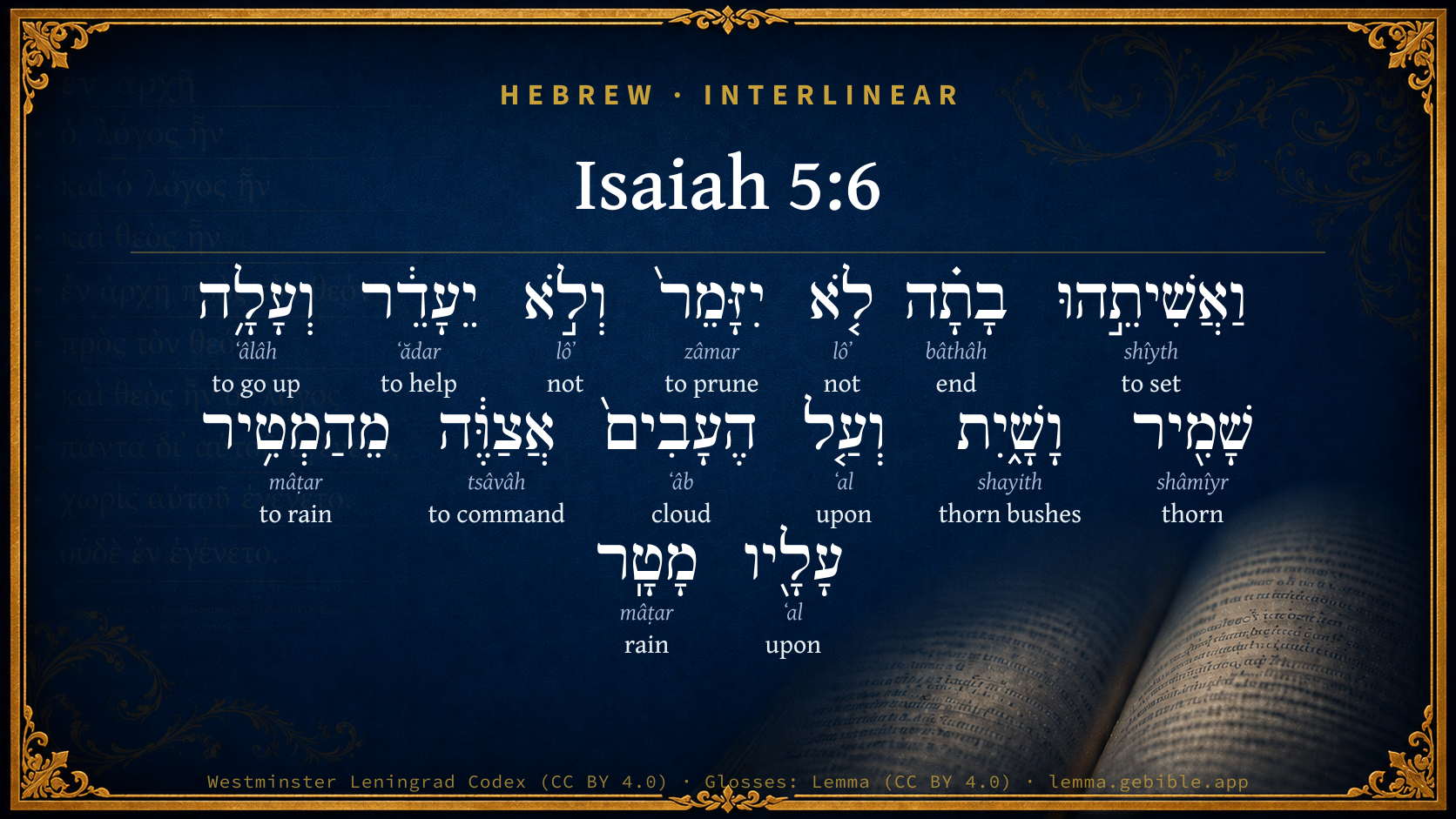
Hebrew (Westminster Leningrad Codex) Isaiah 5:6 appears in the Hebrew Old Testament. The text above is from the Westminster Leningrad Codex. Each word links to its Strong’s number, a concise gloss, and parsing drawn from the Open Scriptures Hebrew Bible morphology. Click any word for its full Brown-Driver-Briggs (BDB) entry.
Download image
Cite this verse

Isaiah 5:6 (World English Bible). Public Domain. Lemma interlinear Bible study tool, https://lemma.gebible.app/v/isaiah/5/6.

Show BibTeX & RIS
BibTeX
RIS
English Translation
I will lay it a wasteland. It won't be pruned nor hoed, But it will grow briers and thorns. I will also command the clouds that they rain no rain on it."
World English Bible · Public Domain
Highlights
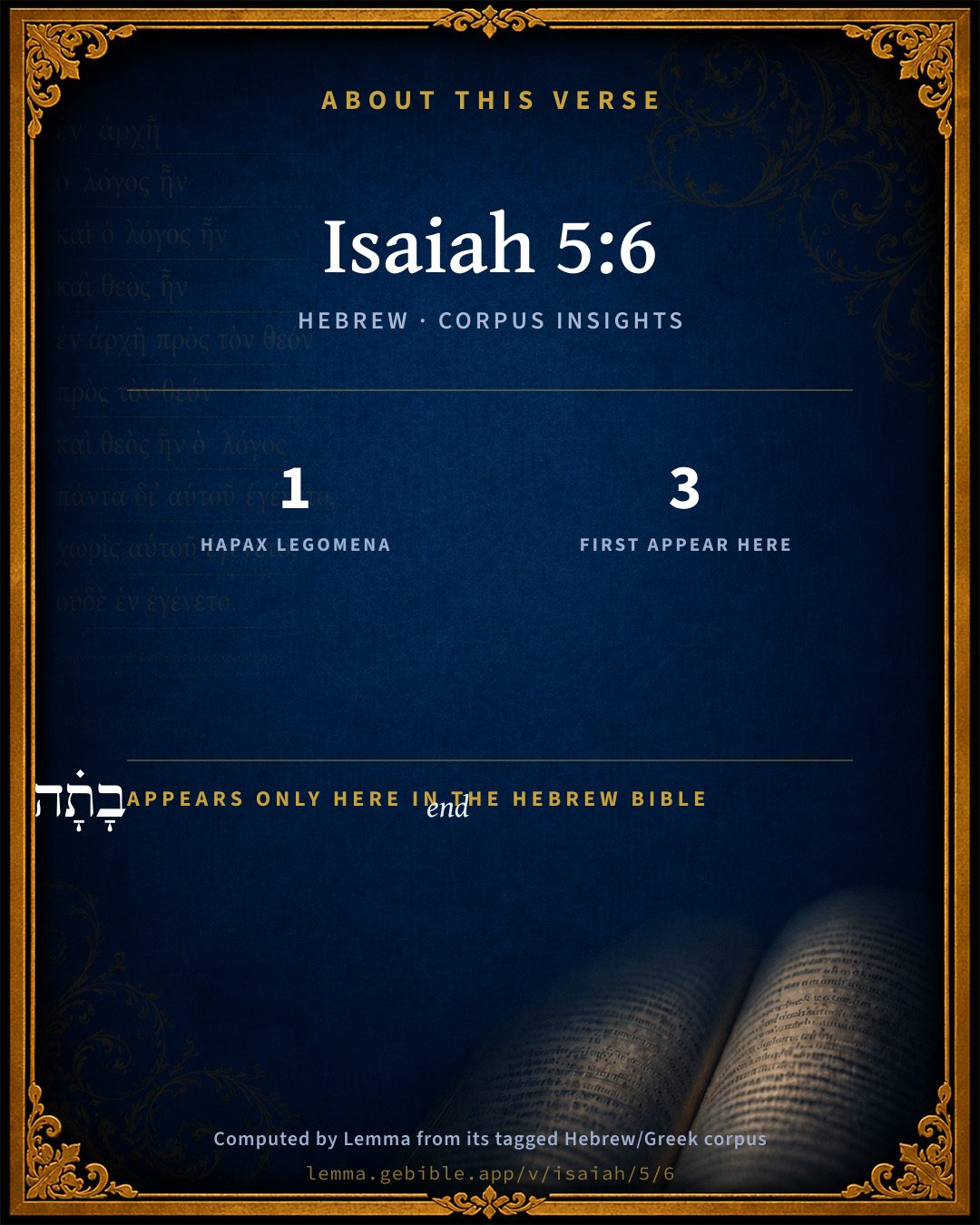
  • 1 hapax legomenon — only here in the Hebrew Bible
  • 3 first appearances in the Hebrew Bible
Full analysis ↓
Download a study sheet

One document with this verse’s original text, its word-by-word gloss line, the meaning frame, cross-references with their text, attributed commentary, and full source and license credits — printable, and it pastes into notes with its structure intact.

This verse Autodidact and up

Study sheet (.html) Plain text (.txt)

A passage Seminary Student

Up to 50 verses in one chapter. A passage sheet keeps up to 6 commentary sources and 12 cross-references per verse, in the order this page ranks them, and says so on the sheet whenever that leaves anything out. Ask for a single verse and you get the Autodidact verse sheet above.

Everything on this page stays free to read, with no account — the sheet is a download of what is already on screen, not access to it.

Want to remove ads? Support Godless Engineer
Compare translations 3

The same verse in 3 English versions, stacked beneath the original-language interlinear above. Click any original word for its lexicon entry.

Each is an independent rendering of the whole verse — the interlinear is not word-aligned to these translations.

Highlighted words mark where these versions differ — a whole-verse word diff, not a word-by-word alignment.

  • World English Bible Public Domain
    I will lay it a wasteland. It won't be pruned nor hoed, But it will grow briers and thorns. I will also command the clouds that they rain no rain on it."
  • King James Version Public Domain
    And I will lay it waste: it shall not be pruned, nor digged; but there shall come up briers and thorns: I will also command the clouds that they rain no rain upon it.
  • unfoldingWord Literal Text CC BY-SA 4.0
    And I will make it a waste; it will not be pruned and it will not be hoed, and briar and thorn will come up. And to the clouds, I will command not to rain rain upon it.”

unfoldingWord Literal Text — © unfoldingWord, licensed CC BY-SA 4.0. Word-aligned USFM3 via Door43 (git.door43.org/unfoldingWord/en_ult).

Versions to compare (up to 4)

3 of 4 selected

Show all 17 translations

Every available English version of this verse, each an independent rendering of the whole verse.

  • World English Bible Public Domain
    I will lay it a wasteland. It won't be pruned nor hoed, But it will grow briers and thorns. I will also command the clouds that they rain no rain on it."
  • Berean Standard Bible Public Domain
    I will make it a wasteland, neither pruned nor cultivated, and thorns and briers will grow up. I will command the clouds that rain shall not fall on it.”
  • Majority Standard Bible Public Domain
    I will make it a wasteland, neither pruned nor cultivated, and thorns and briers will grow up. I will command the clouds that rain shall not fall on it.”
  • King James Version Public Domain
    And I will lay it waste: it shall not be pruned, nor digged; but there shall come up briers and thorns: I will also command the clouds that they rain no rain upon it.
  • American Standard Version (1901) Public Domain
    and I will lay it waste; it shall not be pruned nor hoed; but there shall come up briers and thorns: I will also command the clouds that they rain no rain upon it.
  • Revised Version (1885) Public Domain
    and I will lay it waste; it shall not be pruned nor hoed; but there shall come up briers and thorns: I will also command the clouds that they rain no rain upon it.
  • Geneva Bible (1599) Public Domain
    And I will laye it waste: it shall not be cut, nor digged, but briers, and thornes shall growe vp: I will also commande the cloudes that they raine no raine vpon it.
  • Young's Literal Translation Public Domain
    And I make it a waste, It is not pruned, nor arranged, And gone up have brier and thorn, And on the thick clouds I lay a charge, From raining upon it rain.
  • Literal Standard Version CC BY-SA 4.0
    And I make it a waste, || It is not pruned, nor arranged, || And brier and thorn have gone up, || And I lay a charge on the thick clouds, || From raining on it rain.
  • Unlocked Literal Bible CC BY-SA 4.0
    I will lay it waste, and it will not be pruned nor hoed. Instead, briers and thorns will spring up. I will also command the clouds not to rain on it.
  • unfoldingWord Literal Text CC BY-SA 4.0
    And I will make it a waste; it will not be pruned and it will not be hoed, and briar and thorn will come up. And to the clouds, I will command not to rain rain upon it.”
  • Darby Bible Public Domain
    and I will make it a waste -- it shall not be pruned nor cultivated, but there shall come up briars and thorns; and I will command the clouds that they rain no rain upon it.
  • World Messianic Bible Public Domain
    I will lay it a wasteland. It won’t be pruned or hoed, but it will grow briers and thorns. I will also command the clouds that they rain no rain on it.”
  • Webster's Bible Public Domain
    And I will lay it waste: it shall not be pruned, nor digged; but there shall come up briers and thorns: I will also command the clouds that they rain no rain upon it.
  • Free Bible Version CC BY-SA 4.0
    I'll turn it into a wasteland. It won't be pruned or weeded—it will be overgrown with brambles and thorns. I'll order the clouds not to rain on it.”
  • Bible in Basic English Public Domain
    And I will make it waste; its branches will not be touched with the knife, or the earth worked with the spade; but blackberries and thorns will come up in it: and I will give orders to the clouds not to send rain on it.
  • JPS Tanakh (1917) Public Domain
    And I will lay it waste: it shall not be pruned nor hoed, but there shall come up briers and thorns; I will also command the clouds that they rain no rain upon it.

Literal Standard Version (2020), Covenant Press — licensed CC BY-SA 4.0. Text via the HelloAO Bible API (eBible.org). Unlocked Literal Bible (unfoldingWord) — licensed CC BY-SA 4.0. Text via the HelloAO Bible API (eBible.org). unfoldingWord Literal Text — © unfoldingWord, licensed CC BY-SA 4.0. Word-aligned USFM3 via Door43 (git.door43.org/unfoldingWord/en_ult). Free Bible Version, Dr. Jonathan Gallagher — licensed CC BY-SA 4.0. Text via the HelloAO Bible API (eBible.org).

Word by word

More ways to search: Search by grammar → Find every occurrence → Compare this word →

Practice this passage: Drill this verse → Learn its vocabulary →

בָתָ֗ה
bâthâh
H1326
“end”
Noun, Common, Feminine, Singular, Absolute
Part of Speech
Noun
Type
Common
Gender
Feminine
Number
Singular
State
Absolute
Full BDB Definition

Origin: probably an orthographical variation for H1327

TWOT: 298c

end, destruction
  1. וַאֲשִׁיתֵ֣הוּ shîyth H7896 “and · to set · him” Conjunction + Verb, Qal, Imperfect, 1st Person, Common, Singular + Suffix, Personal, 3rd Person, Masculine, Singular
  2. לֹ֤א lôʼ H3808 “not” Particle, Negative
  3. יִזָּמֵר֙ zâmar H2168 “to prune” Verb, Niphal, Imperfect, 3rd Person, Masculine, Singular
  4. וְלֹ֣א lôʼ H3808 “and · not” Conjunction + Particle, Negative
  5. יֵעָדֵ֔ר ʻădar H5737 “to help” Verb, Niphal, Imperfect, 3rd Person, Masculine, Singular
  6. וְעָלָ֥ה ʻâlâh H5927 “and · to go up” Conjunction + Verb, Qal, Sequential Perfect, 3rd Person, Masculine, Singular
  7. שָׁמִ֖יר shâmîyr H8068 “thorn” Noun, Common, Masculine, Singular, Absolute
  8. וָשָׁ֑יִת shayith H7898 “and · thorn bushes” Conjunction + Noun, Common, Masculine, Singular, Absolute
  9. וְעַ֤ל ʻal H5921 “and · upon” Conjunction + Preposition
  10. הֶעָבִים֙ ʻâb H5645 “the · clouds” Particle, Definite Article + Noun, Common, Both, Plural, Absolute
  11. אֲצַוֶּ֔ה tsâvâh H6680 “to command” Verb, Piel, Imperfect, 1st Person, Common, Singular
  12. מֵהַמְטִ֥יר mâṭar H4305 “from · to rain” Preposition + Verb, Hiphil, Infinitive Construct
  13. עָלָ֖יו ʻal H5921 “upon · him” Preposition + Suffix, Personal, 3rd Person, Masculine, Singular
  14. מָטָֽר mâṭar H4306 “rain” Noun, Common, Masculine, Singular, Absolute

About this verse

These counts appear in no published source. They are computed here, from the morphology-tagged text and Lemma’s own curated glosses. What Lemma adds →

15
words
13
distinct lemmas
Prophets
section

Notable vocabulary

1 hapax legomenon — a word that appears only here in the entire Hebrew Bible:

First appearance in Scripture

These words make their first canonical appearance in the Hebrew Bible here:

  • בָתָ֗ה end H1326
  • שָׁמִ֖יר thorn H8068
  • וָשָׁ֑יִת thorn bushes H7898

Shared distinctive vocabulary

יִזָּמֵר֙ to prune H2168 occurs in 3 verses of the Hebrew Bible. Also found in:

Grammatical profile

  • 6 verbs
  • 5 nouns
  • 2 prepositions
  • 2 particles

Verb forms

  • וַאֲשִׁיתֵ֣הוּ Qal · Imperfect
  • יִזָּמֵר֙ Niphal · Imperfect
  • יֵעָדֵ֔ר Niphal · Imperfect
  • וְעָלָ֥ה Qal · Sequential Perfect
  • אֲצַוֶּ֔ה Piel · Imperfect
  • מֵהַמְטִ֥יר Hiphil · Infinitive Construct

Repetition

Words recur within this verse — often emphatic in Hebrew:

  • וְעַ֤ל upon H5921 ×2
  • לֹ֤א not H3808 ×2

Hebrew & Septuagint length

In English translation the verse runs 32 words from the Hebrew and 37 from the Septuagint (LXX English) — closely comparable.

A rough comparison of the two English renderings, which tokenize alike — not a word-level alignment.

Word counts can differ between the Hebrew and the Greek without any difference in meaning — e.g. the Hebrew direct-object marker אֵת has no separate Greek word, and Greek often adds the article ὁ.

Cross-references

22

Topical passages linked to Isaiah 5:6 in the Treasury of Scripture Knowledge — connected by theme and wording, ordered by reader-vote popularity; previews shown in the World English Bible.

  • Isaiah 7:23–25 It will happen in that day that every place where there were a thousand vines at a thousand silver shekels, shall be for briers and thorns.
  • Jeremiah 25:11 This whole land shall be a desolation, and an astonishment; and these nations shall serve the king of Babylon seventy years.
  • Isaiah 24:1–3 Behold, Yahweh makes the earth empty, and makes it waste, and turns it upside down, and scatters abroad the inhabitants of it.
  • Leviticus 26:33–35 I will scatter you among the nations, and I will draw out the sword after you: and your land will be a desolation, and your cities shall be a waste.
  • Deuteronomy 28:23–24 Your sky that is over your head shall be brass, and the earth that is under you shall be iron.
  • Deuteronomy 29:23 [and that] the whole land of it is sulfur, and salt, [and] a burning, [that] it is not sown, nor bears, nor any grass grows therein, like the overthrow of Sodom and Gomorrah, Admah and Zeboiim, which Yahweh overthrew in his anger, and in his wrath:
  • 1 Kings 17:1 Elijah the Tishbite, who was of the foreigners of Gilead, said to Ahab, As Yahweh, the God of Israel, lives, before whom I stand, there shall not be dew nor rain these years, but according to my word.
  • 2 Chronicles 36:19–21 They burnt the house of God, and broke down the wall of Jerusalem, and burnt all the palaces of it with fire, and destroyed all the goodly vessels of it.
  • Isaiah 5:9–10 In my ears, Yahweh of Hosts says: "Surely many houses will be desolate, Even great and beautiful, unoccupied.
  • Isaiah 6:11–12 Then I said, "Lord, how long?" He answered, "Until cities are waste without inhabitant, And houses without man, And the land becomes utterly waste,
  • Isaiah 24:12 In the city is left desolation, and the gate is struck with destruction.
  • Isaiah 30:23 He will give the rain for your seed, with which you shall sow the ground; and bread of the increase of the ground, and it shall be fat and plenteous. In that day shall your cattle feed in large pastures;
  • Isaiah 32:13–14 On the land of my people shall come up thorns and briers; yes, on all the houses of joy in the joyous city.
  • Jeremiah 14:1 The word of Yahweh that came to Jeremiah concerning the drought.
  • Jeremiah 14:22 Are there any among the vanities of the nations that can cause rain? or can the sky give showers? Aren't you he, Yahweh our God? therefore we will wait for you; for you have made all these things.
  • Jeremiah 45:4 Thus shall you tell him, Thus says Yahweh: Behold, that which I have built will I break down, and that which I have planted I will pluck up; and this in the whole land.
  • Hosea 3:4 For the children of Israel shall abide many days without king, and without prince, and without sacrifice, and without sacred stone, and without ephod or idols.
  • Amos 4:7 "I also have withheld the rain from you, When there were yet three months to the harvest; And I caused it to rain on one city, And caused it not to rain on another city. One place was rained on, And the piece where it didn't rain withered.
  • Zechariah 14:16–17 It will happen that everyone who is left of all the nations that came against Jerusalem will go up from year to year to worship the King, Yahweh of Hosts, and to keep the feast of tents.
  • Luke 21:24 They will fall by the edge of the sword, and will be led captive into all the nations. Jerusalem will be trampled down by the Gentiles, until the times of the Gentiles are fulfilled.
  • Hebrews 6:6–8 and then fell away, it is impossible to renew them again to repentance; seeing they crucify the Son of God for themselves again, and put him to open shame.
  • Revelation 11:6 These have the power to shut up the sky, that it may not rain during the days of their prophecy. They have power over the waters, to turn them into blood, and to strike the earth with every plague, as often as they desire.

Cross-references courtesy of OpenBible.info (CC BY 4.0).

Hebrew and Greek witnesses Masoretic Hebrew ↔ Greek Septuagint

The same verse in the two great witnesses to the Old Testament, shown verse-for-verse.

These are two independent witnesses, not word-aligned to each other, and the Septuagint is shown in lemma (dictionary) form.

Hebrew Isaiah 5:6 Masoretic · Westminster Leningrad Codex

וַאֲשִׁיתֵ֣הוּ בָתָ֗ה לֹ֤א יִזָּמֵר֙ וְלֹ֣א יֵעָדֵ֔ר וְעָלָ֥ה שָׁמִ֖יר וָשָׁ֑יִת וְעַ֤ל הֶעָבִים֙ אֲצַוֶּ֔ה מֵהַמְטִ֥יר עָלָ֖יו מָטָֽר

I will lay it a wasteland. It won't be pruned nor hoed, But it will grow briers and thorns. I will also command the clouds that they rain no rain on it."

World English Bible · Public Domain

Greek LXX Isaiah 5:6 Septuagint · lemma form

καί ἀναἵημι ὁ ἀμπελών ἐγώ καί οὐ μή τέμνω οὐδέ μή σκάπτω καί ἀναβαίνω εἰς αὐτός ὡς εἰς χέρσος ἄκανθα καί ὁ νεφέλη ἐντέλλομαι ὁ μή βρέχω εἰς αὐτός ὑετός

And I will forsake my vineyard; and it shall not be pruned, nor dug, and thorns shall come up upon it as on barren land; and I will command the clouds to rain no rain upon it.

LXX2012 (modern English Septuagint) · Public Domain

On this verse, Adam Clarke's Commentary discusses the Septuagint’s reading. Read the note in Commentary ↓

Hebrew: Westminster Leningrad Codex (CC BY 4.0). Greek: Septuagint (public domain); English from LXX2012 (modern English Septuagint) (Public Domain). How the Septuagint differs from the Hebrew →

Targum (Aramaic paraphrase)

1

The Targum is the ancient Jewish Aramaic paraphrase of the Hebrew Scriptures — an interpretive translation, not the Hebrew text itself. Onkelos (literal) and Pseudo-Jonathan (expansive) render the Torah, and Jonathan the Prophets. Coverage is partial: where no permissively-licensed English translation exists for a verse, only the Aramaic is shown. This is verse-level text, not a word-by-word alignment to the Hebrew.

  1. Targum Jonathan Prophets (Joshua–Malachi)
    וַאֲשַׁוִינוּן רְטִישִׁין לָא אִסְתַּעֲרוּן וְלָא יִסְתַּמָכוּן וִיהוֹן מְטַלְטְלִין וּשְׁבִיקִין וְעַל נְבִיַיָא אֲפַקֵיד דְלָא יִתְנַבּוּן עֲלֵיהוֹן נְבוּאָה:

    I will make them abandoned ones; they shall not be visited, neither shall they be supported; and they shall be cast out and forsaken. I will command the prophets that they do not prophesy to them prophecy.

    Targum Jonathan — Aramaic: “Mikraot Gedolot” (public domain). English: “Sefaria Community Translation” (CC0 1.0 (public-domain dedication)); “London "Chaldee Paraphrase," 1871” (public domain). Text via Sefaria.

Commentary

Notes on Isaiah 5:6 from classic Christian and Jewish commentators (each source and its license shown beneath its notes). The classic Christian expositions comment on the surrounding passage and are grouped to its opening verse, so a note may address several verses; the Jewish commentaries on the Tanakh (Rashi and others) are per-verse, so they appear only where the commentator wrote on this verse.

Lemma curates 59 commentaries, every one of them public domain or Creative Commons licensed, each selected and text-cleaned for this edition rather than reprinted as found. About our sources →

Trapp's Complete Commentary

John Trapp

Isa 5:6 And I will lay it waste: it shall not be pruned, nor digged; but there shall come up briers and thorns: I will also command the clouds that they rain no rain upon it.

Ver. 6. And I will lay it waste.] Heb., Wasteness; I will utterly root it up and ruin it. Lege et lute; by law and dirt, wrath is come upon Jewry to the utmost. Lukewarm Laodicea was swallowed up by an earthquake, as Eutropius testifieth. The rest of these seven famous churches are overrun by the Turk. And our utter ruin, unless we repent, may be as plainly foreseen as if letters had been sent us from heaven to such a purpose.

It shall not be pruned nor digged,] sc., By such painful vinedressers as were wont both to dig and beg for it, as he in Luk 13:8. Such labour shall now be no longer lost, such cost cast away no more. Cutting shall be used where there is no longer hope of curing.

But there shall come up briers and thorns.] Being bereft of the means of grace, they shall run into foul and flagitious practices, which shall ripen them for ruin. See Heb 6:8.

I will also command the clouds.] The prophets and ministers.

That they rain no rain upon it.] No, not a small shower or mist. Non pluma dignabitur nedum imbre, saith Oecolampadius.

John Trapp, A Commentary or Exposition upon All the Books of the Old and New Testament (1647–1656) — public domain. Text from a community e-Sword module.

Tyndale Open Study Notes

Tyndale Open Resources

5:6 The withholding of rain was at times a divine judgment (Deut 28:23-24; Hag 1:11; 2:16). It was especially devastating to a society that depended heavily on agriculture.

Tyndale Open Study Notes — © Tyndale Open Resources, licensed CC BY-SA 4.0. Text via the HelloAO Bible API.

Jamieson, Fausset & Brown

Robert Jamieson, A. R. Fausset & David Brown

I will . . . command--The parable is partly dropped and Jehovah, as in Isa 5:7, is implied to be the Owner: for He alone, not an ordinary husbandman (Mat 21:43; Luk 17:22), could give such a "command."

no rain--antitypically, the heaven-sent teachings of the prophets (Amo 8:11). Not accomplished in the Babylonish captivity; for Jeremiah, Ezekiel, Daniel, Haggai, and Zechariah prophesied during or after it. But in gospel times.

Jamieson, Fausset & Brown — Commentary Critical and Explanatory on the Whole Bible (1871) — public domain (CC PDM 1.0). Text via the HelloAO Bible API.

Adam Clarke's Commentary

Verse 6. There shall come up briers and thorns - "The thorn shall spring up in it"] One MS. has בשמיר beshamir. The true reading seems to be בו שמור bo shamir, which is confirmed by the Septuagint, Syriac, and Vulgate.

Adam Clarke's Commentary on the Bible (1810–1826) — public domain. Text from a community e-Sword/MySword module.

Ellicott's Commentary for English Readers

(6) There shall come up briers and thorns.—The picture of desolation is still part of a parable. The “briers and thorns” (both the words are peculiar to Isaiah) are the base and unworthy who take the place of the true leaders of the people (Jdg_9:7-15). The absence of the pruning and the digging answers to the withdrawal of the means of moral and spiritual culture (Joh_15:2; Luk_13:8). The command given to the clouds (comp. 2Sa_1:21, for the outward form of the thought) implies the cessation of all gracious spiritual influences.

A Bible Commentary for English Readers, edited by Charles John Ellicott (1878–1897) — public domain. Text from a community e-Sword module.

The Cambridge Bible for Schools and Colleges

gen. ed. J. J. S. Perowne

6. lay it waste] or, make an end of it. The word is thought to be connected with that rendered “desolate” in ch. Isa_7:19,—better “precipitous,” “cut off,” hence (as here) “made an end of.”

there shall come up … thorns] The Heb. is more forcible: it shall go up in thorns and thistles. “Thorns and thistles,” a phrase peculiar to the book of Isaiah: Isa_7:23-25; Isa_9:18; Isa_10:17; Isa_27:4. The change of rhythm referred to (Introd. Note above) commences with this clause—rightly, since the next line reveals the whole drift of the parable: He who can command the clouds must be no other than Jehovah himself.

The Cambridge Bible for Schools and Colleges (gen. ed. J. J. S. Perowne; Cambridge University Press, 1878–1918) — public domain. Text from a community e-Sword module.

John Gill's Exposition

And I will lay it waste,.... Or "desolate", as it was by the Romans: the whole land of Judea, as well as the city and temple Mat 23:38,

it shall not be pruned nor digged; as vineyards are, to make them more fruitful; but no care shall be taken of it, no means made use of to cultivate it, all being ineffectual:

but there shall come up briers and thorns; sons of Belial, wicked and ungodly men; immoralities, errors, heresies, contentions, quarrels, &c. which abounded about the time of Jerusalem's destruction, and before:

I will also command the clouds that they rain no rain upon them; by "the clouds" are meant the apostles of Christ, who were full of the doctrines of grace, from whom they dropped as rain upon the mown grass; these, when the Jews contradicted and blasphemed the Gospel, and judged themselves unworthy of it, were commanded by Christ to turn from them, and go to the Gentiles, Act 13:45 agreeably to this sense is the Targum,

"and I will command the prophets, that they do not prophesy upon them prophecy.''

John Gill's Exposition of the Whole Bible (1746–1763) — public domain (CC PDM 1.0). Text via the HelloAO Bible API.

Albert Barnes' Notes on the Bible

I will lay it waste ... - The description here is continued from Isa 5:5. The image is carried out, and means that the Jews should be left utterly without protection.

I will also command the clouds ... - It is evident here, that the parable or figure is partially dropped. A farmer could not command the clouds. It is God alone who could do that; and the figure of the vineyard is dropped, and God is introduced speaking as a sovereign. The meaning is, that he would withhold his divine influences, and would abandon them to desolation. The sense of the whole verse is plain. God would leave the Jews without protection; he would remove the guards, the helps, the influences, with which he had favored them, and leave them to their own course, as a vineyard that was unpruned, uncultivated, unwatered. The Chaldee has well expressed the sense of the passage: ‘I will take away the house of my sanctuary (the temple), and they shall be trodden down. I will regard them as guilty, and there shall be no support or defense for them; they shall be abandoned, and shall become wanderers. I will command the prophets, that they shall not prophesy over them.’ The lesson taught here is, that when a people become ungrateful, and rebellious, God will withdraw from them, and leave them to desolation; compare Rev 2:3.

Albert Barnes' Notes on the Bible (1834–1885) — public domain. Text from a community e-Sword/MySword module.

Haydock's Catholic Bible Commentary

It. During the whole of the captivity, the land might keep its sabbaths, Leviticus xxvi. 34. (Calmet) --- The people shall be deprived of saving doctrine. (Menochius)

George Leo Haydock (1774–1849), Haydock's Catholic Family Bible and Commentary, 1859 edition — public domain. Excludes Psalms (Douay-Rheims chapter numbering differs from Protestant) and Deuterocanonical books (Catholic canon only).

Matthew Poole's English Annotations

It shall not be pruned nor digged: vine-dressers use to dig up and open the earth about the roots of the vines, for divers good purposes. The meaning is. I will remove my ministers, who used great care and diligence to make you fruitful.

There shall come briers and thorns; I will give you up to your own wicked lusts.

I will also command the clouds that they rain no rain on it; I will deprive you of all my blessings, which are oft compared to rain, &c.

Matthew Poole's English Annotations on the Holy Bible (1683–1685) — public domain. Text from a community e-Sword/MySword module.

The Pulpit Commentary

I will lay it waste; literally, I will make it a desolation. (comp. Isa_7:19, where a cognate term occurs) Active ravage is not so much pointed at, as the desolation which comes from neglect. There shall come up briers and thorns. The natural produce of neglected ground in Palestine. (see Pro_24:31) The "thorns and briers" symbolize vices of various kinds, the natural produce of the human soul, if God leaves it to itself. The words are scarcely to be taken literally, though it is probably true that "no country in the world has such variety and abundance of thorny plants as Palestine in its present desolation" (Macmillan, "Min. of Nat.," p. 103). I will also command the clouds. Here at last disguise is thrown off, and the speaker manifestly appears as Jehovah, who can alone "command the clouds." The "rain" intended is probably that of his gracious influences.

The Pulpit Commentary (1880–1919), ed. H.D.M. Spence-Jones & Joseph S. Exell — public domain. Text from a community e-Sword module.

John Wesley's Explanatory Notes

Nor digged - Vine-dressers use to dig up and open the earth about the roots of the vines. The meaning is, I will remove my ministers, who used great care and diligence to make you fruitful. Thorns - I will give you up to your own lusts. No rain - I will deprive you of all my blessings.

John Wesley, Explanatory Notes Upon the Whole Bible (1754–1765) — public domain. Text via the GEBible commentary corpus.

Keil & Delitzsch

C. F. Keil & F. Delitzsch

This puts an end to the unthankful vineyard, and indeed a hopeless one."And I will put an end to it: it shall not be pruned nor digged, and it shall break out in thorns and thistles; and I will command the clouds to rain no rain over it." "Put an end:" bâthâh (= battâh : Ges. 67, Anm. 11) signifies, according to the primary meaning of bâthath (בּוּת, בּהת, see at Isa 1:29), viz., abscindere, either abscissum = locus abscissus or praeruptus (Isa 7:19), or abscissio = deletio. The latter is the meaning here, where shı̄th bâthâh is a refined expression for the more usual כלה עשׂה, both being construed with the accusative of the thing which is brought to an end. Further pruning and hoeing would do it no good, but only lead to further disappointment: it was the will of the Lord, therefore, that the deceitful vineyard should shoot up in thorns and thistles (âlâh is applied to the soil, as in Isa 34:13 and Pro 24:31; shâimr vâshaith, thorns and thistles, are in the accusative, according to Ges. 138, 1, Anm. 2; and both the words themselves, and also their combination, are exclusively and peculiarly Isaiah's).

(Note: Cassel associates shâmir as the name of a plant (saxifraga) with σμὐρις, and shaith with sentis, ἄκανθα; but the name shâmir is not at all applicable to those small delicate plants, which are called saxifraga (stone-breakers) on account of their growing out of clefts in the rock, and so appearing to have split the rock itself. Both shâmir vâshaith and kōts v'dardar, in Gen 3:18, seem rather to point to certain kinds of rhamnus, together with different kinds of thistles. The more arid and waste the ground is, the more does it abound, where not altogether without vegetation, in thorny, prickly, stunted productions.)

In order that it might remain a wilderness, the clouds would also receive commandment from the Lord not to rain upon it. There can be no longer any doubt who the Lord of the vineyard is. He is Lord of the clouds, and therefore the Lord of heaven and earth. It is He who is the prophet's beloved and dearest one. The song which opened in so minstrel-like and harmless a tone, has now become painfully severe and terribly repulsive. The husk of the parable, which has already been broken through, now falls completely off (cf., Mat 22:13; Mat 25:30). What it sets forth in symbol is really true. This truth the prophet establishes by an open declaration.

Keil & Delitzsch — Biblical Commentary on the Old Testament (1861–1891) — public domain (CC PDM 1.0). Text via the HelloAO Bible API. (Old Testament only.)

J. A. Alexander on Isaiah

Joseph Addison Alexander

To the threatening of exposure he now adds that of desolation arising from neglect of culture, while the last clause contains a beautiful though almost imperceptible transition from the apologue to the reality. By adding to the other threats, which any human vine-dresser might have reasonably uttered, one which only God could execute, the parable at one stroke is brought to a conclusion, and the mind prepared for the ensuing application. “And I place it (render it) a desolation. It shall not be pruned, and it shall not be dressed, and there shall come up thorns and briers. And I will lay my commands upon the clouds from raining rain upon it,” (i.e., that they rain no rain upon it). The addition of the noun rain is emphatic and equivalent to any rain at all. The English Version lay waste is perhaps too strong for the original expression, which rather signifies the letting it run to waste by mere exposure and neglect. To command from or away from is to deter from any act by a command, in other words to forbid or to command not to do the thing in question. In this sense only can the preposition from be said to have a negative meaning.

Joseph Addison Alexander, The Prophecies of Isaiah (1846–1847; New York: Scribner, 1870–1878) — public domain. Text from a community e-Sword module.

Rashi

Rabbi Shlomo Yitzchaki (Rashi)

And I will make it a desolation Heb. בָתָה, an expression of desolation and emptiness. Compare (infra 7:19): “in the desolate valleys (הַבַּתּוֹת).”

nor hoed Heb. יֵעָדֵר; this is an expression of digging in a vineyard.

the shamir and desolation will come up Heb. שָׁמִיר וָשָׁיִת. Menahem ben Seruk interprets them as kinds of thorns (Machbereth Menahem p. 176), but I say that “shamir” is a word denoting a strong worm that splits stones, with which Solomon built the Temple, like the matter that is written (Ezekiel 3:19), “Like a shamir, stronger than rock.”

desolation Heb. שַׁיִת, an expression similar to (Lamentations 3:47), “desolation (הַשְׁאֵת) and breach,” an expression similar to (infra 6:11), “shall be made desolate (תִּשָּׁאֶה) [as a wilderness”; i.e., it will be] empty with no one seeking it to enter it, and thereby worms will overrun it.

Rashi on the Tanakh — English translations: “The Judaica Press complete Tanach with Rashi, translated by A. J. Rosenberg” (CC BY 4.0); “Pentateuch with Rashi's commentary by M. Rosenbaum and A.M. Silbermann, 1929-1934” (public domain); “The Metsudah Tanach series, Lakewood, N.J” (CC BY 4.0); and “The Book of Joshua, Metsudah Publications, 1997” (CC BY 4.0). Text via Sefaria.

Ibn Ezra

Rabbi Abraham ibn Ezra

בתה Waste. Comp. בתות The desolate places (7:19).

יזמר It shall be pruned. זמורה branch is of the same root; זמר means to dress the vineyard by cutting off the branches.

יעדר It shall be digged. עדר to dig, to prepare the vineyard by digging (comp. 7:25).

שמיר ושית Two kinds of thorns. The application of this figure is The wicked will increase.

The clouds. The prophets are hereby meant; comp. Her prophets also find no vision from the Lord (Lam. 2:9).

Ibn Ezra on the Tanakh — English translations: “Sefaria Community Translation” (CC0 1.0 (public-domain dedication)); “Yalkut, Sifsei Chachomim Chumash, Metsudah Publications, 2009” (CC BY 4.0); and “Commentary of Ibn Ezra on Isaiah - trans. by M. Friedlander, 1873” (public domain). Text via Sefaria.

Lesson kit

Teaching starters — assembled from the data on this page, not authored interpretation. Every prompt links to the verse data it draws on. Edit before teaching.

Isaiah, in the Prophets, opens this verse with 15 words (13 distinct Hebrew lemmas). Its most distinctive word is bâthâh (“end”). A historical commentator’s framing appears above. Read the whole chapter for the surrounding context.

Discussion questions

  1. How does “end” (bâthâh) shape what this verse is saying?
  2. This verse holds 1 word here found nowhere else in the Hebrew Bible. What might the rare word draw attention to?
  3. 3 words here appear for the first time in Scripture. What is being introduced at this debut?
  4. Leviticus 25:3 shares the word «to prune» with this verse. How do the two illuminate each other?
  5. “upon” occurs 2× in this one verse. What is the effect of the repetition?
  6. The translations on this page render this verse differently — a whole-verse word diff, not a word-by-word alignment. What might account for the different wordings?
  7. The verb «וַאֲשִׁיתֵ֣הוּ» is Qal Imperfect. How does its form color the action?
  8. Reading how Trapp's Complete Commentary and Tyndale Open Study Notes read this verse, where do the two commentators agree and where do they part?

Things to notice

  • 1 word in this verse appears nowhere else in the Hebrew Bible.
  • 3 words make their first canonical appearance in Scripture here.
  • These translations choose different wording for 18 words in this verse.
  • “upon” occurs 2× in this single verse.
  • 13 distinct Hebrew lemmas span 15 words in this verse.

Reading settings

Reading text

Shown beneath each verse's original-language words.

Old Testament
Old Testament edition

Read the OT as the Masoretic Hebrew (MT) or the Greek Septuagint (LXX).

English shown for the Greek Septuagint (in the Hebrew ↔ Greek comparison).

Comparing translations? Open the Compare panel on any verse page to stack up to four side by side.