
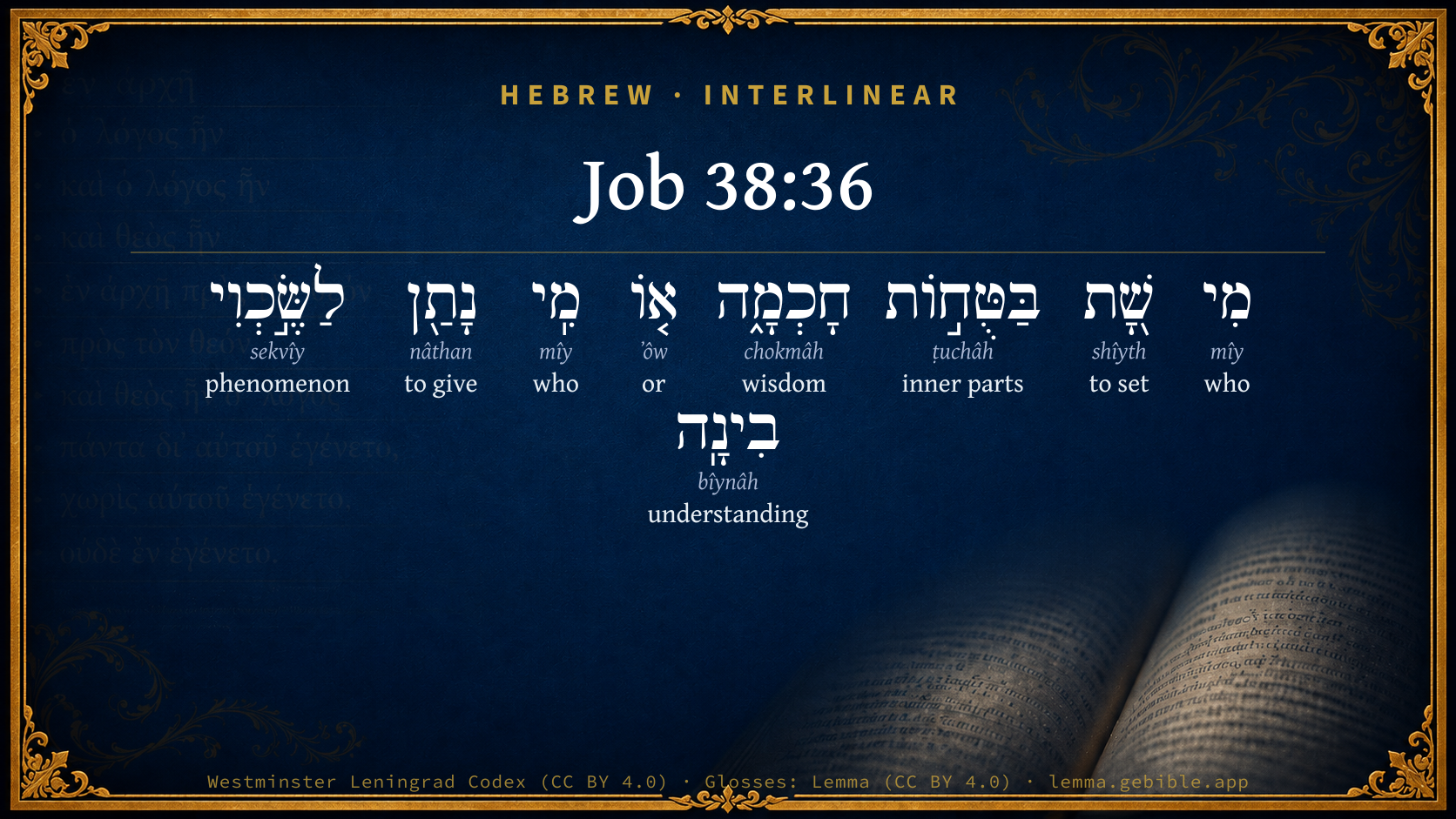
Job 38:36

Hebrew (Westminster Leningrad Codex) Job 38:36 appears in the Hebrew Old Testament. The text above is from the Westminster Leningrad Codex. Each word links to its Strong’s number, a concise gloss, and parsing drawn from the Open Scriptures Hebrew Bible morphology. Click any word for its full Brown-Driver-Briggs (BDB) entry.
Download image
Cite this verse

Job 38:36 (World English Bible). Public Domain. Lemma interlinear Bible study tool, https://lemma.gebible.app/v/job/38/36.

Show BibTeX & RIS
BibTeX
RIS
English Translation
Who has put wisdom in the inward parts? Or who has given understanding to the mind?
World English Bible · Public Domain
Highlights
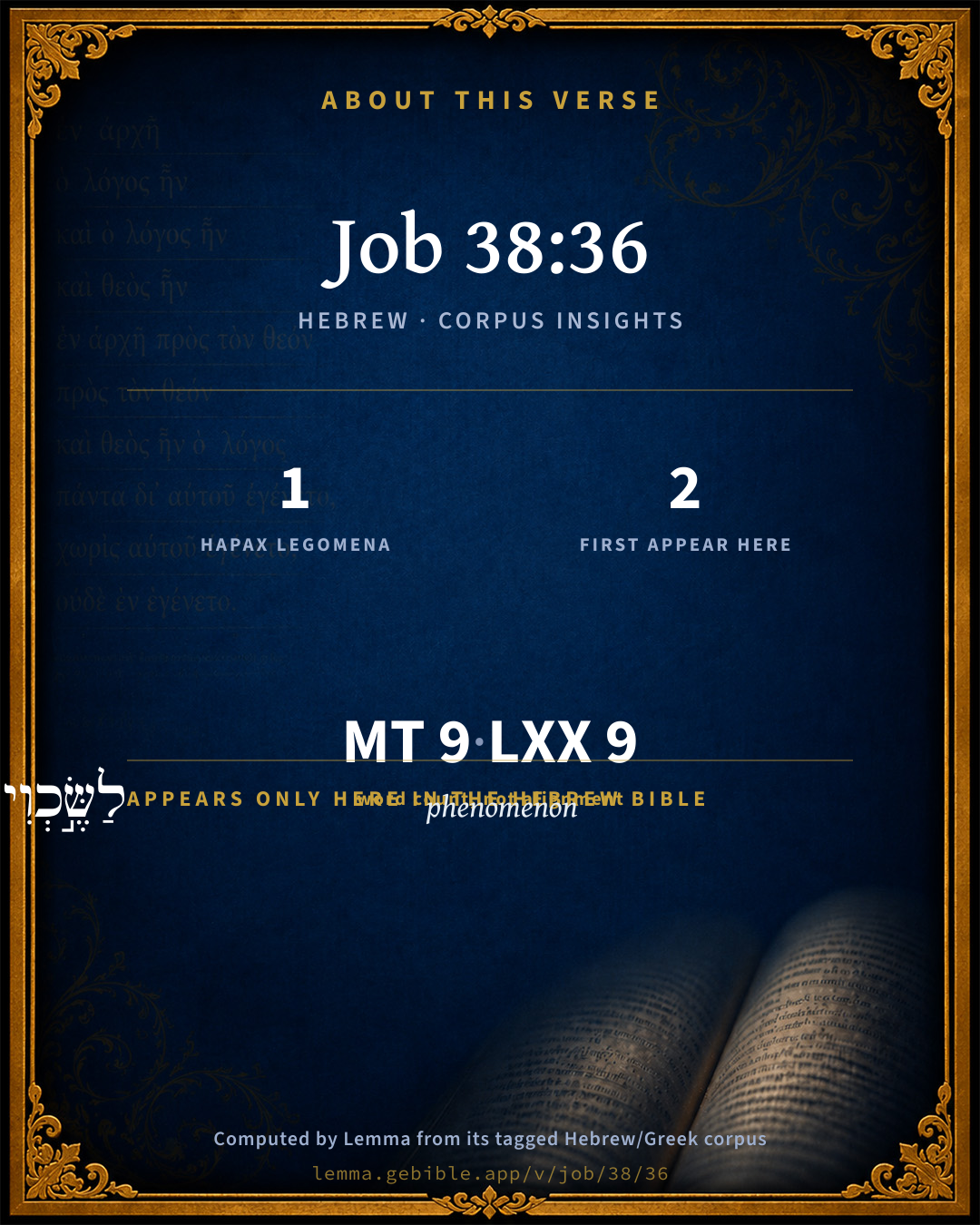
  • 1 hapax legomenon — only here in the Hebrew Bible
  • 2 first appearances in the Hebrew Bible
Full analysis ↓
Download a study sheet

One document with this verse’s original text, its word-by-word gloss line, the meaning frame, cross-references with their text, attributed commentary, and full source and license credits — printable, and it pastes into notes with its structure intact.

This verse Autodidact and up

Study sheet (.html) Plain text (.txt)

A passage Seminary Student

Up to 50 verses in one chapter. A passage sheet keeps up to 6 commentary sources and 12 cross-references per verse, in the order this page ranks them, and says so on the sheet whenever that leaves anything out. Ask for a single verse and you get the Autodidact verse sheet above.

Everything on this page stays free to read, with no account — the sheet is a download of what is already on screen, not access to it.

Want to remove ads? Support Godless Engineer
Compare translations 3

The same verse in 3 English versions, stacked beneath the original-language interlinear above. Click any original word for its lexicon entry.

Each is an independent rendering of the whole verse — the interlinear is not word-aligned to these translations.

Highlighted words mark where these versions differ — a whole-verse word diff, not a word-by-word alignment.

  • World English Bible Public Domain
    Who has put wisdom in the inward parts? Or who has given understanding to the mind?
  • King James Version Public Domain
    Who hath put wisdom in the inward parts? or who hath given understanding to the heart?
  • unfoldingWord Literal Text CC BY-SA 4.0
    Who has put wisdom in the clouds, or who has given understanding to the mist?

unfoldingWord Literal Text — © unfoldingWord, licensed CC BY-SA 4.0. Word-aligned USFM3 via Door43 (git.door43.org/unfoldingWord/en_ult).

Versions to compare (up to 4)

3 of 4 selected

Show all 18 translations

Every available English version of this verse, each an independent rendering of the whole verse.

  • World English Bible Public Domain
    Who has put wisdom in the inward parts? Or who has given understanding to the mind?
  • Berean Standard Bible Public Domain
    Who has put wisdom in the heart or given understanding to the mind?
  • Majority Standard Bible Public Domain
    Who has put wisdom in the heart or given understanding to the mind?
  • King James Version Public Domain
    Who hath put wisdom in the inward parts? or who hath given understanding to the heart?
  • American Standard Version (1901) Public Domain
    Who hath put wisdom in the inward parts? Or who hath given understanding to the mind?
  • Revised Version (1885) Public Domain
    Who hath put wisdom in the inward parts? or who hath given understanding to the mind?
  • Geneva Bible (1599) Public Domain
    Who hath put wisedome in the reines? or who hath giuen the heart vnderstanding?
  • Douay-Rheims (1899) Public Domain
    Who hath put wisdom in the heart of man? or who gave the cock understanding?
  • Young's Literal Translation Public Domain
    Who hath put in the inward parts wisdom? Or who hath given To the covered part understanding?
  • Literal Standard Version CC BY-SA 4.0
    Who has put wisdom in the inward parts? Or who has given understanding to the covered part?
  • Unlocked Literal Bible CC BY-SA 4.0
    Who has put wisdom in the clouds or has given understanding to the mists?
  • unfoldingWord Literal Text CC BY-SA 4.0
    Who has put wisdom in the clouds, or who has given understanding to the mist?
  • Darby Bible Public Domain
    Who hath put wisdom in the inward parts? or who hath given understanding to the mind?
  • World Messianic Bible Public Domain
    Who has put wisdom in the inward parts? Or who has given understanding to the mind?
  • Webster's Bible Public Domain
    Who hath put wisdom in the inward parts? or who hath given understanding to the heart?
  • Free Bible Version CC BY-SA 4.0
    Who has placed wisdom inside people? Who has given understanding to the mind?
  • Bible in Basic English Public Domain
    Who has put wisdom in the high clouds, or given knowledge to the lights of the north?
  • JPS Tanakh (1917) Public Domain
    Who hath put wisdom in the inward parts? Or who hath given understanding to the mind?

Literal Standard Version (2020), Covenant Press — licensed CC BY-SA 4.0. Text via the HelloAO Bible API (eBible.org). Unlocked Literal Bible (unfoldingWord) — licensed CC BY-SA 4.0. Text via the HelloAO Bible API (eBible.org). unfoldingWord Literal Text — © unfoldingWord, licensed CC BY-SA 4.0. Word-aligned USFM3 via Door43 (git.door43.org/unfoldingWord/en_ult). Free Bible Version, Dr. Jonathan Gallagher — licensed CC BY-SA 4.0. Text via the HelloAO Bible API (eBible.org).

Word by word

More ways to search: Search by grammar → Find every occurrence → Compare this word →

Practice this passage: Drill this verse → Learn its vocabulary →

About this verse

These counts appear in no published source. They are computed here, from the morphology-tagged text and Lemma’s own curated glosses. What Lemma adds →

9
words
8
distinct lemmas
Wisdom
section

Notable vocabulary

1 hapax legomenon — a word that appears only here in the entire Hebrew Bible:

  • לַשֶּׂ֣כְוִי phenomenon H7907

First appearance in Scripture

These words make their first canonical appearance in the Hebrew Bible here:

  • בַּטֻּח֣וֹת inner parts H2910
  • לַשֶּׂ֣כְוִי phenomenon H7907

Shared distinctive vocabulary

בַּטֻּח֣וֹת inner parts H2910 occurs in 2 verses of the Hebrew Bible. Also found in:

Grammatical profile

  • 2 verbs
  • 4 nouns
  • 1 conjunction
  • 2 particles

Verb forms

  • שָׁ֭ת Qal · Perfect
  • נָתַ֖ן Qal · Perfect

Repetition

A word recurs within this verse — often emphatic in Hebrew:

Hebrew & Septuagint length

In English translation the verse runs 16 words from the Hebrew and 13 from the Septuagint (LXX English) — closely comparable.

A rough comparison of the two English renderings, which tokenize alike — not a word-level alignment.

Word counts can differ between the Hebrew and the Greek without any difference in meaning — e.g. the Hebrew direct-object marker אֵת has no separate Greek word, and Greek often adds the article ὁ.

In the original languages it is 9 Hebrew tokens and 9 Greek tokens — but the two are counted differently (Hebrew bundles its prefixes and suffixes into one token; the Greek is in lemma form), so that isn’t a like-for-like length.

Cross-references

10

Topical passages linked to Job 38:36 in the Treasury of Scripture Knowledge — connected by theme and wording, ordered by reader-vote popularity; previews shown in the World English Bible.

  • Job 32:8 But there is a spirit in man, And the breath of the Almighty gives them understanding.
  • Psalms 51:6 Behold, you desire truth in the inward parts. You teach me wisdom in the inmost place.
  • Proverbs 2:6 For Yahweh gives wisdom. Out of his mouth comes knowledge and understanding.
  • Ecclesiastes 2:26 For to the man who pleases him, God gives wisdom, knowledge, and joy; but to the sinner he gives travail, to gather and to heap up, that he may give to him who pleases God. This also is vanity and a chasing after wind.
  • James 1:5 But if any of you lacks wisdom, let him ask of God, who gives to all liberally and without reproach; and it will be given to him.
  • Exodus 31:3 and I have filled him with the Spirit of God, in wisdom, and in understanding, and in knowledge, and in all manner of workmanship,
  • Job 9:4 God who is wise in heart, and mighty in strength: Who has hardened himself against him, and prospered?
  • James 1:17 Every good gift and every perfect gift is from above, coming down from the Father of lights, with whom can be no variation, nor turning shadow.
  • Exodus 36:1–2 "Bezalel and Oholiab shall work with every wise-hearted man, in whom Yahweh has put wisdom and understanding to know how to work all the work for the service of the sanctuary, according to all that Yahweh has commanded."
  • Isaiah 28:26 For his God does instruct him aright, [and] does teach him.

Cross-references courtesy of OpenBible.info (CC BY 4.0).

Hebrew and Greek witnesses Masoretic Hebrew ↔ Greek Septuagint

The same verse in the two great witnesses to the Old Testament, shown verse-for-verse.

These are two independent witnesses, not word-aligned to each other, and the Septuagint is shown in lemma (dictionary) form.

Hebrew Job 38:36 Masoretic · Westminster Leningrad Codex

מִי שָׁ֭ת בַּטֻּח֣וֹת חָכְמָ֑ה א֤וֹ מִֽי נָתַ֖ן לַשֶּׂ֣כְוִי בִינָֽה

Who has put wisdom in the inward parts? Or who has given understanding to the mind?

World English Bible · Public Domain

Greek LXX Job 38:36 Septuagint · lemma form

τίς δέ δίδωμι γυνή ὕφασμα σοφία ἤ ποικιλτικός ἐπιστήμη

And who has given to women skill in weaving, or knowledge of embroidery?

LXX2012 (modern English Septuagint) · Public Domain

On this verse, Trapp's Complete Commentary discusses the Septuagint’s reading. Read the note in Commentary ↓

Hebrew: Westminster Leningrad Codex (CC BY 4.0). Greek: Septuagint (public domain); English from LXX2012 (modern English Septuagint) (Public Domain). How the Septuagint differs from the Hebrew →

Commentary

Notes on Job 38:36 from classic Christian and Jewish commentators (each source and its license shown beneath its notes). The classic Christian expositions comment on the surrounding passage and are grouped to its opening verse, so a note may address several verses; the Jewish commentaries on the Tanakh (Rashi and others) are per-verse, so they appear only where the commentator wrote on this verse.

Lemma curates 59 commentaries, every one of them public domain or Creative Commons licensed, each selected and text-cleaned for this edition rather than reprinted as found. About our sources →

Trapp's Complete Commentary

John Trapp

Job 38:36 Who hath put wisdom in the inward parts? or who hath given understanding to the heart?

Ver. 36. Who hath put wisdom in the inward parts?] Hitherto God hath set forth his own admirable power, wisdom, and providence in making and governing the lifeless creatures, the meteors especially. Now he comes to declare the same in things endued with life; and first with man, his masterpiece: Who hath given him wisdom (saith God) in the inward parts, or reins? where the reasonable soul sitteth and sovereigneth. The Hebrews say, That the heart understandeth, and the reins deliberate. They have their name here from plastering over, or covering, because they are overly covered with fat and flesh; howbeit the Lord trieth them, Jer 17:10; and hath given wisdom to man to moderate his affections and concupiscences which are here seated, and to get truth into these inward parts, Psa 51:6, that this hidden man of the heart may be highly accepted in heaven, 1Pe 3:4.

Or who hath given understanding to the heart?] To the cock, saith the Vulgate Latin, after the Talmudists and Jewish doctors; who teach their disciples whensoever they hear the cock crow by night to say this benediction, The Lord be praised, who giveth understanding to the cock; sc. to awaken men, and to announce day. The Septuagint render it, Who hath given to women skill to weave and art to embroider? But they do best that take the word (though found only in this place) for the heart, as that wherein are painted and imprinted the imaginations and representations of things, as the word seemeth to import, Mens quasi imaginatrix et figuratrix dicta quod omnia pervideat et cognoscat.

John Trapp, A Commentary or Exposition upon All the Books of the Old and New Testament (1647–1656) — public domain. Text from a community e-Sword module.

Joseph Benson's Commentary

Job 38:36. Who hath put wisdom in the inward parts? — Namely, of a man; who gave thee that understanding which thou hast, and which thou now usest so arrogantly as to contend with me, and censure my dispensations? Or who hath given understanding to the heart? — Considered by the Hebrews as the seat of understanding, and commonly put for it in Scripture.

Joseph Benson's Commentary on the Old and New Testaments (1811–1818) — public domain. Text from a community e-Sword module.

Whedon's Commentary on the Bible

Daniel D. Whedon

δ. Job is plied with questions as to the source of wisdom and understanding, on which man (Job) prides himself so highly; and whether, with all his wisdom, he can even number the clouds, or make them to incline, that they may empty themselves upon the earth, Job_38:36-38.

36. The inward parts — שׂחות: a word which appears once besides, Psa_51:6. Its root meaning, covered, hidden, points to the seat of affections, or moral nature, which, of all the elements of our being, is the most concealed. According to the Rabbis, whom Gesenius follows, it means the reins or kidneys, in Hebrew physiology regarded as the abode of instinctive yearnings, and which also were deemed — so Delitzsch thinks — to be the organs of the faculty of foreboding. See note on Job_16:13. These and similar functions were, according to Plato, discharged by the liver — a fancy which probably gave rise to the prophetic inspection of the liver among the ancient Babylonians, (Eze_21:21,) Etruscans, Greeks, and Romans. See Diodorus Siculus, ii, ch. iii, Booth ed., 1:125. Recent German commentators for the most part regard tuhhoth as phenomenal, in like manner with the corresponding word of the next clause, (sekvi,) and render it “dark clouds,” (Zockler, Dillmann, Hitzig,) on the assumption that it is demanded by the context.

The heart — Sekvi. Another rare word, whose meaning also is difficult to determine. Its radical idea, of insight, some of the best critics associate with mind or heart, and it is thus rendered. The context induces others to seek a meaning in the phenomena or powers of nature. The derivation of the word שׂכוי, heart, from שׂכה, “to see,” figuratively “to understand,” is now generally admitted, and yet it has led to weak and insipid interpretations: such as, “phenomena caused by light,” (Hahn, Ewald;) “the full moon,” (Dillmann;) “atmospheric phenomena,” (Zockler, Hitzig;) while Conant, Schlottmann, Renan, Hengstenberg, and others, properly render as in the Authorized Version. The word is evidently cognate with משׂכיות, (Psa_73:7,) “thoughts,” and seemingly justifies the view of Gesenius, (Thes. 1329,) that it signifies that which sees rather than that which is seen. The mention of the subtle lightning not unnaturally suggests the subtler spiritual nature of man. If the wonderful endowments of a mental and moral being — powers infinitely superior to the brute forces of nature — are not alluded to in this verse, the discourse altogether ignores them; an omission simply incredible. The connexion of thought Schlottmann finds in the mention of the celestial laws and their ruling in the earth, which suggests most naturally that greater work of God, the making and implanting of the faculties which may comprehend his works. Hengstenberg finds the pivot of thought in wisdom, (hhokmah, Job_38:36-37,) of which man is the great embodiment. To say the least, the “putting wisdom (hhokmah) into” the dark clouds, and “the giving intelligence (binah, see note on Job_28:12,) to” fiery meteors, full moons, or atmospheric phenomena of any kind, involves a medley which is no more to be tolerated in the Hebrew use of words or their modes of thought than in our own. The interpretation of the Septuagint, from an apparently corrupted text. “And who has given woman skill in weaving, or knowledge of embroidery,” may be mentioned as one of the many vagaries to which this text has given occasion.

Daniel D. Whedon (gen. ed.), Commentary on the Old and New Testaments (1874–1909) — public domain. Text from a community e-Sword module.

Tyndale Open Study Notes

Tyndale Open Resources

38:36 heart . . . mind: These words can also be translated ibis . . . rooster. The Egyptians thought the ibis was wise about the flooding of the Nile, the most important seasonal event in Egypt; and Israel’s rabbis thought the rooster could forecast rain or that its crow distinguished day from night. The idea would then be Who taught the ibis and the rooster? See also Ps 51:6; Prov 2:6; Jas 1:5, 17.

Tyndale Open Study Notes — © Tyndale Open Resources, licensed CC BY-SA 4.0. Text via the HelloAO Bible API.

Geneva Bible (1599)

Geneva Bible translators

In the secret parts of man.

Geneva Bible (1599) marginal notes — public domain. Text via Bolls.life.

Jamieson, Fausset & Brown

Robert Jamieson, A. R. Fausset & David Brown

inward parts . . . heart--But "dark clouds" ("shining phenomena") [UMBREIT]; "meteor" [MAURER], referring to the consultation of these as signs of weather by the husbandman (Ecc 11:4). But Hebrew supports English Version. The connection is, "Who hath given thee the intelligence to comprehend in any degree the phenomena just specified?"

heart--not the usual Hebrew word, but one from a root "to view"; perception.

Jamieson, Fausset & Brown — Commentary Critical and Explanatory on the Whole Bible (1871) — public domain (CC PDM 1.0). Text via the HelloAO Bible API.

Adam Clarke's Commentary

Verse 36. Who hath put wisdom in the in ward parts?] Who has given לשכוי lasechvi, to the contemplative person, understanding? Even the most sedulous attention to a subject, and the deepest contemplation, are not sufficient to investigate truth, without the inspiration of the Almighty, which alone can give understanding. But who has given man the power to conceive and understand? A power which he knows he has, but which he cannot comprehend. Man knows nothing of his own mind, nor of the mode of its operations. This mind we possess, these operations we perform;-and of either do we know any thing? If we know not our own spirit, how can we comprehend that SPIRIT which is infinite and eternal?

Mr. Good thinks that this verse is a continuation of the subject above, relative to the lightnings, and therefore translates thus: -

Who putteth understanding into the vollies?

And who giveth to the shafts discernment?

All the versions, except the Septuagint, which trifles here, understand the place as we do. Either makes a good sense. The Septuagint has, "Who hath given the knowledge of weaving to women; or the science of embroidery?" Instead of understanding to the heart, the Vulgate has, understanding to the cock; that it might be able to distinguish and proclaim the watches of the night.

Adam Clarke's Commentary on the Bible (1810–1826) — public domain. Text from a community e-Sword/MySword module.

Ellicott's Commentary for English Readers

(36) Wisdom in the inward parts.—The mention of the inward parts and the heart here, in the midst of natural phenomena, perplexes every one; but it is a natural solution to refer them to the lightnings personified: “Who hath put such understanding in their inward parts?”

A Bible Commentary for English Readers, edited by Charles John Ellicott (1878–1897) — public domain. Text from a community e-Sword module.

The Cambridge Bible for Schools and Colleges

gen. ed. J. J. S. Perowne

36. The verse is obscure, owing to the terms “inward parts” and “heart” being of uncertain meaning. The translation of the A.V. may be certainly set aside, (1) because the introduction of a reference to the “inward parts” and “heart” of man in the middle of a description of celestial phenomena is not to be thought of; and (2) any laudatory reference to man is out of keeping with the whole drift of the speech, the purpose of which is to abase man before the wonders of God’s creation and His operations outside the sphere of man’s life. The word rendered “inward parts” may be the same as that so rendered, Psa_51:6. There the parallel word is “hidden part,” and the reference may be to the dark and deep cloud-masses. The word “heart” does not occur again; it may mean, form, figure, and refer to the manifold cloud formations or phenomena. These fulfilling the purposes of God seem themselves endowed with wisdom. If this be the sense, the best commentary on the verse would be the words of Elihu, ch. Job_37:12, “And it (the cloud) turneth about every way by His guidance, that it may do whatsoever He commandeth it upon the face of the whole earth.”

The Cambridge Bible for Schools and Colleges (gen. ed. J. J. S. Perowne; Cambridge University Press, 1878–1918) — public domain. Text from a community e-Sword module.

John Gill's Exposition

Wilt thou hunt the prey for the lion?.... From meteors the Lord passes to animals, beasts, and birds, wherefore some here begin the thirty ninth chapter, which only treats of such; and he begins with the lion, the strongest among beasts, and most fierce; cruel, and voracious; and asks, who hunts his prey for him? Not man, who cannot; and if he could, durst not: but the Lord does; and, according to some writers (x), he has provided a small creature, between a fox and a wolf, called a jackal; which goes before the lion, and hunts the prey for him. And could this be understood particularly of the old lion, as Cocceius and others, naturalists (y) observe, that young lions hunt for the old ones, when they are not able to go in search of prey; and when they have got it, either bring it to them, or call them to partake of it with them;

or fill the appetite of the young lions, whose appetite is sharp and keen, and requires a great deal to fill it, and especially to satisfy a great many of them; herds of them, as Mr. Broughton renders the word, and which signifies a company; see Psa 68:30. Men cannot feed them, but God can and does; there being some ends in Providence to be answered thereby, see Psa 104:21; see also Psa 34:8.

(x) Thevenot's Travels, part 2. c. 13. (y) Aelian. de Animal. l. 9. c. 1.

John Gill's Exposition of the Whole Bible (1746–1763) — public domain (CC PDM 1.0). Text via the HelloAO Bible API.

Albert Barnes' Notes on the Bible

Who hath put wisdom in the inward parts? - There is great variety in the interpretation of this passage. Jerome renders it, Quis posuit in visceribus heminis sapienttam? Vel quis dedit gallo intelligentiam? “Who hath put wisdom in the inner parts of man? Or who has given to the cock intelligence?” Just as strangely, the Septuagint has: “Who hath given to women skill in weaving, and a knowledge of the art of embroidering?.” One of the Targums renders it, “Who has given to the woodcock intelligence that he should praise his Master?” Herder renders it,

“Who gave understanding to the flying clouds,

Or intelligence to the meteors of the air?”

Umbreit,

“Who placed wisdom in the dark clouds?

Who gave understanding to the forms of the air?”

Schultens and Rosenmuller explain it of the various phenomena that appear in the sky - as lightning, thunder, meteoric lights, etc. So Prof. Lee explains the words as referring to the “tempest” and the “thunder-storm.” According to that interpretation, the idea is, that these phenomena appear to be endowed with intelligence, There is proof of plan and wisdom in their arrangement and connection, and they show that it is not by chance that they are directed. One reason assigned for this interpretation is, that it accords with the connection. The course of the argument, it is remarked, relates to the various phenomena that appear in the sky - to the lightnings, tempests, and clouds. It is unnatural to suppose that a remark would be interposed here respecting the intellectual endowments of man, when the appeal to the clouds is again Job 38:37 immediately resumed. There can be no doubt that there is much weight in this observation, and that the connection demands this interpretation, and that it should be adopted if the words which are used will admit of it.

The only difficulty relates to the words rendered “inward parts,” and “heart.” The former of these (טחות ṭûchôt) according to the Hebrew interpreters, is derived from טוח ṭûach, “to cover over, to spread, to besmear”; and is hence given to the veins, because covered with fat. It occurs only in this place, and in Psa 51:6, “Behold thou desirest truth in the inward parts,” where it undoubtedly refers to the seat of the affections or thoughts in man. The verb is often used as meaning to daub, overlay, or plaster, as in Lev 14:42; Eze 22:28; Eze 13:12, Eze 13:14. Schultens, Lee, Umbreit, and others, have recourse in the explanation to the use of the Arabic word of the same letters with the Hebrew, meaning to wander, to make a random shot, etc., and thence, apply it to lightning, and to meteors. Umbreit supposes that there is allusion to the prevalent opinion in the East that the clouds and the phenomena of the air could be regarded as furnishing prophetic indications of what was to occur; or to the custom of predicting future events by the aspects of the sky.

It is a sufficient objection to this, however, that it cannot be supposed that the Almighty would lend his sanction to this opinion by appealing to it as if it were so. After all that bas been written on the passage, and all the force of the difficulty which is urged, I do not see evidence that we are to depart from the common interpretation, to wit, that God means to appeal to the fact that he has endowed man with intelligence as a proof of his greatness and supremacy. The connection is, indeed, not very apparent. It may be, however, as Noyes suggests, that the reference is to the mind of Job in particular, and to the intelligence with which he was able to perceive, and in some measure to comprehend, these various phenomena. The connection may be something like this: “Look to the heavens, and contemplate these wonders. Explain them, if possible; and then ask who it is that has so endowed the mind of man that it can trace in them such proofs of the wisdom and power of the Almighty. The phenomena themselves, and the capacity to contemplate them, and to be instructed by them, are alike demonstrations of the supremacy of the Most High.”

Understanding to the heart - To the mind. The common word to denote “heart” - לב lêb is not used here, but a word (שׂכוי śekvı̂y from שכה) meaning “to look at, to view”; and hence, denoting the mind; the intelligent soul. “Gesenius.”

Albert Barnes' Notes on the Bible (1834–1885) — public domain. Text from a community e-Sword/MySword module.

Haydock's Catholic Bible Commentary

Understanding. That is, to distinguish the hours of the night. (Challoner) --- Septuagint, "Who gave to women the knowledge of the loom, and the art of embroidering?" (Haydock) --- It was the part of women to weave, as appears from the conduct of queen Penelope. But the best interpreters translate, "Who has placed wisdom in the reins, or who hath given understanding to the heart," or soul? (Calmet) --- God gives wisdom to man, and an instinct to cocks, (Haydock) or the skill, of which the former is deprived, (Worthington) to know the approach of day. (Du Hamel)

George Leo Haydock (1774–1849), Haydock's Catholic Family Bible and Commentary, 1859 edition — public domain. Excludes Psalms (Douay-Rheims chapter numbering differs from Protestant) and Deuterocanonical books (Catholic canon only).

Matthew Poole's English Annotations

In the inward parts, to wit, of a man. Compare Job 19:27; Psa 51:6. Who gave thee that wit and understanding which thou hast, and which thou now usest so arrogantly and wickedly, to contend with me, and to censure my actions?

Who hath given understanding to the heart; so he limits the former general expression of the inward parts. The heart is made by the Hebrews the seat of the understanding, and is commonly put for it in Scripture.

Matthew Poole's English Annotations on the Holy Bible (1683–1685) — public domain. Text from a community e-Sword/MySword module.

The Pulpit Commentary

Who hath put wisdom in the inward parts? Some refer this to human wisdom, and understand the Almighty as asking Who has put man"s wisdom into his inward parts? literally, into his kidneys, or as our idiom would express it, "into his heart." But there is great difficulty in supposing a sudden transition from clouds and lightning in vers. 34, 35 to the human understanding in ver. 36, with a return to clouds and rain in ver. 37. Hence many of the best critics understand ver. 36 of the purpose and intelligence that may be regarded as existing in the clouds and rain and lightning themselves, which are God"s ministers, and run to and fro at his command, and execute his pleasure. (So Schultens, Rosenmuller, Professor Lee, and Professer Stanley Leathes.) To obtain this result, we must translate the word twOjWf By "tempest" or "thunder-belts," and the word ywkc, in the next clause, by "storm n or something similar (see the Revised Version, where "dark clouds" is suggested as an alternative for "inward parts and "meteor" as an alternative for "heart"). The whole passage will then run thus: Who hath put wisdom in the thunderbolts? or who hath given understanding to the tempest?

The Pulpit Commentary (1880–1919), ed. H.D.M. Spence-Jones & Joseph S. Exell — public domain. Text from a community e-Sword module.

unfoldingWord translationNotes

Door43 World Missions Community

Connecting Statement:

Yahweh continues to challenge Job.

General Information:

Yahweh uses three questions to emphasize to Job that he rules the clouds and rain and Job does not. (See: Rhetorical Question)

Who has put wisdom ... tightly together?

These questions can be translated as statements. AT: "Tell me who has put wisdom in the clouds and given understanding to the mists. Tell me who can number the clouds by his skill. Tell me who can pour out the water skins of the sky when the dust runs into a hard mass and the clods of earth clump tightly together." (See: Rhetorical Question)

Who has put wisdom in the clouds or has given understanding to the mists?

These two lines mean similar things. Yahweh describes the clouds and mists as though they were people to whom he gives wisdom and understanding so that they know what to do. The abstract nouns "wisdom" and "understanding" can be translated as the adjective "wise" and the verb "understand." AT: "Who has made the clouds wise or the mists understand?" (See: Parallelism and Personification and Abstract Nouns)

has put wisdom in the clouds

"has given wisdom to the clouds"

Who can number the clouds by his skill?

"Who is able to count the clouds?"

the water skins

These are skins that people sew together so that they can hold water. Yahweh refers to the thick clouds as "waters skins" because they hold much water just like water skins. (See: Metaphor)

when the dust runs into a hard mass and the clods of earth clump tightly together

These two lines mean similar things. (See: Parallelism)

when the dust runs into a hard mass

The rain makes the loose dry dirt stick together like one piece of dirt. This can be stated in active form. AT: "when the rain molds the dirt into a hard mass" (See: Active or Passive)

the clods of earth clump tightly together

"the lumps of soil stick together"

translationWords

wise

earth

unfoldingWord translationNotes — © Distant Shores Media and the Door43 World Missions Community, licensed CC BY-SA 4.0. Source: git.door43.org/Door43/en_tn.

Rashi

Rabbi Shlomo Yitzchaki (Rashi)

in the inward parts These are the reins.

the rooster Heb. לשכוי. This is the rooster in the language of the Sages (Rosh Hashanah 26a). And some say: This is the heart, which looks (שוכה), watches, and considers the coming events.

Rashi on the Tanakh — English translations: “The Judaica Press complete Tanach with Rashi, translated by A. J. Rosenberg” (CC BY 4.0); “Pentateuch with Rashi's commentary by M. Rosenbaum and A.M. Silbermann, 1929-1934” (public domain); “The Metsudah Tanach series, Lakewood, N.J” (CC BY 4.0); and “The Book of Joshua, Metsudah Publications, 1997” (CC BY 4.0). Text via Sefaria.

Lesson kit

Teaching starters — assembled from the data on this page, not authored interpretation. Every prompt links to the verse data it draws on. Edit before teaching.

Job, in the Wisdom, opens this verse with 9 words (8 distinct Hebrew lemmas). Its most distinctive word is sekvîy (“phenomenon”). A historical commentator’s framing appears above. Read the whole chapter for the surrounding context.

Discussion questions

  1. The word sekvîy carries the sense “phenomenon.” How does it shape the verse?
  2. 1 word here appears nowhere else in the Hebrew Bible. Why might the author reach for such rare wording?
  3. 2 words make their first appearance in Scripture here. What does this debut establish?
  4. How does Psalms 51:6, which shares the word «inner parts», read alongside this verse?
  5. What does the repetition of “who” (2× in this one verse) do in this verse?
  6. The translations on this page render this verse differently — a whole-verse word diff, not a word-by-word alignment. What might account for the different wordings?
  7. «שָׁ֭ת» is a Qal Perfect verb. How does that grammatical form shape the action described?
  8. Compare how Trapp's Complete Commentary and Joseph Benson's Commentary read this verse. Where do they agree or differ?

Things to notice

  • 1 word in this verse appears nowhere else in the Hebrew Bible.
  • 2 words make their first canonical appearance in Scripture here.
  • This verse counts 9 Hebrew ↔ 9 Greek words.
  • These translations choose different wording for 7 words in this verse.
  • “who” occurs 2× in this single verse.

Reading settings

Reading text

Shown beneath each verse's original-language words.

Old Testament
Old Testament edition

Read the OT as the Masoretic Hebrew (MT) or the Greek Septuagint (LXX).

English shown for the Greek Septuagint (in the Hebrew ↔ Greek comparison).

Comparing translations? Open the Compare panel on any verse page to stack up to four side by side.