Jeremiah 51:39

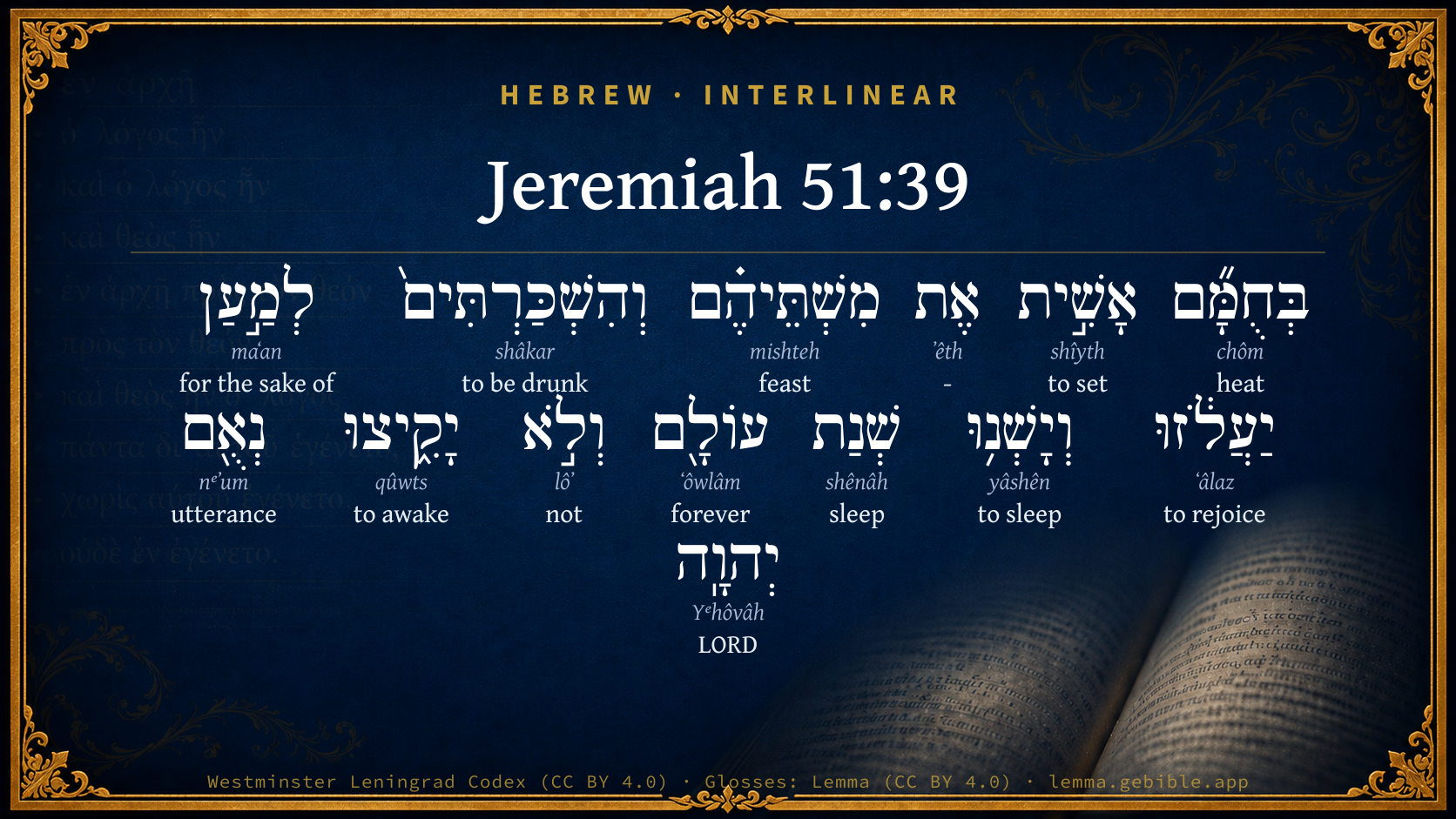
Hebrew (Westminster Leningrad Codex) Jeremiah 51:39 appears in the Hebrew Old Testament. The text above is from the Westminster Leningrad Codex. Each word links to its Strong’s number, a concise gloss, and parsing drawn from the Open Scriptures Hebrew Bible morphology. Click any word for its full Brown-Driver-Briggs (BDB) entry.
Download image
Cite this verse

Jeremiah 51:39 (World English Bible). Public Domain. Lemma interlinear Bible study tool, https://lemma.gebible.app/v/jeremiah/51/39.

Show BibTeX & RIS
BibTeX
RIS
English Translation
When they are heated, I will make their feast, and I will make them drunken, that they may rejoice, and sleep a perpetual sleep, and not wake, says Yahweh.
World English Bible · Public Domain
Download a study sheet

One document with this verse’s original text, its word-by-word gloss line, the meaning frame, cross-references with their text, attributed commentary, and full source and license credits — printable, and it pastes into notes with its structure intact.

This verse Autodidact and up

Study sheet (.html) Plain text (.txt)

A passage Seminary Student

Up to 50 verses in one chapter. A passage sheet keeps up to 6 commentary sources and 12 cross-references per verse, in the order this page ranks them, and says so on the sheet whenever that leaves anything out. Ask for a single verse and you get the Autodidact verse sheet above.

Everything on this page stays free to read, with no account — the sheet is a download of what is already on screen, not access to it.

Want to remove ads? Support Godless Engineer
Compare translations 3

The same verse in 3 English versions, stacked beneath the original-language interlinear above. Click any original word for its lexicon entry.

Each is an independent rendering of the whole verse — the interlinear is not word-aligned to these translations.

Highlighted words mark where these versions differ — a whole-verse word diff, not a word-by-word alignment.

  • World English Bible Public Domain
    When they are heated, I will make their feast, and I will make them drunken, that they may rejoice, and sleep a perpetual sleep, and not wake, says Yahweh.
  • King James Version Public Domain
    In their heat I will make their feasts, and I will make them drunken, that they may rejoice, and sleep a perpetual sleep, and not wake, saith the LORD.
  • unfoldingWord Literal Text CC BY-SA 4.0
    When they become hot with greed, I will make a feast for them; I will make them drunk so they become happy, and then sleep an unending sleep and not wake up—this is Yahweh’s declaration—

unfoldingWord Literal Text — © unfoldingWord, licensed CC BY-SA 4.0. Word-aligned USFM3 via Door43 (git.door43.org/unfoldingWord/en_ult).

Versions to compare (up to 4)

3 of 4 selected

Show all 18 translations

Every available English version of this verse, each an independent rendering of the whole verse.

  • World English Bible Public Domain
    When they are heated, I will make their feast, and I will make them drunken, that they may rejoice, and sleep a perpetual sleep, and not wake, says Yahweh.
  • Berean Standard Bible Public Domain
    While they are flushed with heat, I will serve them a feast, and I will make them drunk so that they may revel; then they will fall asleep forever and never wake up, declares the LORD.
  • Majority Standard Bible Public Domain
    While they are flushed with heat, I will serve them a feast, and I will make them drunk so that they may revel; then they will fall asleep forever and never wake up, declares the LORD.
  • King James Version Public Domain
    In their heat I will make their feasts, and I will make them drunken, that they may rejoice, and sleep a perpetual sleep, and not wake, saith the LORD.
  • American Standard Version (1901) Public Domain
    When they are heated, I will make their feast, and I will make them drunken, that they may rejoice, and sleep a perpetual sleep, and not wake, saith Jehovah.
  • Revised Version (1885) Public Domain
    When they are heated, I will make their feast, and I will make them drunken, that they may rejoice, and sleep a perpetual sleep, and not wake, saith the LORD.
  • Geneva Bible (1599) Public Domain
    In their heate I will make them feastes, and I wil make them drunken, that they may reioyce, and sleepe a perpetual sleepe, and not wake, sayth the Lord.
  • Douay-Rheims (1899) Public Domain
    In their heat I will set them drink: and I will make them drunk, that they may slumber, and sleep an everlasting sleep, and awake no more, saith the Lord.
  • Young's Literal Translation Public Domain
    In their heat I make their banquets, And I have caused them to drink, so that they exult, And have slept a sleep age-during, And awake not -- an affirmation of Jehovah.
  • Literal Standard Version CC BY-SA 4.0
    In their heat I make their banquets, || And I have caused them to drink, so that they exult, || And have slept a continuous sleep, || And do not awaken,” a declaration of YHWH.
  • Unlocked Literal Bible CC BY-SA 4.0
    When they become hot with greed, I will make a feast for them; I will make them drunk so they become happy, and then sleep an unending sleep and not wake up—this is Yahweh's declaration—
  • unfoldingWord Literal Text CC BY-SA 4.0
    When they become hot with greed, I will make a feast for them; I will make them drunk so they become happy, and then sleep an unending sleep and not wake up—this is Yahweh’s declaration—
  • Darby Bible Public Domain
    When they are heated, I will prepare their drink, and I will make them drunken, that they may exult, and sleep a perpetual sleep, and not wake, saith Jehovah.
  • World Messianic Bible Public Domain
    When they are inflamed, I will make their feast, and I will make them drunk, that they may rejoice, and sleep a perpetual sleep, and not wake up,” says the LORD.
  • Webster's Bible Public Domain
    In their heat I will make their feasts, and I will make them drunken, that they may rejoice, and sleep a perpetual sleep, and not wake, saith the LORD.
  • Free Bible Version CC BY-SA 4.0
    But while their passions are aroused, I will serve them a banquet and get them drunk. They'll celebrate so much that they'll pass out and won't ever wake up, declares the Lord.
  • Bible in Basic English Public Domain
    When they are heated, I will make a feast for them, and overcome them with wine, so that they may become unconscious, sleeping an eternal sleep without awaking, says the Lord.
  • JPS Tanakh (1917) Public Domain
    With their poison I will prepare their feast, and I will make them drunken, that they may be convulsed, and sleep a perpetual sleep, and not wake, saith the LORD.

Literal Standard Version (2020), Covenant Press — licensed CC BY-SA 4.0. Text via the HelloAO Bible API (eBible.org). Unlocked Literal Bible (unfoldingWord) — licensed CC BY-SA 4.0. Text via the HelloAO Bible API (eBible.org). unfoldingWord Literal Text — © unfoldingWord, licensed CC BY-SA 4.0. Word-aligned USFM3 via Door43 (git.door43.org/unfoldingWord/en_ult). Free Bible Version, Dr. Jonathan Gallagher — licensed CC BY-SA 4.0. Text via the HelloAO Bible API (eBible.org).

Word by word

More ways to search: Search by grammar → Find every occurrence → Compare this word →

Practice this passage: Drill this verse → Learn its vocabulary →

בְּחֻמָּ֞ם
chôm
H2527
“in/at · heat · them”
Preposition + Verb, Qal, Infinitive Construct + Suffix, Personal, 3rd Person, Masculine, Plural
Part of Speech
Preposition + Verb
Stem
Qal
Form
Infinitive Construct
Full BDB Definition

Origin: from H2552

TWOT: 677a

heat, hot
  1. אָשִׁ֣ית shîyth H7896 “to set” Verb, Qal, Imperfect, 1st Person, Common, Singular
  2. אֶת ʼêth H853 “-” Particle, Direct Object
  3. מִשְׁתֵּיהֶ֗ם mishteh H4960 “feast · their” Noun, Common, Masculine, Singular, Construct + Suffix, Personal, 3rd Person, Masculine, Plural
  4. וְהִשְׁכַּרְתִּים֙ shâkar H7937 “and · to be drunk · them” Conjunction + Verb, Hiphil, Sequential Perfect, 1st Person, Common, Singular + Suffix, Personal, 3rd Person, Masculine, Plural
  5. לְמַ֣עַן maʻan H4616 “for the sake of” Preposition
  6. יַעֲלֹ֔זוּ ʻâlaz H5937 “to rejoice” Verb, Qal, Imperfect, 3rd Person, Masculine, Plural
  7. וְיָשְׁנ֥וּ yâshên H3462 “and · to sleep” Conjunction + Verb, Qal, Sequential Perfect, 3rd Person, Common, Plural
  8. שְׁנַת shênâh H8142 “sleep of” Noun, Common, Feminine, Singular, Construct
  9. עוֹלָ֖ם ʻôwlâm H5769 “forever” Noun, Common, Masculine, Singular, Absolute
  10. וְלֹ֣א lôʼ H3808 “and · not” Conjunction + Particle, Negative
  11. יָקִ֑יצוּ qûwts H6974 “to awake” Verb, Hiphil, Imperfect, 3rd Person, Masculine, Plural
  12. נְאֻ֖ם nᵉʼum H5002 “utterance of” Noun, Common, Masculine, Singular, Construct
  13. יְהוָֽה Yᵉhôvâh H3068 “LORD” Noun, Proper

About this verse

These counts appear in no published source. They are computed here, from the morphology-tagged text and Lemma’s own curated glosses. What Lemma adds →

14
words
14
distinct lemmas
Prophets
section

Notable vocabulary

The rarest word here is בְּחֻמָּ֞ם heat H2527 — appearing just 15 times in the whole Hebrew Bible.

Shared distinctive vocabulary

בְּחֻמָּ֞ם heat H2527 occurs in 13 verses of the Hebrew Bible. Also found in:

Grammatical profile

  • 6 verbs
  • 5 nouns
  • 1 preposition
  • 2 particles

Verb forms

  • בְּחֻמָּ֞ם Qal · Infinitive Construct
  • אָשִׁ֣ית Qal · Imperfect
  • וְהִשְׁכַּרְתִּים֙ Hiphil · Sequential Perfect
  • יַעֲלֹ֔זוּ Qal · Imperfect
  • וְיָשְׁנ֥וּ Qal · Sequential Perfect
  • יָקִ֑יצוּ Hiphil · Imperfect

Cross-references

11

Topical passages linked to Jeremiah 51:39 in the Treasury of Scripture Knowledge — connected by theme and wording, ordered by reader-vote popularity; previews shown in the World English Bible.

  • Jeremiah 51:57 I will make drunk her princes and her wise men, her governors and her deputies, and her mighty men; and they shall sleep a perpetual sleep, and not wake up, says the King, whose name is Yahweh of Hosts.
  • Jeremiah 25:27 You shall tell them, Thus says Yahweh of Hosts, the God of Israel: Drink you, and be drunken, and spew, and fall, and rise no more, because of the sword which I will send among you.
  • Isaiah 22:12–14 In that day did the Lord, Yahweh of Hosts, call to weeping, and to mourning, and to baldness, and to girding with sackcloth:
  • Nahum 1:10 For entangled like thorns, and drunken as with their drink, they are consumed utterly like dry stubble.
  • Nahum 3:11 You also will be drunken. You will be hidden. You also will seek a stronghold because of the enemy.
  • Psalms 13:3 Behold, and answer me, Yahweh, my God. Give light to my eyes, lest I sleep in death;
  • Psalms 76:5–6 Valiant men lie plundered, They have slept their last sleep. None of the men of war can lift their hands.
  • Isaiah 21:4–5 My heart flutters, horror has frightened me; the twilight that I desired has been turned into trembling to me.
  • Jeremiah 48:26 Make you him drunken; for he magnified himself against Yahweh: and Moab shall wallow in his vomit, and he also shall be in derision.
  • Daniel 5:1–4 Belshazzar the king made a great feast to a thousand of his lords, and drank wine before the thousand.
  • Daniel 5:30 In that night Belshazzar the Chaldean King was slain.

Cross-references courtesy of OpenBible.info (CC BY 4.0).

Hebrew and Greek witnesses Masoretic Hebrew ↔ Greek Septuagint

The same verse in the two great witnesses to the Old Testament, shown verse-for-verse.

These are two independent witnesses, not word-aligned to each other, and the Septuagint is shown in lemma (dictionary) form.

Hebrew Jeremiah 51:39 Masoretic · Westminster Leningrad Codex

בְּחֻמָּ֞ם אָשִׁ֣ית אֶת מִשְׁתֵּיהֶ֗ם וְהִשְׁכַּרְתִּים֙ לְמַ֣עַן יַעֲלֹ֔זוּ וְיָשְׁנ֥וּ שְׁנַת עוֹלָ֖ם וְלֹ֣א יָקִ֑יצוּ נְאֻ֖ם יְהוָֽה

When they are heated, I will make their feast, and I will make them drunken, that they may rejoice, and sleep a perpetual sleep, and not wake, says Yahweh.

World English Bible · Public Domain

Greek LXX Structure differs

In the Septuagint, Jeremiah is about an eighth shorter than the Hebrew and arranges its material differently — the Oracles Against the Nations (Hebrew chapters 46–51) appear in the middle of the Greek book, after 25:13. Because the chapter and verse boundaries do not line up, a verse-for-verse comparison with the Hebrew is not shown.

A verse-for-verse comparison isn’t shown here because the chapters and verses don’t line up. Switch to the LXX edition with the MT / LXX toggle above to read the Greek directly.

On this verse, The Cambridge Bible for Schools and Colleges discusses the Septuagint’s reading. Read the note in Commentary ↓

Hebrew: Westminster Leningrad Codex (CC BY 4.0). Greek: Septuagint (public domain); English from a public-domain English Septuagint. How the Septuagint differs from the Hebrew →

Targum (Aramaic paraphrase)

1

The Targum is the ancient Jewish Aramaic paraphrase of the Hebrew Scriptures — an interpretive translation, not the Hebrew text itself. Onkelos (literal) and Pseudo-Jonathan (expansive) render the Torah, and Jonathan the Prophets. Coverage is partial: where no permissively-licensed English translation exists for a verse, only the Aramaic is shown. This is verse-level text, not a word-by-word alignment to the Hebrew.

  1. Targum Jonathan Prophets (Joshua–Malachi)
    אַיְתָא עֲלֵיהוֹן עָקָא וִיהוֹן דָמָן לְרַוְיָא בְּדִיל דְלָא יְהוֹן תַּקִיפִין וִימוּתוּן מוֹתָא תִנְיָינָא וְלָא יֵחוּן לְעַלְמָא דְאָתֵי אֲמַר יְיָ:

    (no public-domain English translation for this verse)

    Targum Jonathan — Aramaic: “Mikraot Gedolot” (public domain). English: “Sefaria Community Translation” (CC0 1.0 (public-domain dedication)); “London "Chaldee Paraphrase," 1871” (public domain). Text via Sefaria.

Commentary

Notes on Jeremiah 51:39 from classic Christian and Jewish commentators (each source and its license shown beneath its notes). The classic Christian expositions comment on the surrounding passage and are grouped to its opening verse, so a note may address several verses; the Jewish commentaries on the Tanakh (Rashi and others) are per-verse, so they appear only where the commentator wrote on this verse.

Lemma curates 59 commentaries, every one of them public domain or Creative Commons licensed, each selected and text-cleaned for this edition rather than reprinted as found. About our sources →

Trapp's Complete Commentary

John Trapp

Jer 51:39 In their heat I will make their feasts, and I will make them drunken, that they may rejoice, and sleep a perpetual sleep, and not wake, saith the LORD.

Ver. 39. In their heat I will make their feasts.] Or, I will dispose their drinkings - that is, I will pour into their cups the wine of my wrath. Now, poison mixed with wine worketh the more furiously. God can punish one kind of drunkenness with another worse.

That they may rejoice.] That they may revel it and sleep their last; and so they did, as being slain in a night of public solemn feasting and great dissoluteness, which was soon turned in moerorem et metum, into heaviness and horror. Ecce, hic compotationum est finis. Behold this is the end of the party.

And not wake.] Till awakened by the sound of the last trump. The Chaldee here hath it, They shall die the second death, and not be quickened in the world to come - sc., unto life everlasting.

John Trapp, A Commentary or Exposition upon All the Books of the Old and New Testament (1647–1656) — public domain. Text from a community e-Sword module.

Geneva Bible (1599)

Geneva Bible translators

When they are inflamed with surfeiting and drinking, I will feast with them, alluding to Belshazzar’s banquet, Dan. 5:2.

Geneva Bible (1599) marginal notes — public domain. Text via Bolls.life.

Jamieson, Fausset & Brown

Robert Jamieson, A. R. Fausset & David Brown

In their heat I will make their feasts--In the midst of their being heated with wine, I will give them "their" potions,--a very different cup to drink, but one which is their due, the wine cup of My stupefying wrath (Jer 25:15; Jer 49:12; Isa 51:17; Lam 4:21).

rejoice, and sleep . . . perpetual, &c.--that they may exult, and in the midst of their jubilant exultation sleep the sleep of death (Jer 51:57; Isa 21:4-5).

Jamieson, Fausset & Brown — Commentary Critical and Explanatory on the Whole Bible (1871) — public domain (CC PDM 1.0). Text via the HelloAO Bible API.

Adam Clarke's Commentary

Verse 39. In their heat I will make their feasts] It was on the night of a feast day, while their hearts were heated with wine and revelry, that Babylon was taken; see Da 5:1-3. This feast was held in honour of the goddess Sheshach, (or perhaps of Bel,) who is mentioned, Jer 51:41, as being taken with her worshippers. As it was in the night the city was taken, many had retired to rest, and never awoke; slain in their beds, they slept a perpetual sleep.

Adam Clarke's Commentary on the Bible (1810–1826) — public domain. Text from a community e-Sword/MySword module.

John Calvin's Commentaries

Here, also, he describes the manner in which Babylon was taken. And hence we learn, that the Prophet did not speak darkly or ambiguously, but so showed, as it were by the finger, the judgment of God, that the prophecy might be known by posterity, in order that they might understand that God’s Spirit had revealed these things by the mouth of the Prophet: for no mortal, had he been a hundred times endowed with the spirit of divination, could ever have thus clearly expressed a thing unknown. But as nothing is past or future with God, he thus plainly spoke of the destruction of Babylon by his Prophet, that posterity, confirmed by the event, might acknowledge him to have been, of a certainty, the instrument of the Holy Spirit. And Daniel afterwards sealed the prophecy of Jeremiah, when he historically related what had taken place; nay, God extorted from heathen writers a confession, so that they became witnesses to the truth of prophecy. Though Xenophon was not, indeed, by design a witness to Jeremiah, yet that unprincipled writer, whose object was flattery, did, notwithstanding, render service for God, and sealed, by a public testimony, what had been divinely predicted by Jeremiah.

In their heat, he says, I will make their feasts, that is, I will make them hot in their feasts; for when the king of Babylon was drunk, he was slain, together with his princes and counselors. I will inebriate them that they may exult, that is, that they may become wanton. This refers to their sottishness, for they thought that they should be always safe, and ridiculed Cyrus for suffering so many hardships. For he lived in tents, and the siege had been now long, and there was no want in the city. Thus, then, their wantonness destroyed them. And hence the Prophet says that God would make them hot, that they might become wanton in their pleasures; and then, that they might sleep a perpetual sleep, that is, that they might perish in their luxury: though they had despised their enemy, yet they should never awake; for Babylon, as we observed yesterday, might have resisted for a long time, but it was at once taken. The Babylonians were not afterwards allowed to have arms. Cyrus, indeed, suffered them to indulge in pleasures, but took away from them the use of arms, deprived them of all authority, so that they lived in a servile state, in the greatest degradation: and then, in course of time, they became more and more contemptible, until at length the city was so overthrown, that nothing remained but a few cottages, and it became a mean village. We hence see that whatever God had predicted by his servant Jeremiah was at length fulfilled, but at the appropriate time, — at the time of treading or threshing, as it has been stated. It follows, —

John Calvin's Commentaries (1540-1563) — public domain. Text from the Calvin Translation Society English edition (1840s-50s) via the Christian Classics Ethereal Library (ccel.org). Calvin's coverage is partial (roughly two-thirds of the Bible); uncommented books and verses are honest gaps, never fabricated. The 19th-century editor's footnotes and remarks are omitted so the notes are faithfully Calvin's own voice.

Ellicott's Commentary for English Readers

(39) In their heat I will make their feasts . . .—The words are stern and bitter in their irony. When the revellers are hot with wine and lust (comp. Hos_7:4-7) Jehovah would call them to a banquet of another kind. The wine cup which He would give them would be that of His wrath (Jer_25:16-17), and their drunken joy should end in an eternal sleep. So Herodotus (i. 191) narrates that when Cyrus took the city by his stratagem the inhabitants were keeping a feast with their wonted revelry and license. (Compare Xenoph. Cyropœd. vii. 23.)

A Bible Commentary for English Readers, edited by Charles John Ellicott (1878–1897) — public domain. Text from a community e-Sword module.

The Cambridge Bible for Schools and Colleges

gen. ed. J. J. S. Perowne

39. While they are exulting over the spoil which they have won from the conquered nations I will prepare a feast for them, inducing a sleep that shall be endless.

When they are heated] referring either to the glow of passionate indulgence, or to murderous ferocity. But Gi. would read When I am hot (with anger).

may rejoice] The LXX, reading apparently one consonant differently from MT., render, may be stupefied.

The Cambridge Bible for Schools and Colleges (gen. ed. J. J. S. Perowne; Cambridge University Press, 1878–1918) — public domain. Text from a community e-Sword module.

John Gill's Exposition

How is Sheshach taken!.... Not the city Shushan, as Sir John Marsham thinks (e); but Babylon, as is plain from a following clause; and so the Targum,

"how is Babylon subdued!''

called Sheshach, by a position and commutation of letters the Jews call "athbash"; so Jarchi, Kimchi, and Abarbinel account for it; or else from their idol Shach, the same with Bel, which was worshipped here, and had a temple erected for it; and where an annual feast was kept in honour of it, called the Sacchean feast; and which was observing the very time the city was taken; and may be the true reason of its having this name given it now; See Gill on Jer 25:26; the taking of which was very wonderful; and therefore this question is put by way of admiration; it being so well fortified and provided to hold out a long siege:

and how is the praise of the whole earth surprised? for it was taken by stratagem and surprise, before the king and his guards, the army, and the inhabitants of it, were aware; that city, which was matter and occasion of praise to all the world, and went through it; for the compass of it, and height and strength of its walls; the river Euphrates that ran through it, and flowed about it; the temple, palaces, and gardens in it:

how is Babylon become an astonishment among the nations! or, "a desolation"; and indeed its being a desolation was the reason of its being an astonishment among the nations; who were amazed to see so strong, rich, and splendid a city brought to ruin in a very short time.

(e) Canon. Chron. p. 607.

John Gill's Exposition of the Whole Bible (1746–1763) — public domain (CC PDM 1.0). Text via the HelloAO Bible API.

Albert Barnes' Notes on the Bible

In their heat ... - While, like so many young lions, they are in the full glow of excitement over their prey, God prepares for them a drinking-bout to end in the sleep of death. Compare Dan 5:1.

Albert Barnes' Notes on the Bible (1834–1885) — public domain. Text from a community e-Sword/MySword module.

Matthew Poole's English Annotations

When they shall grow hot with wine, I will put, or give, or make them a feast of another nature. Interpreters judge that the prophet referreth to the feast made by Belshazzar, Dan 5:1,

to a thousand of his lords, when he and his wives and concubines drank wine in the vessels belonging to the temple, during which feast the city was taken. So they were made drunk with the wine cup of God’s fury, because the Lord had designed them to utter ruin and destruction, that as men filled with wine are merry, and shout, and then fall asleep; so the Chaldeans being drunk with the wine of the Lord’s wrath, while they were merry with their cups of wine, might fall into such a sleep as they should never awake out of.

Matthew Poole's English Annotations on the Holy Bible (1683–1685) — public domain. Text from a community e-Sword/MySword module.

John Wesley's Explanatory Notes

Heat - When they shall grow hot with wine, I will make them a feast of another nature. Interpreters judge that Belshazzar, Dan. v, 1, made a feast to a thousand of his Lords, when he and his wives, and concubines, drank wine in the vessels belonging to the temple, during which feast the city was taken. And not awake - While they were merry with their wine, they fell into a sleep which they never awoke out of.

John Wesley, Explanatory Notes Upon the Whole Bible (1754–1765) — public domain. Text via the GEBible commentary corpus.

Rashi

Rabbi Shlomo Yitzchaki (Rashi)

in their heat, I will place their wine feasts I will intend that their wine feasts shall be in the hot season so that they become drunk.

in order that they become joyful and sleep Heb. וישנו, and sleep soundly.

a perpetual sleep Heb. שנתעולם, a perpetual sleep, and so it happened to them; out of their wine feast and drunkenness they were destroyed and slain, and the city was captured, as it is written in Daniel (5:2): “Belshazzar said while he tasted the wine, etc.”; (5:4), “They drank wine, etc.”; (5: 30), “On that night, Belshazzar, the king of the Chaldeans, was slain”; (6:1), “And Darius the Mede received the kingship.”

Rashi on the Tanakh — English translations: “The Judaica Press complete Tanach with Rashi, translated by A. J. Rosenberg” (CC BY 4.0); “Pentateuch with Rashi's commentary by M. Rosenbaum and A.M. Silbermann, 1929-1934” (public domain); “The Metsudah Tanach series, Lakewood, N.J” (CC BY 4.0); and “The Book of Joshua, Metsudah Publications, 1997” (CC BY 4.0). Text via Sefaria.

Lesson kit

Teaching starters — assembled from the data on this page, not authored interpretation. Every prompt links to the verse data it draws on. Edit before teaching.

Jeremiah, in the Prophets, opens this verse with 14 words (14 distinct Hebrew lemmas). Its most distinctive word is chôm (“heat”). A historical commentator’s framing appears above. Read the whole chapter for the surrounding context.

Discussion questions

  1. How does “heat” (chôm) shape what this verse is saying?
  2. How does Genesis 8:22, which shares the word «heat», read alongside this verse?
  3. These translations render this verse differently; the difference is in the English rendering, not the original. What questions does that raise?
  4. «בְּחֻמָּ֞ם» is a Qal Infinitive Construct verb. How does that grammatical form shape the action described?
  5. Compare how Trapp's Complete Commentary and Geneva Bible (1599) read this verse. Where do they agree or differ?

Things to notice

Reading settings

Reading text

Shown beneath each verse's original-language words.

Old Testament
Old Testament edition

Read the OT as the Masoretic Hebrew (MT) or the Greek Septuagint (LXX).

English shown for the Greek Septuagint (in the Hebrew ↔ Greek comparison).

Comparing translations? Open the Compare panel on any verse page to stack up to four side by side.