
Hosea 2:3

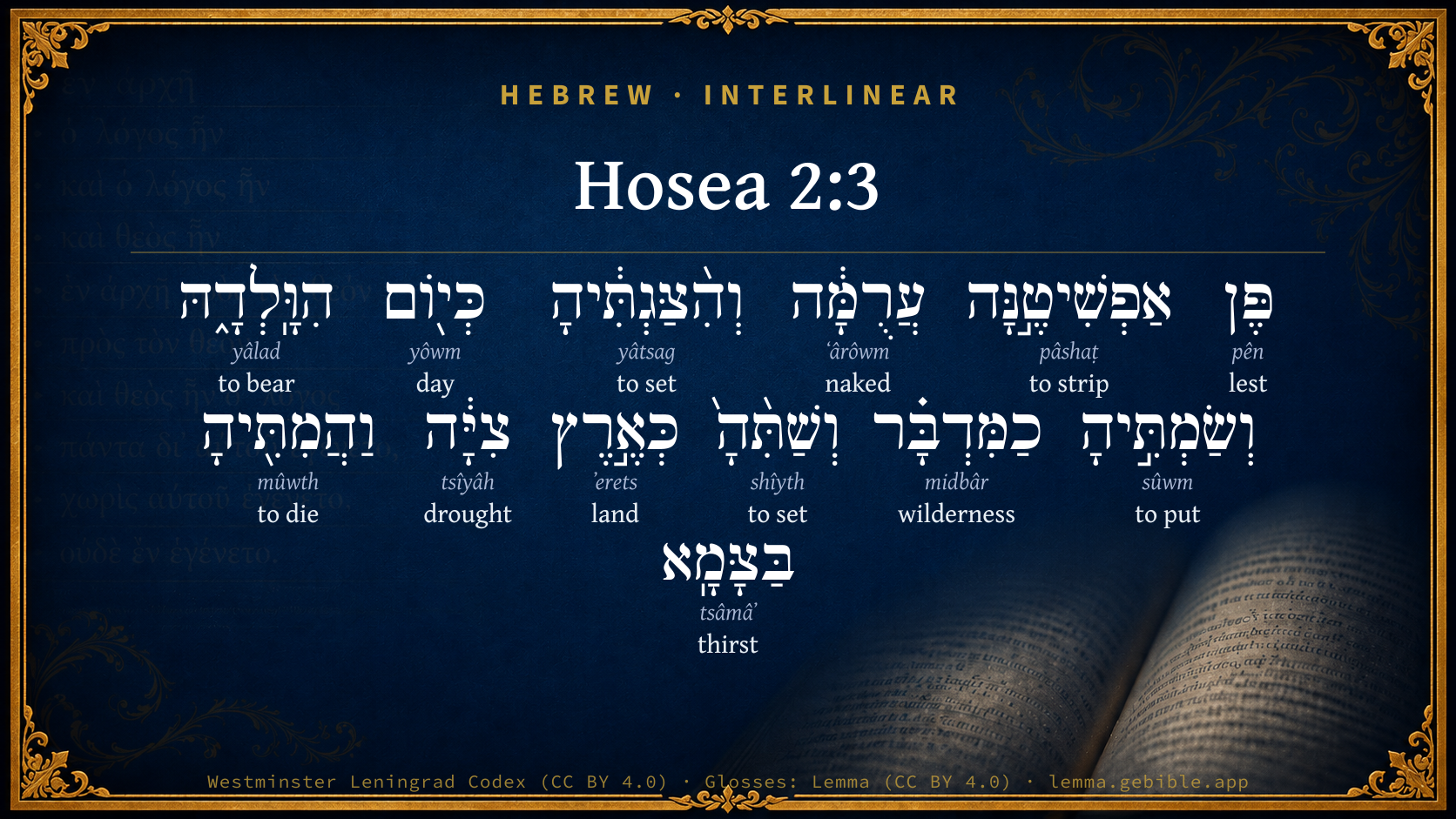
Hebrew (Westminster Leningrad Codex) Hosea 2:3 appears in the Hebrew Old Testament. The text above is from the Westminster Leningrad Codex. Each word links to its Strong’s number, a concise gloss, and parsing drawn from the Open Scriptures Hebrew Bible morphology. Click any word for its full Brown-Driver-Briggs (BDB) entry.
Download image
Cite this verse

Hosea 2:3 (World English Bible). Public Domain. Lemma interlinear Bible study tool, https://lemma.gebible.app/v/hosea/2/3.

Show BibTeX & RIS
BibTeX
RIS
English Translation
Lest I strip her naked, And make her bare as in the day that she was born, And make her like a wilderness, And set her like a dry land, And kill her with thirst.
World English Bible · Public Domain
Download a study sheet

One document with this verse’s original text, its word-by-word gloss line, the meaning frame, cross-references with their text, attributed commentary, and full source and license credits — printable, and it pastes into notes with its structure intact.

This verse Autodidact and up

Study sheet (.html) Plain text (.txt)

A passage Seminary Student

Up to 50 verses in one chapter. A passage sheet keeps up to 6 commentary sources and 12 cross-references per verse, in the order this page ranks them, and says so on the sheet whenever that leaves anything out. Ask for a single verse and you get the Autodidact verse sheet above.

Everything on this page stays free to read, with no account — the sheet is a download of what is already on screen, not access to it.

Want to remove ads? Support Godless Engineer
Compare translations 3

The same verse in 3 English versions, stacked beneath the original-language interlinear above. Click any original word for its lexicon entry.

Each is an independent rendering of the whole verse — the interlinear is not word-aligned to these translations.

Highlighted words mark where these versions differ — a whole-verse word diff, not a word-by-word alignment.

  • World English Bible Public Domain
    Lest I strip her naked, And make her bare as in the day that she was born, And make her like a wilderness, And set her like a dry land, And kill her with thirst.
  • King James Version Public Domain
    Lest I strip her naked, and set her as in the day that she was born, and make her as a wilderness, and set her like a dry land, and slay her with thirst.
  • unfoldingWord Literal Text CC BY-SA 4.0
    lest I strip her naked, and place her as the day of her being born, and I make her like the wilderness, and set her like a land of dryness, and I kill her with the thirst.

unfoldingWord Literal Text — © unfoldingWord, licensed CC BY-SA 4.0. Word-aligned USFM3 via Door43 (git.door43.org/unfoldingWord/en_ult).

Versions to compare (up to 4)

3 of 4 selected

Show all 18 translations

Every available English version of this verse, each an independent rendering of the whole verse.

  • World English Bible Public Domain
    Lest I strip her naked, And make her bare as in the day that she was born, And make her like a wilderness, And set her like a dry land, And kill her with thirst.
  • Berean Standard Bible Public Domain
    Otherwise, I will strip her naked and expose her like the day of her birth. I will make her like a desert and turn her into a parched land, and I will let her die of thirst.
  • Majority Standard Bible Public Domain
    Otherwise, I will strip her naked and expose her like the day of her birth. I will make her like a desert and turn her into a parched land, and I will let her die of thirst.
  • King James Version Public Domain
    Lest I strip her naked, and set her as in the day that she was born, and make her as a wilderness, and set her like a dry land, and slay her with thirst.
  • American Standard Version (1901) Public Domain
    lest I strip her naked, and set her as in the day that she was born, and make her as a wilderness, and set her like a dry land, and slay her with thirst.
  • Revised Version (1885) Public Domain
    lest I strip her naked, and set her as in the day that she was born, and make her as a wilderness, and set her like a dry land, and slay her with thirst;
  • Geneva Bible (1599) Public Domain
    Lest I strippe her naked, and set her as in the day that shee was borne, and make her as a wildernes, and leaue her like a drie land, and slaie her for thirst.
  • Douay-Rheims (1899) Public Domain
    Lest I strip her naked, and set her as in the day that she was born: and I will make her as a wilderness, and will set her as a land that none can pass through, and will kill her with drought.
  • Young's Literal Translation Public Domain
    Lest I strip her naked. And have set her up as `in' the day of her birth, And have made her as a wilderness, And have set her as a dry land, And have put her to death with thirst.
  • Literal Standard Version CC BY-SA 4.0
    Lest I strip her naked. And have set her up as [in] the day of her birth, || And have made her as a wilderness, || And have set her as a dry land, || And have put her to death with thirst.
  • Unlocked Literal Bible CC BY-SA 4.0
    If not, I will strip her naked and show her nakedness as on the day that she was born. I will make her like the wilderness, like a parched land, and I will make her die from thirst.
  • unfoldingWord Literal Text CC BY-SA 4.0
    lest I strip her naked, and place her as the day of her being born, and I make her like the wilderness, and set her like a land of dryness, and I kill her with the thirst.
  • Darby Bible Public Domain
    lest I strip her naked, and set her as in the day that she was born, and make her as a wilderness, and set her as a dry land, and slay her with thirst.
  • World Messianic Bible Public Domain
    lest I strip her naked, and make her bare as in the day that she was born, and make her like a wilderness, and set her like a dry land, and kill her with thirst.
  • Webster's Bible Public Domain
    Lest I strip her naked, and set her as in the day that she was born, and make her as a wilderness, and set her like a dry land, and kill her with thirst.
  • Free Bible Version CC BY-SA 4.0
    Otherwise I will strip her naked as the day she was born, and make her like a desert, a barren land, and let her die of thirst.
  • Bible in Basic English Public Domain
    For fear that I may take away her robe from her, making her uncovered as in the day of her birth; making her like a waste place and a dry land, causing her death through need of water.
  • JPS Tanakh (1917) Public Domain
    (2-5) Lest I strip her naked, and set her as in the day that she was born, and make her as a wilderness, and set her like a dry land, and slay her with thirst.

Literal Standard Version (2020), Covenant Press — licensed CC BY-SA 4.0. Text via the HelloAO Bible API (eBible.org). Unlocked Literal Bible (unfoldingWord) — licensed CC BY-SA 4.0. Text via the HelloAO Bible API (eBible.org). unfoldingWord Literal Text — © unfoldingWord, licensed CC BY-SA 4.0. Word-aligned USFM3 via Door43 (git.door43.org/unfoldingWord/en_ult). Free Bible Version, Dr. Jonathan Gallagher — licensed CC BY-SA 4.0. Text via the HelloAO Bible API (eBible.org).

Word by word

More ways to search: Search by grammar → Find every occurrence → Compare this word →

Practice this passage: Drill this verse → Learn its vocabulary →

עֲרֻמָּ֔ה
ʻârôwm
H6174
“naked”
Adjective, Adjective, Feminine, Singular, Absolute
Part of Speech
Adjective
Type
Adjective
Gender
Feminine
Number
Singular
State
Absolute
Full BDB Definition

Origin: from H6191 (in its original sense)

TWOT: 1588c

naked, bare
  1. פֶּן pên H6435 “lest” Conjunction
  2. אַפְשִׁיטֶ֣נָּה pâshaṭ H6584 “to strip · her” Verb, Hiphil, Imperfect, 1st Person, Common, Singular + Suffix, Personal, 3rd Person, Feminine, Singular
  3. וְהִ֨צַּגְתִּ֔יהָ yâtsag H3322 “and · to set · her” Conjunction + Verb, Hiphil, Sequential Perfect, 1st Person, Common, Singular + Suffix, Personal, 3rd Person, Feminine, Singular
  4. כְּי֖וֹם yôwm H3117 “like/as · day of” Preposition + Noun, Common, Masculine, Singular, Construct
  5. הִוָּֽלְדָ֑הּ yâlad H3205 “to bear · her” Verb, Niphal, Infinitive Construct + Suffix, Personal, 3rd Person, Feminine, Singular
  6. וְשַׂמְתִּ֣יהָ sûwm H7760 “and · to put · her” Conjunction + Verb, Qal, Perfect, 1st Person, Common, Singular + Suffix, Personal, 3rd Person, Feminine, Singular
  7. כַמִּדְבָּ֗ר midbâr H4057 “like/as the · wilderness” Preposition, Determined + Noun, Common, Masculine, Singular, Absolute
  8. וְשַׁתִּ֨הָ֙ shîyth H7896 “and · to set · her” Conjunction + Verb, Qal, Sequential Perfect, 1st Person, Common, Singular + Suffix, Personal, 3rd Person, Feminine, Singular
  9. כְּאֶ֣רֶץ ʼerets H776 “like/as · land” Preposition + Noun, Common, Both, Singular, Absolute
  10. צִיָּ֔ה tsîyâh H6723 “drought” Noun, Common, Feminine, Singular, Absolute
  11. וַהֲמִתִּ֖יהָ mûwth H4191 “and · to die · her” Conjunction + Verb, Hiphil, Sequential Perfect, 1st Person, Common, Singular + Suffix, Personal, 3rd Person, Feminine, Singular
  12. בַּצָּמָֽא tsâmâʼ H6772 “in/at the · thirst” Preposition, Determined + Noun, Common, Masculine, Singular, Absolute

About this verse

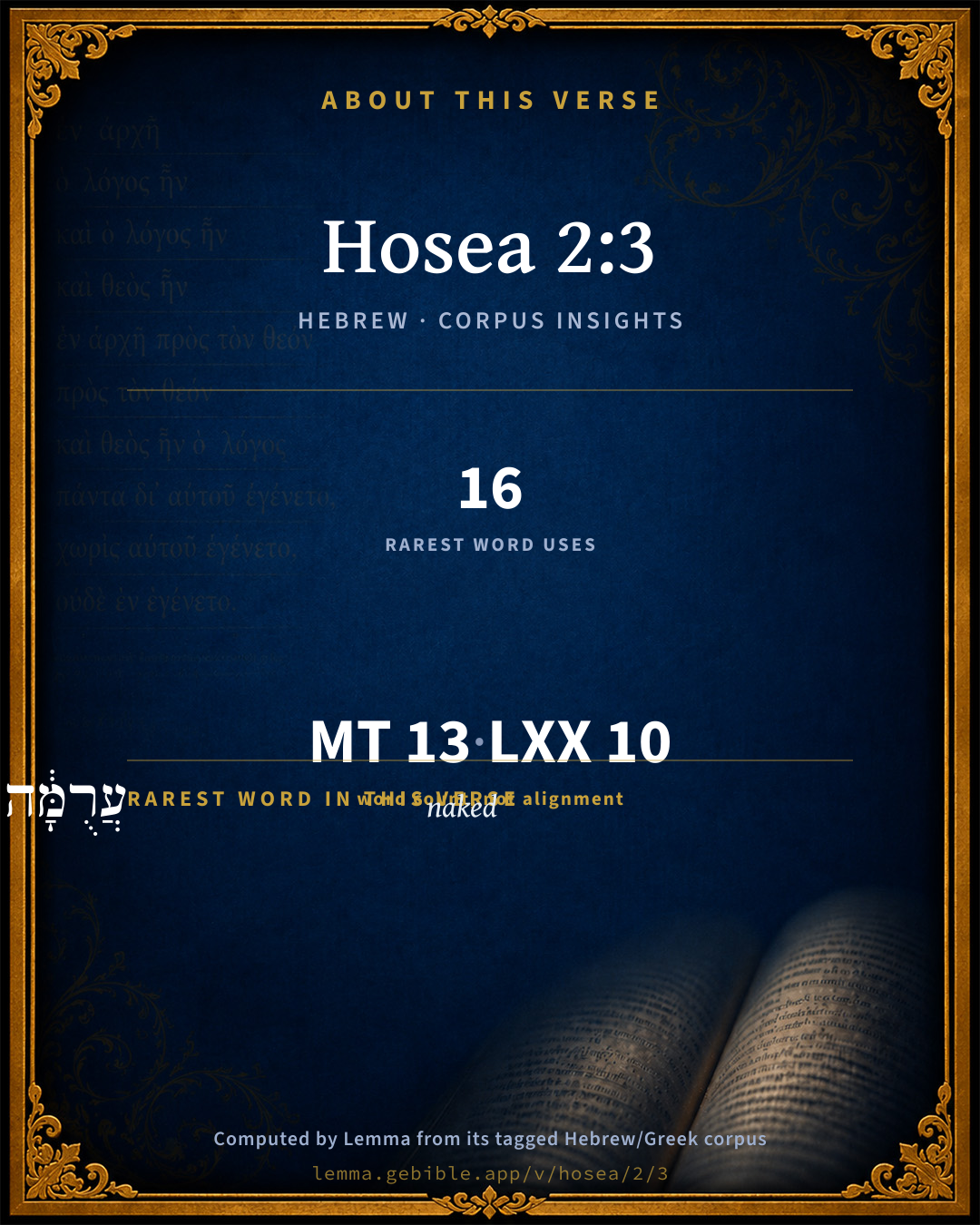
These counts appear in no published source. They are computed here, from the morphology-tagged text and Lemma’s own curated glosses. What Lemma adds →

13
words
13
distinct lemmas
Prophets
section

Notable vocabulary

The rarest word here is עֲרֻמָּ֔ה naked H6174 — appearing just 16 times in the whole Hebrew Bible.

Shared distinctive vocabulary

עֲרֻמָּ֔ה naked H6174 occurs in 15 verses of the Hebrew Bible. Also found in:

Grammatical profile

  • 6 verbs
  • 5 nouns
  • 1 adjective
  • 1 conjunction

Verb forms

  • אַפְשִׁיטֶ֣נָּה Hiphil · Imperfect
  • וְהִ֨צַּגְתִּ֔יהָ Hiphil · Sequential Perfect
  • הִוָּֽלְדָ֑הּ Niphal · Infinitive Construct
  • וְשַׂמְתִּ֣יהָ Qal · Perfect
  • וְשַׁתִּ֨הָ֙ Qal · Sequential Perfect
  • וַהֲמִתִּ֖יהָ Hiphil · Sequential Perfect

Hebrew & Septuagint length

In English translation the verse runs 35 words from the Hebrew and 38 from the Septuagint (LXX English) — closely comparable.

A rough comparison of the two English renderings, which tokenize alike — not a word-level alignment.

Word counts can differ between the Hebrew and the Greek without any difference in meaning — e.g. the Hebrew direct-object marker אֵת has no separate Greek word, and Greek often adds the article ὁ.

In the original languages it is 13 Hebrew tokens and 10 Greek tokens — but the two are counted differently (Hebrew bundles its prefixes and suffixes into one token; the Greek is in lemma form), so that isn’t a like-for-like length.

Cross-references

24

Topical passages linked to Hosea 2:3 in the Treasury of Scripture Knowledge — connected by theme and wording, ordered by reader-vote popularity; previews shown in the World English Bible.

  • Ezekiel 16:22 In all your abominations and your prostitution you have not remembered the days of your youth, when you were naked and bare, and was weltering in your blood.
  • Isaiah 32:13–14 On the land of my people shall come up thorns and briers; yes, on all the houses of joy in the joyous city.
  • Exodus 17:3 The people were thirsty for water there; and the people murmured against Moses, and said, "Why have you brought us up out of Egypt, to kill us, our children, and our livestock with thirst?"
  • Jeremiah 13:22 If you say in your heart, Why are these things come on me? for the greatness of your iniquity are your skirts uncovered, and your heels suffer violence.
  • Ezekiel 19:13 Now it is planted in the wilderness, in a dry and thirsty land.
  • Amos 8:11–13 Behold, the days come," says the Lord Yahweh, "That I will send a famine in the land, Not a famine of bread, Nor a thirst for water, But of hearing the words of Yahweh.
  • Judges 15:18 He was very thirsty, and called on Yahweh, and said, You have given this great deliverance by the hand of your servant; and now shall I die for thirst, and fall into the hand of the uncircumcised.
  • Isaiah 33:9 The land mourns and languishes; Lebanon is confounded and withers away; Sharon is like a desert; and Bashan and Carmel shake off [their leaves].
  • Isaiah 47:3 Your nakedness shall be uncovered, yes, your shame shall be seen: I will take vengeance, and will spare no man.
  • Isaiah 64:10 Your holy cities are become a wilderness, Zion is become a wilderness, Jerusalem a desolation.
  • Jeremiah 2:6 Neither said they, Where is Yahweh who brought us up out of the land of Egypt, who led us through the wilderness, through a land of deserts and of pits, through a land of drought and of the shadow of death, through a land that none passed through, and where no man lived?
  • Jeremiah 2:31 Generation, see the word of Yahweh. Have I been a wilderness to Israel? or a land of thick darkness? why say my people, We are broken loose; we will come no more to you?
  • Jeremiah 4:26 I saw, and, behold, the fruitful field was a wilderness, and all the cities of it were broken down at the presence of Yahweh, [and] before his fierce anger.
  • Jeremiah 12:10 Many shepherds have destroyed my vineyard, they have trodden my portion under foot, they have made my pleasant portion a desolate wilderness.
  • Jeremiah 13:26 Therefore will I also uncover your skirts on your face, and your shame shall appear.
  • Jeremiah 17:6 For he shall be like the heath in the desert, and shall not see when good comes, but shall inhabit the parched places in the wilderness, a salt land and not inhabited.
  • Jeremiah 22:6 For thus says Yahweh concerning the house of the king of Judah: You are Gilead to me, [and] the head of Lebanon; [yet] surely I will make you a wilderness, [and] cities which are not inhabited.
  • Jeremiah 51:43 Her cities are become a desolation, a dry land, and a desert, a land in which no man dwells, neither does any son of man pass thereby.
  • Ezekiel 16:4–8 As for your birth, in the day you were born your navel was not cut, neither were you washed in water to cleanse you; you weren't salted at all, nor swaddled at all.
  • Ezekiel 16:37–39 therefore see, I will gather all your lovers, with whom you have taken pleasure, and all those who you have loved, with all those who you have hated; I will even gather them against you on every side, and will uncover your nakedness to them, that they may see all your nakedness.
  • Ezekiel 20:35–36 and I will bring you into the wilderness of the peoples, and there will I enter into judgment with you face to face.
  • Ezekiel 23:26–29 They shall also strip you of your clothes, and take away your beautiful jewels.
  • Revelation 17:16 The ten horns which you saw, and the beast, these will hate the prostitute, and will make her desolate, and will make her naked, and will eat her flesh, and will burn her utterly with fire.
  • Hosea 2:10 Now I will uncover her lewdness in the sight of her lovers, And no one will deliver her out of my hand.

Cross-references courtesy of OpenBible.info (CC BY 4.0).

Hebrew and Greek witnesses Masoretic Hebrew ↔ Greek Septuagint

The same verse in the two great witnesses to the Old Testament, shown verse-for-verse.

These are two independent witnesses, not word-aligned to each other, and the Septuagint is shown in lemma (dictionary) form.

Hebrew Hosea 2:3 Masoretic · Westminster Leningrad Codex

פֶּן אַפְשִׁיטֶ֣נָּה עֲרֻמָּ֔ה וְהִ֨צַּגְתִּ֔יהָ כְּי֖וֹם הִוָּֽלְדָ֑הּ וְשַׂמְתִּ֣יהָ כַמִּדְבָּ֗ר וְשַׁתִּ֨הָ֙ כְּאֶ֣רֶץ צִיָּ֔ה וַהֲמִתִּ֖יהָ בַּצָּמָֽא

Lest I strip her naked, And make her bare as in the day that she was born, And make her like a wilderness, And set her like a dry land, And kill her with thirst.

World English Bible · Public Domain

Greek LXX Hosea 2:3 Septuagint · lemma form

εἶπον ὁ ἀδελφός σύ λαόσ-ἐγώ καί ὁ ἀδελφή σύ ἐλεέω

that I may strip her naked, and make her again as she was at the day of her birth: and I will make her desolate, and make her as a dry land, and will kill her with thirst.

LXX2012 (modern English Septuagint) · Public Domain

On this verse, Trapp's Complete Commentary discusses the Septuagint’s reading. Read the note in Commentary ↓

Hebrew: Westminster Leningrad Codex (CC BY 4.0). Greek: Septuagint (public domain); English from LXX2012 (modern English Septuagint) (Public Domain). How the Septuagint differs from the Hebrew →

Targum (Aramaic paraphrase)

1

The Targum is the ancient Jewish Aramaic paraphrase of the Hebrew Scriptures — an interpretive translation, not the Hebrew text itself. Onkelos (literal) and Pseudo-Jonathan (expansive) render the Torah, and Jonathan the Prophets. Coverage is partial: where no permissively-licensed English translation exists for a verse, only the Aramaic is shown. This is verse-level text, not a word-by-word alignment to the Hebrew.

  1. Targum Jonathan Prophets (Joshua–Malachi)
    נְבִיַיָא אֱמָרוּ לַאֲחֵיכוֹן עַמִי תּוּבוּ לְאוֹרַיְתִי וְעַל כְּנִישַׁתְכוֹן אֲרַחֵם:

    (no public-domain English translation for this verse)

    Targum Jonathan — Aramaic: “Mikraot Gedolot” (public domain). English: “Sefaria Community Translation” (CC0 1.0 (public-domain dedication)); “London "Chaldee Paraphrase," 1871” (public domain). Text via Sefaria.

Commentary

Notes on Hosea 2:3 from classic Christian and Jewish commentators (each source and its license shown beneath its notes). The classic Christian expositions comment on the surrounding passage and are grouped to its opening verse, so a note may address several verses; the Jewish commentaries on the Tanakh (Rashi and others) are per-verse, so they appear only where the commentator wrote on this verse.

Lemma curates 59 commentaries, every one of them public domain or Creative Commons licensed, each selected and text-cleaned for this edition rather than reprinted as found. About our sources →

Trapp's Complete Commentary

John Trapp

Hos 2:3 Lest I strip her naked, and set her as in the day that she was born, and make her as a wilderness, and set her like a dry land, and slay her with thirst.

Ver. 3. Lest I strip her naked] Deus ideo minatur ut non puniat. God therefore threateneth, that he may not proceed to punish. Here he doth not so much direct as threaten, as conditionally terrify, from the pernicious effect or sad issue of their adulteries, a full and final desolation, after an utter deprivation of God’s gifts and graces, shadowed under a fourfold metaphor. 1. Of stripping her of all her borrowed beauty, those jewels, and that comeliness that he had put upon her. 2. Of reducing her to her first forlorn condition wherein he found her, Eze 16:6, viz. in her blood, in her blood, in her blood, as it is there said and set out for greater emphasis. 3. Of laying her waste as a wilderness (by the incursions and hostilities of cruel enemies), or, as in the wilderness (so some read it, by understanding the particle in) that is, as in the wilderness of Arabia, where they were put to great straits when they came out of Egypt. The very first handful God gave them there was bitterness and thirst. It was by Marah that they came to Elim, &c. 4. Of afflicting and punishing her with the most miserable and insufferable kind of death; "I will slay her with thirst," which is worse than to be slain with hunger. All which is foretold, with some hope nevertheless of grace and forgiveness, if she return and seek the Lord; as by the word lest is secretly given to understand:

Lest I strip her naked] As a jealous husband snatcheth away with indignation the clothes and ornaments that he had bestowed upon his adulterous wife. The Lord threateneth the wanton women of Zion to make naked their secret parts, Isa 3:17, so that their shame should be seen, Isa 47:3, even all their nakedness, Eze 16:37, to discover their skirts upon their face, as Nah 3:5. Thus the great whore of Babylon is threatened with nakedness, Rev 17:16. And this we see already performed upon her in part, as Mr Philpot barely told Chadsey in that vehement expression of his, "Before God, you are bare breeched in all your religion": he uttereth it somewhat more grossly. There was a base custom in Rome, that when any woman was taken in adultery, they compelled her (for a punishment) openly and beastly to play the harlot: ringing a bell while the deed was doing, that all the neighbours might be made aware. This the good Emperor Theodosius took away, and made better laws for the punishment of adultery. God, when he threateneth to strip the Jewish synagogue naked, meaneth (saith Mercer) that he will take away ornamenta regai et sacerdotii, those ornaments of the kingdom and of the priesthood, leave them, as 2Ch 15:3, without the true God, and without a teaching priest, and without law, sine lege, sine rege, sine fide, without law, a king and trust, as the Brazilians are said to be. "The children of Israel" (saith our prophet, Hos 3:4, where he interprets this text) "shall abide many days without a king, and without a prince, and without a sacririce, and without an image, and without an ephod, and without teraphim"; that is, without any form of civil government, and without any exercise of true (yea, or of false) religion. What a comfort was it to good David, in his banishment, and after the slaughter of the priests by Saul (even "fourscore and five persons that did wear a linen ephod," 1Sa 22:18), that Abiathar, the son of Ahimelech, came down to him to Keilah, with an ephod in his hand, and that thereby he could inquire of God what to do, as he did! 1Sa 30:7. And what a grief and misery to Saul, that God had forsaken him in those visible pledges of his favour, and would not be found of him! Hence he lay all open and naked to his enemies, who now might do what they would to him, and none to hinder them. This also was the case and condition of the people, when Aaron (by making the golden calf at their command) had made the people "naked unto their shame among their enemies," Exo 22:25, that is destitute of God’s powerful protection, and deprived of their former privileges. A people, or a person, may sin away their happiness, and forfeit the favours they formerly enjoyed. A hypocrite may lose his gifts and common graces; as that idle and evil servant did his talent; his light may be put out in obscure darkness. See Eze 43:11; Eze 43:17. {See Trapp on "Eze 43:11"} {See Trapp on "Eze 43:17"}

And set her as in the day that she was born] Not only nudam tanquam ex matre, Naked as ever she was born (the Albigenses in France, those old Protestants, were turned out stark naked, both men and women, at the taking of Caracasson, by command of the popish bishop: and so were thousands of good Christians by the bloody rebels in Ireland now of late), but as she was born of the Amorite and Hittite; her navel was not cut, her birth blot was not washed in water, nay, she was cast out into the open field, and no eye pitied her (as the princess did Moses, and as the shepherdess did Romulus and Remus). See all this and more, most elegantly set out, Ezek. xvi., together with what high honour and sumptuous ornaments God did put upon her, Hos 2:11-12. What this people were in the day of their nativity, Joshua telleth them in part, Jos 24:2 : "Your fathers dwelt on the other side of the flood in old time, even Terah, the father of Abraham, and the father of Nachor: and served other gods." And I took your father Abraham out of Ur of the Chaldees, as a brand out of that fire, &c., and gave him Isaac. And I gave unto Isaac Jacob, who, together with his children, went down into Egypt, where they fell to the worshipping of idols, Eze 16:26. And although they were there, held under miserable servitude, yet they continued exceeding wicked and abominable. The fire of their afflictions seemed to harden their hearts as much as the fire of the furnace did the bricks they made. Hence, as they hardened their hearts, God hardened his hand, and had hastened their destruction, had it not been that he had feared the wrath of the enemy: lest their "adversaries should behave themselves strangely, and lest they should say, Our hand is high, and the Lord hath not done all this," Deu 32:27. The Psalmist was sensible of all this, and therefore saith, "Our fathers understood not thy wonders in Egypt, they remembered not the multitudes of thy mercies, but provoked him at the sea, even at the Red Sea. Nevertheless, he saved them for his name’s sake," Psa 106:7-8. And what was it else but the respect to his own great name and the remembrance of his holy covenant that moved the Lord to premonish this perverse people of their present danger: and not to suffer his whole wrath to arise against them, and to rush in upon them without a Ne forte, "lest I set her as in the day," &c. "Therefore thus will I do unto thee, O Israel: and because I will do this unto thee, prepare to meet thy God," Amo 4:12, with entreaties of peace, lest your house be left unto you desolate, Luk 21:20; lest wrath seize upon you, and that without remedy.

And make her as a wilderness] After that I have brought her out of a wilderness, and set her in a land that floweth with milk and honey. God can quickly curse our blessings, and destroy us after that he hath done us good. See this excellency set forth, Isa 5:5 Jer 17:5-6 Psa 107:34 Zec 7:14, {See Trapp on "Isa 5:5"} {See Trapp on "Jer 17:5"}{see Trapp on "Zec 7:14"}{see Trapp on "Jer 17:6"} {See Trapp on "Zec 7:14"} and take heed lest living in God’s good land, but not by God’s good laws, we forfeit all into his hands, and he take the forfeiture. For he had rather that wild beasts should devour the good of the land, yea, that satyrs and devils should dance there, than that wicked and stubborn sinners should enjoy it. If Philip of Spain could say he would rather have no subjects than Lutheran subjects; and if the council of Toulouse (out of a like blind zeal for propagating popery) did decree that the very house should be pulled down in qua fuerit inventus haereticus, wherein a heretic (as they then called God’s true servants) was found; how much more shall the King of heaven, the righteous Judge, root out and pluck up a rabble of rebels that refused to be ruled by him! Idolatry is a land desolating sin, and brings in the devouring sword, Jdg 5:8 Psa 78:58-59; Psa 78:62 Jer 22:7-9. Cavete ab idolis, Beware of idols, 1Jn 5:21.

And slay them with thirst] Surgit hic oratio, surgit afflictio. To be slain with thirst is a grievous judgment. Lysimachus parted with his kingdom for a draught of water in a dry land; and made himself of a great king a miserable captive to the king of Getae. Darius, fleeing from his enemies, was glad to drink of a dirty puddle that had carrion lying in it; professing it was the sweetest draught that ever he drank in his life. Dives would have given all that ever he was worth for a drop of cold water. The members, enfeebled for want of due moisture, seek to the veins for relief, the veins to the liver, the liver to the entrails, the entrails to the ventricle, the ventricle to the orifice. But these being not able to impart what they cannot receive, out he cries, "Father Abraham." But hospitable Abraham hath it not for him: fire and brimstone, storm and tempest, is now the portion of his cup: extreme thirst is a piece of hell’s pains, and one of the greatest of earth’s miseries. A dear servant of God in Queen Mary’s days (kept and pined in prison) would fain have drunk his own water: but for want of nourishment could make none. Inward refreshings he had, even those divine consolations of the martyrs: he drank of the river of God’s pleasures, Psa 36:8, which cast him into a sweet sleep: at which time one clad all in white seemed to stand before him and to say, Samuel, Samuel, be of good cheer, for after this day thou shalt never be hungry or thirsty more (for soon after this he was buried): and from that time till he should suffer, he felt neither hunger nor thirst (as himself declared), though he were kept by the cruel Bishop of Norwich with two or three morsels of bread every day, and three spoonfuls only of water. Mercer expounds this text of spiritual thirst, the same that was foretold by Amos, Amo 8:11, Ideoque subdit, Hos 2:4, saith Oecolampadius, and therefore God addeth in the next verse, that he will not have mercy upon her children, but will kill them with death, hurl them to hell, as he threateneth to do Jezebel’s children, Rev 2:23. Oh, when the poor soul shall be in a wilderness, in a dry and thirsty land, scorched and parched with the sense of sin and fear of wrath; when the terrors of God fall thick upon it, even the envenomed arrows of the Almighty; besides the buffetings of Satan, that hail-shot, hell-shot of fiery darts, Eph 6:16, so called for the dolor and distemper they work (in allusion to the poisoned darts used in war by the Scythians and other nations, the venomous heat whereof is like a fire in the flesh), - when conscience, I say, shall by this means lie burning and boiling, what would it not give for a cup of consolation, yea, for any consolation in Christ as the apostle hath it, Php 2:1, for any Beerlahairoi, to fill the bottle at, yea, for any Enhakkore, any cleft in a jaw bone to revive a thirsty Samson, that must else be slain with thirst, Gen 16:14 Jdg 15:19. David never so desired after the water of the well of Bethlehem, as he did after God in a dry and thirsty land, where no water was, Psa 63:1. As the hunted hart (the hind, saith the Septuagint, ελαφος) panteth after the water brooks, so panteth or brayeth my soul after thee. "My soul thirsteth for God," &c. "Oh, when shall I come and appear before God? The tears have been my meat," &c., Psa 42:1-3. Hunters say the hart sheds tears (or something like) when hotly pursued and cannot escape. He is a beast thirsty by nature, and whose thirst is much increased when he is hunted. The female especially, in whom the passions are stronger than in males. Christ, that Aijeleth Shachar, that is, the morning hart or stag, as he seemeth to be styled, Psa 22:1, in the title, felt his soul heavy to the death in his bitter agony; and tasted so deep of that dreadful cup, that in a cold winter night he sweat great clots of blood, which, through clothes and all, fell down to the ground. And when this Lamb of God was even a roasting in the fire of his Father’s wrath, he cried out, "I thirst." At which time men gave him cold comfort, even vinegar to drink: but God, his Father, most sweetly supported him: so that he might better say than David, "In the multitude of my perplexed thoughts within me, thy comforts have refreshed my soul." But what shall those poor creatures do that are strangers to the promises, and have no water of the well of life to relieve them, when God’s wrath is as a fire in their bones, and falleth upon their flesh like molten lead or running bell metal. Then they that have sucked in sin as an ox sucks in water, shall suck the gall of asps and venom of vipers, and have none to pity them. Francis Spira felt this spiritual thirst.

John Trapp, A Commentary or Exposition upon All the Books of the Old and New Testament (1647–1656) — public domain. Text from a community e-Sword module.

The Biblical Illustrator

Joseph S. Exell

Hos_2:3

Lest I strip her naked.

Eastern divorce custom

It was the custom among the Jews when any married that what dowry they brought their husbands was written down in a table; and if afterwards the husband should divorce his wife, except there could be proved some gross and vile thing against the woman, she was to go away with her table, with her dowry; she must not go away empty, or naked. But if there could be proved some notorious villainy which she had committed, then she was sent away naked, without her tables, her dowry. Thus God threatens this people. She is not My wife. She shall be sent away without any tables, naked and wholly destitute. Observe--

1. The beginnings of great excellences are sometimes very low and mean. Set her as in the day that she was born.

2. Gods mercy is a peoples beauty and glory. When we have any excellency, any beauty upon us, it is Gods mercy that is all our beauty.

3. Though sinners deserve great evils, to be stripped of all comforts, yet God, in patience and clemency continues them a long time.

4. The mercies that God bestows upon a nation, are but common favours, not spiritual graces, they are such ornaments as a people may be stripped of. The great mercies a people have, they may wholly lose.

5. Continuance in sin, and especially the sin of spiritual whoredom, is that which will strip a nation from all their excellences, from all their ornaments and beauty.

6. It is time for a people to plead, when there is danger of desolation.

7. Those who will not be convinced by the Word, God has other means to convince them besides the Word. If pleading and convincing arguments will not do it, well then, stripping naked shall do it.

8. Whatever are the means of stripping a nation, it is really God that does it.

9. It is a grievous judgment for one that is advanced from a low to a high degree to be brought down again.

10. When God has delivered a people out of misery, and bestowed upon them great mercies, it is their duty often to think of the poor condition in which they were, and to use all the means they can that they may not be brought thither again. God loves this, that we should remember and seriously take to heart what once we were. (Jeremiah Burroughs.)

Spiritual chastity

It is not enough that God should choose any people for Himself, except the people themselves persevere in the obedience of faith; for this is the spiritual chastity which the Lord requires from all His people. But when is a wife, whom God hath bound to Himself by a sacred marriage, said to become wanton? When she falls away from pure and sound faith. Then it follows that the marriage between God and men so long endures as they who have been adopted continue in pure faith. Apostasy in a manner frees God from us, so that He may justly repudiate us. (John Calvin.)

The Biblical Illustrator, edited by Joseph S. Exell (c. 1880s–1900s) — public domain. Text from a community e-Sword module.

Joseph Benson's Commentary

Hos 2:3. Lest I strip her naked, &c. — The punishment frequently inflicted upon harlots was, to strip them naked and expose them to the world. The punishment of adulteresses among the Germans is thus described by Tacitus, “Accisis crinibus nudatam coram propinguis expellit domo maritus.” Or the allusion may be to the ignominy which brutal conquerors sometimes inflicted on the captives they took in war, by stripping them of their clothing and causing them to travel in that condition, exposed to the inclemency of the weather, and, which was yet worse, to the intolerable heat of the sun: see note on Isa 3:17. Thus God threatens to deal with the Israelites: to deliver them into the hands of their enemies, and carry them away naked into captivity, (see Hos 2:9,) in as forlorn and desolate a condition as they were in during their bondage in Egypt. And make her as a wilderness — A state of captivity is fitly compared to being placed in a wilderness, in want of common necessaries: compare Eze 19:13. “It may seem harsh,” says Bishop Horsley, “to say of a woman that she shall be laid waste like a wilderness, and reduced to the condition of a parched land. But it is to be observed that the allegorical style makes an intercommunity of attributes between the type and the thing typified. So that when a woman is the image of a country or of a church, that may be said of a woman, which, in unfigured language, might be said of the country, or the church, which she represents. The country might literally be made a waste wilderness, by unfruitful seasons, by the devastations of war, or of noxious vermin: a church is made a wilderness and a parched land, when the living waters of the Spirit are withheld.”

Joseph Benson's Commentary on the Old and New Testaments (1811–1818) — public domain. Text from a community e-Sword module.

Tyndale Open Study Notes

Tyndale Open Resources

2:3 The Lord warns unfaithful Israel that unless she repents and returns to her covenant partner, he will strip her . . . naked (see also 2:10). Ezekiel also employs this image of judgment and shame (Ezek 16:36-37).

Tyndale Open Study Notes — © Tyndale Open Resources, licensed CC BY-SA 4.0. Text via the HelloAO Bible API.

Geneva Bible (1599)

Geneva Bible translators

For though this people were as an harlot for their idolatries, yet he had left them with their apparel and dowry and certain signs of his favor, but if they continued still, he would utterly destroy them.

When I brought her out of Egypt, Ezek. 16:4.

Geneva Bible (1599) marginal notes — public domain. Text via Bolls.life.

Jamieson, Fausset & Brown

Robert Jamieson, A. R. Fausset & David Brown

set her as in the day . . . born-- (Eze 16:4; Eze 23:25-26, Eze 23:28-29). The day of her political "birth" was when God delivered her from the bondage of Egypt, and set up the theocracy.

make her as a wilderness-- (Jer 6:8; Zep 2:13). Translate, "make her as the wilderness," namely, that in which she passed forty years on her way to her goodly possession of Canaan. With this agrees the mention of "thirst" (compare Jer 2:6).

Jamieson, Fausset & Brown — Commentary Critical and Explanatory on the Whole Bible (1871) — public domain (CC PDM 1.0). Text via the HelloAO Bible API.

Adam Clarke's Commentary

Verse 3. Lest I strip her naked] Lest I expose her to infamy, want, and punishment. The punishment of an adulteress among the ancient Germans was this: "They shaved off her hair, stripped her naked in the presence of her relatives, and in this state drove her from the house of her husband." See on Isa 3:17; and see also Eze 16:39; Eze 23:26. However reproachful this might be to such delinquents, it had no tendency to promote their moral reformation.

And set her like a dry land] The Israelites, if obedient, were promised a land flowing with milk and honey; but, should they be disobedient, the reverse. And this is what God here threatens against disobedient Israel.

Adam Clarke's Commentary on the Bible (1810–1826) — public domain. Text from a community e-Sword/MySword module.

John Calvin's Commentaries

Though the Prophet in this verse severely threatens the Israelites, yet it appears from a full view of the whole passage, that he mitigates the sentence we have explained: for by declaring what sort of vengeance was suspended over them, except they timely repented, he shows that there was some hope of pardon remaining, which, as we shall see, he expresses afterwards more clearly.

He now begins by saying, Lest I strip her naked, and set her as on the day of her nativity This alone would have been dreadful; but we shall see in the passage, that God so denounces punishment, that he cuts not off altogether the hope of mercy: and at the same time he reminds them that the divorce, for which they were disposed to contend with God, was such, that God yet shows indulgence to the repudiated wife. For when a husband dismisses an adulteress, he strips her entirely, and rightly so: but God shows here, that though the Israelites had become wanton, and were like a shameless woman, he had yet so divorced them hitherto, that he had left them their dowry, their ornaments and marriage gifts. We then see that God had not used, as he might have done, his right; and hence he says, Lest I strip her naked; which means this, “I seem to you too rigid, because I have declared, that I am no longer a husband to your mother: and yet see how kindly I have spared her; for she remains as yet almost untouched: though she has lost the name of wife, I have not yet stripped her; she as yet lives in sufficient plenty. Whence is this but from my indulgence? for I did not wish to follow up my right, as husbands do. But except she learns to humble herself, I now gird up myself for the purpose of executing heavier punishments.” We now comprehend the whole import of the passage.

What the Prophet means by the day of nativity, we may readily learn from Ezekiel 16; for Ezekiel there treats the same subject with our Prophet, but much more at large. He says that the Israelites were then born, when God delivered them from the tyranny of Egypt. This then was the nativity of the people. And yet it was a miserable sight, when they fled away with fear and trembling, when they were exposed to their enemies: and after they entered the wilderness, being without bread and water, their condition was very wretched. The Prophet says now, Lest I set her as on the day of her nativity, and set her as the desert. Some regard the letter כcaph to be understood, as if it were written, כבמדבר as in the desert; that is, I will set her as she was formerly in the desert; and this exposition is not unsuitable; for the day of nativity, the Prophet doubtless calls that time, when the people were brought out of Egypt: they immediately entered the desert, where there was the want of every thing. They might then have soon perished there, being consumed by famine and thirst, had not the Lord miraculously supported them. The sense then seems consistent by this rendering, Lest I set her as in the deserts and as in a dry land. But another exposition is more approved, Lest I set her like the desert and dry land

With regard to what the Prophet had in view, it was necessary to remind the Israelites here of what they were at their beginning. For whence was their contempt of God, whence was their obstinate pride, but that they were inebriated with their pleasures? For when there flowed an abundance of all good things, they thought of themselves, that they had come as it were from the clouds; for men commonly forget what they formerly were, when the Lord has made them rich. As then the benefits of God for the most part blind us, and make us to think ourselves to be as it were half-gods, the Prophet here sets before the children of Abraham what their condition was when the Lord redeemed them. “I have redeemed you,” he says, “from the greatest miseries and extreme degradation.” Sons of kings are born kings, and are brought up in the midst of pomps and pleasures; nay, before they are born, great pomps, we know, are prepared for them, which they enjoy from their mother’s womb. But when one is born of an ignoble and obscure mother, and begotten by a mean and poor father, and afterwards arises to a different condition, if he is proud of his splendour, and remembers not that he was once a plebeian and of no repute, this may be justly thrown in his face, “Who were you formerly? Why! do you not know that you were a cow-herd, or a mechanic, or one covered with filth? Fortune has smiled on you, or God has raised you to riches and honours; but you are so self-complacent as though your condition had ever been the same.”

This is the drift of what the Prophet says: I will set thy mother, he says, as she was at her first nativity. For who are you? A holy race, a chosen nation, a people sacred to me? Be it so: but free adoption has brought all this to you. Ye were exiles in Egypt, strangers in the land of Canaan, and were nothing better than other people. Besides, Pharaoh reduced you to a base servitude, ye were then the most abject of slaves. How magnificent, with regard to you, was your going forth! Did you not flee away tremblingly and in the night? And did you not afterwards live in a miraculous way for forty years in the desert, when I rained manna on you from the clouds? Since then your poverty and want has been so great, since there is nothing to make you to raise your crests, how is it that you show no more modesty? But if your present condition creates in you forgetfulness, I will set you as on the day of your nativity.” It now follows —

John Calvin's Commentaries (1540-1563) — public domain. Text from the Calvin Translation Society English edition (1840s-50s) via the Christian Classics Ethereal Library (ccel.org). Calvin's coverage is partial (roughly two-thirds of the Bible); uncommented books and verses are honest gaps, never fabricated. The 19th-century editor's footnotes and remarks are omitted so the notes are faithfully Calvin's own voice.

Ellicott's Commentary for English Readers

(3) Set her . . .—Reduce Israel to the destitute exposed condition in which she struggled into being in Egyptian bondage, and endured the wanderings and terrors of the wilderness. Probably we have here an allusion to the custom of female infanticide, which still prevails very widely in the East, as it did in the ancient world, the child being simply abandoned to death on the day that she was born. (Comp. Eze_16:4.)

A Bible Commentary for English Readers, edited by Charles John Ellicott (1878–1897) — public domain. Text from a community e-Sword module.

The Cambridge Bible for Schools and Colleges

gen. ed. J. J. S. Perowne

3. Lest I strip her naked …] So far the punishment of the adulteress agrees with that customary among the Germans (Tac. Germ. §§ 18, 19). But the punishment of the Hebrew adulteress is not intended to stop here; death was the penalty she had to fear—death by strangling, according to the Rabbinical explanation of Lev_20:10, Deu_22:22, death by stoning, according to Ezekiel in a passage which alludes to the present (Eze_16:39-40, comp. Joh_8:5). But the prophet speaks here of neither form of punishment, but of death by thirst in the desert. The meaning of the allegory is, that the people of N. Israel shall be put to open shame, and deprived of the rich temporal blessings vouchsafed to them. At the beginning of Israel’s history, we see her, as it were, a homeless wanderer in the wilderness, with nothing either in her nature or in her surroundings to promise a longer existence than was enjoyed by many another of the Semitic pastoral tribes (comp. Eze_16:5), and the close of her history, says the prophet, shall present an exactly similar picture. Observe in passing how nearly the ideas of ‘land’ and ‘people’ cover each other in the mind of Hosea. In fact, in the mythic stage of religion (from which Hosea’s countrymen had not as yet for the most part emerged), it was the land which was imagined as in direct relation to the deity, the people being only so related in virtue of their dwelling in the land. They were in fact the children of the land (comp. Eze_14:15 ‘bereave it,’ viz. the land); nationality, land, and religion were three inseparable ideas. Hence, though Hosea begins with the figure of disclothing, he glides insensibly into forms of expression appropriate to a land. ‘Lest I make her as the wilderness, and set her as a dry land, and slay her with thirst.’ The latter expression could of course be used of a wanderer in the desert, but was also allowable of a desolate region (see Eze_19:13, and comp. Koran 30:18).

The Cambridge Bible for Schools and Colleges (gen. ed. J. J. S. Perowne; Cambridge University Press, 1878–1918) — public domain. Text from a community e-Sword module.

John Gill's Exposition

Lest I strip her naked, and set her as in the day that she was born,.... Alluding to the case of an infant when born, which comes naked into the world; and referring to the state and condition of the Israelites in Egypt, which was the time of their nativity, as a people and church; see Eze 16:4, and when they were in a state of servitude and bondage, and had no wealth and substance, and without possessions and lands, and had no country of their own to inhabit; and signifying that this should be their case again, if they persisted in their idolatry, impenitence, and unbelief; as has been the case of the ten tribes upon their captivity, when they were stripped of all their wealth and riches, carried away out of their own land, and scattered among the nations, and have never returned since; and as was the case of the Jews in their last destruction, for the rejection of Christ, they were stripped of their civil and religious privileges, of their temporal and spiritual mercies as a nation and church; what they feared is come upon them, that the Romans would come and take away their place and nation, Joh 11:48

and make her as a wilderness, and set her like a dry land; having some respect to her former condition in the wilderness, where they had no food nor drink but what they had from God, as Abarbinel thinks; or else to the destruction and consumption of them in the wilderness, their carcasses falling there, who sinned against the Lord, as the Targum and Jarchi; and denoting the utter destruction of their commonwealth and church, when their land was laid waste, their city destroyed, their house and temple left desolate and burnt, and they deprived of all the necessaries of life, which was their case at their last destruction by the Romans; and to this day they are as they are described, Hos 3:4,

and slay her with thirst; after their vainly expected Messiah, which has brought them to desperation; or with a thirst, not for water, but of hearing the word of the Lord, Amo 8:11, the Gospel, and the ordinances of it, being taken away from them, and the clouds ordered to drop down no rain upon them; that is, the ministers of the word not to preach the Gospel to them; and so are left destitute of the means of grace, and of spiritual life, and of escaping eternal death, Mat 21:43. The Targum of the whole is,

"lest I remove my Shechinah from her, and take away her glory, and set her forsaken, as in the days of old, before she came to my worship; and my fury shall remain upon her, as it remained upon the people of that generation that transgressed my law in the wilderness; and I will set the land desolate, and kill her with thirst.''

John Gill's Exposition of the Whole Bible (1746–1763) — public domain (CC PDM 1.0). Text via the HelloAO Bible API.

Albert Barnes' Notes on the Bible

Lest I strip her naked - “There is an outward visible nakedness and an inward, which is invisible. The invisible nakedness is, when the soul within is bared of the glory and the grace of God.” The visible nakedness is the privation of God’s temporal and visible gifts, the goods of this world, or outward distinction. God’s inward gifts the sinful soul or nation despises, while those outward gifts she prizes. And therefore, when the soul parts with the inward ornaments of God’s grace, He strips her of the outward, His gifts of nature, of His providence and of His protection, if so be, through her outward misery and shame and poverty, she may come to feel that deeper misery and emptiness and disgrace within, which she had had no heart to feel. So, when our first parents lost the robe of innocence, “they knew that they were naked” Gen 3:7.

And set her - (Literally “I will fix her,” so that she shall have no power to free herself, but must remain as a gazing stock,) “as in the day that she was born,” i. e., helpless, defiled, uncleansed, uncared for, unformed, cast out and loathsome. Such she was in Egypt, which is in Holy Scripture spoken of, as her birthplace Eze 16:4; for there she first became a people; thence the God of her fathers called her to be His people. There she was naked of the grace and of the love of God, and of the wisdom of the law; indwelt by an evil spirit, as being an idolatress; without God; and under hard bondage, in works of mire and clay, to Pharaoh, the type of Satan, and her little ones a prey. For when a soul casts off the defense of heavenly grace, it is an easy prey to Satan.

And make her as a wilderness, and set her as a dry land, and slay her with thirst - The outward desolation, which God inflicts, is a picture of the inward. Drought and famine are among the four sore judgments, with which God threatened the land, and our Lord forewarned them, “Your house is left unto you desolate” Mat 23:38; and Isaiah says, “Whereas thou hast been forsaken and hated, so that no man went through thee” Isa 60:15. But the prophet does not say, make her a wilderness, but make “her as a wilderness.” The soul of the sinner is solitary and desolate, for it has not the presence of God; unfruitful, bearing briars and thorns only, for it is unbedewed by God’s grace, unwatered by the Fountain of living waters; athirst, “not with thirst for water, but of hearing the word of the Lord,” yet also, burning with desire, which the foul streams of this world’s pleasure never slake. In contrast with such thirst, Jesus says of the Holy Spirit which He would give to them that believe in Him, “Whosoever drinketh of the water, that I shall give him, shall never thirst; but the water, that I shall give him, shall be in him a well of water, springing up into everlasting life” Joh 4:14; Joh 7:38-39.

: “But was not that certain, which God had said, ‘I will no more have mercy on the house of Israel?’ How then does God recall it, saying, ‘Let her put away her fornications, etc. lest I do to her this or that which I have spoken?’ This is not unlike to that, when sentence had been passed on Nebuchadnezzar, Daniel saying, ‘This is the decree of the Most High, which is come upon my Lord the king; they shall drive thee from men, and thy dwelling; the same Daniel says, Wherefore, O king, let my counsel be acceptable unto thee, and redeem thy sins by righteousness, and thine iniquities by shewing mercy on the poor, if it may be a lengthening of thy tranquility’ Dan 4:24-25, Dan 4:27. What should we learn hereby, but that it hangs upon our own will, whether God suspend the judgment or no? For we ought not to impute our own evil to God, or impiously think that fate rules us. In other words, this or that evil comes, not because God foreknew or foreordained it; but, because this evil was to be, or would be done, therefore God both foreknew it, and prefixed His sentence upon it. Why then does God predetermine an irrevocable sentence? Because He foresaw incorrigible malice. Why, again, after pronouncing sentence, doth God counsel amendment? That we may know by experience, that they are incorrigible. Therefore, He waits for them, although they will not return, and with much patience invites them to repentance.” Individuals also repented, although the nation was incorrigible.

Albert Barnes' Notes on the Bible (1834–1885) — public domain. Text from a community e-Sword/MySword module.

Haydock's Catholic Bible Commentary

Drought. In Egypt the people were plunged into idolatry, and oppressed. (Calmet)

George Leo Haydock (1774–1849), Haydock's Catholic Family Bible and Commentary, 1859 edition — public domain. Excludes Psalms (Douay-Rheims chapter numbering differs from Protestant) and Deuterocanonical books (Catholic canon only).

Matthew Poole's English Annotations

Lest: this little word suggests great hopes; if this treacherous wife will cease her lewdness, and become chaste, she may be forgiven; it reserves room for repentance and reconciliation, without these it threatens.

Strip her naked; as was usually done by incensed husbands, divorcing impudent adulteresses: see Eze 16:38,39; 23:26. So God will strip her of all her ornaments which he gave; so he did gradually by Israel’s enemies the Assyrians, till at last by Shalmaneser she was stripped to the skin, and led away captive; God east her out thus by him.

And set her as in the day that she was born: it is not much material to fix the period of this birth, but it is enough God threatens, as sometimes we do, an extreme, poor, desolate, and comfortless condition, by a kind of proverbial speech, as naked as ever born.

And make her as a wilderness: this phrase may somewhat intimate the time of Israel’s birth, viz. between their going out of Egypt and the giving of the law, or their entering upon their travels in the wilderness. Their state was poor enough then, now it shall be as bad, or worse; they shall be as the wilderness, barren and desolate, affording nothing for life or delight, much less for profit: whereas adulteresses ordinarily hunt after profit and delights, God will punish adulterous Israel with denying both to her, she shall be like the wilderness, horrid and starving.

And set her like a dry land: this is much the same with the former, and added to confirm and illustrate it.

And slay her: all this shall be done to the end she may be destroyed: of old God led his people through the. wilderness to a city of habitation, now he will make them as the wilderness that they may perish in it.

With thirst: a miserable end, surely, thus to be scorched up with parching heat! so will God’s wrath burn up these wicked, idolatrous Israelites.

Matthew Poole's English Annotations on the Holy Bible (1683–1685) — public domain. Text from a community e-Sword/MySword module.

The Pulpit Commentary

Lest I strip her naked, and set her as in the day that she was born. The Lord, by his servant the prophet, enforces the preceding exhortation by a stern denunciation, and the threat of further severities unless averted by repentance; as an injured husband withdraws from a faithless wife all the gifts and presents he had made for her adornment, leaving her poor and bare. Not only the removal of her garments by way of degradation and disgrace, but exposure in that position to insult and ignominy would ensue. In other words, the nation is threatened with deprivation of all the blessings previously lavished upon them property, prosperity, population, and privileges; while dishonor of the deepest dye would aggravate the misery. The day of the nation"s birth denotes the weakness and wretchedness of their infant state. To this corresponded their servile, suffering condition during their bondage and oppression in Egypt. Rashi thus explains it; Kimchi says, "The figure of birth is the time they are slaves in Egypt;" so also Theodoret, the latter calls the day of her birth the sojourn in Egypt. The Prophet Ezekiel (Eze_16:4) expands the idea, occasionally employing, as Rosenm remarks, the very words of Hosea. And make her as a wilderness, and set her like a dry land, and clay her with thirst. This part of the verse is susceptible of two explanations. The faithless female, under which character the northern kingdom is personified, may be compared to a wilderness, that is, according to Cyril, fruitless, parched, and productive only of thorns, thirsty and waterless. This comparison of a woman to a desert is wanting in suitability, and seems in some degree awkward in itself, beside being out of harmony with the closing clause; for to slay with thirst," however applicable to a person, cannot with any propriety be said of a place, whether desert or otherwise. No doubt the wilderness may stand for those dwelling in it. We prefer, therefore, the alternative rendering, "make her as in a wilderness, and set her as in a dry land." Rashi aptly explains the threat to mean, Lest I pronounce against them such a sentence as of old in this desert, (Num_14:35) "In this wilderness they shall be consumed, and there they shall die. There is, moreover, a natural connection of ideas between a wilderness, a dry land, and thirst. The nation"s birth, represented by or compared to their sojourn in Egypt, naturally suggests the idea of their wandering in the wilderness after their exodus from that country; a wilderness, again, suggests what is an ordinary feature of such a district, namely, a dry land; while a region thus without water is suggestive as well as provocative of thirst. The former explanation, however, is given by Kimehi: "I will make thee like the wilderness which is open to every one, and in which, moreover, one finds no means of subsistence, nor anything that man needs; so I"ll withdraw my goodness from them, and they shall be surrendered as a prey to every one."

The Pulpit Commentary (1880–1919), ed. H.D.M. Spence-Jones & Joseph S. Exell — public domain. Text from a community e-Sword module.

John Wesley's Explanatory Notes

Strip her - As was usually done by incensed husbands, divorcing impudent adulteresses. As a wilderness - Barren and desolate.

John Wesley, Explanatory Notes Upon the Whole Bible (1754–1765) — public domain. Text via the GEBible commentary corpus.

Rashi

Rabbi Shlomo Yitzchaki (Rashi)

Say to your brethren, “Ammi” To be explained according to the Targum: Return to My Torah, and I will grant clemency to your nation.

Rashi on the Tanakh — English translations: “The Judaica Press complete Tanach with Rashi, translated by A. J. Rosenberg” (CC BY 4.0); “Pentateuch with Rashi's commentary by M. Rosenbaum and A.M. Silbermann, 1929-1934” (public domain); “The Metsudah Tanach series, Lakewood, N.J” (CC BY 4.0); and “The Book of Joshua, Metsudah Publications, 1997” (CC BY 4.0). Text via Sefaria.

Lesson kit

Teaching starters — assembled from the data on this page, not authored interpretation. Every prompt links to the verse data it draws on. Edit before teaching.

Hosea, in the Prophets, opens this verse with 13 words (13 distinct Hebrew lemmas). Its most distinctive word is ʻârôwm (“naked”). A historical commentator’s framing appears above. Read the whole chapter for the surrounding context.

Discussion questions

  1. How does “naked” (ʻârôwm) shape what this verse is saying?
  2. How does Genesis 2:25, which shares the word «naked», read alongside this verse?
  3. These translations render this verse differently; the difference is in the English rendering, not the original. What questions does that raise?
  4. «אַפְשִׁיטֶ֣נָּה» is a Hiphil Imperfect verb. How does that grammatical form shape the action described?
  5. Compare how Trapp's Complete Commentary and The Biblical Illustrator read this verse. Where do they agree or differ?

Things to notice

Reading settings

Reading text

Shown beneath each verse's original-language words.

Old Testament
Old Testament edition

Read the OT as the Masoretic Hebrew (MT) or the Greek Septuagint (LXX).

English shown for the Greek Septuagint (in the Hebrew ↔ Greek comparison).

Comparing translations? Open the Compare panel on any verse page to stack up to four side by side.