
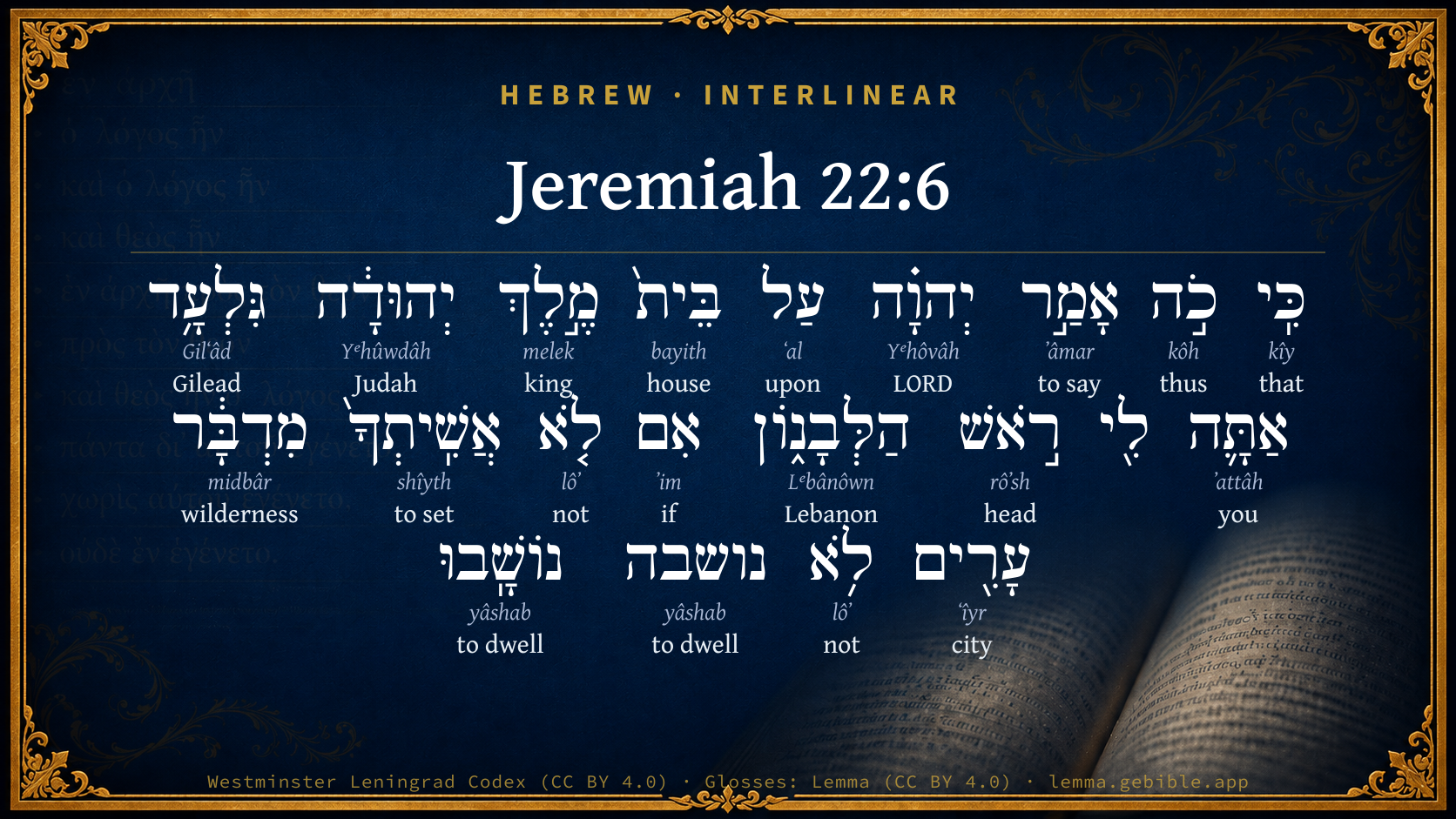
Jeremiah 22:6

Hebrew (Westminster Leningrad Codex) Jeremiah 22:6 appears in the Hebrew Old Testament. The text above is from the Westminster Leningrad Codex. Each word links to its Strong’s number, a concise gloss, and parsing drawn from the Open Scriptures Hebrew Bible morphology. Click any word for its full Brown-Driver-Briggs (BDB) entry.
Download image
Cite this verse

Jeremiah 22:6 (World English Bible). Public Domain. Lemma interlinear Bible study tool, https://lemma.gebible.app/v/jeremiah/22/6.

Show BibTeX & RIS
BibTeX
RIS
English Translation
For thus says Yahweh concerning the house of the king of Judah: You are Gilead to me, [and] the head of Lebanon; [yet] surely I will make you a wilderness, [and] cities which are not inhabited.
World English Bible · Public Domain
Download a study sheet

One document with this verse’s original text, its word-by-word gloss line, the meaning frame, cross-references with their text, attributed commentary, and full source and license credits — printable, and it pastes into notes with its structure intact.

This verse Autodidact and up

Study sheet (.html) Plain text (.txt)

A passage Seminary Student

Up to 50 verses in one chapter. A passage sheet keeps up to 6 commentary sources and 12 cross-references per verse, in the order this page ranks them, and says so on the sheet whenever that leaves anything out. Ask for a single verse and you get the Autodidact verse sheet above.

Everything on this page stays free to read, with no account — the sheet is a download of what is already on screen, not access to it.

Want to remove ads? Support Godless Engineer
Compare translations 3

The same verse in 3 English versions, stacked beneath the original-language interlinear above. Click any original word for its lexicon entry.

Each is an independent rendering of the whole verse — the interlinear is not word-aligned to these translations.

Highlighted words mark where these versions differ — a whole-verse word diff, not a word-by-word alignment.

  • World English Bible Public Domain
    For thus says Yahweh concerning the house of the king of Judah: You are Gilead to me, [and] the head of Lebanon; [yet] surely I will make you a wilderness, [and] cities which are not inhabited.
  • King James Version Public Domain
    For thus saith the LORD unto the king's house of Judah; Thou art Gilead unto me, and the head of Lebanon: yet surely I will make thee a wilderness, and cities which are not inhabited.
  • unfoldingWord Literal Text CC BY-SA 4.0
    For thus says Yahweh concerning the house of the king of Judah: “You Gilead to me, the top of Lebanon. surely I will make you a wilderness, cities not inhabited.

unfoldingWord Literal Text — © unfoldingWord, licensed CC BY-SA 4.0. Word-aligned USFM3 via Door43 (git.door43.org/unfoldingWord/en_ult).

Versions to compare (up to 4)

3 of 4 selected

Show all 18 translations

Every available English version of this verse, each an independent rendering of the whole verse.

  • World English Bible Public Domain
    For thus says Yahweh concerning the house of the king of Judah: You are Gilead to me, [and] the head of Lebanon; [yet] surely I will make you a wilderness, [and] cities which are not inhabited.
  • Berean Standard Bible Public Domain
    For this is what the LORD says concerning the house of the king of Judah: “You are like Gilead to Me, like the summit of Lebanon; but I will surely turn you into a desert, like cities that are uninhabited.
  • Majority Standard Bible Public Domain
    For this is what the LORD says concerning the house of the king of Judah: “You are like Gilead to Me, like the summit of Lebanon; but I will surely turn you into a desert, like cities that are uninhabited.
  • King James Version Public Domain
    For thus saith the LORD unto the king's house of Judah; Thou art Gilead unto me, and the head of Lebanon: yet surely I will make thee a wilderness, and cities which are not inhabited.
  • American Standard Version (1901) Public Domain
    For thus saith Jehovah concerning the house of the king of Judah: Thou art Gilead unto me, `and' the head of Lebanon; `yet' surely I will make thee a wilderness, `and' cities which are not inhabited.
  • Revised Version (1885) Public Domain
    For thus saith the LORD concerning the house of the king of Judah: Thou art Gilead unto me, and the head of Lebanon: yet surely I will make thee a wilderness, and cities which are not inhabited.
  • Geneva Bible (1599) Public Domain
    For thus hath the Lord spoken vpon the Kings house of Iudah, Thou art Gilead vnto me, and the head of Lebanon, yet surely I wil make thee a wildernes and as cities not inhabited,
  • Douay-Rheims (1899) Public Domain
    For thus saith the Lord to the house of the king of Juda: Thou art to me Galaad the head of Libanus: yet surely I will make thee a wilderness, and cities not habitable.
  • Young's Literal Translation Public Domain
    For thus said Jehovah, Concerning the house of the king of Judah: Gilead `art' thou to Me -- head of Lebanon, If not -- I make thee a wilderness, Cities not inhabited.
  • Literal Standard Version CC BY-SA 4.0
    For thus said YHWH concerning the house of the king of Judah: “You [are] Gilead to Me—head of Lebanon, || If not—I make you a wilderness, || Cities [that] are not inhabited.
  • Unlocked Literal Bible CC BY-SA 4.0
    For Yahweh says this concerning the house of the king of Judah, 'You are like Gilead, or like the summit of Lebanon to me. Yet I will turn you into a wilderness, into cities with no inhabitants.
  • unfoldingWord Literal Text CC BY-SA 4.0
    For thus says Yahweh concerning the house of the king of Judah: “You Gilead to me, the top of Lebanon. surely I will make you a wilderness, cities not inhabited.
  • Darby Bible Public Domain
    For thus saith Jehovah concerning the house of the king of Judah: Thou art a Gilead unto me, the summit of Lebanon: verily I will make thee a wilderness, cities not inhabited.
  • World Messianic Bible Public Domain
    For the LORD says concerning the house of the king of Judah: “You are Gilead to me, the head of Lebanon. Yet surely I will make you a wilderness, cities which are not inhabited.
  • Webster's Bible Public Domain
    For thus saith the LORD to the king's house of Judah; Thou art Gilead to me, and the head of Lebanon; yet surely I will make thee a wilderness, and cities which are not inhabited.
  • Free Bible Version CC BY-SA 4.0
    This is what the Lord says about the royal family of the king of Judah: You are as dear to me as the forests on Gilead and on the mountains of Lebanon. But I will turn you into a desert, into towns where no one lives.
  • Bible in Basic English Public Domain
    For this is what the Lord has said about the family of the king of Judah: You are Gilead to me, and the top of Lebanon: but, truly, I will make you waste, with towns unpeopled.
  • JPS Tanakh (1917) Public Domain
    For thus saith the LORD concerning the house of the king of Judah: Thou art Gilead unto Me, the head of Lebanon; yet surely I will make thee a wilderness, cities which are not inhabited.

Literal Standard Version (2020), Covenant Press — licensed CC BY-SA 4.0. Text via the HelloAO Bible API (eBible.org). Unlocked Literal Bible (unfoldingWord) — licensed CC BY-SA 4.0. Text via the HelloAO Bible API (eBible.org). unfoldingWord Literal Text — © unfoldingWord, licensed CC BY-SA 4.0. Word-aligned USFM3 via Door43 (git.door43.org/unfoldingWord/en_ult). Free Bible Version, Dr. Jonathan Gallagher — licensed CC BY-SA 4.0. Text via the HelloAO Bible API (eBible.org).

Word by word

More ways to search: Search by grammar → Find every occurrence → Compare this word →

Practice this passage: Drill this verse → Learn its vocabulary →

הַלְּבָנ֑וֹן
Lᵉbânôwn
H3844
“the · Lebanon”
Particle, Definite Article + Noun, Proper
Part of Speech
Particle + Noun
Type
Proper
Full BDB Definition

Origin: from H3835

TWOT: 1074e

Lebanon = "whiteness" - a wooded mountain range on the northern border of Israel
  1. כִּֽי kîy H3588 “that” Conjunction
  2. כֹ֣ה kôh H3541 “thus” Adverb
  3. אָמַ֣ר ʼâmar H559 “to say” Verb, Qal, Perfect, 3rd Person, Masculine, Singular
  4. יְהוָ֗ה Yᵉhôvâh H3068 “LORD” Noun, Proper
  5. עַל ʻal H5921 “upon” Preposition
  6. בֵּית֙ bayith H1004 “house of” Noun, Common, Masculine, Singular, Construct
  7. מֶ֣לֶךְ melek H4428 “king of” Noun, Common, Masculine, Singular, Construct
  8. יְהוּדָ֔ה Yᵉhûwdâh H3063 “Judah” Noun, Proper
  9. גִּלְעָ֥ד Gilʻâd H1568 “Gilead” Noun, Proper
  10. אַתָּ֛ה ʼattâh H859 “you” Pronoun, Personal, 2nd Person, Masculine, Singular
  11. רֹ֣אשׁ rôʼsh H7218 “head of” Noun, Common, Masculine, Singular, Construct
  12. אִם ʼim H518 “if” Conjunction
  13. לֹ֤א lôʼ H3808 “not” Particle, Negative
  14. אֲשִֽׁיתְךָ֙ shîyth H7896 “to set · you” Verb, Qal, Imperfect, 1st Person, Common, Singular + Suffix, Personal, 2nd Person, Masculine, Singular
  15. מִדְבָּ֔ר midbâr H4057 “wilderness” Noun, Common, Masculine, Singular, Absolute
  16. עָרִ֖ים ʻîyr H5892 “cities” Noun, Common, Feminine, Plural, Absolute
  17. לֹ֥א lôʼ H3808 “not” Particle, Negative
  18. נושבה yâshab H3427 “dwelled” Verb, Niphal, Participle Passive, Feminine, Singular, Absolute
  19. נוֹשָֽׁבוּ yâshab H3427 “to dwell” Verb, Niphal, Perfect, 3rd Person, Common, Plural

About this verse

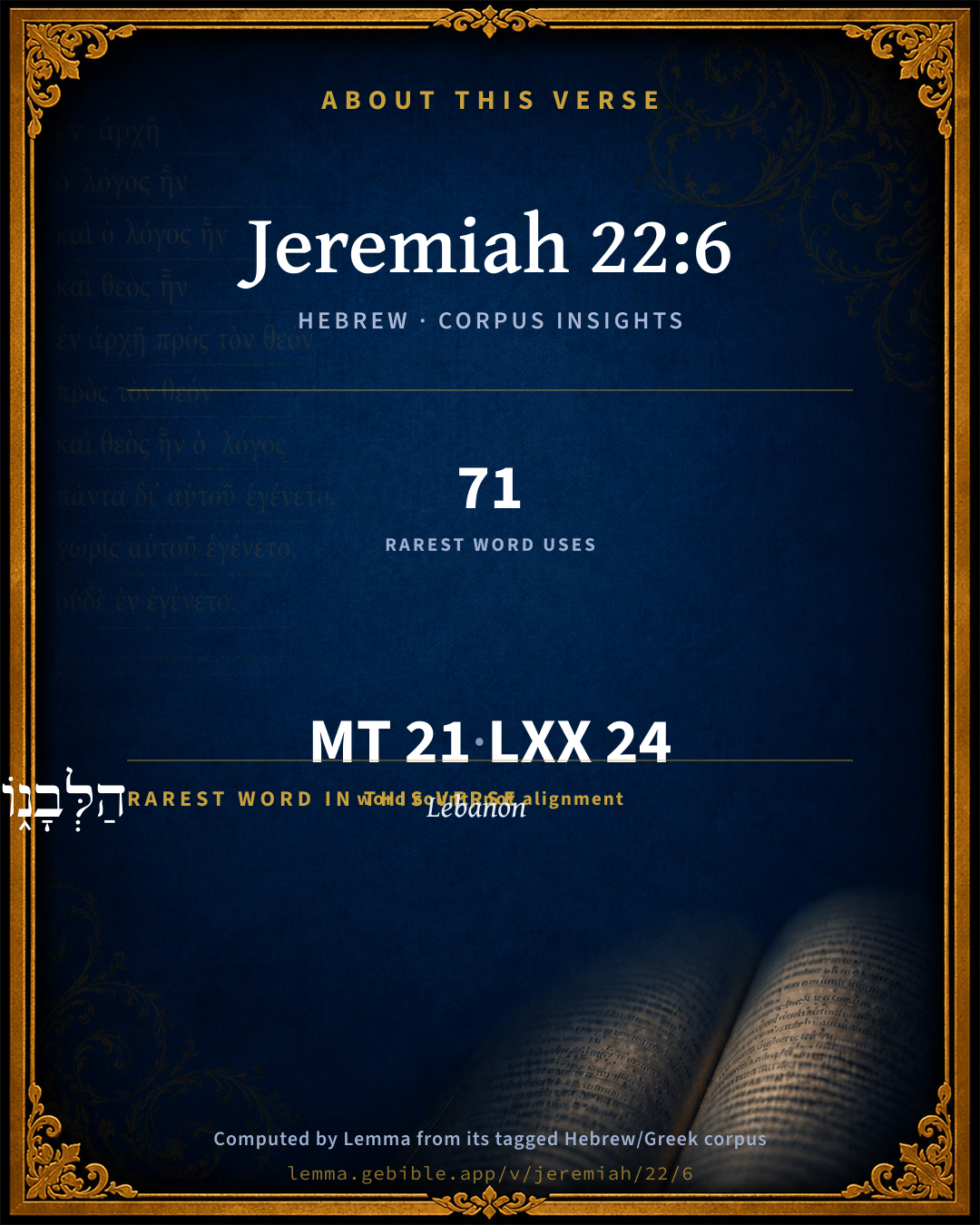
These counts appear in no published source. They are computed here, from the morphology-tagged text and Lemma’s own curated glosses. What Lemma adds →

21
words
18
distinct lemmas
Prophets
section

Grammatical profile

  • 4 verbs
  • 9 nouns
  • 1 pronoun
  • 2 prepositions
  • 2 conjunctions
  • 1 adverb
  • 2 particles

Verb forms

  • אָמַ֣ר Qal · Perfect
  • אֲשִֽׁיתְךָ֙ Qal · Imperfect
  • נושבה Niphal · Participle Passive
  • נוֹשָֽׁבוּ Niphal · Perfect

Repetition

Words recur within this verse — often emphatic in Hebrew:

  • נושבה to dwell H3427 ×2
  • לֹ֤א not H3808 ×2

Hebrew & Septuagint length

In the original languages it is 21 Hebrew tokens and 24 Greek tokens — but the two are counted differently (Hebrew bundles its prefixes and suffixes into one token; the Greek is in lemma form), so that isn’t a like-for-like length.

Cross-references

19

Topical passages linked to Jeremiah 22:6 in the Treasury of Scripture Knowledge — connected by theme and wording, ordered by reader-vote popularity; previews shown in the World English Bible.

  • Psalms 107:34 And a fruitful land into a salt waste, For the wickedness of those who dwell in it.
  • Isaiah 6:11 Then I said, "Lord, how long?" He answered, "Until cities are waste without inhabitant, And houses without man, And the land becomes utterly waste,
  • Isaiah 27:10 For the fortified city is solitary, a habitation deserted and forsaken, like the wilderness: there shall the calf feed, and there shall he lie down, and consume the branches of it.
  • Jeremiah 9:11 I will make Jerusalem heaps, a dwelling-place of jackals; and I will make the cities of Judah a desolation, without inhabitant.
  • Micah 3:12 Therefore Zion for your sake will be plowed like a field, And Jerusalem will become heaps of rubble, And the mountain of the temple like the high places of a forest.
  • Genesis 37:25 They sat down to eat bread, and they lifted up their eyes and looked, and saw a caravan of Ishmaelites was coming from Gilead, with their camels bearing spices and balm and myrrh, going to carry it down to Egypt.
  • Jeremiah 7:34 Then will I cause to cease from the cities of Judah, and from the streets of Jerusalem, the voice of mirth and the voice of gladness, the voice of the bridegroom and the voice of the bride; for the land shall become a waste.
  • Jeremiah 26:18 Micah the Morashtite prophesied in the days of Hezekiah king of Judah; and he spoke to all the people of Judah, saying, Thus says Yahweh of Hosts: Zion shall be plowed as a field, and Jerusalem shall become heaps, and the mountain of the house as the high places of a forest.
  • Deuteronomy 3:25 Please let me go over and see the good land that is beyond the Jordan, that goodly mountain, and Lebanon.
  • Song of Solomon 5:15 His legs are like pillars of marble set on sockets of fine gold. His appearance is like Lebanon, excellent as the cedars.
  • Isaiah 24:1–6 Behold, Yahweh makes the earth empty, and makes it waste, and turns it upside down, and scatters abroad the inhabitants of it.
  • Jeremiah 4:20 Destruction on destruction is cried; for the whole land is laid waste: suddenly are my tents destroyed, [and] my curtains in a moment.
  • Jeremiah 19:7–8 I will make void the counsel of Judah and Jerusalem in this place; and I will cause them to fall by the sword before their enemies, and by the hand of those who seek their life: and their dead bodies will I give to be food for the birds of the sky, and for the animals of the earth.
  • Jeremiah 21:11 Touching the house of the king of Judah, hear you the word of Yahweh:
  • Jeremiah 21:14 I will punish you according to the fruit of your doings, says Yahweh; and I will kindle a fire in her forest, and it shall devour all that is round about her.
  • Jeremiah 22:24 As I live, says Yahweh, though Coniah the son of Jehoiakim king of Judah were the signet on my right hand, yet would I pluck you there;
  • Jeremiah 25:9–10 behold, I will send and take all the families of the north, says Yahweh, and [I will send] to Nebuchadrezzar the king of Babylon, my servant, and will bring them against this land, and against the inhabitants of it, and against all these nations round about; and I will utterly destroy them, and make them an astonishment, and a hissing, and perpetual desolations.
  • Jeremiah 26:6–9 then will I make this house like Shiloh, and will make this city a curse to all the nations of the earth.
  • Ezekiel 33:27–28 Thus shall you tell them, Thus says the Lord Yahweh: As I live, surely those who are in the waste places shall fall by the sword; and him who is in the open field will I give to the animals to be devoured; and those who are in the strongholds and in the caves shall die of the pestilence.

Cross-references courtesy of OpenBible.info (CC BY 4.0).

Hebrew and Greek witnesses Masoretic Hebrew ↔ Greek Septuagint

The same verse in the two great witnesses to the Old Testament, shown verse-for-verse.

These are two independent witnesses, not word-aligned to each other, and the Septuagint is shown in lemma (dictionary) form.

Hebrew Jeremiah 22:6 Masoretic · Westminster Leningrad Codex

כִּֽי כֹ֣ה אָמַ֣ר יְהוָ֗ה עַל בֵּית֙ מֶ֣לֶךְ יְהוּדָ֔ה גִּלְעָ֥ד אַתָּ֛ה לִ֖י רֹ֣אשׁ הַלְּבָנ֑וֹן אִם לֹ֤א אֲשִֽׁיתְךָ֙ מִדְבָּ֔ר עָרִ֖ים לֹ֥א נושבה נוֹשָֽׁבוּ

For thus says Yahweh concerning the house of the king of Judah: You are Gilead to me, [and] the head of Lebanon; [yet] surely I will make you a wilderness, [and] cities which are not inhabited.

World English Bible · Public Domain

Greek LXX Structure differs

In the Septuagint, Jeremiah is about an eighth shorter than the Hebrew and arranges its material differently — the Oracles Against the Nations (Hebrew chapters 46–51) appear in the middle of the Greek book, after 25:13. Because the chapter and verse boundaries do not line up, a verse-for-verse comparison with the Hebrew is not shown.

A verse-for-verse comparison isn’t shown here because the chapters and verses don’t line up. Switch to the LXX edition with the MT / LXX toggle above to read the Greek directly.

Hebrew: Westminster Leningrad Codex (CC BY 4.0). Greek: Septuagint (public domain); English from a public-domain English Septuagint. How the Septuagint differs from the Hebrew →

Targum (Aramaic paraphrase)

1

The Targum is the ancient Jewish Aramaic paraphrase of the Hebrew Scriptures — an interpretive translation, not the Hebrew text itself. Onkelos (literal) and Pseudo-Jonathan (expansive) render the Torah, and Jonathan the Prophets. Coverage is partial: where no permissively-licensed English translation exists for a verse, only the Aramaic is shown. This is verse-level text, not a word-by-word alignment to the Hebrew.

  1. Targum Jonathan Prophets (Joshua–Malachi)
    אֲרֵי כִדְנַן אֲמַר יְיָ עַל בֵּית מְלַךְ שִׁבְטָא דְבֵית יְהוּדָה אִילוּ אַתְּ חֲבִיב קָדָמַי מִבֵּית מִקְדָשָׁא דְרָם בְּרֵישׁ טוּרַיָא אִם לָא אַשְׁוִינָךְ מַדְבְּרָא קִרְוִין דְלָא אִתְיַתְבָא:

    (no public-domain English translation for this verse)

    Targum Jonathan — Aramaic: “Mikraot Gedolot” (public domain). English: “Sefaria Community Translation” (CC0 1.0 (public-domain dedication)); “London "Chaldee Paraphrase," 1871” (public domain). Text via Sefaria.

Commentary

Notes on Jeremiah 22:6 from classic Christian and Jewish commentators (each source and its license shown beneath its notes). The classic Christian expositions comment on the surrounding passage and are grouped to its opening verse, so a note may address several verses; the Jewish commentaries on the Tanakh (Rashi and others) are per-verse, so they appear only where the commentator wrote on this verse.

Lemma curates 59 commentaries, every one of them public domain or Creative Commons licensed, each selected and text-cleaned for this edition rather than reprinted as found. About our sources →

The Cambridge Bible for Schools and Colleges

gen. ed. J. J. S. Perowne

6. concerning] if there is any preference, better as mg. unto.

Gilead unto me, and the head of Lebanon] well-wooded regions. Cp. Isa_2:13; Isa_37:24; Zec_11:1 f.

6–9. See introd. summary to section. We may take Jer_22:6-7 (which are in Ḳinah metre) to be in the main genuine, although (Co.) the statement that they concern the palace is somewhat inconsistent with the general tenor of the passage, which evidently refers to the city as a whole. Jer_22:8-9 are generally thought to be inserted by a later hand. They are almost identical with Deu_29:24 f. and are not in any distinct metre.

The Cambridge Bible for Schools and Colleges (gen. ed. J. J. S. Perowne; Cambridge University Press, 1878–1918) — public domain. Text from a community e-Sword module.

Trapp's Complete Commentary

John Trapp

Jer 22:6 For thus saith the LORD unto the king’s house of Judah; Thou [art] Gilead unto me, [and] the head of Lebanon: [yet] surely I will make thee a wilderness, [and] cities [which] are not inhabited.

Ver. 6. For thus saith the Lord concerning the king’s house,] i.e., Concerning the whole kingdom of Judah, saith Junius.

Thou art Gilead unto me, and the head of Lebanon,] i.e., High and happy, as these fruitful mountains, famous for spicery and other things desirable. {Gen 37:25}

Yet surely I will make thee a wilderness.] Like as I have made them when the ten tribes were carried away captive.

John Trapp, A Commentary or Exposition upon All the Books of the Old and New Testament (1647–1656) — public domain. Text from a community e-Sword module.

Joseph Benson's Commentary

Jer 22:6-9. For thus saith the Lord unto, or, concerning, the king’s house: Thou art Gilead unto me, &c.; yet surely, &c. — “Though thou wert never so precious in my sight, as valuable for riches and plenty as the fat pastures of Gilead, and thy buildings as beautiful for their stateliness as the tall cedars of Lebanon, yet unless thy princes and people reform, thou shalt become nothing but ruin and desolation.” Thus Lowth. But Blaney translates the verse, Gilead art thou through me, O summit of Lebanon; surely I will make thee a desert, cities not inhabited. Which he interprets as follows, “Lebanon was the highest mountain in Israel, and was therefore an apt emblem of the reigning family advanced to the highest rank of dignity in the state. Gilead was the richest and most fertile part of the country. The meaning then is plainly this, By my providence thou art not only supreme in rank, but hast been rendered exceedingly wealthy and flourishing. But the same power that raised will likewise be exerted in reducing thee to the lowest state of indigence and distress.” And I will prepare — Hebrew, וקדשׁתי, I will sanctify destroyers against thee — That is, I will solemnly appoint and set them apart for the work of destroying thee. And they shall cut down thy choice cedars — Having compared the king’s palace, or the city of Jerusalem, to Lebanon, Jer 22:6, pursuing the metaphor, he threatens to destroy them and their most beautiful edifices by the Chaldean army. And many nations — Persons of many nations; shall pass by this city, &c. — Namely, when on their travels; and they shall say, Wherefore hath the Lord done thus unto this great city — They who have heard that this had been a very strong, rich, and populous city, and that it had been called the city of God, and the place of his especial residence, would be astonished to find it, through his judgments, a scene of ruin and desolation, and would require how such an effect came to be produced. Thus was fulfilled that threatening of Moses, Deu 28:37, that God would make the Jews an astonishment to other nations. See likewise 1Ki 9:8. Then shall they answer — Some shall answer, or they shall answer one another. The reason is so obvious that it shall be ready in every man’s mouth. Because they have forsaken the covenant of Jehovah their God; have revolted from their allegiance to him, and from the duty which they had solemnly covenanted to perform, and worshipped other gods and served them — In contempt of him; and therefore he gave them up to this destruction.

Joseph Benson's Commentary on the Old and New Testaments (1811–1818) — public domain. Text from a community e-Sword module.

Tyndale Open Study Notes

Tyndale Open Resources

22:6-9 After the Temple, Judah’s royal palace was the nation’s most important building. It was an expensive building produced by the best craftsmen (1 Kgs 7:1-12), and it was the king’s home and the center of his government. Although the Lord loved the palace, it would not escape the destruction he decreed for Jerusalem.

22:6-7 Valuable crops were raised in the valleys and on the slopes of Gilead, the highlands rising eastward from the Jordan Valley. • Lebanon was the area north of Israel along the seacoast, including the high mountain ridge on the country’s eastern side. It was famous for its stately cedar trees.

Tyndale Open Study Notes — © Tyndale Open Resources, licensed CC BY-SA 4.0. Text via the HelloAO Bible API.

Geneva Bible (1599)

Geneva Bible translators

He compareth Jerusalem to Gilead, which was beyond Jordan, and the beauty of Judea to Lebanon.

Geneva Bible (1599) marginal notes — public domain. Text via Bolls.life.

Jamieson, Fausset & Brown

Robert Jamieson, A. R. Fausset & David Brown

Though thou art as beautiful as Gilead, and as majestic in Mine eyes (before Me) as the summit of Lebanon, yet surely (the Hebrew is a formula of swearing to express certainly: "If I do not make thee . . . believe Me not ever hereafter": so "as truly as I live," Num 14:28; "surely," Num 14:35). The mention of Gilead may allude not only to its past beauty, but covertly also to its desolation by the judgment on Israel; a warning now to Judah and the house of "David." "Lebanon" is appropriately mentioned, as the king's house was built of its noble cedars.

cities--not other cities, but the different parts of the city of Jerusalem (Sa2 12:27; Kg2 10:25) [MAURER].

Jamieson, Fausset & Brown — Commentary Critical and Explanatory on the Whole Bible (1871) — public domain (CC PDM 1.0). Text via the HelloAO Bible API.

Adam Clarke's Commentary

Verse 6. Thou art Gilead unto me, and the head of Lebanon] Perhaps in allusion, says Dahler, to the oaks of Gilead, and the cedars of Mount Lebanon, of which the palace was constructed. Lebanon was the highest mountain in Israel, and Gilead the richest and most fertile part of the country; and were, therefore, proper emblems of the reigning family. Though thou art the richest and most powerful, I, who raised thee up, can bring thee down and make thee a wilderness.

Adam Clarke's Commentary on the Bible (1810–1826) — public domain. Text from a community e-Sword/MySword module.

John Calvin's Commentaries

He confirms the preceding declaration, and explains more at large what had been stated sufficiently clear; for the false boasting of the Jews could hardly be restrained, as they still thought that the kingdom in the family of David would be permanent and exempt from any danger of a change.

But interpreters differ as to the meaning of the words. I will not repeat their views, nor is it necessary: I will only state what seems to me to be the real meaning. All others indeed give a different explanation; but the Prophet, I doubt not, means the same thing as we have observed in Jeremiah 7:12; where he says,

“Go to Shiloh, and see what is the state of that place, for the ark of the covenant had a long time dwelt there.”

Though, then, they thought that place sacred, yet it was reduced to desolation; and thus it must have become a dreadful spectacle to the whole people. For the same reason now, as it seems to me, the Prophet compares Lebanon to Mount Gilead; for what some say, that Gilead was the chief city of the ten tribes, has nothing in it. But we must remember the state of things at that time; the kingdom of Israel was wholly demolished when our Prophet spoke these words. Judea had indeed been much reduced by many calamities; but still some kind of a kingdom remained. Then by Mount Gilead the Prophet doubtless meant, by stating a part for the whole, the kingdom of Israel, but for a purpose different from that assigned by interpreters, even because the whole land of Israel was then laid waste; for all the inhabitants had been led into exile, and all the spoils had been removed, and nothing had escaped the rapacity and cruelty of their enemies.

Since, then, the land of Israel had been reduced unto desolation, God says now, that Jerusalem and the kingdom of Judah would not be of greater value in his sight than the whole country of the ten tribes had been, which was doubtless larger in extent and in wealth. And this meaning may be easily gathered from the words of the passage; he does not say, “Thou art like Gilead the head of Lebanon;” but, Gilead to me art thou the head of Lebanon And he calls Jerusalem Lebanon, because it was, as it were, the queen of that land; for by Mount Lebanon he designated whatever was precious in that country, for the reason we mentioned yesterday. As to Gilead, I do not consider that the Prophet refers especially to the city, but by stating a part for the whole, he includes the whole country, and for this reason, because Mount Gilead was full of many fruitful trees, and particularly of the balsam and the rosin tree, and of many odoriferous herbs and aromatics, which at this day are from thence brought to different parts of the world. And hence we found it asked in Jeremiah 8:22,

“Is there no rosin in Gilead? is there no medicine found there to heal the Church?”

Why was mention made then of Mount Gilead? even because there grew the best aromatics, and especially the balsam tree, and also many odoriferous trees and most precious fruits.

The meaning then is, “What dost thou think thyself to be? or, for what reason dost thou trust so much in thyself? I did not spare Mount Gilead and that extensive country which was much superior to thee; what means then this foolish presumption, that thou persuadest thyself that all danger is far off? Thou shalt be to me as Gilead. Think of my judgment on Mount Gilead, and of the dreadful desolation of the land of Israel; the same which you may now see there shall happen to thee.” We now perceive in what sense the Prophet says, that before God the head of Lebanon, that is, Jerusalem itself, which ruled over Lebanon, would become like Gilead

He then adds, If I make thee not a desert God again makes an oath; for it is, we know, an elliptical mode of expression, when the particle אם, am, is only used, for an imprecation is to be understood, — “Let me not be thought a God;” or, “Let my power be deemed nothing;” or, “Let me not be hereafter counted true and faithful.” However this may be, God makes an oath, that the city would become a desert, as those cities which are not inhabited Thus the whole context appears consistent, — that Jerusalem would be at length like the land of Israel, for he would no more spare Lebanon than Mount Gilead. It afterwards follows:

John Calvin's Commentaries (1540-1563) — public domain. Text from the Calvin Translation Society English edition (1840s-50s) via the Christian Classics Ethereal Library (ccel.org). Calvin's coverage is partial (roughly two-thirds of the Bible); uncommented books and verses are honest gaps, never fabricated. The 19th-century editor's footnotes and remarks are omitted so the notes are faithfully Calvin's own voice.

Ellicott's Commentary for English Readers

(6) Thou art Gilead unto me, and the head of Lebanon.—The conjunction, which is not found in the Hebrew, is better omitted. Even in his utterance of woes the prophet’s mind is still that of a poet. The chief point of the comparison in both cases is to be found in the forests that crowned the heights of both ranges of mountains. The “oaks of Bashan,” in the Gilead district (Isa_2:13; Zec_11:2), were as famous as the cedars of Lebanon, and both were alike the fit symbol of the glory of sovereignty (Isa_37:24; Eze_17:3). There may be a reference to the group of cedar-buildings, which of old gave to one of the palaces the name of “the house of the forest of Lebanon” (2Sa_7:2; 2Sa_7:7; 1Ki_7:2; 1Ki_10:21).

A Bible Commentary for English Readers, edited by Charles John Ellicott (1878–1897) — public domain. Text from a community e-Sword module.

John Gill's Exposition

For thus saith the Lord unto the king's house of Judah,.... That is, to the family of the king of Judah; though it may be rendered, "concerning the house of the king of Judah" (z); and so refer to his palace as before:

thou art Gilead unto me, and the head of Lebanon; or, though like to Gilead (which was a very fruitful country) for wealth, riches, and all kind of valuable things; and like to the top of Mount Lebanon (a), being set with tall cedars, for stateliness. So the Targum is,

"although thou art beloved before me more than the sanctuary, which is high upon the top of the mountains:''

or thou shall be as Gilead, and Mount Lebanon, which belonged to the ten tribes of Israel, and are put for the whole kingdom of Israel, which was wasted by the king of Assyria; and in like condition should the royal palace at Jerusalem be, notwithstanding all its riches and grandeur, and so the city and temple likewise; as follows:

yet surely I will make thee a wilderness, and cities which are not inhabited; though as fruitful as Gilead, yet shall become like a barren desert; and though full of children, courtiers, princes, and nobles, yet shall be like cities quite depopulated: or, "if I do not make thee" (b), &c. it is in the form of an oath, as Kimchi and Ben Melech observe; and to be supplied thus, if I do not do as I have said, let me never be believed; let me be reckoned a liar, or not thought to be God, and the like. It shows the certain accomplishment of these things.

(z) "de domo regis", Cocceius, Junius & Tremellius, Piscator. (a) "velut Gilead, ut caput Libani", Junius & Tremellius. (b) "si non posuero te", Vatablus, Pagninus, Montanus, Schmidt.

John Gill's Exposition of the Whole Bible (1746–1763) — public domain (CC PDM 1.0). Text via the HelloAO Bible API.

Albert Barnes' Notes on the Bible

Omit and. “Thou art a Gilead unto me, a summit of Lebanon.”

Yet surely - literally, if not, the form of an oath with the imprecation omitted. For the full form see Num 14:23.

A wilderness, and cities - Omit and. The meaning is: If the house of David does not hear God’s words, though it be now grand as Lebanon, God will make it a wilderness, even uninhabited cities; the house of David being regarded as equivalent to the kingdom of Judah.

Albert Barnes' Notes on the Bible (1834–1885) — public domain. Text from a community e-Sword/MySword module.

Haydock's Catholic Bible Commentary

Galaad, the head of Libanus. By Galaad, a rich and fruitful country, is here signified the royal palace of the kings of the house of David; by Libanus, a high mountain abounding in cedar-trees, the populous city of Jerusalem. (Challoner) (Worthington) (Theodoret) --- Both mountains are connected. (St. Jerome) (Strabo xvi.) --- Yet the proper Galaad was at some distance, and on the side of Ammon very barren. The palaces had arisen from a miserable state to resemble Libanus. They shall surely be destroyed. (Calmet) --- The advantageous situation of Jerusalem should not protect it, no more than it had done Galaad, 4 Kings xv. 29. (Junius; Grotius)

George Leo Haydock (1774–1849), Haydock's Catholic Family Bible and Commentary, 1859 edition — public domain. Excludes Psalms (Douay-Rheims chapter numbering differs from Protestant) and Deuterocanonical books (Catholic canon only).

Matthew Poole's English Annotations

Interpreters are not agreed in what sense God saith that

the king’s house of Judah was unto him as

Gilead, or

the head of Lebanon. Gilead was a country fertile for pastures; upon which account the Reubenites and Gadites, being men whose estates lay in cattle, begged it of Moses for their portion, Num 32:2, and Moses gave it to the sons of Manasseh, Num 32:40. It was also famous for spicery, balm, and myrrh, Gen 37:25. It had in it a famous mountain. Lebanon also was a very pleasant place, famous for cedars, and indeed whatsoever could gratify, the senses; they both were in the lot of Gad and Manasseh. Some think God compareth the king of Judah’s house to these places, in regard of the height and nobleness of the structure; others, for the pleasantness and delightfulness of it. Others consider Gilead as the principal part of the inheritance of the ten tribes, wasted by Tiglath-pileser, 2Ki 15:29; and that God telleth them, by this comparison, that he would certainly destroy them, and make them as Gilead, which was the head of Lebanon. Though Jerusalem were a noble and pleasant place, yet they might remember so was Gilead, which yet for their sins was wasted and brought to ruin. So also Jerusalem, formerly the garden of Judea, and joy of the whole earth, should be made a wilderness, and the cities of Judah should not be inhabited.

Matthew Poole's English Annotations on the Holy Bible (1683–1685) — public domain. Text from a community e-Sword/MySword module.

Whedon's Commentary on the Bible

Daniel D. Whedon

6. Thou art Gilead unto me, and the head of Lebanon — Beautiful as Gilead, majestic as Lebanon. This language is used in respect of the commanding position and magnificence of the royal palace. Gilead was doubtless then, as now, the most beautiful forest tract in the vicinity of the Holy Land; and Lebanon everywhere stands as the symbol of stateliness and magnificence. Its perpetual snows, its firs and cedars, its wealth of springs, and its noble forests, are all prominent in the scenery of the Old Testament. To these localities this splendid palace, with its cluster of associated buildings, is beautifully and expressively compared. But God’s displeasure will change all this splendour and magnificence into a treeless steppe: wilderness… cities… not inhabited.

Daniel D. Whedon (gen. ed.), Commentary on the Old and New Testaments (1874–1909) — public domain. Text from a community e-Sword module.

The Pulpit Commentary

Unto the king"s house of Judah; rather, concerning the house of the King of Judah; i.e. the royal palace, which, on account of its height and its being constructed so largely out of cedar-weed (comp. vers. 14, 23), is called "Gilead, and the summit of Lebanon," just as Solomon"s palace was called "the house of the forest of Lebanon". (1Ki_7:2) Of Gilead in general, Canon Tristram writes, "No one can fairly judge of Israel"s heritage who has not seen the luxuriant exuberance of Gilead, as well as the bard rocks of Judaea." And again, "Lovely knolls and dells open out at every turn, gently rising to the wooded plateau above. Then we rise to higher ground and ride through noble forests of oak. Then for a mile or two through luxuriant green corn, or perhaps through a rich forest of scattered olive trees, left untended and uncared for, with perhaps patches of corn in the open glades" ("Bible Places," p. 322). The cedars of Lebanon, however diminished, still bear witness to the ancient fame of this splendid mountain district. A wilderness, and cities which are not inhabited. The comparison has a terrible significance when read in the light of De Vogue"s and Freshfield"s discoveries. For Gilead itself is full of ruined cities of massive stone architecture. "It is no uncommon thing," says Mr. F.A. Eaton, "to see these houses in a complete state of preservation, built of huge blocks of black basalt, with slabs of the same for the roof, twelve feet long, a foot and a half wide, and half a foot thick, and entrance doors also of basalt... great solid stones of the same material being used as lintels at the top and bottom" (Speech at the meeting for setting on foot the survey of Eastern Palestine, November 30, 1880: Statement of Palestine Exploration Fund, January, 1880, p. 11). Cities which are not inhabited; not, indeed, the cities of Gilead of the time of Jeremiah, but constructed of materials which may reasonably be presumed to have been chiseled in a far more remote antiquity. (The date of the cities in their present state is subsequent to the Christian era.)

The Pulpit Commentary (1880–1919), ed. H.D.M. Spence-Jones & Joseph S. Exell — public domain. Text from a community e-Sword module.

John Wesley's Explanatory Notes

Gilead - Gilead was a country fertile for pastures; upon which account the Reubenites and Gadites, being men whose estate lay in cattle, begged it of Moses for their portion. Lebanon also was a very pleasant place: they were both in the lot of Gad and Manasseh. Perhaps God compares the king of Judah's house to these places, in regard of the height and nobleness of the structure, or for the pleasantness and delightfulness of it.

John Wesley, Explanatory Notes Upon the Whole Bible (1754–1765) — public domain. Text via the GEBible commentary corpus.

unfoldingWord translationNotes

Door43 World Missions Community

the house of the king of Judah

Possible meanings are 1) this refers to the royal palace where the king lived or 2) "house" is a metonym for the family that lives in the house, who were the royal line of the kings of Judah. AT: "the royal dynasty of Judah" (See: Metonymy)

You are like Gilead, or like the summit of Lebanon

Possible meanings are 1) "You are as beautiful as Gilead or the summit of Lebanon" or 2) "You give me as much pleasure as Gilead or the summit of Lebanon." (See: Simile)

turn you into a wilderness

What was formerly beautiful is said to become bare and deserted. AT: "cause you to become empty like the desert" (See: Metaphor)

I have designated destroyers to come against you

"I have chosen an army to attack you"

the best of your cedars

Possible meaning are 1) the beams of the palace or 2) the leading men of the royal family. (See: Metaphor)

fall into the fire

Possible meanings are 1) a literal fire that will burn the palace beams or 2) the destruction of the royal family is spoken of as if they were burned in a fire. (See: Metaphor)

translationWords

Gilead

Lebanon

turn

desert

cut off

cedar

fire

unfoldingWord translationNotes — © Distant Shores Media and the Door43 World Missions Community, licensed CC BY-SA 4.0. Source: git.door43.org/Door43/en_tn.

Rashi

Rabbi Shlomo Yitzchaki (Rashi)

You are [as] Gilead to Me, etc. Even if you are as dear to Me as the Temple, which is high on the mountain peaks, I swear that I will make you a desert.

You are [as] Gilead The Temple from which balm and healing emanate to the whole world.

Rashi on the Tanakh — English translations: “The Judaica Press complete Tanach with Rashi, translated by A. J. Rosenberg” (CC BY 4.0); “Pentateuch with Rashi's commentary by M. Rosenbaum and A.M. Silbermann, 1929-1934” (public domain); “The Metsudah Tanach series, Lakewood, N.J” (CC BY 4.0); and “The Book of Joshua, Metsudah Publications, 1997” (CC BY 4.0). Text via Sefaria.

Lesson kit

Teaching starters — assembled from the data on this page, not authored interpretation. Every prompt links to the verse data it draws on. Edit before teaching.

Jeremiah, in the Prophets, opens this verse with 21 words (18 distinct Hebrew lemmas). Its most distinctive word is Lᵉbânôwn (“Lebanon”). A historical commentator’s framing appears above. Read the whole chapter for the surrounding context.

Discussion questions

  1. What does “Lebanon” (Lᵉbânôwn) contribute to the verse as a whole?
  2. How does Psalms 107:34, which shares this passage’s theme, read alongside this verse?
  3. What does the repetition of “to dwell” (2× in this one verse) do in this verse?
  4. The translations on this page render this verse differently — a whole-verse word diff, not a word-by-word alignment. What might account for the different wordings?
  5. «אָמַ֣ר» is a Qal Perfect verb. How does that grammatical form shape the action described?
  6. Compare how The Cambridge Bible for Schools and Colleges and Trapp's Complete Commentary read this verse. Where do they agree or differ?

Things to notice

Reading settings

Reading text

Shown beneath each verse's original-language words.

Old Testament
Old Testament edition

Read the OT as the Masoretic Hebrew (MT) or the Greek Septuagint (LXX).

English shown for the Greek Septuagint (in the Hebrew ↔ Greek comparison).

Comparing translations? Open the Compare panel on any verse page to stack up to four side by side.