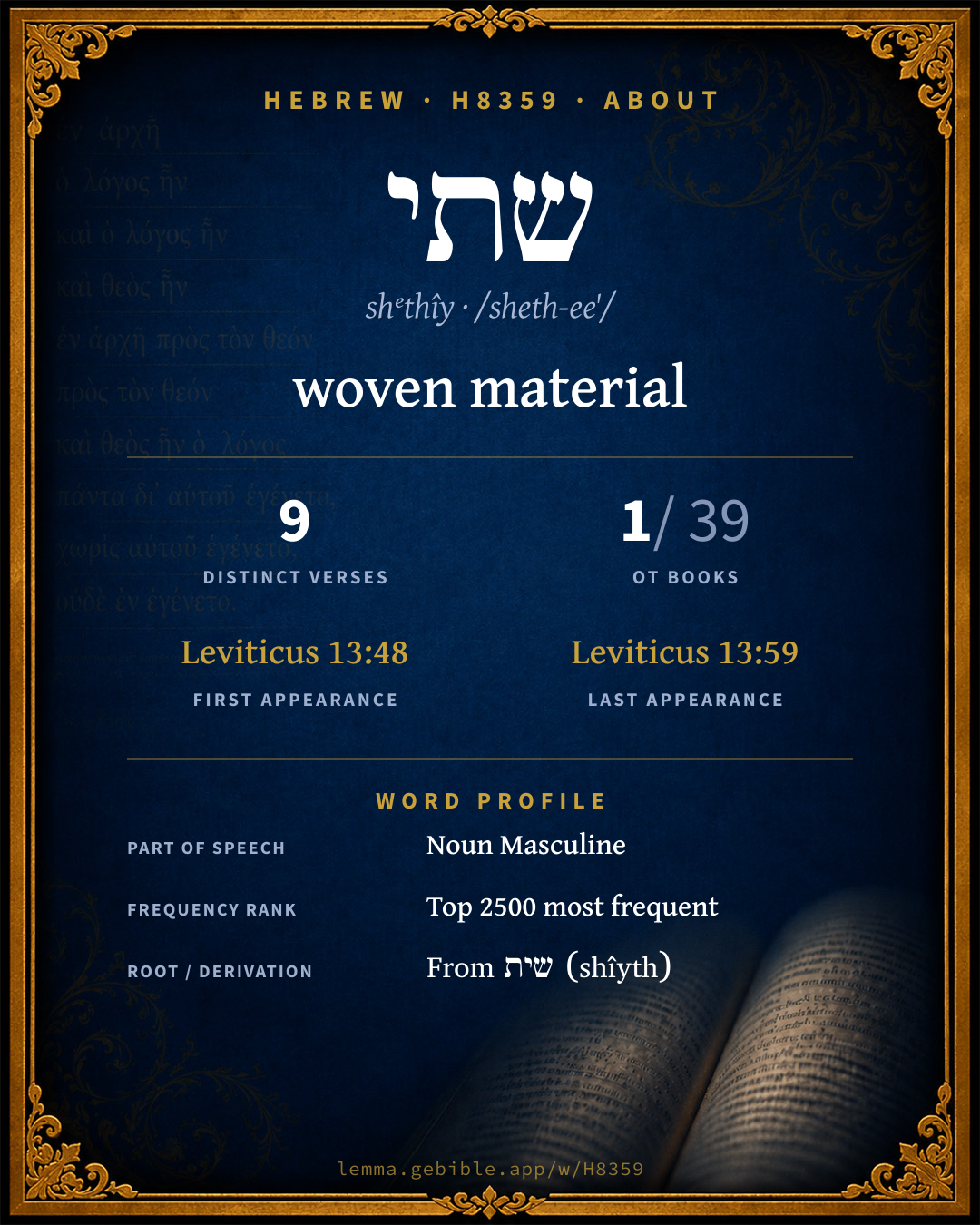
שְׁתִי
woven material
Full lexicon entry — Brown-Driver-Briggs (BDB)
From Brown-Driver-Briggs (BDB)
Where this word appears
Grammar key — what these labels mean
Noun type
- Common
- A common noun — a general class of person, place, or thing (“king,” “city,” “water”), not a specific name.
State
- Absolute
- The independent form of a noun, not bound to a following word.
Gender
- Masculine
- Grammatically masculine.
Number
- Singular
- One.
Every verse where H8359 appears — 9 distinct verses across 1 book. Click any verse to open its interlinear word-by-word view. Verse text shown in the World English Bible for context — . Each verse’s Hebrew form is shown with its reference; the English is not keyword-highlighted, since the data carries no word-level English alignment. Use “Compare translations” on any verse to read it across multiple English versions. This concordance covers the Hebrew Bible; Septuagint (Greek Old Testament) occurrences are not indexed here.
Leviticus 9 verses
- Leviticus 13:48 בִֽ/שְׁתִי֙ prep + n c ms whether it is in warp, or woof; of linen, or of wool; whether in a skin, or in anything made of skin;
- Leviticus 13:49 בַ/שְּׁתִ֤י prep det + n c ms if the plague is greenish or reddish in the garment, or in the skin, or in the warp, or in the woof, or in anything made of skin; it is the plague of leprosy, and shall be shown to the priest.
- Leviticus 13:51 בַ/שְּׁתִ֤י prep det + n c ms He shall examine the plague on the seventh day. If the plague has spread in the garment, either in the warp, or in the woof, or in the skin, whatever use the skin is used for, the plague is a destructive mildew. It is unclean.
- Leviticus 13:52 הַ/שְּׁתִ֣י ptcl def.art + n c ms He shall burn the garment, whether the warp or the woof, in wool or in linen, or anything of skin, in which the plague is: for it is a destructive mildew. It shall be burned in the fire.
- Leviticus 13:53 בַ/שְּׁתִ֖י prep det + n c ms "If the priest examines it, and, behold, the plague hasn't spread in the garment, either in the warp, or in the woof, or in anything of skin;
- Leviticus 13:56 הַ/שְּׁתִ֖י ptcl def.art + n c ms If the priest looks, and, behold, the plague has faded after it is washed, then he shall tear it out of the garment, or out of the skin, or out of the warp, or out of the woof:
- Leviticus 13:57 בַ/שְּׁתִ֤י prep det + n c ms and if it appears again in the garment, either in the warp, or in the woof, or in anything of skin, it is spreading. You shall burn with fire that in which the plague is.
- Leviticus 13:58 הַ/שְּׁתִ֨י ptcl def.art + n c ms The garment, either the warp, or the woof, or whatever thing of skin it is, which you shall wash, if the plague has departed from them, then it shall be washed the second time, and it will be clean."
- Leviticus 13:59 הַ/שְּׁתִי֙ ptcl def.art + n c ms This is the law of the plague of mildew in a garment of wool or linen, either in the warp, or the woof, or in anything of skin, to pronounce it clean, or to pronounce it unclean.
About this entry
At a glance — auto-summarized from this page’s data, not written by a person. Every figure links to its source below. This summary describes the numbers; it doesn’t interpret them.
שתי — transliterated shᵉthîy — is a Hebrew noun carrying the sense “woven material.” Its uses cluster heavily in Leviticus (100% of all occurrences). With 9 verses in 1 book, it is an uncommon word in the Hebrew Bible. It first appears in Leviticus 13:48. Translators differ — “warp” in the King James Version, then “weave” (Berean Standard Bible), as the renderings breakdown shows. Each statement above links to its evidence; the full detail follows below.
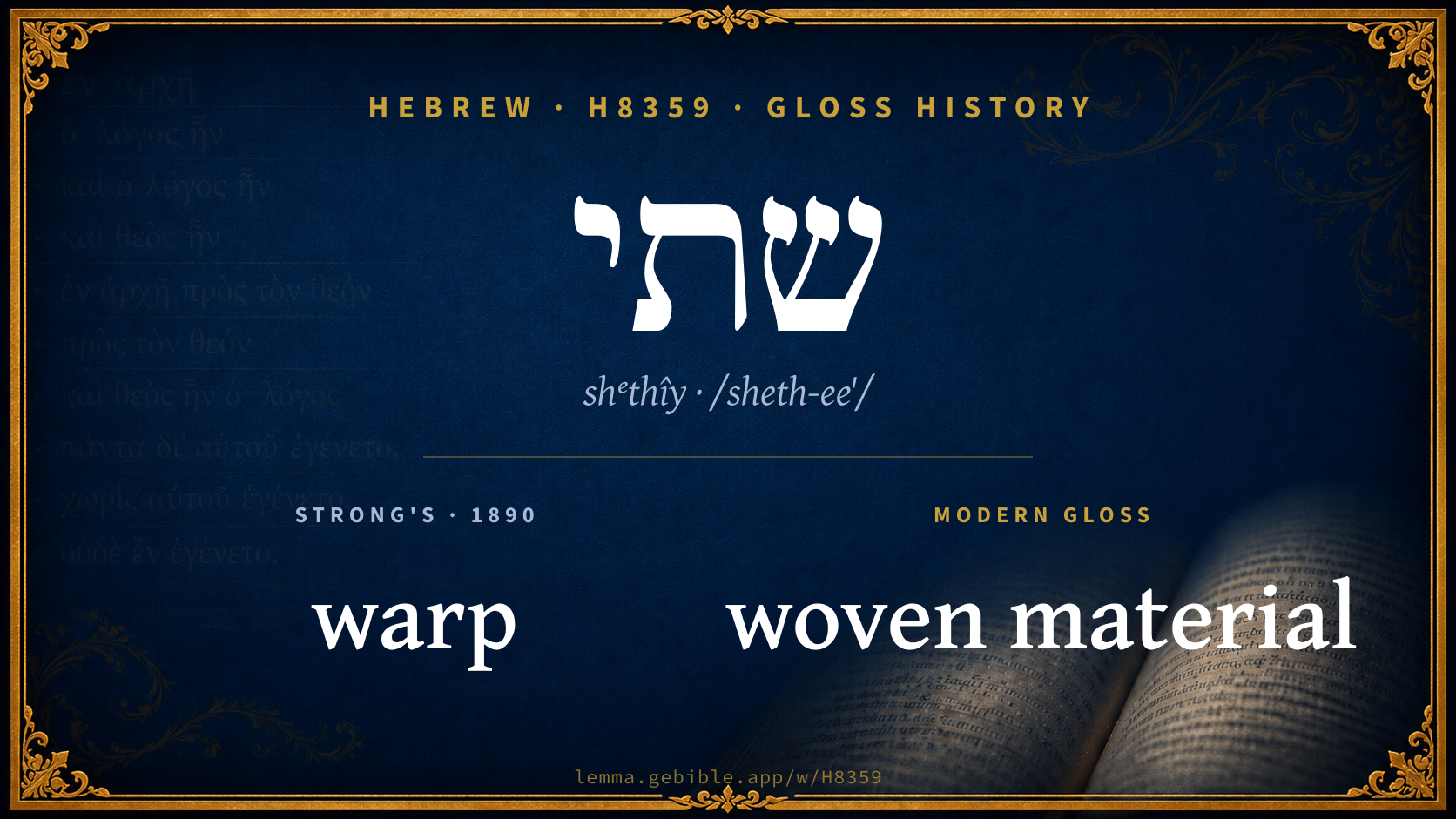
Gloss history
Strong's 1890 vs modern scholarship
About this word
Strong's H8359 catalogs a Hebrew word from the Hebrew Old Testament.
These counts are not copied from any lexicon or concordance. They are computed here, from the morphology-tagged Hebrew Old Testament. What Lemma adds →
- 9
- distinct verses
- The word appears in 9 distinct verses.
- 1 / 39
- OT books
- The word appears in 1 of 39 Old Testament books.
- #2,481
- by frequency
- Top 2500 most frequent Hebrew words (rank 2,481 of 8,640 Hebrew words by occurrence).
View all 9 occurrences in the concordance →
Most concentrated in
- Leviticus 9 verses 100%
By section of the Old Testament
By traditional corpus
Conventional, traditional groupings — biblical authorship is debated, so this is a traditional corpus grouping, not an authorship claim. Each share is this word’s portion of its verses in that division of the Hebrew canon. Each figure is a share of the word’s 9 distinct verses.
- Torah (Pentateuch) 9 verses · 100%
How translations render this word
Counts come from each version’s own published word-to-Strong’s tagging or interlinear alignment — an approximate guide to how each version renders this word, not a word-level alignment the data otherwise carries. Because each total is that version’s own tagged count, the per-version totals vary from one another and need not match the appearance or distinct-verse counts above. These counts may also differ from a printed concordance because Lemma counts each distinctly tagged rendering and does not collapse phrase taggings into a single head-word total. This is a fixed set of word-tagged versions (KJV, ASV, BSB, ULT) and does not change with the reading translation you choose elsewhere. Each version’s license is shown beside its name below (and on Sources).
- King James Version: Warp 6×
- American Standard Version: Warp 6×
- Berean Standard Bible: Weave 8×
- unfoldingWord Literal Text: Warp 9×
King James Version Public Domain
Renders H8359 across 9 tagged occurrences — most commonly:
Plus 3 renderings that appear only once — usually multi-word phrases or single function words the recovered tagging swept in, not distinct renderings.
American Standard Version Public Domain
Renders H8359 across 9 tagged occurrences — most commonly:
Plus 3 renderings that appear only once — usually multi-word phrases or single function words the recovered tagging swept in, not distinct renderings.
Berean Standard Bible Public Domain
Renders H8359 across 9 tagged occurrences — most commonly:
Plus 1 rendering that appears only once — usually multi-word phrases or single function words the recovered tagging swept in, not distinct renderings.
unfoldingWord Literal Text CC BY-SA 4.0
Renders H8359 across 9 tagged occurrences — most commonly:
Senses in BDB
The 1 sense BDB distinguishes for this word, in lexicon order (not ranked by frequency or importance). The full entry — with sub-senses — is in the Lexicon Entry tab.
- warp, woven material
Word origin
שְׁתִי 8 n.m. warp, the set of threads drawn lengthwise in loom, through which the shuttle bearing the woof is thrown crosswise
— Brown-Driver-Briggs (Oxford 1906, public domain), digitized via Sefaria, supplemented by the OpenScriptures HebrewLexicon (CC BY 4.0). See Sources.
Derived from שית (shîyth) (H7896) — to set.
Jastrow Dictionary
A second Hebrew/Aramaic lexicon for comparison, covering Aramaic and post-biblical (Talmudic, Targumic, Midrashic) usage that the biblical-Hebrew BDB does not. Matched by lemma rather than by Strong’s number, so a lemma may carry more than one Jastrow headword (shown separately below), and the entries cover usage well beyond the Bible.
שְׁנַיִם
- (b. h.) two. Ber. 8ᵃ ש׳ מקרא ואחד תרגום reading the Scriptural portion of the week twice, and the Targum once. Ib. שיעור ש׳ פתחים a distance of two gates. Zeb. V, 4, v. מַתָּנָה. Sabb. I, 1 ש׳ שהן ארבע two ways of transfer from place to place, which become four (by rabbinical addition). Ib. שְׁנֵיהֶם פטורין both of them are free. Snh. V, 3 בש׳ בחדש on the second day of the month. Ib. בש׳ שעות in the second hour of the day. Men. III, 3. Ib. 6; a. v. fr.—שְׁנֵים עָשָׂר, שְׁתֵּים עֶשְׂרֵה twelve. Nidd. 69ᵇ. Ab. Zar. 3ᵇ; a. fr.
שְׁתֵּי
- , v. שְׁנַיִם
שתי
- (b. h.) [to be settled, satisfied,] to drink. Pes. 86ᵇ השׁוֹתֶה כוסו וכ׳ he who drinks his cupful at one draught is called greedy (גַּרְגְּרָן). Ber. 51ᵃ מקבלו … ושׁוֹתֵהוּ בשמאל he must receive it (the medicine, v. אִסְפַּרְגּוֹס) with his right hand, and drink it (take it to his lips) with his left hand. Ib.ᵇ השותה כפלים he who drinks an even number of cups (v. זוּג). Tosef. Sot. XV, 11; B. Bath. 60ᵇ כשחרב … ושלא לִשְׁתּוֹת יין when the Temple was destroyed, … there were many scrupulous persons (פרושים, determined) not to eat meat nor drink wine. Ib. נִשְׁתֶּה יין וכ׳ should we drink wine, of which libations were offered on the altar? Ib. מים לא נשתה וכ׳ then let us drink no water, because water libation has ceased. Keth. 8ᵇ רבים שָׁתוּ רבים יִשְׁתּוּ many have drank (the cup of mourning), many shall drink, v. מִשְׁתֶּה. Nidd. 24ᵇ כמה … שָׁתַת אמו וכ׳ how much unmixed wine the mother of this embryo must have drunk!; a. fr.—Part. pass. שָׁתוּי being under the influence of drink. Erub. 64ᵃ שְׁתוּי יין אל וכ׳ Ms. M. (ed. only שָׁ׳) one feeling the wine must not pray, contrad. to שִׁכּוֹר, q. v. Lev. R. s. 12 שנכנסו שְׁתוּיֵי יין וכ׳ they (Nadab and Abihu) entered the Tabernacle while under the influence of wine; a. fr.—[Hif. from שָׁקָה q. v.]
שְׁתֵי
- Targ. Gen. IX, 21. Targ. I Sam. XXX, 12; a. fr.—Targ. Deut. XXXIII, 22 שַׁתְיָא (Y. II שתימין, corr. acc.).—Y. Shek. IV, 47ᶜ top כד הוה שָׁתֵי וכ׳ when he had drunk the four cups of wine on the Passover night &c.; Y. Sabb. VIII, beg. 11ᵃ; Y. Pes. X, 37ᶜ. Erub. 64ᵃ כל כמה דלא שָׁתֵינָא וכ׳ so long as I have not drunk a fourth (of a Log) of wine, my mind is not clear. Sabb. 152ᵃ עד … מכאן ואילך מִשְׁתֵּי מעלי up to forty years eating is more salutary, after that drinking is more salutary. R. Hash. 4ᵃ כלבתא בת משתי חמרא היא (ed. משתיא) does a bitch drink wine?; Yalk. Neh. 1069 מי שַׁתְיָא חמרא; a. fr.—With prefixed אִשְׁתֵּי ׃א, אִישְׁ׳. Targ. O. Ex. XXXIV, 28 ed. Berl. (ed. Vien. שתי); Y. אש׳. Targ. O. Gen. XXIV, 14 אִישְׁתְּ (ed. Vien. אֵשְׁתְּ) imperative; a. fr.—Erub. 54ᵃ חטוף … ואִישְׁתֵּי make haste and eat, make haste and drink (enjoy life, v. חֲטַף). Lev. R. s. 12 עשרה … אִישְׁתֵּית thou drankest ten &c., v. קִיסְטָא I. Yeb. 65ᵇ אִישְׁתִּיָא סמא וכ׳ she drank a drug causing barrenness; a. fr.—R. Hash. 4ᵃ מִשְׁתָּיֵא, v. supra.
- to be drunk. Targ. O. Lev. XI, 34 דיִשְׁתְּתֵי (Y. דיִשְׁתֵּיתֵי; h. text יִשָּׁתֶה).
שתי ²
- [to settle,]
- 1. to lay the foundation of; v. שָׁתַת II.
- 2. to fix the warp, start the loom, v. שְׁתִי.
- 1. to found, establish, v. שָׁתַת II.
- 2. to weave. Midr. Sam. ch. XIX (ref. to נסכתי, Ps. II, 6) הִשְׁתֵּיתִיו I have woven him (established him, ref. to מסכת, Jud. XVI, 14); Yalk. Is. 338; Yalk. Ps. 620 השיתיו (corr. acc.). e.g. Psalms 2:6
- to be established, started. Y. Yoma V, 42ᶜ, v. שְׁתִיָּה II; a. e.
- same. Tosef. Yoma III (II), 6 ed. Zuck. (Var. נשתת), v. שָׁתַת II
שְׁתֵי ²
- , to weave. Targ. Jud. XVI, 13 תִּשְׁתִּין (ed. Lag. a. oth. תִּשְׁתִּן, not תַּן …).
- , (Pe. with prefixed א) אִשְׁתֵּי, אִישְׁ׳ same,
- 1. to start the loom, weave. Targ. Ps. CXXXIX, 13 אַשְׁתְּיָת, ed. Wil. (ed. Lag. אִישְׁתְּיָית; h. text תסכני). Targ. Job X, 11.—Y. Sabb. VII, 10ᶜ top כד מַשְׁתָּיָיא וכ׳, v. קוּבְיָה. Y. Taan. IV, 64ᶜ דלא למִישְׁתָּיֵיא מן וכ׳ not to start a loom from the beginning of the month of Ab; Y. Pes. IV, 30ᵈ top; Yalk. Ps. 653 למשתי יינא (corr. acc.).
- 2. to found, establish. Targ. Ps. VIII, 3 ed. Lag. (ed. Wil. אַשְׁתֵּסְ׳, not אִ׳, v. שְׁתַאס; h. text יסד).
שְׁתִי
- preced.) warp; trnsf. longitudinal direction, v. עֵרֶב. Y. Shek. VI, 50ᵃ top כחוט של ש׳ as thin as a thread of the warp. Mikv. VI, 9 כותל … שנסדק לש׳ a wall … which is cracked lengthwise; a. fr.—ש׳ וערב crosswise, v. עֵרֶב.
A Dictionary of the Targumim, the Talmud Babli and Yerushalmi, and the Midrashic Literature (Marcus Jastrow; London, Luzac, 1903) — Public Domain. Digitized via Sefaria. Digitized via Sefaria. Full attribution on Sources.
Forms in the corpus
The 7 distinct written forms H8359 takes in the Hebrew Bible, most frequent first — each parse links to that state’s occurrences in the concordance. Hebrew forms include their vowel points and cantillation, so a single lemma takes many written forms.
| Form | Parsing | Example | Uses |
|---|---|---|---|
| בַ/שְּׁתִ֤י | Noun, Common, Masculine, Singular, Absolute | Leviticus 13:49 | 3 |
| בִֽ/שְׁתִי֙ | Noun, Common, Masculine, Singular, Absolute | Leviticus 13:48 | 1 |
| בַ/שְּׁתִ֖י | Noun, Common, Masculine, Singular, Absolute | Leviticus 13:53 | 1 |
| הַ/שְּׁתִ֖י | Noun, Common, Masculine, Singular, Absolute | Leviticus 13:56 | 1 |
| הַ/שְּׁתִ֣י | Noun, Common, Masculine, Singular, Absolute | Leviticus 13:52 | 1 |
| הַ/שְּׁתִ֨י | Noun, Common, Masculine, Singular, Absolute | Leviticus 13:58 | 1 |
| הַ/שְּׁתִי֙ | Noun, Common, Masculine, Singular, Absolute | Leviticus 13:59 | 1 |
Same root — word family
Other BDB entries built from the same root as H8359, grouped by Strong’s listed origin. These share a root / origin per the lexicon — not necessarily a shared meaning. Each links to that word’s own entry.
Derives from
Shares the same root
- שית shîyth H7897 garment
- שית shayith H7898 thorn bushes
- שתה shâthâh H8356 foundation
- שתה shêthâh H8357 buttocks
Proper names from this root
People and places named from this root — a name, not an additional meaning of the word.
Compare all same-root words → Showing 4 of 7 — not the complete family. 1 of the same-root words is a proper name (a person or place). They share a root, not necessarily a meaning.
Septuagint verse parallels
This word appears in 9 verses that also exist in the Greek Old Testament (Septuagint), out of the 9 Hebrew verses it occurs in. You can read those verses in Greek by switching the Old Testament edition to the Septuagint.
Read these verses in the Septuagint
This is a verse-level parallel only — the same verses exist in both the Hebrew and Greek Old Testaments. No word-level Hebrew↔Greek correspondence is claimed: the data carries no such alignment, so no Greek word is shown as this Hebrew word’s translation. Coverage is not total — the Septuagint omits the deuterocanon and renumbers the Psalms, so some Hebrew verses have no direct Greek parallel.