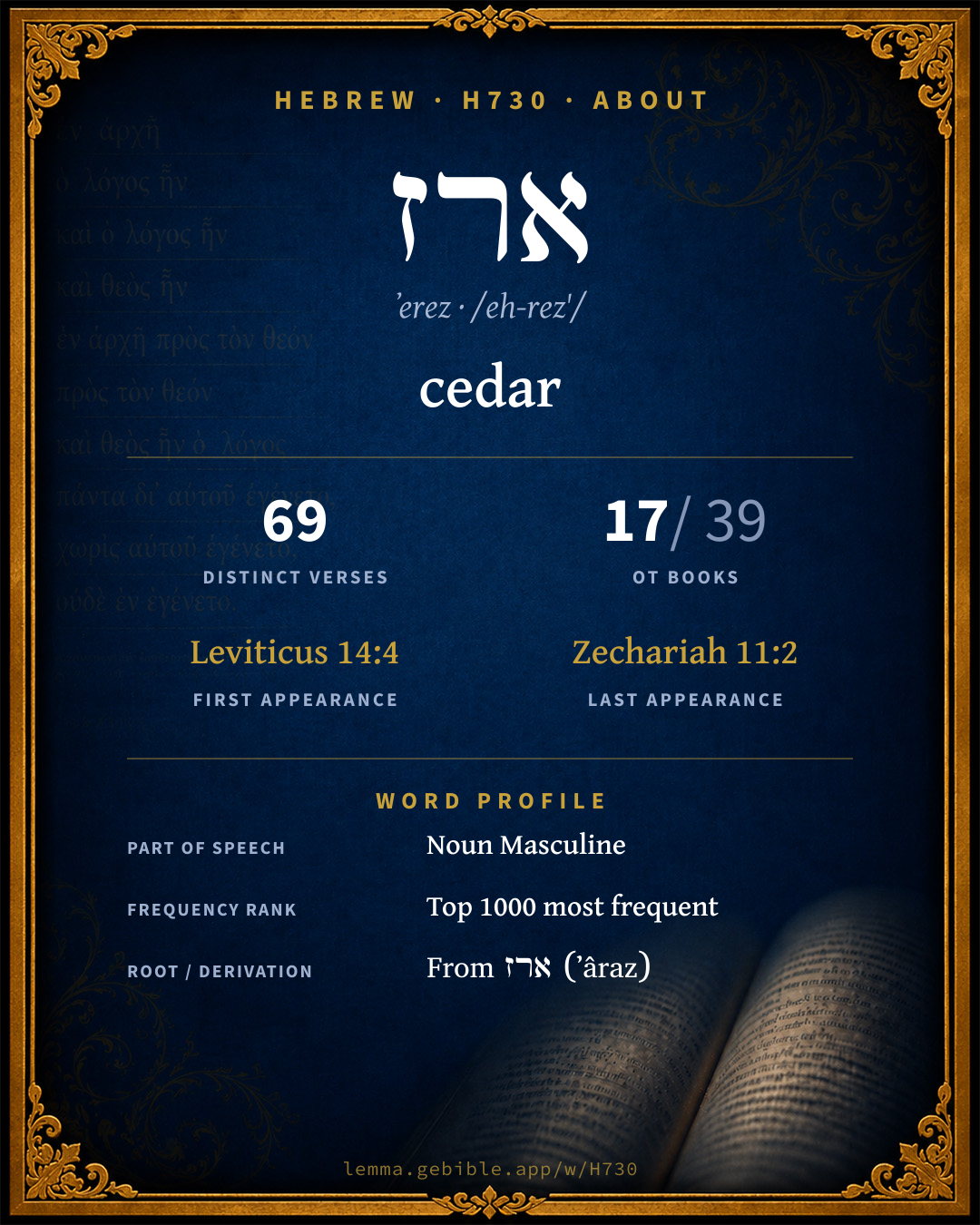
אֶ֫רֶז
cedar
‘cedar’ is one of 4 main senses fuller range ↓
Full lexicon entry — Brown-Driver-Briggs (BDB)
From Brown-Driver-Briggs (BDB)
Where this word appears
See every Absolute-state word in the Hebrew Bible →
Grammar key — what these labels mean
Part of speech
- Noun
- A naming word — a person, place, thing, or idea.
Noun type
- Common
- A common noun — a general class of person, place, or thing (“king,” “city,” “water”), not a specific name.
State
- Absolute
- The independent form of a noun, not bound to a following word.
- Construct
- A noun bound to a following noun in a possessive / “of” relationship (the construct chain).
Gender
- Masculine
- Grammatically masculine.
Number
- Plural
- More than one (in Hebrew, generally three or more).
- Singular
- One.
Grammatical forms
- Noun, Common, Masculine, Plural, Absolute 36 times (49%)
- Noun, Common, Masculine, Singular, Absolute 27 times (37%)
- Noun, Common, Masculine, Plural, Construct 10 times (14%)
Parsed forms decoded from the imported morphology (morphhb / Westminster Leningrad Codex — WLC text public domain, morphhb tagging CC BY 4.0), counted across 73 parsed occurrences — not distinct verses.
Every verse where H730 appears — 69 distinct verses across 17 books. Click any verse to open its interlinear word-by-word view. Verse text shown in the World English Bible for context — . Each verse’s Hebrew form is shown with its reference; the English is not keyword-highlighted, since the data carries no word-level English alignment. Use “Compare translations” on any verse to read it across multiple English versions. This concordance covers the Hebrew Bible; Septuagint (Greek Old Testament) occurrences are not indexed here.
Leviticus 5 verses
- Leviticus 14:4 אֶ֔רֶז n c ms then the priest shall command them to take for him who is to be cleansed two living clean birds, and cedar wood, and scarlet, and hyssop.
- Leviticus 14:6 הָ/אֶ֛רֶז ptcl def.art + n c ms As for the living bird, he shall take it, and the cedar wood, and the scarlet, and the hyssop, and shall dip them and the living bird in the blood of the bird that was killed over the running water.
- Leviticus 14:49 אֶ֔רֶז n c ms To cleanse the house he shall take two birds, and cedar wood, and scarlet, and hyssop.
- Leviticus 14:51 הָ֠/אֶרֶז ptcl def.art + n c ms He shall take the cedar wood, and the hyssop, and the scarlet, and the living bird, and dip them in the blood of the slain bird, and in the running water, and sprinkle the house seven times.
- Leviticus 14:52 הָ/אֶ֛רֶז ptcl def.art + n c ms He shall cleanse the house with the blood of the bird, and with the running water, with the living bird, with the cedar wood, with the hyssop, and with the scarlet;
Numbers 2 verses
- Numbers 19:6 אֶ֛רֶז n c ms and the priest shall take cedar-wood, and hyssop, and scarlet, and cast it into the midst of the burning of the heifer.
- Numbers 24:6 כַּ/אֲרָזִ֖ים prep + n c mp As valleys are they spread forth, As gardens by the river-side, As lign-aloes which Yahweh has planted, As cedar trees beside the waters.
Judges 1 verse
2 Samuel 3 verses
- 2 Samuel 5:11 אֲרָזִ֔ים n c mp Hiram king of Tyre sent messengers to David, and cedar trees, and carpenters, and masons; and they built David a house.
- 2 Samuel 7:2 אֲרָזִ֑ים n c mp that the king said to Nathan the prophet, See now, I dwell in a house of cedar, but the ark of God dwells within curtains.
- 2 Samuel 7:7 אֲרָזִֽים n c mp In all places in which I have walked with all the children of Israel, spoke I a word with any of the tribes of Israel, whom I commanded to be shepherd of my people Israel, saying, Why have you not built me a house of cedar?
1 Kings 18 verses
- 1 Kings 4:33 הָ/אֶ֨רֶז֙ ptcl def.art + n c ms He spoke of trees, from the cedar that is in Lebanon even to the hyssop that springs out of the wall; he spoke also of animals, and of birds, and of creeping things, and of fish.
- 1 Kings 5:6 אֲרָזִ֜ים n c mp Now therefore command you that they cut me cedar trees out of Lebanon; and my servants shall be with your servants; and I will give you hire for your servants according to all that you shall say: for you know that there is not among us any who knows how to cut timber like the Sidonians.
- 1 Kings 5:8 אֲרָזִ֖ים n c mp Hiram sent to Solomon, saying, I have heard [the message] which you have sent to me: I will do all your desire concerning timber of cedar, and concerning timber of fir.
- 1 Kings 5:10 אֲרָזִ֛ים n c mp So Hiram gave Solomon timber of cedar and timber of fir according to all his desire.
- 1 Kings 6:9 בָּ/אֲרָזִֽים prep det + n c mp So he built the house, and finished it; and he covered the house with beams and planks of cedar.
- 1 Kings 6:10 אֲרָזִֽים n c mp He built the stories against all the house, each five cubits high: and they rested on the house with timber of cedar.
- 1 Kings 6:15 אֲרָזִ֔ים n c mp He built the walls of the house within with boards of cedar: from the floor of the house to the walls of the ceiling, he covered them on the inside with wood; and he covered the floor of the house with boards of fir.
- 1 Kings 6:16 אֲרָזִ֔ים n c mp He built twenty cubits on the hinder part of the house with boards of cedar from the floor to the walls [of the ceiling]: he built [them] for it within, for an oracle, even for the most holy place.
- 1 Kings 6:18 וְ/אֶ֤רֶז אֶ֔רֶז conj + n c ms n c ms There was cedar on the house within, carved with buds and open flowers: all was cedar; there was no stone seen.
- 1 Kings 6:20 אָֽרֶז n c ms Within the oracle was [a space of] twenty cubits in length, and twenty cubits in breadth, and twenty cubits in the height of it; and he overlaid it with pure gold: and he covered the altar with cedar.
- 1 Kings 6:36 אֲרָזִֽים n c mp He built the inner court with three courses of hewn stone, and a course of cedar beams.
- 1 Kings 7:2 אֲרָזִ֔ים אֲרָזִ֖ים n c mp n c mp For he built the house of the forest of Lebanon; the length of it was one hundred cubits, and the breadth of it fifty cubits, and the height of it thirty cubits, on four rows of cedar pillars, with cedar beams on the pillars.
- 1 Kings 7:3 בָּ/אֶ֗רֶז prep det + n c ms It was covered with cedar above over the forty-five beams, that were on the pillars; fifteen in a row.
- 1 Kings 7:7 בָּ/אֶ֔רֶז prep det + n c ms He made the porch of the throne where he was to judge, even the porch of judgment: and it was covered with cedar from floor to floor.
- 1 Kings 7:11 וָ/אָֽרֶז conj + n c ms Above were costly stones, even hewn stone, according to measure, and cedar-wood.
- 1 Kings 7:12 אֲרָזִ֑ים n c mp The great court round about had three courses of hewn stone, and a course of cedar beams; like as the inner court of the house of Yahweh, and the porch of the house.
- 1 Kings 9:11 אֲרָזִ֨ים n c mp (now Hiram the king of Tyre had furnished Solomon with cedar trees and fir trees, and with gold, according to all his desire), that then king Solomon gave Hiram twenty cities in the land of Galilee.
- 1 Kings 10:27 הָ/אֲרָזִ֗ים ptcl def.art + n c mp The king made silver to be in Jerusalem as stones, and cedars made he to be as the sycamore trees that are in the lowland, for abundance.
2 Kings 2 verses
- 2 Kings 14:9 הָ/אֶ֜רֶז ptcl def.art + n c ms Jehoash the king of Israel sent to Amaziah king of Judah, saying, The thistle that was in Lebanon sent to the cedar that was in Lebanon, saying, Give your daughter to my son as wife: and there passed by a wild animal that was in Lebanon, and trod down the thistle.
- 2 Kings 19:23 אֲרָזָי/ו֙ n c mp cs + sfx pers 3ms By your messengers you have defied the Lord, and have said, With the multitude of my chariots am I come up to the height of the mountains, to the innermost parts of Lebanon; and I will cut down the tall cedars of it, and the choice fir trees of it; and I will enter into his farthest lodging-place, the forest of his fruitful field.
1 Chronicles 4 verses
- 1 Chronicles 14:1 אֲרָזִ֔ים n c mp Hiram king of Tyre sent messengers to David, and cedar trees, and masons, and carpenters, to build him a house.
- 1 Chronicles 17:1 הָֽ/אֲרָזִ֔ים ptcl def.art + n c mp It happened, when David lived in his house, that David said to Nathan the prophet, Behold, I dwell in a house of cedar, but the ark of the covenant of Yahweh [dwells] under curtains.
- 1 Chronicles 17:6 אֲרָזִֽים n c mp In all places in which I have walked with all Israel, spoke I a word with any of the judges of Israel, whom I commanded to be shepherd of my people, saying, Why have you not built me a house of cedar?
- 1 Chronicles 22:4 אֲרָזִ֖ים אֲרָזִ֛ים n c mp n c mp and cedar trees without number: for the Sidonians and they of Tyre brought cedar trees in abundance to David.
2 Chronicles 5 verses
- 2 Chronicles 1:15 הָ/אֲרָזִ֗ים ptcl def.art + n c mp The king made silver and gold to be in Jerusalem as stones, and cedars made he to be as the sycamore trees that are in the lowland, for abundance.
- 2 Chronicles 2:3 אֲרָזִ֔ים n c mp Solomon sent to Huram the king of Tyre, saying, As you dealt with David my father, and sent him cedars to build him a house in which to dwell, [even so deal with me].
- 2 Chronicles 2:8 אֲרָזִ֜ים n c mp Send me also cedar trees, fir trees, and algum trees, out of Lebanon; for I know that your servants know how to cut timber in Lebanon: and, behold, my servants shall be with your servants,
- 2 Chronicles 9:27 הָ/אֲרָזִ֗ים ptcl def.art + n c mp The king made silver to be in Jerusalem as stones, and cedars made he to be as the sycamore trees that are in the lowland, for abundance.
- 2 Chronicles 25:18 הָ/אֶ֜רֶז ptcl def.art + n c ms Joash king of Israel sent to Amaziah king of Judah, saying, The thistle that was in Lebanon sent to the cedar that was in Lebanon, saying, Give your daughter to my son as wife: and there passed by a wild animal that was in Lebanon, and trod down the thistle.
Ezra 1 verse
Job 1 verse
Psalms 5 verses
- Psalms 29:5 אֲרָזִ֑ים אַרְזֵ֥י n c mp n c mp cs The voice of Yahweh breaks the cedars. Yes, Yahweh breaks in pieces the cedars of Lebanon.
- Psalms 80:10 אַֽרְזֵי n c mp cs The mountains were covered with its shadow. Its boughs were like God's cedars.
- Psalms 92:12 כְּ/אֶ֖רֶז prep + n c ms The righteous shall flourish like the palm tree. He will grow like a cedar in Lebanon.
- Psalms 104:16 אַֽרְזֵ֥י n c mp cs Yahweh's trees are well watered, The cedars of Lebanon, which he has planted;
- Psalms 148:9 אֲרָזִֽים n c mp Mountains and all hills; Fruit trees and all cedars;
Song of Solomon 3 verses
- Song of Solomon 1:17 אֲרָזִ֔ים n c mp The beams of our house are cedars. Our rafters are firs. Beloved
- Song of Solomon 5:15 כָּ/אֲרָזִֽים prep det + n c mp His legs are like pillars of marble set on sockets of fine gold. His appearance is like Lebanon, excellent as the cedars.
- Song of Solomon 8:9 אָֽרֶז n c ms If she is a wall, We will build on her a turret of silver. If she is a door, We will enclose her with boards of cedar. Beloved
Isaiah 6 verses
- Isaiah 2:13 אַרְזֵ֣י n c mp cs For all the cedars of Lebanon, that are high and lifted up, For all the oaks of Bashan,
- Isaiah 9:10 וַ/אֲרָזִ֖ים conj + n c mp The bricks are fallen, but we will build with hewn stone; the sycamores are cut down, but we will put cedars in their place.
- Isaiah 14:8 אַרְזֵ֣י n c mp cs Yes, the fir trees rejoice at you, [and] the cedars of Lebanon, [saying], Since you are laid low, no lumberjack is come up against us.
- Isaiah 37:24 אֲרָזָי/ו֙ n c mp cs + sfx pers 3ms By your servants have you defied the Lord, and have said, With the multitude of my chariots am I come up to the height of the mountains, to the innermost parts of Lebanon; and I will cut down the tall cedars of it, and the choice fir trees of it; and I will enter into its farthest height, the forest of its fruitful field;
- Isaiah 41:19 אֶ֣רֶז n c ms I will put in the wilderness the cedar, the acacia, and the myrtle, and the oil tree; I will set in the desert the fir tree, the pine, and the box tree together:
- Isaiah 44:14 אֲרָזִ֔ים n c mp He cuts down cedars for himself, and takes the cypress and the oak, and strengthens for himself one among the trees of the forest: he plants a fir tree, and the rain nourishes it.
Jeremiah 4 verses
- Jeremiah 22:7 אֲרָזֶ֔י/ךָ n c mp cs + sfx pers 2ms I will prepare destroyers against you, everyone with his weapons; and they shall cut down your choice cedars, and cast them into the fire.
- Jeremiah 22:14 בָּ/אָ֔רֶז prep det + n c ms who says, I will build me a wide house and spacious chambers, and cuts him out windows; and it is ceiling with cedar, and painted with vermilion.
- Jeremiah 22:15 בָ/אָ֑רֶז prep det + n c ms Shall you reign, because you strive to excel in cedar? Didn't your father eat and drink, and do justice and righteousness? then it was well with him.
- Jeremiah 22:23 בָּֽ/אֲרָזִ֑ים prep det + n c mp Inhabitant of Lebanon, who makes your nest in the cedars, how greatly to be pitied shall you be when pangs come on you, the pain as of a woman in travail!
Ezekiel 6 verses
- Ezekiel 17:3 הָ/אָֽרֶז ptcl def.art + n c ms and say, Thus says the Lord Yahweh: A great eagle with great wings and long feathers, full of feathers, which had various colors, came to Lebanon, and took the top of the cedar:
- Ezekiel 17:22 הָ/אֶ֛רֶז ptcl def.art + n c ms Thus says the Lord Yahweh: I will also take of the lofty top of the cedar, and will set it; I will crop off from the topmost of its young twigs a tender one, and I will plant it on a high and lofty mountain:
- Ezekiel 17:23 לְ/אֶ֣רֶז prep + n c ms in the mountain of the height of Israel will I plant it; and it shall bring forth boughs, and bear fruit, and be a goodly cedar: and under it shall dwell all birds of every wing; in the shade of the branches of it shall they dwell.
- Ezekiel 27:5 אֶ֤רֶז n c ms They have made all your planks of fir trees from Senir; they have taken a cedar from Lebanon to make a mast for you.
- Ezekiel 31:3 אֶ֣רֶז n c ms Behold, the Assyrian was a cedar in Lebanon with beautiful branches, and with a forest-like shade, and of high stature; and its top was among the thick boughs.
- Ezekiel 31:8 אֲרָזִ֣ים n c mp The cedars in the garden of God could not hide it; the fir trees were not like its boughs, and the plane trees were not as its branches; nor was any tree in the garden of God like it in its beauty.
Amos 1 verse
Zechariah 2 verses
- Zechariah 11:1 בַּ/אֲרָזֶֽי/ךָ prep + n c mp cs + sfx pers 2ms Open your doors, Lebanon, That the fire may devour your cedars.
- Zechariah 11:2 אֶ֔רֶז n c ms Wail, fir tree, for the cedar has fallen, Because the stately ones are destroyed. Wail, you oaks of Bashan, For the strong forest has come down.
About this entry
At a glance — auto-summarized from this page’s data, not written by a person. Every figure links to its source below. This summary describes the numbers; it doesn’t interpret them.
“cedar” is the headline sense of the Hebrew noun ארז (ʼerez). Its meaning spans more than one sense — see its full sense range. It appears 69 verses across 17 books of the Hebrew Bible, among its moderately common vocabulary. More than a quarter of its appearances fall in 1 Kings. First canonically at Leviticus 14:4, it enters the text early. See the sense tree, 69-verse concordance, and the renderings breakdown below.
Gloss history
Strong's 1890 vs modern scholarship
About this word
Strong's H730 catalogs a Hebrew word from the Hebrew Old Testament.
These counts are not copied from any lexicon or concordance. They are computed here, from the morphology-tagged Hebrew Old Testament. What Lemma adds →
- 69
- distinct verses
- The word appears in 69 distinct verses.
- 17 / 39
- OT books
- The word appears in 17 of 39 Old Testament books.
- #542
- by frequency
- Top 1000 most frequent Hebrew words (rank 542 of 8,640 Hebrew words by occurrence).
View all 69 occurrences in the concordance →
By section of the Old Testament
By traditional corpus
Conventional, traditional groupings — biblical authorship is debated, so this is a traditional corpus grouping, not an authorship claim. Each share is this word’s portion of its verses in that division of the Hebrew canon. Each figure is a share of the word’s 69 distinct verses.
- Prophets (Nevi'im) 43 verses · 62%
- Writings (Ketuvim) 19 verses · 28%
- Torah (Pentateuch) 7 verses · 10%
How translations render this word
Counts come from each version’s own published word-to-Strong’s tagging or interlinear alignment — an approximate guide to how each version renders this word, not a word-level alignment the data otherwise carries. Because each total is that version’s own tagged count, the per-version totals vary from one another and need not match the appearance or distinct-verse counts above. These counts may also differ from a printed concordance because Lemma counts each distinctly tagged rendering and does not collapse phrase taggings into a single head-word total. This is a fixed set of word-tagged versions (KJV, ASV, BSB, ULT) and does not change with the reading translation you choose elsewhere. Each version’s license is shown beside its name below (and on Sources).
- King James Version: Cedar 36×, Cedars 20×, Cedar trees 5×
- American Standard Version: Cedar 39×, Cedars 15×, Cedar-trees 3×
- Berean Standard Bible: Cedar 41×, Cedars 21×, Along with cedar 2×
- unfoldingWord Literal Text: Cedar 37×, Cedars 23×, Cedars of 5×
King James Version Public Domain
Renders H730 across 73 tagged occurrences — most commonly:
Plus 10 renderings that appear only once — usually multi-word phrases or single function words the recovered tagging swept in, not distinct renderings.
American Standard Version Public Domain
Renders H730 across 72 tagged occurrences — most commonly:
Plus 15 renderings that appear only once — usually multi-word phrases or single function words the recovered tagging swept in, not distinct renderings.
Berean Standard Bible Public Domain
Renders H730 across 73 tagged occurrences — most commonly:
Plus 7 renderings that appear only once — usually multi-word phrases or single function words the recovered tagging swept in, not distinct renderings.
unfoldingWord Literal Text CC BY-SA 4.0
Renders H730 across 74 tagged occurrences — most commonly:
Plus 7 renderings that appear only once — usually multi-word phrases or single function words the recovered tagging swept in, not distinct renderings.
Senses in the full BDB
What do BDB’s symbols mean?
BDB uses these scholarly abbreviations:
| Symbol | Meaning |
|---|---|
| 𝔊 | the Septuagint (the ancient Greek translation, LXX) |
| 𝔙 | the Vulgate (the Latin translation) |
| 𝔖 | the Syriac version (the Peshitta) |
| 𝔗 | the Targum (the Aramaic translation) |
| ψ | the Psalms |
| √ | root (the underlying root or stem) |
| ‖ | parallel passage (a synonymous or contrasted parallel) |
| † | the dagger: every passage where the word occurs is cited |
The 3 senses and sub-senses the full Brown-Driver-Briggs lexicon distinguishes for this word, in lexicon order (not ranked by frequency), with BDB’s own verbatim wording and sub-sense lettering. Shown in Hebrew script with BDB’s own scholarly abbreviations. The condensed entry is in the Lexicon Entry tab. See also the Forms in the corpus table below.
- 1. cedar-tree, (a) as growing Nu 24:6 ψ 148:9; Is 41:19; 44:14 cf. Ez 31:8; especially as growing on Lebanon 1 K 5:13; 2 K 14:9 = 2 Ch 25:18 (both in fable of Jehoash); often אַרְזֵי (הַ)לְּבָנוֹן Ju 9:15 Is 2:13; 14:8 ψ 29:5(×2) (fig.) 104:16, cf. 1 K 5:20 2 K 19:23 = Is 37:24; ψ 92:13; Ct 5:15; Ez 27:5 (sg. coll.) Zc 11:1, 2 (fig.); Ct 1:17; Ezr 3:7; Je 22:23 (fig.) Ez 17:3 (fig.); (b) especially in sim., of outward power, stateliness & majesty ψ 80:11 (א׳ אֵל) cf. Ez 31:3 (personif., but v. Co on text), Am 2:9; of individuals Je 22:7; ψ 92:13; Ez 17:22, 23; cf. other exx. of fig. use, supr.; sim. of straightness & strength Jb 40:17 (tail of hippopotamus). e.g. Numbers 24:6
- 2. cedar-timber, cedar-wood for building, עֲצֵי אֲרָזִים 2 S 5:11; 1 K 5:22, 24; 6:10; 9:11; 1 Ch 14:1; 22:4(×2) 2 Ch 2:7; Ezr 3:7; without עֵץ 2 S 7:2, 7; 1 K 6:9, 15, 16, 18(×2), 20, 36; 7:2(×2), 3, 7, 11, 12; 10:27; 1 Ch 17:1, 6; 2 Ch 1:15; 2:2; 9:27 & Ct 8:9; Is 9:9; Je 22:14, 15 (cf. also Is 44:14; 1 K 5:20; Ez 27:5 supr.) e.g. 2 Samuel 5:11
- 3. cedar-wood used in purifications, c. עֵץ Lv 14:4, 6, 49, 51, 52 Nu 19:6 (all P). e.g. Leviticus 14:4
Senses from the full Brown-Driver-Briggs lexicon (Brown, Driver, Briggs; Oxford 1906 — public domain), digitized via Sefaria, supplemented by the OpenScriptures HebrewLexicon (CC BY 4.0). Full attribution on Sources.
Word origin
n.m. Ez 17:23 cedar;—f. Ez 17:22 א׳ הָרָמָה, but del. הרמה 𝔊 Co;—(Arabic أَرْزٌ pine-tree, etc.; Ethiopic አርዝ Syriac ܐܰܪܙܳܐ )—א׳ abs. Lv 14:4 + 19 times, אָ֑רֶז Jb 40:17 + 6 times; pl. אֲרָזִים Is 9:9 + 35 times; cstr. אַרְזֵי Is 2:13 + 5 times; sf. אֲרָזֶיךָ Je 22:7; Zc 11:1; אֲרָזָיו Is 37:24 = 2 K 19:23;—
— Brown-Driver-Briggs (Oxford 1906, public domain), digitized via Sefaria, supplemented by the OpenScriptures HebrewLexicon (CC BY 4.0). See Sources.
Derived from ארז (ʼâraz) (H729) — firm.
Jastrow Dictionary
A second Hebrew/Aramaic lexicon for comparison, covering Aramaic and post-biblical (Talmudic, Targumic, Midrashic) usage that the biblical-Hebrew BDB does not. Matched by lemma rather than by Strong’s number, so a lemma may carry more than one Jastrow headword (shown separately below), and the entries cover usage well beyond the Bible.
*ארז
- (√אר, v. ארר; cmp. חרז)
- 1. to penetrate deeply, to take deep root.
- 2. to be prickly, dry, hard. Sabb. 155ᵃ זירין דאַרְזֵי Zirin are called bundles of twigs which are hard. Ib. כיפין דא׳; [oth. opin., v. אַרְזָא]. Denom. אוּרְזָא, אָרוּזָא, a. next ws.
אֶרֶז
- (b. h.) cedar. Tam. III, 5 של א׳ of cedar wood.—Pl. אֲרָזִים. R. Hash. 23ᵃ; Taan. 25ᵇ; a. e.—Metaph. prominent men, scholars. Sabb. 118ᵇ I planted חמשה א׳ five cedars (begot five sons who acquired renown). M. Kat. 25ᵇ, v. אֵזוֹב.
A Dictionary of the Targumim, the Talmud Babli and Yerushalmi, and the Midrashic Literature (Marcus Jastrow; London, Luzac, 1903) — Public Domain. Digitized via Sefaria. Digitized via Sefaria. Full attribution on Sources.
Forms in the corpus
The 43 distinct written forms H730 takes in the Hebrew Bible, most frequent first — each parse links to that state’s occurrences in the concordance. Hebrew forms include their vowel points and cantillation, so a single lemma takes many written forms.
Same root — word family
Other BDB entries built from the same root as H730, grouped by Strong’s listed origin. These share a root / origin per the lexicon — not necessarily a shared meaning. Each links to that word’s own entry.
Derives from
Derived from this word
Compare all same-root words → They share a root, not necessarily a meaning.
Septuagint verse parallels
This word appears in 64 verses that also exist in the Greek Old Testament (Septuagint), out of the 69 Hebrew verses it occurs in. You can read those verses in Greek by switching the Old Testament edition to the Septuagint.
Read these verses in the Septuagint
- Leviticus 14:4
- Numbers 19:6
- Judges 9:15
- 2 Samuel 5:11
- 1 Kings 5:10
- 2 Kings 14:9
- 1 Chronicles 14:1
- 2 Chronicles 1:15
- Ezra 3:7
- Job 40:17
- Psalms 29:5
- Song of Solomon 1:17
This is a verse-level parallel only — the same verses exist in both the Hebrew and Greek Old Testaments. No word-level Hebrew↔Greek correspondence is claimed: the data carries no such alignment, so no Greek word is shown as this Hebrew word’s translation. Coverage is not total — the Septuagint omits the deuterocanon and renumbers the Psalms, so some Hebrew verses have no direct Greek parallel.