Ezekiel 31:3

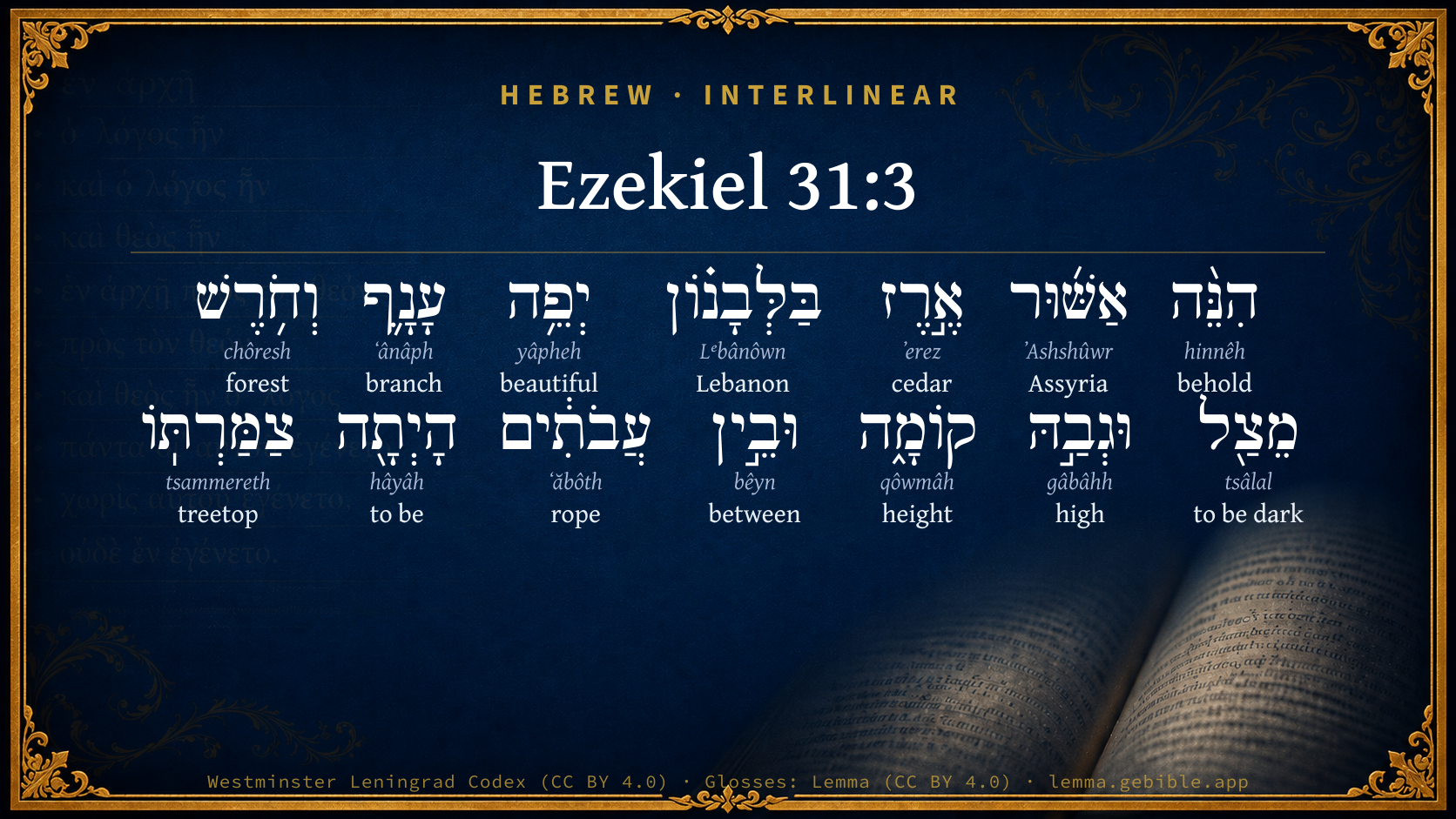
Hebrew (Westminster Leningrad Codex) Ezekiel 31:3 appears in the Hebrew Old Testament. The text above is from the Westminster Leningrad Codex. Each word links to its Strong’s number, a concise gloss, and parsing drawn from the Open Scriptures Hebrew Bible morphology. Click any word for its full Brown-Driver-Briggs (BDB) entry.
Download image
Cite this verse

Ezekiel 31:3 (World English Bible). Public Domain. Lemma interlinear Bible study tool, https://lemma.gebible.app/v/ezekiel/31/3.

Show BibTeX & RIS
BibTeX
RIS
English Translation
Behold, the Assyrian was a cedar in Lebanon with beautiful branches, and with a forest-like shade, and of high stature; and its top was among the thick boughs.
World English Bible · Public Domain
Download a study sheet

One document with this verse’s original text, its word-by-word gloss line, the meaning frame, cross-references with their text, attributed commentary, and full source and license credits — printable, and it pastes into notes with its structure intact.

This verse Autodidact and up

Study sheet (.html) Plain text (.txt)

A passage Seminary Student

Up to 50 verses in one chapter. A passage sheet keeps up to 6 commentary sources and 12 cross-references per verse, in the order this page ranks them, and says so on the sheet whenever that leaves anything out. Ask for a single verse and you get the Autodidact verse sheet above.

Everything on this page stays free to read, with no account — the sheet is a download of what is already on screen, not access to it.

Want to remove ads? Support Godless Engineer
Compare translations 3

The same verse in 3 English versions, stacked beneath the original-language interlinear above. Click any original word for its lexicon entry.

Each is an independent rendering of the whole verse — the interlinear is not word-aligned to these translations.

Highlighted words mark where these versions differ — a whole-verse word diff, not a word-by-word alignment.

  • World English Bible Public Domain
    Behold, the Assyrian was a cedar in Lebanon with beautiful branches, and with a forest-like shade, and of high stature; and its top was among the thick boughs.
  • King James Version Public Domain
    Behold, the Assyrian was a cedar in Lebanon with fair branches, and with a shadowing shroud, and of an high stature; and his top was among the thick boughs.
  • unfoldingWord Literal Text CC BY-SA 4.0
    Behold! Assyria was a cedar in Lebanon with beautiful branches, giving shade to the forest, and the tallest in height, and the branches formed its treetop.

unfoldingWord Literal Text — © unfoldingWord, licensed CC BY-SA 4.0. Word-aligned USFM3 via Door43 (git.door43.org/unfoldingWord/en_ult).

Versions to compare (up to 4)

3 of 4 selected

Show all 18 translations

Every available English version of this verse, each an independent rendering of the whole verse.

  • World English Bible Public Domain
    Behold, the Assyrian was a cedar in Lebanon with beautiful branches, and with a forest-like shade, and of high stature; and its top was among the thick boughs.
  • Berean Standard Bible Public Domain
    Look at Assyria, a cedar in Lebanon, with beautiful branches that shaded the forest. It towered on high; its top was among the clouds.
  • Majority Standard Bible Public Domain
    Look at Assyria, a cedar in Lebanon, with beautiful branches that shaded the forest. It towered on high; its top was among the clouds.
  • King James Version Public Domain
    Behold, the Assyrian was a cedar in Lebanon with fair branches, and with a shadowing shroud, and of an high stature; and his top was among the thick boughs.
  • American Standard Version (1901) Public Domain
    Behold, the Assyrian was a cedar in Lebanon with fair branches, and with a forest-like shade, and of high stature; and its top was among the thick boughs.
  • Revised Version (1885) Public Domain
    Behold, the Assyrian was a cedar in Lebanon with fair branches, and with a shadowing shroud, and of an high stature; and his top was among the thick boughs.
  • Geneva Bible (1599) Public Domain
    Beholde, Asshur was like a cedar in Lebanon with faire branches, and with thicke shadowing boughes, and shot vp very hye, and his toppe was among the thicke boughes.
  • Douay-Rheims (1899) Public Domain
    Behold, the Assyrian was like a cedar in Libanus, with fair branches, and full of leaves, of a high stature, and his top was elevated among the thick boughs.
  • Young's Literal Translation Public Domain
    Lo, Asshur, a cedar in Lebanon, Fair in branch, and shading bough, and high in stature, And between thickets hath its foliage been.
  • Literal Standard Version CC BY-SA 4.0
    Behold, Asshur, a cedar in Lebanon, || Beautiful in branch, and shading bough, and high in stature, || And its foliage has been between thickets.
  • Unlocked Literal Bible CC BY-SA 4.0
    Behold! Assyria was a cedar in Lebanon with beautiful branches, giving shade to the forest, and the tallest in height, and the branches formed its treetop.
  • unfoldingWord Literal Text CC BY-SA 4.0
    Behold! Assyria was a cedar in Lebanon with beautiful branches, giving shade to the forest, and the tallest in height, and the branches formed its treetop.
  • Darby Bible Public Domain
    Behold, Assyria was a cedar in Lebanon, with fair branches and a shadowing shroud, and of a high stature: and his top was amidst the thick boughs.
  • World Messianic Bible Public Domain
    Behold, the Assyrian was a cedar in Lebanon with beautiful branches, and with a forest-like shade, of high stature; and its top was among the thick boughs.
  • Webster's Bible Public Domain
    Behold, the Assyrian was a cedar in Lebanon with fair branches, and with a shady cover, and of a high stature; and his top was among the thick boughs.
  • Free Bible Version CC BY-SA 4.0
    Look at Assyria. It was like a cedar in Lebanon, with its beautiful branches providing shade in the forest. It was so high that its top reached the clouds.
  • Bible in Basic English Public Domain
    See, a pine-tree with beautiful branches and thick growth, giving shade and very tall; and its top was among the clouds.
  • JPS Tanakh (1917) Public Domain
    Behold, the Assyrian was a cedar in Lebanon, with fair branches, and with a shadowing shroud, and of a high stature; and its top was among the thick boughs.

Literal Standard Version (2020), Covenant Press — licensed CC BY-SA 4.0. Text via the HelloAO Bible API (eBible.org). Unlocked Literal Bible (unfoldingWord) — licensed CC BY-SA 4.0. Text via the HelloAO Bible API (eBible.org). unfoldingWord Literal Text — © unfoldingWord, licensed CC BY-SA 4.0. Word-aligned USFM3 via Door43 (git.door43.org/unfoldingWord/en_ult). Free Bible Version, Dr. Jonathan Gallagher — licensed CC BY-SA 4.0. Text via the HelloAO Bible API (eBible.org).

Word by word

More ways to search: Search by grammar → Find every occurrence → Compare this word →

Practice this passage: Drill this verse → Learn its vocabulary →

מֵצַ֖ל
tsâlal
H6751
“being dark”
Verb, Hiphil, Participle Active, Masculine, Singular, Absolute
Part of Speech
Verb
Stem
Hiphil
Form
Participle Active
Gender
Masculine
Number
Singular
State
Absolute
Full BDB Definition

Origin: a primitive root [identical with H6749 through the idea of hovering over (compare H6754 )]

TWOT: 1921

to be or become or grow dark - (Qal) to become or grow dark - (Hiphil) to shadow
  1. הִנֵּ֨ה hinnêh H2009 “behold” Particle, Demonstrative
  2. אַשּׁ֜וּר ʼAshshûwr H804 “Assyria” Noun, Proper
  3. אֶ֣רֶז ʼerez H730 “cedar” Noun, Common, Masculine, Singular, Absolute
  4. בַּלְּבָנ֗וֹן Lᵉbânôwn H3844 “in/at the · Lebanon” Preposition, Determined + Noun, Proper
  5. יְפֵ֥ה yâpheh H3303 “beautiful of” Adjective, Adjective, Masculine, Singular, Construct
  6. עָנָ֛ף ʻânâph H6057 “branch” Noun, Common, Masculine, Singular, Absolute
  7. וְחֹ֥רֶשׁ chôresh H2793 “and · forest” Conjunction + Noun, Common, Masculine, Singular, Absolute
  8. וּגְבַ֣הּ gâbâhh H1362 “and · high of” Conjunction + Adjective, Adjective, Masculine, Singular, Construct
  9. קוֹמָ֑ה qôwmâh H6967 “height” Noun, Common, Feminine, Singular, Absolute
  10. וּבֵ֣ין bêyn H996 “and · between” Conjunction + Preposition
  11. עֲבֹתִ֔ים ʻăbôth H5688 “ropes” Noun, Common, Both, Plural, Absolute
  12. הָיְתָ֖ה hâyâh H1961 “to be” Verb, Qal, Perfect, 3rd Person, Feminine, Singular
  13. צַמַּרְתּֽוֹ tsammereth H6788 “treetop · his” Noun, Common, Feminine, Singular, Construct + Suffix, Personal, 3rd Person, Masculine, Singular

About this verse

These counts appear in no published source. They are computed here, from the morphology-tagged text and Lemma’s own curated glosses. What Lemma adds →

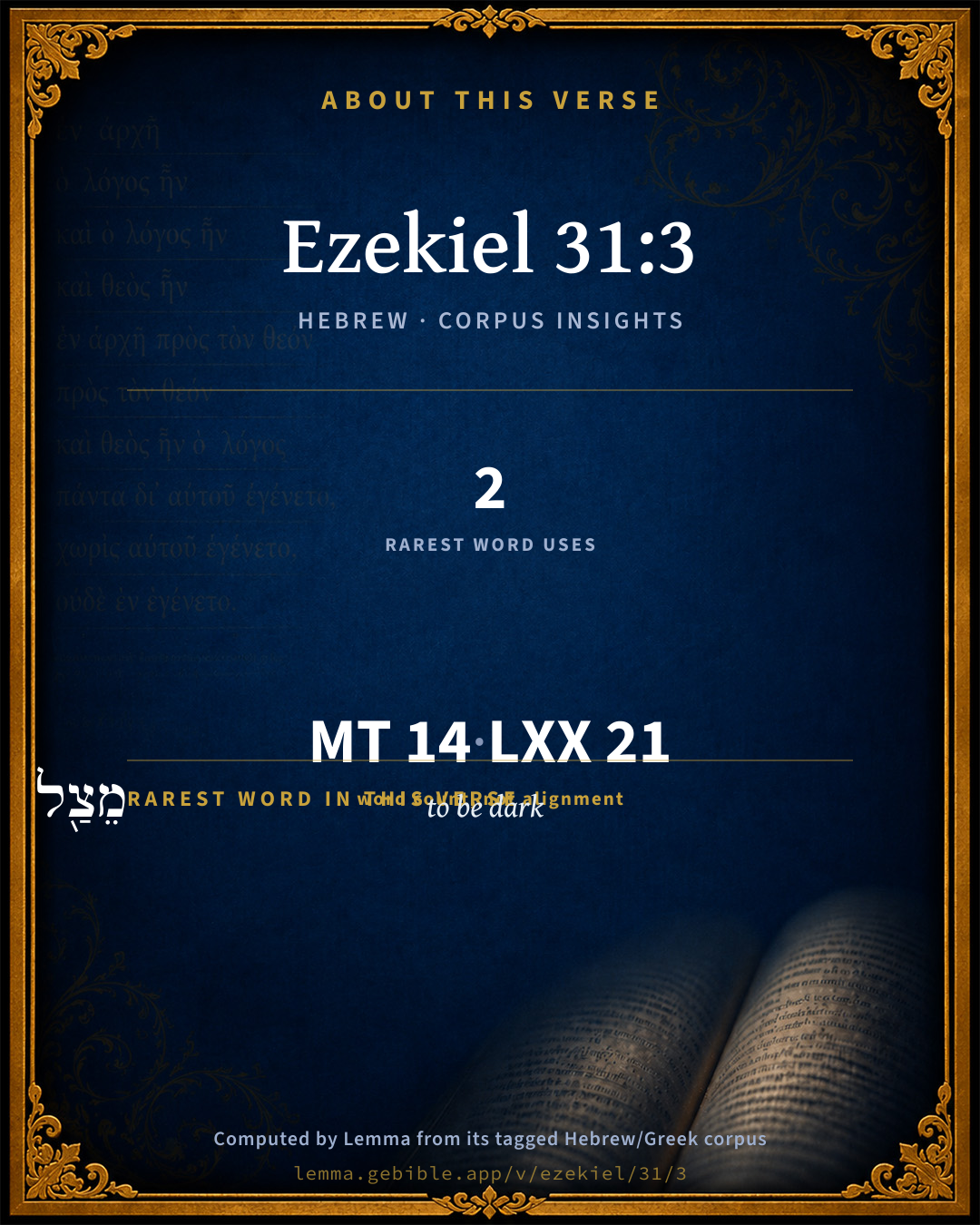
14
words
14
distinct lemmas
Prophets
section

Notable vocabulary

The rarest word here is מֵצַ֖ל to be dark H6751 — appearing just 2 times in the whole Hebrew Bible.

Shared distinctive vocabulary

מֵצַ֖ל to be dark H6751 occurs in 2 verses of the Hebrew Bible. Also found in:

Grammatical profile

  • 2 verbs
  • 8 nouns
  • 2 adjectives
  • 1 preposition
  • 1 particle

Verb forms

  • מֵצַ֖ל Hiphil · Participle Active
  • הָיְתָ֖ה Qal · Perfect

Hebrew & Septuagint length

In English translation the verse runs 28 words from the Hebrew and 26 from the Septuagint (LXX English) — closely comparable.

A rough comparison of the two English renderings, which tokenize alike — not a word-level alignment.

Word counts can differ between the Hebrew and the Greek without any difference in meaning — e.g. the Hebrew direct-object marker אֵת has no separate Greek word, and Greek often adds the article ὁ.

In the original languages it is 14 Hebrew tokens and 21 Greek tokens — but the two are counted differently (Hebrew bundles its prefixes and suffixes into one token; the Greek is in lemma form), so that isn’t a like-for-like length.

Cross-references

13

Topical passages linked to Ezekiel 31:3 in the Treasury of Scripture Knowledge — connected by theme and wording, ordered by reader-vote popularity; previews shown in the World English Bible.

  • Isaiah 10:33–34 Behold, the Lord, Yahweh of Hosts, will lop the boughs with terror: and the high of stature shall be hewn down, and the lofty shall be brought low.
  • Daniel 4:10 Thus were the visions of my head on my bed: I saw, and, behold, a tree in the midst of the earth; and the height of it was great.
  • Daniel 4:20–23 The tree that you saw, which grew, and was strong, whose height reached to the sky, and the sight of it to all the earth;
  • Judges 9:15 The bramble said to the trees, If in truth you anoint me king over you, then come and take refuge in my shade; and if not, let fire come out of the bramble, and devour the cedars of Lebanon.
  • Ezekiel 17:3–4 and say, Thus says the Lord Yahweh: A great eagle with great wings and long feathers, full of feathers, which had various colors, came to Lebanon, and took the top of the cedar:
  • Ezekiel 17:22 Thus says the Lord Yahweh: I will also take of the lofty top of the cedar, and will set it; I will crop off from the topmost of its young twigs a tender one, and I will plant it on a high and lofty mountain:
  • Isaiah 37:24 By your servants have you defied the Lord, and have said, With the multitude of my chariots am I come up to the height of the mountains, to the innermost parts of Lebanon; and I will cut down the tall cedars of it, and the choice fir trees of it; and I will enter into its farthest height, the forest of its fruitful field;
  • Ezekiel 31:6 All the birds of the sky made their nests in its boughs; and under its branches did all the animals of the field bring forth their young; and under its shadow lived all great nations.
  • Ezekiel 31:16 I made the nations to shake at the sound of his fall, when I cast him down to Sheol with those who descend into the pit; and all the trees of Eden, the choice and best of Lebanon, all that drink water, were comforted in the lower parts of the earth.
  • Daniel 4:12 The leaves of it were beautiful, and the fruit of it much, and in it was food for all: the animals of the field had shadow under it, and the birds of the sky lived in the branches of it, and all flesh was fed from it.
  • Nahum 3:1–19 Woe to the bloody city! It is all full of lies and robbery. The prey doesn't depart.
  • Zephaniah 2:13 He will stretch out his hand against the north, destroy Assyria, and will make Nineveh a desolation, and dry like the wilderness.
  • Zechariah 11:2 Wail, fir tree, for the cedar has fallen, Because the stately ones are destroyed. Wail, you oaks of Bashan, For the strong forest has come down.

Cross-references courtesy of OpenBible.info (CC BY 4.0).

Hebrew and Greek witnesses Masoretic Hebrew ↔ Greek Septuagint

The same verse in the two great witnesses to the Old Testament, shown verse-for-verse.

These are two independent witnesses, not word-aligned to each other, and the Septuagint is shown in lemma (dictionary) form.

Hebrew Ezekiel 31:3 Masoretic · Westminster Leningrad Codex

הִנֵּ֨ה אַשּׁ֜וּר אֶ֣רֶז בַּלְּבָנ֗וֹן יְפֵ֥ה עָנָ֛ף וְחֹ֥רֶשׁ מֵצַ֖ל וּגְבַ֣הּ קוֹמָ֑ה וּבֵ֣ין עֲבֹתִ֔ים הָיְתָ֖ה צַמַּרְתּֽוֹ

Behold, the Assyrian was a cedar in Lebanon with beautiful branches, and with a forest-like shade, and of high stature; and its top was among the thick boughs.

World English Bible · Public Domain

Greek LXX Ezekiel 31:3 Septuagint · lemma form

ἰδού ασσουρ κυπάρισσος ἐν ὁ λίβανος καί καλός ὁ παραφυάς καί ὑψηλός ὁ μέγεθος εἰς μέσος νεφέλη γίγνομαι ὁ ἀρχή αὐτός

Behold, the Assyrian was a cypress in Libanus, and was fair in shoots, and high in stature: his top reached to the midst of the clouds.

LXX2012 (modern English Septuagint) · Public Domain

On this verse, The Cambridge Bible for Schools and Colleges discusses the Septuagint’s reading. Read the note in Commentary ↓

Hebrew: Westminster Leningrad Codex (CC BY 4.0). Greek: Septuagint (public domain); English from LXX2012 (modern English Septuagint) (Public Domain). How the Septuagint differs from the Hebrew →

Targum (Aramaic paraphrase)

1

The Targum is the ancient Jewish Aramaic paraphrase of the Hebrew Scriptures — an interpretive translation, not the Hebrew text itself. Onkelos (literal) and Pseudo-Jonathan (expansive) render the Torah, and Jonathan the Prophets. Coverage is partial: where no permissively-licensed English translation exists for a verse, only the Aramaic is shown. This is verse-level text, not a word-by-word alignment to the Hebrew.

  1. Targum Jonathan Prophets (Joshua–Malachi)
    הָא אַתּוּרָאָה דַמְיָא לְאַרְזָא בְּלִבְנָן דְנוֹפֵיהּ שַׁפִּיר וְסוֹכֵיהּ מַטְלָן וְרָם בְקוֹמָה וְעַל נַגְדִין שָׁלַח שָׁרְשׁוֹהִי:

    (no public-domain English translation for this verse)

    Targum Jonathan — Aramaic: “Mikraot Gedolot” (public domain). English: “Sefaria Community Translation” (CC0 1.0 (public-domain dedication)); “London "Chaldee Paraphrase," 1871” (public domain). Text via Sefaria.

Commentary

Notes on Ezekiel 31:3 from classic Christian and Jewish commentators (each source and its license shown beneath its notes). The classic Christian expositions comment on the surrounding passage and are grouped to its opening verse, so a note may address several verses; the Jewish commentaries on the Tanakh (Rashi and others) are per-verse, so they appear only where the commentator wrote on this verse.

Lemma curates 59 commentaries, every one of them public domain or Creative Commons licensed, each selected and text-cleaned for this edition rather than reprinted as found. About our sources →

The Cambridge Bible for Schools and Colleges

gen. ed. J. J. S. Perowne

3. the Assyrian was a cedar] It is evident that the Assyrian has nothing to do here; any comparison of Egypt to Assyria is without motive. Besides Eze_31:3 is repeated in Eze_31:10, and spoken of Egypt (cf. Eze_31:18). The word “asshur” here is the name of a tree, either the same as teasshur (ch. Eze_27:6), or this form should be read. Render: Behold a stately cedar in Lebanon (lit. a teasshur of a cedar); or, behold a sherbin, a cedar in Lebanon—the more general “cedar” being added after the species.

a shadowing shrowd] The “shroud,” usually “forest,” must refer to the closely interwoven branches, hardly to the underwood. The phrase is wanting in LXX.

the thick boughs] The clouds, so Eze_31:10; Eze_31:14; cf. Eze_19:11.

The Cambridge Bible for Schools and Colleges (gen. ed. J. J. S. Perowne; Cambridge University Press, 1878–1918) — public domain. Text from a community e-Sword module.

Trapp's Complete Commentary

John Trapp

Eze 31:3 Behold, the Assyrian [was] a cedar in Lebanon with fair branches, and with a shadowing shroud, and of an high stature; and his top was among the thick boughs.

Ver. 3. Behold, the Assyrian was a cedar.] See Eze 17:3; Eze 17:22-23 Dan 4:10-11. {See Trapp on "Eze 17:3"} {See Trapp on "Eze 17:22"} {See Trapp on "Eze 17:23"} {See Trapp on "Dan 4:10"} {See Trapp on "Dan 4:11"} The cedar is a very tall, fair, shady, leafy, and lively tree. Such was Esarhaddon, King of Assyria, once a most potent monarch, now not the master of a mole hill. Now, therefore (by an argument from the greater to the less), if he so fell through his pride, shalt not thou much more?

John Trapp, A Commentary or Exposition upon All the Books of the Old and New Testament (1647–1656) — public domain. Text from a community e-Sword module.

Joseph Benson's Commentary

Eze 31:3-9. Behold the Assyrian — This, says Archbishop Secker, seems an admonitory comparison of Pharaoh to the late Assyrian monarch, applied to Pharaoh, Eze 31:18. By the Assyrian, compared here to a tall and fair cedar, such as grew in mount Lebanon, Archbishop Usher and Dr. Prideaux understand that king of Assyria whom some call Chyniladanus, others Saracus, of whom it seems the words of the Prophet Nahum (Nah 3:18) are to be understood. In like manner Zephaniah joins the destruction of Assyria and the desolation of Nineveh together, Zep 2:13. Nabopolassar, the king of Babylon, and Cyaxares, the king of Media, called by the names of Nebuchadonosor and Assuerus in Tobit, (chap. Eze 14:15,) joining their forces together against him, besieged Nineveh, took it, and, after having slain the king, utterly destroyed that great and famous city, and put an end to that part of the Assyrian empire, Nabopolassar having before possessed himself of the other part, which was properly called the Babylonian empire. See Dr. Prideaux, p. 45. In this remarkable catastrophe the prophecies of Jonah, Nahum, and Zephaniah, foretelling the destruction of Nineveh, were fulfilled. His top was among the thick boughs — He overtopped all the other flourishing trees. The waters made him great — “As trees flourish by a river side, so the traffic of the several branches of the river Tigris, upon which Nineveh was situate, made that city and kingdom rich and populous, and she imparted her wealth and stores among the neighbouring provinces.” — Lowth. Therefore his height was exalted, &c. — He became greater than all the kings about him. The greatness of Nebuchadnezzar’s power and kingdom is set forth under the same emblem, Dan 4:10, &c. All the fowls made their nests in his boughs — Several nations applied to him for protection, and thought themselves and all their concerns safe under his government. Under his branches did all the beasts of the field bring forth, &c. — Under the protection of his extensive empire did the people increase, and the countries become more populous. The cedars in the garden of God could not hide him, &c. — He overtopped the goodly cedars, called in the Hebrew the cedars of God, Psa 80:9; such fair ones as might be supposed to have grown in paradise. The expressions are all allegorical, signifying the super-eminent greatness of the king of Assyria, and how much more powerful he was than any other of the kings of that time. All the trees of Eden, &c. — All the kings of the East envied him, and his greatness. So the Chaldee paraphrast.

Joseph Benson's Commentary on the Old and New Testaments (1811–1818) — public domain. Text from a community e-Sword module.

Jamieson, Fausset & Brown

Robert Jamieson, A. R. Fausset & David Brown

He illustrates the pride and the consequent overthrow of the Assyrian, that Egypt may the better know what she must expect.

cedar in Lebanon--often eighty feet high, and the diameter of the space covered by its boughs still greater: the symmetry perfect. Compare the similar image (Eze 17:3; Dan 4:20-22).

with a shadowing shroud--with an overshadowing thicket.

top . . . among . . . thick boughs--rather [HENGSTENBERG], "among the clouds." But English Version agrees better with the Hebrew. The top, or topmost shoot, represents the king; the thick boughs, the large resources of the empire.

Jamieson, Fausset & Brown — Commentary Critical and Explanatory on the Whole Bible (1871) — public domain (CC PDM 1.0). Text via the HelloAO Bible API.

Adam Clarke's Commentary

Verse 3. Behold, the Assyrian was a cedar] Why is the Assyrian introduced here, when the whole chapter concerns Egypt? Bp. Lowth has shown that אשור ארז ashshur erez should be translated the tall cedar, the very stately cedar; hence there is reference to his lofty top; and all the following description belongs to Egypt, not to Assyria. But see on Eze 31:11.

Adam Clarke's Commentary on the Bible (1810–1826) — public domain. Text from a community e-Sword/MySword module.

Ellicott's Commentary for English Readers

(3) A cedar in Lebanon.—Lebanon is mentioned only because it was the place where the most famous cedars grew in their greatest perfection. Assyria did, indeed, at one time possess Lebanon, but this was never its home or seat of empire. The word “shroud” in the description refers to the thickness of the shade of the branches.

Among the thick boughs.—Rather, among the clouds. (See Note on Eze_19:11 .Comp. also Eze_31:10; Eze_31:14.)

A Bible Commentary for English Readers, edited by Charles John Ellicott (1878–1897) — public domain. Text from a community e-Sword module.

John Gill's Exposition

Behold, the Assyrian was a cedar in Lebanon,.... Here grew the tallest, most stately, broad and flourishing ones. This sense is, that he was as one of them; comparable to one, for his exaltation and dignity; for the largeness of his dominion, the flourishing circumstances of it, and its long duration; that empire having lasted from the times of Nimrod unto a few years of the present time; for this is to be understood, either of the monarchy itself, or of Esarhaddon; or rather of Chynilidanus, or Saracus, the last king of it. The Septuagint, and Arabic versions render it the "cypariss" in Lebanon; but not that, but the cedar, grew there, and which best suits the comparison:

with fair branches; meaning not children, nor nobles, nor subjects; but provinces, many and large, which were subject to this monarch:

and with a shadowing shroud; power, dominion, authority, a mighty army sufficient to protect all that were under his government, and subject to it:

and of an high stature: exalted above all the kings and kingdoms of the earth:

and his top was among the thick boughs; his kingly power, headship, and dominion, was over a multitude of petty princes and states, comparable to the thick boughs and branches of a tree: or, "among the clouds"; as the Septuagint and Arabic versions render it; above the heights of which the Assyrian monarch attempted to ascend, Isa 14:14.

John Gill's Exposition of the Whole Bible (1746–1763) — public domain (CC PDM 1.0). Text via the HelloAO Bible API.

Albert Barnes' Notes on the Bible

Fifth prophecy against Egypt: a warning to Pharaoh from the fate of the Assyrians. The Assyrian empire, after having been supreme in Asia for four centuries, had been overthrown by the united forces of the Babylonians and Medes, in the year of the battle of Carchemish (605 b.c.), which had broken the power of Egypt. This gives force to the warning to Egypt from Assyria’s fall.

Eze 31:4

His plants - Rather, her plantation. The water represents the riches and might which flowed into Assyria.

Eze 31:5

When be shot forth - Or, when the deep water sent forth its streams.

Eze 31:8

Garden of God - Paradise.

Albert Barnes' Notes on the Bible (1834–1885) — public domain. Text from a community e-Sword/MySword module.

Haydock's Catholic Bible Commentary

Assyrian. The ruin of this great empire (Calmet) might have admonished the king of Egypt of his frail condition. (Haydock) --- About thirty-eight years before (Calmet) Ninive had been taken, and its king (Sarac or Chinaladan) slain by his own general, Nabopolassar, and by Astyages, of Media. They divided the empire between them, and the father of Nabuchodonosor fixed his residence at Babylon. (Usher, the year of the world 3378.) --- Cedar. Septuagint, "cypress." --- Top; the king of Ninive. (Calmet) --- Egypt’s monarch thought himself invincible; yet would fall like the Assyrians. (Worthington)

George Leo Haydock (1774–1849), Haydock's Catholic Family Bible and Commentary, 1859 edition — public domain. Excludes Psalms (Douay-Rheims chapter numbering differs from Protestant) and Deuterocanonical books (Catholic canon only).

Matthew Poole's English Annotations

The Assyrian kingdom and its kings were the greatest the world ever knew before thee, they had longest time of growth, through 1340 or 1360 years, from Belus who was Nimrod, or Belus Assyrius, to Sardanapalus, from 1719 or 1717, or 1718, to 3059, of the world. And they had as fair advantages, as reaching a foresight, and as unwearied diligence to advance the kingdom; yet I bought it down.

A cedar; like a cedar; kings and kingdoms oft compared to trees, both in profane and sacred emblems; or like the most goodly cedar for strength and beauty. In Lebanon; a great mountainous tract from east to west, one hundred and twenty five miles in length, encloseth Canaan on the north.

With fair branches, which are the beauty, greatness, strength of the tree; so had this mighty kingdom fair provinces, as branches springing from it.

With a shadowing shroud: what we render shadowing in the Hebrew may signify either silent and quiet, or framing and modelling, intimating that this kingdom, like a shady tree, gave shelter to the weak, as if framed artificially to this, and it was a silent quiet repose its subjects had; as weak creatures find shelter in a mighty wood, so these.

Of an high stature: this kingdom grew to great height, while its branches were so beneficial.

Among the thick boughs, or clouds; for so the word will without violence bear, clouds being called so from their thickness; however, the head among the thick boughs speaks the magnificence and greatness of this king, compassed about with tributary kings and princes and mighty men.

Matthew Poole's English Annotations on the Holy Bible (1683–1685) — public domain. Text from a community e-Sword/MySword module.

Whedon's Commentary on the Bible

Daniel D. Whedon

3. The Assyrian — The Hebrew text and all versions read as A.V.; in which case Egypt would be compared to Assyria, a country as great as itself yet now crushed by Nebuchadnezzar. One species of cedar was, however, called Tasshur, and if this is referred to here we could translate, “Behold, there was a cedar on Lebanon.”

Shroud — This refers to the thick foliage. The word is usually rendered forest.

Thick boughs — Rather, as R.V., margin, “clouds;” also in Eze_31:10; Eze_31:14.

Daniel D. Whedon (gen. ed.), Commentary on the Old and New Testaments (1874–1909) — public domain. Text from a community e-Sword module.

The Pulpit Commentary

Behold, the Assyrian was a cedar in Lebanon. The Hebrew text, as rendered in all versions and interpreted by most commentators, gives us, in the form of the parable of the cedar, the history of the Assyrian empire in its glory and its fall. That had passed away in spite of its greatness, and so should Egypt. The question in Ver. 18 takes the place of "Thou art the man!" in Nathan"s interpretation of his parable, (2Sa_12:7) or the mutato nominee de te fabula, narratur of the Roman satirist. Some recent commentaters, however, either like Ewald, taking the Hebrew word for, Assyrian" as describing a particular kind of cedar or fir tree, or, like Comill and amend, adopting a conjectural emendation of the text which actually gives that meaning (Tasshur for Asshur), refer the whole parable primarily to Egypt, and dwell on the fact that the words of Vers. 10, 18 are addressed to the living representative of a great monarchy, and not to a power that has already passed away into the Hades of departed glory. The former view seems to me the more tenable of the two, and I therefore adopt it throughout the chapter. It may be admitted, however, that the inner meaning of the parable at times breaks through the outward imagery, as was indeed to be expected, the prophet seeking to apply his apologue even before he had completed it. The "cedar in Lebanon" has already met us as the symbol of s kingdom, in Eze_17:2. The shadowing shroud may be noted as a specially vivid picture of the peculiar foliage of the cedar rendered with singular felicity. His top was among the thick boughs; better, clouds, as in the margin of the Revised Version. So Keil, Smend, and others (comp. Vers. 10, 14).

The Pulpit Commentary (1880–1919), ed. H.D.M. Spence-Jones & Joseph S. Exell — public domain. Text from a community e-Sword module.

John Wesley's Explanatory Notes

A cedar - Like the most goodly cedar for strength and beauty.

John Wesley, Explanatory Notes Upon the Whole Bible (1754–1765) — public domain. Text via the GEBible commentary corpus.

unfoldingWord translationNotes

Door43 World Missions Community

General Information:

These are God's words to Pharaoh about Assyria. God gives his message in the form of a parable about a great cedar tree. (See: Parables)

Behold!

"Look!" or "Listen!" or "Pay attention to what I am about to tell you!"

Assyria was a cedar

In this parable, God speaks about Assyria as if it were a great tree to emphasize how great and powerful the Assyrians were. This parable continues until Eze 31:9. AT: "Assyria was like a cedar" (See: Parables)

the branches formed its treetop

"its top was above the branches of the other trees." Some versions of the Bible translate this as "the top of the tree was in the clouds."

Many waters made it tall

"Because the cedar had a lot of water, it grew very tall"

the deep waters made it huge

"the water deep in the ground made the cedar grow very big"

for their channels stretched out to all the trees in the field

"and streams flowed from the rivers to all the trees of the field"

translationWords

Assyria

cedar

Lebanon

water

unfoldingWord translationNotes — © Distant Shores Media and the Door43 World Missions Community, licensed CC BY-SA 4.0. Source: git.door43.org/Door43/en_tn.

Rashi

Rabbi Shlomo Yitzchaki (Rashi)

Behold Assyria which I have already cast down.

a cedar in Lebanon it was

shady woods A forest that covers, [making] a great shade.

and among the interwoven branches the green trees.

its lofty tops [Heb. צַמַּרְתּוֹ,] cime in French, top.

Rashi on the Tanakh — English translations: “The Judaica Press complete Tanach with Rashi, translated by A. J. Rosenberg” (CC BY 4.0); “Pentateuch with Rashi's commentary by M. Rosenbaum and A.M. Silbermann, 1929-1934” (public domain); “The Metsudah Tanach series, Lakewood, N.J” (CC BY 4.0); and “The Book of Joshua, Metsudah Publications, 1997” (CC BY 4.0). Text via Sefaria.

Lesson kit

Teaching starters — assembled from the data on this page, not authored interpretation. Every prompt links to the verse data it draws on. Edit before teaching.

Ezekiel, in the Prophets, opens this verse with 14 words (14 distinct Hebrew lemmas). Its most distinctive word is tsâlal (“to be dark”). A historical commentator’s framing appears above. Read the whole chapter for the surrounding context.

Discussion questions

  1. What does “to be dark” (tsâlal) contribute to the verse as a whole?
  2. Nehemiah 13:19 shares the word «to be dark» with this verse. How do the two illuminate each other?
  3. These translations render this verse differently; the difference is in the English rendering, not the original. What questions does that raise?
  4. The verb «מֵצַ֖ל» is Hiphil Participle Active. How does its form color the action?
  5. Reading how The Cambridge Bible for Schools and Colleges and Trapp's Complete Commentary read this verse, where do the two commentators agree and where do they part?

Things to notice

Reading settings

Reading text

Shown beneath each verse's original-language words.

Old Testament
Old Testament edition

Read the OT as the Masoretic Hebrew (MT) or the Greek Septuagint (LXX).

English shown for the Greek Septuagint (in the Hebrew ↔ Greek comparison).

Comparing translations? Open the Compare panel on any verse page to stack up to four side by side.