1 Kings 6:10

Hebrew (Westminster Leningrad Codex) 1 Kings 6:10 appears in the Hebrew Old Testament. The text above is from the Westminster Leningrad Codex. Each word links to its Strong’s number, a concise gloss, and parsing drawn from the Open Scriptures Hebrew Bible morphology. Click any word for its full Brown-Driver-Briggs (BDB) entry.
Download image
Cite this verse

1 Kings 6:10 (World English Bible). Public Domain. Lemma interlinear Bible study tool, https://lemma.gebible.app/v/1-kings/6/10.

Show BibTeX & RIS
BibTeX
RIS
English Translation
He built the stories against all the house, each five cubits high: and they rested on the house with timber of cedar.
World English Bible · Public Domain
Download a study sheet

One document with this verse’s original text, its word-by-word gloss line, the meaning frame, cross-references with their text, attributed commentary, and full source and license credits — printable, and it pastes into notes with its structure intact.

This verse Autodidact and up

Study sheet (.html) Plain text (.txt)

A passage Seminary Student

Up to 50 verses in one chapter. A passage sheet keeps up to 6 commentary sources and 12 cross-references per verse, in the order this page ranks them, and says so on the sheet whenever that leaves anything out. Ask for a single verse and you get the Autodidact verse sheet above.

Everything on this page stays free to read, with no account — the sheet is a download of what is already on screen, not access to it.

Want to remove ads? Support Godless Engineer
Compare translations 3

The same verse in 3 English versions, stacked beneath the original-language interlinear above. Click any original word for its lexicon entry.

Each is an independent rendering of the whole verse — the interlinear is not word-aligned to these translations.

Highlighted words mark where these versions differ — a whole-verse word diff, not a word-by-word alignment.

  • World English Bible Public Domain
    He built the stories against all the house, each five cubits high: and they rested on the house with timber of cedar.
  • King James Version Public Domain
    And then he built chambers against all the house, five cubits high: and they rested on the house with timber of cedar.
  • unfoldingWord Literal Text CC BY-SA 4.0
    And he built the addition against all of the house, five cubits its height, and it held the house with wood of cedars.

unfoldingWord Literal Text — © unfoldingWord, licensed CC BY-SA 4.0. Word-aligned USFM3 via Door43 (git.door43.org/unfoldingWord/en_ult).

Versions to compare (up to 4)

3 of 4 selected

Show all 18 translations

Every available English version of this verse, each an independent rendering of the whole verse.

  • World English Bible Public Domain
    He built the stories against all the house, each five cubits high: and they rested on the house with timber of cedar.
  • Berean Standard Bible Public Domain
    He built chambers all along the temple, each five cubits high and attached to the temple with beams of cedar.
  • Majority Standard Bible Public Domain
    He built chambers all along the temple, each five cubits high and attached to the temple with beams of cedar.
  • King James Version Public Domain
    And then he built chambers against all the house, five cubits high: and they rested on the house with timber of cedar.
  • American Standard Version (1901) Public Domain
    And he built the stories against all the house, each five cubits high: and they rested on the house with timber of cedar.
  • Revised Version (1885) Public Domain
    And he built the stories against all the house, each five cubits high: and they rested on the house with timber of cedar.
  • Geneva Bible (1599) Public Domain
    And he built the galleries vpon al the wall of the house of fiue cubites height, and they were ioyned to the house with beames of cedar.
  • Douay-Rheims (1899) Public Domain
    And he built a floor over all the house five cubits in height, and he covered the house with timber of cedar.
  • Young's Literal Translation Public Domain
    And he buildeth the couch against all the house, five cubits `is' its height, and it taketh hold of the house by cedar-wood.
  • Literal Standard Version CC BY-SA 4.0
    And he builds the couch against all the house, its breadth [is] five cubits, and it takes hold of the house by cedar-wood.
  • Unlocked Literal Bible CC BY-SA 4.0
    He built the side rooms against the inner chambers of the temple, each side five cubits high; they were joined to the house with timbers of cedar.
  • unfoldingWord Literal Text CC BY-SA 4.0
    And he built the addition against all of the house, five cubits its height, and it held the house with wood of cedars.
  • Darby Bible Public Domain
    And he built the floors against all the house, five cubits high; and they held to the house by the timbers of cedar.
  • World Messianic Bible Public Domain
    He built the floors all along the house, each five cubits high; and they rested on the house with timbers of cedar.
  • Webster's Bible Public Domain
    And then he built chambers against all the house, five cubits high: and they rested on the house with timber of cedar.
  • Free Bible Version CC BY-SA 4.0
    He built the external structure along the whole of the Temple. It was five cubits high, joined to the Temple with cedar joists.
  • Bible in Basic English Public Domain
    And he put up the line of side rooms against the walls of the house, fifteen cubits high, resting against the house on boards of cedar-wood.
  • JPS Tanakh (1917) Public Domain
    And he built the stories of the side-structure against all the house, each five cubits high; and they rested on the house with timber of cedar.

Literal Standard Version (2020), Covenant Press — licensed CC BY-SA 4.0. Text via the HelloAO Bible API (eBible.org). Unlocked Literal Bible (unfoldingWord) — licensed CC BY-SA 4.0. Text via the HelloAO Bible API (eBible.org). unfoldingWord Literal Text — © unfoldingWord, licensed CC BY-SA 4.0. Word-aligned USFM3 via Door43 (git.door43.org/unfoldingWord/en_ult). Free Bible Version, Dr. Jonathan Gallagher — licensed CC BY-SA 4.0. Text via the HelloAO Bible API (eBible.org).

Word by word

More ways to search: Search by grammar → Find every occurrence → Compare this word →

Practice this passage: Drill this verse → Learn its vocabulary →

היצוע
yâtsûwaʻ
H3326
“the · bed”
Particle, Definite Article + Noun, Common, Masculine, Singular, Absolute
Part of Speech
Particle + Noun
Type
Common
Gender
Masculine
Number
Singular
State
Absolute
Full BDB Definition

Origin: passive participle of H3331

TWOT: 896a

couch, bed
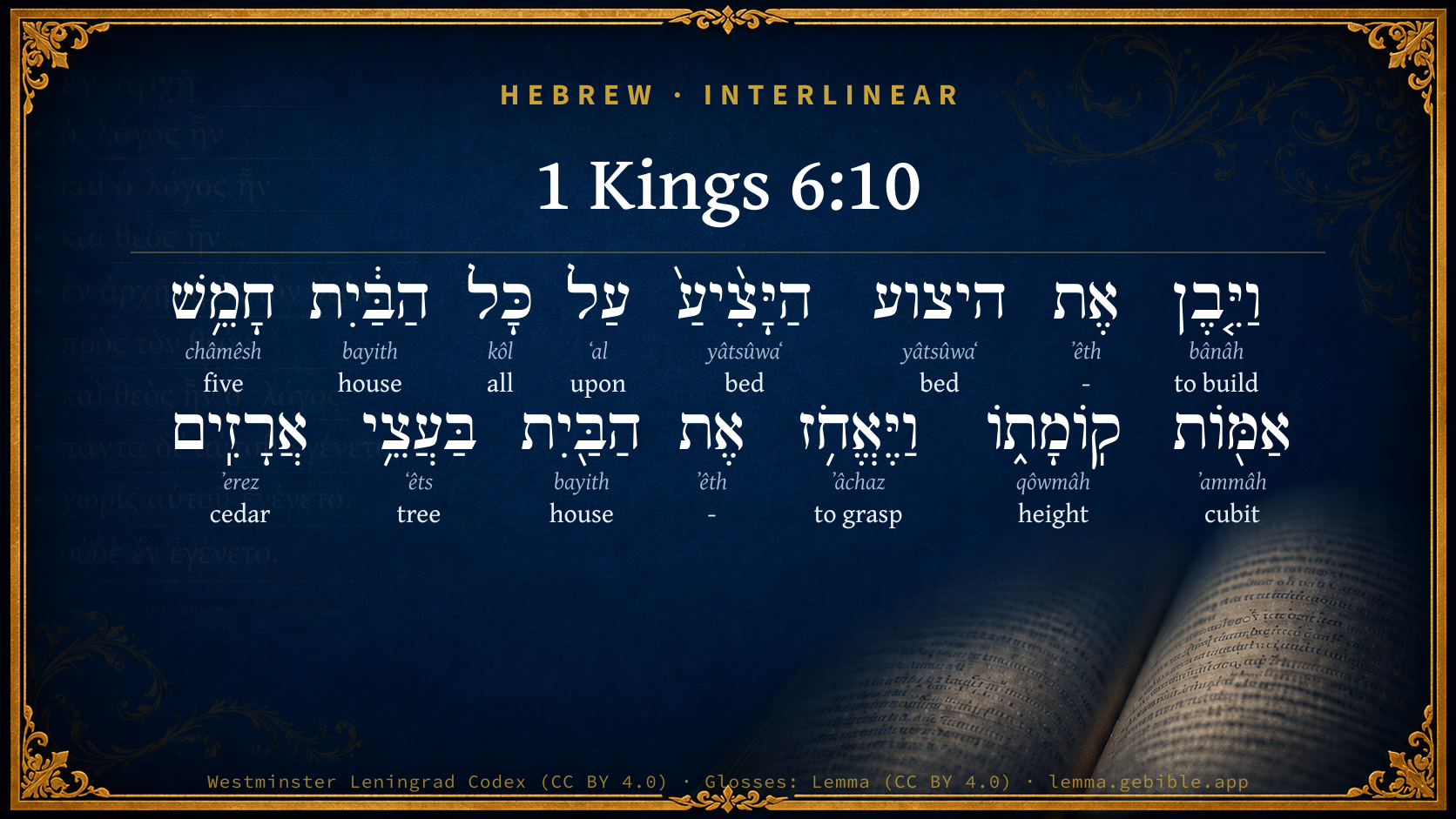
  1. וַיִּ֤בֶן bânâh H1129 “and · to build” Conjunction + Verb, Qal, Sequential Imperfect, 3rd Person, Masculine, Singular
  2. אֶת ʼêth H853 “-” Particle, Direct Object
  3. הַיָּצִ֨יעַ֙ yâtsûwaʻ H3326 “the · bed” Particle, Definite Article + Noun, Common, Masculine, Singular, Absolute
  4. עַל ʻal H5921 “upon” Preposition
  5. כָּל kôl H3605 “all of” Noun, Common, Masculine, Singular, Construct
  6. הַבַּ֔יִת bayith H1004 “the · house” Particle, Definite Article + Noun, Common, Masculine, Singular, Absolute
  7. חָמֵ֥שׁ châmêsh H2568 “five” Adjective, Cardinal number, Feminine, Singular, Absolute
  8. אַמּ֖וֹת ʼammâh H520 “cubits” Noun, Common, Feminine, Plural, Absolute
  9. קֽוֹמָת֑וֹ qôwmâh H6967 “height · his” Noun, Common, Feminine, Singular, Construct + Suffix, Personal, 3rd Person, Masculine, Singular
  10. וַיֶּאֱחֹ֥ז ʼâchaz H270 “and · to grasp” Conjunction + Verb, Qal, Sequential Imperfect, 3rd Person, Masculine, Singular
  11. אֶת ʼêth H853 “-” Particle, Direct Object
  12. הַבַּ֖יִת bayith H1004 “the · house” Particle, Definite Article + Noun, Common, Masculine, Singular, Absolute
  13. בַּעֲצֵ֥י ʻêts H6086 “in/at · trees of” Preposition + Noun, Common, Masculine, Plural, Construct
  14. אֲרָזִֽים ʼerez H730 “cedars” Noun, Common, Masculine, Plural, Absolute

About this verse

These counts appear in no published source. They are computed here, from the morphology-tagged text and Lemma’s own curated glosses. What Lemma adds →

15
words
12
distinct lemmas
Historical
section

Notable vocabulary

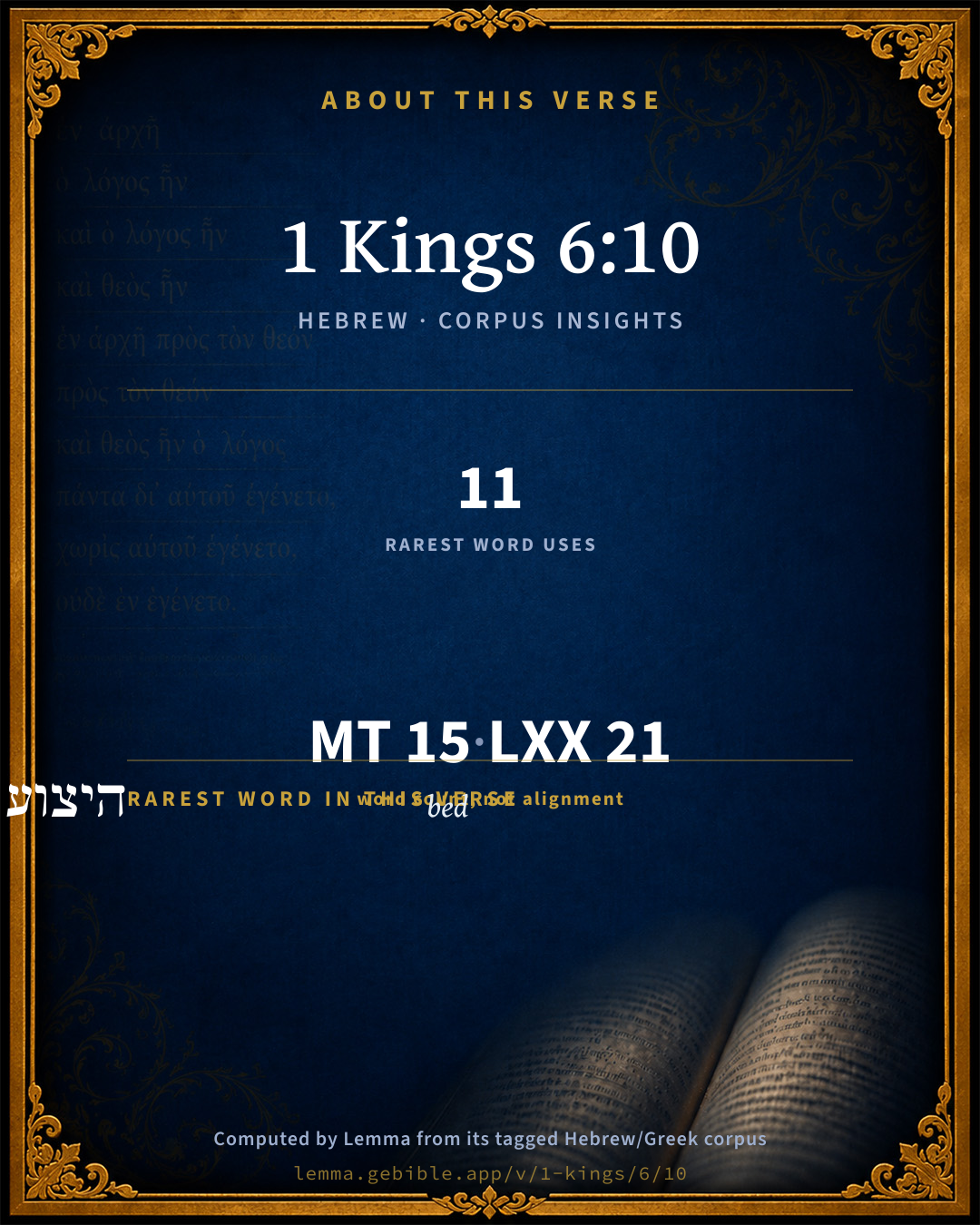
The rarest word here is היצוע bed H3326 — appearing just 11 times in the whole Hebrew Bible.

Shared distinctive vocabulary

היצוע bed H3326 occurs in 8 verses of the Hebrew Bible. Also found in:

Grammatical profile

  • 2 verbs
  • 9 nouns
  • 1 adjective
  • 1 preposition
  • 2 particles

Verb forms

  • וַיִּ֤בֶן Qal · Sequential Imperfect
  • וַיֶּאֱחֹ֥ז Qal · Sequential Imperfect

Repetition

Words recur within this verse — often emphatic in Hebrew:

  • היצוע bed H3326 ×2
  • הַבַּ֔יִת house H1004 ×2

Hebrew & Septuagint length

In English translation the verse runs 22 words from the Hebrew and 20 from the Septuagint (LXX English) — closely comparable.

A rough comparison of the two English renderings, which tokenize alike — not a word-level alignment.

Word counts can differ between the Hebrew and the Greek without any difference in meaning — e.g. the Hebrew direct-object marker אֵת has no separate Greek word, and Greek often adds the article ὁ.

In the original languages it is 15 Hebrew tokens and 21 Greek tokens — but the two are counted differently (Hebrew bundles its prefixes and suffixes into one token; the Greek is in lemma form), so that isn’t a like-for-like length.

Hebrew and Greek witnesses Masoretic Hebrew ↔ Greek Septuagint

The same verse in the two great witnesses to the Old Testament, shown verse-for-verse.

These are two independent witnesses, not word-aligned to each other, and the Septuagint is shown in lemma (dictionary) form.

Hebrew 1 Kings 6:10 Masoretic · Westminster Leningrad Codex

וַיִּ֤בֶן אֶת היצוע הַיָּצִ֨יעַ֙ עַל כָּל הַבַּ֔יִת חָמֵ֥שׁ אַמּ֖וֹת קֽוֹמָת֑וֹ וַיֶּאֱחֹ֥ז אֶת הַבַּ֖יִת בַּעֲצֵ֥י אֲרָזִֽים

He built the stories against all the house, each five cubits high: and they rested on the house with timber of cedar.

World English Bible · Public Domain

Greek LXX 1 Kings 6:10 Septuagint · lemma form

καί οἰκοδομέω ὁ ἔνδεσμος διά ὅλος ὁ οἶκος πέντε ἐν πῆχυς ὁ ὕψος αὐτός καί συνἔχω ὁ ἔνδεσμος ἐν ξύλον κέδρινος

And he made the partitions through all the house, each five cubits high, and enclosed each partition with cedar boards.

LXX2012 (modern English Septuagint) · Public Domain

On this verse, The Pulpit Commentary discusses the Septuagint’s reading. Read the note in Commentary ↓

Hebrew: Westminster Leningrad Codex (CC BY 4.0). Greek: Septuagint (public domain); English from LXX2012 (modern English Septuagint) (Public Domain). How the Septuagint differs from the Hebrew →

Targum (Aramaic paraphrase)

1

The Targum is the ancient Jewish Aramaic paraphrase of the Hebrew Scriptures — an interpretive translation, not the Hebrew text itself. Onkelos (literal) and Pseudo-Jonathan (expansive) render the Torah, and Jonathan the Prophets. Coverage is partial: where no permissively-licensed English translation exists for a verse, only the Aramaic is shown. This is verse-level text, not a word-by-word alignment to the Hebrew.

  1. Targum Jonathan Prophets (Joshua–Malachi)
    וּבְנָא יַת תֵּיקָא עַל כָּל בֵּיתָא חֲמֵשׁ אַמִין רוּמֵיהּ וְטַלֵיל יַת בֵּיתָא בַּעֲאֵי אַרְזַיָא:

    (no public-domain English translation for this verse)

    Targum Jonathan — Aramaic: “Mikraot Gedolot” (public domain). English: “Sefaria Community Translation” (CC0 1.0 (public-domain dedication)); “London "Chaldee Paraphrase," 1871” (public domain). Text via Sefaria.

Commentary

Notes on 1 Kings 6:10 from classic Christian and Jewish commentators (each source and its license shown beneath its notes). The classic Christian expositions comment on the surrounding passage and are grouped to its opening verse, so a note may address several verses; the Jewish commentaries on the Tanakh (Rashi and others) are per-verse, so they appear only where the commentator wrote on this verse.

Lemma curates 59 commentaries, every one of them public domain or Creative Commons licensed, each selected and text-cleaned for this edition rather than reprinted as found. About our sources →

Trapp's Complete Commentary

John Trapp

1Ki 6:10 And [then] he built chambers against all the house, five cubits high: and they rested on the house [with] timber of cedar.

Ver. 10. And he built chambers.] The tabernacle had none such. See on 1Ki 6:5.

John Trapp, A Commentary or Exposition upon All the Books of the Old and New Testament (1647–1656) — public domain. Text from a community e-Sword module.

Jamieson, Fausset & Brown

Robert Jamieson, A. R. Fausset & David Brown

chambers . . . five cubits high--The height of the whole three stories was therefore about fifteen cubits.

they rested on the house with timber of cedar--that is, because the beams of the side stones rested on the ledges of the temple wall. The wing was attached to the house; it was connected with the temple, without, however, interfering injuriously with the sanctuary [KEIL].

Jamieson, Fausset & Brown — Commentary Critical and Explanatory on the Whole Bible (1871) — public domain (CC PDM 1.0). Text via the HelloAO Bible API.

The Cambridge Bible for Schools and Colleges

gen. ed. J. J. S. Perowne

10. And then he built chambers against all the house, five cubits high] Better with R.V. ‘And he built the stories against all the house, each five cubits high.’ We ought perhaps to make some allowance for the thickness of floors and roofs. So that the whole height to which this three-storied structure rose may have been much more than 15 cubits, if five cubits were the inside height of each range of rooms. Mr Fergusson (p. 27) says ‘It hardly admits of dispute that with the requisite thickness of their roofs they make up the 20 or 21 cubits which are necessary to bring up their roofs to the level of that of the Holy of Holies.’

they rested on the house] i.e. On the shoulders or rebatements mentioned in 1Ki_6:6. The other ends of these cedar beams were embedded in the outside wall of the encasing story-work.

The Cambridge Bible for Schools and Colleges (gen. ed. J. J. S. Perowne; Cambridge University Press, 1878–1918) — public domain. Text from a community e-Sword module.

John Gill's Exposition

And then he built chambers against all the house five cubits high,.... Which some understand of the same chambers in Kg1 6:5; here made mention of again for the sake of giving the height of them, not before given; but they were built against, or upon the wall of the house, these against, or rather upon the whole house itself; and are the chambers referred to; see Gill on Kg1 6:2; which consisting of three stories of ninety cubits, raised the whole house to an equal height with the porch, Ch2 3:4; as is there intended (x); these are the upper chambers in Ch2 3:9; and they rested on the house with timber of cedar; or on the timber of cedar, the beams of cedar, with which the house was covered, as in Kg1 6:9; on these the chambers rested, being built upon them; and in one of these chambers the disciples might be after Christ's ascension, Act 1:13.

(x) Vid. Joseph. Antiqu. ut supra. (l. 8. c. 3. sect. 2.)

John Gill's Exposition of the Whole Bible (1746–1763) — public domain (CC PDM 1.0). Text via the HelloAO Bible API.

Haydock's Catholic Bible Commentary

Height. To prevent the excessive heats. Five other cubits were also subtracted, ver. 20. Some translate, "he made also stories of all the temple, each five cubits high;" so that the three stories occupied half the height of the walls, which were 30 cubits in height, ver. 2. (Calmet) --- Covered. Hebrew, "took (or bound together) the house," &c. The roof was flat. (Calmet) --- Villalpand maintains the contrary, (in Ezechiel xli.) with Sanchez, &c. Salien gathers from many of the ancients, that the floor here mentioned, was a balustrade, or the pinnacle of the temple, (Matthew iv.) where people might walk or pray. (Menochius)

George Leo Haydock (1774–1849), Haydock's Catholic Family Bible and Commentary, 1859 edition — public domain. Excludes Psalms (Douay-Rheims chapter numbering differs from Protestant) and Deuterocanonical books (Catholic canon only).

Matthew Poole's English Annotations

Against all the house; which interpreters understand of those chambers described 1Ki 6:5,6. But why should that be repeated again, and that so darkly and confusedly, after he had particularly and exactly treated of them (unless to give an account of the height of each chamber, or story, which before was not done)? And the Hebrew words may be truly and properly rendered thus,

He built a roof (to wit, a flat and plain roof, called yatziah, because of the exact resemblance it hath with the floor of a house) over all the house, according to the manner of all the Israelitish buildings, which were flat at the top; of which see Deu 22:8; Jos 2:6; 2Sa 11:2. The inner roof was arched, 1Ki 6:9, that it might be more beautiful and glorious to behold; but the outward roof was flat.

Five cubits high, above the walls of the temple; which was necessary, that it might be a little higher than the arched roof, which it was designed to cover and secure.

They rested, Heb. it rested, to wit, the roof; for the Hebrew verb is of the singular number.

With timber of cedar; which rested upon the top of the wall, as the chambers, 1Ki 6:5, rested upon the sides of the wall. But all this I submit to the learned and judicious.

Matthew Poole's English Annotations on the Holy Bible (1683–1685) — public domain. Text from a community e-Sword/MySword module.

Whedon's Commentary on the Bible

Daniel D. Whedon

10. Chambers… five cubits high — Literally, Five cubits its height; that is, each chamber or story was five cubits high from floor to ceiling. “Their flooring and roofing being added, they reached together to about eighteen or twenty cubits in height; so that there would be room for the windows of the temple to be opened out, like clear story windows, above them.” — Wordsworth.

Rested on the house with timber of cedar — Rather, were fastened to (אחז) the house by means of cedar beams set into the side-walls or rebatements described 1Ki_6:6.

Daniel D. Whedon (gen. ed.), Commentary on the Old and New Testaments (1874–1909) — public domain. Text from a community e-Sword module.

The Pulpit Commentary

And then Heb. omits he built chambers Heb. the floor (wxiYh). The word (masculine) is here again used of the entire side structure against all the house, five cubits high i.e. , each story was five cubits (7.5 feet). The three stories would altogether measure fifteen cubits, and of course something must be allowed for joists, floors, etc. The entire height of the side structure (exterior) would consequently be about 18 or 20 cubits. And as the house was internally 30 cubits high, the exterior measurement would probably be about 32 cubits. It has hence been inferred that between the side structure and the top of temple wall there would be a clear space of 12 or 14 cubits, in which the windows were inserted. But this is based on the assumption that the side structure had a flat roof, which is by no means certain. If the roof leaned against the walls of the house, with a low pitch, there would still be space amply sufficient for the clerestory windows. Rawlinson"s diagram (p. 511), which gives 80 cubits as the height from basement to ridge of roof, and only allows 20 cubits for height of walls, practically makes the house 20 instead of 30 cubits high, for it is hardly likely that it had an open roof. In fact, we know that it had a cieling (ver. 14), which must have been at the height of 30 cubits (see the diagrams on p. 102. In

(1) house and side structure are represented with flat, in

(2) with ridged or sloping roofs),

unless there was an upper chamber above the house, as to which see ver. 20. Rawlinson"s diagram has this further defect, that he allows nothing forthickness of joists, floors, and cielings. If we allow one cubit for each floor, then, on his plan, there would be little or no room left for the windows. This verse is hardly to be considered as a repetition of ver. 5, the side structure being here mentioned in connexion with its height and the materials used in its construction and they rested on the meaning of the Heb. zjoaYw has been much disputed. It is uncertain what is the nominative, Solomon (as in bYiw), or the "floor" (just referred to in wOtmwOq). Gesenius understands the former, and renders, he covered the house," etc. Thenius, he fastened the floor," etc. Keil adopts the latter alternative, "it held to the house with cedar beams." It may be urged against this rendering (as also against Thenius"s) that beams which merely rested on the walls would hardly bind or hold the side structure to the main building. But it is almost impossible to decide between these interpretations. We may either render "he covered," etc. (with Chald., Vulg.) in which case ver. 10 would agree with ver. 9 (each, i.e., would refer to the roofing; ver. 9 to roof of temple; ver. 10 to roof of side structure and its stories); or we may take the words to mean "it laid hold of, i.e., rested on the house with timber of cedar.

At this point the historian interrupts his description of the building to record the gracious promise made to the king during its erection. It should, perhaps, be stated that this (vers. 11-14) is omitted in the Vat. LXX But it has every mark of genuineness.

The Pulpit Commentary (1880–1919), ed. H.D.M. Spence-Jones & Joseph S. Exell — public domain. Text from a community e-Sword module.

John Wesley's Explanatory Notes

Built chambers - The Hebrew words may be properly rendered, He built a roof, a flat and plain roof, over all the house, according to the manner of the Israelitish buildings. The inner roof was arched, ver. 9, that it might be the more beautiful, but the outward roof was flat. Five cubits - Above the walls of the temple: that it might be a little higher than the arched roof, which it was designed to cover and secure. They rested - Hebrew. it rested, namely, the roof. Timber of cedar - Which rested upon the top of the wall, as the chambers, ver. 5, rested upon the sides of the wall.

John Wesley, Explanatory Notes Upon the Whole Bible (1754–1765) — public domain. Text via the GEBible commentary corpus.

Rashi

Rabbi Shlomo Yitzchaki (Rashi)

Five amohs high. Of each one. Therefore, their total height was fifteen amohs besides the thickness of the ceiling.

And he covered the Beis Hamikdosh. That is the upper covering of the roof, and the covering [=והספון] mentioned above that was the ceiling of the upper story.

Rashi on the Tanakh — English translations: “The Judaica Press complete Tanach with Rashi, translated by A. J. Rosenberg” (CC BY 4.0); “Pentateuch with Rashi's commentary by M. Rosenbaum and A.M. Silbermann, 1929-1934” (public domain); “The Metsudah Tanach series, Lakewood, N.J” (CC BY 4.0); and “The Book of Joshua, Metsudah Publications, 1997” (CC BY 4.0). Text via Sefaria.

Lesson kit

Teaching starters — assembled from the data on this page, not authored interpretation. Every prompt links to the verse data it draws on. Edit before teaching.

1 Kings, in the Historical, opens this verse with 15 words (12 distinct Hebrew lemmas). Its most distinctive word is yâtsûwaʻ (“bed”). A historical commentator’s framing appears above. Read the whole chapter for the surrounding context.

Discussion questions

  1. What does “bed” (yâtsûwaʻ) contribute to the verse as a whole?
  2. Genesis 49:4 shares the word «bed» with this verse. How do the two illuminate each other?
  3. “bed” occurs 2× in this one verse. What is the effect of the repetition?
  4. These translations render this verse differently; the difference is in the English rendering, not the original. What questions does that raise?
  5. The verb «וַיִּ֤בֶן» is Qal Sequential Imperfect. How does its form color the action?
  6. Reading how Trapp's Complete Commentary and Jamieson, Fausset & Brown read this verse, where do the two commentators agree and where do they part?

Things to notice

Reading settings

Reading text

Shown beneath each verse's original-language words.

Old Testament
Old Testament edition

Read the OT as the Masoretic Hebrew (MT) or the Greek Septuagint (LXX).

English shown for the Greek Septuagint (in the Hebrew ↔ Greek comparison).

Comparing translations? Open the Compare panel on any verse page to stack up to four side by side.