
Psalms 104:16

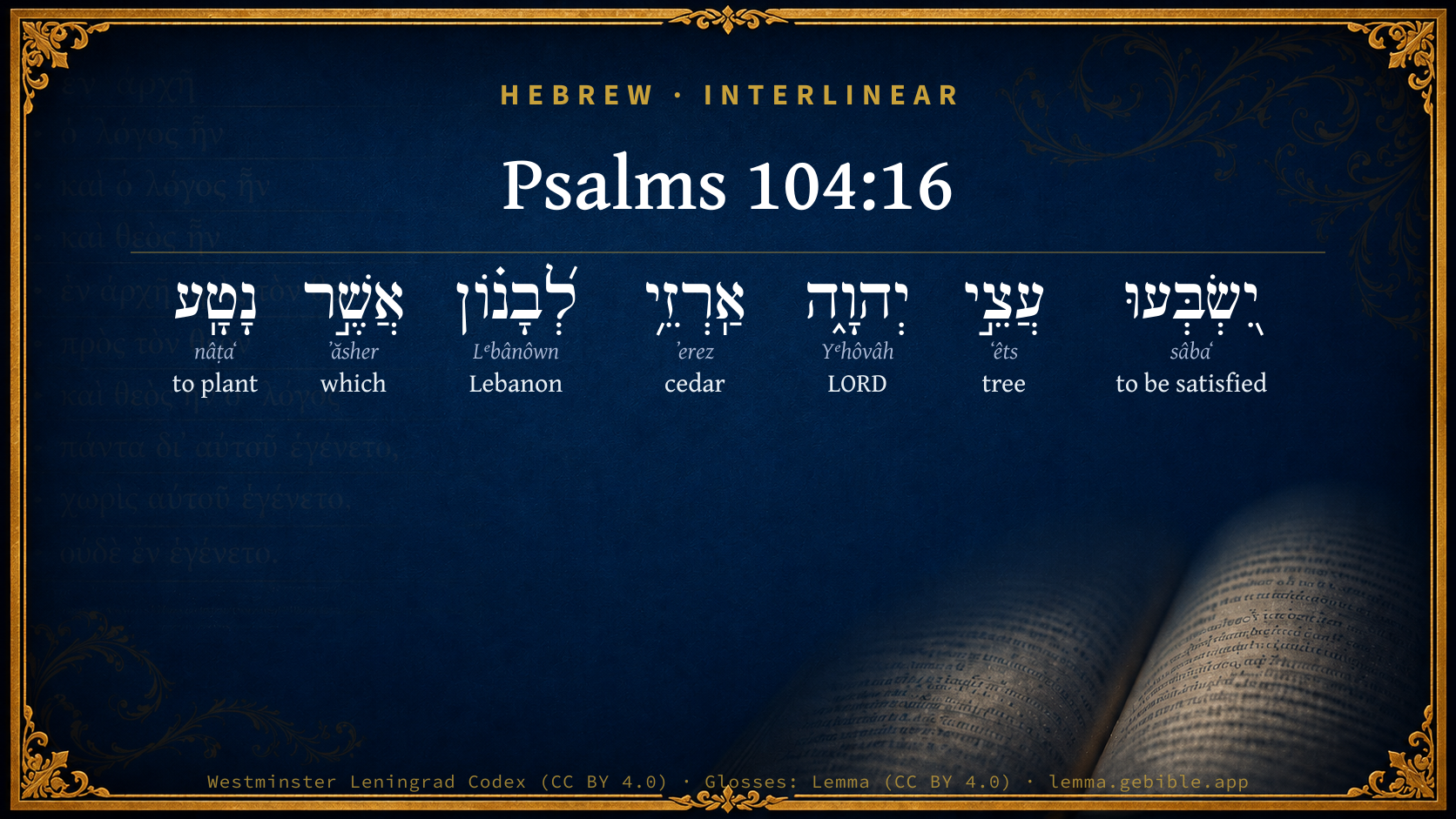
Hebrew (Westminster Leningrad Codex) Psalms 104:16 appears in the Hebrew Old Testament. The text above is from the Westminster Leningrad Codex. Each word links to its Strong’s number, a concise gloss, and parsing drawn from the Open Scriptures Hebrew Bible morphology. Click any word for its full Brown-Driver-Briggs (BDB) entry.
Download image
Cite this verse

Psalms 104:16 (World English Bible). Public Domain. Lemma interlinear Bible study tool, https://lemma.gebible.app/v/psalms/104/16.

Show BibTeX & RIS
BibTeX
RIS
English Translation
Yahweh's trees are well watered, The cedars of Lebanon, which he has planted;
World English Bible · Public Domain
Download a study sheet

One document with this verse’s original text, its word-by-word gloss line, the meaning frame, cross-references with their text, attributed commentary, and full source and license credits — printable, and it pastes into notes with its structure intact.

This verse Autodidact and up

Study sheet (.html) Plain text (.txt)

A passage Seminary Student

Up to 50 verses in one chapter. A passage sheet keeps up to 6 commentary sources and 12 cross-references per verse, in the order this page ranks them, and says so on the sheet whenever that leaves anything out. Ask for a single verse and you get the Autodidact verse sheet above.

Everything on this page stays free to read, with no account — the sheet is a download of what is already on screen, not access to it.

Want to remove ads? Support Godless Engineer
Compare translations 3

The same verse in 3 English versions, stacked beneath the original-language interlinear above. Click any original word for its lexicon entry.

Each is an independent rendering of the whole verse — the interlinear is not word-aligned to these translations.

Highlighted words mark where these versions differ — a whole-verse word diff, not a word-by-word alignment.

  • World English Bible Public Domain
    Yahweh's trees are well watered, The cedars of Lebanon, which he has planted;
  • King James Version Public Domain
    The trees of the LORD are full of sap; the cedars of Lebanon, which he hath planted;
  • unfoldingWord Literal Text CC BY-SA 4.0
    The trees of Yahweh are satisfied— the cedars of Lebanon which he planted,

unfoldingWord Literal Text — © unfoldingWord, licensed CC BY-SA 4.0. Word-aligned USFM3 via Door43 (git.door43.org/unfoldingWord/en_ult).

Versions to compare (up to 4)

3 of 4 selected

Show all 18 translations

Every available English version of this verse, each an independent rendering of the whole verse.

  • World English Bible Public Domain
    Yahweh's trees are well watered, The cedars of Lebanon, which he has planted;
  • Berean Standard Bible Public Domain
    The trees of the LORD have their fill, the cedars of Lebanon that He planted,
  • Majority Standard Bible Public Domain
    The trees of the LORD have their fill, the cedars of Lebanon that He planted,
  • King James Version Public Domain
    The trees of the LORD are full of sap; the cedars of Lebanon, which he hath planted;
  • American Standard Version (1901) Public Domain
    The trees of Jehovah are filled `with moisture', The cedars of Lebanon, which he hath planted;
  • Revised Version (1885) Public Domain
    The trees of the LORD are satisfied; the cedars of Lebanon, which he hath planted;
  • Geneva Bible (1599) Public Domain
    The high trees are satisfied, euen the cedars of Lebanon, which he hath planted,
  • Douay-Rheims (1899) Public Domain
    The trees of the field shall be filled, and the cedars of Libanus which he hath planted:
  • Young's Literal Translation Public Domain
    Satisfied `are' the trees of Jehovah, Cedars of Lebanon that He hath planted,
  • Literal Standard Version CC BY-SA 4.0
    The trees of YHWH [are] satisfied, || Cedars of Lebanon that He has planted,
  • Unlocked Literal Bible CC BY-SA 4.0
    The trees of Yahweh get plenty of rain; the cedars of Lebanon which he planted.
  • unfoldingWord Literal Text CC BY-SA 4.0
    The trees of Yahweh are satisfied— the cedars of Lebanon which he planted,
  • Darby Bible Public Domain
    The trees of Jehovah are satisfied, the cedars of Lebanon, which he hath planted,
  • World Messianic Bible Public Domain
    The LORD’s trees are well watered, the cedars of Lebanon, which he has planted,
  • Webster's Bible Public Domain
    The trees of the LORD are full of sap; the cedars of Lebanon, which he hath planted;
  • Free Bible Version CC BY-SA 4.0
    The Lord's trees are well-watered, the cedars of Lebanon that he planted.
  • Bible in Basic English Public Domain
    The trees of the Lord are full of growth, the cedars of Lebanon of his planting;
  • JPS Tanakh (1917) Public Domain
    The trees of the LORD have their fill, the cedars of Lebanon, which He hath planted;

Literal Standard Version (2020), Covenant Press — licensed CC BY-SA 4.0. Text via the HelloAO Bible API (eBible.org). Unlocked Literal Bible (unfoldingWord) — licensed CC BY-SA 4.0. Text via the HelloAO Bible API (eBible.org). unfoldingWord Literal Text — © unfoldingWord, licensed CC BY-SA 4.0. Word-aligned USFM3 via Door43 (git.door43.org/unfoldingWord/en_ult). Free Bible Version, Dr. Jonathan Gallagher — licensed CC BY-SA 4.0. Text via the HelloAO Bible API (eBible.org).

Word by word

More ways to search: Search by grammar → Find every occurrence → Compare this word →

Practice this passage: Drill this verse → Learn its vocabulary →

About this verse

These counts appear in no published source. They are computed here, from the morphology-tagged text and Lemma’s own curated glosses. What Lemma adds →

7
words
7
distinct lemmas
Wisdom
section

Shared distinctive vocabulary

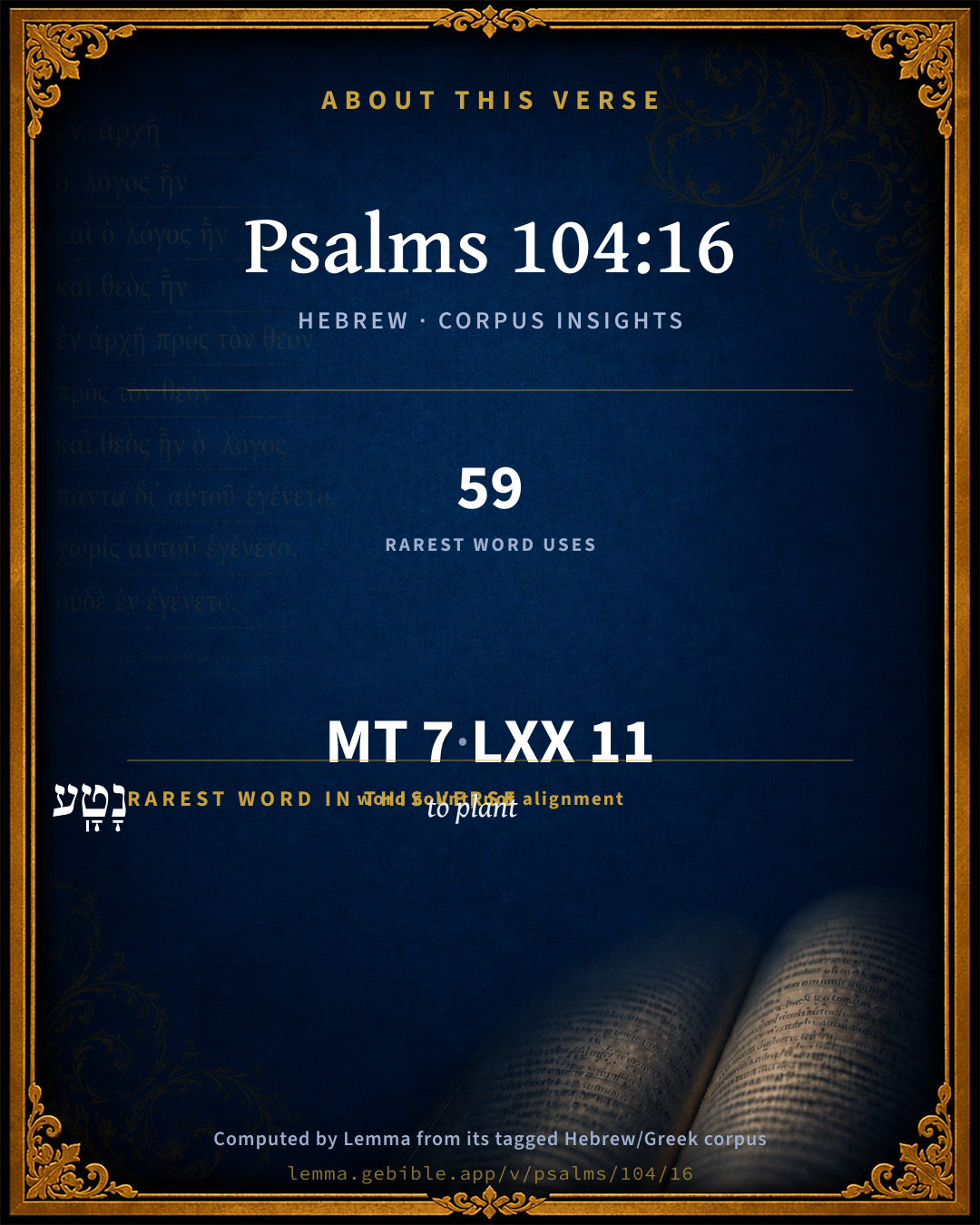
נָטָֽע to plant H5193 occurs in 55 verses of the Hebrew Bible. Also found in:

Grammatical profile

  • 2 verbs
  • 4 nouns
  • 1 particle

Verb forms

  • יִ֭שְׂבְּעוּ Qal · Imperfect
  • נָטָֽע Qal · Perfect

Hebrew & Septuagint length

In English translation the verse runs 13 words from the Hebrew and 19 from the Septuagint (LXX English) — closely comparable.

A rough comparison of the two English renderings, which tokenize alike — not a word-level alignment.

Word counts can differ between the Hebrew and the Greek without any difference in meaning — e.g. the Hebrew direct-object marker אֵת has no separate Greek word, and Greek often adds the article ὁ.

In the original languages it is 7 Hebrew tokens and 11 Greek tokens — but the two are counted differently (Hebrew bundles its prefixes and suffixes into one token; the Greek is in lemma form), so that isn’t a like-for-like length.

Cross-references

4

Topical passages linked to Psalms 104:16 in the Treasury of Scripture Knowledge — connected by theme and wording, ordered by reader-vote popularity; previews shown in the World English Bible.

  • Numbers 24:6 As valleys are they spread forth, As gardens by the river-side, As lign-aloes which Yahweh has planted, As cedar trees beside the waters.
  • Psalms 29:5 The voice of Yahweh breaks the cedars. Yes, Yahweh breaks in pieces the cedars of Lebanon.
  • Psalms 92:2 To proclaim your loving kindness in the morning, And your faithfulness every night,
  • Ezekiel 17:23 in the mountain of the height of Israel will I plant it; and it shall bring forth boughs, and bear fruit, and be a goodly cedar: and under it shall dwell all birds of every wing; in the shade of the branches of it shall they dwell.

Cross-references courtesy of OpenBible.info (CC BY 4.0).

Hebrew and Greek witnesses Masoretic Hebrew ↔ Greek Septuagint

The same verse in the two great witnesses to the Old Testament, shown verse-for-verse.

You’re reading Greek Psalm 103 (Hebrew Psalm 104). The Septuagint counts the superscription, so verse numbers can differ from the Hebrew — chapter-level alignment, not verse-by-verse. Numbering follows Rahlfs.

These are two independent witnesses, not word-aligned to each other, and the Septuagint is shown in lemma (dictionary) form.

Hebrew Psalms 104:16 Masoretic · Westminster Leningrad Codex

יִ֭שְׂבְּעוּ עֲצֵ֣י יְהוָ֑ה אַֽרְזֵ֥י לְ֝בָנ֗וֹן אֲשֶׁ֣ר נָטָֽע

Yahweh's trees are well watered, The cedars of Lebanon, which he has planted;

World English Bible · Public Domain

Greek LXX Greek Psalm 103:16 Septuagint · lemma form

χορτάζω ὁ ξύλον ὁ πεδίον ὁ κέδρος ὁ λίβανος ὅς φυτεύω

The trees of the plain shall be full of sap; even the cedars of Libanus which he has planted.

LXX2012 (modern English Septuagint) · Public Domain

On this verse, John Gill's Exposition discusses the Septuagint’s reading. Read the note in Commentary ↓

Hebrew: Westminster Leningrad Codex (CC BY 4.0). Greek: Septuagint (public domain); English from LXX2012 (modern English Septuagint) (Public Domain). How the Septuagint differs from the Hebrew →

Commentary

Notes on Psalms 104:16 from classic Christian and Jewish commentators (each source and its license shown beneath its notes). The classic Christian expositions comment on the surrounding passage and are grouped to its opening verse, so a note may address several verses; the Jewish commentaries on the Tanakh (Rashi and others) are per-verse, so they appear only where the commentator wrote on this verse.

Lemma curates 59 commentaries, every one of them public domain or Creative Commons licensed, each selected and text-cleaned for this edition rather than reprinted as found. About our sources →

Trapp's Complete Commentary

John Trapp

Psa 104:16 The trees of the LORD are full [of sap]; the cedars of Lebanon, which he hath planted;

Ver. 16. The trees of the Lord are fall of sap] Heb. are satisfied, viz. with moisture, sucked by their roots out of the earth plentifully watered, whereby they are nourished, grow mightily, and serve man for meat, drink, medicine, &c.

The cedars of Lebanon] These are instanced, as tallest and most durable. God’s temple at Jerusalem was built of them; and so was the devil’s temple at Ephesus, for he will needs be God’s ape.

John Trapp, A Commentary or Exposition upon All the Books of the Old and New Testament (1647–1656) — public domain. Text from a community e-Sword module.

The Biblical Illustrator

Joseph S. Exell

Psa_104:16-17

The trees of the Lord are full of sap.

The trees of the Lord

The cedars are amongst the most beautiful of the trees--majestic in appearance, towering in stature, and enormous as to girth. Being indigenous to Palestine, they are fitly called trees of the Lords planting, for no human hand has fixed them on their heights. Moreover, it must be God who waters them, from the river that is always full. Despite their exposed position, they are ever green, and always fragrant: they never shed their leaves, and from every branch and spine exudes a sweet aroma. The trees of the Lord are full of sap. And that sap is sweetly scented. The smell of Lebanon is most delightful, and the cedars themselves are the noblest and the royalest amongst the trees of the forest. Let us give glory to God, as we view every object of His cure, every token of His power. The cedars are a fitting type of the people of God.

I. The first likeness that I trace is as to ownership and possession. The cedars are the trees of the Lord. They are His peculiar property; His mark is on them, if I may so speak. We own no proprietorship but that of God Most High. His we are, and Him we ought to serve. The Lords portion is His people. The Lord has planted the cedars and His Saints; therefore He owns both. If there is any beauty in us, any blossom on us, any promise of fruit, any shadow or shelter for our fellows, it is the Lords doing, and it is marvellous in our eyes if we are members of Christs Church through faith in Him, it was His Spirit that planted us upon the hills of God.

II. Gods people resemble cedars because of their beauty and majesty. I associate those two adjectives, for it takes at least two to describe the peculiar charm of the cedar tree. It is possessed alike of grace and grandeur. So should it be with Christians. There should be about every lover of the Lord a tender spirit, a loving disposition, the beauty of holiness, the charm of grace: and there should be withal a sacred dignity, a laudable ambition, a holy audacity, high up-holding of the head--not in selfish pride, but in simple trust.

III. The feature of these trees to which our text specially directs us is their vitality. They are full of sap. The sap of the tree is as the blood of the body--and the blood is the life thereof. It is this same sap which is the secret of its growth from the sapling stage to the full maturity of which we have been speaking; and it is the grace of our Lord Jesus Christ, the power of this blessed Book, and the influence of the good Spirit in our hearts, which make us to grow. Oh, that all my powers of heart, and head, and thought, and wish, and feeling, felt the blessed influence of the Divine life. I cannot bring forth fruit, I cannot hope to be fresh and green, unless I also am thus full of sap.

IV. We shall also do well to seek to be like the cedars as to their utility. I venture to class under this head their ornamental character. We get into a habit of dissociating these two qualities--ornament and usefulness. I cannot at all see why a thing cannot be both ornamental and useful. If it can be only one, I know which I prefer. Away with the mere ornamental, and let us have what is practical and serviceable. But if we can combine the two, so much the better: what say you? The cedars are both ornamental and useful. We have spoken of their charm and grace, and I put that down as one of their uses. Do you not think God designed that some eye should be gratified by a look at His cedars? You know that wherever trees are, the adjoining country is rendered much more fertile through their presence. Some lands have been quite transformed by the patient planting of trees. Oh, where the Church exists, if the members are often of this sort, there will be blessing all around. The wide-spreading cedars gave grateful shade. This was the beauty of their branches, that twixt them the sunshine could scarcely filter through; and in those hot lands it was gratifying indeed to get beneath those boughs. Have you shaded anybody? Have you tried to help the sick, to feed the hungry, to clothe the naked, and to teach the ignorant? That is your work. Do it for Jesus, and your reward is sure. The cedar trees were useful, too, for building purposes. The woodwork of the House of the Lord was of cedar-beams. You know what this meant for the cedars--the axe had to be plied upon them. They must needs he cut and planed and squared, that they might have their place in the Sanctuary, the Lord make us content even for this. If we can serve Thee better, let Thine axe come upon us; let us know the sharp edge of sorrow, and the heavy tool of trial. What matters it if we by so suffering can take honourable place in the building of God, and help to glorify the Name of Jesus! (T. Spurgeon.)

The trees o/ the Lord

I. As the sap is the vital principle of vegetation, so is the holy spirit the Lord and Giver of life--of all life in every realm where living things move and have their being. But the life of man is the highest outcome of His vital force, revealing itself in his physical, mental, and emotional energy. From Him and from Him alone has come that most wonderful of all forces, which can arrest the moral decay within the souls of men and transform them into living trees of the Lords right-hand planting.

1. The creation of the Christian Church was an evidence of this Divine energy.

2. Another evidence of the indwelling of the Holy Spirit in the Church is its imperishable vitality. He has enabled it to grow through all these centuries, to survive the wear and tear of years, the storms of persecution--still clothed with foliage, and laden with fruit for the healing of the nations.

3. If the presence of the indwelling Spirit accounts for the existence and indestructible vitality of the Church, it also explains the marvellous variety of its forms of life.

II. The movements of the sap are suggestive of the methods by which the Holy Spirit conveys His life to men.

1. There is a mystery in His operations. Nature in all her works for ever half reveals and half conceals the soul within. So is it with the energy of the Lord and Giver of Life. His ways are past tracing out, nor can it be otherwise. He is a Spirit, moving with absolute freedom whensoever He listeth on whomsoever He pleaseth, in whatever manner He may choose.

2. A second analogy between the movement of the sap and the energy of this spiritual life lies in its gentleness.

3. The impartiality of the Holy Spirits influence. The sap leaves no part of the tree unvisited. The unseen network of roots and fibres, the pillared stem and its bark, the branches and their twigs, with the innumerable leaves--all receive their supply. It is so with the individual--the mind, will, and affections, aye and the body also, are penetrated by the Divine influence. It is so when the Divine grace descends upon a congregation--it reaches the richest and the poorest, the youngest and the oldest, the learned and the illiterate. It will be so when it enters the open heart of the habitable world--for we may perceive by the very trees of the wood that God is no respecter of persons!

III. Returning once more to the trees of the Lord, we see in their abounding fulness the response they give to the spring life imparted. They are filled--they are satisfied. The human heart is not like the three things of the wise man--the grave, the thirsty earth, the flame of fire--insatiable. It longs and craves and seeks, but there is a supply. We cannot hope from outward forms to win the passion and the life whose fountains are within, but the Holy Spirit brings to the soul that inward stream of life to fill it with all the fulness of God. Then are we satisfied, as the trees are, and for similar reasons. Their yearnings are appeased--the impulse to unfold themselves in form, colour, movement, is met, and that mysterious ecstasy of travail to bear fruit is abundantly fulfilled. (E. J. Brailsford.)

The trees of the Lord

(a Spring discourse):--They are trees of the Lord.

I. On account of the peculiarities of their structure. They reveal a new idea of the creative mind. They are neither Phaenogams, or flowering plants, nor Cryptogams, or flowerless, and have many points of alliance with club-moss. They combine the highest appearance with the lowest structure, and are thus links binding together the two great orders of vegetation. In them we have an example among plants of a common principle in Gods moral procedure towards His creatures, choosing the weak things of the world to confound the things which are mighty, and giving more abundant honour to that which lacked. Into the earthen vessel of the humble organization of the cedars He has poured the glory of the highest development, that the glory may be seen to be all His own. And in this wondrous combination of types in the trees of the Lord we have a dim foreshadowing of Him who dwelt in the bush; who united in Himself the highest and the lowest, God and man, in one person for ever; and who still, though in the midst of the throne, dwells with the man that is of an humble and contrite heart. The cedars are trees of the Lord.

II. On account of the antiquity of their type. Of this class Preadamite forests were principally composed. In every stratum in which arborescent fossils occur we can trace this antique tree pattern. We burn the relics of extinct cedars in our household fires, as the microscopic investigation of the coal formation reveals. They form the evergreen link between the ages and the zones, growing now as they grew in the remote past, inhabiting the same latitudes, and preserving the same appearances in bulk and figure. Universal in space and universal in time they are monuments of the unchangeableness of the Ancient of Days--proofs indisputable that the vegetable kingdom did not commence as monads, or vital points, but as organisms so noble and complicated that even the most bigoted advocate of the development theory must admit that they could not have been formed by the agency of physical force. During untold ages the cedars were the sole examples of forest vegetation. They afford an illustration of a general law of the deepest philosophic import, namely, that the first introduced animals or plants of any class have been combining types. From the side, as it were, of those Preadamite cedars God took the ribs, of which He made the graceful palm-tree to yield its welcome shade and fruit in the thirsty desert, and the beautiful apple-tree to clothe itself with its bridal dress of blossoms under the smiling, tearful skies of the northern spring. Thus is illustrated that the ceaseless working of the Creator hitherto has been exercised only in the eternal unfolding of the original conception. The cedars are trees of the Lord.

III. On account of the majesty of their appearance. Religion and poetry have sounded so loudly the praise of the cedar that it has become the most renowned natural monument in the world. At an elevation of six thousand feet, with their roots firmly planted in the moraines of extinct glaciers, with their trunks riven and furrowed by lightning, with the snows of Lebanon gleaming white through their dusky foliage, who can fail to feet the force of the psalmists words, The trees of the Lord are full of sap, etc. (H. Macmillan, D.D.)

The abundance of the trees

In A.V. the words of sap are added by the translator; in R.V. the translation is, The trees of the Lord are satisfied. I think that the true meaning is indicated by A.V. without the addition of the words of sap, which the translators added. It is not contentment which the trees suggest to the writer; it is not merely abundance of moisture or sap in their veins; vegetation suggests fulness, abundance. The trees of the Lord are full of everything--full of sap, full of leaves, full of blossoms, full of fruit, full of shade, full of singing-birds, full of seeds for new trees. It is very strange that men should not understand the message which the abundant provision of God in nature has for them. If this teeming earth were cultivated, and all that she offers in her palm were freely distributed, there would be no hungry men in all this globe of ours. But if God thus provides for the body which to-day is and to-morrow is not, does He make only niggardly provision for the soul? No, no. The trees of the Lord are full--always full (2Co_9:8).

1. The grace of God is like the vegetation of the earth, in all places. Climb the Alp, and far up on its side you pluck the edelweiss. God was here before you. Go out upon the desert, and far out in that sterile plain you find the waving palm growing beside the spring. God was there before you. Go with your message of cheer to some down-town ward where men are crowded together thicker than corpses in a cemetery, and between the chinks in the pavement are seen blades of grass. God was there before you. As in nature, so in grace. Gods prophets are not all confined to Judaism; Gods grace is not all confined to Christendom. Wherever a man has been found bowing the knee and lifting up the heart, there Gods grace has been responding; for Gods grace reaches unto all them that call upon Him, by whatever name, through whatever form, in whatever service.

2. As Gods grace is everywhere, like the trees, Gods grace is freely offered unto all, as the forest offers its shade alike to the wild beast and to the domestic animal, and its shelter for nests alike to the large and the little, and drops its fruit alike into the hands of the good and the evil.

3. The grace of God, like the trees of God, is everywhere, and for every one; and it is clothed with a great, great power. Ask the child what is the greatest manifestation of force in the world. Perhaps he will summon you to the battlefield. Listen, he will say, to all these cannon belching out their thunderous tones; what power there is. Perhaps he will carry you to the factory. See, he will say, this ponderous engine driving its great wheels, and stirring all thin factory with its vibrating life. But when he is wiser he will go to the forest, where there is no sound of hammer or of saw, no buzz or bustle of wheel, no bang as of cannon; but in one great forest more power is wrought, it is said, than in all the factories in the world put together. The power of God is the power of a silent love. The still, small voice is more than the fire, the tempest, or the earthquake. Not in Sinai, but in Calvary; not in deluge of water or destroying flame, but in the manger and the cross, is the power of God witnessed.

4. My God shall supply all your need. There is scarce any physical need of man which the carpeted and sheltering earth does not provide. And this is what the abundant trees whisper, bending their leaves to you, to repeat the message: God is able to make all grace, abound toward you, that you at all times, having all sufficiency in all things, may abound unto all good works. We need not wait for the great transition, but here and now we may walk by the river of the water of life, we may walk under the shade of those trees whose leaves are for the healing of the nations, and we may pluck the fruit of that only tree that bears its fruit every month. Other trees lie bare and sere through the long winter; other trees drop their fruit only in the autumn time; but this tree of life, of which they are, after all, but a poor symbol, gives forth its fruit in every month, and every manner of fruit for every manner of need; and here and now we may harvest them, fed on food more life-giving and sheltered by shade more comforting than the Garden of Eden ever knew. (Lyman Abbot, D.D.)

The cedars of Lebanon, which He hath planted.--

The cedars of Lebanon

If Solomon were here, who spoke of all trees, from the hyssop on the wall to the cedar that is in Lebanon, he would greatly instruct us in the natural history of the cedar; and, at the same time, uttering similitudes and proverbs of wisdom, he would give us apples of gold in baskets of silver. But since Christ, according to His promise, is with us, one greater than Solomon is here, and we trust He will speak to our hearts concerning those who are planted in the courts of the Lord, and, therefore, flourish like cedars. Let the venerable cedars of Lebanon serve as witnesses concerning them. And these reveal--

I. The absence of all human culture. For--

1. They owe their planting entirely to the Lord. No human hand had any part in this work, neither delving the soil nor dropping in the fruitful cone. How those giants of the grove came to be where they are, none can tell. The early planting of these mighty trees is among the secrets which belong unto God. And this is quite true of every child of God. We are not self-planted, but God-planted.

2. Nor are they dependent upon man for their watering. The trees in the plain are fertilized by little canals running at their roots, and therefore are they green: but these, on the top of Lebanon, who shall find a stream for them? And so is it with the Christian who has learned to live by faith. He sings, The Lord is my Shepherd, I shall not want. And--

3. No mortal might protects them. They are planted on a mountain ridge no loss than six thousand feet above the level of the sea. The snow frequently lies upon their branches in enormous masses. They are in the most exposed position conceivable. Deadly dangers have threatened them from the very first. They are left unprotected, and yet the veterans survive. It is precisely the same with the Christian. He is not a hot-house plant, sheltered from temptation; he, too, stands in most exposed positions, and innumerable perils compass him about. But still he is able to say, In all these things we are more than conquerors.

4. And they are utterly indifferent to human gaze. For thousands of years no human eye may have looked upon them. Moses desired to see them. David sang of them. But they heed not. And so with the Christian: he cares nothing for the smiles of men, and he cares as little for their frowns. He walks not before them, but before the Lord. He leans not upon any arm of flesh, but understands how to stand upright. Out upon the piety which depends upon the public eye. I am not to have a religion like a dog-collar, which I may slip off and on, and be glad to be rid of it; it must be part and parcel of my being. It must not be the Pharisees paint and tinsel which he puts on in the public place, and privately laughs at when he gets alone.

5. Their exultation is all for God and not for man. In vine and other fruit trees man has had some share in the product: not so here. It is all of God. The cedars have not a green leaf to magnify man with, nor a single cone with which to make him proud. And so in the Christian: there is nothing in you that can magnify man. All your thanks are due to God. You are the Lords trees from first to last.

6. The cedar is independent of man in its expectations. They never expect man to care for them or to help them. Arab and Turk do their best to ruin the whole grove, but yet there they stand, expecting as little help from man as, in fact, they get. That is your case, O Christian. You are to depend on God alone. God is ever seeking to strike away from us all our human props and buttresses upon which we are so apt to lean. He would wean us from the world.

II. The cedars of lebanon are a glorious display of Divine care.

1. In the abundance of their supply. The trees of the Lord are full. They are saturated with moisture.

2. They are always green.

3. See their grandeur and size. In The Land and the Book it is said that some of them measure forty-one feet in girth, and are a hundred feet high. Supply direct from God is better than all else.

4. Their fragrance.

5. Their perpetuity.

6. How venerable they are.

III. They have fulness of living principles. They are full of sap. Now this is--

1. Vitally necessary.

2. Essentially mysterious.

3. Radically secret.

4. Permanently active.

5. Externally operative.

6. Greatly to be desired. Think, what glory to God a full-grown Christian brings to God Let us have this fulness of life. (C. H. Spurgeon.)

The cedars of Lebanon

The cedar is the tree par excellence of the Bible--the type of all forest vegetation. Religion and poetry have sounded its praises so loudly and repeatedly that it has become the most renowned natural monument in the woods. For untold ages it covered the rugged slopes of Lebanon with one continuous forest of verdure and fragrance, and formed its crowning glory. The ravages of man, carried on century after century, in the most ruthless manner, laid its proud honours low; and now only a few scattered groves survive amid the fastnesses of the highest valleys to tell of the splendour that had perished. But what a magnificent relic the one grove of Kadisha is! Each huge trunk, scarred and hoary with the elemental strife of hundreds of years, still spreads out its great gnarled boughs laden with emerald foliage and exquisite cones, full of sap in the freshness of undying youth, so that we cannot wonder at the superstition of the awe-struck Arabs, who attribute to the cedars not only a vegetative power, which enables them to live eternally, but also a wise instinct, an intelligent foresight, by means of which they understand the changes of the weather, and provide accordingly. No temple of Nature can be grander than the interior of that grove, where the natives of the neighbouring villages celebrate mass annually in June. It is a spot unique on earth. The sacred associations of thousands of years crowd around one there. In the fragrance of the cedars comes up the richness of Bible memories; each sight and sound suggest some incident alluded to by psalmist or prophet, and a feeling of awe and reverence, such as few other scenes can inspire, fills the soul to overflowing. There, at an elevation of six thousand feet, with their roots firmly planted in the moraines of extinct glaciers, with their trunks riven and furrowed by lightnings, with the snows of Lebanon gleaming white through their dusky foliage, with the stillness of earths mightiest powers asleep around them, who can fail to feel the force of the psalmists words, The trees of the Lord are full of sap; the cedars of Lebanon which He hath planted. (H. Macmillan, D.D.)

Graciousness of a devout soul

A traveller tells us that in the wood, bark, and even the cones of the cedar there is an abundance of resin. They are saturated with it, so that he says he can scarcely touch one of the cedars of Lebanon without having the turpentine or resin of them upon his hands. That is always the way with a truly healthy Christian, his grace is externally manifested. There is the inner life within, it is active, and by and by when it is in a right state it saturates everything. You talk with the gracious man, he cannot help talking about Christ; you go into his house, you will soon see that a Christian lives there; you notice his actions and you will see he has been with Jesus. He is so full of sap that the sap must come out. He has so much of the Divine life within, that the holy oil and Divine balsam must flow from him. (C. H. Spurgeon.)

Where the birds make their nests.--

Little birds and cedars

John Ruskin makes bold to say that every real triumph of natural science is anticipated in this, the 104th, psalm. By which he means that the Hebrew poet has found out the bright shoots of everlastingness that flash for ever behind the veil of nature, while physical students of our day are too much absorbed in examining and admiring the veil itself. The cedars of Lebanon show more than the pretty playfulness of blind force; they are parts of a living whole. Little birds--such the word signifies--prove more than the skilfulness of mechanical adjustment; they prove that God likes a pretty little thing, and cares for it well. These tiny, roving minstrels of the air find a happy home in the venerable trees of Gods planting. The little and the great are fitted for each other: the great give the home, the little give the song. Wings and flowers, feathers and leaves, are adjusted to meet mutual wants and cultivate mutual trade. So God wills.

I. No greatness is self-complete. The spirit of the angels has been given largely to the forces of nature--are they not all ministering spirits? Is not the sea a servant, the wind a servant, and the sun a servant to the needs of man? Does he not count the lightning and the breeze and the moon among his maidservants? Had God created a larger sun than that which lights us now; had He made its face more clear, its heart more fiery, but had not given it a ministering spirit, that would be a worthless sun. If the sun we now have had been more independent, rising and setting according to its fancy, making winter in a fit of bad humour, and making summer after coming to itself again; if it burned its fires without caring anything for the comfort of the worlds under its government, there would be no longer any Cosmic life. But the sun knoweth its going down; and its light and heat have been blessed with the spirit of the angels--the spirit of generous service. The best minds of the world do not gather knowledge to keep it for themselves, but to share it with all. The best thinker that ever trod the earth was the young teacher of Nazareth, who was not ashamed to publish the highest truths of heaven in a common and popular language. His parables are meek and gentle enough to come in as the door of the poorest cottage. Had Christ been less a servant He would have been less a God. His generosity of intellect has made Him the Teacher of the ages the best disciples of God are the best teachers of men.

II. A true Christian life delights in the service of others. To the religious idler the chapter of excuses is a very interesting chapter; and there are many in the Church to-day who know every verse of it by heart. What could the cedars of Lebanon say if they wanted to refuse shelter to the little birds?

1. They might say that they were too venerable to serve such poor little things. Is there not a murmur like this on the lips of the Church? saying under its breath that it is too venerable to go out into the highways and hedges to search for the wounded poor? the way is too rugged and too far to go after the lost sheep. That is not the speech of God. Eternity was not too far away for Him to think of saving man. No Church can live on its past history. When it gives itself too much to the reading of the genealogies of the family, its decay is beginning.

2. They might say that there were other trees in plenty who could serve the little birds. One of the chartered texts of Carlyle was that the world had made the value of a soul to be notching. And his severe way of putting the truth calls for the solemn thought of the Church. Souls are lost in the congregation; and we forget that the salvation of one soul is worth a life of toil and weariness and sacrifice. You have laboured for twenty years and have made only one convert yet, said a man unmercifully to a quiet, hard-working minister. Have I made one convert? was the noble answer; here are twenty years for the next one. One pearl won by thee for the Redeemers crown will shine through all heaven!

3. They might say that the little birds often went away to sing. Many a village church teaches its children well, and then the glitter of city life takes them away from it before they have paid anything in return. Many a father and mother have placed the noblest sacrifices on the altar to give their boys to the world. There is a sound of loss in every home and in every church--the birds gone away from the nests. The teachers of our Sunday schools have to change their scholars often; the old leaving and the new coming. Is there not a moaning among the cedars of Lebanon for the music that is lost, the sweet carollings that have been hushed there for ever, the morning hymn and evening song silent, and the little homes empty and cold? When shall they return? This only teaches every honest workman in Zion to leave the harvest unreaped until he has reached home. The creation has been too skilfully fitted together for any good to get lost in it. If the song has forsaken the cedar where the young soul was nursed, the music of the world is richer somewhere. The hymn learned on the hallowed hearth keeps a longing in the mind for heaven. There the songsters, separated and scattered here, will meet again; and to hear them sing among the branches of the tree of life in Paradise will more than repay for the grief and distress of the parents, and the teacher, and the minister who lost them here. (H. E. Lewis.)

Lesson, s Item nature

This psalm is all through a song of nature, the adoration of God in the great outward temple of the universe. Some in these modern times have thought it to be a mark of high spirituality never to obscure nature; and I remember sorrowfully reading the expressions of a godly person, who, in sailing down one of the most famous rivers in the world, closed his eyes, lest the beauties of the scene should divert his mind from scriptural topics. There may be persons who think they have grown in grace when they have attained to this; it seems to me that they are growing out of their senses. What God hath cleansed, that call not thou common, and nature, unlike ourselves, hath been clean from the beginning. And it is a mark not of strength but of weakness in the Divine life to forbear the study of nature. As it was a sign of weakness and not of strength for monks and hermits to shut themselves out from the world in which God had placed them. Now, let us learn from the psalmists contemplation of nature as given in our text--

I. That for each place God has prepared a suitable form of life. For the fir trees, the stork; for the high hills, the wild goat, and so on. Now, the teaching of this is clear.

1. Each age has its saints. So has it been, and so it ever will be.

2. And every position. From the palace to the poor-house, the Christian religion is adapted to all conditions.

3. In every Church.

4. In every city. God has an elect people everywhere.

II. Each creature has its appropriate place. They look wretched enough out of their place. See the animals in the Zoological Gardens. Each creature looks best in his own place. So we each one are best in the position where God has placed us.

1. Providentially. We think otherwise, oftentimes; we say, Oh, if we were only in such a position, how much better it would be.

2. Experimentally. God has not made two creatures precisely alike. No two leaves are: and it is so in Christian experience. Many distress themselves because they have not the experience of certain good people of whom they have read. Have I felt precisely thus? Have I felt exactly that? If not, I am lost. But how vain all this is.

3. The same holds good as to individuality of character. God gives to one man one temperament: to another man another. As Luther and Melanchthon; Peter and John. Let no man wish to be what another is. Be yourselves in your religion.

III. Every creature that God has made is provided with shelter. See the declarations of the text. If, then, He has so cared for the lesser creatures, can He have left mans soul without shelter?

IV. For each creature the shelter is appropriate. And--

V. Each creature uses its shelter. I never heard of a stork that when it met with a fir tree demurred as to its right to build its nest there, and I never heard of a coney yet that questioned whether it had a right to run into the rock. Yet the sinner does not recognize the provisions of his Saviour. He asks, May I? and I am afraid it is not for me. O sinner, come, believe in Jesus and find salvation now. (C. H. Spurgeon.)

The Biblical Illustrator, edited by Joseph S. Exell (c. 1880s–1900s) — public domain. Text from a community e-Sword module.

Joseph Benson's Commentary

Psa 104:16. The trees of the Lord — Trees which are not planted by the art, nor watered by the care of man, but by God’s almighty providence, are full of sap — Being sufficiently supplied therewith through the rain, of the good effects of which he is yet speaking; for “the moisture of the earth, rarefied by the heat of the sun, enters their roots, ascends their tubes, and, by due degrees, expands and increases them, till they arrive at their growth.” The cedars of Lebanon which he hath planted — Yea, the tallest and largest cedars, those of Lebanon, and even whole forests of them, though growing upon the most barren and stony mountains.

Joseph Benson's Commentary on the Old and New Testaments (1811–1818) — public domain. Text from a community e-Sword module.

J. A. Alexander on Psalms

Joseph Addison Alexander

16. (Psa 104:16) Full are the trees of Jehovah; the cedars of Lebanon which he planted. Full, i.e. abundantly supplied, saturated, as in ver. 13 (Psa 104:13). The English versions supply sap; but the idea suggested by the context is the more general one of moisture, irrigation. The mutual relation of the clauses is the same as in ver. 11(Psa 104:11). What is first said of trees, or of the noblest trees in general, is then said of the cedars in particular. The trees of Jehovah, like the cedars of God in Psa 80:10, are those which he has planted (Num 24:6), those which, by their loftiness or fruitfulness or beauty, bear the strongest impress of their Maker's hand. The cedars of Lebanon are often mentioned as the noblest and most famous of their kind. See above, on Psa 29:5; Psa 92:12.

Joseph Addison Alexander, The Psalms Translated and Explained (1850) — public domain. Text from a community e-Sword module.

Adam Clarke's Commentary

Verse 16. The trees of the Lord are full of sap] ישבעו yisbeu, "are saturated."

The cedars of Lebanon] God's providence not only extends to men and cattle, but also to the trees of the field and forest. Many of these are not only sustained, but planted by his providence. Who ever planted the seeds of the cedars of Lebanon, or of the thousands of woods and forests on the globe? God himself sowed those seeds, and they have sprung up and flourished without the care of man.

Adam Clarke's Commentary on the Bible (1810–1826) — public domain. Text from a community e-Sword/MySword module.

John Calvin's Commentaries

16. The trees of Jehovah shall be satiated The Psalmist again treats of God’s general providence in cherishing all the parts of the world. In the first place, he asserts, that by the watering of which he had spoken the trees are satiated, or filled with sap, that thus flourishing they may be a place of abode to the birds. He next declares, that the wild deer and conies have also their places of shelter, to show that no part of the world is forgotten by Him, who is the best of fathers, and that no creature is excluded from his care. The transition which the prophet makes from men to trees is as if he had said, It is not to be wondered at, if God so bountifully nourishes men who are created after his own image, since he does not grudge to extend his care even to trees. By the trees of the Lord, is meant those which are high and of surpassing beauty; for God’s blessing is more conspicuous in them. It seems scarcely possible for any juice of the earth to reach so great a height, and yet they renew their foliage every year.

John Calvin's Commentaries (1540-1563) — public domain. Text from the Calvin Translation Society English edition (1840s-50s) via the Christian Classics Ethereal Library (ccel.org). Calvin's coverage is partial (roughly two-thirds of the Bible); uncommented books and verses are honest gaps, never fabricated. The 19th-century editor's footnotes and remarks are omitted so the notes are faithfully Calvin's own voice.

Ellicott's Commentary for English Readers

(16) The trees . . .—Better, Jehovah’s trees are satisfied. The parallelism shows what are Jehovah’s trees. The cedar of Lebanon (see 1Ki_4:33) was the grandest and fairest tree known to the Hebrew; and like lightning and the tropical rain, is honoured by the epithet most expressive of grandeur. (See Bible Educator, iv., 359.) Such trees the poet feels must have been planted by the Divine hand itself—man could grow herbs, but not cedars—and here, as a proof of the lavish provision made by the Creator for the fertility of the earth, he states that even these monarchs of the wood have enough.

A Bible Commentary for English Readers, edited by Charles John Ellicott (1878–1897) — public domain. Text from a community e-Sword module.

The Cambridge Bible for Schools and Colleges

gen. ed. J. J. S. Perowne

16. The trees of Jehovah are not merely stately and majestic trees, but as the next line shews, those which He has planted, the natural growth of the primeval forest, in contrast to trees planted by the hand of man. Cp. Num_24:6. They are satisfied (cp. 13 b) with the rain from heaven.

The Cambridge Bible for Schools and Colleges (gen. ed. J. J. S. Perowne; Cambridge University Press, 1878–1918) — public domain. Text from a community e-Sword module.

John Gill's Exposition

The trees of the Lord are full of sap,.... Or "satiated" (s); that is, with rain; and through it are filled with fruits. This is to be understood not only of the tallest and largest trees; which are therefore called the trees of the Lord, as high mountains are called the mountains of the Lord, Psa 36:6 and so other things excellent in their kind: but of trees of the field and forest; so the Septuagint, Vulgate Latin, and Arabic versions; which are not planted and cultivated by man, as trees in gardens and orchards are; but are more especially under the care and cultivation of the Lord himself, and may design such as were produced by him at the creation.

The cedars of Lebanon which he hath planted; a mountain on the borders of Judea, so called from its whiteness, through the snow on it, as the Alps are; and where grew great quantities of large and spreading cedars, which were not of man's, but of the Lord's planting: these were watered and made to grow with the rain of heaven. Rauwolff (t), who was upon this mountain in 1574, says,

"though this hill in former ages has been quite covered over with cedars, yet they are so decreased, that I could tell, says he, no more but twenty four, that stood round about in a circle; and two others, the branches whereof are quite decayed with age.''

But Thevenot (u), who has been there since, affirms there are no more nor less than twenty three, great and small; of the largeness, thickness, and height of these trees; see Gill on Isa 37:24. Saints are often compared to trees, which are planted by the Lord in Christ, and in his churches; and particularly to cedars, for their height, strength, and durableness; see Psa 92:13, and these, through the grace of God, are full of sap and spiritual life, and are filled with the fruits of righteousness, and are often represented as planted and growing by rivers of water; see Num 24:6.

(s) "satiantur", Vatablus, Junius & Tremellius, Piscator, Cocceius; so Musculus, Gejerus, Michaelis. (t) Travels, par. 2. ch. 13. p. 191. (u) Travels, par. 1. B. 2. ch. 60. p. 224.

John Gill's Exposition of the Whole Bible (1746–1763) — public domain (CC PDM 1.0). Text via the HelloAO Bible API.

Albert Barnes' Notes on the Bible

The trees of the Lord - From the grass, from the herb, from the vine, and from bread, as adapted to sustain the living beings upon the earth, the psalmist passes to the more lofty and grand productions of the vegetable world - to those which display more manifestly the power of God, and which furnish abodes and retreats for the various orders of living beings. The phrase “the trees of the Lord” means great and magnificent trees - as the expression “mountains of God” means great and lofty mountains - as if they seemed to “approach” God, or as if no appellation would so well describe their nature as that which was derived from the Infinite One. See Psa 36:6, note; Psa 65:9, note; Psa 80:10, note.

Are full of sap - The word so rendered means merely to be full, to be saturated - the words “of sap” being supplied by the translators. The idea is, that, lofty as they are, they are abundantly supplied with that which is necessary to their growth. There is no want - no lack - of that which is needful to supply them. They flourish, sustained abundantly by that which is derived from the earth and the waters.

The cedars of Lebanon - As among the loftiest and most magnificent productions of the earth. See Psa 29:5, note; Psa 92:12, note; Isa 2:13, note.

Which he hath planted - So lofty and large, that it would seem as if none could plant them but the Almighty.

Albert Barnes' Notes on the Bible (1834–1885) — public domain. Text from a community e-Sword/MySword module.

Matthew Poole's English Annotations

The trees of the Lord, i.e. which the Lord hath planted, as the next clause expounds this; which came up and grew. and thrive not by man’s art and industry, but merely by the care of God’s providence.

Are full of sap, Heb. are or shall be satisfied, to wit, with the rain, of whose good effects he is yet speaking.

The cedars of Lebanon; yea, even the tallest and largest cedars, such as these were, are supported and nourished by it.

Matthew Poole's English Annotations on the Holy Bible (1683–1685) — public domain. Text from a community e-Sword/MySword module.

The Treasury of David

Charles H. Spurgeon

Ver. 16. The watering of the hills not only produces the grass and the cultivated herbs, but also the nobler species of vegetation, which come not within the range of human culture:

"Their veins with genial moisture fed,

Jehovah's forests lift the head:

Nor other than his fostering hand

Thy cedars, Lebanon, demand."

The trees of the Lord the greatest, noblest, and most royal of trees; those too which are unowned of man, and untouched by his hand.

Are full of sap, or are full, well supplied, richly watered, so that they become, as the cedars, full of resin, flowing with life, and verdant all the year round.

The cedars of Lebanon, which he hath planted. They grow where none ever thought of planting them, where for ages they were unobserved, and where at this moment they are too gigantic for man to prune them. What would our psalmist have said to some of the trees in the Yosemite valley? Truly these are worthy to be called the trees of the Lord, for towering stature and enormous girth. Thus is the care of God seen to be effectual and all sufficient. If trees uncared for by man are yet so full of sap, we may rest assured that the people of God who by faith live upon the Lord alone shall be equally well sustained. Planted by grace, and owing all to our heavenly Father's care, we may defy the hurricane, and laugh at the fear of drought, for none that trust in him shall ever be left unwatered.

Ver. 16. The trees of the Lord. The transition which the prophet makes from men to trees is as if he had said, It is not to be wondered at, if God so bountifully nourishes men who are created after his own image, since he does not grudge to extend his care even to trees. By "the trees of the Lord", is meant those which are high and of surpassing beauty; for God's blessing is more conspicuous in them. It seems scarcely possible for any juice of the earth to reach so great a height, and yet they renew their foliage every year. John Calving.

Ver. 16. The trees of the Lord may be so named from their size and staturethis name being used as a superlative in the Hebrew, or to denote aught which is great and extraordinary. Thomas Chalmers.

Ver. 16. The trees of the Lord, etc. The cedars are indeed the trees of the Lord. They are especially his planting. There is a sense in which, above all other trees, they belong to him, and shadow forth in a higher degree his glory. The peculiar expression of the text, however, must not be limited to one particular species of cedar... Encouraged by this Scripture usage, I shall use the word in a somewhat wider sense than the conventional one, to denote three remarkable examples which may be selected from the coniferae to show the power and wisdom of God as displayed in the trees of the forest. These are, the cedar of Lebanon, the cedar of the Himalayas, and the cedar of the Sierra Nevada. The epithet which the psalmist applies to one, may most appropriately be applied to all of them; and there are various reasons why the Lord may be said to have a special interest and property in each of them, to a few of which our attention may now be profitably directed.

1. They are "trees of the Lord" on account of the peculiarities of their structure. In common with all the pine tribe, they are exceptional in their organization. They reveal a new idea of the creative mind.

2. The cedars are "the trees of the Lord" on account of the antiquity of their type it was of this class of trees that the pre Adamite forests were principally composed.

3. The cedars are the "trees of the Lord, "on account of the majesty of their appearance. It is the tree, par excellence, of the Biblethe type of all forest vegetation.

Condensed from Hugh Macmillan's "Bible Teachings in Nature, "1868.

Ver. 16. Full of sap. The cedar has a store of resin. It flows from wounds made in the bark, and from the scales of the cones, and is abundant in the seeds. Both the resin and the wood were much valued by the ancients. The Romans believed that the gum which exuded from the cedar had the power of rendering whatever was steeped in it incorruptible; and we are told that the books of Numa, the early king of Rome, which were found uninjured in his tomb, five hundred years after his death, had been steeped in oil of cedar. The Egyptians also used the oil in embalming their dead. Mary and Elizabeth Kirby, in "Chapters on Trees", 1873.

Ver. 16. "The Cedars of Lebanon." (See "Spurgeon's Sermons, "

No. 529.)

1. The absence of all human culture. These trees are peculiarly the Lord's trees, because,

(a) They owe their planting entirely to him: "He hath

planted."

(b) They are not dependent upon man for their watering.

(c) No mortal might protects them.

(d) As to their inspectionthey preserve a sublime

indifference to human gaze.

(e) Their exultation is all for God.

(f) There is not a cedar upon Lebanon which is not

independent of man in its expectations.

2. The glorious display of divine care.

(a) In the abundance of their supply.

(b) They are always green.

(c) Observe the grandeur and size of these trees.

(d) Their fragrance.

(e) Their perpetuity.

(f) They are very venerable.

3. The fulness of living principle: "The trees of the Lord are full of sap."

(a) This is vitally necessary.

(b) It is essentially mysterious.

(c) It is radically secret.

(d) It is permanently active.

(e) It is externally operative.

(f) It is abundantly to be desired.

Psalms 104:17*

Charles H. Spurgeon's The Treasury of David (1869–1885) — public domain. Psalms only. Text from a community e-Sword/MySword module.

Whedon's Commentary on the Bible

Daniel D. Whedon

16. Trees of the Lord—That is, Great trees, such as, in the vegetable kingdom, proclaim the greatness of the Lord, as the cedars of Lebanon. To the same effect, “Trees… which the Lord hath planted:” Num_24:6

Daniel D. Whedon (gen. ed.), Commentary on the Old and New Testaments (1874–1909) — public domain. Text from a community e-Sword module.

The Pulpit Commentary

The trees of the Lord are full of sap; rather, are satisfied, or have their fill; i.e. drink in sufficiently God"s rain, so that they grow up and flourish amazingly. Even the cedars of Lebanon. (see Psa_29:5, 6 92:11) These are particularized as the grandest of God"s vegetable productions known to the psalmist. (comp. Jud_1:9:15 1Ki_4:33 2Ki_14:19 Isa_2:13 Eze_31:3) Which he hath planted . (comp. Num_24:6)

The Pulpit Commentary (1880–1919), ed. H.D.M. Spence-Jones & Joseph S. Exell — public domain. Text from a community e-Sword module.

John Wesley's Explanatory Notes

Trees - Which come up, and thrive not by man's industry, but merely by the care of God's providence.

John Wesley, Explanatory Notes Upon the Whole Bible (1754–1765) — public domain. Text via the GEBible commentary corpus.

unfoldingWord translationNotes

Door43 World Missions Community

The trees of Yahweh get plenty of rain

This can be stated in active form. AT: "Yahweh provides plenty of rain for his trees" (See: Active or Passive)

There the birds make their nests

They makes their nests in the cedars. This can be stated clearly. AT: "The birds make their nests in the cedars" (See: Assumed Knowledge and Implicit Information)

stork

This is a type of bird. AT: "bird"

hyraxes

I hyrax is a small animal that looks like a large rodent. AT: "rock badger"

translationWords

cedar

Lebanon

fir

goat

life

refuge

unfoldingWord translationNotes — © Distant Shores Media and the Door43 World Missions Community, licensed CC BY-SA 4.0. Source: git.door43.org/Door43/en_tn.

Rashi

Rabbi Shlomo Yitzchaki (Rashi)

The Lord’s trees in the Garden of Eden.

Rashi on the Tanakh — English translations: “The Judaica Press complete Tanach with Rashi, translated by A. J. Rosenberg” (CC BY 4.0); “Pentateuch with Rashi's commentary by M. Rosenbaum and A.M. Silbermann, 1929-1934” (public domain); “The Metsudah Tanach series, Lakewood, N.J” (CC BY 4.0); and “The Book of Joshua, Metsudah Publications, 1997” (CC BY 4.0). Text via Sefaria.

Lesson kit

Teaching starters — assembled from the data on this page, not authored interpretation. Every prompt links to the verse data it draws on. Edit before teaching.

Psalms, in the Wisdom, opens this verse with 7 words (7 distinct Hebrew lemmas). Its most distinctive word is nâṭaʻ (“to plant”). A historical commentator’s framing appears above. Read the whole chapter for the surrounding context.

Discussion questions

  1. How does “to plant” (nâṭaʻ) shape what this verse is saying?
  2. Genesis 2:8 shares the word «to plant» with this verse. How do the two illuminate each other?
  3. The translations on this page render this verse differently — a whole-verse word diff, not a word-by-word alignment. What might account for the different wordings?
  4. The verb «יִ֭שְׂבְּעוּ» is Qal Imperfect. How does its form color the action?
  5. Reading how Trapp's Complete Commentary and The Biblical Illustrator read this verse, where do the two commentators agree and where do they part?

Things to notice

Reading settings

Reading text

Shown beneath each verse's original-language words.

Old Testament
Old Testament edition

Read the OT as the Masoretic Hebrew (MT) or the Greek Septuagint (LXX).

English shown for the Greek Septuagint (in the Hebrew ↔ Greek comparison).

Comparing translations? Open the Compare panel on any verse page to stack up to four side by side.