
Song of Solomon 1:17

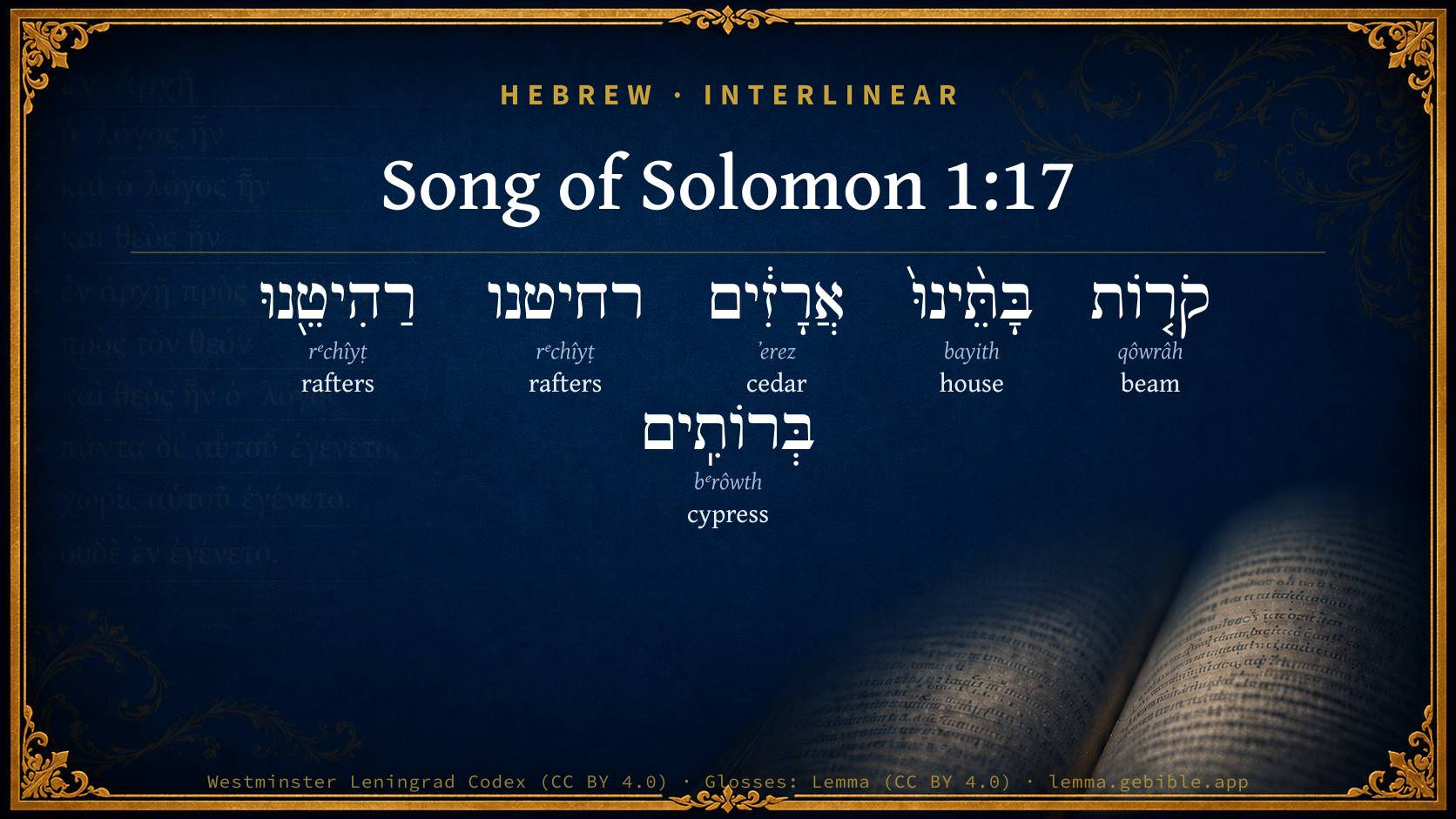
Hebrew (Westminster Leningrad Codex) Song of Solomon 1:17 appears in the Hebrew Old Testament. The text above is from the Westminster Leningrad Codex. Each word links to its Strong’s number, a concise gloss, and parsing drawn from the Open Scriptures Hebrew Bible morphology. Click any word for its full Brown-Driver-Briggs (BDB) entry.
Download image
Cite this verse

Song of Solomon 1:17 (World English Bible). Public Domain. Lemma interlinear Bible study tool, https://lemma.gebible.app/v/song-of-solomon/1/17.

Show BibTeX & RIS
BibTeX
RIS
English Translation
The beams of our house are cedars. Our rafters are firs. Beloved
World English Bible · Public Domain
Highlights
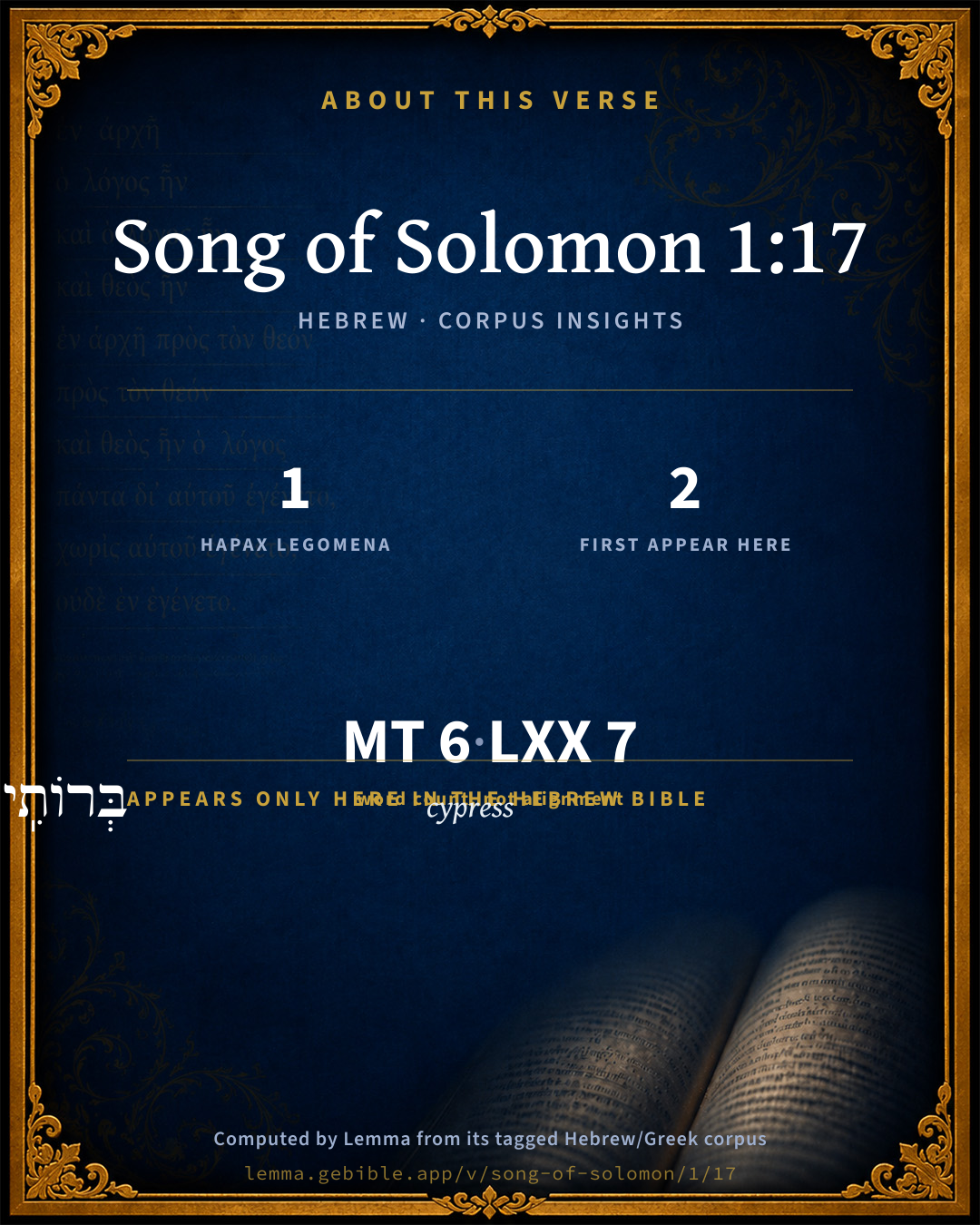
  • 1 hapax legomenon — only here in the Hebrew Bible
  • 2 first appearances in the Hebrew Bible
Full analysis ↓
Download a study sheet

One document with this verse’s original text, its word-by-word gloss line, the meaning frame, cross-references with their text, attributed commentary, and full source and license credits — printable, and it pastes into notes with its structure intact.

This verse Autodidact and up

Study sheet (.html) Plain text (.txt)

A passage Seminary Student

Up to 50 verses in one chapter. A passage sheet keeps up to 6 commentary sources and 12 cross-references per verse, in the order this page ranks them, and says so on the sheet whenever that leaves anything out. Ask for a single verse and you get the Autodidact verse sheet above.

Everything on this page stays free to read, with no account — the sheet is a download of what is already on screen, not access to it.

Want to remove ads? Support Godless Engineer
Compare translations 3

The same verse in 3 English versions, stacked beneath the original-language interlinear above. Click any original word for its lexicon entry.

Each is an independent rendering of the whole verse — the interlinear is not word-aligned to these translations.

Highlighted words mark where these versions differ — a whole-verse word diff, not a word-by-word alignment.

  • World English Bible Public Domain
    The beams of our house are cedars. Our rafters are firs. Beloved
  • King James Version Public Domain
    The beams of our house are cedar, and our rafters of fir.
  • unfoldingWord Literal Text CC BY-SA 4.0
    The beams of our house cedars; our rafters pine.

unfoldingWord Literal Text — © unfoldingWord, licensed CC BY-SA 4.0. Word-aligned USFM3 via Door43 (git.door43.org/unfoldingWord/en_ult).

Versions to compare (up to 4)

3 of 4 selected

Show all 16 translations

Every available English version of this verse, each an independent rendering of the whole verse.

  • World English Bible Public Domain
    The beams of our house are cedars. Our rafters are firs. Beloved
  • Berean Standard Bible Public Domain
    The beams of our house are cedars; our rafters are fragrant firs.
  • Majority Standard Bible Public Domain
    The beams of our house are cedars; our rafters are fragrant firs.
  • King James Version Public Domain
    The beams of our house are cedar, and our rafters of fir.
  • American Standard Version (1901) Public Domain
    The beams of our house are cedars, `And' our rafters are firs.
  • Revised Version (1885) Public Domain
    The beams of our house are cedars, and our rafters are firs.
  • Young's Literal Translation Public Domain
    The beams of our houses `are' cedars, Our rafters `are' firs, I `am' a rose of Sharon, a lily of the valleys!
  • Literal Standard Version CC BY-SA 4.0
    The beams of our houses [are] cedars, || Our rafters [are] firs, I [am] a rose of Sharon, a lily of the valleys!
  • Unlocked Literal Bible CC BY-SA 4.0
    The beams of our house are cedars; our rafters are firs.
  • unfoldingWord Literal Text CC BY-SA 4.0
    The beams of our house cedars; our rafters pine.
  • Darby Bible Public Domain
    The beams of our houses are cedars, Our rafters are cypresses.
  • World Messianic Bible Public Domain
    The beams of our house are cedars. Our rafters are firs.
  • Webster's Bible Public Domain
    The beams of our house are cedar, and our rafters of fir.
  • Free Bible Version CC BY-SA 4.0
    with cedar trees as beams for our “house,” and pine trees for the rafters.
  • Bible in Basic English Public Domain
    Cedar-trees are the pillars of our house; and our boards are made of fir-trees.
  • JPS Tanakh (1917) Public Domain
    The beams of our houses are cedars, and our panels are cypresses.

Literal Standard Version (2020), Covenant Press — licensed CC BY-SA 4.0. Text via the HelloAO Bible API (eBible.org). Unlocked Literal Bible (unfoldingWord) — licensed CC BY-SA 4.0. Text via the HelloAO Bible API (eBible.org). unfoldingWord Literal Text — © unfoldingWord, licensed CC BY-SA 4.0. Word-aligned USFM3 via Door43 (git.door43.org/unfoldingWord/en_ult). Free Bible Version, Dr. Jonathan Gallagher — licensed CC BY-SA 4.0. Text via the HelloAO Bible API (eBible.org).

Word by word

More ways to search: Search by grammar → Find every occurrence → Compare this word →

Practice this passage: Drill this verse → Learn its vocabulary →

About this verse

These counts appear in no published source. They are computed here, from the morphology-tagged text and Lemma’s own curated glosses. What Lemma adds →

6
words
5
distinct lemmas
Wisdom
section

Notable vocabulary

1 hapax legomenon — a word that appears only here in the entire Hebrew Bible:

  • בְּרוֹתִֽים cypress H1266

First appearance in Scripture

These words make their first canonical appearance in the Hebrew Bible here:

  • רחיטנו rafters H7351
  • בְּרוֹתִֽים cypress H1266

Grammatical profile

  • 6 nouns

Repetition

A word recurs within this verse — often emphatic in Hebrew:

  • רחיטנו rafters H7351 ×2

Hebrew & Septuagint length

In English translation the verse runs 12 words from the Hebrew and 12 from the Septuagint (LXX English) — the same length.

A rough comparison of the two English renderings, which tokenize alike — not a word-level alignment.

Word counts can differ between the Hebrew and the Greek without any difference in meaning — e.g. the Hebrew direct-object marker אֵת has no separate Greek word, and Greek often adds the article ὁ.

In the original languages it is 6 Hebrew tokens and 7 Greek tokens — but the two are counted differently (Hebrew bundles its prefixes and suffixes into one token; the Greek is in lemma form), so that isn’t a like-for-like length.

Cross-references

10

Topical passages linked to Song of Solomon 1:17 in the Treasury of Scripture Knowledge — connected by theme and wording, ordered by reader-vote popularity; previews shown in the World English Bible.

  • Hebrews 11:10 For he looked for the city which has the foundations, whose builder and maker is God.
  • Psalms 92:12 The righteous shall flourish like the palm tree. He will grow like a cedar in Lebanon.
  • 1 Kings 6:9 So he built the house, and finished it; and he covered the house with beams and planks of cedar.
  • 2 Chronicles 2:8–9 Send me also cedar trees, fir trees, and algum trees, out of Lebanon; for I know that your servants know how to cut timber in Lebanon: and, behold, my servants shall be with your servants,
  • Song of Solomon 7:5 Your head on you is like Carmel, The hair of your head like purple; The king is held captive in its tresses.
  • Song of Solomon 8:9 If she is a wall, We will build on her a turret of silver. If she is a door, We will enclose her with boards of cedar. Beloved
  • Ezekiel 41:16 the thresholds, and the closed windows, and the galleries round about on their three stories, over against the threshold, with wood ceilings round about, and [from] the ground up to the windows, (now the windows were covered),
  • Ezekiel 42:3 Over against the twenty [cubits] which belonged to the inner court, and over against the pavement which belonged to the outer court, was gallery against gallery in the third story.
  • 1 Timothy 3:15–16 but if I wait long, that you may know how men ought to behave themselves in the house of God, which is the assembly of the living God, the pillar and ground of the truth.
  • 1 Peter 2:4–5 coming to him, a living stone, rejected indeed by men, but chosen by God, precious.

Cross-references courtesy of OpenBible.info (CC BY 4.0).

Hebrew and Greek witnesses Masoretic Hebrew ↔ Greek Septuagint

The same verse in the two great witnesses to the Old Testament, shown verse-for-verse.

These are two independent witnesses, not word-aligned to each other, and the Septuagint is shown in lemma (dictionary) form.

Hebrew Song of Solomon 1:17 Masoretic · Westminster Leningrad Codex

קֹר֤וֹת בָּתֵּ֨ינוּ֙ אֲרָזִ֔ים רחיטנו רַהִיטֵ֖נוּ בְּרוֹתִֽים

The beams of our house are cedars. Our rafters are firs. Beloved

World English Bible · Public Domain

Greek LXX Song of Solomon 1:17 Septuagint · lemma form

δοκός οἶκος ἐγώ κέδρος φάτνωμα ἐγώ κυπάρισσος

The beams of our house are cedars, our ceilings are of cypress.

LXX2012 (modern English Septuagint) · Public Domain

On this verse, Ellicott's Commentary for English Readers discusses the Septuagint’s reading. Read the note in Commentary ↓

Hebrew: Westminster Leningrad Codex (CC BY 4.0). Greek: Septuagint (public domain); English from LXX2012 (modern English Septuagint) (Public Domain). How the Septuagint differs from the Hebrew →

Commentary

Notes on Song of Solomon 1:17 from classic Christian and Jewish commentators (each source and its license shown beneath its notes). The classic Christian expositions comment on the surrounding passage and are grouped to its opening verse, so a note may address several verses; the Jewish commentaries on the Tanakh (Rashi and others) are per-verse, so they appear only where the commentator wrote on this verse.

Lemma curates 59 commentaries, every one of them public domain or Creative Commons licensed, each selected and text-cleaned for this edition rather than reprinted as found. About our sources →

Trapp's Complete Commentary

John Trapp

Son 1:17 The beams of our house [are] cedar, [and] our rafters of fir.

Ver. 17. The beams of our house are cedar,] Not my, but our house, as before, our bed, and after, our galleries. All is common between the bridegroom and the bride - bed, board, house, all. It should be so between married couples, who should not have several purses, interests, &c., but both bring in what they have or get to the common hive. The Church is Christ’s house, and every faithful soul is God’s building; {1Ti 3:15 Heb 3:6} he "plants the heavens, and lays the foundation of the earth, that he may say to Zion, Thou art my people." {Isa 51:16} The great Architect of the world doth as wonderful a work in converting a soul to himself as he did in setting up this goodly edifice of the universe. This stately structure of the new creature he makes of the best materials, cedar, cypress, boratine, &c. A mud wall may be made up of dirt, straw, stones of the street, &c.; not so a stately palace, a marble monument. Solomon’s temple was built of cedar wood; so was the temple of Diana of the Ephesians, as Vitruvius testifieth: the devil will needs be God’s ape. He knew that cedar is a tree strong and durable; and for the dryness of it, the timber chawneth not, rotteth not; yea, it hath a property to preserve other things from putrefaction. A late writer observeth of it that viventes res putrefacit et perdit, putridas autem restituit et conservat. {a} The Church is also stable, and cannot be ruined; it is founded upon a rock; the elect cannot be finally deceived the faithful ministers, by preaching law and gospel, kill the quick Pharisee, and quicken the dead publican; {Rom 7:9 2Co 2:16} they "declare unto man his righteousness," {Job 33:23} and show him how he may be "found in Christ" (viz., when sought for by the justice of God), "not having his own righteousness," {Php 3:9} those filthy garments, {Zec 3:4} but the bride’s "fine white linen, and shining," {Rev 19:14} and after a few turns taken here with Christ in the terrace or galleries of the Church militant made of fir, he shall have places given him in heaven, to walk among "those that stand by"; {Zec 3:7} that is, among the seraphim, as the Chaldee paraphrast expounds it.

{a} Hinc. Horat., Cedro dignum, et cerite cera. - Scribon. in Physic., lib. ii.

John Trapp, A Commentary or Exposition upon All the Books of the Old and New Testament (1647–1656) — public domain. Text from a community e-Sword module.

Adam Clarke's Commentary

Verse 17. The beams of our house are cedar] Perhaps it was under a cedar tree, whose vast limbs were interwoven with the ברות beroth, a tree of the cypress kind, where they now sat. And this natural bower recommended itself to the poet's attention by its strength, loftiness, and its affording them a shady cover and cool retreat. How natural to break out into the praise of a bower, by whose branches and foliage we are shielded from the intense heat of the sun! Even the shelter of a great rock to a weary land is celebrated by the pen of the first of prophets and greatest of poets, Isa 32:2.

With this chapter the first day of the marriage ceremonies is supposed to end.

Adam Clarke's Commentary on the Bible (1810–1826) — public domain. Text from a community e-Sword/MySword module.

Ellicott's Commentary for English Readers

(17) Rafters.—Marg., galleries (comp. Son_7:5); LXX., φατνώματα; Vulg., laquearia; Heb., rahît, from rahat = run, flow: hence (1) a gutter, from the water running down (Gen. 3:38); (2) a curl, from its flowing down the neck (Son_7:5—Hebrews 6); (3) here rafters, or roof beams, from their spreading overhead. “Our couch was the green grass, the arches of our bower the cedar branches, and its rafters the firs.” Others read rachitim, which is explained as a transposition for charitim = turned work. But the thought is plainly connected with the woods, not with a gorgeous house. For cedar see 1Ki_4:33.

Fir.—Heb., berôth (Aramaic form of berôsh), a tree often mentioned in connection with cedar as an emblem of majesty, &c. (Eze_31:8; Isa_37:24; Isa_60:13). “The plain here has evidently been buried deep under sand long ages ago, precisely as at Beirût, and here are the usual pine forests growing upon it (Beirût is by some derived from berûth). These are the finest specimens we have seen in Palestine, though every sandy ridge of Lebanon and Hermon is clothed with them. In my opinion it is the Heb. berôsh, concerning which there is so much confusion in the various translations of the Bible . . . the generic name for the pine, of which there are several varieties in Lebanon. Cypress is rarely found there, but pine everywhere, and it is the tree used for beams and rafters (Thomson, The Land and Book, p. 511). The Pinus maritima and the Aleppo pine are the most common, the latter being often mistaken for the Scotch fir. (See Tristram, Nat. Hist. of Bible, p. 353, &c.)

A Bible Commentary for English Readers, edited by Charles John Ellicott (1878–1897) — public domain. Text from a community e-Sword module.

The Cambridge Bible for Schools and Colleges

gen. ed. J. J. S. Perowne

17. Render, The beams of our houses are cedars, and our rafters are cypresses. The meaning is not that their houses are built of cedar, but that the cedar trees and fir trees form the roof over their heads as they seek shelter under them. Perhaps the plural houses may be significant. They have not one, but many palaces in the forest glades. The country maiden speaks as a country maiden whose couch was often in the green grass, and who had cedars and cypresses for walls and roof at her meetings with her lover.

our rafters] Heb. râchîtçnu. This word is not found elsewhere, and its meaning can only be conjectured. The context suggests some portion of the woodwork of the roof, hence the ‘rafters’ of the A.V. LXX, φατνώματα = laquearia, lacunaria, i.e. ‘panelled ceilings.’

of fir] are cypresses. The form of the Heb. word here is bìrôthîm, which is supposed to be the North Palestinian pronunciation for the usual berôshîm. The Vulgate everywhere renders abies = pine, the LXX and Syriac give in many places ‘cypress.’ But the cedar and cypress were trees of Lebanon, and the most valued among them, and Solam, at the S.W. foot of Jebel-ed-Dahi (Oettli), was not very far from the forests of Lebanon. Probably therefore the cypress is meant.

The Cambridge Bible for Schools and Colleges (gen. ed. J. J. S. Perowne; Cambridge University Press, 1878–1918) — public domain. Text from a community e-Sword module.

Matthew Poole's English Annotations

The beams of our house are cedar; not only strong and incorruptible, but also fragrant and delightful. Though I am in myself but a mean and rustic person, yet the house to which I invite thee, and where thou and I shall dwell together, is, by thy favour, built with cedar; whereby is here signified the stability of God’s church upon earth, which is called God’s house, 1Ti 3:15, and the firmness and sureness of God’s word and promises.

Rafters; the lesser beams. Or, as it is rendered in our margin, and by others, galleries, wherein we may walk.

Of fir; or, as the ancients and others render it, of cypress, which was used in buildings, which also was strong and fragrant, and therefore suits well with cedars.

Matthew Poole's English Annotations on the Holy Bible (1683–1685) — public domain. Text from a community e-Sword/MySword module.

Whedon's Commentary on the Bible

Daniel D. Whedon

17. The beams, etc. — Better, The arches of our house are cedar, and its roof-work of cypress. A summer retreat which, in its coolness and fragrance and templed trees, may vie with the king’s canopies as a home for love.

Daniel D. Whedon (gen. ed.), Commentary on the Old and New Testaments (1874–1909) — public domain. Text from a community e-Sword module.

John Wesley's Explanatory Notes

Cedar - Not only strong, but also fragrant and delightful. Cypress - Which also was strong and fragrant, and therefore suits well with cedar.

John Wesley, Explanatory Notes Upon the Whole Bible (1754–1765) — public domain. Text via the GEBible commentary corpus.

Rashi

Rabbi Shlomo Yitzchaki (Rashi)

The beams of our houses are cedars This is the praise of the Tabernacle.

our corridors Heb. רָהִיטֵנוּ. I do not know if this is a term referring to boards or a term referring to bars, but I do know that also in the language of the Mishnah, we learned (Hag. 16a): “The רָהִיטִים of a person’s house testify against him.”

Rashi on the Tanakh — English translations: “The Judaica Press complete Tanach with Rashi, translated by A. J. Rosenberg” (CC BY 4.0); “Pentateuch with Rashi's commentary by M. Rosenbaum and A.M. Silbermann, 1929-1934” (public domain); “The Metsudah Tanach series, Lakewood, N.J” (CC BY 4.0); and “The Book of Joshua, Metsudah Publications, 1997” (CC BY 4.0). Text via Sefaria.

Lesson kit

Teaching starters — assembled from the data on this page, not authored interpretation. Every prompt links to the verse data it draws on. Edit before teaching.

Song of Solomon, in the Wisdom, opens this verse with 6 words (5 distinct Hebrew lemmas). Its most distinctive word is bᵉrôwth (“cypress”). A historical commentator’s framing appears above. Read the whole chapter for the surrounding context.

Discussion questions

  1. How does “cypress” (bᵉrôwth) shape what this verse is saying?
  2. This verse holds 1 word here found nowhere else in the Hebrew Bible. What might the rare word draw attention to?
  3. 2 words here appear for the first time in Scripture. What is being introduced at this debut?
  4. Hebrews 11:10 shares this passage’s theme. How do the two illuminate each other?
  5. “rafters” occurs 2× in this one verse. What is the effect of the repetition?
  6. These translations render this verse differently. What is at stake in choosing one wording over another?
  7. Reading how Trapp's Complete Commentary and Adam Clarke's Commentary read this verse, where do the two commentators agree and where do they part?

Things to notice

  • 1 word in this verse appears nowhere else in the Hebrew Bible.
  • 2 words make their first canonical appearance in Scripture here.
  • This verse counts 6 Hebrew ↔ 7 Greek words.
  • These translations choose different wording for 6 words in this verse.
  • “rafters” occurs 2× in this single verse.

Reading settings

Reading text

Shown beneath each verse's original-language words.

Old Testament
Old Testament edition

Read the OT as the Masoretic Hebrew (MT) or the Greek Septuagint (LXX).

English shown for the Greek Septuagint (in the Hebrew ↔ Greek comparison).

Comparing translations? Open the Compare panel on any verse page to stack up to four side by side.