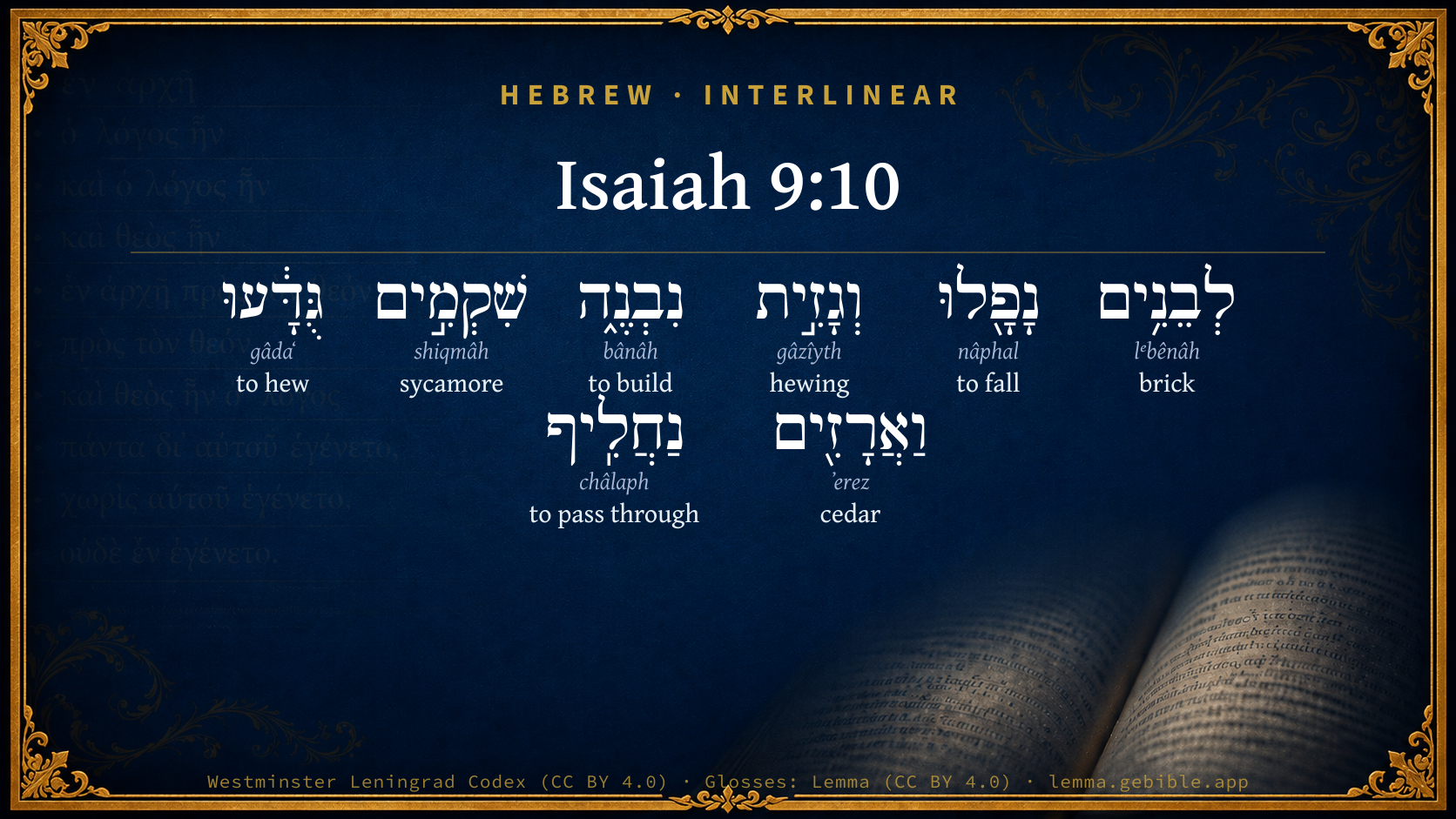
Isaiah 9:10

Hebrew (Westminster Leningrad Codex) Isaiah 9:10 appears in the Hebrew Old Testament. The text above is from the Westminster Leningrad Codex. Each word links to its Strong’s number, a concise gloss, and parsing drawn from the Open Scriptures Hebrew Bible morphology. Click any word for its full Brown-Driver-Briggs (BDB) entry.
Download image
Cite this verse

Isaiah 9:10 (World English Bible). Public Domain. Lemma interlinear Bible study tool, https://lemma.gebible.app/v/isaiah/9/10.

Show BibTeX & RIS
BibTeX
RIS
English Translation
The bricks are fallen, but we will build with hewn stone; the sycamores are cut down, but we will put cedars in their place.
World English Bible · Public Domain
Download a study sheet

One document with this verse’s original text, its word-by-word gloss line, the meaning frame, cross-references with their text, attributed commentary, and full source and license credits — printable, and it pastes into notes with its structure intact.

This verse Autodidact and up

Study sheet (.html) Plain text (.txt)

A passage Seminary Student

Up to 50 verses in one chapter. A passage sheet keeps up to 6 commentary sources and 12 cross-references per verse, in the order this page ranks them, and says so on the sheet whenever that leaves anything out. Ask for a single verse and you get the Autodidact verse sheet above.

Everything on this page stays free to read, with no account — the sheet is a download of what is already on screen, not access to it.

Want to remove ads? Support Godless Engineer
Compare translations 3

The same verse in 3 English versions, stacked beneath the original-language interlinear above. Click any original word for its lexicon entry.

Each is an independent rendering of the whole verse — the interlinear is not word-aligned to these translations.

Highlighted words mark where these versions differ — a whole-verse word diff, not a word-by-word alignment.

  • World English Bible Public Domain
    The bricks are fallen, but we will build with hewn stone; the sycamores are cut down, but we will put cedars in their place.
  • King James Version Public Domain
    The bricks are fallen down, but we will build with hewn stones: the sycomores are cut down, but we will change them into cedars.
  • unfoldingWord Literal Text CC BY-SA 4.0
    “The bricks have fallen, but we will build hewn stone. Sycamores have been cut down, but we will change cedars.”

unfoldingWord Literal Text — © unfoldingWord, licensed CC BY-SA 4.0. Word-aligned USFM3 via Door43 (git.door43.org/unfoldingWord/en_ult).

Versions to compare (up to 4)

3 of 4 selected

Show all 18 translations

Every available English version of this verse, each an independent rendering of the whole verse.

  • World English Bible Public Domain
    The bricks are fallen, but we will build with hewn stone; the sycamores are cut down, but we will put cedars in their place.
  • Berean Standard Bible Public Domain
    “The bricks have fallen, but we will rebuild with finished stone; the sycamores have been felled, but we will replace them with cedars.”
  • Majority Standard Bible Public Domain
    “The bricks have fallen, but we will rebuild with finished stone; the sycamores have been felled, but we will replace them with cedars.”
  • King James Version Public Domain
    The bricks are fallen down, but we will build with hewn stones: the sycomores are cut down, but we will change them into cedars.
  • American Standard Version (1901) Public Domain
    The bricks are fallen, but we will build with hewn stone; the sycomores are cut down, but we will put cedars in their place.
  • Revised Version (1885) Public Domain
    The bricks are fallen, but we will build with hewn stone: the sycomores are cut down, but we will change them into cedars.
  • Geneva Bible (1599) Public Domain
    The brickes are fallen, but we will build it with hewen stones: the wilde figge trees are cut downe, but we will change them into ceders.
  • Douay-Rheims (1899) Public Domain
    The bricks are fallen down, but we will build with square stones: they have cut down the sycamores, but we will change them for cedars.
  • Young's Literal Translation Public Domain
    `Bricks have fallen, and hewn work we build, Sycamores have been cut down, and cedars we renew.'
  • Literal Standard Version CC BY-SA 4.0
    “Bricks have fallen, and we build hewn work, || Sycamores have been cut down, and we renew cedars.”
  • Unlocked Literal Bible CC BY-SA 4.0
    “The bricks have fallen, but we will rebuild with chiseled stone; the sycamores have been cut down, but we will put cedars in their place.”
  • unfoldingWord Literal Text CC BY-SA 4.0
    “The bricks have fallen, but we will build hewn stone. Sycamores have been cut down, but we will change cedars.”
  • Darby Bible Public Domain
    The bricks are fallen down, but we will build with hewn stones; the sycamore trees are cut down, but we will replace them with cedars.
  • World Messianic Bible Public Domain
    “The bricks have fallen, but we will build with cut stone. The sycamore fig trees have been cut down, but we will put cedars in their place.”
  • Webster's Bible Public Domain
    The bricks have fallen down, but we will build with hewn stones; the sycamores are cut down, but we will change them into cedars.
  • Free Bible Version CC BY-SA 4.0
    “The brick buildings have collapsed, but we will rebuild them with dressed stone; the sycamore fig trees have been cut down, but we will replace them with cedars.”
  • Bible in Basic English Public Domain
    The bricks have come down, but we will put up buildings of cut stone in their place: the sycamores are cut down, but they will be changed to cedars.
  • JPS Tanakh (1917) Public Domain
    (9-9) 'The bricks are fallen, but we will build with hewn stones; the sycamores are cut down, but cedars will we put in their place.'

Literal Standard Version (2020), Covenant Press — licensed CC BY-SA 4.0. Text via the HelloAO Bible API (eBible.org). Unlocked Literal Bible (unfoldingWord) — licensed CC BY-SA 4.0. Text via the HelloAO Bible API (eBible.org). unfoldingWord Literal Text — © unfoldingWord, licensed CC BY-SA 4.0. Word-aligned USFM3 via Door43 (git.door43.org/unfoldingWord/en_ult). Free Bible Version, Dr. Jonathan Gallagher — licensed CC BY-SA 4.0. Text via the HelloAO Bible API (eBible.org).

Word by word

More ways to search: Search by grammar → Find every occurrence → Compare this word →

Practice this passage: Drill this verse → Learn its vocabulary →

About this verse

These counts appear in no published source. They are computed here, from the morphology-tagged text and Lemma’s own curated glosses. What Lemma adds →

8
words
8
distinct lemmas
Prophets
section

Notable vocabulary

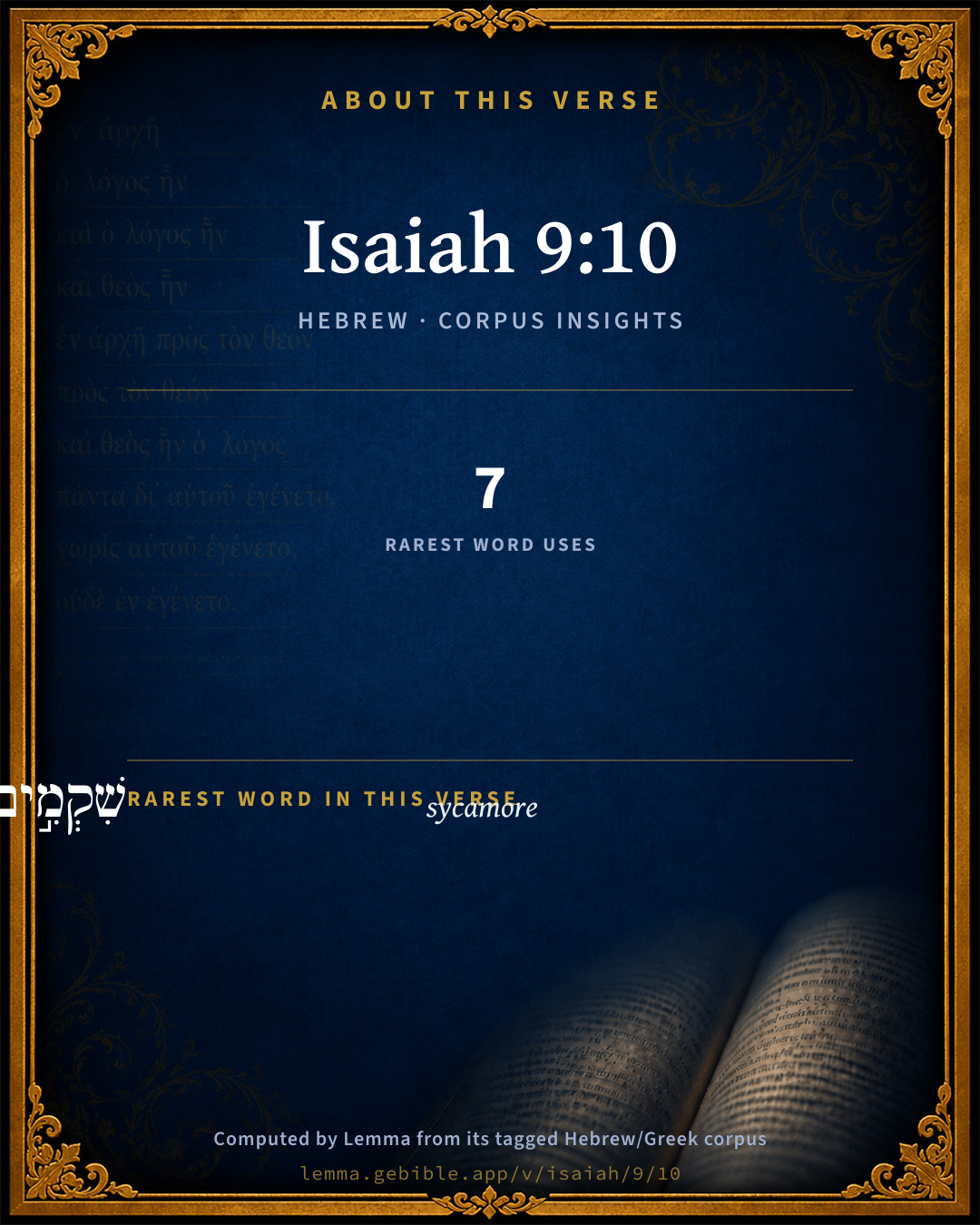
The rarest word here is שִׁקְמִ֣ים sycamore H8256 — appearing just 7 times in the whole Hebrew Bible.

Shared distinctive vocabulary

שִׁקְמִ֣ים sycamore H8256 occurs in 7 verses of the Hebrew Bible. Also found in:

Grammatical profile

  • 4 verbs
  • 4 nouns

Verb forms

  • נָפָ֖לוּ Qal · Perfect
  • נִבְנֶ֑ה Qal · Imperfect
  • גֻּדָּ֔עוּ Pual · Perfect
  • נַחֲלִֽיף Hiphil · Imperfect

Hebrew & Septuagint length

In English translation the verse runs 24 words from the Hebrew and 25 from the Septuagint (LXX English) — closely comparable.

A rough comparison of the two English renderings, which tokenize alike — not a word-level alignment.

Word counts can differ between the Hebrew and the Greek without any difference in meaning — e.g. the Hebrew direct-object marker אֵת has no separate Greek word, and Greek often adds the article ὁ.

Cross-references

3

Topical passages linked to Isaiah 9:10 in the Treasury of Scripture Knowledge — connected by theme and wording, ordered by reader-vote popularity; previews shown in the World English Bible.

  • Malachi 1:4 Whereas Edom says, "We are beaten down, but we will return and build the waste places;" thus says Yahweh of Hosts, "They shall build, but I will throw down; and men will call them 'The Wicked Land,' even the people against whom Yahweh shows wrath forever."
  • 1 Kings 10:27 The king made silver to be in Jerusalem as stones, and cedars made he to be as the sycamore trees that are in the lowland, for abundance.
  • 1 Kings 7:9–12 All these were of costly stones, even of hewn stone, according to measure, sawed with saws, inside and outside, even from the foundation to the coping, and so on the outside to the great court.

Cross-references courtesy of OpenBible.info (CC BY 4.0).

Hebrew and Greek witnesses Masoretic Hebrew ↔ Greek Septuagint

The same verse in the two great witnesses to the Old Testament, shown verse-for-verse.

These are two independent witnesses, not word-aligned to each other, and the Septuagint is shown in lemma (dictionary) form.

Hebrew Isaiah 9:10 Masoretic · Westminster Leningrad Codex

לְבֵנִ֥ים נָפָ֖לוּ וְגָזִ֣ית נִבְנֶ֑ה שִׁקְמִ֣ים גֻּדָּ֔עוּ וַאֲרָזִ֖ים נַחֲלִֽיף

The bricks are fallen, but we will build with hewn stone; the sycamores are cut down, but we will put cedars in their place.

World English Bible · Public Domain

Greek LXX Isaiah 9:10 Septuagint · lemma form

καί ῥάσσω ὁ θεός ὁ ἀναἵστημι ἐπί ὄρος σιων ἐπί αὐτός καί ὁ ἐχθρός αὐτός διασκεδάζω

The bricks are fallen down, but come, let us hew stones, and cut down sycamores and cedars, and let us build for ourselves a tower.

LXX2012 (modern English Septuagint) · Public Domain

On this verse, John Gill's Exposition discusses the Septuagint’s reading. Read the note in Commentary ↓

Hebrew: Westminster Leningrad Codex (CC BY 4.0). Greek: Septuagint (public domain); English from LXX2012 (modern English Septuagint) (Public Domain). How the Septuagint differs from the Hebrew →

Targum (Aramaic paraphrase)

1

The Targum is the ancient Jewish Aramaic paraphrase of the Hebrew Scriptures — an interpretive translation, not the Hebrew text itself. Onkelos (literal) and Pseudo-Jonathan (expansive) render the Torah, and Jonathan the Prophets. Coverage is partial: where no permissively-licensed English translation exists for a verse, only the Aramaic is shown. This is verse-level text, not a word-by-word alignment to the Hebrew.

  1. Targum Jonathan Prophets (Joshua–Malachi)
    וְתַקֵיף יְיָ סַנָאָה רְצִין עֲלוֹהִי וְיַת בַּעֲלֵי דְבָבוֹהִי יְעָרֵר:

    Therefore the Lord shall make strong the hatred of Rezin against him, and he will stir up his adversaries.

    Targum Jonathan — Aramaic: “Mikraot Gedolot” (public domain). English: “Sefaria Community Translation” (CC0 1.0 (public-domain dedication)); “London "Chaldee Paraphrase," 1871” (public domain). Text via Sefaria.

Commentary

Notes on Isaiah 9:10 from classic Christian and Jewish commentators (each source and its license shown beneath its notes). The classic Christian expositions comment on the surrounding passage and are grouped to its opening verse, so a note may address several verses; the Jewish commentaries on the Tanakh (Rashi and others) are per-verse, so they appear only where the commentator wrote on this verse.

Lemma curates 59 commentaries, every one of them public domain or Creative Commons licensed, each selected and text-cleaned for this edition rather than reprinted as found. About our sources →

Adam Clarke's Commentary

Verse 10. The bricks] "The eastern bricks," says Sir John Chardin, (see Harmer's Observ. I., p. 176,) "are only clay well moistened with water, and mixed with straw, and dried in the sun." So that their walls are commonly no better than our mud walls; see Maundrell, p. 124. That straw was a necessary part in the composition of this sort of bricks, to make the parts of the clay adhere together, appears from Ex 5:7-19. These bricks are properly opposed to hewn stone, so greatly superior in beauty and durableness. The sycamores, which, as Jerome on the place says, are timber of little worth, with equal propriety are opposed to the cedars. "As the grain and texture of the sycamore is remarkably coarse and spongy, it could therefore stand in no competition at all (as it is observed, Isa 9:10) with the cedar, for beauty and ornament." - Shaw, Supplement to Travels, p. 96. We meet with the same opposition of cedars to sycamores, 1Kg 10:27, where Solomon is said to have made silver as the stones, and cedars as the sycamores in the vale for abundance. By this mashal, or figurative and sententious speech, they boast that they shall easily be able to repair their present losses, suffered perhaps by the first Assyrian invasion under Tiglath-pileser; and to bring their affairs to a more flourishing condition than ever.

Some of the bricks mentioned above lie before me. They were brought from the site of ancient Babylon. The straw is visible, kneaded with the clay; they are very hard, and evidently were dried in the sun; for they are very easily dissolved in water.

Adam Clarke's Commentary on the Bible (1810–1826) — public domain. Text from a community e-Sword/MySword module.

Trapp's Complete Commentary

John Trapp

Isa 9:10 The bricks are fallen down, but we will build with hewn stones: the sycomores are cut down, but we will change [them into] cedars.

Ver. 10. The bricks are fallen down.] Not thrown down by Providence, but fallen down by fate or blind fortune. God is not so far honoured as once to be owned by these atheists, who think they can make their party good against him, and mend what he had marred, whether he would or not. Thus this giant-like generation; and the like impiety is in the corrupt nature of us all. For "as in water face answereth to face, so doth the heart of a man to a man," saith Solomon. {Pro 27:19}

The sycamores are cut down, &e.] Another proverbial speech to the same purpose. Sycamores were then very common in that country, and little set by. {1Ki 10:27} Now they are not to be found there, saith Jerome, as neither are cedars in Lebanon.

John Trapp, A Commentary or Exposition upon All the Books of the Old and New Testament (1647–1656) — public domain. Text from a community e-Sword module.

The Biblical Illustrator

Joseph S. Exell

Isa_9:10

The bricks are fallen down, but we will build with hewn stones

A drinking song

It has been conjectured that these words are a fragment of a drinking song actually sung in Ephraim.

(Prof. J. Skinner, D. D.)

Israels presumption

In the first strophe Isaiah depicted the

Ephraimites proud superiority to danger, and their placid, assurance after defeat: The bricks, they say, are fallen, but we will build with hewn stone; the sycamores are cut down, but we will put cedars in their place: no sooner, in other words, has one scheme miscarried than they are prepared with a more magnificent one to take its place; no sooner is one dynasty overthrown than another rises in its stead. The proverb gives apt expression to the temper habitually displayed by the northern kingdom. (Prof. S. H. Driver, D. D.)

The sycamore

The commonest tree in the lowlands of Palestine, by the

Mediterranean Sea (1Ki_10:27). (Prof. S. H. Driver, D. D.)

Beautiful words of varying import

There cannot be two opinions about the beauty of these words. What, then, will be your surprise, when you find that they express nothing more than a wicked thought on the part of

Ephraim and the inhabitant of Samaria? This circumstance gives us our first point. Noble mottoes may be written upon unworthy banners. Religious words may be pronounced by irreligious lips. We must always look at the surroundings of a circumstance in order to understand its full value. Every circumstance, like every globe, has an atmosphere of its own, hence the wisdom of looking at the context as well as at the text itself. How needful it is to inquire into the surroundings of anything that may charm us. If you have seen a man in church, his mouth opened in praise, his head inclined in prayer, surely you have a right to argue from that individual circumstance to the whole circle and bearing of his daily life. It is impossible that a man can have bowed his head in prayer, and then allow the devil to roam through the whole circle of his intellect, there to inspire evil thoughts. He cannot allow anything that is mean and unworthy to touch and debase the life that has been consecrated by prayer. You know how fallacious would be such reasoning! But the rule should be applied impartially, and therefore I hasten with the noblest interpretation which my judgment can approve to those who may have been caught in some moment of evil passion. Surely a man is not a bad man utterly because he has once been in high excitement. If the one little beauty does not redeem the whole sterile place, in the midst of which it was found, surely the one act of evil cannot spoil the whole paradise of the life, and blight a heart beautiful as a garden in summer. We may learn from these words that wickedness is not mitigated by the beauty of the language in which it is expressed. Is there anything lovelier in all the universe, possible to the inspired imagination, than poetry, painting, and music? Do they not carry with them all elements of beauty and all qualities of high and noble strength. Yet even they have been uncrowned, robbed of their nobleness, and bound down to do menial work in the devils service. Let me guard the young, therefore, along this line. They will come from certain places and will say, the music was so beautiful! No doubt of it. They will come again and say, the whole scene was so lovely! No one questions its loveliness. The bricks are fallen down, but we will build with hewn stones; the sycamores are cut down, but we will change them into cedars,--what language, what music could be more beautiful! And yet through this beautiful speech, Ephraim and the inhabitant of Samaria indicated their ambitious purpose to thwart the God of the universe! What would you say if I told you that this hand of mine was the hand of an assassin, but yet pleaded for it because of the jewel which flashed upon its fingers! Would you kiss a hand so decorated? Now, take the other view, and let us imagine beautiful words expressing a beautiful purpose. Then we shall have the wedlock which God loves. (J. Parker, D. D.)

Building with hewn stone

There are three classes of you who are building with bricks, and I will ask you if you had not better build with hewn stones.

1. Take those who make good vows limited by time. There are many such. A man, for example, has said to his father, I promise I will go to church once a week, for twelve months. It is very good so far as it goes, but it is building with bricks, not with hewn stones. A young man has said, Give me thin paper, and I will pledge myself to abstain from everything that can intoxicate for six months. Very good. I do not pour contempt upon such a resolution; so far as it goes, it is good. But the very limitation of the vow is a source of weakness. Thus--for the first few days you are strong in your purpose, but gradually you begin to count the days that you have yet to serve. The last week comes, and the vow is like a pale figure gradually disappearing; the last day but one comes, where then is the vow? tomorrow you say you will be free. Free what to do? To become a slave again! Now I want you to change that brick wall of temporary resolution for the hewn stone of an eternal vow.

2. Then there is another class building with bricks instead of hewn stones, namely, those who are inspired by inadequate motives. Where the motive is insufficient, conduct must go down. We live in motive. When the motive force fails the machinery must of necessity stand still There is a man who says he will do a certain thing to obtain a reward. That mans virtue is only suppressed vice. He who will do a good thing simply because he will earn a reward, will do a bad thing if you double the premium. The motive is insufficient, and the last state of that man will be worse than the first. Others will come to church to please an admirer. That is not church going. Would that I could speak in sufficiently forceful language to the young about this! Where the motive of church going is inadequate it will always be intermittent, and in the end it will expire. If you go to church because you love to be there, and would have Sunday doubled in its golden hours, then you will always be strong in your religious attachments, affections, and convictions. Then there are those who attempt to do right in order to escape a penalty. This is an insufficient motive. I know that fear plays a very important part in the constitution of the human mind, and in the direction of human conduct. But man can outlive fear. Man can become accustomed to the unexpected. There is but one true motive--a hearty love of God!

3. Then there is the third class to which I refer,--those who have not calculated the full force and weight of temptation. When you build a house, you build for the roughest day in the whole year. That should be the sovereign rule, in the building of the life house. The ship that left for the United States yesterday, probably took out three or fourfold the necessary provisions, according to the season of the year, and probably took out coal sufficient for a double journey. Why this excess? Why take more than is needed for the ten days voyage? Because of the unforeseen. If, therefore, in such things men make such arrangements, they condemn themselves--I do not hesitate to say the word--as fools, if they leave the spiritual life and the spiritual destiny without more than a transient consideration. Herein is the glory of Christianity, that it builds with hewn stones. Christs Gospel is full of soundness, life, and indestructible virility. (J. Parker, D. D.)

Wise lessons from wicked lips

Jesus said, The children of this world are in their generation wiser than the children of light, meaning by the statement that they excel them in the shrewdness and tact with which they manage their business when that has taken an adverse turn. Men of the world do not readily submit to defeat and failure, but strive to convert defeat into victory, and failure into success. Of this the text affords illustration.

I. These children of this world PROCEED WITH A DEFINED PURPOSE, and in this are worthy of imitation. The bricks mentioned as having fallen down were not a heap of burned clay which had got piled up, no one could tell how. They had been built by human hands, and the builders had heads as well as hands. We are not told what sort of buildings they were which Ephraim and the inhabitant of Samaria had constructed, and which had fallen down. They may have been dwelling houses, or a temple, round which the sycamores would be planted for groves in which idolatrous Israel worshipped the gods of her own evil devising and choice, and for which she had forsaken the God of her fathers. But let this be as it may, now that the bricks had fallen, and the sycamores were out down, in making up their minds as to what should be done--being anxious to repair the ruin and desolation--they proceed with a defined purpose. The architect precedes the builder: the head leads the hand. So when they set to work they know what they are about. Now, the same principle should underlie the building up of all Christian character and work. Knowledge and zeal should ever be in partnership.

II. These children of the world WERE INSPIRED WITH HOPEFULNESS, and, therefore, are worthy of imitation. Their bricks fell down, but their spirits fell not into the pit of despair. Their sycamores were cut down, but their ambition was not. Is not that the spirit of the world today as then? In 1865 men said England and America shall be connected by the electric telegraph, and they went to work. But the cable snapped, and for the present the enterprise failed. Were the promoters daunted, and persuaded that their scheme was beyond the reach of possible things? No, not they. The next year saw them again at their work, and saw not only a new cable successfully laid, but the broken one, searched for in the great wilderness of waters, at length found, after which it was lost and found again several times over, until the 2 nd September, when it was at last secured, and the following telegram flashed along its wire. I have much pleasure in speaking to you through the 1865 cable. So the Christian ought to be hopeful. You have fallen! Say, I will rise again. Your schemes have failed! Say, I will try again. You are afraid you have laboured in vain! Say, In labours I will be more abundant. You have stormed the citadel of indwelling passion and evil, and still you have to confess, The good that I would I do not, but the evil which I would not that I do. Say again, By the grace of God I shall meet my spiritual foes. Have you with earnest soul entered the Holy of holies, desirous to know the deep things of God, and where you expected light, lo! great darkness; and where you sought for peace, and sunshine, and beauty, and harmony, lo! seeming contradiction, the howling waste, cloud, and storm? You searched for a way out of your intellectual doubts and difficulties, and behold mystery has added itself to mystery. Still hope thou in God.

III. These children of this world SHOW A SPIRIT OF INDUSTRIOUS PERSEVERANCE, and are therefore worthy of imitation. Their hands responded to the impulse of their hearts. They dreamed not that by mere wishing their ruined walls would rise again, or their gardens, laid waste, would blossom with the rose, and be made beautiful with the cedar. The moral here is plain. Not everyone that saith unto Me, Lord, Lord (so hoping to enter), shall enter into the kingdom of heaven; but he that doeth the will of My Father. Hoping will not do everything. It must be backed by earnest effort.

IV. These children of the world IMPROVE MATTERS, and are, therefore, worthy of imitation. These tumble down buildings were, after all, but brick; but now they would build, not with bricks, but with hewn stones. Around them had flourished the sycamores, but now that these were cut down, they would plant no more sycamores. They would do better than that; they would plant cedars. In three different places (1Ki_10:27; 2Ch_1:15; 2Ch_9:27) the value of the sycamore as compared with the cedar is given as the value of stones compared to that of silver. Such is the spirit of the world. Is not this the spirit which ought to animate us Never to rest satisfied with present attainments in self-culture or success in our work. (A. Scott.)

The Biblical Illustrator, edited by Joseph S. Exell (c. 1880s–1900s) — public domain. Text from a community e-Sword module.

The Preacher's Complete Homiletical Commentary

Joseph S. Exell (gen. ed.)

WISE LESSONS FROM WICKED LIPS

Isa_9:10. The bricks are fallen down, &c.

Jesus said, “The children of this world are in their generation wiser than the children of light,” meaning that they excel them in shrewdness and tact. Men of the world do not readily submit to defeat and failure, but strive to convert defeat into victory, and failure into success. In this respect, therefore, the children of this world are worthy of imitation. Within the spiritual, Christian sphere we might well emulate them in the determined, hopeful, persevering, progressive, patient spirit with which they prosecute their affairs. Of this the text affords illustration. The children of this world, of whom it speaks to us, are worthy of our imitation in the following respects:—

I. They proceed with a defined purpose. The bricks mentioned as having fallen down were not a heap of burned clay, which somehow had got piled up, no one could tell how. They had been built by human hands, and the builders had heads as well as hands. But now that the bricks had fallen, in making up their minds as to what should be done, they proceed with a defined purpose. The architect precedes the builder; the head leads the hand. They build not at 2G random. They first say what they will build, and how. They also resolve once more to beautify their surroundings with trees, and they make their choice. This time they will not have sycamores, but cedars.

The same principle should underlie the building up of all Christian character and work. Knowledge and zeal should ever be in partnership. The hand should be under control of the head. Everything should be done well, because done wisely. One purpose should run through and be supreme in each life. Striving, and toiling, and fighting, we should have it first settled what we are to strive, and toil, and fight for. And as to this we are left in no difficulty. A plan is made for us, and our wisdom is to work it out. A number of young men were one day practising archery, when the arrows of one invariably stuck in the ground. Seeing this, one of his companions cried out, “Do aim higher.” That is what we have to do. We substitute our own low, faltering purpose for the high, glorious purpose of God (Rom_8:29; 1Pe_2:21). So, also, in connection with our work, a high purpose should be our aim. We should not make up our minds to do as little as possible, neither should our only object be to do as much as possible. Our question should be, What is my Master’s will? Obedience is better than sacrifice. They who would work for their Lord with acceptance must wait on Him, and He will give “to every man his work.” Further, with our plan fixed, we must set our whole heart upon the working of it out. Here Israel teaches us. When her first effort failed, she tried again. The spirit of enthusiasm must inspire us. This it is which makes labour rest, and turns the yoke into a crown.

II. They were inspired with hopefulness. Their bricks fell down, but their spirits fell not into the pit of despair. Their sycamores were cut down, but their ambition was not. They viewed the desolation not without sadness, but in the midst of it all “Nil Desperandum” was the song which they sang. And that is the spirit of the world to-day. So the Christian ought to be hopeful. You have fallen! Say, “I will rise again.” Your schemes have failed! Say, “I will try again.” You are afraid you have laboured in vain! Say, “In labours I will be more abundant.” You went into what you thought the paradise of God, but lo! it turned out to be a dreary wilderness. What then? Still hope in God. Seek on, O seeker, and thou shalt find. Knock on, louder and louder; the door will be opened.

Night must give way to day. Mystery after mystery will unfold itself. Light will appear to every man having eyes and using them. The children of this world hope; greater reason have they to hope who are children of God.

III. They show a spirit of industrious perseverance. Their hands responded to the impulse of their hearts. What they were ready to say they were ready to do. They were prepared by hard, persevering toil to make good their hope. These men of Israel were at this time without God, but they were not without common sense. They dreamed not that by mere wishing their ruined walls would rise again. If they wanted new temples and goodly cedars, they must build and plant them. The moral here is plain (Mat_7:21). Hoping will not do everything. It must be backed by earnest effort. The way to heaven is not reached by flying, but by toiling. I am a son of God; let me then subscribe myself “Servant of the Lord Jesus Christ.” Beautiful city of God! we hope some day to reach thy gate of pearl and enter in, but till then—

“Many a sorrow, many a labour,

Many a tear.”

To your hope add diligence. Watch and wait, but forget not to work.

IV. They improve matters. These tumble-down buildings were, after all, but brick; but now they would build, not with bricks, but with hewn stones. Around them had flourished sycamores, but now that these were cut down they would plant cedars. Such is the spirit of the world. To-day is to be an improvement upon yesterday. “Excelsior” is added to “Nil Desperandum.” Is not this the spirit which ought to animate us? There is no temper but may be improved. You never did a thing for Jesus, let it be ever so trifling, but you may do better next time you try. The text speaks to us of failure and ruin; and it shows us that out of these greater and better efforts arose. So should it be with us. Has your faith given way under the severe strain put upon it? Then for the future you must not only have faith, but stronger faith. In the pride and stoutness of their hearts Israel said, “In the future we will do better than we did before;” and we must say, not in the pride of our hearts, but in humble dependence upon God, strengthened with His might, “We count not ourselves to have attained, neither are we already perfect; but this one thing we do,” &c. (Php_3:13-14).

CONCLUSION.—Looking at what Israel proposed to do, three words are suggested, which would be good motto words for us to adopt. They are strength, beauty, growth.

1. “We will build with stones.” They would now erect a strong building, one not easily to be overthrown. This should be our first concern. We are building not for time, but for eternity. What is to last must be strong.

2. They said, moreover, “We will build with hewn stones;” we shall go in for beauty as well as for strength. Some of us are strong, but we are lacking in beauty. We are robust characters, but we are also rough. There is a more excellent way. Perfection of character is reached only in so far as strength and beauty are blended together.

3. There must also be growth. Israel resolved to plant cedars, trees which should live and grow on for centuries. So we, rooted and grounded in faith, and love, and hope, should grow up in strength and beauty. So, on and on—changing bricks for hewn stones, and sycamores for cedars.—Adam Scott: Christian World Pulpit, vol. xvii. pp. 230–232.

The Preacher's Complete Homiletical Commentary (gen. ed. Joseph S. Exell; Funk & Wagnalls, c. 1892) — public domain (pre-1929). A full-Bible homiletical/sermon-outline anthology covering 65 of 66 books (2 John is absent from the source module). Text from a community e-Sword module.

Tyndale Open Study Notes

Tyndale Open Resources

9:10 In their proud confidence, Israel thought it would replace whatever was lost with more expensive items (see 2:13-16; Amos 5:11).

Tyndale Open Study Notes — © Tyndale Open Resources, licensed CC BY-SA 4.0. Text via the HelloAO Bible API.

Geneva Bible (1599)

Geneva Bible translators

We were but weak, when the enemy overcame us, but we will make ourselves so strong, that we will neither care for our enemies, nor fear God’s threatenings.

Geneva Bible (1599) marginal notes — public domain. Text via Bolls.life.

Jamieson, Fausset & Brown

Robert Jamieson, A. R. Fausset & David Brown

bricks--in the East generally sun-dried, and therefore soon dissolved by rain. Granting, say the Ephraimites to the prophet's threat, that our affairs are in a ruinous state, we will restore them to more than their former magnificence. Self-confident unwillingness to see the judgments of God (Isa 26:11).

hewn stones-- (Kg1 5:17).

sycamores--growing abundantly on the low lands of Judea, and though useful for building on account of their antiseptic property (which induced the Egyptians to use them for the cases of their mummies), not very valuable. The cedar, on the other hand, was odorous, free from knots, durable, and precious (Kg1 10:27). "We will replace cottages with palaces."

Jamieson, Fausset & Brown — Commentary Critical and Explanatory on the Whole Bible (1871) — public domain (CC PDM 1.0). Text via the HelloAO Bible API.

Ellicott's Commentary for English Readers

(10) The bricks are fallen down . . .—Sun-dried bricks and the cheap timber of the sycamore (1Ki_10:27) were the common materials used for the dwellings of the poor, hewn stones and cedar for the palaces of the rich. Whatever injury Samaria had sustained (the words are too proverbially figurative to make literal interpretation probable), through the intervention of Tiglath-pileser, was, its rulers thought, but as the prelude to a great and more lasting victory even than that of 2Ch_28:6.

A Bible Commentary for English Readers, edited by Charles John Ellicott (1878–1897) — public domain. Text from a community e-Sword module.

The Cambridge Bible for Schools and Colleges

gen. ed. J. J. S. Perowne

10. It has been conjectured that these words are a fragment of a drinking song actually sung in Ephraim. They express the spirit of bravado which prevailed in the northern capital, cf. Amo_6:13; Hos_7:9-10. It is, therefore, not necessary to refer them to any particular recent reverses, such as the inroads of Assyria which punished the ill-timed attack on Judah. From the time of the Syrian wars there had been abundant “occasion to use this proverb in Israel.”

hewn stones] Cf. Amo_5:11.

sycomores] The wood of the mulberry-fig, spongy but exceedingly durable, is still the cheapest and commonest building material in Palestine, cf. 1Ki_10:27.

The Cambridge Bible for Schools and Colleges (gen. ed. J. J. S. Perowne; Cambridge University Press, 1878–1918) — public domain. Text from a community e-Sword module.

John Gill's Exposition

The bricks are fallen down,.... Houses made of bricks, which were without the cities besieged and destroyed by the Assyrians; of which the haughty Israelites made no account, looking upon such a desolation as little, or no loss at all:

but we will build with hewn stone, so that the houses will be better and stronger, more beautiful, and more durable:

the sycamores are cut down; which grew in the fields, and outer parts of the cities, and were but a mean sort of wood, and which the Assyrians cut down to serve several purposes in their siege; of this sort of trees; see Gill on Luk 19:4,

but we will change them into cedars; that is, will plant cedars in place of them; trees tall and large, very delightful to look at, of great worth and usefulness, and very durable; though this may regard not so much the planting of them as the use of them in building, and the sense be agreeable to the former clause; that as, instead of brick, they would build houses with hewn stone; so, instead of sycamore wood, which was not so substantial and durable, and fit for building, they would make use of cedar, which was both beautiful and lasting; so the Septuagint,

"the bricks are fallen, let us hew stones, and cut down sycamores and cedars, and build for ourselves a tower;''

and so the Arabic version; so that, upon the whole, they flattered themselves they should be gainers, and not losers, by the Assyrian invasion; thus deriding it, and despising the prophecy concerning it. Jarchi interprets the bricks and sycamores of the kings that went before, as Jehoahaz, the son of Jehu, in whose days they were lessened, and were like a building of brick, broken and falling; but their present king, Pekah, the son of Remaliah, was strong, like a building of hewn stone, and so cedars were better for building than sycamores; and to this sense agrees the Targum,

"the heads (or princes) are carried captive, but we will appoint better in their room; goods are spoiled, but what are more beautiful than them we will purchase.''

John Gill's Exposition of the Whole Bible (1746–1763) — public domain (CC PDM 1.0). Text via the HelloAO Bible API.

Albert Barnes' Notes on the Bible

The bricks are fallen down - The language of this verse is figurative; but the sentiment is plain. It contains the confession of the inhabitants of Samaria, that their affairs were in a ruinous and dilapidated state; but also their self-confident assurance that they would be able to repair the evils, and restore their nation to more than their former magnificence.

Bricks, in oriental countries, were made of clay and straw, and were rarely turned. Hence, exposed to suns and rains, they soon dissolved. Walls and houses constructed of such materials would not be very permanent, and to build with them is strongly contrasted with building in a permanent and elegant manner with hewn stone.

The meaning is, that their former state was one of less splendor than they designed that their subsequent state should be. Desolation had come in upon their country, and this they could not deny. But they confidently boasted that they would more than repair the evil.

We will build - Our ruined houses and walls.

With hewn stones - At once more permanent and elegant than the structures of bricks had been.

The sycamores - These trees grew abundantly on the low lands of Judea, and were very little esteemed; 1Ki 10:27; 2Ch 1:15; 2Ch 9:27.

‘This curious tree seems to partake of the nature of two different species,’ says Calmet, ‘the mulberry and the fig; the former in its leaf, and the latter in its fruit. Its Greek name, συκόμορος sukomoros, is plainly descriptive of its character, being compounded of συκος sukos, a fig tree, and μορος moros, a mulberry tree. It is thus described by Norden: “They have in Egypt divers sorts of figs; but if there is any difference between them, a particular kind differs still more. I mean that which the sycamore bears, that they name in Arabic giomez. This sycamore is of the height of a beech, and bears its fruit in a manner quite different from other trees. It has them on the trunk itself, which shoots out little sprigs in form of a grapestalk, at the end of which grows the fruit close to one another, most like bunches of grapes. The tree is always green, and bears fruit several times in the year, without observing any certain seasons, for I have seen some sycamores which had fruit two months after others. This sort of tree is pretty common in Egypt.”’ They were not highly valued, though it is probable they were often employed in building.

They are contrasted with cedars here -

(1) Because the cedar was a much more rare and precious wood.

(2) Because it was a much more smooth and elegant article of building.

(3) Because it was more permanent. The grain and texture of the sycamore is remarkably coarse and spongy, and could, therefore, stand in no competition with the cedar for beauty and ornament.

We will change them - We will employ in their stead.

Cedars - The cedar was a remarkably fine; elegant, and permanent wood for building. It was principally obtained on mount Lebanon, and was employed in temples, palaces, and in the houses of the rich; see the note at Isa 2:18.

The sycamore is contrasted with the cedar in 1Ki 10:27 : ‘Cedars he made to be as sycamore trees.’ The whole passage denotes self-confidence and pride; an unwillingness to submit to the judgments of God, and a self-assurance that they would more than repair all the evils that would be inflicted on them.

Albert Barnes' Notes on the Bible (1834–1885) — public domain. Text from a community e-Sword/MySword module.

Matthew Poole's English Annotations

The bricks are fallen down, but we will build with hewn stones. It is true, we have received some damages from our enemies; but Rezin and the Syrians being now our friends and confederates, we doubt not we shall quickly repair them with great glory and advantage.

Sycomores; wild fig trees, a contemptible sort of trees, if compared with cedars, 1Ki 10:27.

We will change them into cedars; putting cedars into our buildings instead of sycomores. See Jer 22:13,15.

Matthew Poole's English Annotations on the Holy Bible (1683–1685) — public domain. Text from a community e-Sword/MySword module.

Whedon's Commentary on the Bible

Daniel D. Whedon

10. Whether yet chastised by the visitation of Tiglath-pileser or not, the people of Israel remain defiant and contemptuous toward the capital of Judah.

The bricks are fallen down — An admission on the part of Israel of its own apparent weakness but stern resolution; its strength being seemingly but as a wall of mud-baked bricks, which had become disintegrated, and were already crumbling away.

We will build with hewn stones — And so make their position stronger than ever. This expression displays the audacity and self-confidence of backslidden Israel.

Sycamores — A mean timber for strong and finely finished buildings.

Cedars — A wood of much greater strength and durability. The thought is another illustration of the undue self-confidence and pride of these Israelites.

Daniel D. Whedon (gen. ed.), Commentary on the Old and New Testaments (1874–1909) — public domain. Text from a community e-Sword module.

The Pulpit Commentary

The bricks are fallen down, etc.; i.e. we have suffered a moderate damage, but we will more than make up for it; all our losses we will replace with something better. Bricks were the ordinary material for the poorer class of houses in Palestine; stone was reserved for the dwellings of the rich and great. (Amo_5:11) Sycamore wood was the commonest sort of timber, cedar the scarcest and most precious, having to be imported from Phoenicia. (1Ki_5:6 2Ch_2:3 Ezr_3:7) (On the contrast between cedar and sycamore wood, comp. 2Ch_1:15) Cut down. The Israelites probably alluded to damage done by Tiglath-Pileser in his first invasion. The Assyrians were in the habit of actually cutting down trees in foreign countries, in order to injure and weaken them; but the present passage is, perhaps, rather intended to be figurative.

The Pulpit Commentary (1880–1919), ed. H.D.M. Spence-Jones & Joseph S. Exell — public domain. Text from a community e-Sword module.

John Wesley's Explanatory Notes

Stones - We have received some damage; but, we doubt not we shall quickly repair it with advantage.

John Wesley, Explanatory Notes Upon the Whole Bible (1754–1765) — public domain. Text via the GEBible commentary corpus.

J. A. Alexander on Isaiah

Joseph Addison Alexander

The very words of the self-confident Ephraimites are now recorded. Instead of being warned and instructed by what they had already suffered, they presumptuously look for greater prosperity than ever. “Bricks are fallen, and hewn stone will we build; sycamores are felled, and cedars will we substitute.” The oriental bricks are unburnt, so that most of their brick structures are as little durable as mud walls. The sycamore is durable, but too light and spongy to be used in solid building. The latter is accordingly contrasted with the cedar, and the former with hewn stone, the two most highly valued building materials. This verse is a metaphorical description of a change from worse to better, by a substitution of the precious for the vile. Bricks and sycamores are proverbial expressions for that which is inferior, and cedars and hewn stone for that which is superior. An illustrative parallel is found in Isa 60:17, where the same general idea is expressed by the exchange’ of stones for iron, iron for silver, wood for brass, brass for gold, of course without allusion to a literal exchange or mutual substitution.

Joseph Addison Alexander, The Prophecies of Isaiah (1846–1847; New York: Scribner, 1870–1878) — public domain. Text from a community e-Sword module.

Rashi

Rabbi Shlomo Yitzchaki (Rashi)

And the Lord strengthened the adversaries of Rezin over him They trust in their dependence on Rezin, king of Aram, and the Holy One, blessed be He, shall strengthen the king of Assyria over him and stir him up to incite him to come upon him. So I heard from my teachers, but I say that “His enemies” is said in reference to the Shechinah. The Holy One, blessed be He, shall incite His enemies [to war] with one another, one nation with another nation, Aram and the Philistines with Israel, and Israel among themselves, as it is stated below in this matter: “Manasseh with Ephraim...”

Rashi on the Tanakh — English translations: “The Judaica Press complete Tanach with Rashi, translated by A. J. Rosenberg” (CC BY 4.0); “Pentateuch with Rashi's commentary by M. Rosenbaum and A.M. Silbermann, 1929-1934” (public domain); “The Metsudah Tanach series, Lakewood, N.J” (CC BY 4.0); and “The Book of Joshua, Metsudah Publications, 1997” (CC BY 4.0). Text via Sefaria.

Ibn Ezra

Rabbi Abraham ibn Ezra

The adversaries of Rezin. The Assyrians.

His enemies. The enemies of God: Aram, or Israel.

Ibn Ezra on the Tanakh — English translations: “Sefaria Community Translation” (CC0 1.0 (public-domain dedication)); “Yalkut, Sifsei Chachomim Chumash, Metsudah Publications, 2009” (CC BY 4.0); and “Commentary of Ibn Ezra on Isaiah - trans. by M. Friedlander, 1873” (public domain). Text via Sefaria.

Lesson kit

Teaching starters — assembled from the data on this page, not authored interpretation. Every prompt links to the verse data it draws on. Edit before teaching.

Isaiah, in the Prophets, opens this verse with 8 words (8 distinct Hebrew lemmas). Its most distinctive word is shiqmâh (“sycamore”). A historical commentator’s framing appears above. Read the whole chapter for the surrounding context.

Discussion questions

  1. How does “sycamore” (shiqmâh) shape what this verse is saying?
  2. How does 1 Kings 10:27, which shares the word «sycamore», read alongside this verse?
  3. The translations on this page render this verse differently — a whole-verse word diff, not a word-by-word alignment. What might account for the different wordings?
  4. «נָפָ֖לוּ» is a Qal Perfect verb. How does that grammatical form shape the action described?
  5. Compare how Adam Clarke's Commentary and Trapp's Complete Commentary read this verse. Where do they agree or differ?

Things to notice

Reading settings

Reading text

Shown beneath each verse's original-language words.

Old Testament
Old Testament edition

Read the OT as the Masoretic Hebrew (MT) or the Greek Septuagint (LXX).

English shown for the Greek Septuagint (in the Hebrew ↔ Greek comparison).

Comparing translations? Open the Compare panel on any verse page to stack up to four side by side.