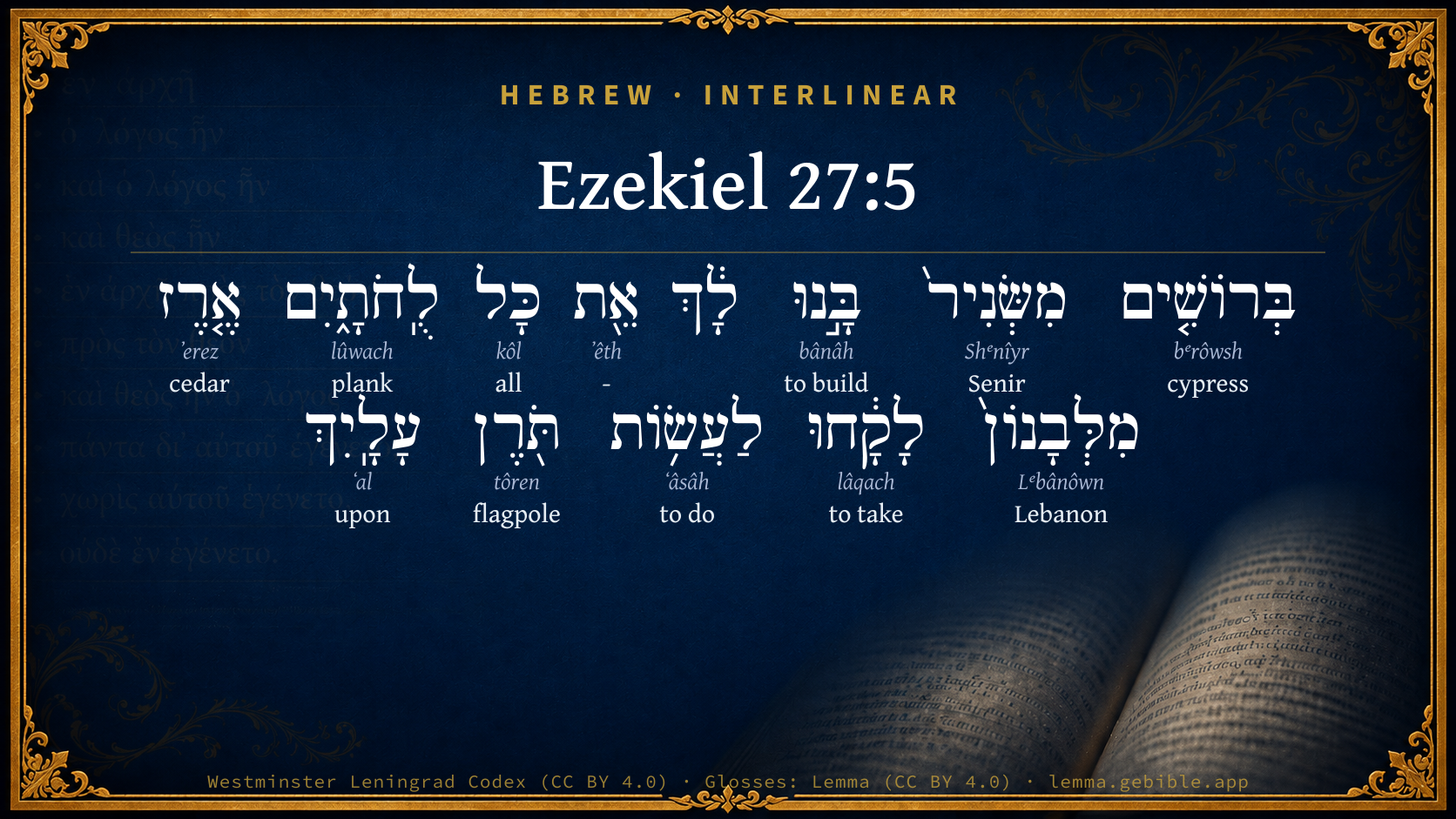
Ezekiel 27:5

Hebrew (Westminster Leningrad Codex) Ezekiel 27:5 appears in the Hebrew Old Testament. The text above is from the Westminster Leningrad Codex. Each word links to its Strong’s number, a concise gloss, and parsing drawn from the Open Scriptures Hebrew Bible morphology. Click any word for its full Brown-Driver-Briggs (BDB) entry.
Download image
Cite this verse

Ezekiel 27:5 (World English Bible). Public Domain. Lemma interlinear Bible study tool, https://lemma.gebible.app/v/ezekiel/27/5.

Show BibTeX & RIS
BibTeX
RIS
English Translation
They have made all your planks of fir trees from Senir; they have taken a cedar from Lebanon to make a mast for you.
World English Bible · Public Domain
Download a study sheet

One document with this verse’s original text, its word-by-word gloss line, the meaning frame, cross-references with their text, attributed commentary, and full source and license credits — printable, and it pastes into notes with its structure intact.

This verse Autodidact and up

Study sheet (.html) Plain text (.txt)

A passage Seminary Student

Up to 50 verses in one chapter. A passage sheet keeps up to 6 commentary sources and 12 cross-references per verse, in the order this page ranks them, and says so on the sheet whenever that leaves anything out. Ask for a single verse and you get the Autodidact verse sheet above.

Everything on this page stays free to read, with no account — the sheet is a download of what is already on screen, not access to it.

Want to remove ads? Support Godless Engineer
Compare translations 3

The same verse in 3 English versions, stacked beneath the original-language interlinear above. Click any original word for its lexicon entry.

Each is an independent rendering of the whole verse — the interlinear is not word-aligned to these translations.

Highlighted words mark where these versions differ — a whole-verse word diff, not a word-by-word alignment.

  • World English Bible Public Domain
    They have made all your planks of fir trees from Senir; they have taken a cedar from Lebanon to make a mast for you.
  • King James Version Public Domain
    They have made all thy ship boards of fir trees of Senir: they have taken cedars from Lebanon to make masts for thee.
  • unfoldingWord Literal Text CC BY-SA 4.0
    They have made all your planks with cypress from Senir; they took a cedar from Lebanon to make a mast for you.

unfoldingWord Literal Text — © unfoldingWord, licensed CC BY-SA 4.0. Word-aligned USFM3 via Door43 (git.door43.org/unfoldingWord/en_ult).

Versions to compare (up to 4)

3 of 4 selected

Show all 18 translations

Every available English version of this verse, each an independent rendering of the whole verse.

  • World English Bible Public Domain
    They have made all your planks of fir trees from Senir; they have taken a cedar from Lebanon to make a mast for you.
  • Berean Standard Bible Public Domain
    They constructed all your planking with cypress from Senir. They took a cedar from Lebanon to make a mast for you.
  • Majority Standard Bible Public Domain
    They constructed all your planking with cypress from Senir. They took a cedar from Lebanon to make a mast for you.
  • King James Version Public Domain
    They have made all thy ship boards of fir trees of Senir: they have taken cedars from Lebanon to make masts for thee.
  • American Standard Version (1901) Public Domain
    They have made all thy planks of fir-trees from Senir; they have taken a cedar from Lebanon to make a mast for thee.
  • Revised Version (1885) Public Domain
    They have made all thy planks of fir trees from Senir: they have taken cedars from Lebanon to make a mast for thee.
  • Geneva Bible (1599) Public Domain
    They haue made all thy shippe boardes of firre trees of Shenir: they haue brought cedars from Lebanon, to make mastes for thee.
  • Douay-Rheims (1899) Public Domain
    With fir trees of Sanir they have built thee with all sea planks: they have taken cedars from Libanus to make thee masts.
  • Young's Literal Translation Public Domain
    Of firs of Senir they have built to thee all thy double-boarded ships, Of cedars of Lebanon they have taken to make a mast for thee,
  • Literal Standard Version CC BY-SA 4.0
    They have built of firs from Senir all your double-boarded ships for you, || They have taken of cedars from Lebanon to make a mast for you,
  • Unlocked Literal Bible CC BY-SA 4.0
    They have made all your planks with cypress from Mount Hermon; they took cedar from Lebanon to make a mast for you.
  • unfoldingWord Literal Text CC BY-SA 4.0
    They have made all your planks with cypress from Senir; they took a cedar from Lebanon to make a mast for you.
  • Darby Bible Public Domain
    They made all thy double boards of cypress-trees of Senir; they took cedars from Lebanon to make masts for thee.
  • World Messianic Bible Public Domain
    They have made all your planks of cypress trees from Senir. They have taken a cedar from Lebanon to make a mast for you.
  • Webster's Bible Public Domain
    They have made all thy ship-boards of fir-trees of Senir: they have taken cedars from Lebanon to make masts for thee.
  • Free Bible Version CC BY-SA 4.0
    They built you with pine timber from Mount Hermon. They used a cedar from Lebanon to make your mast.
  • Bible in Basic English Public Domain
    They have made all your boards of fir-trees from Senir: they have taken cedars from Lebanon to make the supports for your sails.
  • JPS Tanakh (1917) Public Domain
    Of cypress-trees from Senir have they fashioned all thy planks; they have taken cedars from Lebanon to make masts for thee.

Literal Standard Version (2020), Covenant Press — licensed CC BY-SA 4.0. Text via the HelloAO Bible API (eBible.org). Unlocked Literal Bible (unfoldingWord) — licensed CC BY-SA 4.0. Text via the HelloAO Bible API (eBible.org). unfoldingWord Literal Text — © unfoldingWord, licensed CC BY-SA 4.0. Word-aligned USFM3 via Door43 (git.door43.org/unfoldingWord/en_ult). Free Bible Version, Dr. Jonathan Gallagher — licensed CC BY-SA 4.0. Text via the HelloAO Bible API (eBible.org).

Word by word

More ways to search: Search by grammar → Find every occurrence → Compare this word →

Practice this passage: Drill this verse → Learn its vocabulary →

תֹּ֖רֶן
tôren
H8650
“flagpole”
Noun, Common, Masculine, Singular, Absolute
Part of Speech
Noun
Type
Common
Gender
Masculine
Number
Singular
State
Absolute
Full BDB Definition

Origin: probably for H766

TWOT: 2544

beacon, mast, flagpole
  1. בְּרוֹשִׁ֤ים bᵉrôwsh H1265 “cypresses” Noun, Common, Masculine, Plural, Absolute
  2. מִשְּׂנִיר֙ Shᵉnîyr H8149 “from · Senir” Preposition + Noun, Proper
  3. בָּ֣נוּ bânâh H1129 “to build” Verb, Qal, Perfect, 3rd Person, Common, Plural
  4. אֵ֖ת ʼêth H853 “-” Particle, Direct Object
  5. כָּל kôl H3605 “all of” Noun, Common, Masculine, Singular, Construct
  6. לֻֽחֹתָ֑יִם lûwach H3871 “planks” Noun, Common, Masculine, Dual, Absolute
  7. אֶ֤רֶז ʼerez H730 “cedar” Noun, Common, Masculine, Singular, Absolute
  8. מִלְּבָנוֹן֙ Lᵉbânôwn H3844 “from · Lebanon” Preposition + Noun, Proper
  9. לָקָ֔חוּ lâqach H3947 “to take” Verb, Qal, Perfect, 3rd Person, Common, Plural
  10. לַעֲשׂ֥וֹת ʻâsâh H6213 “to do” Preposition + Verb, Qal, Infinitive Construct
  11. עָלָֽיִךְ ʻal H5921 “upon · you” Preposition + Suffix, Personal, 2nd Person, Feminine, Singular

About this verse

These counts appear in no published source. They are computed here, from the morphology-tagged text and Lemma’s own curated glosses. What Lemma adds →

13
words
12
distinct lemmas
Prophets
section

Notable vocabulary

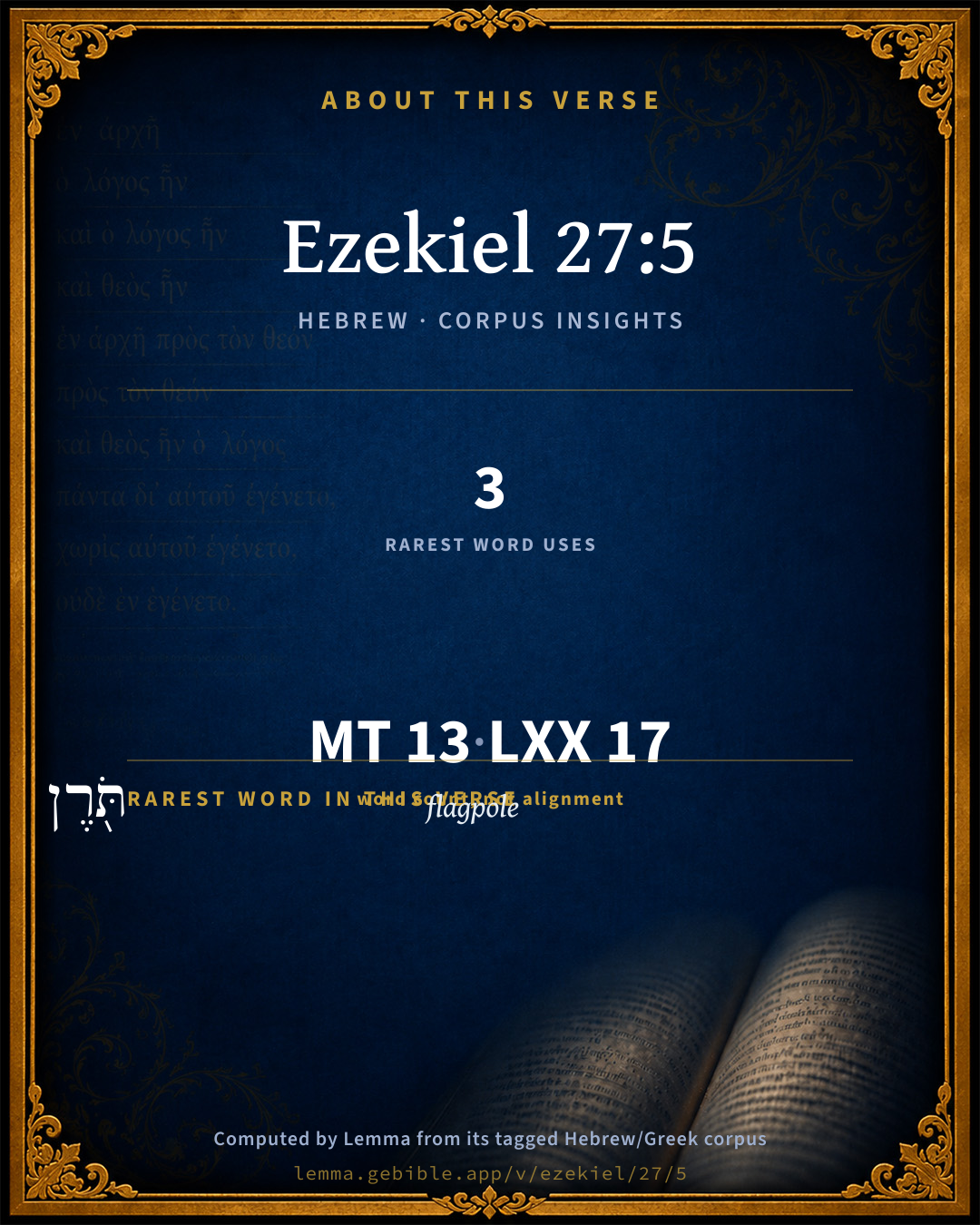
The rarest word here is תֹּ֖רֶן flagpole H8650 — appearing just 3 times in the whole Hebrew Bible.

Shared distinctive vocabulary

תֹּ֖רֶן flagpole H8650 occurs in 3 verses of the Hebrew Bible. Also found in:

Grammatical profile

  • 3 verbs
  • 7 nouns
  • 2 prepositions
  • 1 particle

Verb forms

  • בָּ֣נוּ Qal · Perfect
  • לָקָ֔חוּ Qal · Perfect
  • לַעֲשׂ֥וֹת Qal · Infinitive Construct

Hebrew & Septuagint length

In English translation the verse runs 24 words from the Hebrew and 26 from the Septuagint (LXX English) — closely comparable.

A rough comparison of the two English renderings, which tokenize alike — not a word-level alignment.

Word counts can differ between the Hebrew and the Greek without any difference in meaning — e.g. the Hebrew direct-object marker אֵת has no separate Greek word, and Greek often adds the article ὁ.

In the original languages it is 13 Hebrew tokens and 17 Greek tokens — but the two are counted differently (Hebrew bundles its prefixes and suffixes into one token; the Greek is in lemma form), so that isn’t a like-for-like length.

Cross-references

8

Topical passages linked to Ezekiel 27:5 in the Treasury of Scripture Knowledge — connected by theme and wording, ordered by reader-vote popularity; previews shown in the World English Bible.

  • Deuteronomy 3:9 ([which] Hermon the Sidonians call Sirion, and the Amorites call it Senir;)
  • Song of Solomon 4:8 Come with me from Lebanon, my bride, With me from Lebanon. Look from the top of Amana, From the top of Senir and Hermon, From the lions' dens, From the mountains of the leopards.
  • Isaiah 14:8 Yes, the fir trees rejoice at you, [and] the cedars of Lebanon, [saying], Since you are laid low, no lumberjack is come up against us.
  • 1 Kings 5:1 Hiram king of Tyre sent his servants to Solomon; for he had heard that they had anointed him king in the room of his father: for Hiram was ever a lover of David.
  • 1 Kings 5:6 Now therefore command you that they cut me cedar trees out of Lebanon; and my servants shall be with your servants; and I will give you hire for your servants according to all that you shall say: for you know that there is not among us any who knows how to cut timber like the Sidonians.
  • Psalms 29:5 The voice of Yahweh breaks the cedars. Yes, Yahweh breaks in pieces the cedars of Lebanon.
  • Psalms 92:12 The righteous shall flourish like the palm tree. He will grow like a cedar in Lebanon.
  • Psalms 104:16 Yahweh's trees are well watered, The cedars of Lebanon, which he has planted;

Cross-references courtesy of OpenBible.info (CC BY 4.0).

Hebrew and Greek witnesses Masoretic Hebrew ↔ Greek Septuagint

The same verse in the two great witnesses to the Old Testament, shown verse-for-verse.

These are two independent witnesses, not word-aligned to each other, and the Septuagint is shown in lemma (dictionary) form.

Hebrew Ezekiel 27:5 Masoretic · Westminster Leningrad Codex

בְּרוֹשִׁ֤ים מִשְּׂנִיר֙ בָּ֣נוּ לָ֔ךְ אֵ֖ת כָּל לֻֽחֹתָ֑יִם אֶ֤רֶז מִלְּבָנוֹן֙ לָקָ֔חוּ לַעֲשׂ֥וֹת תֹּ֖רֶן עָלָֽיִךְ

They have made all your planks of fir trees from Senir; they have taken a cedar from Lebanon to make a mast for you.

World English Bible · Public Domain

Greek LXX Ezekiel 27:5 Septuagint · lemma form

κέδρος ἐκ σανιρ οἰκοδομέω σύ ταινία σανίδος κυπάρισσος ἐκ ὁ λίβανος λαμβάνω ὁ ποιέω σύ ἱστός ἐλάτινος

Cedar in Senir was employed for you in building: boards of cypress timber were taken out of Libanus, and wood to make you masts of fir.

LXX2012 (modern English Septuagint) · Public Domain

On this verse, Haydock's Catholic Bible Commentary discusses the Septuagint’s reading. Read the note in Commentary ↓

Hebrew: Westminster Leningrad Codex (CC BY 4.0). Greek: Septuagint (public domain); English from LXX2012 (modern English Septuagint) (Public Domain). How the Septuagint differs from the Hebrew →

Targum (Aramaic paraphrase)

1

The Targum is the ancient Jewish Aramaic paraphrase of the Hebrew Scriptures — an interpretive translation, not the Hebrew text itself. Onkelos (literal) and Pseudo-Jonathan (expansive) render the Torah, and Jonathan the Prophets. Coverage is partial: where no permissively-licensed English translation exists for a verse, only the Aramaic is shown. This is verse-level text, not a word-by-word alignment to the Hebrew.

  1. Targum Jonathan Prophets (Joshua–Malachi)
    בִּירְוָן מִשְׂנִיר בְּנוֹ לִיךְ יַת כָּל נִשְׁרֵךְ אַרְזִין מִלִבְנָן נְסִיבוּ לְמֶעְבַּד תּוֹרְנִין עֲלָךְ:

    (no public-domain English translation for this verse)

    Targum Jonathan — Aramaic: “Mikraot Gedolot” (public domain). English: “Sefaria Community Translation” (CC0 1.0 (public-domain dedication)); “London "Chaldee Paraphrase," 1871” (public domain). Text via Sefaria.

Commentary

Notes on Ezekiel 27:5 from classic Christian and Jewish commentators (each source and its license shown beneath its notes). The classic Christian expositions comment on the surrounding passage and are grouped to its opening verse, so a note may address several verses; the Jewish commentaries on the Tanakh (Rashi and others) are per-verse, so they appear only where the commentator wrote on this verse.

Lemma curates 59 commentaries, every one of them public domain or Creative Commons licensed, each selected and text-cleaned for this edition rather than reprinted as found. About our sources →

Trapp's Complete Commentary

John Trapp

Eze 27:5 They have made all thy [ship] boards of fir trees of Senir: they have taken cedars from Lebanon to make masts for thee.

Ver. 5. They have made all thy ship boards.] Of the most precious materials, which, with thy rich freight, did incite and entice the arch-pirate to surprise and make prize of thee.

John Trapp, A Commentary or Exposition upon All the Books of the Old and New Testament (1647–1656) — public domain. Text from a community e-Sword module.

Joseph Benson's Commentary

Eze 27:5-7. They have made thy ship-boards — The decks of thy ships; of fir-trees of Senir — By these are meant, the fir-trees which grew upon mount Hermon, which was anciently called Shenir, or Senir. They have taken cedars to make masts for thee — Though cedars have a thick, and not a lofty trunk, masts consisting of different parts may be made of different cedars duly sized, or properly shaped if of too large a size. Of the oaks of Bashan have they made thine oars — That they might be strong. The company of the Ashurites — That is, the Assyrians; have made thy benches of ivory — “Perhaps the seats in the cabins of the royal galleys.” Instead of the company of the Ashurites, &c., Bishop Newcome (with R. Salerno, Bochart, Houbigant, and some others, using a different pointing of the Hebrew word so rendered) reads the latter part of the verse thus: Thy benches have they made of ivory, inlaid in box from the isles of Chittim — That is, the islands and coasts of the Mediterranean. In this sense the Chaldee understands the clause. Corsica, with which no doubt the Tyrians traded, was famous for the box-tree; and we may easily allow that the benches of some of the Tyrian ships were adorned with streaks of ivory inlaid in that kind of wood which certainly would appear very beautiful. So Virgil would have thought, who uses such an emblem to set forth the beauty of young Ascanius:

“ — — Quale per artem Inclusum buxo, aut Oricia terebintho Lucet ebur.” — — — — ÆN. 10:135.

“Distinguish’d from the crowd he shines a gem Enchased in gold, or polish’d ivory set Amidst the meaner foil of sable jet.” — DRYDEN.

Fine linen with broidered work, &c., from Egypt — “Fine linen was one of the principal commodities of Egypt, and was a habit used for persons of the best quality; which shows to what an excess of vanity the Tyrians were come, to use such costly manufactures for sails to their ships. Suetonius, in his Life of Caligula, cap. 37, reckons this among several instances of that emperor’s extravagance, that he furnished his pleasure-boats with costly sails, and other expensive ornaments.” Blue and purple from the isles of Elishah was that which covered thee — “Blue and purple are elsewhere reckoned among those colours which set off the richest attire. The common clothing of the Tyrians was of these kinds, which were brought from the islands of the Ægean sea, particularly Coos, famed for purple among heathen authors. Elishah denotes the countries upon the coast of Greece: a part of Peloponnesus retains the name of Elis among the Greek writers.” — Lowth.

Joseph Benson's Commentary on the Old and New Testaments (1811–1818) — public domain. Text from a community e-Sword module.

Geneva Bible (1599)

Geneva Bible translators

This mountain was called Hermon, but the Amorites called it Senir, Deut. 3:9.

Geneva Bible (1599) marginal notes — public domain. Text via Bolls.life.

Jamieson, Fausset & Brown

Robert Jamieson, A. R. Fausset & David Brown

Senir--the Amorite name of Hermon, or the southern height of Anti-libanus (Deu 3:9); the Sidonian name was Sirion. "All thy . . . boards"; dual in Hebrew, "double-boards," namely, placed in a double order on the two sides of which the ship consisted [VATABLUS]. Or, referring to the two sides or the two ends, the prow and the stern, which every ship has [MUNSTER].

cedars--most suited for "masts," from their height and durability.

Jamieson, Fausset & Brown — Commentary Critical and Explanatory on the Whole Bible (1871) — public domain (CC PDM 1.0). Text via the HelloAO Bible API.

Adam Clarke's Commentary

Verse 5. Fir trees of Senir] Senir is a mountain which the Sidonians called Sirion, and the Hebrews Hermon, De 3:9. It was beyond Jordan, and extended from Libanus to the mountains of Gilead.

Adam Clarke's Commentary on the Bible (1810–1826) — public domain. Text from a community e-Sword/MySword module.

Ellicott's Commentary for English Readers

(5) Ship boards.—Planking for the sides of the ship. The word in the original is in the dual, with reference to its two sides. Senir was the Amorite name of Hermon, or Antilebanon, called by the Sido-nians Sirion (Deu_3:9). Ezekiel wished to use a foreign name, and the latter may at this time have become obsolete. The timber brought thence for the ship’s planking, and called fir, was the same with that furnished by Hiram to Solomon for the floor of the Temple (1Ki_6:15), and may have been either “fir” (spruce?) or cypress. The Scripture names of trees are not always well identified. Both were esteemed among the ancients for ship-building, especially the cypress, on account of its lightness, durability, and freedom from the attacks of worms.

A Bible Commentary for English Readers, edited by Charles John Ellicott (1878–1897) — public domain. Text from a community e-Sword module.

John Gill's Exposition

Of the oaks of Bashan have they made thine oars,.... To row the ships with; for their ships probably were no other than galleys, which were rowed with oars, as were the ships of first invention. Bashan was a country in Judea where oaks grew; see Isa 2:13. The country of Judea in general was famous for oaks; it abounded with them in the times of Homer (t), who speaks of Typho being buried in a country abounding with oaks, among the rich or fat people of Judea; and he seems to design Bashan particularly, of which Og was king, whom he calls Typho, and of whose bed he makes mention in the same place; hence several places in Judea had their names from the oaks which grew, there, as Elonmoreh, Allonbachuth, Elonmeonenim, Elontabor, and Elonbethhanan, Gen 12:6 and which one would have thought were fitter to make their ships of; but of these only their oars were made:

the company of the Ashurites have made thy benches of ivory, brought out of the isles of Chittim; the benches for the towers to sit on, or for others in the cabin and decks; but that these should be wholly of ivory is not very probable; nor was ivory brought from the isles of Chittim, but from other parts; nor is it easy to say who the company of the Ashurites were; some say the Assyrians; but why they should be so called is not plain. Jarchi makes to be but one word, which signifies box trees, as it is used in Isa 41:19 and he supposes that these benches, or be they what they will, were made of box trees covered or inlaid with ivory. So the Targum,

"the lintels of thy gates (the hatches) were planks of box tree inlaid with ivory;''

which box, and not the ivory, was brought from the isles of Chittim; either from Cyprus, where was a place called Citium; or from Macedonia, from whence box was fetched; or from the province of Apulia, as the Targum; where there might be plenty of it, as in Corsica, and other places, where particularly the best box grows, as Pliny (u) says. Jerom interprets Cittin of Italy; and Ben Gorion says (w) that Cittim are the Romans.

(t) ', . Homer. Iliad. 2. Vid. Dickinson, Delphi Phoenicix. c. 2. p. 13, 16. (u) Nat. Hist. l. 10. c. 16. (w) Heb. Hist. l. 1. c. 1. p. 7.

John Gill's Exposition of the Whole Bible (1746–1763) — public domain (CC PDM 1.0). Text via the HelloAO Bible API.

Albert Barnes' Notes on the Bible

Fir-trees (or, cypress) of Senir - The name by which the Amorites knew Mount Hermon.

Albert Barnes' Notes on the Bible (1834–1885) — public domain. Text from a community e-Sword/MySword module.

Haydock's Catholic Bible Commentary

Thee. Hebrew, "all thy ship-boards." (Septuagint) (Protestants) (Haydock) --- St. Jerome has divided (Calmet) leuthim, "decks of the sea," as yam denotes the sea. (Haydock)

George Leo Haydock (1774–1849), Haydock's Catholic Family Bible and Commentary, 1859 edition — public domain. Excludes Psalms (Douay-Rheims chapter numbering differs from Protestant) and Deuterocanonical books (Catholic canon only).

Matthew Poole's English Annotations

They; thy shipwrights.

Ship-boards; the planks, and benches, or transoms, for their ships.

Of fir trees; of the best and finest fir trees

of Senir, i.e. Hermen, Deu 3:9.

Cedars, for height, strength, durableness, and pleasing smell, beside smoothness of grain, and fitness for curious carvings, the best of trees.

From Lebanon, whose cedars excelled others.

Matthew Poole's English Annotations on the Holy Bible (1683–1685) — public domain. Text from a community e-Sword/MySword module.

Whedon's Commentary on the Bible

Daniel D. Whedon

5. Fir trees [or, cypress] of Senir — Senir, or Shenir, was the Amorite name for Mount Hermon (Deu_3:9). Assyrian, Shaniru.

Cedars from Lebanon to make masts — Literally, a mast. The Egyptians and Hebrews, as well as the Phoenicians, depended upon Lebanon for their best timber. (See note Eze_26:2; compare 1Ki_5:10; 1Ki_7:2.)

The cedar was ordinarily used for houses and fir trees for ships. Only the largest ideal ship — such as the prophet pictures Tyre to be — would need a cedar for a mast.

Daniel D. Whedon (gen. ed.), Commentary on the Old and New Testaments (1874–1909) — public domain. Text from a community e-Sword module.

The Pulpit Commentary

Fir trees of Senti. The name appears in Deu_3:9 and Son_4:8 as Shenir; in 1Ch_5:23 it is spelt as here Deu_3:9 we learn that it was the Amorite name for Hermon, as Sirion was the Sidonian name in 1Ki_5:10 Hiram King of Tyro appears as supplying Solomon with the fir and cedar timber mentioned here for the erection of his palace, the house of the forest of Lebanon. (1Ki_7:2) The fir tree was more commonly used for ships, the cedar for houses (Virgil, "Georg.," 2:444). The Hebrew for "boards" is unique in its form as a plural with a dual form superadded to indicate that each plank had its counterpart on the other side of the ship.

The Pulpit Commentary (1880–1919), ed. H.D.M. Spence-Jones & Joseph S. Exell — public domain. Text from a community e-Sword module.

John Wesley's Explanatory Notes

They - The shipwrights. Shipboards - The planks and benches, or transoms for their ships. Fir-trees - Of the best and finest fir- trees. Lebanon - Whose cedars excelled others.

John Wesley, Explanatory Notes Upon the Whole Bible (1754–1765) — public domain. Text via the GEBible commentary corpus.

Rashi

Rabbi Shlomo Yitzchaki (Rashi)

junipers from Senir Since it was built on the sea and was destroyed by the sea, the prophet compares it to a superior ship whose cargo in its hold was too heavy for it, and which sank by the east wind.

all the planks the planks from which the ship was made.

cedars from Lebanon the name of the forest where the cedars are prevalent.

a mast [Heb. תֹּרֶן.] This is the tall, upright pole that is thrust into the ship, upon which they hang the sail, which is called voile in French. Also, there are holes at its top, through which is drawn the rope by which they pull the ship. [“Pole” is] mast in Old French.

Rashi on the Tanakh — English translations: “The Judaica Press complete Tanach with Rashi, translated by A. J. Rosenberg” (CC BY 4.0); “Pentateuch with Rashi's commentary by M. Rosenbaum and A.M. Silbermann, 1929-1934” (public domain); “The Metsudah Tanach series, Lakewood, N.J” (CC BY 4.0); and “The Book of Joshua, Metsudah Publications, 1997” (CC BY 4.0). Text via Sefaria.

Lesson kit

Teaching starters — assembled from the data on this page, not authored interpretation. Every prompt links to the verse data it draws on. Edit before teaching.

Ezekiel, in the Prophets, opens this verse with 13 words (12 distinct Hebrew lemmas). Its most distinctive word is tôren (“flagpole”). A historical commentator’s framing appears above. Read the whole chapter for the surrounding context.

Discussion questions

  1. How does “flagpole” (tôren) shape what this verse is saying?
  2. How does Isaiah 30:17, which shares the word «flagpole», read alongside this verse?
  3. These translations render this verse differently. What is at stake in choosing one wording over another?
  4. «בָּ֣נוּ» is a Qal Perfect verb. How does that grammatical form shape the action described?
  5. Compare how Trapp's Complete Commentary and Joseph Benson's Commentary read this verse. Where do they agree or differ?

Things to notice

Reading settings

Reading text

Shown beneath each verse's original-language words.

Old Testament
Old Testament edition

Read the OT as the Masoretic Hebrew (MT) or the Greek Septuagint (LXX).

English shown for the Greek Septuagint (in the Hebrew ↔ Greek comparison).

Comparing translations? Open the Compare panel on any verse page to stack up to four side by side.