Jeremiah 22:14

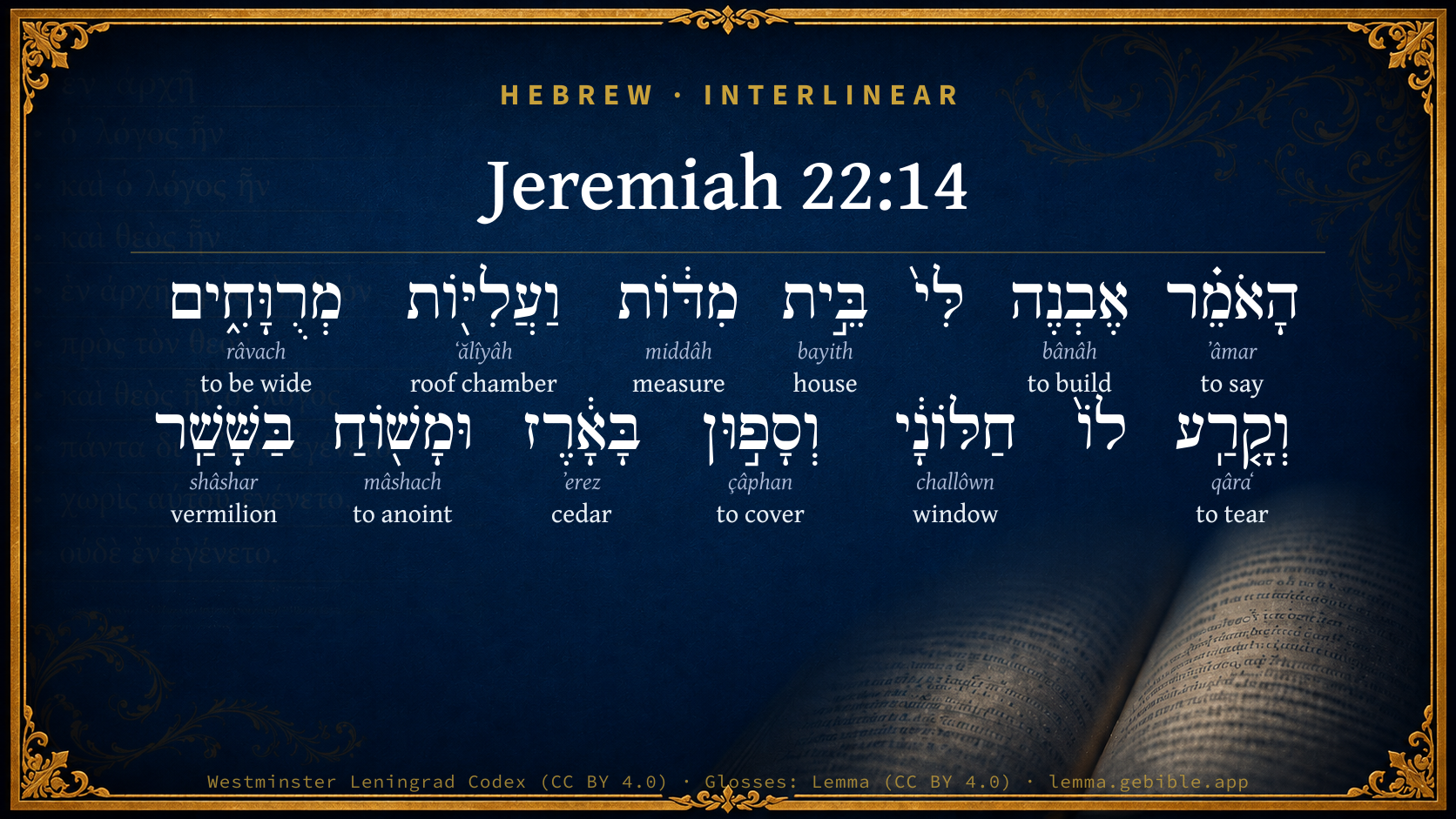
Hebrew (Westminster Leningrad Codex) Jeremiah 22:14 appears in the Hebrew Old Testament. The text above is from the Westminster Leningrad Codex. Each word links to its Strong’s number, a concise gloss, and parsing drawn from the Open Scriptures Hebrew Bible morphology. Click any word for its full Brown-Driver-Briggs (BDB) entry.
Download image
Cite this verse

Jeremiah 22:14 (World English Bible). Public Domain. Lemma interlinear Bible study tool, https://lemma.gebible.app/v/jeremiah/22/14.

Show BibTeX & RIS
BibTeX
RIS
English Translation
who says, I will build me a wide house and spacious chambers, and cuts him out windows; and it is ceiling with cedar, and painted with vermilion.
World English Bible · Public Domain
Highlights
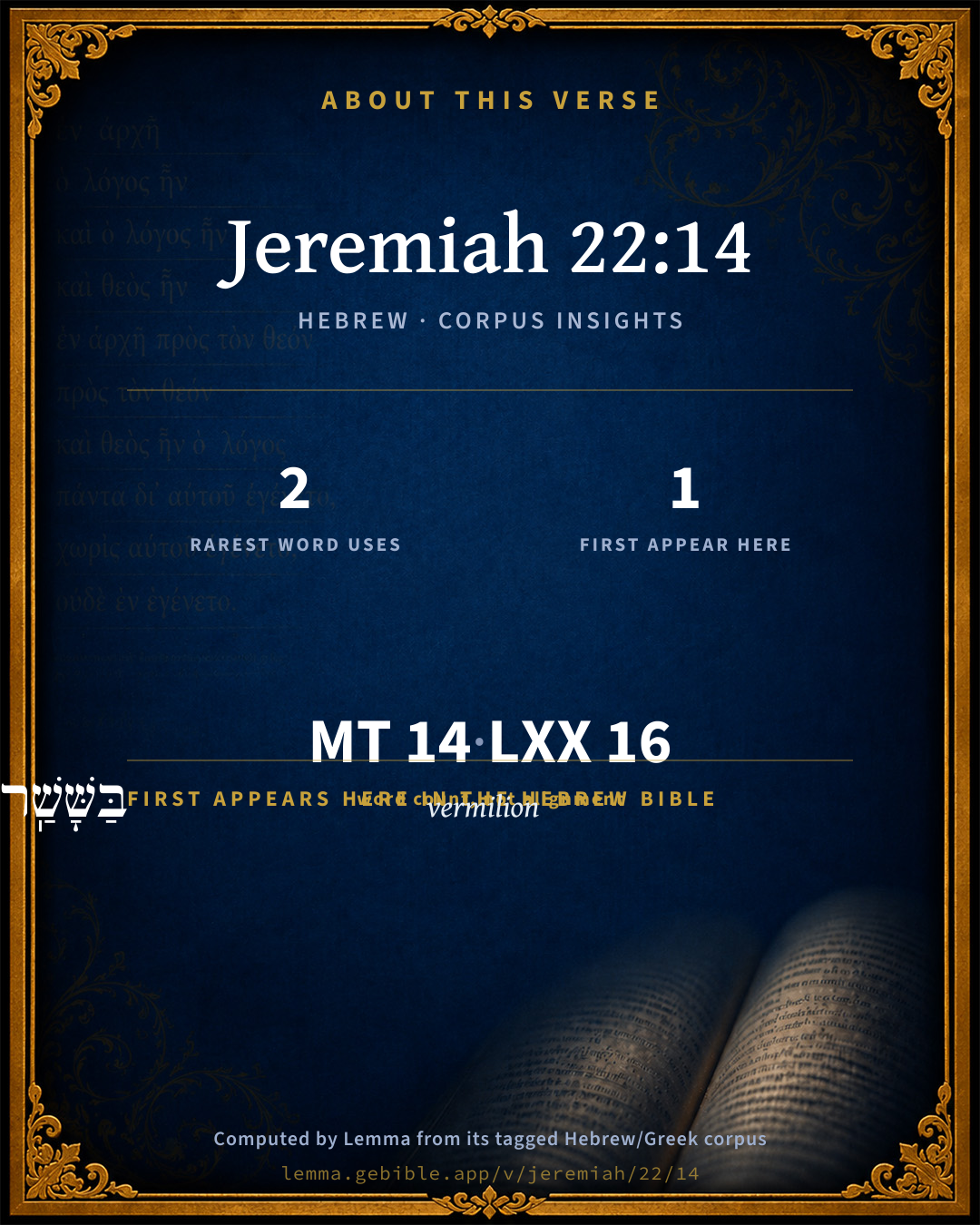
  • 1 first appearance in the Hebrew Bible
Full analysis ↓
Download a study sheet

One document with this verse’s original text, its word-by-word gloss line, the meaning frame, cross-references with their text, attributed commentary, and full source and license credits — printable, and it pastes into notes with its structure intact.

This verse Autodidact and up

Study sheet (.html) Plain text (.txt)

A passage Seminary Student

Up to 50 verses in one chapter. A passage sheet keeps up to 6 commentary sources and 12 cross-references per verse, in the order this page ranks them, and says so on the sheet whenever that leaves anything out. Ask for a single verse and you get the Autodidact verse sheet above.

Everything on this page stays free to read, with no account — the sheet is a download of what is already on screen, not access to it.

Want to remove ads? Support Godless Engineer
Compare translations 3

The same verse in 3 English versions, stacked beneath the original-language interlinear above. Click any original word for its lexicon entry.

Each is an independent rendering of the whole verse — the interlinear is not word-aligned to these translations.

Highlighted words mark where these versions differ — a whole-verse word diff, not a word-by-word alignment.

  • World English Bible Public Domain
    who says, I will build me a wide house and spacious chambers, and cuts him out windows; and it is ceiling with cedar, and painted with vermilion.
  • King James Version Public Domain
    That saith, I will build me a wide house and large chambers, and cutteth him out windows; and it is cieled with cedar, and painted with vermilion.
  • unfoldingWord Literal Text CC BY-SA 4.0
    the one saying, “I will build for myself a house of great measurements and spacious upper rooms,” and he cuts out windows for himself and panels with cedar and paints with vermilion.

unfoldingWord Literal Text — © unfoldingWord, licensed CC BY-SA 4.0. Word-aligned USFM3 via Door43 (git.door43.org/unfoldingWord/en_ult).

Versions to compare (up to 4)

3 of 4 selected

Show all 18 translations

Every available English version of this verse, each an independent rendering of the whole verse.

  • World English Bible Public Domain
    who says, I will build me a wide house and spacious chambers, and cuts him out windows; and it is ceiling with cedar, and painted with vermilion.
  • Berean Standard Bible Public Domain
    who says, ‘I will build myself a great palace, with spacious upper rooms.’ So he cuts windows in it, panels it with cedar, and paints it with vermilion.
  • Majority Standard Bible Public Domain
    who says, ‘I will build myself a great palace, with spacious upper rooms.’ So he cuts windows in it, panels it with cedar, and paints it with vermilion.
  • King James Version Public Domain
    That saith, I will build me a wide house and large chambers, and cutteth him out windows; and it is cieled with cedar, and painted with vermilion.
  • American Standard Version (1901) Public Domain
    that saith, I will build me a wide house and spacious chambers, and cutteth him out windows; and it is ceiled with cedar, and painted with vermilion.
  • Revised Version (1885) Public Domain
    that saith, I will build me a wide house and spacious chambers, and cutteth him out windows; and it is cieled with cedar, and painted with vermilion.
  • Geneva Bible (1599) Public Domain
    He saith, I will build me a wide house and large chambers: so he will make him selfe large windowes, and feeling with cedar, and paint them with vermilion.
  • Douay-Rheims (1899) Public Domain
    Who saith: I will build me a wide house and large chambers: who openeth to himself windows, and maketh roofs of cedar, and painteth them with vermilion.
  • Young's Literal Translation Public Domain
    Who is saying, `I build for myself a large house, And airy upper chambers,' And he hath cut out for himself its windows, Ceiled with cedar, and painted with vermillion.
  • Literal Standard Version CC BY-SA 4.0
    Who is saying, || I build a large house for myself, || And airy upper chambers, || And he has cut out its windows for himself, || Covered with cedar, and painted with vermillion.
  • Unlocked Literal Bible CC BY-SA 4.0
    he says, 'I will build for myself a large house with spacious upper rooms.' So he cuts out large windows for it, and he panels it with cedar, and he paints it red.
  • unfoldingWord Literal Text CC BY-SA 4.0
    the one saying, “I will build for myself a house of great measurements and spacious upper rooms,” and he cuts out windows for himself and panels with cedar and paints with vermilion.
  • Darby Bible Public Domain
    that saith, I will build me a wide house, and spacious upper chambers; and he cutteth out for himself windows; and it is wainscoted with cedar, and painted with vermilion.
  • World Messianic Bible Public Domain
    who says, ‘I will build myself a wide house and spacious rooms,’ and cuts out windows for himself, with a cedar ceiling, and painted with red.
  • Webster's Bible Public Domain
    That saith, I will build me a wide house and large chambers, and cutteth him out windows; and it is ceiled with cedar, and painted with vermilion.
  • Free Bible Version CC BY-SA 4.0
    He says to himself, “I'm going to build myself a great palace, with large upper rooms.” He has windows inserted, puts in cedar panels, and paints it bright red with vermilion.
  • Bible in Basic English Public Domain
    Who says, I will make a wide house for myself, and rooms of great size, and has windows cut out, and has it roofed with cedar and painted with bright red.
  • JPS Tanakh (1917) Public Domain
    That saith: 'I will build me a wide house and spacious chambers', and cutteth him out windows, and it is ceiled with cedar, and painted with vermilion.

Literal Standard Version (2020), Covenant Press — licensed CC BY-SA 4.0. Text via the HelloAO Bible API (eBible.org). Unlocked Literal Bible (unfoldingWord) — licensed CC BY-SA 4.0. Text via the HelloAO Bible API (eBible.org). unfoldingWord Literal Text — © unfoldingWord, licensed CC BY-SA 4.0. Word-aligned USFM3 via Door43 (git.door43.org/unfoldingWord/en_ult). Free Bible Version, Dr. Jonathan Gallagher — licensed CC BY-SA 4.0. Text via the HelloAO Bible API (eBible.org).

Word by word

More ways to search: Search by grammar → Find every occurrence → Compare this word →

Practice this passage: Drill this verse → Learn its vocabulary →

בַּשָּׁשַֽׁר
shâshar
H8350
“in/at the · vermilion”
Preposition, Determined + Noun, Common, Masculine, Singular, Absolute
Part of Speech
Preposition + Noun
Type
Common
Gender
Masculine
Number
Singular
State
Absolute
Full BDB Definition

Origin: perhaps from the base of H8324 in the sense of that of H8320

TWOT: 2476

red colour, vermilion - formerly gained from 'kermes' insect
  1. הָאֹמֵ֗ר ʼâmar H559 “the · saying” Particle, Definite Article + Verb, Qal, Participle Active, Masculine, Singular, Absolute
  2. אֶבְנֶה bânâh H1129 “to build” Verb, Qal, Imperfect, 1st Person, Common, Singular
  3. בֵּ֣ית bayith H1004 “house of” Noun, Common, Masculine, Singular, Construct
  4. מִדּ֔וֹת middâh H4060 “measures” Noun, Common, Feminine, Plural, Absolute
  5. וַעֲלִיּ֖וֹת ʻălîyâh H5944 “and · roof chambers of” Conjunction + Noun, Common, Feminine, Plural, Construct
  6. מְרֻוָּחִ֑ים râvach H7304 “wide” Verb, Pual, Participle Passive, Masculine, Plural, Absolute
  7. וְקָ֤רַֽע qâraʻ H7167 “and · to tear” Conjunction + Verb, Qal, Sequential Perfect, 3rd Person, Masculine, Singular
  8. חַלּוֹנָ֔י challôwn H2474 “windows · my” Noun, Common, Both, Plural, Construct + Suffix, Personal, 1st Person, Common, Singular
  9. וְסָפ֣וּן çâphan H5603 “and · covered” Conjunction + Verb, Qal, Participle Passive, Masculine, Singular, Absolute
  10. בָּאָ֔רֶז ʼerez H730 “in/at the · cedar” Preposition, Determined + Noun, Common, Masculine, Singular, Absolute
  11. וּמָשׁ֖וֹחַ mâshach H4886 “and · to anoint” Conjunction + Verb, Qal, Infinitive Absolute

About this verse

These counts appear in no published source. They are computed here, from the morphology-tagged text and Lemma’s own curated glosses. What Lemma adds →

14
words
12
distinct lemmas
Prophets
section

Notable vocabulary

The rarest word here is בַּשָּׁשַֽׁר vermilion H8350 — appearing just 2 times in the whole Hebrew Bible.

First appearance in Scripture

This word makes its first canonical appearance in the Hebrew Bible here:

  • בַּשָּׁשַֽׁר vermilion H8350

Shared distinctive vocabulary

בַּשָּׁשַֽׁר vermilion H8350 occurs in 2 verses of the Hebrew Bible. Also found in:

Grammatical profile

  • 6 verbs
  • 6 nouns
  • 2 prepositions

Verb forms

  • הָאֹמֵ֗ר Qal · Participle Active
  • אֶבְנֶה Qal · Imperfect
  • מְרֻוָּחִ֑ים Pual · Participle Passive
  • וְקָ֤רַֽע Qal · Sequential Perfect
  • וְסָפ֣וּן Qal · Participle Passive
  • וּמָשׁ֖וֹחַ Qal · Infinitive Absolute

Hebrew & Septuagint length

In the original languages it is 14 Hebrew tokens and 16 Greek tokens — but the two are counted differently (Hebrew bundles its prefixes and suffixes into one token; the Greek is in lemma form), so that isn’t a like-for-like length.

Cross-references

11

Topical passages linked to Jeremiah 22:14 in the Treasury of Scripture Knowledge — connected by theme and wording, ordered by reader-vote popularity; previews shown in the World English Bible.

  • 2 Samuel 7:2 that the king said to Nathan the prophet, See now, I dwell in a house of cedar, but the ark of God dwells within curtains.
  • Isaiah 5:8–9 Woe to those who join house to house, Who lay field to field, until there is no room, And you are made to dwell alone in the midst of the land!
  • Haggai 1:4 "Is it a time for you yourselves to dwell in your paneled houses, while this house lies waste?
  • 2 Chronicles 3:5 The greater house he made a ceiling with fir-wood, which he overlaid with fine gold, and worked thereon palm trees and chains.
  • Proverbs 17:19 He who loves disobedience loves strife. One who builds a high gate seeks destruction.
  • Proverbs 24:27 Prepare your work outside, And get your fields ready. Afterwards, build your house.
  • Song of Solomon 1:17 The beams of our house are cedars. Our rafters are firs. Beloved
  • Isaiah 9:9 All the people shall know, [even] Ephraim and the inhabitant of Samaria, who say in pride and in arrogance of heart,
  • Daniel 4:30 The king spoke and said, Is not this great Babylon, which I have built for the royal dwelling-place, by the might of my power and for the glory of my majesty?
  • Malachi 1:4 Whereas Edom says, "We are beaten down, but we will return and build the waste places;" thus says Yahweh of Hosts, "They shall build, but I will throw down; and men will call them 'The Wicked Land,' even the people against whom Yahweh shows wrath forever."
  • Luke 14:28–29 For which of you, desiring to build a tower, doesn't first sit down and count the cost, to see if he has enough to complete it?

Cross-references courtesy of OpenBible.info (CC BY 4.0).

Hebrew and Greek witnesses Masoretic Hebrew ↔ Greek Septuagint

The same verse in the two great witnesses to the Old Testament, shown verse-for-verse.

These are two independent witnesses, not word-aligned to each other, and the Septuagint is shown in lemma (dictionary) form.

Hebrew Jeremiah 22:14 Masoretic · Westminster Leningrad Codex

הָאֹמֵ֗ר אֶבְנֶה לִּי֙ בֵּ֣ית מִדּ֔וֹת וַעֲלִיּ֖וֹת מְרֻוָּחִ֑ים וְקָ֤רַֽע לוֹ֙ חַלּוֹנָ֔י וְסָפ֣וּן בָּאָ֔רֶז וּמָשׁ֖וֹחַ בַּשָּׁשַֽׁר

who says, I will build me a wide house and spacious chambers, and cuts him out windows; and it is ceiling with cedar, and painted with vermilion.

World English Bible · Public Domain

Greek LXX Structure differs

In the Septuagint, Jeremiah is about an eighth shorter than the Hebrew and arranges its material differently — the Oracles Against the Nations (Hebrew chapters 46–51) appear in the middle of the Greek book, after 25:13. Because the chapter and verse boundaries do not line up, a verse-for-verse comparison with the Hebrew is not shown.

A verse-for-verse comparison isn’t shown here because the chapters and verses don’t line up. Switch to the LXX edition with the MT / LXX toggle above to read the Greek directly.

On this verse, The Cambridge Bible for Schools and Colleges discusses the Septuagint’s reading. Read the note in Commentary ↓

Hebrew: Westminster Leningrad Codex (CC BY 4.0). Greek: Septuagint (public domain); English from a public-domain English Septuagint. How the Septuagint differs from the Hebrew →

Targum (Aramaic paraphrase)

1

The Targum is the ancient Jewish Aramaic paraphrase of the Hebrew Scriptures — an interpretive translation, not the Hebrew text itself. Onkelos (literal) and Pseudo-Jonathan (expansive) render the Torah, and Jonathan the Prophets. Coverage is partial: where no permissively-licensed English translation exists for a verse, only the Aramaic is shown. This is verse-level text, not a word-by-word alignment to the Hebrew.

  1. Targum Jonathan Prophets (Joshua–Malachi)
    דַאֲמַר אֶבְנֵי לִי בָּתִּין דְמִשְׁחָן וְעִלְיָן מְרַוְחָן וּפַצִים לֵיהּ חֲרַכִּין וּמְטַלֵיל בְּכִיוֹרֵי אַרְזַיָא וּמְצַיֵר בְּסַמְמָנִין:

    (no public-domain English translation for this verse)

    Targum Jonathan — Aramaic: “Mikraot Gedolot” (public domain). English: “Sefaria Community Translation” (CC0 1.0 (public-domain dedication)); “London "Chaldee Paraphrase," 1871” (public domain). Text via Sefaria.

Commentary

Notes on Jeremiah 22:14 from classic Christian and Jewish commentators (each source and its license shown beneath its notes). The classic Christian expositions comment on the surrounding passage and are grouped to its opening verse, so a note may address several verses; the Jewish commentaries on the Tanakh (Rashi and others) are per-verse, so they appear only where the commentator wrote on this verse.

Lemma curates 59 commentaries, every one of them public domain or Creative Commons licensed, each selected and text-cleaned for this edition rather than reprinted as found. About our sources →

John Calvin's Commentaries

Some render the last words, “and painted with red;” but vermilion is a kind of red. They, indeed, mention three kinds of red, — deep red, brownish, and the third mixed with various colors; but vermilion is a brighter color. As to the main point there is no difficulty; the Prophet reproves the ambition and pride of King Jehoiakim, that he was not content with the moderation of his fathers, but indulged in extravagant display, and built for himself a palace as it were in the clouds, as though he did not wish to have a dwelling on the earth. Splendor in houses cannot in itself be condemned; but, as it can hardly be, nay, as it seldom happens, but that such insatiable ambition proceeds from pride, hence the Prophets vehemently denounced sumptuous houses; and they pronounced a curse on such displays, because they had a regard to the motive and the end. Such was the design of the Prophet in this passage.

He therefore thus introduces King Jehoiakim, who says, I will build for myself a large house and chambers of respirations That he said this proved the foolish ambition with which Jehoiakim had been inebriated, so that he regarded as nothing whatever was splendid before in Jerusalem. There were palaces, we know, very sumptuous there; and we also know that the king of Judah lived in great splendor. For though the palaces of Solomon were not then standing in their original grandeur, yet what remained was abundantly sufficient to satisfy a man who was not filled with pride. It hence appears that a fondness for excess prevailed in Jehoiakim, for he despised the royal palace, and whatever remained after the death of Solomon. For God, we know, had blessed with prosperity Hezekiah, and Josiah, and other kings; but they had continued within proper bounds. Since, then, such haughtiness had crept into the heart of Jehoiakim, it is evident, that he was filled with vain pride, nay, was drunk with folly. This was the reason why the Prophet severely reproved him for saying, “I will build for myself a large house and chambers of respirations,” or of perflations.

He then adds, and he perforates for himself windows It was a proof of luxury, when men began to indulge in superfluities. In old times the windows were small; for use only was regarded by frugal men; but afterwards a sort of madness possessed the minds of many, so that they sought to be suspended as it were in the air. And hence they began to have wider windows. The thing in itself, as I have said, is not what God condemns; but we must ever remember, as I have reminded you, that men never go to excesses in external things, except when their hearts are infected with pride, so that they do not regard what is useful, what is becoming, but are carried away by fondness for excess.

It is then added, and it is covered with cedar, that is, the house is covered with cedar boards. For in my judgment the Prophet means here the wainscotting, when he says that the house was covered with cedar; as though he had said, that King Jehoiakim esteemed the squared and polished stones as nothing, unless a covering was added of cedar boards to ornament the walls. And for the same purpose was the painting with vermilion; for justly might paintings be deemed excessive superfluities. As, then, it was a part of luxury to adorn the walls with various paintings, as though men wished to change the simple nature of things, the Prophet here is indignant against King Jehoiakim. Nor is it to be doubted, but that God had regard also to the circumstances of the times; for God had already warned him and all the Jews respecting their future calamities. This, then, was in a manner to treat with mockery the threatenings of God. And we know how intolerable was this regarded by him; for he thus declares by Isaiah,

“Live do I, never shall this iniquity be blotted out,” (Isaiah 22:14)

for when he had exhorted them to put on sackcloth and ashes, they said, “Let us eat and drink, tomorrow we shall die.” Similar, then, was the perverseness of King Jehoiakim; for he ought to have seen the coming calamity which was set as it were before his eyes; but he, like one infatuated, increased the royal splendor, so that the wealth of David and of Solomon appeared as nothing compared with what he had expended. It now follows, —

John Calvin's Commentaries (1540-1563) — public domain. Text from the Calvin Translation Society English edition (1840s-50s) via the Christian Classics Ethereal Library (ccel.org). Calvin's coverage is partial (roughly two-thirds of the Bible); uncommented books and verses are honest gaps, never fabricated. The 19th-century editor's footnotes and remarks are omitted so the notes are faithfully Calvin's own voice.

Trapp's Complete Commentary

John Trapp

Jer 22:14 That saith, I will build me a wide house and large chambers, and cutteth him out windows; and [it is] cieled with cedar, and painted with vermilion.

Ver. 14. I will build me a wide house.] Heb., A house of measures, or dimensions; such as is the Turk’s Seraglio, two or three miles in compass, or rather such as is Westminster Hall, built by William Rufus, who found much fault with it for being too little, saying it was fitter for a chamber than for a hall for a king of England; and taking a plot for one more spacious to be added unto it, he came to an untimely end. {a} Sarcophago contentus, shut up in a little grave, which yet was more honour than this ambitious prince attained to; for he was "cast out and buried with the burial of an ass," as it followeth. {Jer 22:19}

And large chambers.] Heb., Widened or winded; thoroughly aired. {b} Thus, with those Megarensians, spoken of by Plato, he built as if his life had been riveted upon eternity.

And cutteth him out windows.] Some render it, and the original will bear it, That teareth my windows {c} - scil., To enlarge and beautify therewith his new building: he took in, belike, a piece of God’s house. This was such a piece of sacrilege as the very heathens abhorred. A certain King of Sicily, to enlarge his palace, pulled down an old temple; but the emperor, Marcus Antoninus, calleth it a beastly and lewd action, not to be spoken of without shame, protesting that it was a matter of wonder and scandal, not only to him, but to the whole city and senate of Rome; and therefore he blamed the king exceedingly for it. Our William the Conqueror is much cried out upon for throwing down thirty-six mother churches in Hampshire for the making of his New Forest, to hunt in. {d}

{a} Daniel’s History.

{b} Coenacula perstabilia.

{c} Et lacerat sibi fenestras meas. - Trem.

{d} Camden’s Britain.

John Trapp, A Commentary or Exposition upon All the Books of the Old and New Testament (1647–1656) — public domain. Text from a community e-Sword module.

Tyndale Open Study Notes

Tyndale Open Resources

22:14 a magnificent palace: Archaeologists have unearthed the foundations of what is believed to be this palace three miles south of Jerusalem. The foundations indicate that the building had huge rooms.

Tyndale Open Study Notes — © Tyndale Open Resources, licensed CC BY-SA 4.0. Text via the HelloAO Bible API.

Jamieson, Fausset & Brown

Robert Jamieson, A. R. Fausset & David Brown

wide--literally, "a house of dimensions" ("measures"). Compare Num 13:32, Margin, "men of statures."

large--rather, as Margin, "airy" from Hebrew root, "to breathe freely." Upper rooms in the East are the principal apartments.

cutteth him out windows--The Hebrew, if a noun, is rather, "my windows"; then the translation ought to be, "and let my windows (Jehoiakim speaking) be cut out for it," that is, in the house; or, "and let (the workman) cut out my windows for it." But the word is rather an adjective; "he cutteth it (the house) out for himself, so as to be full of windows." The following words accord with this construction, "and (he makes it) ceiled with cedar," &c. [MAURER]. Retaining English Version, there must be understood something remarkable about the windows, since they are deemed worthy of notice. GESENIUS thinks thinks the word dual, "double windows," the blinds being two-leaved.

vermilion--Hebrew, shashar, called so from a people of India beyond the Ganges, by whom it is exported [PLINY, 6.19]. The old vermilion was composed of sulphur and quicksilver; not of red lead, as our vermilion.

Jamieson, Fausset & Brown — Commentary Critical and Explanatory on the Whole Bible (1871) — public domain (CC PDM 1.0). Text via the HelloAO Bible API.

Ellicott's Commentary for English Readers

(14) Large chambers.—As before, “upper storeys or chambers.”

Cutteth him out windows.—The verb is the same as that used in Jer_4:30 for dilating the eyes by the use of antimony, and implies accordingly the construction of windows of unusual width. These, after the Eastern fashion, were fitted with lattice-work, or shielded by curtains.

Vermilion.—Probably the red pigment (sulphuret of mercury?) still conspicuous in the buildings of Egypt. The word meets us again in Eze_23:14. The king was probably impelled by a vainglorious desire to imitate the magnificence of the Egyptian king (Pharaoh-nechoh) who had placed him on the throne.

A Bible Commentary for English Readers, edited by Charles John Ellicott (1878–1897) — public domain. Text from a community e-Sword module.

The Cambridge Bible for Schools and Colleges

gen. ed. J. J. S. Perowne

14. There is considerable variance between MT. and LXX in this v., but the general sense is clear.

windows] The Hebrew word is unusual in its form. Michaelis by a different division of words, renders … his windows, cieling it, etc., i.e. covering (it) in, panelling (it), as “cieling” meant when A.V. was made. “Painted” will then become painting.

vermilion] formerly obtained from the kermes insect; hence its name (vermiculus).

The Cambridge Bible for Schools and Colleges (gen. ed. J. J. S. Perowne; Cambridge University Press, 1878–1918) — public domain. Text from a community e-Sword module.

John Gill's Exposition

That saith, I will build me a wide house,.... Or, "a house of measures", or, "dimensions" (i); a very large house, whose length and breadth measure much consisting of many spacious rooms, upper as well as lower; as follows:

and large chambers; or, "widened ones"; very spacious and roomy; or "aired", or "airy (k) ones"; through which the wind blows, or into which much air comes; so that they were good summer chambers, for which they might be built:

and cutteth him out windows; to let in light and air, as well as for ornament. Some render it, "and teareth my windows" (l); as if he had taken some of the windows of the temple, and placed them in his palace, and so was guilty of sacrilege; but this is not very likely:

and it is ceiled with cedar; wainscotted with it; or the roof of it was covered with cedar, as Jarchi; or its beams and rafters were made of cedar, as Kimchi; it might be lined throughout with cedar:

and painted with vermilion. The Vulgate Latin version renders it, "sinopis"; so called from Sinope, a city in Pontus, where it is found; of which Pliny says (m) there are three sorts, one red, another reddish, and a third between them both: this is the same with "minium" or vermilion. Strabo (n) says, in Cappadocia the best Sinopic minium or vermilion is produced, and which vies with that of Spain; and he says it is called sinopic, because the merchants used to bring it to that place (Sinope) before the commerce of the Ephesians reached the men of this country, Cappadocia; other versions (o), besides the Vulgate Latin, so render it here. Schindler (p) renders the Hebrew word by this; and also by "cinnabar", which is a red mineral stone, and chiefly found in quicksilver mines; and may be thought to be quicksilver petrified, and fixed by means of sulphur, and a subterraneous heat; for artificial cinnabar is made of a mixture of mercury and sulphur sublimed, and reduced into a kind of fine red glebe; and this is called by the painters vermilion; and is made more beautiful by grinding it with gum water, and a little saffron; which two drugs prevent its growing black: and there are two kinds of vermilion; the one natural, which is found in some silver mines, in form of a ruddy sand, of a bright beautiful red colour; the other is made of artificial cinnabar, ground up with white wine, and afterwards with the whites of eggs. There are two sorts of it that we have; the one of a deep red; the other pale; but are the same; the difference of colour only proceeding from the cinnabar's being more or less ground; when fine ground, the vermilion is pale, and is preferred to the coarser and redder. It is of considerable use among painters in oil and miniature (q); and here it may be rendered, "anointed with minium" or "vermilion" (r); but it is questionable whether this vermilion was known so early. Kimchi here says, it is the same which the Arabians call "zingapher", or cinnabar. The Hebrew word is "shashar", which Junius and Tremellius translate "indico" (s); and observe from Pliny (t), that there is a people in India called Sasuri, from whence it is brought; but this is of a different colour from minium or vermilion; the one is blue, the other red; but, be it which it will, the painting was for ornament; and either colours look beautiful.

(i) "domum mensurarum", Vatablus, Montanus, Calvin, Schmidt. (k) "perflabilia", Piscator; "vento exposita", Vatablus, Montanus. (l) "et lacerat sibi fenestras meas", Junius & Tremellius. (m) Nat. Hist. l. 35. c. 6. (n) Geograph. l. 12. p. 373. (o) Pagninus, Tigurine version, Castalio. (p) Lexic. Pentaglott. col. 1179. So Castel Lex. Polyglott. col. 3664. (q) Chambers's Cyclopaedia, in the words "Cinnabar" and "Vermilion". (r) "ungendo in minio", Montanus; "uncta est minio", Vatablus, Calvin; "ungit minio", Cocceius. (s) So Buxtorf, Gussetius, Stockius. (t) Nat. Hist. l. 6. c. 9.

John Gill's Exposition of the Whole Bible (1746–1763) — public domain (CC PDM 1.0). Text via the HelloAO Bible API.

Albert Barnes' Notes on the Bible

Large chambers - spacious upper chambers.

It is cieled - Or, roofing it.

Vermilion - The pigment which gives the deep red color still bright and untarnished on many ancient buildings.

Albert Barnes' Notes on the Bible (1834–1885) — public domain. Text from a community e-Sword/MySword module.

Haydock's Catholic Bible Commentary

CHAPTER XXII.

Wide. Hebrew, "measured;" large, and well-proportioned. --- Vermilion, (cynopide.) This colour was invented in the town of Pontus, and was used for statues, &c. (Pliny, [Natural History?] xxxiii. 6., and xxxv. 6.) (Wisdom xiii. 14.) (Calmet) --- Hebrew shashar (Haydock) may mean indigo. (Junius) (Calmet)

George Leo Haydock (1774–1849), Haydock's Catholic Family Bible and Commentary, 1859 edition — public domain. Excludes Psalms (Douay-Rheims chapter numbering differs from Protestant) and Deuterocanonical books (Catholic canon only).

Matthew Poole's English Annotations

That is, Woe to that man, who suffering oppression in his government, or making it his business himself to oppress, yet buildeth himself great houses and large chambers, ceiling them with cedar, promising himself prosperity and splendour, notwithstanding his wicked courses! for otherwise, it is lawful enough for princes to build themselves stately houses, &c. Yet some think that Jehoiakim’s pride, and luxury, and magnificence is here blamed, which also may be, considering what fate he was trader, for Judah was reprieved only during Josiah’s life, 2Ch 34:24-28. And this prince had seen Shallum or Jehoahaz his brother carried into captivity, and he still walked in the same wicked courses his brother had done; yet in contempt of the word of the Lord by Huldah in his father’s time, he promiseth himself all prosperity and splendour, and accordingly was building himself stately houses, and adorning them; for this the woe is here denounced.

Matthew Poole's English Annotations on the Holy Bible (1683–1685) — public domain. Text from a community e-Sword/MySword module.

Whedon's Commentary on the Bible

Daniel D. Whedon

14. Wide house — Literally, a house of dimensions, or extensions — a grand palace.

Cutteth him out windows — The verb is the same which is used in Jer_4:30, of enlarging or opening the eyes with paint. The word rendered “windows” presents a difficulty, in that it seems to have the suffix of the first person, which here gives no sense at all. Different solutions have been proposed, but the simplest and best is that of Furst, Keil, and others, which takes this as the primary form of a derivative word having the general sense of “window work.” The architectural force of the expression is thus manifest.

Ceiled — Used in 1Ki_6:9; 1Ki_7:3, in the sense of roofing, which is the sense here.

Vermilion — See also Eze_23:14. It was either red lead or sulphuret of mercury. The sculptures of Nineveh still attest the beauty and permanency of this pigment.

Daniel D. Whedon (gen. ed.), Commentary on the Old and New Testaments (1874–1909) — public domain. Text from a community e-Sword module.

The Pulpit Commentary

A wide house; literally, a house of extensions. Large chambers. The Hebrew specifies "upper chambers the principal rooms in ancient houses. Cutteth him out windows; and it is ceiled with cedar; rather... his windows, roofing it with cedar. (This involves no change of letters, but a very slight rearrangement, and the alteration of one point; grammar gains greatly by the change.) "Cutteth out" is, literally, rend-eth; it is the word used in Jer_4:30 of the apparent enlargement of the eyes by putting powdered antimony upon the eyelids. Windows are, as it were, the eyes of a building. (Graf compares Ecc_12:3) Beams of cedar wood were used for the roof of the palace, as being the most costly and durable. (comp. Isa_9:10) And painted rather, and painting it with vermilion; a taste derived from the Egyptians rather than the Babylonians, who seem to have had a difficulty in procuring red.

The Pulpit Commentary (1880–1919), ed. H.D.M. Spence-Jones & Joseph S. Exell — public domain. Text from a community e-Sword module.

Rashi

Rabbi Shlomo Yitzchaki (Rashi)

a wide house a large house. Cf. (Num. 13:32) “Men of great stature (אַנְֹשֵי מִדּוֹת),” who have what to measure.

and he cuts out...for himself And he widens for himself (Some emend: And he opens for himself) Comp. (supra 4:30) “that you enlarge (וַתִּקְרְעִי)...with paint.” Also (Isaiah 63:19), “Had You rent (קָרַעְתְּ) the heavens, had You descended.” They are all an expression of opening.

and ceiled with cedar He covers the roof with cedars.

and painted with vermilion painted with dyes, so does Jonathan render. בּשָּׁשַּׁר is a color of a type used for painting. Another explanation: וּמָשּׁוֹחַ בִּשָּׁשַּׁר is like a cord used for measuring (חוּט הַמִּשְּׁחָה) ([a] lignant en sinople in O.F.), drawing green lines, delineate with a green color.

Rashi on the Tanakh — English translations: “The Judaica Press complete Tanach with Rashi, translated by A. J. Rosenberg” (CC BY 4.0); “Pentateuch with Rashi's commentary by M. Rosenbaum and A.M. Silbermann, 1929-1934” (public domain); “The Metsudah Tanach series, Lakewood, N.J” (CC BY 4.0); and “The Book of Joshua, Metsudah Publications, 1997” (CC BY 4.0). Text via Sefaria.

Lesson kit

Teaching starters — assembled from the data on this page, not authored interpretation. Every prompt links to the verse data it draws on. Edit before teaching.

Jeremiah, in the Prophets, opens this verse with 14 words (12 distinct Hebrew lemmas). Its most distinctive word is shâshar (“vermilion”). A historical commentator’s framing appears above. Read the whole chapter for the surrounding context.

Discussion questions

  1. What does “vermilion” (shâshar) contribute to the verse as a whole?
  2. The word “vermilion” first appears here in Scripture. What is being introduced at this debut?
  3. Ezekiel 23:14 shares the word «vermilion» with this verse. How do the two illuminate each other?
  4. These translations render this verse differently; the difference is in the English rendering, not the original. What questions does that raise?
  5. The verb «הָאֹמֵ֗ר» is Qal Participle Active. How does its form color the action?
  6. Reading how John Calvin's Commentaries and Trapp's Complete Commentary read this verse, where do the two commentators agree and where do they part?

Things to notice

Reading settings

Reading text

Shown beneath each verse's original-language words.

Old Testament
Old Testament edition

Read the OT as the Masoretic Hebrew (MT) or the Greek Septuagint (LXX).

English shown for the Greek Septuagint (in the Hebrew ↔ Greek comparison).

Comparing translations? Open the Compare panel on any verse page to stack up to four side by side.