
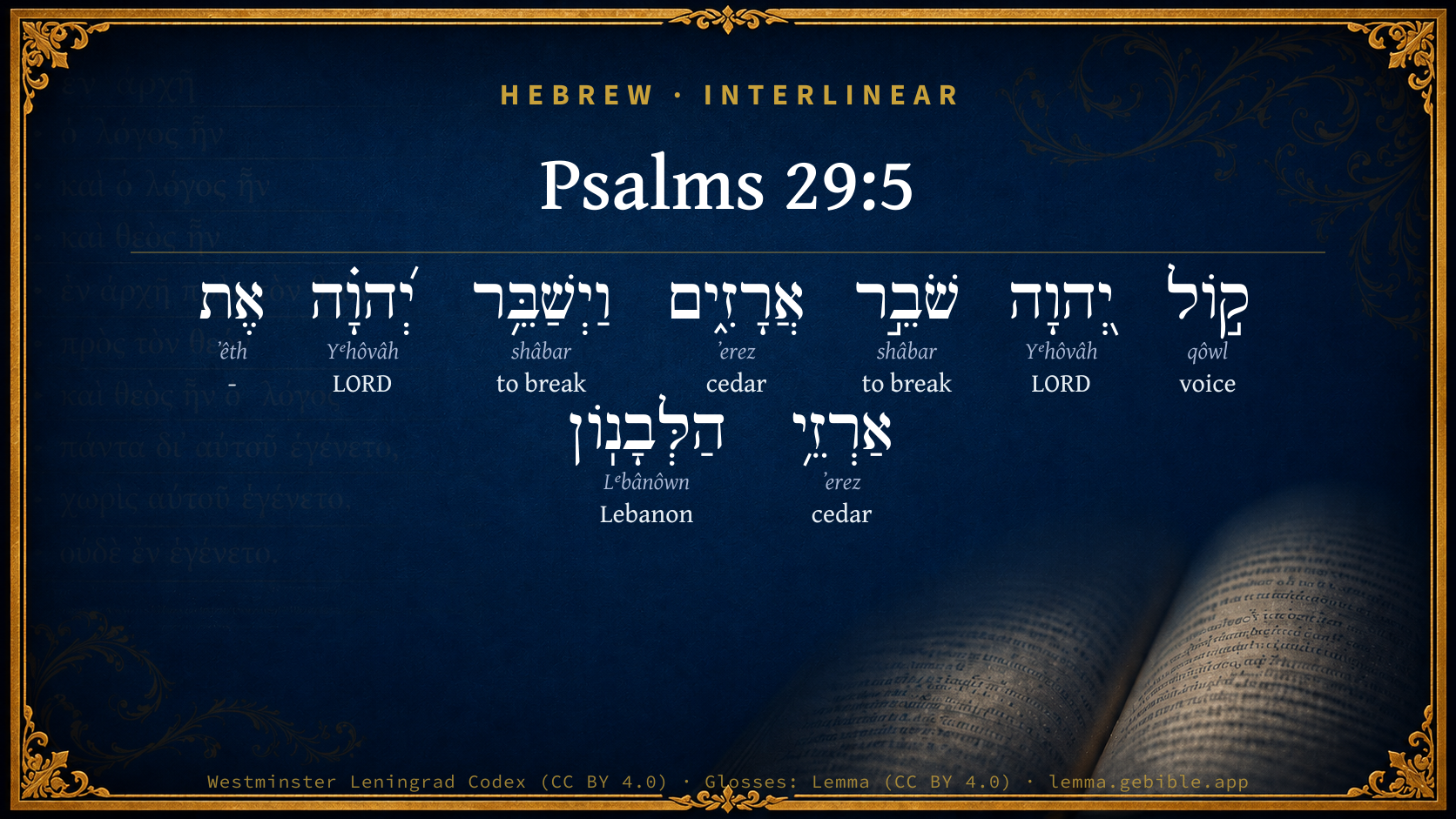
Psalms 29:5

Hebrew (Westminster Leningrad Codex) Psalms 29:5 appears in the Hebrew Old Testament. The text above is from the Westminster Leningrad Codex. Each word links to its Strong’s number, a concise gloss, and parsing drawn from the Open Scriptures Hebrew Bible morphology. Click any word for its full Brown-Driver-Briggs (BDB) entry.
Download image
Cite this verse

Psalms 29:5 (World English Bible). Public Domain. Lemma interlinear Bible study tool, https://lemma.gebible.app/v/psalms/29/5.

Show BibTeX & RIS
BibTeX
RIS
English Translation
The voice of Yahweh breaks the cedars. Yes, Yahweh breaks in pieces the cedars of Lebanon.
World English Bible · Public Domain
Download a study sheet

One document with this verse’s original text, its word-by-word gloss line, the meaning frame, cross-references with their text, attributed commentary, and full source and license credits — printable, and it pastes into notes with its structure intact.

This verse Autodidact and up

Study sheet (.html) Plain text (.txt)

A passage Seminary Student

Up to 50 verses in one chapter. A passage sheet keeps up to 6 commentary sources and 12 cross-references per verse, in the order this page ranks them, and says so on the sheet whenever that leaves anything out. Ask for a single verse and you get the Autodidact verse sheet above.

Everything on this page stays free to read, with no account — the sheet is a download of what is already on screen, not access to it.

Want to remove ads? Support Godless Engineer
Compare translations 3

The same verse in 3 English versions, stacked beneath the original-language interlinear above. Click any original word for its lexicon entry.

Each is an independent rendering of the whole verse — the interlinear is not word-aligned to these translations.

Highlighted words mark where these versions differ — a whole-verse word diff, not a word-by-word alignment.

  • World English Bible Public Domain
    The voice of Yahweh breaks the cedars. Yes, Yahweh breaks in pieces the cedars of Lebanon.
  • King James Version Public Domain
    The voice of the LORD breaketh the cedars; yea, the LORD breaketh the cedars of Lebanon.
  • unfoldingWord Literal Text CC BY-SA 4.0
    The voice of Yahweh is breaking cedars, and Yahweh breaks the cedars of Lebanon.

unfoldingWord Literal Text — © unfoldingWord, licensed CC BY-SA 4.0. Word-aligned USFM3 via Door43 (git.door43.org/unfoldingWord/en_ult).

Versions to compare (up to 4)

3 of 4 selected

Show all 18 translations

Every available English version of this verse, each an independent rendering of the whole verse.

  • World English Bible Public Domain
    The voice of Yahweh breaks the cedars. Yes, Yahweh breaks in pieces the cedars of Lebanon.
  • Berean Standard Bible Public Domain
    The voice of the LORD breaks the cedars; the LORD shatters the cedars of Lebanon.
  • Majority Standard Bible Public Domain
    The voice of the LORD breaks the cedars; the LORD shatters the cedars of Lebanon.
  • King James Version Public Domain
    The voice of the LORD breaketh the cedars; yea, the LORD breaketh the cedars of Lebanon.
  • American Standard Version (1901) Public Domain
    The voice of Jehovah breaketh the cedars; Yea, Jehovah breaketh in pieces the cedars of Lebanon.
  • Revised Version (1885) Public Domain
    The voice of the LORD breaketh the cedars; yea, the LORD breaketh in pieces the cedars of Lebanon.
  • Geneva Bible (1599) Public Domain
    The voyce of the Lord breaketh the cedars: yea, the Lord breaketh the cedars of Lebanon.
  • Douay-Rheims (1899) Public Domain
    The voice of the Lord breaketh the cedars: yea, the Lord shall break the cedars of Libanus.
  • Young's Literal Translation Public Domain
    The voice of Jehovah `is' shivering cedars, Yea, Jehovah shivers the cedars of Lebanon.
  • Literal Standard Version CC BY-SA 4.0
    The voice of YHWH [is] shattering cedars, || Indeed, YHWH shatters the cedars of Lebanon.
  • Unlocked Literal Bible CC BY-SA 4.0
    The voice of Yahweh breaks the cedars; Yahweh breaks in pieces the cedars of Lebanon.
  • unfoldingWord Literal Text CC BY-SA 4.0
    The voice of Yahweh is breaking cedars, and Yahweh breaks the cedars of Lebanon.
  • Darby Bible Public Domain
    The voice of Jehovah breaketh cedars; yea, Jehovah breaketh the cedars of Lebanon:
  • World Messianic Bible Public Domain
    The LORD’s voice breaks the cedars. Yes, the LORD breaks in pieces the cedars of Lebanon.
  • Webster's Bible Public Domain
    The voice of the LORD breaketh the cedars; yes, the LORD breaketh the cedars of Lebanon.
  • Free Bible Version CC BY-SA 4.0
    the Lord's voice shatters the cedars, even breaking the cedars of Lebanon.
  • Bible in Basic English Public Domain
    By the voice of the Lord are the cedar-trees broken, even the cedars of Lebanon are broken by the Lord.
  • JPS Tanakh (1917) Public Domain
    The voice of the LORD breaketh the cedars; yea, the LORD breaketh in pieces the cedars of Lebanon.

Literal Standard Version (2020), Covenant Press — licensed CC BY-SA 4.0. Text via the HelloAO Bible API (eBible.org). Unlocked Literal Bible (unfoldingWord) — licensed CC BY-SA 4.0. Text via the HelloAO Bible API (eBible.org). unfoldingWord Literal Text — © unfoldingWord, licensed CC BY-SA 4.0. Word-aligned USFM3 via Door43 (git.door43.org/unfoldingWord/en_ult). Free Bible Version, Dr. Jonathan Gallagher — licensed CC BY-SA 4.0. Text via the HelloAO Bible API (eBible.org).

Word by word

More ways to search: Search by grammar → Find every occurrence → Compare this word →

Practice this passage: Drill this verse → Learn its vocabulary →

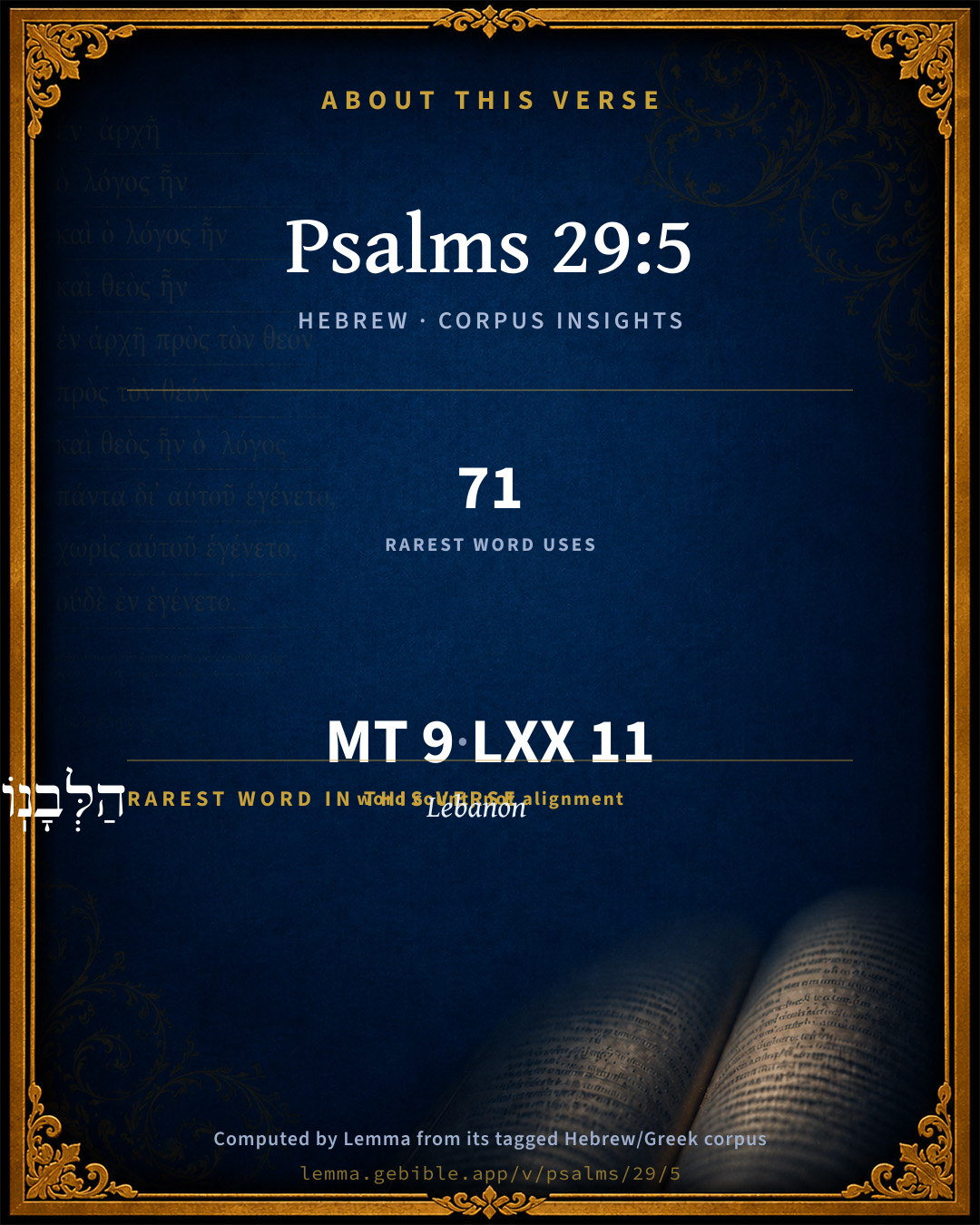
About this verse

These counts appear in no published source. They are computed here, from the morphology-tagged text and Lemma’s own curated glosses. What Lemma adds →

9
words
6
distinct lemmas
Wisdom
section

Grammatical profile

  • 2 verbs
  • 6 nouns
  • 1 particle

Verb forms

  • שֹׁבֵ֣ר Qal · Participle Active
  • וַיְשַׁבֵּ֥ר Piel · Sequential Imperfect

Repetition

Words recur within this verse — often emphatic in Hebrew:

  • יְ֭הוָה LORD H3068 ×2
  • שֹׁבֵ֣ר to break H7665 ×2
  • אֲרָזִ֑ים cedar H730 ×2

Hebrew & Septuagint length

In English translation the verse runs 16 words from the Hebrew and 19 from the Septuagint (LXX English) — closely comparable.

A rough comparison of the two English renderings, which tokenize alike — not a word-level alignment.

Word counts can differ between the Hebrew and the Greek without any difference in meaning — e.g. the Hebrew direct-object marker אֵת has no separate Greek word, and Greek often adds the article ὁ.

In the original languages it is 9 Hebrew tokens and 11 Greek tokens — but the two are counted differently (Hebrew bundles its prefixes and suffixes into one token; the Greek is in lemma form), so that isn’t a like-for-like length.

Cross-references

3

Topical passages linked to Psalms 29:5 in the Treasury of Scripture Knowledge — connected by theme and wording, ordered by reader-vote popularity; previews shown in the World English Bible.

  • Isaiah 2:13 For all the cedars of Lebanon, that are high and lifted up, For all the oaks of Bashan,
  • Judges 9:15 The bramble said to the trees, If in truth you anoint me king over you, then come and take refuge in my shade; and if not, let fire come out of the bramble, and devour the cedars of Lebanon.
  • Psalms 104:16 Yahweh's trees are well watered, The cedars of Lebanon, which he has planted;

Cross-references courtesy of OpenBible.info (CC BY 4.0).

Hebrew and Greek witnesses Masoretic Hebrew ↔ Greek Septuagint

The same verse in the two great witnesses to the Old Testament, shown verse-for-verse.

You’re reading Greek Psalm 28 (Hebrew Psalm 29). The Septuagint counts the superscription, so verse numbers can differ from the Hebrew — chapter-level alignment, not verse-by-verse. Numbering follows Rahlfs.

These are two independent witnesses, not word-aligned to each other, and the Septuagint is shown in lemma (dictionary) form.

Hebrew Psalms 29:5 Masoretic · Westminster Leningrad Codex

ק֣וֹל יְ֭הוָה שֹׁבֵ֣ר אֲרָזִ֑ים וַיְשַׁבֵּ֥ר יְ֝הוָ֗ה אֶת אַרְזֵ֥י הַלְּבָנֽוֹן

The voice of Yahweh breaks the cedars. Yes, Yahweh breaks in pieces the cedars of Lebanon.

World English Bible · Public Domain

Greek LXX Greek Psalm 28:5 Septuagint · lemma form

φωνή κύριος συντρίβω κέδρος καί συντρίβω κύριος ὁ κέδρος ὁ λίβανος

There is the voice of the Lord who breaks the cedars; the Lord will break the cedars of Libanus.

LXX2012 (modern English Septuagint) · Public Domain

Hebrew: Westminster Leningrad Codex (CC BY 4.0). Greek: Septuagint (public domain); English from LXX2012 (modern English Septuagint) (Public Domain). How the Septuagint differs from the Hebrew →

Commentary

Notes on Psalms 29:5 from classic Christian and Jewish commentators (each source and its license shown beneath its notes). The classic Christian expositions comment on the surrounding passage and are grouped to its opening verse, so a note may address several verses; the Jewish commentaries on the Tanakh (Rashi and others) are per-verse, so they appear only where the commentator wrote on this verse.

Lemma curates 59 commentaries, every one of them public domain or Creative Commons licensed, each selected and text-cleaned for this edition rather than reprinted as found. About our sources →

Trapp's Complete Commentary

John Trapp

Psa 29:5 The voice of the LORD breaketh the cedars; yea, the LORD breaketh the cedars of Lebanon.

Ver. 5. The voice of the Lord breaketh the cedars] i.e. The thunder, and those things that either go before it or follow it, as lightnings, thunder bolts, storms, tempest, &c., breaking and turning up by the roots huge trees.

The Lord breaketh the cedars of Lebanon] Which are the tallest, thickest, and most durable of any place in the habitable world. What a shame is it, then, that our hard hearts break not, yield not, though thunderstruck with the dreadful menaces of God’s mouth! Corripimur sad non corrigimur, &c. A fearful case. Let the tall cedars see to it. Nam per Cedros intelligit αλληγορικως quicquid est eximium in mundo. Where is that hammer of the nations, Nebuchadnezzar? that terror of the world, Tamerlane, &c.? Are they not broken in pieces as a potter’s vessel?

John Trapp, A Commentary or Exposition upon All the Books of the Old and New Testament (1647–1656) — public domain. Text from a community e-Sword module.

J. A. Alexander on Psalms

Joseph Addison Alexander

5. (Psa 29:5) The voice of Jehovah (is) breaking cedars, and Jehovah has broken the cedars of Lebanon. In the powerful working of the elements the Psalmist hears the voice of God. That this expression always denotes thunder (Exo 9:28) is a perfectly gratuitous assumption.—Cedars are mentioned as the loftiest forest trees, and those of Lebanon as the loftiest of the species. Between the verbs of the two clauses there is a twofold variation which appears to be significant. The first is the primitive verb which simply means to break; the other an intensive form, implying an extraordinary violence. See above, Psa 3:8 (7). This distinction can be reproduced in English only by a change of verb (break and crush), or by some qualifying addition (break and break in pieces), But besides this variation, the first word is an active participle (breaking), and the Second a finite tense denoting past time (broke or has broken), which together may indicate progression (it is breaking and now he has broken), or express the same idea, namely, that he habitually breaks, or has often broken, the cedars of Lebanon.

Joseph Addison Alexander, The Psalms Translated and Explained (1850) — public domain. Text from a community e-Sword module.

Tyndale Open Study Notes

Tyndale Open Resources

29:5 The cedars of Lebanon were known for their size and quality (see Isa 2:13).

Tyndale Open Study Notes — © Tyndale Open Resources, licensed CC BY-SA 4.0. Text via the HelloAO Bible API.

Geneva Bible (1599)

Geneva Bible translators

That is, the thunderbolt breaketh the most strong trees, and shall men think their power to be able to resist God?

Geneva Bible (1599) marginal notes — public domain. Text via Bolls.life.

Jamieson, Fausset & Brown

Robert Jamieson, A. R. Fausset & David Brown

The tall and large cedars, especially of Lebanon, are shivered, utterly broken. The waving of the mountain forests before the wind is expressed by the figure of skipping or leaping.

Jamieson, Fausset & Brown — Commentary Critical and Explanatory on the Whole Bible (1871) — public domain (CC PDM 1.0). Text via the HelloAO Bible API.

Adam Clarke's Commentary

Verse 5. Breaketh the cedars] Very tall trees attract the lightning from the clouds, by which they are often torn to pieces. Woods and forests give dreadful proof of this after a thunderstorm.

Adam Clarke's Commentary on the Bible (1810–1826) — public domain. Text from a community e-Sword/MySword module.

John Calvin's Commentaries

5. The voice of Jehovah breaketh the cedars. We see how the prophet, in order to subdue the stubbornness of men, shows, by every word, that God is terrible. He also seems to rebuke, in passing, the madness of the proud, and of those who swell with vain presumption, because they hearken not to the voice of God in his thunders, rending the air with his lightnings, shaking the lofty mountains, prostrating and overthrowing the loftiest trees. What a monstrous thing is it, that while all the irrational portion of the creation tremble before God, men alone, who are endued with sense and reason, are not moved! Moreover, though they possess genius and learning, they employ enchantments to shut their ears against God’s voice, however powerful, lest it should reach their hearts. Philosophers think not that they have reasoned skilfully enough about inferior causes, unless they separate God very far from his works. It is a diabolical science, however, which fixes our contemplations on the works of nature, and turns them away from God. If any one who wished to know a man should take no notice of his face, but should fix his eyes only on the points of his nails, his folly might justly be derided. But far greater is the folly of those philosophers, who, out of mediate and proximate causes, weave themselves vails, lest they should be compelled to acknowledge the hand of God, which manifestly displays itself in his works. The Psalmist particularly mentions the cedars of Lebanon, because lofty and beautiful cedars were to be found there. He also refers to Lebanon and Mount Hermon, and to the wilderness of Kadesh, That is, the wilderness of Zin, Numbers 33:36. It is described in Deuteronomy 1:19, as the “great and terrible wilderness.” The Israelites passed through this wilderness in their way from Egypt to the promised land, Numbers 13:27. It received its name from the city of Kadesh, by which it lay, Numbers 20:1, 16.

The Sidonians applied to Hermon the name of Sirion, Deuteronomy 3:9.

“D’approcher de Dieu.” — Fr.

“Fait avortir.” — Fr. “To miscarry or prove abortive.”

John Calvin's Commentaries (1540-1563) — public domain. Text from the Calvin Translation Society English edition (1840s-50s) via the Christian Classics Ethereal Library (ccel.org). Calvin's coverage is partial (roughly two-thirds of the Bible); uncommented books and verses are honest gaps, never fabricated. The 19th-century editor's footnotes and remarks are omitted so the notes are faithfully Calvin's own voice.

Ellicott's Commentary for English Readers

(5) The voice of the Lord breaketh.—Better more literally, The voice of Jehovah breaking the cedars, and Jehovah hath shivered the cedars of Lebanon. (The verb in the second clause is an intensive of that used in the first.) The range of Lebanon receives the first fury of the storm. Its cedars, mightiest and longest-lived of Eastern trees, crash down, broken by the violence of the wind. (For cedar, see 2Sa_7:2.) It has been objected that the thunder should not be made the agent in the destruction; but comp. Shakespeare—

“And thou, all-shaking thunder,

Smite flat the thick rotundity o’ the world!

Crack Nature’s moulds, all germens spill at once.

That make ingrateful man!”—King Lear, Acts 3, sc. 2.

A Bible Commentary for English Readers, edited by Charles John Ellicott (1878–1897) — public domain. Text from a community e-Sword module.

The Cambridge Bible for Schools and Colleges

gen. ed. J. J. S. Perowne

5. cedars] The noblest and strongest of the trees of the forest; emblematical of worldly magnificence (Isa_2:13).

yea, the Lord breaketh] R.V. yea, the Lord breaketh in pieces. The idea of the first line is emphasised and particularised in the second. Cp. Psa_29:8.

The Cambridge Bible for Schools and Colleges (gen. ed. J. J. S. Perowne; Cambridge University Press, 1878–1918) — public domain. Text from a community e-Sword module.

John Gill's Exposition

The voice of the Lord breaketh the cedars,.... Such an effect thunder has upon the tallest, strongest, and largest trees, as to break them into shivers;

yea, the Lord breaketh the cedars of Lebanon; a mountain in the north part of the land of Judea, so called from its whiteness, both by reason of the snow with which some part of it is covered in summer, as Tacitus observes (b); and partly from the colour of the earth that has no snow on it, which looks as white as if it was covered with white tiles, as Maundrell (c) says; and where the goodliest cedars grow; and to which may be compared proud, haughty, lofty, and stouthearted sinners, who are broken, brought down, and laid low, by the voice of Christ in his Gospel, his power attending it. The Targum renders it, "the Word of the Lord".

(b) Hist. l. 5. c. 6. (c) Travels, p. 176.

John Gill's Exposition of the Whole Bible (1746–1763) — public domain (CC PDM 1.0). Text via the HelloAO Bible API.

Albert Barnes' Notes on the Bible

Breaketh the cedars - The thunder prostrates the lofty trees of the forest. The psalmist speaks as things appeared, attributing, as was natural, and as was commonly done, that to the thunder which was really produced by the lightning. It, is now fully known that the effect here referred to is not produced by thunder, but by the rapid passage of the electric fluid as it passes from the cloud to the earth. that power is so great as to rive the oak or the cedar; to twist off their limbs; to prostrate their lofty trunks to the ground. The psalmist speaks of thunder as accomplishing this, in the same way that the sacred writers and all men, even scientific men, commonly speak, as when we say, the sun rises and sets - the stars rise and set, etc. People who would undertake in all cases to speak with scientific accuracy, or in the strict language of science, would be unintelligible to the mass of mankind; perhaps on most subjects they would soon cease to speak at all - since they themselves would be in utter doubt as to what is scientific accuracy. People who require that a revelation from God should always use language of strict scientific precision, really require that a revelation should anticipate by hundreds or thousands of years the discoveries of science, and use language which, when the revelation was given, would be unintelligible to the mass of mankind; nay, which would be always unintelligible to a large portion of the race - since people ordinarily, however much the exact truths of science may be diffused, do not learn to use such exactness of speech. As long as men have occasion to speak on the subject at all they will probably continue to say that the sun rises and sets; that the grass grows; and that water runs.

Breaketh the cedars of Lebanon - “Cedars are mentioned as the loftiest forest trees, and those of Lebanon as the loftiest of their species.” - “Prof. Alexander.” The cedars of Lebanon are often referred to in the Scriptures as remarkable for their size and grandeur: 1Ki 4:33; 1Ki 5:6; Psa 92:12; Ezr 3:7.

Albert Barnes' Notes on the Bible (1834–1885) — public domain. Text from a community e-Sword/MySword module.

Matthew Poole's English Annotations

By thunder-bolts; which have oft thrown down trees and towers.

Lebanon; a place famous for strong and lofty cedars. See 2Ch 2:8; Son 3:9; 5:15.

Matthew Poole's English Annotations on the Holy Bible (1683–1685) — public domain. Text from a community e-Sword/MySword module.

The Treasury of David

Charles H. Spurgeon

Ver. 5. The voice of the Lord breaketh the cedars.

"Black from the stroke above, the smouldering pine

Stands a sad shattered trunk."

Noble trees fall prostrate beneath the mysterious bolt, or stand in desolation as mementoes of its power. Lebanon itself is not secure, high as it stands, and ancient as are its venerable woods: Yea, the Lord breaketh the cedars of Lebanon. The greatest and most venerable of trees or men, may not reckon upon immunity when the Lord is abroad in his wrath. The gospel of Jesus has a like dominion over the most inaccessible of mortals; and when the Lord sends the word, it breaks hearts far stouter than the cedars.

Ver 3-10. The Lord, etc. See Psalms on "Ps 29:3" for further information.

Ver. 5. The voice of Jehovah. Philosophers think not that they have reasoned skilfully enough about inferior causes, unless they separate God very far from his works. It is a diabolical science, however, which fixes our contemplations on the works of nature, and turns them away from God. If any one who wished to know a man, should take no notice of his face, but should fix his eyes only on the points of his nails, his folly might justly be derided. But far greater is the folly of those philosophers, who, out of mediate and proximate causes, weave themselves vails lest they should be compelled to acknowledge the hand of God, which manifestly displays itself in his works. John Calvin.

Ver. 5. The voice of the Lord breaketh the cedars, etc. Like as tempests when they arise, and lightnings, quickly and in a trice, hurl down and overturn mountains and the highest trees; even so doth the Lord bring down with a break neck fall, the proud, haughty, arrogant, and insolent, who set themselves against God, and seek the spoil of those that be quiet and godly. Robert Cawdray.

Ver. 5. The voice of the Lord breaketh the cedars. The ancient expositors remind us that the breaking of the cedar trees by the wind, is a figure of the laying low of the lofty and proud things of this world, by the rushing mighty wind of the Holy Spirit, given on that day. Confringit cedros Deus, hoc est humiliat superbos. (S. Jerome, and so S. Basil.) Christopher Wordsworth.

Ver. 5. The Lord breaketh the cedars of Lebanon. What a shame is it then that our hard hearts break not, yield not, though thunder struck with the dreadful menaces of God's mouth! John Trapp.

Ver. 5. "Breaketh the cedars of Lebanon:"

When high in the air the pine ascends,

To every ruder blast it bends.

The palace falls with heavier weight,

When tumbling from its airy height;

And when from heaven the lightning flies,

It blasts the hills that proudest rise.

Horace, translated by Philip Francis, D.D., 1765.

Ver. 5. The cedars of Lebanon. These mighty trees of God, which for ages have stood the force of the tempest, rearing their evergreen colossal boughs in the region of everlasting snow, are the first objects of the fury of the lightning, which is well known to visit first the highest objects. Robert Murray Macheyne.

Ver. 5. The breaking power of the gospel.

Psalms 29:6*

Charles H. Spurgeon's The Treasury of David (1869–1885) — public domain. Psalms only. Text from a community e-Sword/MySword module.

Whedon's Commentary on the Bible

Daniel D. Whedon

5. Breaketh the cedars of Lebanon—Thunderbolts riving great trees and tearing up the earth, particularly as seen in tropical climates, have been the terror of all ages.

Daniel D. Whedon (gen. ed.), Commentary on the Old and New Testaments (1874–1909) — public domain. Text from a community e-Sword module.

The Pulpit Commentary

The voice of the Lord breaketh the cedars. At length down swoops the hurricane wind and rain and forked flashes of lightning all blended together, and violently tearing through the forest. The tall cedars the pride and glory of Syria and Palestine are snapped like reeds, and fall in a tangled mass. The Lord, who erstwhile "planted them", (Psa_104:16) now breaketh the cedars of Lebanon breaketh and destroyeth them in his fury. Such storms, though rare in Palestine and Syria, are sometimes witnessed; and descriptions have been given by travellers which bear out this one of David (comp. Wilson, "Travels," p. 146; Cunningham Geikie, vol. 2. pp. 57, 335; Tristram, "Land. of Israel," pp. 40, 194, 227, etc.).

The Pulpit Commentary (1880–1919), ed. H.D.M. Spence-Jones & Joseph S. Exell — public domain. Text from a community e-Sword module.

John Wesley's Explanatory Notes

Lebanon - A place famous for strong and lofty cedars.

John Wesley, Explanatory Notes Upon the Whole Bible (1754–1765) — public domain. Text via the GEBible commentary corpus.

Rashi

Rabbi Shlomo Yitzchaki (Rashi)

The voice of the Lord breaks the cedars The kings of the nations, as the matter that is written (in I Sam. 7:10): “and the Lord thundered with a loud noise etc. upon the Philistines”; (in Isa. 30:31): “For from the Lord’s voice Assyria shall be broken.” And at the time of the giving of the Torah (Deut. 5: 23): “For who is there of all flesh who has heard the voice of the living God speak out of the fire as we have and remained alive?” You heard and remained alive, but the nations of the world would hear it and die.

Rashi on the Tanakh — English translations: “The Judaica Press complete Tanach with Rashi, translated by A. J. Rosenberg” (CC BY 4.0); “Pentateuch with Rashi's commentary by M. Rosenbaum and A.M. Silbermann, 1929-1934” (public domain); “The Metsudah Tanach series, Lakewood, N.J” (CC BY 4.0); and “The Book of Joshua, Metsudah Publications, 1997” (CC BY 4.0). Text via Sefaria.

Lesson kit

Teaching starters — assembled from the data on this page, not authored interpretation. Every prompt links to the verse data it draws on. Edit before teaching.

Psalms, in the Wisdom, opens this verse with 9 words (6 distinct Hebrew lemmas). Its most distinctive word is Lᵉbânôwn (“Lebanon”). A historical commentator’s framing appears above. Read the whole chapter for the surrounding context.

Discussion questions

  1. How does “Lebanon” (Lᵉbânôwn) shape what this verse is saying?
  2. Isaiah 2:13 shares this passage’s theme. How do the two illuminate each other?
  3. “LORD” occurs 2× in this one verse. What is the effect of the repetition?
  4. These translations render this verse differently; the difference is in the English rendering, not the original. What questions does that raise?
  5. The verb «שֹׁבֵ֣ר» is Qal Participle Active. How does its form color the action?
  6. Reading how Trapp's Complete Commentary and J. A. Alexander on Psalms read this verse, where do the two commentators agree and where do they part?

Things to notice

Reading settings

Reading text

Shown beneath each verse's original-language words.

Old Testament
Old Testament edition

Read the OT as the Masoretic Hebrew (MT) or the Greek Septuagint (LXX).

English shown for the Greek Septuagint (in the Hebrew ↔ Greek comparison).

Comparing translations? Open the Compare panel on any verse page to stack up to four side by side.