
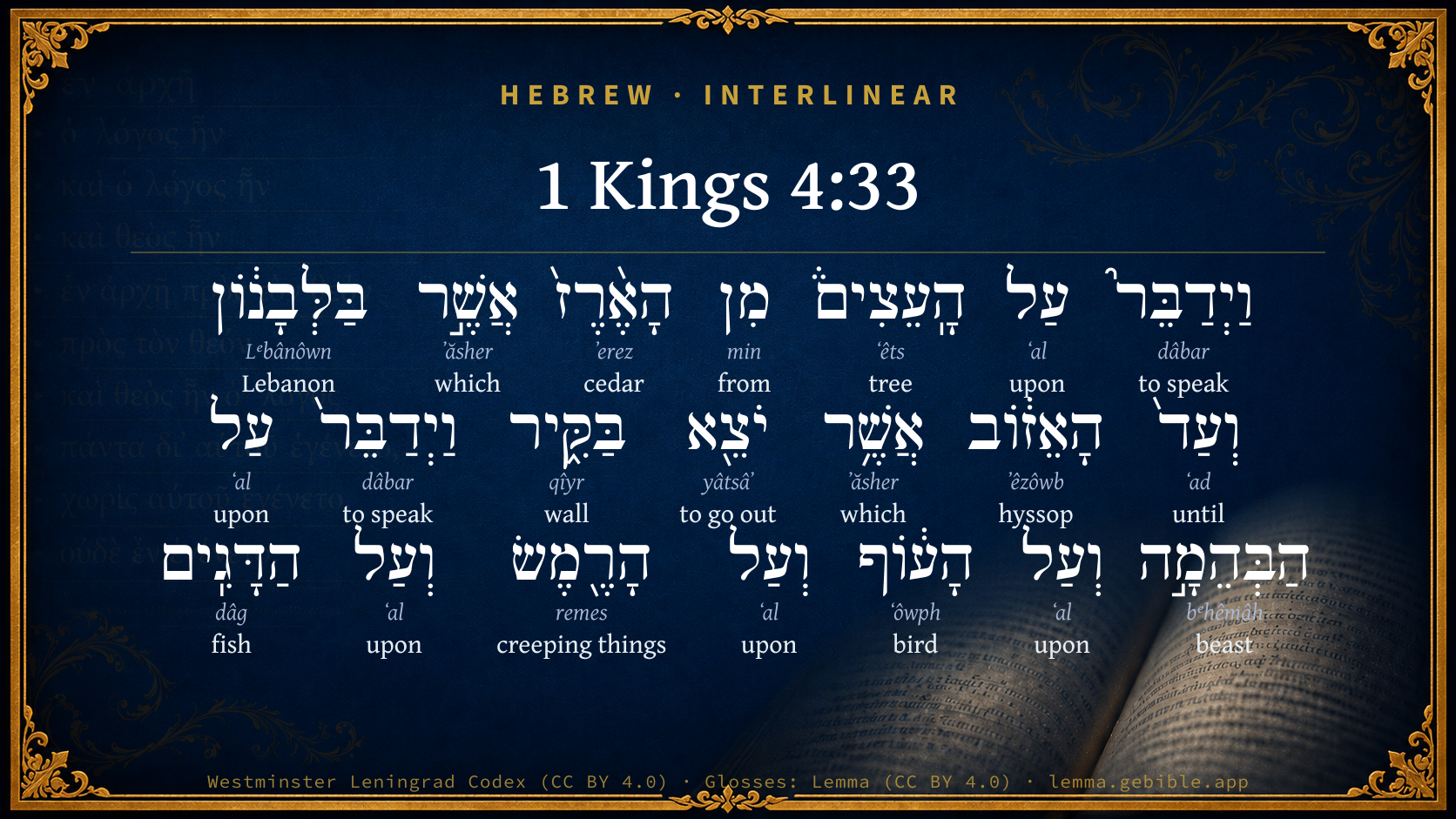
1 Kings 4:33

Hebrew (Westminster Leningrad Codex) 1 Kings 4:33 appears in the Hebrew Old Testament. The text above is from the Westminster Leningrad Codex. Each word links to its Strong’s number, a concise gloss, and parsing drawn from the Open Scriptures Hebrew Bible morphology. Click any word for its full Brown-Driver-Briggs (BDB) entry.
Download image
Cite this verse

1 Kings 4:33 (World English Bible). Public Domain. Lemma interlinear Bible study tool, https://lemma.gebible.app/v/1-kings/4/33.

Show BibTeX & RIS
BibTeX
RIS
English Translation
He spoke of trees, from the cedar that is in Lebanon even to the hyssop that springs out of the wall; he spoke also of animals, and of birds, and of creeping things, and of fish.
World English Bible · Public Domain
Download a study sheet

One document with this verse’s original text, its word-by-word gloss line, the meaning frame, cross-references with their text, attributed commentary, and full source and license credits — printable, and it pastes into notes with its structure intact.

This verse Autodidact and up

Study sheet (.html) Plain text (.txt)

A passage Seminary Student

Up to 50 verses in one chapter. A passage sheet keeps up to 6 commentary sources and 12 cross-references per verse, in the order this page ranks them, and says so on the sheet whenever that leaves anything out. Ask for a single verse and you get the Autodidact verse sheet above.

Everything on this page stays free to read, with no account — the sheet is a download of what is already on screen, not access to it.

Want to remove ads? Support Godless Engineer
Compare translations 3

The same verse in 3 English versions, stacked beneath the original-language interlinear above. Click any original word for its lexicon entry.

Each is an independent rendering of the whole verse — the interlinear is not word-aligned to these translations.

Highlighted words mark where these versions differ — a whole-verse word diff, not a word-by-word alignment.

  • World English Bible Public Domain
    He spoke of trees, from the cedar that is in Lebanon even to the hyssop that springs out of the wall; he spoke also of animals, and of birds, and of creeping things, and of fish.
  • King James Version Public Domain
    And he spake of trees, from the cedar tree that is in Lebanon even unto the hyssop that springeth out of the wall: he spake also of beasts, and of fowl, and of creeping things, and of fishes.
  • unfoldingWord Literal Text CC BY-SA 4.0
    And he spoke about trees, from the cedar that in Lebanon and to the hyssop that comes out in the wall. And he spoke about the beast and about the bird and about the creeping thing and about the fish.

unfoldingWord Literal Text — © unfoldingWord, licensed CC BY-SA 4.0. Word-aligned USFM3 via Door43 (git.door43.org/unfoldingWord/en_ult).

Versions to compare (up to 4)

3 of 4 selected

Show all 18 translations

Every available English version of this verse, each an independent rendering of the whole verse.

  • World English Bible Public Domain
    He spoke of trees, from the cedar that is in Lebanon even to the hyssop that springs out of the wall; he spoke also of animals, and of birds, and of creeping things, and of fish.
  • Berean Standard Bible Public Domain
    He spoke of trees, from the cedar in Lebanon to the hyssop growing in the wall, and he taught about animals, birds, reptiles, and fish.
  • Majority Standard Bible Public Domain
    He spoke of trees, from the cedar in Lebanon to the hyssop growing in the wall, and he taught about animals, birds, reptiles, and fish.
  • King James Version Public Domain
    And he spake of trees, from the cedar tree that is in Lebanon even unto the hyssop that springeth out of the wall: he spake also of beasts, and of fowl, and of creeping things, and of fishes.
  • American Standard Version (1901) Public Domain
    And he spake of trees, from the cedar that is in Lebanon even unto the hyssop that springeth out of the wall; he spake also of beasts, and of birds, and of creeping things, and of fishes.
  • Revised Version (1885) Public Domain
    And he spake of trees, from the cedar that is in Lebanon even unto the hyssop that springeth out of the wall: he spake also of beasts, and of fowl, and of creeping things, and of fishes.
  • Geneva Bible (1599) Public Domain
    And he spake of trees, from the cedar tree that is in Lebanon, euen vnto the hyssope that springeth out of the wall: he spake also of beasts, and of foules, and of creeping thinges, and of fishes.
  • Douay-Rheims (1899) Public Domain
    And he treated about trees from the cedar that is in Libanus, unto the hyssop that cometh out of the wall: and he discoursed of beasts, and of fowls, and of creeping things, and of fishes.
  • Young's Literal Translation Public Domain
    and he speaketh concerning the trees, from the cedar that `is' in Lebanon, even unto the hyssop that is coming out in the wall, and he speaketh concerning the cattle, and concerning the fowl, and concerning the creeping things, and concerning the fishes,
  • Literal Standard Version CC BY-SA 4.0
    and he speaks concerning the trees, from the cedar that [is] in Lebanon, even to the hyssop that is coming out in the wall, and he speaks concerning the livestock, and concerning the bird, and concerning the creeping things, and concerning the fishes,
  • Unlocked Literal Bible CC BY-SA 4.0
    He described the plants, from the cedar that is in Lebanon to the hyssop that grows out of the wall. He explained also about beasts, birds, creeping things, and fish.
  • unfoldingWord Literal Text CC BY-SA 4.0
    And he spoke about trees, from the cedar that in Lebanon and to the hyssop that comes out in the wall. And he spoke about the beast and about the bird and about the creeping thing and about the fish.
  • Darby Bible Public Domain
    And he spoke of the trees, from the cedar-tree that is on Lebanon even to the hyssop that springs out of the wall; he spoke also of cattle, and of fowls, and of creeping things, and of fishes.
  • World Messianic Bible Public Domain
    He spoke of trees, from the cedar that is in Lebanon even to the hyssop that grows out of the wall; he also spoke of animals, of birds, of creeping things, and of fish.
  • Webster's Bible Public Domain
    And he spoke of trees, from the cedar tree that is in Lebanon even to the hyssop that springeth out of the wall: he spoke also of beasts, and of fowls, and of creeping animals, and of fishes.
  • Free Bible Version CC BY-SA 4.0
    He was able to discuss knowledge of trees, from the cedar in Lebanon to the hyssop that grows in the wall. He taught about animals, birds, reptiles, and fish.
  • Bible in Basic English Public Domain
    He made sayings about all plants, from the cedar in Lebanon to the hyssop hanging on the wall; and about all beasts and birds and fishes and the small things of the earth.
  • JPS Tanakh (1917) Public Domain
    (5-13) And he spoke of trees, from the cedar that is in Lebanon even unto the hyssop that springeth out of the wall; he spoke also of beasts, and of fowl, and of creeping things, and of fishes.

Literal Standard Version (2020), Covenant Press — licensed CC BY-SA 4.0. Text via the HelloAO Bible API (eBible.org). Unlocked Literal Bible (unfoldingWord) — licensed CC BY-SA 4.0. Text via the HelloAO Bible API (eBible.org). unfoldingWord Literal Text — © unfoldingWord, licensed CC BY-SA 4.0. Word-aligned USFM3 via Door43 (git.door43.org/unfoldingWord/en_ult). Free Bible Version, Dr. Jonathan Gallagher — licensed CC BY-SA 4.0. Text via the HelloAO Bible API (eBible.org).

Word by word

More ways to search: Search by grammar → Find every occurrence → Compare this word →

Practice this passage: Drill this verse → Learn its vocabulary →

הָאֵז֔וֹב
ʼêzôwb
H231
“the · hyssop”
Particle, Definite Article + Noun, Common, Masculine, Singular, Absolute
Part of Speech
Particle + Noun
Type
Common
Gender
Masculine
Number
Singular
State
Absolute
Full BDB Definition

Origin: probably of foreign derivation

TWOT: 55

hyssop, a plant used for medicinal and religious purposes
  1. וַיְדַבֵּר֮ dâbar H1696 “and · to speak” Conjunction + Verb, Piel, Sequential Imperfect, 3rd Person, Masculine, Singular
  2. עַל ʻal H5921 “upon” Preposition
  3. הָֽעֵצִים֒ ʻêts H6086 “the · trees” Particle, Definite Article + Noun, Common, Masculine, Plural, Absolute
  4. מִן min H4480 “from” Preposition
  5. הָאֶ֨רֶז֙ ʼerez H730 “the · cedar” Particle, Definite Article + Noun, Common, Masculine, Singular, Absolute
  6. אֲשֶׁ֣ר ʼăsher H834 “which” Particle, Relative
  7. בַּלְּבָנ֔וֹן Lᵉbânôwn H3844 “in/at the · Lebanon” Preposition, Determined + Noun, Proper
  8. וְעַד֙ ʻad H5704 “and · until” Conjunction + Preposition
  9. אֲשֶׁ֥ר ʼăsher H834 “which” Particle, Relative
  10. יֹצֵ֖א yâtsâʼ H3318 “going out” Verb, Qal, Participle Active, Masculine, Singular, Absolute
  11. בַּקִּ֑יר qîyr H7023 “in/at the · wall” Preposition, Determined + Noun, Common, Masculine, Singular, Absolute
  12. וַיְדַבֵּר֙ dâbar H1696 “and · to speak” Conjunction + Verb, Piel, Sequential Imperfect, 3rd Person, Masculine, Singular
  13. עַל ʻal H5921 “upon” Preposition
  14. הַבְּהֵמָ֣ה bᵉhêmâh H929 “the · beast” Particle, Definite Article + Noun, Common, Feminine, Singular, Absolute
  15. וְעַל ʻal H5921 “and · upon” Conjunction + Preposition
  16. הָע֔וֹף ʻôwph H5775 “the · bird” Particle, Definite Article + Noun, Common, Masculine, Singular, Absolute
  17. וְעַל ʻal H5921 “and · upon” Conjunction + Preposition
  18. הָרֶ֖מֶשׂ remes H7431 “the · creeping things” Particle, Definite Article + Noun, Common, Masculine, Singular, Absolute
  19. וְעַל ʻal H5921 “and · upon” Conjunction + Preposition
  20. הַדָּגִֽים dâg H1709 “the · fish” Particle, Definite Article + Noun, Common, Masculine, Plural, Absolute

About this verse

These counts appear in no published source. They are computed here, from the morphology-tagged text and Lemma’s own curated glosses. What Lemma adds →

21
words
15
distinct lemmas
Historical
section

Notable vocabulary

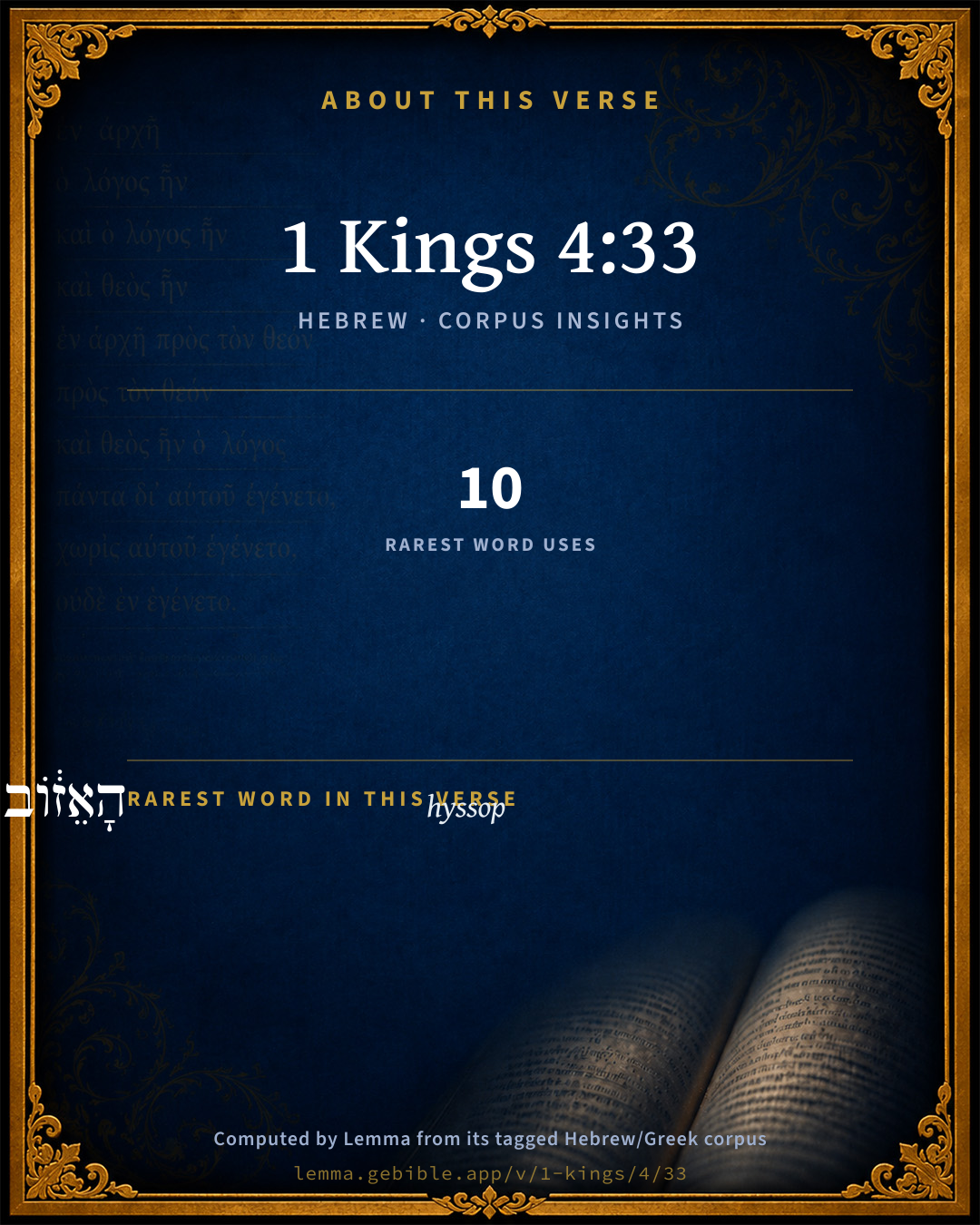
The rarest word here is הָאֵז֔וֹב hyssop H231 — appearing just 10 times in the whole Hebrew Bible.

Shared distinctive vocabulary

הָאֵז֔וֹב hyssop H231 occurs in 10 verses of the Hebrew Bible. Also found in:

Grammatical profile

  • 3 verbs
  • 9 nouns
  • 7 prepositions
  • 2 particles

Verb forms

  • וַיְדַבֵּר֮ Piel · Sequential Imperfect
  • יֹצֵ֖א Qal · Participle Active
  • וַיְדַבֵּר֙ Piel · Sequential Imperfect

Repetition

Words recur within this verse — often emphatic in Hebrew:

  • עַל upon H5921 ×5
  • וַיְדַבֵּר֮ to speak H1696 ×2
  • אֲשֶׁ֣ר which H834 ×2

Hebrew & Septuagint length

In English translation the verse runs 36 words from the Hebrew and 34 from the Septuagint (LXX English) — closely comparable.

A rough comparison of the two English renderings, which tokenize alike — not a word-level alignment.

Word counts can differ between the Hebrew and the Greek without any difference in meaning — e.g. the Hebrew direct-object marker אֵת has no separate Greek word, and Greek often adds the article ὁ.

Cross-references

8

Topical passages linked to 1 Kings 4:33 in the Treasury of Scripture Knowledge — connected by theme and wording, ordered by reader-vote popularity; previews shown in the World English Bible.

  • 2 Kings 19:23 By your messengers you have defied the Lord, and have said, With the multitude of my chariots am I come up to the height of the mountains, to the innermost parts of Lebanon; and I will cut down the tall cedars of it, and the choice fir trees of it; and I will enter into his farthest lodging-place, the forest of his fruitful field.
  • Psalms 51:7 Purify me with hyssop, and I will be clean. Wash me, and I will be whiter than snow.
  • Psalms 92:12 The righteous shall flourish like the palm tree. He will grow like a cedar in Lebanon.
  • Genesis 1:20–25 God said, "Let the waters swarm with swarms of living creatures, and let birds fly above the earth in the open expanse of sky."
  • Exodus 12:22 You shall take a bunch of hyssop, and dip it in the blood that is in the basin, and strike the lintel and the two side-posts with the blood that is in the basin; and none of you shall go out of the door of his house until the morning.
  • Numbers 19:18 and a clean person shall take hyssop, and dip it in the water, and sprinkle it on the tent, and on all the vessels, and on the persons who were there, and on him who touched the bone, or the slain, or the dead, or the grave:
  • Numbers 24:6 As valleys are they spread forth, As gardens by the river-side, As lign-aloes which Yahweh has planted, As cedar trees beside the waters.
  • Hebrews 9:19 For when every commandment had been spoken by Moses to all the people according to the law, he took the blood of the calves and the goats, with water and scarlet wool and hyssop, and sprinkled both the book itself and all the people,

Cross-references courtesy of OpenBible.info (CC BY 4.0).

Hebrew and Greek witnesses Masoretic Hebrew ↔ Greek Septuagint

The same verse in the two great witnesses to the Old Testament, shown verse-for-verse.

These are two independent witnesses, not word-aligned to each other, and the Septuagint is shown in lemma (dictionary) form.

Hebrew 1 Kings 4:33 Masoretic · Westminster Leningrad Codex

וַיְדַבֵּר֮ עַל הָֽעֵצִים֒ מִן הָאֶ֨רֶז֙ אֲשֶׁ֣ר בַּלְּבָנ֔וֹן וְעַד֙ הָאֵז֔וֹב אֲשֶׁ֥ר יֹצֵ֖א בַּקִּ֑יר וַיְדַבֵּר֙ עַל הַבְּהֵמָ֣ה וְעַל הָע֔וֹף וְעַל הָרֶ֖מֶשׂ וְעַל הַדָּגִֽים

He spoke of trees, from the cedar that is in Lebanon even to the hyssop that springs out of the wall; he spoke also of animals, and of birds, and of creeping things, and of fish.

World English Bible · Public Domain

Greek LXX 1 Kings 4:33 Septuagint · lemma form
And he spoke of trees, from the cedar in Libanus even to the hyssop which comes out through the wall: he spoke also of cattle, and of birds, and of reptiles, and of fishes.

LXX2012 (modern English Septuagint) · Public Domain

Hebrew: Westminster Leningrad Codex (CC BY 4.0). Greek: Septuagint (public domain); English from LXX2012 (modern English Septuagint) (Public Domain). How the Septuagint differs from the Hebrew →

Commentary

Notes on 1 Kings 4:33 from classic Christian and Jewish commentators (each source and its license shown beneath its notes). The classic Christian expositions comment on the surrounding passage and are grouped to its opening verse, so a note may address several verses; the Jewish commentaries on the Tanakh (Rashi and others) are per-verse, so they appear only where the commentator wrote on this verse.

Lemma curates 59 commentaries, every one of them public domain or Creative Commons licensed, each selected and text-cleaned for this edition rather than reprinted as found. About our sources →

Trapp's Complete Commentary

John Trapp

1Ki 4:33 And he spake of trees, from the cedar tree that [is] in Lebanon even unto the hyssop that springeth out of the wall: he spake also of beasts, and of fowl, and of creeping things, and of fishes.

Ver. 33. For he spake of trees.] This was a discourse, doubtless, of singular use; and of it we may say as one doth of Origen’s "Oetapla," now lost, Huius operis iacturam deplorare possumus, compensure non possumus, the lack of this book we may bewail, but cannot make good. When preferment was offered to Thomas Aquinas, he was wont to sigh and say, I had rather have Chrysostom’s comment upon Matthew.

That springeth out of the wall.] Herbs parietina, wall-wort, as Trajan the emperor was called, for his desire of vain glory.

He spake also of the beasts, &c.] A worthy work doubtless, and such as whereof it might better be said, than was of Pliny’s Natural History, by Erasmus, that it hath as much variety as nature itself hath, and is not so much a treatise as a treasury, yea, a whole world full of things most worthy to be noted and noticed. Ulysses, Aldrovandus, Conradus, Gesner, Gulielmus Rondeletius, Julius Scaliger, and other writers, both ancient and modern, have written largely and learnedly on the same subject, but nothing comparable to this work of Solomon: which some say was burnt by the Chaldees, together with the temple. Eusebius thinketh it was abolished by Hezekiah, because the people idolised it, as they did the brazen serpent.

John Trapp, A Commentary or Exposition upon All the Books of the Old and New Testament (1647–1656) — public domain. Text from a community e-Sword module.

The Biblical Illustrator

Joseph S. Exell

1Ki_4:33

And he spake of trees . . . he spake also of beasts.

Plant-life

The wise man had a genuine delight in plants, herbs, flowers, and trees. Read the Book of Canticles, and from its pages is caught the very fragrance of spring. He speaks with enthusiasm of the rose of Sharon, of the lily among thorns, of the apple-trees and orchards of pomegranates with pleasant fruits, of the garden of nuts, and the smell of Lebanon. He rejoices when the winter is past, the rain over and gone, when the flowers appear on the earth, when the time of the singing of birds comes, when the voice of the turtle is heard in the land, when the fig-tree putteth forth her green figs, and the vines with the tender grape give a good smell! Such expressions indicate a fervent delight in Nature and an accurate observation of her phases. Jesus also, the greater than Solomon, directed His disciples to consider the lilies, and to notice the way in which God clothes the grass of the field.

I. Gods delight in varied beauty. From the cedar of Lebanon to the hyssop, what a range! What an almost infinite number of species! What variety of colouring and form! All are the expression of Gods thought of beauty. What a God of glory we serve In Society and in the Church, many varieties of men and systems, God is working through all and delights in all. What a painful thing would be a uniform colour or shape for plants.

II. How beauty may spring out of corruption. God has arranged this. It is His plan throughout. Plants flourish best on the mould full of decayed vegetable or animal life. Striking their roots deep down into this reign of decay and death they gather life therefrom. Death supports life. So if only we are enlightened we shall find that out of our natures so sinful, so imperfect, these passions so overmastering, we may, under the influence of the forgiving love of Christ and of Gods Spirit renewing our hearts and lives, bring that which shall be beautiful, good, noble, pure, and approved of God.

III. Growth is a great mystery. True, the plants draw nourishment from the moist earth, but what power or principle is it that set all its ducts and roots at work? We may call it life, attraction, assimilation, or what we like, we are as far off as ever. God is the Author of their life. But the mystery remains. So in our spiritual life. How our receiving as true the fact that Christ died and rose again, should, be as new life to our souls, we cannot explain.

IV. The way growth should tend. Upwards. Higher, higher, is echoed by every flower and every tree. Heavenward should be the constant aim of the Christian, nearer to God. Stretching forth our hands in prayer we should grow. See how the palm-tree shoots upward, surmounted by a graceful tuft of foliage that seems like a symbol of the crown which shall hereafter grace the Christians brow when he has reached the heaven of his joy.

V. Upward growth must be by the aid of that which comes from outside and above. The willow grows by the water of the dark and lazy stream, but the flowers of the field rejoice when the rain cometh down to water the earth. Notice how the one droops downward in reverence, while the others spread their leaves or lift their branches so as to welcome the bounty of God. So we point to Him who came from above, who revealed the Father, who died for sin, and who has been ready to give to every thirsty spirit the water of life, who has brought life and immortality to light; and whose Spirit alone can nourish us that we may grow.

VI. Every plant in its place. Each clump of moss, bunch of ferns, hyssop, flower or tree has its habitat. In the myriad plants of a dense tropical forest, there is not one that is not fulfilling some purpose. The hyssop or fern may help to soften rugged edges of rock or wall. The tree may be for shade to man or shelter to birds, and the cedar may be for timber for the temple, The tall palm standing near a well intimates to the far-off and famishing traveller of the desert that there is relief at hand. The flowers may bloom or die, but they fulfil the end of existence. Let us learn to do so.

VII. Plants teach us also to make the best of circumstances. Winter cuts down the flowers, withers the leaves, bares the trees. Its winds sweep through the branches, its keen frosts nip the buds and early blossoms. Yet they went through all, and in time are reclothed with beauty.

VIII. Hints given of a glorious resurrection. Well, indeed, for us that we should so live that we can look forward to the spring-time of heaven as a further step in the stage of being, and revelation of the glory of God. We shall sleep in the dust of death and rise in the glory of springtide. (Homiletic Quarterly.)

A royal horticulturist

When Lysander brought presents to Cyrus, the prince conducted his illustrious guest through his gardens. Lysander, struck with so fine a prospect, praised the manner in which the grounds were laid out, the neatness of the walks, the abundance of trees planted with an art which knew how to combine the useful with the agreeable; the beauty and the glowing variety of flowers exhaling odours throughout the delightful scene. Everything charms and transports me in this place, said Lysander to Cyrus; but what strikes me most is the exquisite taste of the person who drew the plan of these gardens. Cyrus replied, I drew the plan and entirely marked it out. Many of the trees which you see were planted by my own hands. What! exclaimed Lysander with astonishment, is it possible that those purple robes and splendid vestments, those strings of jewels and bracelets of gold, those buskins so richly embroidered--is it possible that you could play the gardener, and employ your royal hands in planting trees? Does that surprise you? said Cyrus. I assure you that when my health permits I never sit down to my table without having fatigued myself either in military exercise, rural labour, or some other toilsome employment, to which I apply myself with pleasure.

The study of Nature

It is said of Wordsworth that a stranger having on one occasion asked to see his study, the maid said, This is masters room, but he studies in the fields. In doing so the poet followed a venerable example. We read that Isaac went out to meditate in the field at eventide, where in the margin to pray is put for to meditate. Nor could there be a better place either for prayer or for study than the fields. The Word of God is written very clearly for His seers in the green book of Nature. Wordsworths study is one that we can all use, however small our house may be. (Quiver.)

The world is worth seeing

Men must not live under a bushel. A gentleman once met a French priest on board an Atlantic liner. They entered into conversation, and the priest said that months ago he had a dream. He dreamt that he was dead, and that God asked him how much of the world he had seem His answer was that he had seen only a very little of it, for he had been so long in preparing for death, and in helping other people to die, that he had no time to see the world. He saw that God was displeased, and on awakening he resolved to see as much of this beautiful world as he could. It was a wise resolve. The earth is the Lords and not the devils, and we have no right to ignore it. Nature is a temple of God, and we must ever walk through it in a sacramental mood. (Sunday Circle.)

.

The Biblical Illustrator, edited by Joseph S. Exell (c. 1880s–1900s) — public domain. Text from a community e-Sword module.

Geneva Bible (1599)

Geneva Bible translators

From the highest to the lowest.

Geneva Bible (1599) marginal notes — public domain. Text via Bolls.life.

Jamieson, Fausset & Brown

Robert Jamieson, A. R. Fausset & David Brown

he spake of trees, from the cedar . . . to the hyssop--all plants, from the greatest to the least. The Spirit of God has seen fit to preserve comparatively few memorials of the fruits of his gigantic mind. The greater part of those here ascribed to him have long since fallen a prey to the ravages of time, or perished in the Babylonish captivity, probably because they were not inspired.

Next: 1 Kings Chapter 5

Jamieson, Fausset & Brown — Commentary Critical and Explanatory on the Whole Bible (1871) — public domain (CC PDM 1.0). Text via the HelloAO Bible API.

Adam Clarke's Commentary

Verse 33. He spake of trees - beasts - fowl - creeping things, and of fishes.] This is a complete system of natural history, as far as relates to the animal and vegetable kingdoms, and the first intimation we have of any thing of the kind: Solomon was probably the first natural historian in the world.

O, how must the heart of Tournefort, Ray, Linne, Buffon, Cuvier, Swammerdam, Blosch, and other naturalists, be wrung, to know that these works of Solomon are all and for ever lost! What light should we have thrown on the animal and vegetable kingdoms, had these works been preserved! But the providence of God has not thought fit to preserve them, and succeeding naturalists are left to invent the system which he probably left perfect. If there be any remains of his wisdom, they must be sought among the orientals, among whom his character is well known, and rates as high as it does with either Jews or Christians. I shall give some extracts from their works relative to Solomon when I come to consider his character at the end of 1Kg 11:43.

Adam Clarke's Commentary on the Bible (1810–1826) — public domain. Text from a community e-Sword/MySword module.

Ellicott's Commentary for English Readers

(33) He spake of trees.—Of this verse there have been many interpretations. Josephus (Ant. viii. c.2, § 5) supposes Solomon’s utterances on these natural products to have been allegorical and symbolic, although he declares that he described them and their properties “like a philosopher.” Rabbinical and Oriental legends, eagerly accepted in mediaeval times, ascribed to him mystic knowledge and magical use of their occult properties. Modern writers have seen in this utterance the first dawn of a scientific natural history and idyllic poetry. In all these suppositions there is some truth, though each in its literal meaning evidently interprets the work of Solomon by the ideas of its own time. An examination of the Song of Songs, and even of the Book of Proverbs—to say nothing of Ecclesiastes and several of the Psalms, and of the Book of Job, which has been thought to belong to the age of Solomon—shows in them repeated exemplifications of a deep sense of the wonder and the beauty of Nature, and also a keen observation of Natural history in detail But it also shows, as might have been expected, a constant contemplation of God in and over Nature (much as in Psalms 104), a desire to know the secret of His dispensation therein, a conception of a unity in His law over all being, and as a necessary consequence of this, a tendency to mystic interpretation and parable. If in the works here referred to, and now lost to us, there were (as Ewald supposes) “the rudiments of a complete natural history,” it would be an anachronism to doubt that they were marked by these leading characteristics.

A Bible Commentary for English Readers, edited by Charles John Ellicott (1878–1897) — public domain. Text from a community e-Sword module.

The Cambridge Bible for Schools and Colleges

gen. ed. J. J. S. Perowne

33. And he spake] i.e. He gave descriptions of the whole vegetable world, and discussed the virtues of the various plants. For it has been always of their medicinal properties that the earliest works on plants have treated. They were the remedies for all diseases, and a knowledge of ‘simples,’ as they were called in England in old times, was counted for the highest wisdom.

the cedar] The tree of greatest glory in Palestine is named as one extreme of the vegetable world, and the hyssop on the wall as the other.

of beasts] Similarly, under the names of beasts, fowls, creeping things and fishes, the whole animal world is specified after the division of those times. The same classes are mentioned in the account of the creation. Josephus (Ant. viii. 2, 5) enlarges on the simple narrative of the text, telling how the king’s knowledge of the peculiarities of these various creatures was of the most thorough character. He then goes on to tell that he was endowed with power against demons, and could cure men who were possessed with evil spirits. He is also said to have left forms of incantation and exorcism, of which, Josephus says, some knowledge had come down to his own time, and he gives a story of a Jew who wrought such a cure as he describes in the presence of the emperor Vespasian.

The Cambridge Bible for Schools and Colleges (gen. ed. J. J. S. Perowne; Cambridge University Press, 1878–1918) — public domain. Text from a community e-Sword module.

Albert Barnes' Notes on the Bible

Trees ... - A keen appreciation of the beauties of nature, and a habit of minute observation, are apparent in the writings of Solomon that remain to us. The writer here means to say that Solomon composed special works on these subjects. The Lebanon cedars were the most magnificent of all the trees known to the Hebrews, and hence, represent in the Old Testament the grandest of vegetable productions. (Psa 104:16; Son 5:15; Eze 31:3, etc.) For the hyssop, see Exo 12:22 note.

Of beasts, and of fowls, and of creeping things, and of fishes - This is the usual Biblical division of the animal kingdom Gen 1:26; Gen 9:2; Psa 148:10.

Albert Barnes' Notes on the Bible (1834–1885) — public domain. Text from a community e-Sword/MySword module.

Haydock's Catholic Bible Commentary

Wall. Some deny that ezob means hyssop. (Kimchi; Levinus, &c.) But there is a species which grows on mountains, and even out of walls. (Bochart) (Sanctius) --- It is a small odoriferous plant; whereas the cedar was the largest tree with which the Jews were acquainted. (Calmet) --- On Libanus there are found such trees above 36 feet in circumference; which extend their branches 111 feet around them. (Maundrell, Jerus. p. 239.) --- Solomon examined all, Wisdom vii. 17, &c. Many works have been falsely attributed to him, which Origen rejects: hom. 35, in Matthew. See Josephus, [Antiquities?] viii. 2.; Pineda iii. 29. (Calmet) --- Perhaps he might have composed some magical works, while he was an idolater. (Salien)

George Leo Haydock (1774–1849), Haydock's Catholic Family Bible and Commentary, 1859 edition — public domain. Excludes Psalms (Douay-Rheims chapter numbering differs from Protestant) and Deuterocanonical books (Catholic canon only).

Matthew Poole's English Annotations

Of trees, i.e. of all plants, of their nature and qualities; all which discourses are lost, without any impeachment of the perfection of the Holy Scriptures; which were not inspired and written to teach men philosophy or physic, but only to make men wise to salvation. See Joh 20:31; 2Ti 3:16,17.

From the cedar tree unto the hyssop, i.e. from the greatest to the least.

Matthew Poole's English Annotations on the Holy Bible (1683–1685) — public domain. Text from a community e-Sword/MySword module.

Whedon's Commentary on the Bible

Daniel D. Whedon

33. He spake of trees… beasts… fowl… creeping things… fishes — He enjoyed rare opportunities for becoming familiar with the various species of both the animal and vegetable creation. His extended commerce with all nations brought to him specimens of all rare trees, plants, and animals. Cedars he multiplied in his own land like sycamores; (1Ki_10:27;) his navies and caravans supplied him apes and peacocks, horses and mules, and spices. 1Ki_10:22; 1Ki_10:25. Compare Son_4:13-14. That he composed and wrote scientific treatises on botany and natural history, as many commentators have assumed, is not necessarily the meaning of this verse. In the concluding chapters of Job, and in many of the Psalms and Proverbs, we find many wise sayings and parabolic allusions based on the wisdom of God as displayed in the creation; and it seems more natural, on the whole, to suppose Solomon’s sayings about trees, etc., to have been of this character. And so Irenaeus observes that Solomon “expounded psychologically the wisdom of God which is manifest in creation.” So also Josephus: “He spake a parable upon every sort of tree, from the hyssop to the cedar; and in like manner, also, about beasts, and about all sorts of living creatures, whether upon the earth, or in the seas, or in the air; for he was not unacquainted with any of their natures, nor omitted inquiries about them, but described them all like a philosopher, and demonstrated his exquisite knowledge of their several properties.” And so his sayings on these subjects were probably more of the character of natural theology than of natural science. No wonder that his fame went through all lands, and attracted, among others, the queen of Sheba to his court. Chapter 10.

Daniel D. Whedon (gen. ed.), Commentary on the Old and New Testaments (1874–1909) — public domain. Text from a community e-Sword module.

The Pulpit Commentary

And he spare of i.e. , discoursed, treated, not necessarily wrote trees In his proverbs and songs he exceeded the children of the East. But his knowledge was not only speculative, but scientific. In his acquaintance with natural history he outshone the Egyptians, ver. 20, from the cedar tree that is in Lebanon A favourite illustration. The Jews had a profound admiration for all trees, and of these they justly regarded the cedar as king. Cf. Jud_1:9:15; Psa_80:10 Psa_104:16; Son_5:15; Eze_31:3 unto the hyssop that springeth out of the wall His knowledge, i.e. , embraced the least productions of nature as well as the greatest. The common hyssop (Exo_12:22; Lev_14:4) can hardly be intended here, as that often attains a considerable height (two feet), but a miniature variety or moss like hyssop in appearance, probably Orthotrichura saxatile: he spake also of beasts, and of fowl, and of creeping things, and of fishes. "The usual Biblical division of the animal kingdom" (Rawlinson). The arrangment is hardly according to manner of motion (Bahr). If anything, it is according to elements earth, sky, sea. Both Jewish and Mohammedan writers abound in exaggerated or purely fabulous accounts of Solomon"s attainments and gifts. We may see the beginning of these in Jos., Ant. 8:2.5.

HOMILIES BY A. ROWLAND Ver. 33.

The voice of Nature speaking for God.

This is given as an example of the wisdom for which Solomon was justly famed. His information was at once accurate and far reaching. Nothing escaped the notice of his observant eye, nothing was too insignificant to deserve his attention. The" hyssop" which was remarkable neither for size nor beauty, neither for fragrance nor utility, as well as the noble "cedar," was the subject of his research and discourse.

I THE GERM OF HIS KNOWLEDGE WAS FROM GOD. He was enriched with natural capacities above the average, as the preceding chapter shows. Men do differ widely in keenness of perception, in retentiveness of memory, in power of imagination, in love or dislike for the studies of natural science. A remembrance of this is of peculiar value to us in the training of children. The dullard in mathematics may prove the scholar in classics, etc. The wisdom of the Divine arrangement which makes differences between us in our natural tastes and capacities is seen in this, that it is on the one hand a blessing to society, enabling all spheres of life to be filled, and on the other a means of culture to character, by calling forth our sympathy, our forbearance, and our generosity in rejoicing over the triumphs of others.

II THE GROWTH OF HIS KNOWLEDGE WAS FROM STUDY. Solomon did not have all the mysteries of nature unveiled to him by revelation. No "royal road to learning" existed then, or ever. His studiousness as a youth may be fairly inferred from his strenuous exhortations to diligence and his frequent rebukes of sloth. Out of the depths of personal experience he declared that the "hand of the diligent maketh rich in thought, as well as in purse. See also Pro_10:5 Pro_19:24 Pro_26:13, etc. Press home on the young the value of habits of diligence. Illustrate by examples from biography. It would be interesting to know with certainty the substance of Solomon"s discourses. Probably he knew more than any other of his own day of horticulture, physiology, and kindred topics. But the reference is not so much to scientific treatises and orderly classifications as to the ethical use he made of the phenomena of nature. This may be inferred, partly from the fact that in those days, and in Eastern lands, this rather than that would be accounted "wisdom;" and partly from such writings of his as are still extant certain of the Psalms, the Song of Solomon, and the Proverbs. Study the text in the light thrown by these books, and it will be seen that through Solomon"s wisdom the voice of Nature spoke to his people for God, in the same fashion as in far nobler tones it spoke afterwards through Him who made the lilies whisper of God"s care, and the fallow fields speak of Christian duty. Inanimate things and dumb creatures spoke to Solomon"s people through him, and should speak to us.

I THE CREATURES OF GOD SPEAK TO US OF DIVINE CARE. Solomon, like his father, could say, "The heavens declare the glory of God; or like One greater than himself, "Consider the lilies of the field," etc. See how he speaks (Pro_16:15) of the cloud of the latter rain that rifled out the ears of corn; of the dew upon the grass; (Pro_19:12) of the gladness of nature, when the winter is past and the rain is over and gone. (Son_2:11-13) To see God"s hand in all this is true wisdom. The phenomena are visible to pure intellect, but He who is behind them can only he "spiritually discerned." Many now are losing sight of God because the mental perception only is employed, and believed to be necessary. Once the world appeared to men as the expression of God"s thought, the outcome of His will. Now some look on it as you may look on a friend who is not dead so far as natural life is concerned, but is worse than dead, because intelligence and will are gone, and he is an idiot! May we be aroused by the Divine Spirit to yearn for the lost Father, for the vanished heaven.

II THE CREATURES OF GOD SPEAK TO US OF HUMAN DEPENDENCE. Neither "hyssop" nor "cedar" can grow without Heaven"s benediction, and of every "beast," and "fowl," and "creeping thing," and "fish," it may be said, "these all wait upon Thee." Man, with all his attainments and powers, cannot create a single element required by his life. He can use God"s gifts, but they are God"s gifts still; and because He is good, our Lord bids us learn the lessons of content and trust. (Mat_6:25-34) We depend on these creatures in the natural world for food, clothing, shelter, etc., and they only live because God cares for them.

III THE CREATURES OF GOD SPEAK TO US OF DAILY DUTIES. How often in Proverbs we are reminded of that. Agur, who had wisdom similar to that of Solomon, speaks of the diligence of the ant, of the perseverance of the spider, of the strength in union of the locusts, of the conscious weakness and provided shelter of the conies. Solomon speaks of the blessing that came to the keeper of the fig tree (Pro_27:18) as an encourament to servants to be faithful and diligent. Adduce similar examples.

IV THE CREATURES OF GOD SPEAK TO US OF MORAL DANGERS. Take three examples of this.

1. of Son_2:15 Solomon alludes to "the little foxes whoso stealthily approach and spoil the vines and their tender grapes" as illustrations of the small evils which desolate men"s hearts and homes. Apply this.

2. Then in Pro_24:30-34 he draws a picture of a neglected garden, grown over with thorns and nettles, and shows how looking on it he "received instruction," and warning against sloth.

3. Again turn to Pro_23:32, where, speaking of intoxicating drink, he says, "at last it biteth like a serpent, and stingeth like an adder." It was in this way he referred to the animals and plants around him.

V THE CREATURES OF GOD SPEAK TO US OF SOCIAL EVILS. In those days, as in other days, foolish favourites, and unworthy.men, were exalted to places of trust and honour. Seeing it Solomon draws again on his observance of nature; and having noted the disorder and injury caused by untimely storms, says, "As snow in summer, and as rain in harvest, so honor is not seemly in a fool". (Pro_26:1) Another example of this teaching occurs in Pro_28:3. A heavy rain after long drought, raising the streamlets to floods, would sweep away the mud-built dwellings of the poor and the harvest already reaped; and to those who had seen that the wise king said, "A poor man that oppresseth the poor is like a sweeping rain which leaveth no food.

VI THE CREATURES OF GOD SPEAK TO US OF NOBLE POSSIBILITIES. Solomon saw growth around him on every side. The seed dropped in the crevice of a wall was not forgotten, but appeared in the "hyssop;" and the sapling, which a child could break, at last became the great "cedar of Lebanon." God"s benediction and man"s toil developed life; and the feeblest was not forgotten, the smallest not despised. We can imagine how from such facts Solomon would draw lessons of trust and hope.

IN CONCLUSION let us learn from the subject the following lessons

1. Never be afraid of the teachings of natural science. Show how geology, botany, astronomy, etc., are regarded by some Christians with terror, as if their influence would affect the spiritual truths revealed of God. Demonstrate the folly of this. Let theology recognize the sisterhood of science.

2. Never become absorbed in pursuits which are merely intellectual. The soul of man needs more than his intellect can win. The "hunger and thirst after righteousness" only a living God can satisfy. Use the suggestions of nature as the witnesses of God.

3. Never neglect the wonderful works of God. Many a frivolous life would be redeemed from vacuity and ennui if young people were trained to observe and take interest in the habits of animal life and the marvels of inanimate existence. Show the wholesomeness of such studies, as those of Charles Kingsley and others. But let us walk through this fair world as those who follow Christ, and then from the fragrant lilies and golden harvest fields He will speak to us of our Father in heaven. A.R.

The Pulpit Commentary (1880–1919), ed. H.D.M. Spence-Jones & Joseph S. Exell — public domain. Text from a community e-Sword module.

John Wesley's Explanatory Notes

Trees - That is, of all plants, of their nature and qualities: all which discourses are lost, without any impeachment of the perfection of the holy scriptures; which were not written to teach men philosophy or physick, but only to make them wise unto salvation. From the cedar, &c. - That is, from the greatest to the least.

John Wesley, Explanatory Notes Upon the Whole Bible (1754–1765) — public domain. Text via the GEBible commentary corpus.

Lesson kit

Teaching starters — assembled from the data on this page, not authored interpretation. Every prompt links to the verse data it draws on. Edit before teaching.

1 Kings, in the Historical, opens this verse with 21 words (15 distinct Hebrew lemmas). Its most distinctive word is ʼêzôwb (“hyssop”). A historical commentator’s framing appears above. Read the whole chapter for the surrounding context.

Discussion questions

  1. How does “hyssop” (ʼêzôwb) shape what this verse is saying?
  2. How does Exodus 12:22, which shares the word «hyssop», read alongside this verse?
  3. What does the repetition of “upon” (5× in this one verse) do in this verse?
  4. These translations render this verse differently; the difference is in the English rendering, not the original. What questions does that raise?
  5. «וַיְדַבֵּר֮» is a Piel Sequential Imperfect verb. How does that grammatical form shape the action described?
  6. Compare how Trapp's Complete Commentary and The Biblical Illustrator read this verse. Where do they agree or differ?

Things to notice

Reading settings

Reading text

Shown beneath each verse's original-language words.

Old Testament
Old Testament edition

Read the OT as the Masoretic Hebrew (MT) or the Greek Septuagint (LXX).

English shown for the Greek Septuagint (in the Hebrew ↔ Greek comparison).

Comparing translations? Open the Compare panel on any verse page to stack up to four side by side.