
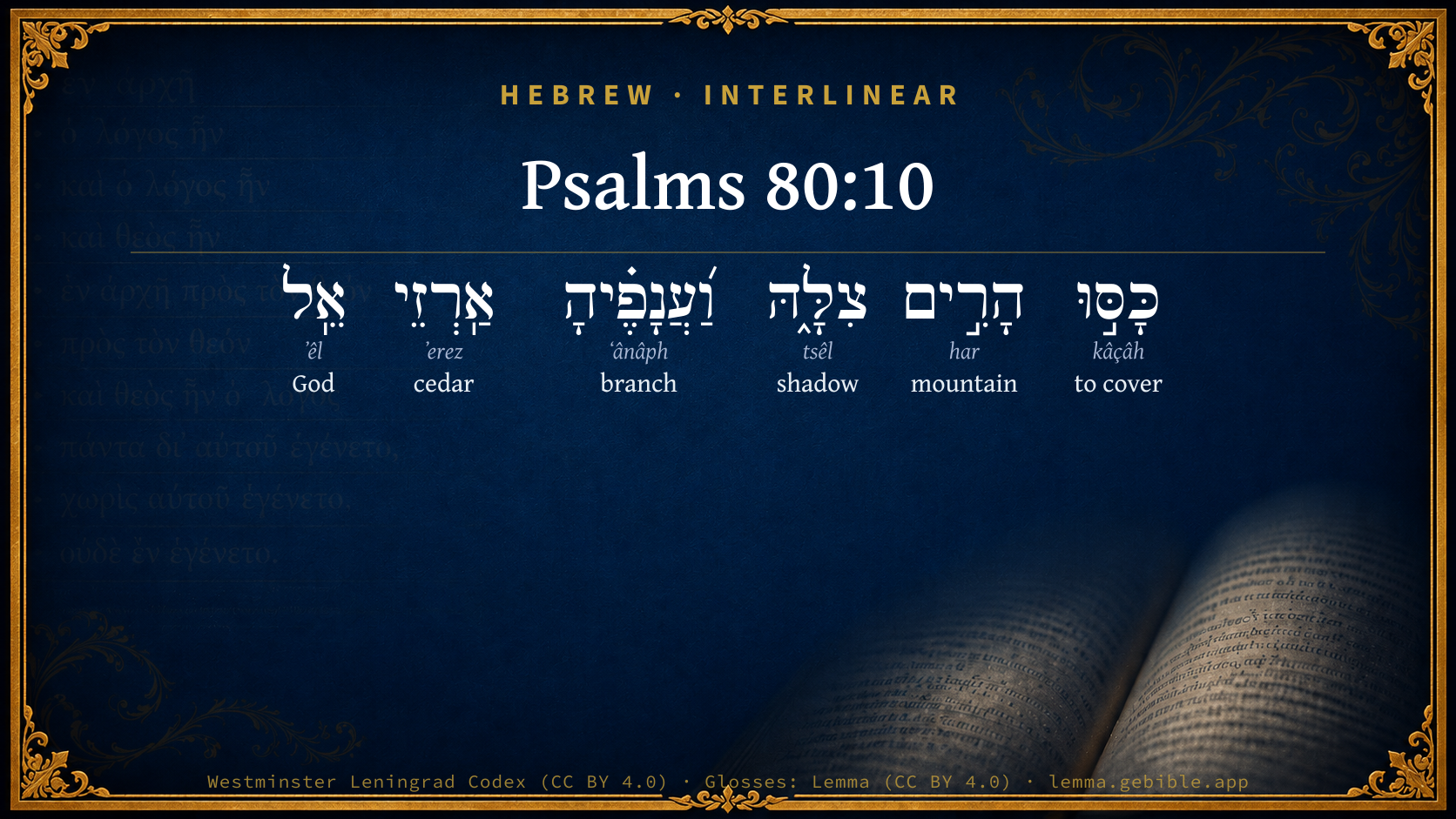
Psalms 80:10

Hebrew (Westminster Leningrad Codex) Psalms 80:10 appears in the Hebrew Old Testament. The text above is from the Westminster Leningrad Codex. Each word links to its Strong’s number, a concise gloss, and parsing drawn from the Open Scriptures Hebrew Bible morphology. Click any word for its full Brown-Driver-Briggs (BDB) entry.
Download image
Cite this verse

Psalms 80:10 (World English Bible). Public Domain. Lemma interlinear Bible study tool, https://lemma.gebible.app/v/psalms/80/10.

Show BibTeX & RIS
BibTeX
RIS
English Translation
The mountains were covered with its shadow. Its boughs were like God's cedars.
World English Bible · Public Domain
Download a study sheet

One document with this verse’s original text, its word-by-word gloss line, the meaning frame, cross-references with their text, attributed commentary, and full source and license credits — printable, and it pastes into notes with its structure intact.

This verse Autodidact and up

Study sheet (.html) Plain text (.txt)

A passage Seminary Student

Up to 50 verses in one chapter. A passage sheet keeps up to 6 commentary sources and 12 cross-references per verse, in the order this page ranks them, and says so on the sheet whenever that leaves anything out. Ask for a single verse and you get the Autodidact verse sheet above.

Everything on this page stays free to read, with no account — the sheet is a download of what is already on screen, not access to it.

Want to remove ads? Support Godless Engineer
Compare translations 3

The same verse in 3 English versions, stacked beneath the original-language interlinear above. Click any original word for its lexicon entry.

Each is an independent rendering of the whole verse — the interlinear is not word-aligned to these translations.

Highlighted words mark where these versions differ — a whole-verse word diff, not a word-by-word alignment.

  • World English Bible Public Domain
    The mountains were covered with its shadow. Its boughs were like God's cedars.
  • King James Version Public Domain
    The hills were covered with the shadow of it, and the boughs thereof were like the goodly cedars.
  • unfoldingWord Literal Text CC BY-SA 4.0
    The mountains were covered its shadow, and its branches cedars of God.

unfoldingWord Literal Text — © unfoldingWord, licensed CC BY-SA 4.0. Word-aligned USFM3 via Door43 (git.door43.org/unfoldingWord/en_ult).

Versions to compare (up to 4)

3 of 4 selected

Show all 18 translations

Every available English version of this verse, each an independent rendering of the whole verse.

  • World English Bible Public Domain
    The mountains were covered with its shadow. Its boughs were like God's cedars.
  • Berean Standard Bible Public Domain
    The mountains were covered by its shade, and the mighty cedars with its branches.
  • Majority Standard Bible Public Domain
    The mountains were covered by its shade, and the mighty cedars with its branches.
  • King James Version Public Domain
    The hills were covered with the shadow of it, and the boughs thereof were like the goodly cedars.
  • American Standard Version (1901) Public Domain
    The mountains were covered with the shadow of it, And the boughs thereof were `like' cedars of God.
  • Revised Version (1885) Public Domain
    The mountains were covered with the shadow of it, and the boughs thereof were like cedars of God.
  • Geneva Bible (1599) Public Domain
    The mountaines were couered with the shadowe of it, and the boughes thereof were like the goodly cedars.
  • Douay-Rheims (1899) Public Domain
    Thou wast the guide of its journey in its sight: thou plantedst the roots thereof, and it filled the land.
  • Young's Literal Translation Public Domain
    Covered have been hills `with' its shadow, And its boughs `are' cedars of God.
  • Literal Standard Version CC BY-SA 4.0
    Hills have been covered [with] its shadow, || And its boughs [are] cedars of God.
  • Unlocked Literal Bible CC BY-SA 4.0
    The mountains were covered with its shade, the cedars of God by its branches.
  • unfoldingWord Literal Text CC BY-SA 4.0
    The mountains were covered its shadow, and its branches cedars of God.
  • Darby Bible Public Domain
    The mountains were covered with its shadow, and the branches thereof were [like] cedars of ùGod;
  • World Messianic Bible Public Domain
    The mountains were covered with its shadow. Its boughs were like God’s cedars.
  • Webster's Bible Public Domain
    \\80:9\\Thou preparedst room before it, and didst cause it to take deep root, and it filled the land.
  • Free Bible Version CC BY-SA 4.0
    The mountains were covered by its shade; its branches covered the great cedars.
  • Bible in Basic English Public Domain
    The mountains were covered with its shade, and the great trees with its branches.
  • JPS Tanakh (1917) Public Domain
    (80-11) The mountains were covered with the shadow of it, and the mighty cedars with the boughs thereof.

Literal Standard Version (2020), Covenant Press — licensed CC BY-SA 4.0. Text via the HelloAO Bible API (eBible.org). Unlocked Literal Bible (unfoldingWord) — licensed CC BY-SA 4.0. Text via the HelloAO Bible API (eBible.org). unfoldingWord Literal Text — © unfoldingWord, licensed CC BY-SA 4.0. Word-aligned USFM3 via Door43 (git.door43.org/unfoldingWord/en_ult). Free Bible Version, Dr. Jonathan Gallagher — licensed CC BY-SA 4.0. Text via the HelloAO Bible API (eBible.org).

Word by word

More ways to search: Search by grammar → Find every occurrence → Compare this word →

Practice this passage: Drill this verse → Learn its vocabulary →

About this verse

These counts appear in no published source. They are computed here, from the morphology-tagged text and Lemma’s own curated glosses. What Lemma adds →

6
words
6
distinct lemmas
Wisdom
section

Notable vocabulary

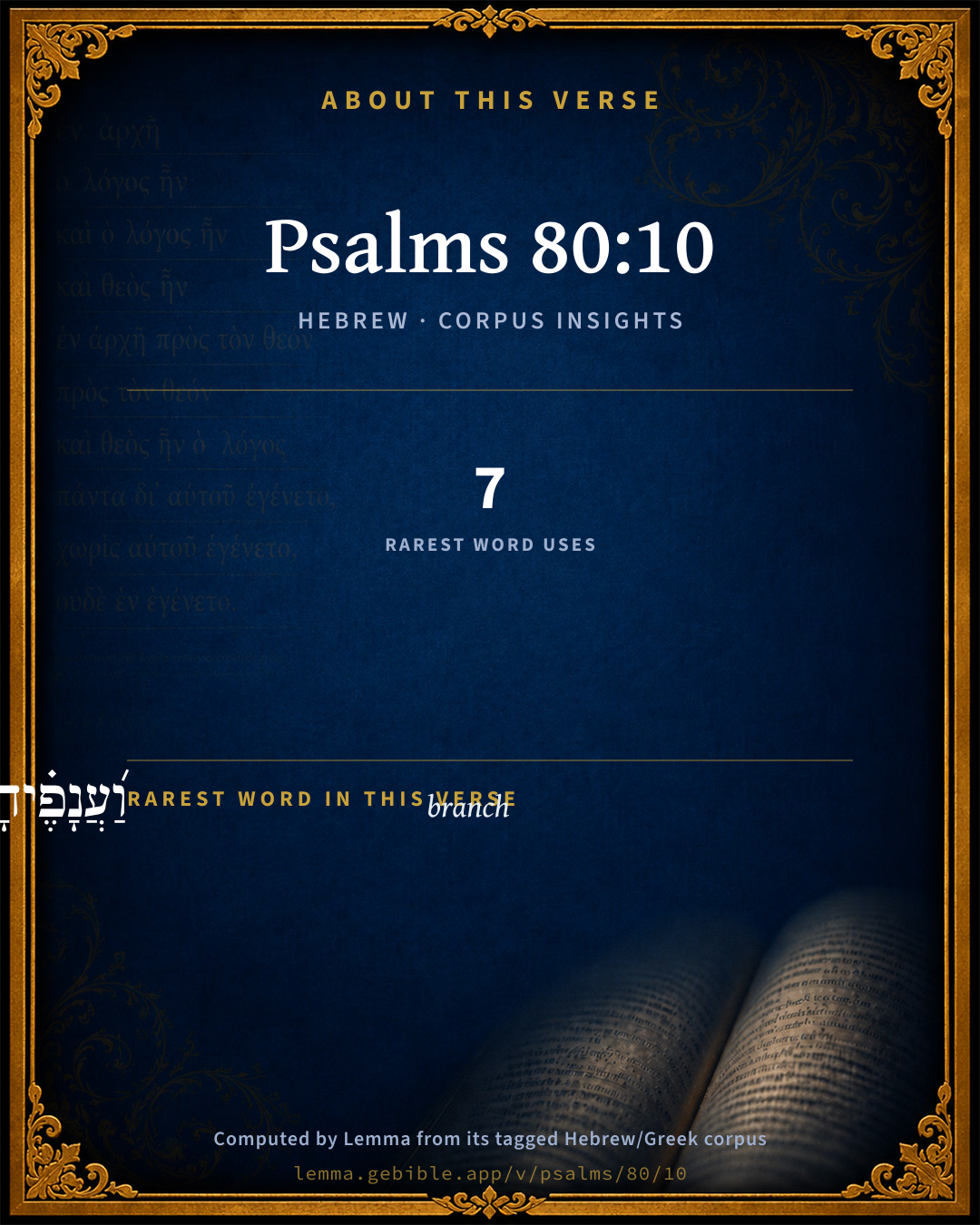
The rarest word here is וַ֝עֲנָפֶ֗יהָ branch H6057 — appearing just 7 times in the whole Hebrew Bible.

Shared distinctive vocabulary

וַ֝עֲנָפֶ֗יהָ branch H6057 occurs in 7 verses of the Hebrew Bible. Also found in:

Grammatical profile

  • 1 verb
  • 5 nouns

Verb forms

  • כָּסּ֣וּ Pual · Perfect

Hebrew & Septuagint length

In English translation the verse runs 13 words from the Hebrew and 12 from the Septuagint (LXX English) — closely comparable.

A rough comparison of the two English renderings, which tokenize alike — not a word-level alignment.

Word counts can differ between the Hebrew and the Greek without any difference in meaning — e.g. the Hebrew direct-object marker אֵת has no separate Greek word, and Greek often adds the article ὁ.

Cross-references

1

Topical passages linked to Psalms 80:10 in the Treasury of Scripture Knowledge — connected by theme and wording, ordered by reader-vote popularity; previews shown in the World English Bible.

  • Psalms 104:16 Yahweh's trees are well watered, The cedars of Lebanon, which he has planted;

Cross-references courtesy of OpenBible.info (CC BY 4.0).

Hebrew and Greek witnesses Masoretic Hebrew ↔ Greek Septuagint

The same verse in the two great witnesses to the Old Testament, shown verse-for-verse.

You’re reading Greek Psalm 79 (Hebrew Psalm 80). The Septuagint counts the superscription, so verse numbers can differ from the Hebrew — chapter-level alignment, not verse-by-verse. Numbering follows Rahlfs.

These are two independent witnesses, not word-aligned to each other, and the Septuagint is shown in lemma (dictionary) form.

Hebrew Psalms 80:10 Masoretic · Westminster Leningrad Codex

כָּסּ֣וּ הָרִ֣ים צִלָּ֑הּ וַ֝עֲנָפֶ֗יהָ אַֽרְזֵי אֵֽל

The mountains were covered with its shadow. Its boughs were like God's cedars.

World English Bible · Public Domain

Greek LXX Greek Psalm 79:10 Septuagint · lemma form

ὁδοποιέω ἔμπροσθεν αὐτός καί καταφυτεύω ὁ ῥίζα αὐτός καί πίμπλημι ὁ γῆ

Its shadow covered the mountains, and its shoots equalled the goodly cedars.

LXX2012 (modern English Septuagint) · Public Domain

On this verse, The Cambridge Bible for Schools and Colleges discusses the Septuagint’s reading. Read the note in Commentary ↓

Hebrew: Westminster Leningrad Codex (CC BY 4.0). Greek: Septuagint (public domain); English from LXX2012 (modern English Septuagint) (Public Domain). How the Septuagint differs from the Hebrew →

Commentary

Notes on Psalms 80:10 from classic Christian and Jewish commentators (each source and its license shown beneath its notes). The classic Christian expositions comment on the surrounding passage and are grouped to its opening verse, so a note may address several verses; the Jewish commentaries on the Tanakh (Rashi and others) are per-verse, so they appear only where the commentator wrote on this verse.

Lemma curates 59 commentaries, every one of them public domain or Creative Commons licensed, each selected and text-cleaned for this edition rather than reprinted as found. About our sources →

Trapp's Complete Commentary

John Trapp

Psa 80:10 The hills were covered with the shadow of it, and the boughs thereof [were like] the goodly cedars.

Ver. 10. The hills were covered, &c.] The Israelites grew amain in wealth, power, and multitude of men; witness their huge armies and valiant acts, though the country was not above 200 miles long, and 50 miles broad.

John Trapp, A Commentary or Exposition upon All the Books of the Old and New Testament (1647–1656) — public domain. Text from a community e-Sword module.

Joseph Benson's Commentary

Psa 80:10-11. The hills were covered with the shadow of it — Its branches extended themselves over all the hills and mountains of Canaan; that is, the people multiplied so much, and became so numerous, that they filled not only the fruitful valleys, but even the barren mountains. And the boughs whereof were like the goodly cedars — Very different from those of ordinary vines, whose boughs are weak and small, and creep upon the walls, on other trees, or on the ground. Israel not only had abundance of men, but those mighty men of valour. She sent out her boughs unto the sea — That is, to the Mediterranean sea; and her branches unto the river — The river Euphrates, alluding to the extent of the Israelitish dominions in the time of David and Solomon.

Joseph Benson's Commentary on the Old and New Testaments (1811–1818) — public domain. Text from a community e-Sword module.

J. A. Alexander on Psalms

Joseph Addison Alexander

11. (Psa 80:10) Covered were the mountains (with) its shadow, and with its branches the cedars of God. This is an amplification and poetical exaggera tion of the last words of Psa 80:9. So completely did it fill the land that its shadow was cast upon the highest hill-tops, and its tendrils overran the loftiest trees. Cedars of God, i.e. in their kind the noblest products of his power, the attribute suggested by (lxe) the divine name here used. See above, on Psa 36:6. Some interpreters suppose the southern range of mountains west of Jordan, sometimes called Mount Judah or the Highlands of Judah, to be here specifically meant and contrasted with the cedars of Lebanon, the northern frontier of the Land of Promise, just as Lebanon and Kadesh are contrasted in Psa 29:5-8. That Lebanon, though not expressly mentioned, is referred to, appears probable from the analogy of Psa 29:5; Psa 92:13; Psa 104:16. The literal fact conveyed by all these figures is the one prophetically stated in Gen 28:14, Deu 11:24, Jos 1:4.

Joseph Addison Alexander, The Psalms Translated and Explained (1850) — public domain. Text from a community e-Sword module.

Tyndale Open Study Notes

Tyndale Open Resources

80:10-11 Solomon’s kingdom had extended west to the Mediterranean Sea and east to the Euphrates River (see 72:8-9; 89:25; 1 Kgs 4:21).

Tyndale Open Study Notes — © Tyndale Open Resources, licensed CC BY-SA 4.0. Text via the HelloAO Bible API.

Geneva Bible (1599)

Geneva Bible translators

Hebrew, cedars of God.

Geneva Bible (1599) marginal notes — public domain. Text via Bolls.life.

Adam Clarke's Commentary

Verse 10. The hills were covered] 6. The vine, carefully cultivated in a suitable soil, may be spread to any extent. In the land of Judea it formed shades under which the people not only sheltered and refreshed themselves in times of sultry heats; but it is said they even ate, drank, and dwelt under the shelter of their vines. See 1Kg 4:25; Mic 4:4; 1Mac 14:12. God so blessed the Jews, particularly in the days of David and Solomon, that all the neighbouring nations were subdued-the Syrians, Idumeans, Philistines, Moabites, and Ammonites.

Adam Clarke's Commentary on the Bible (1810–1826) — public domain. Text from a community e-Sword/MySword module.

Ellicott's Commentary for English Readers

(10) Goodly cedars.—Literally, cedars of God. The branches of the vine are to grow to resemble the luxuriance of the most magnificent of all forest trees.

A Bible Commentary for English Readers, edited by Charles John Ellicott (1878–1897) — public domain. Text from a community e-Sword module.

The Cambridge Bible for Schools and Colleges

gen. ed. J. J. S. Perowne

10. The hills] The mountains.

the goodly cedars] Cedars of God (El), those “which he hath planted,” the indigenous cedars of Lebanon, noblest of forest trees. Cp. “mountains of God” (Psa_36:6). The alternative rendering of R.V. marg., And the cedars of God with the boughs thereof, gives the same sense as the LXX. The vine grew so that it overshadowed the mountainous country to the South, and the cedars of Lebanon on the North, an allusion to the ideal boundaries of the Promised Land, as described in Deu_11:24 (where ‘the wilderness’ = ‘the mountains’ here). That the next verse clearly refers to the Eastern and Western boundaries is an argument in favour of this interpretation.

The Cambridge Bible for Schools and Colleges (gen. ed. J. J. S. Perowne; Cambridge University Press, 1878–1918) — public domain. Text from a community e-Sword module.

John Gill's Exposition

She sent out her boughs unto the sea,.... The Mediterranean, or midland sea, which was the border of the land of Canaan to the west:

and her branches unto the river; the river Euphrates, which was its border to the east; see Deu 11:24. This, in the spiritual sense of it, will have its accomplishment in the church of Christ, when he shall have dominion from sea to sea, and from the river to the ends of the earth, Psa 72:8. The Targum is,

"she sent out her disciples to the great sea, and to the river Euphrates her babes;''

or sucklings.

John Gill's Exposition of the Whole Bible (1746–1763) — public domain (CC PDM 1.0). Text via the HelloAO Bible API.

Albert Barnes' Notes on the Bible

The hills were covered with the shadow of it - That is, It made a shade, by its luxuriant foliage, on the hills in every part of the land; it seemed to cover all the hills.

And the boughs thereof were like the goodly cedars - Margin, as in Hebrew, cedars of God; that is, lofty, majestic cedars. See the notes at Psa 65:9. The reference here is to the cedars of Lebanon, among the most majestic objects known to the Hebrews.

Albert Barnes' Notes on the Bible (1834–1885) — public domain. Text from a community e-Sword/MySword module.

Matthew Poole's English Annotations

They grew so numerous, that they filled not only the fruitful valleys, but even the barren mountains.

Goodly cedars; far differing from ordinary vines, whose boughs are weak and small, and creep upon the walls or ground.

Matthew Poole's English Annotations on the Holy Bible (1683–1685) — public domain. Text from a community e-Sword/MySword module.

The Treasury of David

Charles H. Spurgeon

Ver. 10. "The hills were covered with the shadow of it." Israel dwelt up the mountains' summits, cultivating every foot of soil. The nation multiplied and became so great that other lands felt its influence, or were shadowed by it.

"And the boughs thereof were like the goodly cedars." The nation itself was so great that even its tribes were powerful and worthy to take rank among the mighty. A more correct rendering describes the cedars as covered with the vine, and we know that in many lands vines climb the trees, and cover them. What a vine must that be which ascends the cedars of God, and even overtops them! It is a noble picture of the prosperity of the Israelitish people in their best days. In Solomon's time the little land of Israel occupied a high place among the nations. There have been times when the church of God also has been eminently conspicuous, and her power has been felt far and near.

Ver. 10. "The hills, "etc. That the sides of hills are the most commodious places for vineyards, is sufficiently known; as also that the vine hath props on which it climbs, and rests itself, and that these are lower or higher, according to the nature of the several soils or climates. In fertile soils, as now a days in Lombardy, the vines run up the trees and cover them. And so here with respect to the luxuriant growth of this fruitful vine, it may not unfitly be said, in the poetical style, to run up to and reach the tops of the tall "cedars, "as Joseph is said to be "a fruitful bough, whose branches run over the wall, "Ge 49:22. Thomas Fenton.

Charles H. Spurgeon's The Treasury of David (1869–1885) — public domain. Psalms only. Text from a community e-Sword/MySword module.

The Pulpit Commentary

The hills were covered with the shadow of it. The "hills" intended are probably those of the south the hill country of Judah since the clauses which follow designate the boundaries towards the north, west, and east. (So Hengstenberg, Kay, Professor Cheyne, and others) And the boughs thereof were like the goodly cedars; rather, and the goodly cedar trees were covered with their branches. The cedars of Lebanon are intended. They marked the boundary line on the north. The psalmist calls them "cedars of God," by a strong, but not unprecedented, (Psa_36:6) hyperbole.

The Pulpit Commentary (1880–1919), ed. H.D.M. Spence-Jones & Joseph S. Exell — public domain. Text from a community e-Sword module.

John Wesley's Explanatory Notes

The hills - They filled not only the fruitful valleys, but even the barren mountains.

John Wesley, Explanatory Notes Upon the Whole Bible (1754–1765) — public domain. Text via the GEBible commentary corpus.

Rashi

Rabbi Shlomo Yitzchaki (Rashi)

You cleared before it those dwelling there.

Rashi on the Tanakh — English translations: “The Judaica Press complete Tanach with Rashi, translated by A. J. Rosenberg” (CC BY 4.0); “Pentateuch with Rashi's commentary by M. Rosenbaum and A.M. Silbermann, 1929-1934” (public domain); “The Metsudah Tanach series, Lakewood, N.J” (CC BY 4.0); and “The Book of Joshua, Metsudah Publications, 1997” (CC BY 4.0). Text via Sefaria.

Lesson kit

Teaching starters — assembled from the data on this page, not authored interpretation. Every prompt links to the verse data it draws on. Edit before teaching.

Psalms, in the Wisdom, opens this verse with 6 words (6 distinct Hebrew lemmas). Its most distinctive word is ʻânâph (“branch”). A historical commentator’s framing appears above. Read the whole chapter for the surrounding context.

Discussion questions

  1. What does “branch” (ʻânâph) contribute to the verse as a whole?
  2. How does Leviticus 23:40, which shares the word «branch», read alongside this verse?
  3. These translations render this verse differently. What is at stake in choosing one wording over another?
  4. «כָּסּ֣וּ» is a Pual Perfect verb. How does that grammatical form shape the action described?
  5. Compare how Trapp's Complete Commentary and Joseph Benson's Commentary read this verse. Where do they agree or differ?

Things to notice

Reading settings

Reading text

Shown beneath each verse's original-language words.

Old Testament
Old Testament edition

Read the OT as the Masoretic Hebrew (MT) or the Greek Septuagint (LXX).

English shown for the Greek Septuagint (in the Hebrew ↔ Greek comparison).

Comparing translations? Open the Compare panel on any verse page to stack up to four side by side.