Song of Solomon 5:15

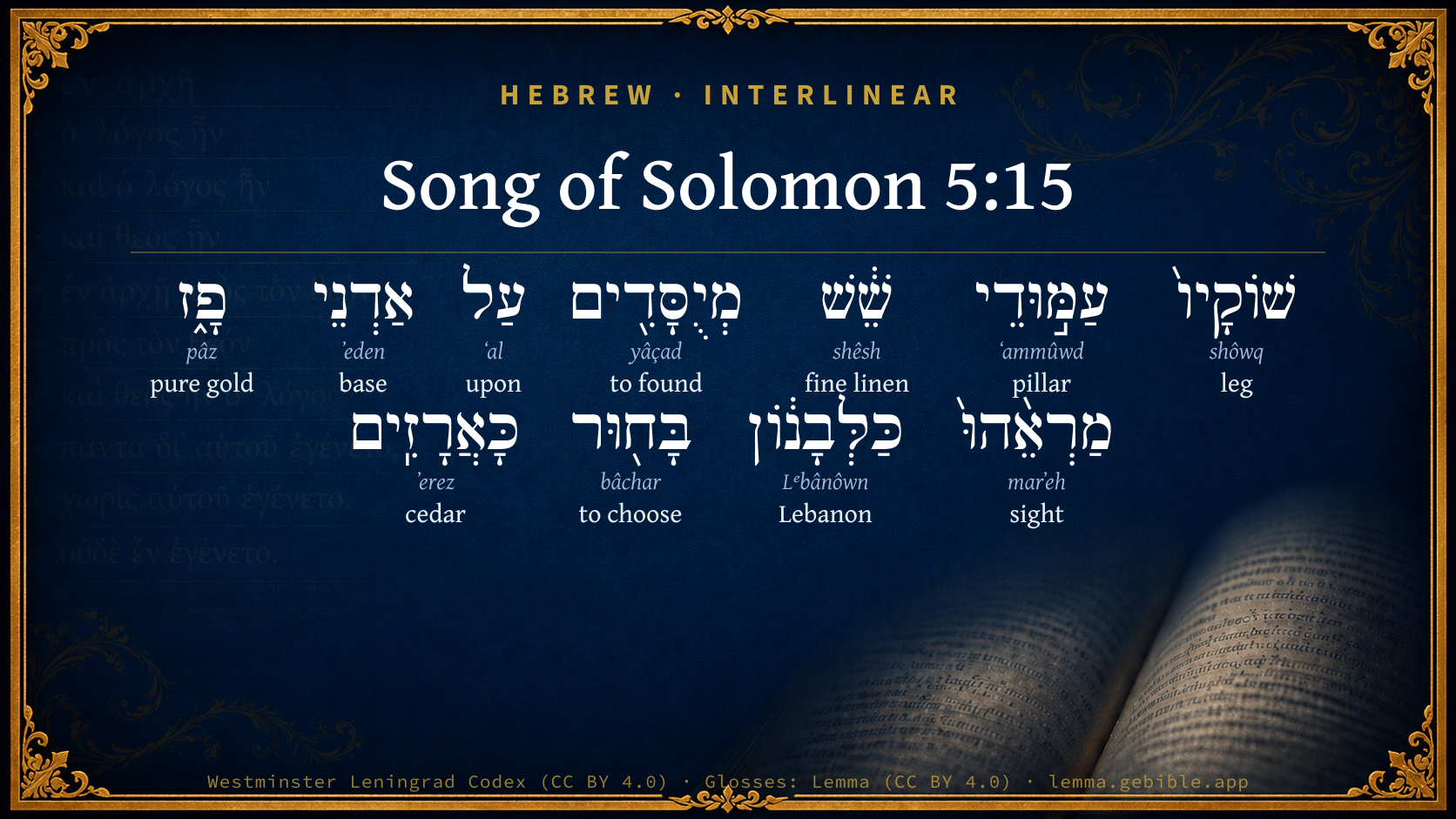
Hebrew (Westminster Leningrad Codex) Song of Solomon 5:15 appears in the Hebrew Old Testament. The text above is from the Westminster Leningrad Codex. Each word links to its Strong’s number, a concise gloss, and parsing drawn from the Open Scriptures Hebrew Bible morphology. Click any word for its full Brown-Driver-Briggs (BDB) entry.
Download image
Cite this verse

Song of Solomon 5:15 (World English Bible). Public Domain. Lemma interlinear Bible study tool, https://lemma.gebible.app/v/song-of-solomon/5/15.

Show BibTeX & RIS
BibTeX
RIS
English Translation
His legs are like pillars of marble set on sockets of fine gold. His appearance is like Lebanon, excellent as the cedars.
World English Bible · Public Domain
Download a study sheet

One document with this verse’s original text, its word-by-word gloss line, the meaning frame, cross-references with their text, attributed commentary, and full source and license credits — printable, and it pastes into notes with its structure intact.

This verse Autodidact and up

Study sheet (.html) Plain text (.txt)

A passage Seminary Student

Up to 50 verses in one chapter. A passage sheet keeps up to 6 commentary sources and 12 cross-references per verse, in the order this page ranks them, and says so on the sheet whenever that leaves anything out. Ask for a single verse and you get the Autodidact verse sheet above.

Everything on this page stays free to read, with no account — the sheet is a download of what is already on screen, not access to it.

Want to remove ads? Support Godless Engineer
Compare translations 3

The same verse in 3 English versions, stacked beneath the original-language interlinear above. Click any original word for its lexicon entry.

Each is an independent rendering of the whole verse — the interlinear is not word-aligned to these translations.

Highlighted words mark where these versions differ — a whole-verse word diff, not a word-by-word alignment.

  • World English Bible Public Domain
    His legs are like pillars of marble set on sockets of fine gold. His appearance is like Lebanon, excellent as the cedars.
  • King James Version Public Domain
    His legs are as pillars of marble, set upon sockets of fine gold: his countenance is as Lebanon, excellent as the cedars.
  • unfoldingWord Literal Text CC BY-SA 4.0
    His thighs pillars of alabaster set on bases of refined gold; his appearance like Lebanon, choice as the cedars.

unfoldingWord Literal Text — © unfoldingWord, licensed CC BY-SA 4.0. Word-aligned USFM3 via Door43 (git.door43.org/unfoldingWord/en_ult).

Versions to compare (up to 4)

3 of 4 selected

Show all 18 translations

Every available English version of this verse, each an independent rendering of the whole verse.

  • World English Bible Public Domain
    His legs are like pillars of marble set on sockets of fine gold. His appearance is like Lebanon, excellent as the cedars.
  • Berean Standard Bible Public Domain
    His legs are pillars of marble set on bases of pure gold. His appearance is like Lebanon, as majestic as the cedars.
  • Majority Standard Bible Public Domain
    His legs are pillars of marble set on bases of pure gold. His appearance is like Lebanon, as majestic as the cedars.
  • King James Version Public Domain
    His legs are as pillars of marble, set upon sockets of fine gold: his countenance is as Lebanon, excellent as the cedars.
  • American Standard Version (1901) Public Domain
    His legs are `as' pillars of marble, set upon sockets of fine gold: His aspect is like Lebanon, excellent as the cedars.
  • Revised Version (1885) Public Domain
    His legs are as pillars of marble, set upon sockets of fine gold: his aspect is like Lebanon, excellent as the cedars.
  • Geneva Bible (1599) Public Domain
    His legges are as pillars of marble, set vpon sockets of fine golde: his countenance as Lebanon, excellent as the cedars.
  • Douay-Rheims (1899) Public Domain
    His legs as pillars of marble, that are set upon bases of gold. His form as of Libanus, excellent as the cedars.
  • Young's Literal Translation Public Domain
    His limbs pillars of marble, Founded on sockets of fine gold, His appearance as Lebanon, choice as the cedars.
  • Literal Standard Version CC BY-SA 4.0
    His limbs pillars of marble, || Founded on sockets of fine gold, || His appearance as Lebanon, choice as the cedars.
  • Unlocked Literal Bible CC BY-SA 4.0
    His legs are pillars of marble, set on bases of pure gold; his appearance is like Lebanon, choice as the cedars.
  • unfoldingWord Literal Text CC BY-SA 4.0
    His thighs pillars of alabaster set on bases of refined gold; his appearance like Lebanon, choice as the cedars.
  • Darby Bible Public Domain
    His legs, pillars of marble, set upon bases of fine gold: His bearing as Lebanon, excellent as the cedars;
  • World Messianic Bible Public Domain
    His legs are like pillars of marble set on sockets of fine gold. His appearance is like Lebanon, excellent as the cedars.
  • Webster's Bible Public Domain
    His legs are as pillars of marble, set upon sockets of fine gold: his countenance is as Lebanon, excellent as the cedars.
  • Free Bible Version CC BY-SA 4.0
    His legs are columns of alabaster set on bases of gold. He looks strong, like the mighty cedars of Lebanon.
  • Bible in Basic English Public Domain
    His legs are as pillars of stone on a base of delicate gold; his looks are as Lebanon, beautiful as the cedar-tree.
  • JPS Tanakh (1917) Public Domain
    His legs are as pillars of marble, set upon sockets of fine gold; his aspect is like Lebanon, excellent as the cedars.

Literal Standard Version (2020), Covenant Press — licensed CC BY-SA 4.0. Text via the HelloAO Bible API (eBible.org). Unlocked Literal Bible (unfoldingWord) — licensed CC BY-SA 4.0. Text via the HelloAO Bible API (eBible.org). unfoldingWord Literal Text — © unfoldingWord, licensed CC BY-SA 4.0. Word-aligned USFM3 via Door43 (git.door43.org/unfoldingWord/en_ult). Free Bible Version, Dr. Jonathan Gallagher — licensed CC BY-SA 4.0. Text via the HelloAO Bible API (eBible.org).

Word by word

More ways to search: Search by grammar → Find every occurrence → Compare this word →

Practice this passage: Drill this verse → Learn its vocabulary →

פָ֑ז
pâz
H6337
“pure gold”
Noun, Common, Masculine, Singular, Absolute
Part of Speech
Noun
Type
Common
Gender
Masculine
Number
Singular
State
Absolute
Full BDB Definition

Origin: from H6338

TWOT: 1753a

refined or pure gold
  1. שׁוֹקָיו֙ shôwq H7785 “legs · his” Noun, Common, Feminine, Dual, Construct + Suffix, Personal, 3rd Person, Masculine, Singular
  2. עַמּ֣וּדֵי ʻammûwd H5982 “pillars of” Noun, Common, Masculine, Plural, Construct
  3. שֵׁ֔שׁ shêsh H8336 “fine linen” Adjective, Cardinal number, Feminine, Singular, Absolute
  4. מְיֻסָּדִ֖ים yâçad H3245 “founded” Verb, Pual, Participle Passive, Masculine, Plural, Absolute
  5. עַל ʻal H5921 “upon” Preposition
  6. אַדְנֵי ʼeden H134 “bases of” Noun, Common, Masculine, Plural, Construct
  7. מַרְאֵ֨הוּ֙ marʼeh H4758 “sight · his” Noun, Common, Masculine, Singular, Construct + Suffix, Personal, 3rd Person, Masculine, Singular
  8. כַּלְּבָנ֔וֹן Lᵉbânôwn H3844 “like/as the · Lebanon” Preposition, Determined + Noun, Proper
  9. בָּח֖וּר bâchar H977 “chosen” Verb, Qal, Participle Passive, Masculine, Singular, Absolute
  10. כָּאֲרָזִֽים ʼerez H730 “like/as the · cedars” Preposition, Determined + Noun, Common, Masculine, Plural, Absolute

About this verse

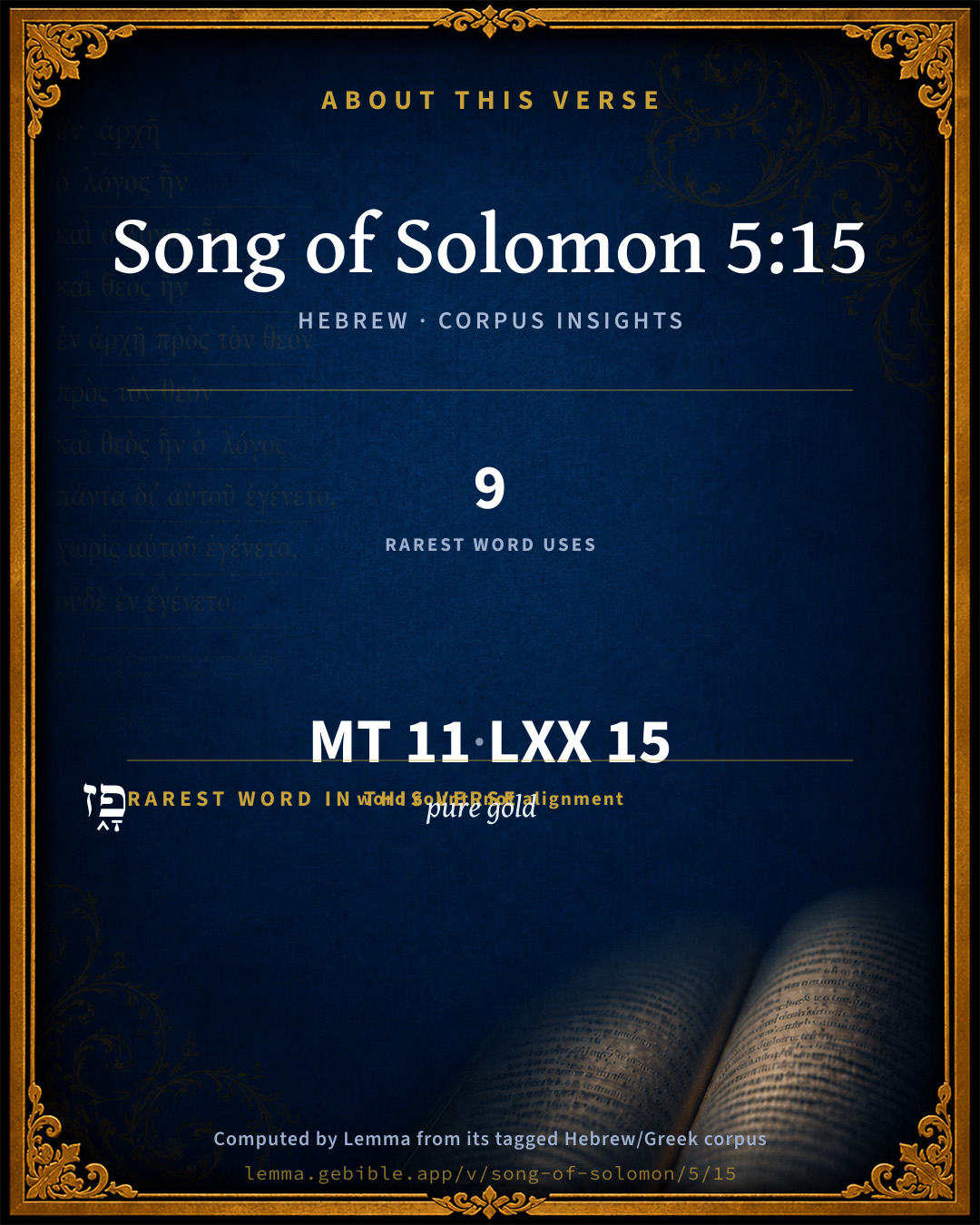
These counts appear in no published source. They are computed here, from the morphology-tagged text and Lemma’s own curated glosses. What Lemma adds →

11
words
11
distinct lemmas
Wisdom
section

Notable vocabulary

The rarest word here is פָ֑ז pure gold H6337 — appearing just 9 times in the whole Hebrew Bible.

Shared distinctive vocabulary

פָ֑ז pure gold H6337 occurs in 9 verses of the Hebrew Bible. Also found in:

Grammatical profile

  • 2 verbs
  • 7 nouns
  • 1 adjective
  • 1 preposition

Verb forms

  • מְיֻסָּדִ֖ים Pual · Participle Passive
  • בָּח֖וּר Qal · Participle Passive

Hebrew & Septuagint length

In English translation the verse runs 22 words from the Hebrew and 18 from the Septuagint (LXX English) — closely comparable.

A rough comparison of the two English renderings, which tokenize alike — not a word-level alignment.

Word counts can differ between the Hebrew and the Greek without any difference in meaning — e.g. the Hebrew direct-object marker אֵת has no separate Greek word, and Greek often adds the article ὁ.

In the original languages it is 11 Hebrew tokens and 15 Greek tokens — but the two are counted differently (Hebrew bundles its prefixes and suffixes into one token; the Greek is in lemma form), so that isn’t a like-for-like length.

Cross-references

14

Topical passages linked to Song of Solomon 5:15 in the Treasury of Scripture Knowledge — connected by theme and wording, ordered by reader-vote popularity; previews shown in the World English Bible.

  • 1 Kings 4:33 He spoke of trees, from the cedar that is in Lebanon even to the hyssop that springs out of the wall; he spoke also of animals, and of birds, and of creeping things, and of fish.
  • Revelation 1:15–16 His feet were like burnished brass, as if it had been refined in a furnace. His voice was like the voice of many waters.
  • Exodus 26:19 You shall make forty sockets of silver under the twenty boards; two sockets under one board for its two tenons, and two sockets under another board for its two tenons.
  • Judges 13:6 Then the woman came and told her husband, saying, A man of God came to me, and his face was like the face of the angel of God, very awesome; and I didn't ask him whence he was, neither did he tell me his name:
  • Psalms 92:12 The righteous shall flourish like the palm tree. He will grow like a cedar in Lebanon.
  • Song of Solomon 2:14 My dove in the clefts of the rock, In the hiding places of the mountainside, Let me see your face. Let me hear your voice; For your voice is sweet, and your face is lovely.
  • Song of Solomon 4:11 Your lips, my bride, drip like the honeycomb. Honey and milk are under your tongue. The smell of your garments is like the smell of Lebanon.
  • Song of Solomon 7:4 Your neck is like an ivory tower. Your eyes are like the pools in Heshbon by the gate of Bath-rabbim; Your nose is like the tower of Lebanon which looks toward Damascus.
  • Hosea 14:7 Men will dwell in his shade. They will revive like the grain, And blossom like the vine. Their fragrance will be like the wine of Lebanon.
  • Zechariah 9:17 For how great is his goodness, And how great is his beauty! Grain will make the young men flourish, And new wine the virgins.
  • Matthew 17:2 He was transfigured before them. His face shone like the sun, and his garments became as white as the light.
  • Matthew 28:3 His appearance was like lightning, and his clothing white as snow.
  • Acts 2:28 You made known to me the ways of life. You will make me full of gladness with your presence.'
  • 1 Timothy 3:16 Without controversy, the mystery of godliness is great: God was revealed in the flesh, Justified in the spirit, Seen by angels, Preached among the nations, Believed on in the world, And received up in glory.

Cross-references courtesy of OpenBible.info (CC BY 4.0).

Hebrew and Greek witnesses Masoretic Hebrew ↔ Greek Septuagint

The same verse in the two great witnesses to the Old Testament, shown verse-for-verse.

These are two independent witnesses, not word-aligned to each other, and the Septuagint is shown in lemma (dictionary) form.

Hebrew Song of Solomon 5:15 Masoretic · Westminster Leningrad Codex

שׁוֹקָיו֙ עַמּ֣וּדֵי שֵׁ֔שׁ מְיֻסָּדִ֖ים עַל אַדְנֵי פָ֑ז מַרְאֵ֨הוּ֙ כַּלְּבָנ֔וֹן בָּח֖וּר כָּאֲרָזִֽים

His legs are like pillars of marble set on sockets of fine gold. His appearance is like Lebanon, excellent as the cedars.

World English Bible · Public Domain

Greek LXX Song of Solomon 5:15 Septuagint · lemma form

κνήμη αὐτός στῦλος μαρμάρινος θεμελιόω ἐπί βάσις χρυσοῦς εἶδος αὐτός ὡς λίβανος ἐκλεκτός ὡς κέδρος

His legs are marble pillars set on golden sockets: his form is as Libanus, choice as the cedars.

LXX2012 (modern English Septuagint) · Public Domain

On this verse, The Cambridge Bible for Schools and Colleges discusses the Septuagint’s reading. Read the note in Commentary ↓

Hebrew: Westminster Leningrad Codex (CC BY 4.0). Greek: Septuagint (public domain); English from LXX2012 (modern English Septuagint) (Public Domain). How the Septuagint differs from the Hebrew →

Commentary

Notes on Song of Solomon 5:15 from classic Christian and Jewish commentators (each source and its license shown beneath its notes). The classic Christian expositions comment on the surrounding passage and are grouped to its opening verse, so a note may address several verses; the Jewish commentaries on the Tanakh (Rashi and others) are per-verse, so they appear only where the commentator wrote on this verse.

Lemma curates 59 commentaries, every one of them public domain or Creative Commons licensed, each selected and text-cleaned for this edition rather than reprinted as found. About our sources →

Trapp's Complete Commentary

John Trapp

Son 5:15 His legs [are as] pillars of marble, set upon sockets of fine gold: his countenance [is] as Lebanon, excellent as the cedars.

Ver. 15. His legs are as pillars of marble.] A sign of Christ’s firmness in his kingdom, works, word, and government, saith a learned expositor, and of his strength to trample upon his enemies, as also of his united power to accomplish the course of his threefold office. Pillars both bear up the building and beautify it; neither can anything be more sure and solid than these, if set upon a firm foundation. The pillars here mentioned are said to be "set upon fine gold" - that is, upon a foundation both fine and firm, for gold hardly rusteth or cankereth; whence it was likely that Tithonus and his son Memnon, when they built the city of Susa, in Persia, they joined the stones together with gold, as Cassiodorus writeth: Christ’s power is founded upon his divine nature; and this is the rock upon which the Church is built, and whereby it is set in safety from all miseries and molestations, satanic or secular. The gates of hell shall not prevail against her. Christ and the father are one; therefore none shall take her out of his hands. God hath "laid help upon one that is mighty," {Psa 89:19} even upon Emmanuel, the mighty strong God, as he is called, {Isa 9:6} "declared to be the Son of God with power according to the spirit of holiness, by the resurrection from the dead," {Rom 1:4} that your "faith and hope might be in God." {1Pe 1:21} Trust perfectly therefore to, or hope to the end, {a} "for the grace that is to be brought unto you at the revelation of Jesus": {1Pe 1:13} since he is "able to save them to the uttermost that come unto God by him." {Heb 7:25}

His countenance is as Lebanon.] His aspect, his look, or general view - i.e., whatsoever of himself Christ is pleased to manifest and lay open unto us is pleasant and delightful, goodly and glorious, excellent and eximious, choice as the cedars, that are chosen before other trees; and why? {See Trapp on "Son 1:17"}

{a} Eις το παντελες. Prorsus, perpetuo, perfecte.

John Trapp, A Commentary or Exposition upon All the Books of the Old and New Testament (1647–1656) — public domain. Text from a community e-Sword module.

Tyndale Open Study Notes

Tyndale Open Resources

5:15 Lebanon was to the north of Israel and contained legendary cedar trees that were large, stately, and pleasantly fragrant.

Tyndale Open Study Notes — © Tyndale Open Resources, licensed CC BY-SA 4.0. Text via the HelloAO Bible API.

Adam Clarke's Commentary

Verse 15. His legs are as pillars of marble] Exquisitely turned and well-shaped; the sockets of gold may refer to his slippers. On these a profusion of gold and ornaments are still lavished in Asiatic countries.

His countenance is as Lebanon] As Lebanon exalts its head beyond all the other mountains near Jerusalem, so my beloved is tall and majestic, and surpasses in stature and majesty all other men. He is also as straight and as firm as the cedars.

Adam Clarke's Commentary on the Bible (1810–1826) — public domain. Text from a community e-Sword/MySword module.

Ellicott's Commentary for English Readers

(15) Marble.—Heb. shesh. Here and in Est_1:6.

A Bible Commentary for English Readers, edited by Charles John Ellicott (1878–1897) — public domain. Text from a community e-Sword module.

The Cambridge Bible for Schools and Colleges

gen. ed. J. J. S. Perowne

15. His legs] Heb. shôq is the part of the leg below the knee.

pillars of marble] i.e. white and firm like marble or alabaster. Here, seeing the lover is an Oriental, and therefore brown in complexion, alabaster would be the better comparison.

sockets] Perhaps rather, bases of fine gold.

his countenance] his aspect is like Lebanon, giving the same impression of majesty.

excellent] Heb. bâchûr = ‘chosen,’ LXX, ἐκλεκτός. The Targum translates it “a young man,” but in that case we should have had ‘a cedar,’ not ‘cedars.’ Goodly as the cedars would fairly give the sense.

The Cambridge Bible for Schools and Colleges (gen. ed. J. J. S. Perowne; Cambridge University Press, 1878–1918) — public domain. Text from a community e-Sword module.

Albert Barnes' Notes on the Bible

His countenance - Or, his appearance (his whole port and mien, but especially head and countenance) “is as the Lebanon.”

Albert Barnes' Notes on the Bible (1834–1885) — public domain. Text from a community e-Sword/MySword module.

Matthew Poole's English Annotations

His legs; the instruments of local motion, and the supporters of the body.

As pillars of marble; white, and straight, and well shaped, and strong; which may note the firmness and stability of Christ’s kingdom in spite of all opposition.

Set upon sockets of fine gold; which add both beauty and strength to them. These may note his feet compared to gold, either for their great price and worth, or for their singular brightness, for which they are compared to fine brass, Rev 1:15; or, as others, for his golden shoes, wherewith they were covered or adorned, as the spouse is commended from her shoes, Son 7:1.

His countenance, Heb. his aspect or appearance; his form or person, as this Hebrew word is elsewhere used.

As Lebanon, in respect of its cedars, as the next words explain it, to wit, tall, and upright, and stately, and withal pleasant to the eye.

Matthew Poole's English Annotations on the Holy Bible (1683–1685) — public domain. Text from a community e-Sword/MySword module.

Whedon's Commentary on the Bible

Daniel D. Whedon

15. His legs — Hebrew, The calves of his legs.

Sockets — Better, pedestals.

His countenance — Literally, His appearance; that is, his whole mien and bearing. The general impression of his stature is like that of “that goodly mountain, even Lebanon,” which, rising to ten thousand feet, always, in sun-shine or in storm, was the Jewish ideal of lofty majesty.

And as Lebanon wears its cedars, unconscious of the crown they give it, so the Beloved bears himself, nobly unaware of the perfect, comeliness of his features.

Daniel D. Whedon (gen. ed.), Commentary on the Old and New Testaments (1874–1909) — public domain. Text from a community e-Sword module.

John Wesley's Explanatory Notes

Marble - White, and strait, and well shaped and strong. Gold - His feet are compared to gold, for their singular brightness, for which they are compared to fine-brass, Rev. i, 15. Countenance - Hebrew. his aspect or appearance, his form or person. Lebanon - In respect of its cedars, tall, and upright, and stately.

John Wesley, Explanatory Notes Upon the Whole Bible (1754–1765) — public domain. Text via the GEBible commentary corpus.

unfoldingWord translationNotes

Door43 World Missions Community

General Information:

The woman continues to describe the man.

His legs are pillars of marble, set on bases of pure gold

Marble and gold are strong and beautiful. (See: Metaphor)

marble

a very strong stone that has many different colors and that people polish to make very smooth

his appearance is like Lebanon

"he looks like Lebanon." Lebanon was a very beautiful area with many mountains and cedar trees. (See: Simile)

translationWords

column

gold

like

Lebanon

cedar

unfoldingWord translationNotes — © Distant Shores Media and the Door43 World Missions Community, licensed CC BY-SA 4.0. Source: git.door43.org/Door43/en_tn.

Rashi

Rabbi Shlomo Yitzchaki (Rashi)

His legs are as pillars of marble, founded upon sockets of fine gold.

pillars of marble Heb. שֵּׁשּׁ, pillars of marble, שַּׁיִשּׁ, and a similar word appears in Megillath Esther (1:6): “on silver rods and marble (שֵּׁשּׁ) columns,” and his appearance is as tall as the cedars of the Lebanon.

chosen as the cedars chosen among the sons as the cedar among the other trees.

Rashi on the Tanakh — English translations: “The Judaica Press complete Tanach with Rashi, translated by A. J. Rosenberg” (CC BY 4.0); “Pentateuch with Rashi's commentary by M. Rosenbaum and A.M. Silbermann, 1929-1934” (public domain); “The Metsudah Tanach series, Lakewood, N.J” (CC BY 4.0); and “The Book of Joshua, Metsudah Publications, 1997” (CC BY 4.0). Text via Sefaria.

Lesson kit

Teaching starters — assembled from the data on this page, not authored interpretation. Every prompt links to the verse data it draws on. Edit before teaching.

Song of Solomon, in the Wisdom, opens this verse with 11 words (11 distinct Hebrew lemmas). Its most distinctive word is pâz (“pure gold”). A historical commentator’s framing appears above. Read the whole chapter for the surrounding context.

Discussion questions

  1. What does “pure gold” (pâz) contribute to the verse as a whole?
  2. Job 28:17 shares the word «pure gold» with this verse. How do the two illuminate each other?
  3. These translations render this verse differently; the difference is in the English rendering, not the original. What questions does that raise?
  4. The verb «מְיֻסָּדִ֖ים» is Pual Participle Passive. How does its form color the action?
  5. Reading how Trapp's Complete Commentary and Tyndale Open Study Notes read this verse, where do the two commentators agree and where do they part?

Things to notice

Reading settings

Reading text

Shown beneath each verse's original-language words.

Old Testament
Old Testament edition

Read the OT as the Masoretic Hebrew (MT) or the Greek Septuagint (LXX).

English shown for the Greek Septuagint (in the Hebrew ↔ Greek comparison).

Comparing translations? Open the Compare panel on any verse page to stack up to four side by side.