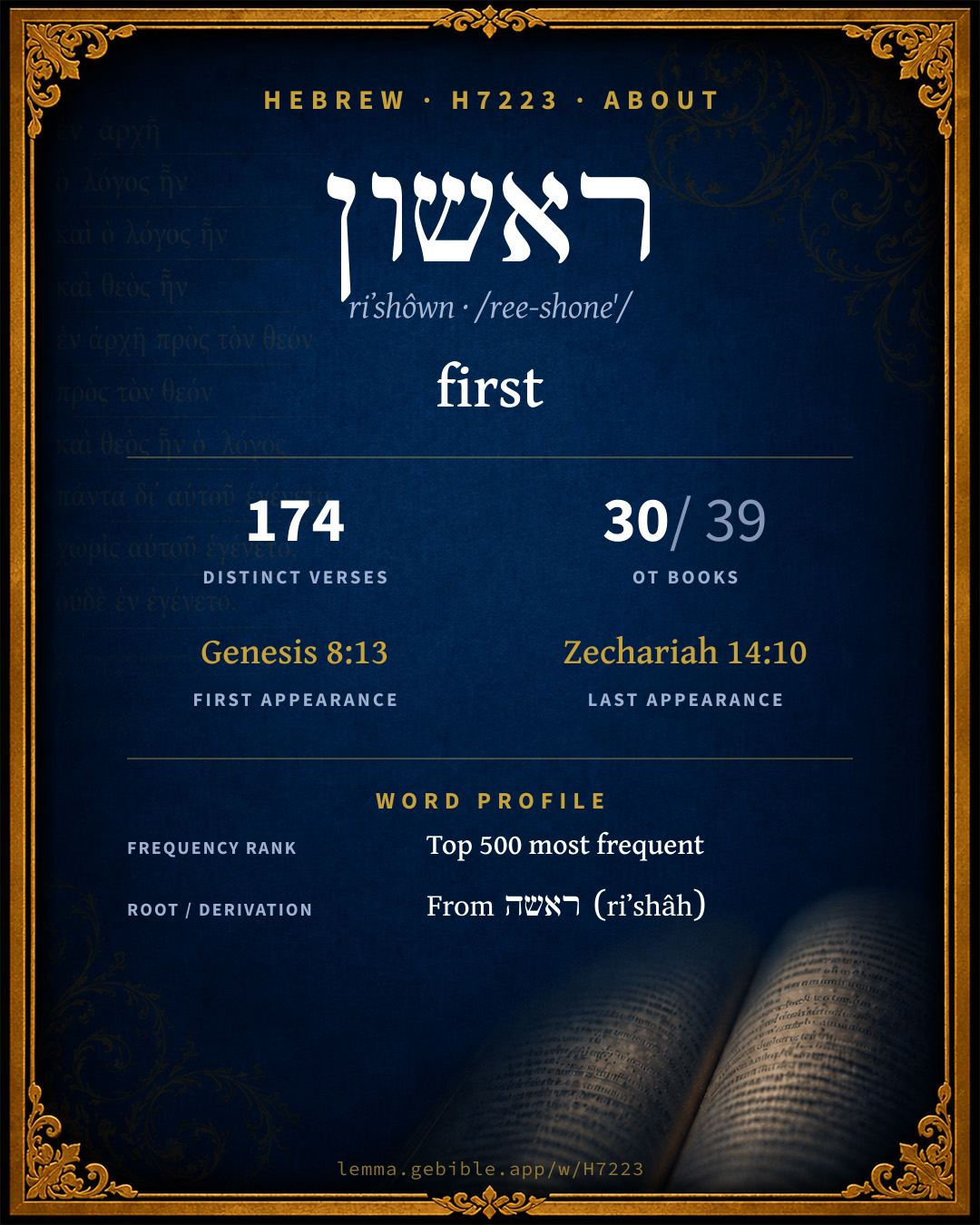
רִאשׁוֹן
first
also: primary, former fuller range ↓
Full lexicon entry — Brown-Driver-Briggs (BDB)
From Brown-Driver-Briggs (BDB)
Where this word appears
Grammar key — what these labels mean
Part of speech
- Adjective
- A word that describes or qualifies a noun.
State
- Absolute
- The independent form of a noun, not bound to a following word.
Gender
- Masculine
- Grammatically masculine.
- Feminine
- Grammatically feminine.
Number
- Singular
- One.
- Plural
- More than one (in Hebrew, generally three or more).
Every verse where H7223 appears in the Book of Joshua — 5 distinct verses. Click any verse to open its interlinear word-by-word view. Verse text shown in the World English Bible for context — . Each verse’s Hebrew form is shown with its reference; the English is not keyword-highlighted, since the data carries no word-level English alignment. Use “Compare translations” on any verse to read it across multiple English versions. This concordance covers the Hebrew Bible; Septuagint (Greek Old Testament) occurrences are not indexed here.
Joshua
- Joshua 4:19 הָ/רִאשׁ֑וֹן ptcl def.art + Adjective Ordinal number ms The people came up out of the Jordan on the tenth day of the first month, and encamped in Gilgal, on the east border of Jericho.
- Joshua 8:5 בָּ/רִֽאשֹׁנָ֔ה prep det + Adjective Adjective fs and I, and all the people who are with me, will approach to the city. It shall happen, when they come out against us, as at the first, that we will flee before them;
- Joshua 8:6 בָּ/רִֽאשֹׁנָ֑ה prep det + Adjective Adjective fs and they will come out after us, until we have drawn them away from the city; for they will say, They flee before us, as at the first: so we will flee before them;
- Joshua 8:33 בָּ/רִאשֹׁנָֽה prep det + Adjective Adjective fs All Israel, and their elders and officers, and their judges, stood on this side of the ark and on that side before the priests the Levites, who bore the ark of the covenant of Yahweh, as well the foreigner as the native; half of them in front of Mount Gerizim, and half of them in front of Mount Ebal; as Moses the servant of Yahweh had commanded at the first, that they should bless the people of Israel.
- Joshua 21:10 רִיאשֹׁנָֽה adj Ordinal number fs and they were for the children of Aaron, of the families of the Kohathites, who were of the children of Levi; for theirs was the first lot.
About this entry
At a glance — auto-summarized from this page’s data, not written by a person. Every figure links to its source below. This summary describes the numbers; it doesn’t interpret them.
At its core, ראשון (riʼshôwn) means “first.” It first appears in Genesis 8:13. Spanning 174 verses in 30 books, it ranks among the common words of the Hebrew Bible. Beyond its headline sense, its full sense range takes in “primary” and “former”. Sharing its root, it stands alongside ראשה and ראשני. Dig into 174-verse concordance and the renderings breakdown below.
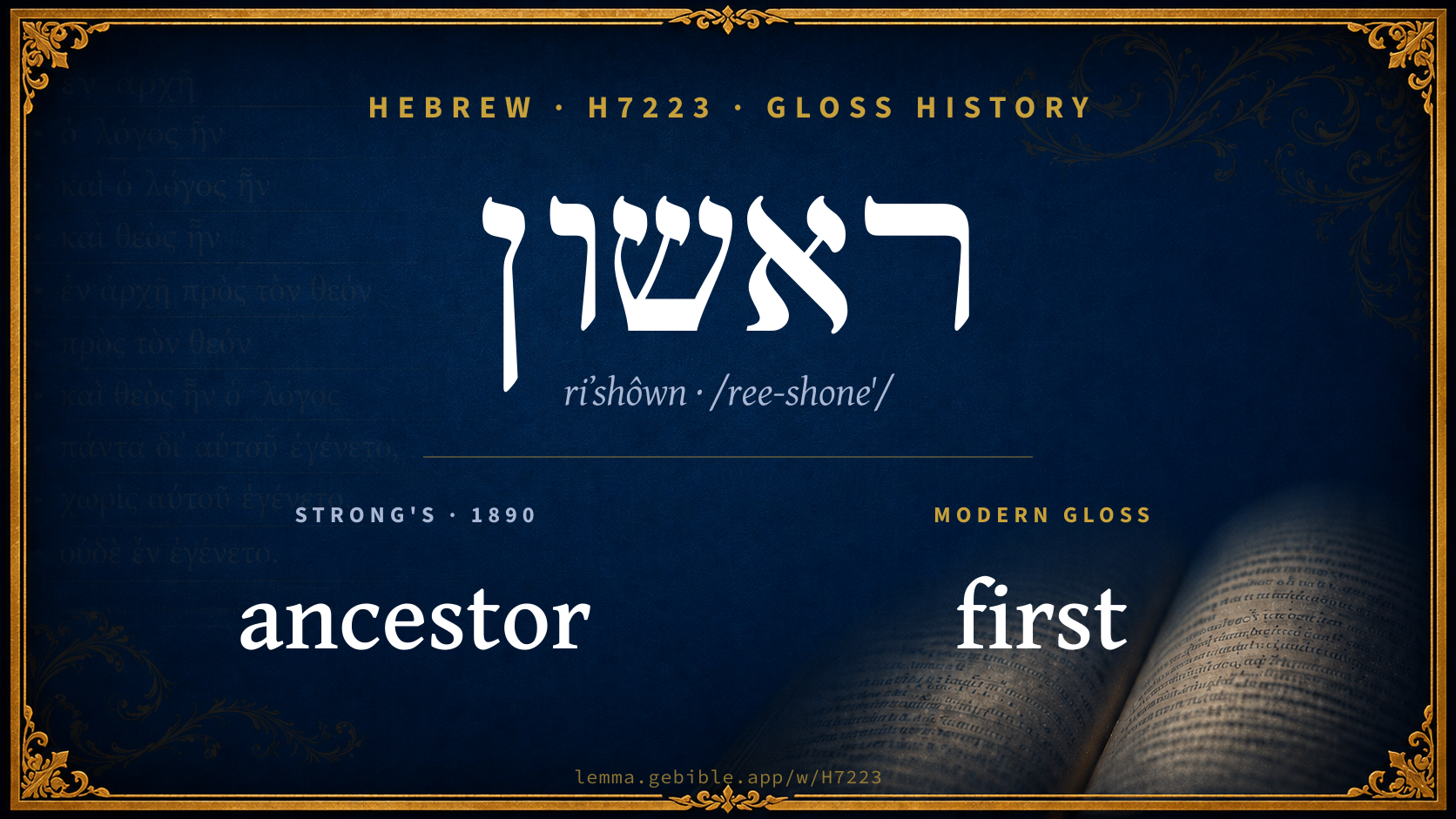
Gloss history
Strong's 1890 vs modern scholarship
About this word
Strong's H7223 catalogs a Hebrew word from the Hebrew Old Testament.
These counts are not copied from any lexicon or concordance. They are computed here, from the morphology-tagged Hebrew Old Testament. What Lemma adds →
- 174
- distinct verses
- The word appears in 174 distinct verses.
- 30 / 39
- OT books
- The word appears in 30 of 39 Old Testament books.
- #257
- by frequency
- Top 500 most frequent Hebrew words (rank 257 of 8,640 Hebrew words by occurrence).
View all 174 occurrences in the concordance →
Most concentrated in
- Isaiah 19 verses 11%
- 2 Chronicles 14 verses 8%
- Numbers 12 verses 7%
By section of the Old Testament
By traditional corpus
Conventional, traditional groupings — biblical authorship is debated, so this is a traditional corpus grouping, not an authorship claim. Each share is this word’s portion of its verses in that division of the Hebrew canon. Each figure is a share of the word’s 174 distinct verses.
- Prophets (Nevi'im) 70 verses · 40%
- Torah (Pentateuch) 52 verses · 30%
- Writings (Ketuvim) 52 verses · 30%
How translations render this word
Counts come from each version’s own published word-to-Strong’s tagging or interlinear alignment — an approximate guide to how each version renders this word, not a word-level alignment the data otherwise carries. Because each total is that version’s own tagged count, the per-version totals vary from one another and need not match the appearance or distinct-verse counts above. These counts may also differ from a printed concordance because Lemma counts each distinctly tagged rendering and does not collapse phrase taggings into a single head-word total. This is a fixed set of word-tagged versions (KJV, ASV, BSB, ULT) and does not change with the reading translation you choose elsewhere. Each version’s license is shown beside its name below (and on Sources).
- King James Version: First 91×, Former 14×, Day of the first 8×
- American Standard Version: First 85×, Former 15×, Day of the first 7×
- Berean Standard Bible: First 75×, Beginning 10×, Former 8×
- unfoldingWord Literal Text: First 114×, Former 24×, First things 8×
King James Version Public Domain
Renders H7223 across 182 tagged occurrences — most commonly:
Plus 42 renderings that appear only once — usually multi-word phrases or single function words the recovered tagging swept in, not distinct renderings. Not rendered by a distinct English word in 3 further occurrences.
American Standard Version Public Domain
Renders H7223 across 181 tagged occurrences — most commonly:
Plus other, less common renderings. Plus 47 renderings that appear only once — usually multi-word phrases or single function words the recovered tagging swept in, not distinct renderings.
Berean Standard Bible Public Domain
Renders H7223 across 171 tagged occurrences — most commonly:
Plus other, less common renderings. Plus 36 renderings that appear only once — usually multi-word phrases or single function words the recovered tagging swept in, not distinct renderings. Not rendered by a distinct English word in 10 further occurrences.
unfoldingWord Literal Text CC BY-SA 4.0
Renders H7223 across 188 tagged occurrences — most commonly:
Plus 18 renderings that appear only once — usually multi-word phrases or single function words the recovered tagging swept in, not distinct renderings.
8 senses and sub-senses in the full BDB
What do BDB’s symbols mean?
BDB uses these scholarly abbreviations:
| Symbol | Meaning |
|---|---|
| 𝔊 | the Septuagint (the ancient Greek translation, LXX) |
| 𝔙 | the Vulgate (the Latin translation) |
| 𝔖 | the Syriac version (the Peshitta) |
| 𝔗 | the Targum (the Aramaic translation) |
| ψ | the Psalms |
| √ | root (the underlying root or stem) |
| ‖ | parallel passage (a synonymous or contrasted parallel) |
| † | the dagger: every passage where the word occurs is cited |
The 8 senses and sub-senses the full Brown-Driver-Briggs lexicon distinguishes for this word, in lexicon order (not ranked by frequency), with BDB’s own verbatim wording and sub-sense lettering. Shown in Hebrew script with BDB’s own scholarly abbreviations. The condensed entry is in the Lexicon Entry tab. See also the Forms in the corpus table below.
- 1. former:
- a. in time, former of two Gn 25:25 (J), 41:20 (E), Dt 10:1, 2, 3, 4, 10; 24:4, cf. Ho 2:9; Lv 4:21; 9:15 (both P), Ju 20:39; 2 K 1:14; Hg 2:3, 9; Ezr 3:12 +; more gen. former, previous, Nu 21:26 (JE), Mi 4:8; 2 K 17:34, 40; Zc 1:4; 7:7, 12; 8:11; Ne 5:15; Ec 17:10 ψ 79:8 +; כָּעֵת הָר׳ Is 8:23; דִּבְרֵי דויד הָר׳ †1 Ch 29:29 the doings of David, the former and the latter (הָאַחֲרֹנִים), cf. †2 Ch 9:29; 12:15; 16:11; 20:34; 25:26; 26:22; 28:26; 35:27; early days of harvest 2 S 21:9; רִאשֹׁנִים as subst., former persons, ancestors, men of old, Dt 19:14; Lv 26:45 (H), Ec 1:11 (opp. אַחֲרֹנִים); (הָ)רִאשֹׁנוֹת as subst. the former things, i.e. past events Is 41:22; 43:9, 18; 46:9; 48:3, earlier predictions 42:9. e.g. Genesis 25:25
- b. loc., foremost, of two 2 S 18:27. e.g. 2 Samuel 18:27
- 2. first:
- a. in time, הַמַּכָּה הָר׳ 1 S 14:14 the first slaughter (prelim. to general carnage); וְלֹא־הָיָה דְּבָרִי ר׳ 2 S 19:44 was not my word first? ר׳ in appos. with pers. subj. †2 S 19:21 I am come as first, cf. perhaps Is 41:27 (ins. אָמַרְתִּי Ges De הִגַּדְתִּים for הִנֵּה הִנָּם, CheHpt KitDi), and הָר׳ Je 50:17 (opp. הָאַחֲרוֹן), Is 43:27; ר׳ abs., first of mankind Jb 15:17; abs. of י׳, I (am the) first Is 41:4 (+ אֶת־ אַחֲרֹנִים), + אַחֲרוֹן 44:6; 48:12; abs. of time, מֵרִאשׁוֹן Je 17:12 from the beginning; especially first of a def. series (sometimes opp. אַחֲרוֹן), first day of feast Dt 16:4; Ex 12:15(×2), 16 + 5 times P (H), Ne 8:18; usually first month (חֹדֶשׁ) Ex 40:2, 17; Lv 23:5 + 6 times P, 1 Ch 12:16 (van d. H. v 15) + 10 times Ch Ezr, Est 3:7; Dn 10:4, חֹדֶשׁ om. Gn 8:13; Ex 12:2, 18; Nu 9:5 (all P) Ez 29:17; 30:20; 45:18, 21, so Jo 2:23, but read כָּרִאשׁוֹנָה (3 a) 𝔊 𝔖 We Now and Dr. e.g. 1 Samuel 14:14
- b. first in degree, chief: יַד הַשָּׁרִים … רִאשׁוֹנָה Ezr 9:2 the hand of the princes … has been first in this trespass; 1 Ch 18:17; Dn 10:13 (cf. Est 1:14 infr.). e.g. Ezra 9:2
- 3.
- a. fem. c. prep. as adv.; phr.: (1) of time, בָּרִאשֹׁנָה Gn 13:4 (J), = before, formerly, so Jos 8:5, 6 (JE), 2 S 7:10; 20:18; Je 7:12; Is 52:4, לָר׳ = before, formerly, Gn 28:19 (J), Ju 18:29; so כְּבָר׳ as formerly Ju 20:32; 1 K 13:6; Is 1:26; Je 33:7, 11, = כָּר׳ Dt 9:15; Dn 11:29 (opp. כָּאַחֲרוֹנָה); בָּר׳ = at first, first of all, Dt 13:10; 17:7 Nu 10:13 (P) Jos 8:33 (D), 1 K 17:13; 20:9; Zc 12:7; Pr 20:21 (opp. אַחֲרִיתָהּ), 1 Ch 11:6(×2); 17:9; Ne 7:5; לְמַבָּרִאשׁוֹנָה 1 Ch 15:13 (= לְמַה־בָּר׳) for what was at first, etc. (מָה 1 e); (2) loc., בָּר׳, i.e. at the head of an army 1 K 20:17, a procession Nu 10:14 (P), cf. Is 60:9. e.g. Genesis 13:4
- b. רִאשֹׁנָה alone as adv.: (1) of time, first Gn 38:28 (J), 1 K 18:25; Je 16:18; Lv 5:8; Nu 2:9; Jos 21:10 (all P), Is 65:7 (Ew De Che Di Du Skinner, > adj. Ges Hi Kn); (2) of place Gn 33:2 (J); (3) of degree, rank, Est 1:14. e.g. Genesis 38:28
Senses from the full Brown-Driver-Briggs lexicon (Brown, Driver, Briggs; Oxford 1906 — public domain), digitized via Sefaria, supplemented by the OpenScriptures HebrewLexicon (CC BY 4.0). Full attribution on Sources.
Word origin
adj. former, first, chief (i heightened from orig. a, v. √);—abs. ר׳ Ho 2:19 +, שֹׁן- Ex 12:15 +, רִישׁוֹן Jb 8:8, cstr. רִאשׁוֹן Jb 15:7 Qr (Kt ראישון, and so always Cod. Sam. Pent., v. Köii. 1. 225 n); f. רִאשֹׁנָה Ju 20:37 + (Jos 21:10 Kt ראישנה, v. supr.); mpl. רִאשֹׁנִים Ex 34:1 +, fpl. רִאשֹׁנוֹת Is 41:22 +, etc.;—
— Brown-Driver-Briggs (Oxford 1906, public domain), digitized via Sefaria, supplemented by the OpenScriptures HebrewLexicon (CC BY 4.0). See Sources.
Derived from ראשה (riʼshâh) (H7221) — early time.
Jastrow Dictionary
A second Hebrew/Aramaic lexicon for comparison, covering Aramaic and post-biblical (Talmudic, Targumic, Midrashic) usage that the biblical-Hebrew BDB does not. Matched by lemma rather than by Strong’s number, so a lemma may carry more than one Jastrow headword (shown separately below), and the entries cover usage well beyond the Bible.
רִאשׁוֹן
- preced.) first. ר׳ ר׳ one after the other. R. Hash. 17ᵃ, v. עָבַר; a. fr.—Gitt. V, 8 כהן קורא ר׳ וכ׳ a priest reads (from the Torah) the first, and after him &c. Ib. 59ᵇ לפתוח ר׳ ולברך ר׳ וליטול … ר׳ to be the first in opening a meeting, the first in saying the blessing &c., v. מָנָה I; a. v. fr.—Esp. a) ר׳ (or ר׳ לטומאה) first degree of uncleanness, original cause of uncleanness. Toh. II, 2 האוכל אוכל ר׳ ר׳ he who eats food of the first degree of uncleanness becomes himself unclean in the first degree. Ib. 3 הר׳ שבחולין טמא ומטמא secular food of the first degree of uncleanness is unclean and makes unclean. Ib. 4; a. v. fr.—b) ר׳ the person with whom a relationship begins, direct relative (brothers with reference to their respective issues). Snh. 28ᵃ, a. e., v. שֵׁנִי.—c) ר׳ (כלי) a vessel direct from the fire. Ḥull. 104ᵇ; a. fr.—Pl. רִאשׁוֹנִים. Yoma III, 11 על הר׳ נאמר וכ׳ to the former was applied the verse &c. Sabb. 112ᵇ אם ר׳ בני וכ׳ if those before us were sons of angels, we are sons of men, and if those before us were sons of men, we are &c. Ib. 56ᵇ מקיש ר׳ לאחרונים the Scriptural text compares the predecessors to the successors. Erub. 64ᵇ דורות הר׳ the earlier generations; a. fr.—Fem. רִאשׁוֹנָה. Ned. 91ᵃ, v. מִשְׁנָה. Keth. 82ᵇ בר׳ in former days, originally. Ned. XI, 12 בר׳ היו אומרים וכ׳ originally the law was that &c.; a. fr.—[Y. Taan. II, 65ᵃ top בדִאשׁוֹנָהּ on its (the year’s) first day (R. Hash. 16ᵇ בתחילתה).]—Pl. רִאשׁוֹנוֹת. Ber. 13ᵃ משכחות את הר׳, v. צָרָה II. Ib. 34ᵃ ר׳ (שלש) the first three sections of the Prayer of Benedictions. B. Kam. 54ᵇ, v. דִּיבַּר; a. v. fr.
A Dictionary of the Targumim, the Talmud Babli and Yerushalmi, and the Midrashic Literature (Marcus Jastrow; London, Luzac, 1903) — Public Domain. Digitized via Sefaria. Digitized via Sefaria. Full attribution on Sources.
Forms in the corpus
The 96 distinct written forms H7223 takes in the Hebrew Bible, most frequent first — each parse links to that state’s occurrences in the concordance. Hebrew forms include their vowel points and cantillation, so a single lemma takes many written forms.
| Form | Parsing | Example | Uses |
|---|---|---|---|
| הָ/רִאשֹׁנִ֖ים | Adjective, Adjective, Masculine, Plural, Absolute | Daniel 10:13 | 12 |
| הָ/רִאשׁ֖וֹן | Adjective, Ordinal number, Masculine, Singular, Absolute | Deuteronomy 16:4 | 9 |
| הָ/רִאשׁ֑וֹן | Adjective, Ordinal number, Masculine, Singular, Absolute | Daniel 10:4 | 9 |
| הָ/רִאשׁ֗וֹן | Adjective, Ordinal number, Masculine, Singular, Absolute | Daniel 10:12 | 8 |
| הָ/רִאשׁ֔וֹן | Adjective, Ordinal number, Masculine, Singular, Absolute | Exodus 12:15 | 7 |
| הָֽ/רִאשׁ֔וֹן | Adjective, Ordinal number, Masculine, Singular, Absolute | Genesis 40:13 | 7 |
| הָ/רִאשֽׁוֹן | Adjective, Ordinal number, Masculine, Singular, Absolute | Daniel 8:21 | 7 |
| הָ/רִ֣אשֹׁנִ֔ים | Adjective, Adjective, Masculine, Plural, Absolute | Deuteronomy 10:10 | 5 |
| הָ/רִאשׁוֹן֙ | Adjective, Ordinal number, Masculine, Singular, Absolute | Esther 3:7 | 4 |
| בָּ/רִאשֹׁנָ֑ה | Adjective, Adjective, Feminine, Singular, Absolute | Numbers 10:13 | 3 |
| הָֽ/רִאשׁוֹן֙ | Adjective, Ordinal number, Masculine, Singular, Absolute | Ezra 3:12 | 3 |
| בָּ/רִֽאשֹׁנָ֑ה | Adjective, Adjective, Feminine, Singular, Absolute | 1 Kings 20:17 | 3 |
| הָ/רִאשֹׁנִים֙ | Adjective, Adjective, Masculine, Plural, Absolute | 2 Chronicles 12:15 | 3 |
| הָ/רִֽאשׁוֹנָה֙ | Adjective, Adjective, Feminine, Singular, Absolute | 1 Chronicles 27:2 | 2 |
| רִאשׁ֥וֹן | Adjective, Adjective, Masculine, Singular, Absolute | Isaiah 41:27 | 2 |
| בָ/רִֽאשֹׁנָה֙ | Adjective, Adjective, Feminine, Singular, Absolute | 1 Kings 20:9 | 2 |
| בָ/רִאשֹׁנָה֙ | Adjective, Adjective, Feminine, Singular, Absolute | Deuteronomy 17:7 | 2 |
| בָּ/רִאשׁוֹנָֽה | Adjective, Adjective, Feminine, Singular, Absolute | 1 Chronicles 17:9 | 2 |
| בָּֽ/רִאשׁ֖וֹן | Adjective, Adjective, Masculine, Singular, Absolute | Ezekiel 29:17 | 2 |
| הָ/רִ֣אשֹׁנ֔וֹת | Adjective, Adjective, Feminine, Plural, Absolute | Isaiah 65:16 | 2 |
| הָ/רִ֣אשֹׁנָ֔ה | Adjective, Adjective, Feminine, Singular, Absolute | Jeremiah 36:28 | 2 |
| הָ/רִֽאשֹׁנִ֑ים | Adjective, Adjective, Masculine, Plural, Absolute | 2 Kings 17:34 | 2 |
| הָ/רִֽאשֹׁנִ֜ים | Adjective, Adjective, Masculine, Plural, Absolute | Jeremiah 34:5 | 2 |
| הָ/רִאשׁ֛וֹן | Adjective, Ordinal number, Masculine, Singular, Absolute | Exodus 40:17 | 2 |
| הָ/רִאשׁ֣וֹן | Adjective, Ordinal number, Masculine, Singular, Absolute | Deuteronomy 24:4 | 2 |
| כְּ/בָ/רִֽאשֹׁנָֽה | Adjective, Adjective, Feminine, Singular, Absolute | 1 Kings 13:6 | 2 |
| כָּ/רִאשֹׁנִ֑ים | Adjective, Adjective, Masculine, Plural, Absolute | Deuteronomy 10:3 | 2 |
| לָ/רִאשֹׁנָֽה | Adjective, Adjective, Feminine, Singular, Absolute | Genesis 28:19 | 2 |
| רִאשׁ֔וֹן | Adjective, Adjective, Masculine, Singular, Absolute | Isaiah 41:4 | 2 |
| רִאשֹׁנִ֑ים | Adjective, Adjective, Masculine, Plural, Absolute | Deuteronomy 19:14 | 2 |
| רִאשֹׁנָ֖ה | Adjective, Adjective, Feminine, Singular, Absolute | Esther 1:14 | 2 |
| רִאשׁוֹן֙ | Adjective, Adjective, Masculine, Singular, Absolute | 2 Samuel 19:20 | 2 |
| בָ/רִֽאשֹׁנָ֖ה | Adjective, Adjective, Feminine, Singular, Absolute | Isaiah 52:4 | 1 |
| בָ/רִֽאשׁוֹנָ֖ה | Adjective, Ordinal number, Feminine, Singular, Absolute | Deuteronomy 13:9 | 1 |
| בָּ/רִ֣אשֹׁנִ֔ים | Adjective, Adjective, Masculine, Plural, Absolute | 2 Samuel 21:9 | 1 |
| בָּ/רִ֣אשֹׁנָ֔ה | Adjective, Adjective, Feminine, Singular, Absolute | Isaiah 60:9 | 1 |
| בָּ/רִ֣אשׁוֹנָ֔ה | Adjective, Adjective, Feminine, Singular, Absolute | 1 Chronicles 11:6 | 1 |
| בָּ/רִ֥אשׁוֹנָ֖ה | Adjective, Adjective, Feminine, Singular, Absolute | 1 Chronicles 15:13 | 1 |
| בָּ/רִֽאשֹׁנָ֔ה | Adjective, Adjective, Feminine, Singular, Absolute | Joshua 8:5 | 1 |
| בָּ/רִֽאשׁוֹנָ֑ה | Adjective, Adjective, Feminine, Singular, Absolute | Jeremiah 7:12 | 1 |
| בָּ/רִאשׁ֡וֹן | Adjective, Adjective, Masculine, Singular, Absolute | Numbers 9:5 | 1 |
| בָּ/רִאשֹׁ֡ן | Adjective, Ordinal number, Masculine, Singular, Absolute | Exodus 12:18 | 1 |
| בָּ/רִאשֹׁנָ֖ה | Adjective, Adjective, Feminine, Singular, Absolute | Numbers 10:14 | 1 |
| בָּ/רִאשֹׁנָֽה | Adjective, Adjective, Feminine, Singular, Absolute | Joshua 8:33 | 1 |
| בָּ/רִאשֽׁוֹן | Adjective, Adjective, Masculine, Singular, Absolute | Joel 2:23 | 1 |
| בָּ/רִאשׁוֹנָ֔ה | Adjective, Adjective, Feminine, Singular, Absolute | Nehemiah 7:5 | 1 |
| בָּ/רִאשׁוֹנָ֛ה | Adjective, Adjective, Feminine, Singular, Absolute | 1 Chronicles 11:6 | 1 |
| בָּ֠/רִאשׁוֹן | Adjective, Adjective, Masculine, Singular, Absolute | Ezekiel 45:21 | 1 |
| בָּֽ/רִאשׁוֹן֙ | Adjective, Adjective, Masculine, Singular, Absolute | Ezekiel 45:18 | 1 |
| בָּֽ/רִאשׁוֹן֙ | Adjective, Adjective, Masculine, Singular, Absolute | Genesis 8:13 | 1 |
| הֲ/רִאישׁ֣וֹן | Adjective, Adjective, Masculine, Singular, Absolute | Job 15:7 | 1 |
| הָ/רִֽאשֹׁנ֖וֹת | Adjective, Adjective, Feminine, Plural, Absolute | Isaiah 42:9 | 1 |
| הָ/רִֽאשֹׁנִ֔ים | Adjective, Adjective, Masculine, Plural, Absolute | Zechariah 7:7 | 1 |
| הָ/רִֽאשֹׁנִ֗ים | Adjective, Adjective, Masculine, Plural, Absolute | Jeremiah 11:10 | 1 |
| הָ/רִֽאשֹׁנִים֙ | Adjective, Adjective, Masculine, Plural, Absolute | Zechariah 8:11 | 1 |
| הָ/רִֽאשֹׁנָ֖ה | Adjective, Ordinal number, Feminine, Singular, Absolute | Zechariah 6:2 | 1 |
| הָ/רִֽאשֹׁנוֹת֙ | Adjective, Adjective, Feminine, Plural, Absolute | Isaiah 48:3 | 1 |
| הָ/רִאשׁ֤וֹן | Adjective, Adjective, Masculine, Singular, Absolute | Jeremiah 50:17 | 1 |
| הָ/רִאשֹׁ֖ן | Adjective, Ordinal number, Masculine, Singular, Absolute | Exodus 12:15 | 1 |
| הָ/רִאשֹׁנ֖וֹת | Adjective, Adjective, Feminine, Plural, Absolute | Genesis 41:20 | 1 |
The 60 most common forms are shown; 36 rarer forms follow in the full concordance.
Same root — word family
Other BDB entries built from the same root as H7223, grouped by Strong’s listed origin. These share a root / origin per the lexicon — not necessarily a shared meaning. Each links to that word’s own entry.
Derives from
Derived from this word
Compare all same-root words → They share a root, not necessarily a meaning.
Septuagint verse parallels
This word appears in 166 verses that also exist in the Greek Old Testament (Septuagint), out of the 174 Hebrew verses it occurs in. You can read those verses in Greek by switching the Old Testament edition to the Septuagint.
Read these verses in the Septuagint
- Genesis 8:13
- Exodus 4:8
- Leviticus 4:21
- Numbers 2:9
- Deuteronomy 4:32
- Joshua 4:19
- Judges 18:29
- Ruth 3:10
- 1 Samuel 14:14
- 2 Samuel 7:10
- 1 Kings 13:6
- 2 Kings 1:14
This is a verse-level parallel only — the same verses exist in both the Hebrew and Greek Old Testaments. No word-level Hebrew↔Greek correspondence is claimed: the data carries no such alignment, so no Greek word is shown as this Hebrew word’s translation. Coverage is not total — the Septuagint omits the deuterocanon and renumbers the Psalms, so some Hebrew verses have no direct Greek parallel.