
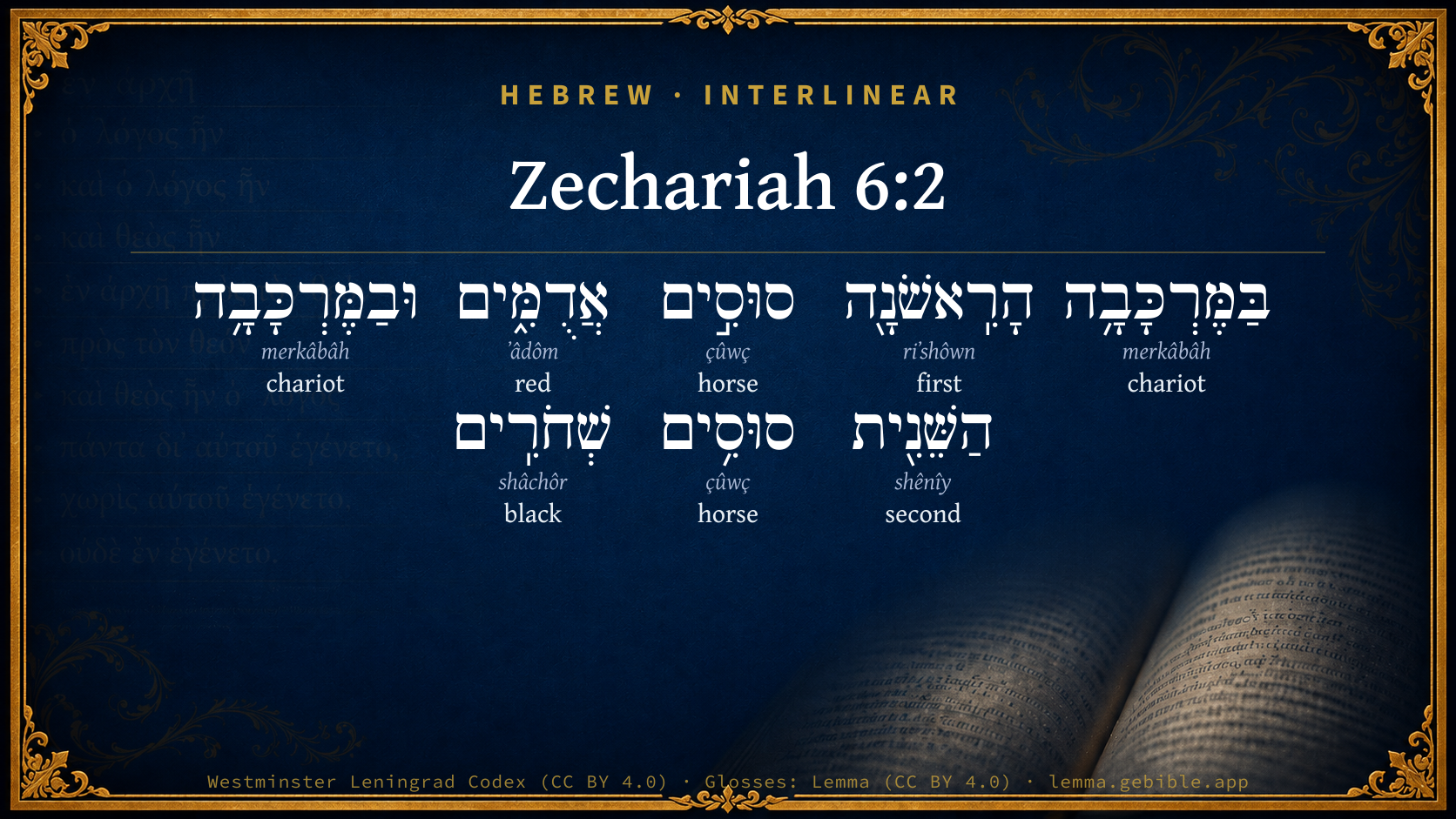
Zechariah 6:2

Hebrew (Westminster Leningrad Codex) Zechariah 6:2 appears in the Hebrew Old Testament. The text above is from the Westminster Leningrad Codex. Each word links to its Strong’s number, a concise gloss, and parsing drawn from the Open Scriptures Hebrew Bible morphology. Click any word for its full Brown-Driver-Briggs (BDB) entry.
Download image
Cite this verse

Zechariah 6:2 (World English Bible). Public Domain. Lemma interlinear Bible study tool, https://lemma.gebible.app/v/zechariah/6/2.

Show BibTeX & RIS
BibTeX
RIS
English Translation
In the first chariot were red horses; in the second chariot black horses;
World English Bible · Public Domain
Download a study sheet

One document with this verse’s original text, its word-by-word gloss line, the meaning frame, cross-references with their text, attributed commentary, and full source and license credits — printable, and it pastes into notes with its structure intact.

This verse Autodidact and up

Study sheet (.html) Plain text (.txt)

A passage Seminary Student

Up to 50 verses in one chapter. A passage sheet keeps up to 6 commentary sources and 12 cross-references per verse, in the order this page ranks them, and says so on the sheet whenever that leaves anything out. Ask for a single verse and you get the Autodidact verse sheet above.

Everything on this page stays free to read, with no account — the sheet is a download of what is already on screen, not access to it.

Want to remove ads? Support Godless Engineer
Compare translations 3

The same verse in 3 English versions, stacked beneath the original-language interlinear above. Click any original word for its lexicon entry.

Each is an independent rendering of the whole verse — the interlinear is not word-aligned to these translations.

Highlighted words mark where these versions differ — a whole-verse word diff, not a word-by-word alignment.

  • World English Bible Public Domain
    In the first chariot were red horses; in the second chariot black horses;
  • King James Version Public Domain
    In the first chariot were red horses; and in the second chariot black horses;
  • unfoldingWord Literal Text CC BY-SA 4.0
    In the first chariot red horses, and in the second chariot black horses,

unfoldingWord Literal Text — © unfoldingWord, licensed CC BY-SA 4.0. Word-aligned USFM3 via Door43 (git.door43.org/unfoldingWord/en_ult).

Versions to compare (up to 4)

3 of 4 selected

Show all 18 translations

Every available English version of this verse, each an independent rendering of the whole verse.

  • World English Bible Public Domain
    In the first chariot were red horses; in the second chariot black horses;
  • Berean Standard Bible Public Domain
    The first chariot had red horses, the second black horses,
  • Majority Standard Bible Public Domain
    The first chariot had red horses, the second black horses,
  • King James Version Public Domain
    In the first chariot were red horses; and in the second chariot black horses;
  • American Standard Version (1901) Public Domain
    In the first chariot were red horses; and in the second chariot black horses;
  • Revised Version (1885) Public Domain
    In the first chariot were red horses; and in the second chariot black horses;
  • Geneva Bible (1599) Public Domain
    In the first charet were red horses, and in the second charet blacke horses,
  • Douay-Rheims (1899) Public Domain
    In the first chariot were red horses, and in the second chariot black horses.
  • Young's Literal Translation Public Domain
    In the first chariot `are' red horses, and in the second chariot brown horses,
  • Literal Standard Version CC BY-SA 4.0
    In the first chariot [are] red horses, and in the second chariot brown horses,
  • Unlocked Literal Bible CC BY-SA 4.0
    The first chariot had red horses, the second chariot had black horses,
  • unfoldingWord Literal Text CC BY-SA 4.0
    In the first chariot red horses, and in the second chariot black horses,
  • Darby Bible Public Domain
    In the first chariot were red horses; and in the second chariot black horses;
  • World Messianic Bible Public Domain
    In the first chariot were red horses. In the second chariot were black horses.
  • Webster's Bible Public Domain
    In the first chariot were red horses; and in the second chariot black horses;
  • Free Bible Version CC BY-SA 4.0
    The first chariot was pulled by red horses, the second by black horses,
  • Bible in Basic English Public Domain
    In the first war-carriage were red horses; and in the second, black horses;
  • JPS Tanakh (1917) Public Domain
    In the first chariot were red horses; and in the second chariot black horses;

Literal Standard Version (2020), Covenant Press — licensed CC BY-SA 4.0. Text via the HelloAO Bible API (eBible.org). Unlocked Literal Bible (unfoldingWord) — licensed CC BY-SA 4.0. Text via the HelloAO Bible API (eBible.org). unfoldingWord Literal Text — © unfoldingWord, licensed CC BY-SA 4.0. Word-aligned USFM3 via Door43 (git.door43.org/unfoldingWord/en_ult). Free Bible Version, Dr. Jonathan Gallagher — licensed CC BY-SA 4.0. Text via the HelloAO Bible API (eBible.org).

Word by word

More ways to search: Search by grammar → Find every occurrence → Compare this word →

Practice this passage: Drill this verse → Learn its vocabulary →

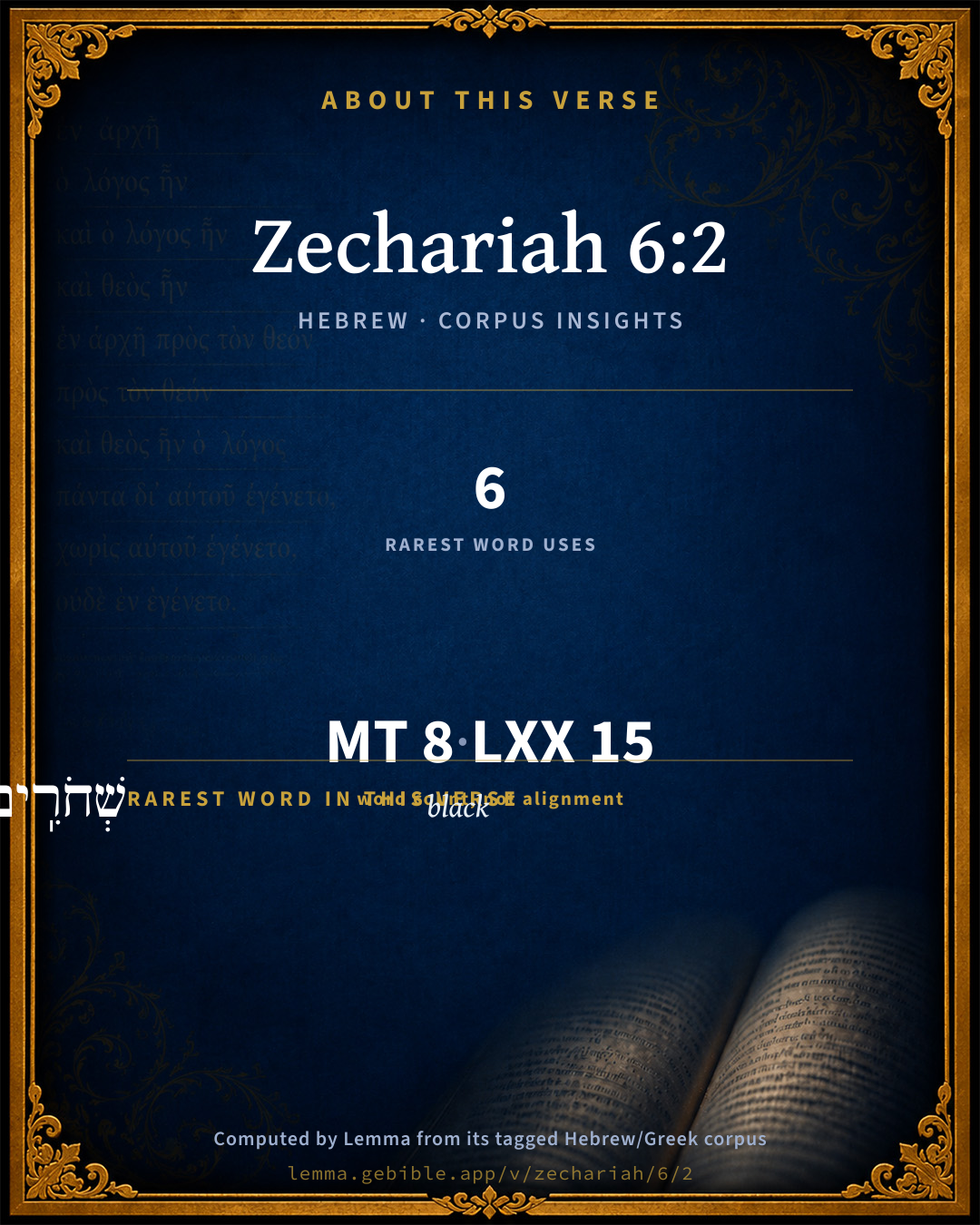
About this verse

These counts appear in no published source. They are computed here, from the morphology-tagged text and Lemma’s own curated glosses. What Lemma adds →

8
words
6
distinct lemmas
Prophets
section

Notable vocabulary

The rarest word here is שְׁחֹרִֽים black H7838 — appearing just 6 times in the whole Hebrew Bible.

Shared distinctive vocabulary

שְׁחֹרִֽים black H7838 occurs in 6 verses of the Hebrew Bible. Also found in:

Grammatical profile

  • 4 nouns
  • 4 adjectives

Repetition

Words recur within this verse — often emphatic in Hebrew:

  • בַּמֶּרְכָּבָ֥ה chariot H4818 ×2
  • סוּסִ֣ים horse H5483 ×2

Hebrew & Septuagint length

In English translation the verse runs 13 words from the Hebrew and 14 from the Septuagint (LXX English) — closely comparable.

A rough comparison of the two English renderings, which tokenize alike — not a word-level alignment.

Word counts can differ between the Hebrew and the Greek without any difference in meaning — e.g. the Hebrew direct-object marker אֵת has no separate Greek word, and Greek often adds the article ὁ.

In the original languages it is 8 Hebrew tokens and 15 Greek tokens — but the two are counted differently (Hebrew bundles its prefixes and suffixes into one token; the Greek is in lemma form), so that isn’t a like-for-like length.

Cross-references

5

Topical passages linked to Zechariah 6:2 in the Treasury of Scripture Knowledge — connected by theme and wording, ordered by reader-vote popularity; previews shown in the World English Bible.

  • Zechariah 1:8 "I had a vision in the night, and, behold, a man riding on a red horse, and he stood among the myrtle trees that were in a ravine; and behind him there were red, brown, and white horses.
  • Revelation 6:2–6 And behold, a white horse, and he who sat on it had a bow. A crown was given to him, and he came forth conquering, and to conquer.
  • Zechariah 6:6 The one with the black horses goes out toward the north country; and the white went out after them; and the dappled went forth toward the south country."
  • Revelation 12:3 Another sign was seen in heaven. Behold, a great red dragon, having seven heads and ten horns, and on his heads seven crowns.
  • Revelation 17:3 He carried me away in the Spirit into a wilderness. I saw a woman sitting on a scarlet-colored animal, full of blasphemous names, having seven heads and ten horns.

Cross-references courtesy of OpenBible.info (CC BY 4.0).

Hebrew and Greek witnesses Masoretic Hebrew ↔ Greek Septuagint

The same verse in the two great witnesses to the Old Testament, shown verse-for-verse.

These are two independent witnesses, not word-aligned to each other, and the Septuagint is shown in lemma (dictionary) form.

Hebrew Zechariah 6:2 Masoretic · Westminster Leningrad Codex

בַּמֶּרְכָּבָ֥ה הָרִֽאשֹׁנָ֖ה סוּסִ֣ים אֲדֻמִּ֑ים וּבַמֶּרְכָּבָ֥ה הַשֵּׁנִ֖ית סוּסִ֥ים שְׁחֹרִֽים

In the first chariot were red horses; in the second chariot black horses;

World English Bible · Public Domain

Greek LXX Zechariah 6:2 Septuagint · lemma form

ἐν ὁ ἅρμα ὁ πρῶτος ἵππος πυρρός καί ἐν ὁ ἅρμα ὁ δεύτερος ἵππος μέλας

In the first chariot were red horses; and in the second chariot black horses;

LXX2012 (modern English Septuagint) · Public Domain

Hebrew: Westminster Leningrad Codex (CC BY 4.0). Greek: Septuagint (public domain); English from LXX2012 (modern English Septuagint) (Public Domain). How the Septuagint differs from the Hebrew →

Targum (Aramaic paraphrase)

1

The Targum is the ancient Jewish Aramaic paraphrase of the Hebrew Scriptures — an interpretive translation, not the Hebrew text itself. Onkelos (literal) and Pseudo-Jonathan (expansive) render the Torah, and Jonathan the Prophets. Coverage is partial: where no permissively-licensed English translation exists for a verse, only the Aramaic is shown. This is verse-level text, not a word-by-word alignment to the Hebrew.

  1. Targum Jonathan Prophets (Joshua–Malachi)
    בִּרְתִיכַיָא קַדְמֵיתָא סוּסְוָן סוּמְקִין וּבִרְתִיכָא תִנְיֵתָא סוּסְוָן אוּכְמִין:

    (no public-domain English translation for this verse)

    Targum Jonathan — Aramaic: “Mikraot Gedolot” (public domain). English: “Sefaria Community Translation” (CC0 1.0 (public-domain dedication)); “London "Chaldee Paraphrase," 1871” (public domain). Text via Sefaria.

Commentary

Notes on Zechariah 6:2 from classic Christian and Jewish commentators (each source and its license shown beneath its notes). The classic Christian expositions comment on the surrounding passage and are grouped to its opening verse, so a note may address several verses; the Jewish commentaries on the Tanakh (Rashi and others) are per-verse, so they appear only where the commentator wrote on this verse.

Lemma curates 59 commentaries, every one of them public domain or Creative Commons licensed, each selected and text-cleaned for this edition rather than reprinted as found. About our sources →

The Cambridge Bible for Schools and Colleges

gen. ed. J. J. S. Perowne

2. red horses] The colours of the horses are not necessarily significant (see Zec_1:8, and note there). They have, however, been interpreted, as for example by Pusey: “Red, as the colour of blood, represented Babylon as sanguinary (Rev_6:4).” “The colour black doubtless symbolises the heavy lot, inflicted by the Medo-Persians (Ib. 5, 6).” “White is a symbol of joy, gladness (Ecc_9:8), victory (Rev_6:2), perhaps also, from its relation to light of acute intelligence.” “The grizzled, the Romans in their mingled character, so prominent in the fourth empire of Daniel (Dan_2:41-43).”

The Cambridge Bible for Schools and Colleges (gen. ed. J. J. S. Perowne; Cambridge University Press, 1878–1918) — public domain. Text from a community e-Sword module.

Trapp's Complete Commentary

John Trapp

Zec 6:2 In the first chariot [were] red horses; and in the second chariot black horses;

Ver. 2. In the first chariot were red horses, &c.] These various colours seem to set forth the various administrations of the angels, deputed to various employments. The black colour betokeneth sorrowful occurrences and revolutions. The white, joyful. The red, bloody. The grizzled, various and mixed matters, partly joyful and partly sorrowful. But I easily subscribe to him that said, We must be content to be ignorant of the full meaning of this vision. Tanta est profunditas Christianarnm literarum, saith Austin so great is the depth of divine learning that there is no fathoming of it. Prophecy is pictured like a matron, with her eyes covered, for the diffculty. For which cause Paulinus Nolanus would never be drawn to write commentaries; and Psellus in Thedoret asketh pardon for expounding the Canticles of Solomon.

John Trapp, A Commentary or Exposition upon All the Books of the Old and New Testament (1647–1656) — public domain. Text from a community e-Sword module.

Joseph Benson's Commentary

Zec 6:2-3. In the first chariot were red horses — This meant the Chaldean empire, the bloody cruelties of which were signified by the red colour of the horses. This empire being overthrown, and its power extinct, when the prophet had this vision, it is only mentioned by-the-by, for the sake of order, and nothing further is said of it. And in the second, black horses — We find by the Apocalypse, Rev 6:5, that a black horse was an emblem of famine, or dearth, so that the chariot with black horses seems to have signified the Persian empire, which brought desolation on many countries, as appears from the history of Darius and Xerxes. And in the third chariot white horses — Conquerors used to ride on white horses, when they were triumphing on account of victories gained over their enemies. This, therefore, aptly denoted the almost continual victories of Alexander, who in a few years overturned the Persian empire, and set up the Macedonian. And in the fourth chariot — Representing the Roman empire; grizzled and bay horses — Denoting the various forms of the Roman government.

Joseph Benson's Commentary on the Old and New Testaments (1811–1818) — public domain. Text from a community e-Sword module.

Tyndale Open Study Notes

Tyndale Open Resources

6:2-3 red . . . black . . . white . . . dappled-gray horses: Zechariah attaches no particular significance to the colors of the horses in his vision (cp. Rev 6:1-8).

Tyndale Open Study Notes — © Tyndale Open Resources, licensed CC BY-SA 4.0. Text via the HelloAO Bible API.

Geneva Bible (1599)

Geneva Bible translators

Which signified the great cruelty and persecution that the Church had endured under divers enemies.

Signifying, that they had endured great afflictions under the Babylonians.

Geneva Bible (1599) marginal notes — public domain. Text via Bolls.life.

Jamieson, Fausset & Brown

Robert Jamieson, A. R. Fausset & David Brown

red--implying carnage.

black--representing sorrow; also famine (Rev 6:5-6; compare Zac 1:8).

Jamieson, Fausset & Brown — Commentary Critical and Explanatory on the Whole Bible (1871) — public domain (CC PDM 1.0). Text via the HelloAO Bible API.

Adam Clarke's Commentary

Verse 2. In the first chariot were red horses] The empire of the Chaldeans, which overthrew the empire of the Assyrians.

The second chariot black horses] The empire of the Persians founded by Cyrus, which destroyed the empire of the Chaldeans.

Adam Clarke's Commentary on the Bible (1810–1826) — public domain. Text from a community e-Sword/MySword module.

John Calvin's Commentaries

With regard to the chariots, we have seen elsewhere that angels are compared to horsemen; for these ride swiftly as it were through the whole world to execute what God commands them: so also whatever changes take place, they are called the chariots of God; for either angels are ready at hand to do anything in obedience to God, or the very events themselves are God’s chariots, that is, they are as it were swift heralds, who announce to us what was before unknown. Let us then know that all fortuitous events, as they are called by the unbelieving, are God’s chariots, are his messengers, who declare and proclaim what was before concealed from us. And there is not in this similitude or metaphor anything strained.

As to the color of the horses, interpreters, as I have already intimated, have toiled with great anxiety; and though I venture not to assert anything as certain, yet the probable conjecture is, that by the black and white horses are designated the Babylonians rather than the Persians, but for a purpose different from what interpreters have thought. For the reference must be to the Jews, when it is said, that black horses and then white horses went forth towards Babylon; for the Holy Spirit intimates, that liberty was given to the Chaldeans to harass the Jews and to fill all places with darkness. The blackness then of which the Prophet speaks signifies the calamities brought on the Jews. The whole of that time was dark, full of grief and sorrow, during which the Chaldeans possessed the oriental empire, and Babylon was the supreme seat of government or of the monarchy. A very different time afterwards succeeded, when the Babylonians were conquered and the Persian enjoyed the oriental empire. The color then was white, for the favor of God shone anew on the Jews, and liberty was immediately given then to return to their own country. We hence see that the Prophet rightly subjoins, that the color of the horses was white; for such was the favor shown to the Jews by the Persian, that the sun of joy arose on them, which exhilarated their hearts. But the Prophet makes no mention of the first chariot as going forth, and for this reason, as interpreters think, because the empire of Babylon was shell overthrown. But they are mistaken in this, as I have already hinted, because they refer not the colors to the state of God’s Church. Hence the Prophet, I doubt not, designedly omits the mention of the going forth of the first chariot, because the Jews had experienced the riding of God’s judgment in their own land, for they had been severely afflicted. As God then is wont to execute his judgment first on his own household, and as it is written, “judgment begins at his own house,” (1 Peter 4:17,) so he purposed to observe the same order in this case, that is, to chastise the sins of the chosen people before he passed over to the Chaldeans and other nations.

John Calvin's Commentaries (1540-1563) — public domain. Text from the Calvin Translation Society English edition (1840s-50s) via the Christian Classics Ethereal Library (ccel.org). Calvin's coverage is partial (roughly two-thirds of the Bible); uncommented books and verses are honest gaps, never fabricated. The 19th-century editor's footnotes and remarks are omitted so the notes are faithfully Calvin's own voice.

Ellicott's Commentary for English Readers

(2) Red.—Better, bay, as in Zec_1:8. “Red” is applicable to cows, but “bay” to horses.

A Bible Commentary for English Readers, edited by Charles John Ellicott (1878–1897) — public domain. Text from a community e-Sword module.

John Gill's Exposition

In the first chariot were red horses,.... If these are to be understood of the apostles of Christ, and ministers of the Gospel, they may be compared to "horses", for bearing the name of Christ, and drawing the chariot of the Gospel; for their strength to labour in the word and doctrine; for their courage in the cause of Christ; and for their swiftness in doing his work; and to "red" ones, for their flaming zeal for the honour of the Redeemer, and their bloody sufferings for his sake: and if of angels, they may be compared to "horses", because strong and swift to do the will of God; and to "red" ones, because they are the executioners of his wrath and vengeance on wicked men: but if by "the chariots" are meant the monarchies, then by these "red horses" must be designed the Babylonians and Chaldeans, so called because their soldiers were clothed in red, and their chariots were like flaming torches; and they were sanguinary, cruel, and bloody in their tempers, and in their actions to the Jews; and were signified by Nebuchadnezzar's head of gold in his image; see Nah 2:3,

and in the second chariot black horses; which, applied to the apostles and ministers of the Gospel, may denote their mean and abject appearance outwardly, and their knowledge in the mysteries of grace, which are dark and obscure to others; and, if understood of angels, is applicable to them, when messengers of ill tidings, or executioners of judgment: but if the monarchies are meant, which seems best, the Medes and Persians are intended; and their "black" colour is expressive of the sorrowful estate of the Jews under them, especially in the time of Haman, as Jarchi and Kimchi observe: black horses were reckoned strong, well made, and fit for labour; and the Ethiopians and Moors chose to have their horses they used in war all of this colour, to strike the greater horror and terror into their enemies; and to see black horses in a dream was accounted a bad omen (s). The Medes and Persians were a strong and warlike people, and were very terrible to their enemies, under Cyrus; and very troublesome and distressing to the Jews, under Cambyses and Ahasuerus.

(s) Vid. Bochart. Hierozoic. par. 1. l. 2. c. 7. col. 106, 107.

John Gill's Exposition of the Whole Bible (1746–1763) — public domain (CC PDM 1.0). Text via the HelloAO Bible API.

Albert Barnes' Notes on the Bible

The symbol is different from that in the first vision. There Zec 1:8, they were horses only, with their riders, to go to and fro to enquire; here they are war-chariots with their horses, to execute God’s judgments, each in their turn. In the first vision also, there is not the characteristic fourfold division, which reminds of the four world-empires of Daniel Dan. 2; after which, in both prophets, is the mention of the kingdom of Christ. Even if the grisled horses be the same as the speckled of the first vision, the black horses are wanting there, as well as the succession, in which they go forth. The only resemblance is, that there are horses of divers colors, two of which, red and white, are the same. The symbol of the fourth empire, grizzled, strong, remarkably corresponds with the strength and mingled character of the fourth empire in Daniel.

Albert Barnes' Notes on the Bible (1834–1885) — public domain. Text from a community e-Sword/MySword module.

Haydock's Catholic Bible Commentary

Red. The Chaldeans were bloody towards the Jews, and clothed in red, Nahum ii. 3. (Menochius)

George Leo Haydock (1774–1849), Haydock's Catholic Family Bible and Commentary, 1859 edition — public domain. Excludes Psalms (Douay-Rheims chapter numbering differs from Protestant) and Deuterocanonical books (Catholic canon only).

Matthew Poole's English Annotations

There is no distinction made between chariot and chariot, nor any mention made of the drivers of these chariots, though these are included in the chariots. Now by the different colours of the horses doth the prophet distinguish the chariots, and possibly that is all intended by the various colours, though generally interpreters do guess by the colour of the horses what should be the quality and temper of the times pointed at; of which a little: red horses may signify bloody times, a fiery execution of wrath, Rev 6:4; black, a time of mortality, and wasting diseases, Rev 6:5.

Matthew Poole's English Annotations on the Holy Bible (1683–1685) — public domain. Text from a community e-Sword/MySword module.

Whedon's Commentary on the Bible

Daniel D. Whedon

2, 3. The chariots were drawn by horses of different colors.

Red… black… white… grisled and bay — For the last R.V. reads “grizzled strong.” Various symbolical meanings have been suggested for these colors; for example, red, the color of blood, has been thought to symbolize war and slaughter, black, the color of mourning, the distress following the slaughter. White has been thought to symbolize victory, grizzled has been taken as equivalent to pale, the color of the horse ridden by Death (Rev_6:8). Those who take the chariots to symbolize four nations interpret the colors as representing the chief characteristics of the nations alluded to. But these and similar interpretations are fanciful; the colors have no symbolical meaning; they serve only to distinguish the chariots from one another. Grizzled means literally covered with hail, that is, spotted (Gen_31:10; Gen_31:12). The word joined with it, bay, or R.V. strong, is of uncertain meaning. Since it occurs in connection with several colors, one would expect another color; this is supplied by A.V., but there is little to support the translation bay. In Isa_63:1, a similar word is translated “dyed,” margin “crimsoned.” Some think, therefore, that the word used here has the same meaning, or that the other was originally in this place. If so, the meaning might be that the ground color was crimson and that on it were the spots. All this is more or less doubtful. Others, who favor the translation strong, explain the use of the term by the more difficult task assigned to this chariot (but see on Zec_6:7). The expression remains peculiar, and Wellhausen and others who, on the basis of Zec_6:6-7, omit strong (see on Zec_6:7), may offer the correct solution.

Daniel D. Whedon (gen. ed.), Commentary on the Old and New Testaments (1874–1909) — public domain. Text from a community e-Sword module.

The Pulpit Commentary

Red horses. (see note on Gen_31:10, Gen_31:12, where it has no symbolical character. As it denotes a combination of colours, probably spots of white on a dark ground, it may signify a quality of a mixed, nature, thus indicating a visitation of war and pestilence, the sword and famine.

The Pulpit Commentary (1880–1919), ed. H.D.M. Spence-Jones & Joseph S. Exell — public domain. Text from a community e-Sword module.

John Wesley's Explanatory Notes

Red horses - Perhaps denoting bloody times, Rev. vi, 4. Black horses - Perhaps a time of mortality, and wasting diseases, Rev. vi, 5.

John Wesley, Explanatory Notes Upon the Whole Bible (1754–1765) — public domain. Text via the GEBible commentary corpus.

Rashi

Rabbi Shlomo Yitzchaki (Rashi)

red horses They were the ones that caused Babylon to mount, for [Babylon] is red, as it is written (Dan. 2:38): “You are the head of gold” [gold having a red tinge].

black [Horses,] to cause Media to mount, for they blackened the faces of Israel in the days of Haman.

Rashi on the Tanakh — English translations: “The Judaica Press complete Tanach with Rashi, translated by A. J. Rosenberg” (CC BY 4.0); “Pentateuch with Rashi's commentary by M. Rosenbaum and A.M. Silbermann, 1929-1934” (public domain); “The Metsudah Tanach series, Lakewood, N.J” (CC BY 4.0); and “The Book of Joshua, Metsudah Publications, 1997” (CC BY 4.0). Text via Sefaria.

Lesson kit

Teaching starters — assembled from the data on this page, not authored interpretation. Every prompt links to the verse data it draws on. Edit before teaching.

Zechariah, in the Prophets, opens this verse with 8 words (6 distinct Hebrew lemmas). Its most distinctive word is shâchôr (“black”). A historical commentator’s framing appears above. Read the whole chapter for the surrounding context.

Discussion questions

  1. The word shâchôr carries the sense “black.” How does it shape the verse?
  2. How does Leviticus 13:31, which shares the word «black», read alongside this verse?
  3. What does the repetition of “chariot” (2× in this one verse) do in this verse?
  4. Compare how The Cambridge Bible for Schools and Colleges and Trapp's Complete Commentary read this verse. Where do they agree or differ?

Things to notice

Reading settings

Reading text

Shown beneath each verse's original-language words.

Old Testament
Old Testament edition

Read the OT as the Masoretic Hebrew (MT) or the Greek Septuagint (LXX).

English shown for the Greek Septuagint (in the Hebrew ↔ Greek comparison).

Comparing translations? Open the Compare panel on any verse page to stack up to four side by side.