Zechariah 8:11

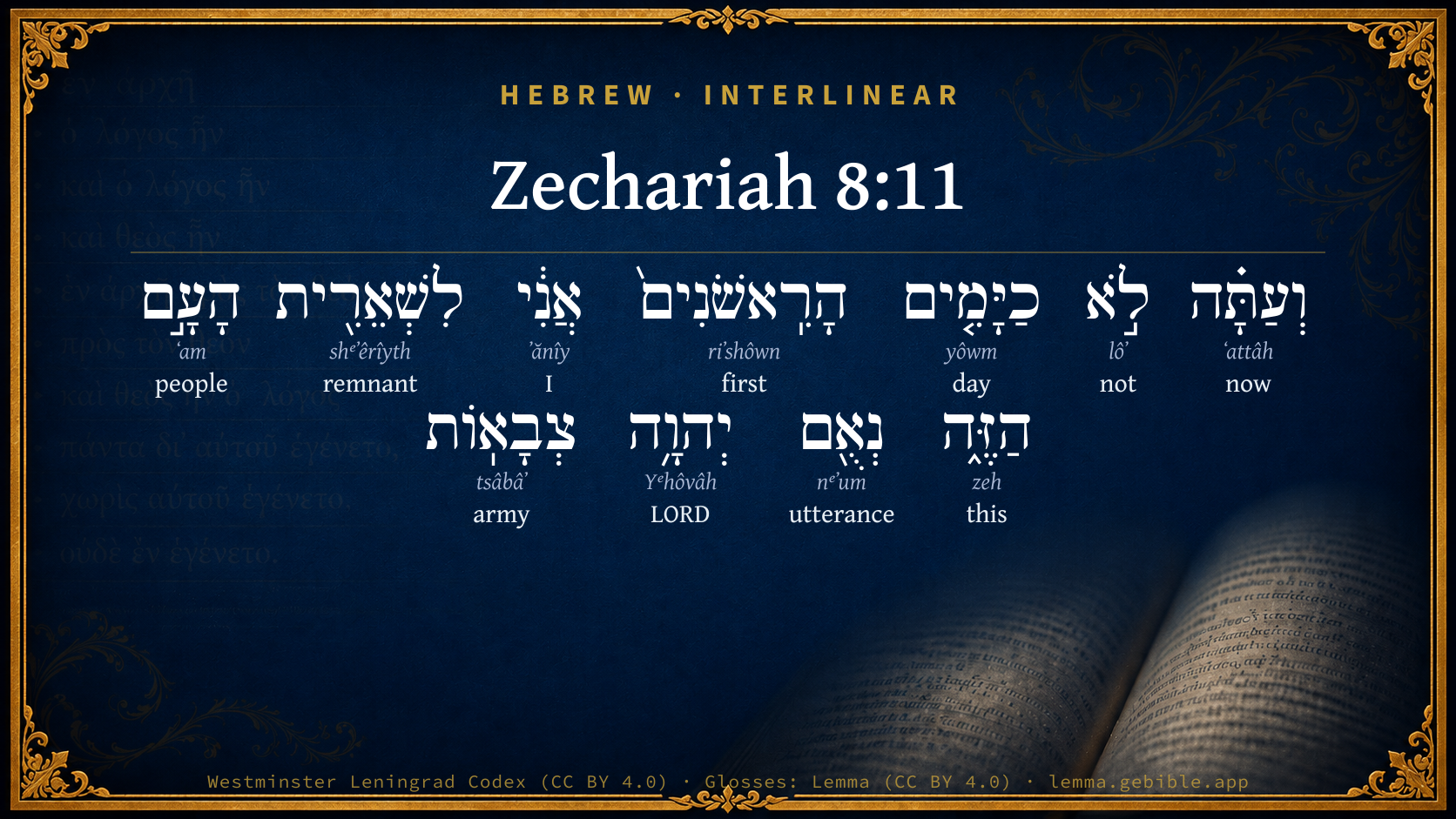
Hebrew (Westminster Leningrad Codex) Zechariah 8:11 appears in the Hebrew Old Testament. The text above is from the Westminster Leningrad Codex. Each word links to its Strong’s number, a concise gloss, and parsing drawn from the Open Scriptures Hebrew Bible morphology. Click any word for its full Brown-Driver-Briggs (BDB) entry.
Download image
Cite this verse

Zechariah 8:11 (World English Bible). Public Domain. Lemma interlinear Bible study tool, https://lemma.gebible.app/v/zechariah/8/11.

Show BibTeX & RIS
BibTeX
RIS
English Translation
But now I will not be to the remnant of this people as in the former days," says Yahweh of Hosts.
World English Bible · Public Domain
Download a study sheet

One document with this verse’s original text, its word-by-word gloss line, the meaning frame, cross-references with their text, attributed commentary, and full source and license credits — printable, and it pastes into notes with its structure intact.

This verse Autodidact and up

Study sheet (.html) Plain text (.txt)

A passage Seminary Student

Up to 50 verses in one chapter. A passage sheet keeps up to 6 commentary sources and 12 cross-references per verse, in the order this page ranks them, and says so on the sheet whenever that leaves anything out. Ask for a single verse and you get the Autodidact verse sheet above.

Everything on this page stays free to read, with no account — the sheet is a download of what is already on screen, not access to it.

Want to remove ads? Support Godless Engineer
Compare translations 3

The same verse in 3 English versions, stacked beneath the original-language interlinear above. Click any original word for its lexicon entry.

Each is an independent rendering of the whole verse — the interlinear is not word-aligned to these translations.

Highlighted words mark where these versions differ — a whole-verse word diff, not a word-by-word alignment.

  • World English Bible Public Domain
    But now I will not be to the remnant of this people as in the former days," says Yahweh of Hosts.
  • King James Version Public Domain
    But now I will not be unto the residue of this people as in the former days, saith the LORD of hosts.
  • unfoldingWord Literal Text CC BY-SA 4.0
    But now it will not be as in former days, I will be with the remnant of this people— this is the declaration of Yahweh of hosts.

unfoldingWord Literal Text — © unfoldingWord, licensed CC BY-SA 4.0. Word-aligned USFM3 via Door43 (git.door43.org/unfoldingWord/en_ult).

Versions to compare (up to 4)

3 of 4 selected

Show all 18 translations

Every available English version of this verse, each an independent rendering of the whole verse.

  • World English Bible Public Domain
    But now I will not be to the remnant of this people as in the former days," says Yahweh of Hosts.
  • Berean Standard Bible Public Domain
    But now I will not treat the remnant of this people as I did in the past,” declares the LORD of Hosts.
  • Majority Standard Bible Public Domain
    But now I will not treat the remnant of this people as I did in the past,” declares the LORD of Hosts.
  • King James Version Public Domain
    But now I will not be unto the residue of this people as in the former days, saith the LORD of hosts.
  • American Standard Version (1901) Public Domain
    But now I will not be unto the remnant of this people as in the former days, saith Jehovah of hosts.
  • Revised Version (1885) Public Domain
    But now I will not be unto the remnant of this people as in the former days, saith the LORD of hosts.
  • Geneva Bible (1599) Public Domain
    But nowe, I wil not intreate the residue of this people as aforetime, saith the Lord of hostes.
  • Douay-Rheims (1899) Public Domain
    But now I will not deal with the remnant of this people according to the former days, saith the Lord of hosts.
  • Young's Literal Translation Public Domain
    And now, not as `in' the former days `am' I to the remnant of this people, An affirmation of Jehovah of Hosts.
  • Literal Standard Version CC BY-SA 4.0
    And now, not as [in] the former days [am] I to the remnant of this people, || A declaration of YHWH of Hosts.
  • Unlocked Literal Bible CC BY-SA 4.0
    But now it will not be as in former days, I will be with the remnant of this people —this is the declaration of Yahweh of hosts.
  • unfoldingWord Literal Text CC BY-SA 4.0
    But now it will not be as in former days, I will be with the remnant of this people— this is the declaration of Yahweh of hosts.
  • Darby Bible Public Domain
    But now I will not be unto the remnant of this people as in the former days, saith Jehovah of hosts;
  • World Messianic Bible Public Domain
    But now I will not be to the remnant of this people as in the former days,” says the LORD of Hosts.
  • Webster's Bible Public Domain
    But now I will not be to the residue of this people as in the former days, saith the LORD of hosts.
  • Free Bible Version CC BY-SA 4.0
    But now I won't treat those who remain of my people like I treated them before, declares the Lord Almighty.
  • Bible in Basic English Public Domain
    But now I will not be to the rest of this people as I was in the past, says the Lord of armies.
  • JPS Tanakh (1917) Public Domain
    But now I will not be unto the remnant of this people as in the former days, saith the LORD of hosts.

Literal Standard Version (2020), Covenant Press — licensed CC BY-SA 4.0. Text via the HelloAO Bible API (eBible.org). Unlocked Literal Bible (unfoldingWord) — licensed CC BY-SA 4.0. Text via the HelloAO Bible API (eBible.org). unfoldingWord Literal Text — © unfoldingWord, licensed CC BY-SA 4.0. Word-aligned USFM3 via Door43 (git.door43.org/unfoldingWord/en_ult). Free Bible Version, Dr. Jonathan Gallagher — licensed CC BY-SA 4.0. Text via the HelloAO Bible API (eBible.org).

Word by word

More ways to search: Search by grammar → Find every occurrence → Compare this word →

Practice this passage: Drill this verse → Learn its vocabulary →

לִשְׁאֵרִ֖ית
shᵉʼêrîyth
H7611
“to/for · remnant of”
Preposition + Noun, Common, Feminine, Singular, Construct
Part of Speech
Preposition + Noun
Type
Common
Gender
Feminine
Number
Singular
State
Construct
Full BDB Definition

Origin: from H7604

TWOT: 2307b

rest, residue, remainder, remnant - rest, what is left - remainder, descendants
  1. וְעַתָּ֗ה ʻattâh H6258 “and · now” Conjunction + Adverb
  2. לֹ֣א lôʼ H3808 “not” Particle, Negative
  3. כַיָּמִ֤ים yôwm H3117 “like/as the · days” Preposition, Determined + Noun, Common, Masculine, Plural, Absolute
  4. הָרִֽאשֹׁנִים֙ riʼshôwn H7223 “the · first” Particle, Definite Article + Adjective, Adjective, Masculine, Plural, Absolute
  5. אֲנִ֔י ʼănîy H589 “I” Pronoun, Personal, 1st Person, Common, Singular
  6. הָעָ֣ם ʻam H5971 “the · people” Particle, Definite Article + Noun, Common, Masculine, Singular, Absolute
  7. הַזֶּ֑ה zeh H2088 “the · this” Particle, Definite Article + Pronoun, Demonstrative, Masculine, Singular
  8. נְאֻ֖ם nᵉʼum H5002 “utterance of” Noun, Common, Masculine, Singular, Construct
  9. יְהוָ֥ה Yᵉhôvâh H3068 “LORD” Noun, Proper
  10. צְבָאֽוֹת tsâbâʼ H6635 “armies” Noun, Common, Both, Plural, Absolute

About this verse

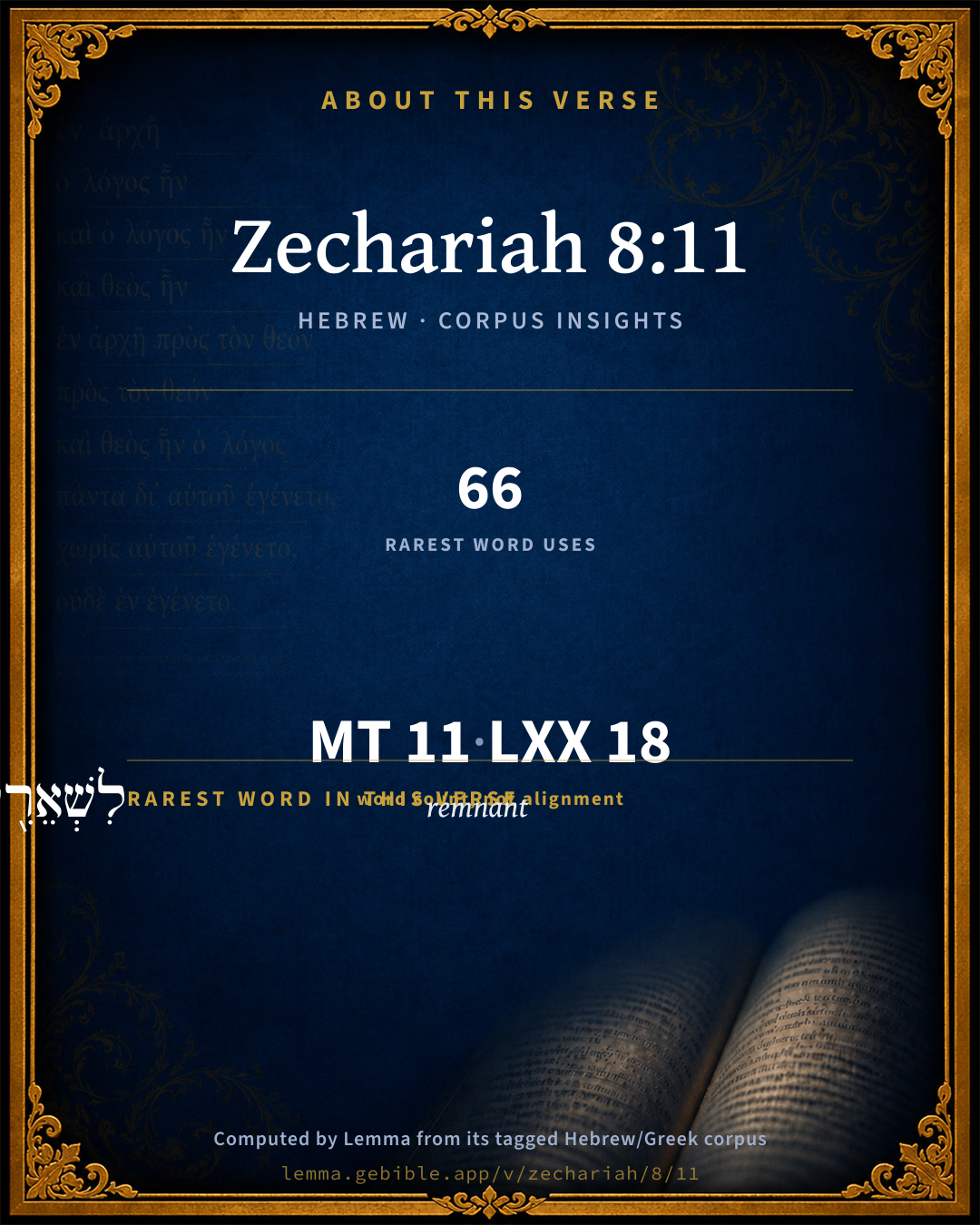
These counts appear in no published source. They are computed here, from the morphology-tagged text and Lemma’s own curated glosses. What Lemma adds →

11
words
11
distinct lemmas
Prophets
section

Grammatical profile

  • 6 nouns
  • 1 adjective
  • 2 pronouns
  • 1 adverb
  • 1 particle

Hebrew & Septuagint length

In English translation the verse runs 21 words from the Hebrew and 21 from the Septuagint (LXX English) — the same length.

A rough comparison of the two English renderings, which tokenize alike — not a word-level alignment.

Word counts can differ between the Hebrew and the Greek without any difference in meaning — e.g. the Hebrew direct-object marker אֵת has no separate Greek word, and Greek often adds the article ὁ.

In the original languages it is 11 Hebrew tokens and 18 Greek tokens — but the two are counted differently (Hebrew bundles its prefixes and suffixes into one token; the Greek is in lemma form), so that isn’t a like-for-like length.

Cross-references

6

Topical passages linked to Zechariah 8:11 in the Treasury of Scripture Knowledge — connected by theme and wording, ordered by reader-vote popularity; previews shown in the World English Bible.

  • Isaiah 12:1 In that day you will say, "I will give thanks to you, Yahweh; for though you were angry with me, your anger has turned away and you comfort me.
  • Psalms 103:9 He will not always accuse; Neither will he stay angry forever.
  • Haggai 2:19 Is the seed yet in the barn? Yes, the vine, the fig tree, the pomegranate, and the olive tree haven't brought forth. From this day will I bless you.'"
  • Zechariah 8:8–9 and I will bring them, and they will dwell in the midst of Jerusalem; and they will be my people, and I will be their God, in truth and in righteousness."
  • Isaiah 11:13 The envy also of Ephraim shall depart, and those who vex Judah shall be cut off: Ephraim shall not envy Judah, and Judah shall not vex Ephraim.
  • Malachi 3:9–11 You are cursed with the curse; for you rob me, even this whole nation.

Cross-references courtesy of OpenBible.info (CC BY 4.0).

Hebrew and Greek witnesses Masoretic Hebrew ↔ Greek Septuagint

The same verse in the two great witnesses to the Old Testament, shown verse-for-verse.

These are two independent witnesses, not word-aligned to each other, and the Septuagint is shown in lemma (dictionary) form.

Hebrew Zechariah 8:11 Masoretic · Westminster Leningrad Codex

וְעַתָּ֗ה לֹ֣א כַיָּמִ֤ים הָרִֽאשֹׁנִים֙ אֲנִ֔י לִשְׁאֵרִ֖ית הָעָ֣ם הַזֶּ֑ה נְאֻ֖ם יְהוָ֥ה צְבָאֽוֹת

But now I will not be to the remnant of this people as in the former days," says Yahweh of Hosts.

World English Bible · Public Domain

Greek LXX Zechariah 8:11 Septuagint · lemma form

καί νῦν οὐ κατά ὁ ἡμέρα ὁ ἔμπροσθεν ἐγώ ποιέω ὁ κατάλοιπος ὁ λαός οὗτος λέγω κύριος παντοκράτωρ

But now I will not do to the remnant of this people according to the former days, says the Lord Almighty.

LXX2012 (modern English Septuagint) · Public Domain

Hebrew: Westminster Leningrad Codex (CC BY 4.0). Greek: Septuagint (public domain); English from LXX2012 (modern English Septuagint) (Public Domain). How the Septuagint differs from the Hebrew →

Targum (Aramaic paraphrase)

1

The Targum is the ancient Jewish Aramaic paraphrase of the Hebrew Scriptures — an interpretive translation, not the Hebrew text itself. Onkelos (literal) and Pseudo-Jonathan (expansive) render the Torah, and Jonathan the Prophets. Coverage is partial: where no permissively-licensed English translation exists for a verse, only the Aramaic is shown. This is verse-level text, not a word-by-word alignment to the Hebrew.

  1. Targum Jonathan Prophets (Joshua–Malachi)
    וּכְעַן לָא כְיוֹמַיָא קַדְמָאֵי אֲנָא לִשְׁאָרָא דְעַמָא הָדֵין אֲמַר יְיָ צְבָאוֹת:

    (no public-domain English translation for this verse)

    Targum Jonathan — Aramaic: “Mikraot Gedolot” (public domain). English: “Sefaria Community Translation” (CC0 1.0 (public-domain dedication)); “London "Chaldee Paraphrase," 1871” (public domain). Text via Sefaria.

Commentary

Notes on Zechariah 8:11 from classic Christian and Jewish commentators (each source and its license shown beneath its notes). The classic Christian expositions comment on the surrounding passage and are grouped to its opening verse, so a note may address several verses; the Jewish commentaries on the Tanakh (Rashi and others) are per-verse, so they appear only where the commentator wrote on this verse.

Lemma curates 59 commentaries, every one of them public domain or Creative Commons licensed, each selected and text-cleaned for this edition rather than reprinted as found. About our sources →

Trapp's Complete Commentary

John Trapp

Zec 8:11 But now I [will] not [be] unto the residue of this people as in the former days, saith the LORD of hosts.

Ver. 11. But now I will not be unto the residue, &c.] Now that the temple is well nigh perfected, and so the cause of my displeasure removed; the matter you see is already well amended, and shall be yet better; for there is a series, a concatenation of God’s mercies, like the links in a chain, every former draws on a future, if we break not the chain by our unthankfulness. The right hand of the Lord shall change all this, saith Hope, when it is at worst, Psa 118:16.

“ Flebile principium melior fortuna sequetur. ”

As, when it is in better case, it saith, "Return to thy rest, O my soul, for the Lord hath dealt bountifully with thee." It is well for the present, and yet it will be better hereafter. Fury is not in God; or, if at any time it seem to be, yet he will not always chide, neither will he keep his anger for ever, Psa 103:9. It is with God in some sort as it was with David, whose soul longed to go forth unto Absalom; for he was comforted concerning Amnon, seeing he was dead, 2Sa 13:39. Let the Lord but see the rainbow of repentance appearing in our hearts, and he will presently be pacified; well he may wash us, but he will never drown us.

John Trapp, A Commentary or Exposition upon All the Books of the Old and New Testament (1647–1656) — public domain. Text from a community e-Sword module.

The Biblical Illustrator

Joseph S. Exell

Zec_8:11-12

But now I will not be unto the residue of this people as in the former days

The danger of resistance to the Divine messages

It is a decisive evidence of sound wisdom to profit by the faults, the errors, and the calamities of other men.

Two sources from whence we ordinarily obtain knowledge and caution. The first is, our own experience, by which we too frequently buy knowledge at a very high cost. The second is, the experience of those who have lived before us; and this knowledge is as good in its quality, and obtained at a much easier rate than the former. In Scripture we have many histories of individuals and histories of communities.

I. A message prom God to the children of men.

1. The immediate agent by whom the communication is made--the Spirit of God. It is this Holy Spirit who is the author, the immediate author, of all communications from God to man. It should give a great solemnity to all that is addressed to us, to recollect that it comes to us by the immediate agency of the Holy Ghost.

2. There are instruments appointed for the communication of this message. By the prophets. The ministration of fellow men--ancient prophets, apostles, evangelists, pastors, and teachers.

3. The nature of the communication thus made. It is a message of instruction, conviction, consolation, and warning.

II. The resistance and opposition which in every age us been made to the message. Mark the varied forms in which this opposition is here described. When is it that resistance may be said to be made to the Spirit, in the Word?

1. When men estrange themselves from the means of grace and salvation, and place themselves beyond the reach of those means, it may be justly feared that they are in the state of those who refuse to hearken. How many do place themselves in such situations!

2. When men perversely act in direct contradiction to the light they have received. All sin is heinous in the sight of God. But that is especially heinous which is committed in direct opposition to the light we have received, whether that light have been communicated by the instructions of an earlier age, by the ministrations of the prophets, or by means of any of the various institutions which have been set on foot in our day.

3. Where there is a determination to persevere in a course of sin, against the remonstrance of conscience and the Word of God. This is surely pulling away the shoulder, and stopping the ears, and hardening the heart.

4. When to the impiety of unbelief is added the iniquity of scorn and contempt, and when ridicule is poured by men of determined minds on things sacred.

III. The tremendous consequences to which such conduct inevitably exposes. To the wrath of God; the Divine displeasure. Here presented as great wrath; and great wrath from the God of armies, the Lord of hosts. Lessons--

1. Admire and adore the condescension, patience, and grace of God the Holy Spirit. Condescension in that He visits our world with the messages of mercy, and brings home to our ears and to our hearts the sounds of reconciliation and salvation. Patience, in that He still visits us and waits to be gracious; still strives in the hearts of the unregenerate--still visits His people with the dews of the heavenly grace.

2. This subject affords a clear demonstration of the depravity of human nature. If I could find no other proof of human depravity, I should find it in this enmity of man to all that is good and gracious.

3. Learn the debt of gratitude you owe to the Son of God. For you would still have gone on in the way of enmity if He had not visited you. It was the sovereignty of Gods distinguishing grace which gave you eyes to see and ears to hear and hearts to feel.

4. We tremble for some of you. Because you have heard these things again and again; you have seen the Cross of Christ reared in your midst--and some of you are still stopping your ears and hardening your hearts; instead of yielding up to the convictions of your minds, you are struggling against them. (George Clayton.)

I will cause the remnant of this people to possess all these things--

A goodly heritage

Wherever there is the teaching of the Holy Spirit it is sure to convince men personally, in their own consciences, souls, and experiences, of their need of Gods Christ.

I. The possessions. The people will be distinguished by that which they are to possess.

1. The city of freedom, the new Jerusalem. There is no sense in which in this possession freedom is not implied. The Jerusalem that is above all is free for us all. The first feature is freedom from sin.

2. This Jerusalem shall be a city of truth. This truth, that from first to last we are saved entirely by the grace of God. This grace is entirely by the Lord Jesus Christ. The second thing to be careful upon is that regeneration is one part of the work of grace.

3. This city is called the mountain of the Lord. So called because the Lord is there.

II. How the people are brought to possess these things. The Jews in their return from captivity, and coming back to their land, and the Lord making the land fruitful, are the things indicated here. It was on Christs account,--that was the deep foundation reason why they came back from captivity at all. And how is it you return to Zion? It is because God chose you in Jesus Christ before the foundation of the world. By virtue of the secret relationship existing between you and Jesus Christ you are brought to possess these things. (James Wells.)

The Biblical Illustrator, edited by Joseph S. Exell (c. 1880s–1900s) — public domain. Text from a community e-Sword module.

Joseph Benson's Commentary

Zec 8:11-13. But now I will not be as in the former days — But now, seeing that ye have proceeded in rebuilding my temple, I will order, by my divine providence, that things shall happen otherwise to you than they did before, or that your affairs shall be more prosperous. For the seed shall be prosperous — This in the Hebrew is, For the seed shall be of peace, which seems intended to express that they should have peaceable times, or be a seed or nation at peace. And, as ye were a curse — A standing form of imprecation; among the heathen — Who wished that their enemies might be as miserable as the Jews. This was to be changed into a blessing, to the contrary effect; May you be as happy as the Jews who are restored. See Grotius and Calmet. O house of Judah and house of Israel — By Israel may be understood here those of the ten tribes who returned to Judea with the two tribes of Judah and Benjamin. But the mentioning both Judah and Israel, which had been so long separated, shows that both the curse and the blessing here spoken of, in their ultimate sense, belong to the whole body of the Jews, who, as they are public instances of God’s judgments now, so shall they be hereafter of his blessings; namely, at the general restoration and conversion of that nation, to which several promises in this chapter relate.

Joseph Benson's Commentary on the Old and New Testaments (1811–1818) — public domain. Text from a community e-Sword module.

Jamieson, Fausset & Brown

Robert Jamieson, A. R. Fausset & David Brown

"But now that the temple has been built, I will not do as I had formerly done to those who returned from Babylon" [JEROME]. Henceforth I will bless you.

Jamieson, Fausset & Brown — Commentary Critical and Explanatory on the Whole Bible (1871) — public domain (CC PDM 1.0). Text via the HelloAO Bible API.

John Calvin's Commentaries

He afterwards adds, But now, not according to former days, shall I be to the remnant of this people, saith Jehovah of hosts. Zechariah now reminds them that things had changed for the better, as it was evident that God was propitious to them. And if the cause of this change be asked, the answer is, the building of the temple. If nothing had been said by the Prophets, the Jews might have only conjectured, but every doubt had been removed; for God had threatened then with punishment which he afterwards inflicted, and then he exhorted them to repentance, and said that he would be reconciled to them: when the Jews rightly considered these things, they had no need of having recourse to conjectures. It was indeed fully evident that God regarded them with favor, and that the fruits of his favor were before their eyes; and they were thus encouraged to proceed with the work of building the temple. It now follows —

John Calvin's Commentaries (1540-1563) — public domain. Text from the Calvin Translation Society English edition (1840s-50s) via the Christian Classics Ethereal Library (ccel.org). Calvin's coverage is partial (roughly two-thirds of the Bible); uncommented books and verses are honest gaps, never fabricated. The 19th-century editor's footnotes and remarks are omitted so the notes are faithfully Calvin's own voice.

The Cambridge Bible for Schools and Colleges

gen. ed. J. J. S. Perowne

11. now I will not be] Rather, now (in this period since ye began to build) I am not. My attitude towards you is already changed.

the residue] Rather, the remnant, as in Zec_8:12, i.e. the returned captives. See Hag_1:12, and note.

The Cambridge Bible for Schools and Colleges (gen. ed. J. J. S. Perowne; Cambridge University Press, 1878–1918) — public domain. Text from a community e-Sword module.

John Gill's Exposition

For the seed shall be prosperous,.... Being cast into the earth, it shall spring up again, and produce a large increase; whereas before, though they sowed much, it came to little, Hag 1:6,

the vine shall give her fruit; be loaded with clusters, and produce large quantities of wine; whereas before there was a drought upon the new wine; and where there were wont to be had fifty vessels out of the press, there were but twenty, Hag 1:11,

and the ground shall give her increase; as usual, meaning of wheat and barley; whereas before there was a drought upon the corn, and where there used to be a heap of twenty measures, there were but ten, Hag 1:11,

and the heavens shall give their dew; which makes the earth fruitful; whereas before the heaven over them was stayed from dew, and instead of it were blasting, mildew, and hail, Hag 1:10,

and I will cause the remnant of this people to possess all these things; as a symbol of better things inherited by the remnant according to the election of grace; and who have the promise both of this life and that to come; and who, seeking in the first place spiritual things, have all others added to them, convenient for them.

John Gill's Exposition of the Whole Bible (1746–1763) — public domain (CC PDM 1.0). Text via the HelloAO Bible API.

Albert Barnes' Notes on the Bible

And now - The words imply a contrast of God’s dealings, rather than a contrast of time. “I am not to the remnant of this people.” He had said, “I will be to them God;” so now He does not say that He will not do to them, “as in former days,” but “I am not to the remnant” of this people as heretofore. He would be, as tie was in Jesus, in a new relation to them.

Albert Barnes' Notes on the Bible (1834–1885) — public domain. Text from a community e-Sword/MySword module.

Matthew Poole's English Annotations

But now; since this people go about building the temple and restoring my worship with some cheerfulness.

I will not be unto the residue of this people: God changeth not, his not being what he was to this people is a change of his providence and his dealings with them. Our affairs will be to us as God is to us.

As in the former days: see Zec 8:10.

Matthew Poole's English Annotations on the Holy Bible (1683–1685) — public domain. Text from a community e-Sword/MySword module.

The Pulpit Commentary

But now I will not be. God"s attitude towards the people had already changed in consequence of their diligence in the work of restoration. Perowne renders, "Now I am not." The residue; the remnant; the returned Jews. (ver. 12; Hag_1:12) The former days. In the time of their inactivity, when a curse rested upon them and upon their land. The curse was now removed, and a marked amelioration had set in. (Hag_2:15-19)

The Pulpit Commentary (1880–1919), ed. H.D.M. Spence-Jones & Joseph S. Exell — public domain. Text from a community e-Sword module.

John Wesley's Explanatory Notes

I will not be - That is, I will not deal with them as in former days.

John Wesley, Explanatory Notes Upon the Whole Bible (1754–1765) — public domain. Text via the GEBible commentary corpus.

Keil & Delitzsch

C. F. Keil & F. Delitzsch

But now the Lord will act differently to His remaining people, and bless it again with a fruitful harvest of the fruits of the field and soil. כּי in Zac 8:12, "for," after a negative clause, "but." זרע השּׁלום, not the seed will be secure (Chald., Pesh.), but the seed of peace, viz., the vine. This is so designated, not because there is a berâkhâh in the grape (Isa 65:8); but because the vine can only flourish in peaceful times, and not when the land is laid waste by enemies (Koehler). On the words which follow, compare Lev 26:4., Psa 67:7; Hag 1:10; Hag 2:19. "Future abundance will compensate for the drought and scarcity of the past" (Jerome).

Keil & Delitzsch — Biblical Commentary on the Old Testament (1861–1891) — public domain (CC PDM 1.0). Text via the HelloAO Bible API. (Old Testament only.)

Scofield Reference Notes

C. I. Scofield

residue

Or, remnant.

The Scofield Reference Bible (1917 edition), notes by C. I. Scofield — public domain. Text from a community e-Sword module.

unfoldingWord translationNotes

Door43 World Missions Community

But now it will not be as in former days, I will be with the remnant of this people

"But I will not treat the remnant of this people now as I did in former days"

in former days

"in the past." The implied information is that this refers to the time when the people started rebuilding the temple. (See: Assumed Knowledge and Implicit Information)

the remnant of this people

The implied information is that this is the remnant of the people who returned from exile. AT: "the people who returned from exile" (See: Assumed Knowledge and Implicit Information)

seeds of peace will be sown

This can be expressed in active form. AT: "the people will safely sow seed" (See: Active or Passive)

this is the declaration of Yahweh of hosts

Yahweh speaks of himself by name to express the certainty of what he is declaring. See how you translated this in Zechariah 1:3. AT: "this is what Yahweh of hosts has declared" or "this is what I, Yahweh of hosts, have declared" (See: First, Second, or Third Person)

the earth will give its produce; the skies will give their dew

The earth and skies are spoken of as if they were persons giving what is needed. (See: Metaphor)

inherit all these things

"to have all these things"

translationWords

peace

plant

vine

fruit

earth

inherit

unfoldingWord translationNotes — © Distant Shores Media and the Door43 World Missions Community, licensed CC BY-SA 4.0. Source: git.door43.org/Door43/en_tn.

Lesson kit

Teaching starters — assembled from the data on this page, not authored interpretation. Every prompt links to the verse data it draws on. Edit before teaching.

Zechariah, in the Prophets, opens this verse with 11 words (11 distinct Hebrew lemmas). Its most distinctive word is shᵉʼêrîyth (“remnant”). A historical commentator’s framing appears above. Read the whole chapter for the surrounding context.

Discussion questions

  1. How does “remnant” (shᵉʼêrîyth) shape what this verse is saying?
  2. How does Isaiah 12:1, which shares this passage’s theme, read alongside this verse?
  3. These translations render this verse differently. What is at stake in choosing one wording over another?
  4. Compare how Trapp's Complete Commentary and The Biblical Illustrator read this verse. Where do they agree or differ?

Things to notice

Reading settings

Reading text

Shown beneath each verse's original-language words.

Old Testament
Old Testament edition

Read the OT as the Masoretic Hebrew (MT) or the Greek Septuagint (LXX).

English shown for the Greek Septuagint (in the Hebrew ↔ Greek comparison).

Comparing translations? Open the Compare panel on any verse page to stack up to four side by side.