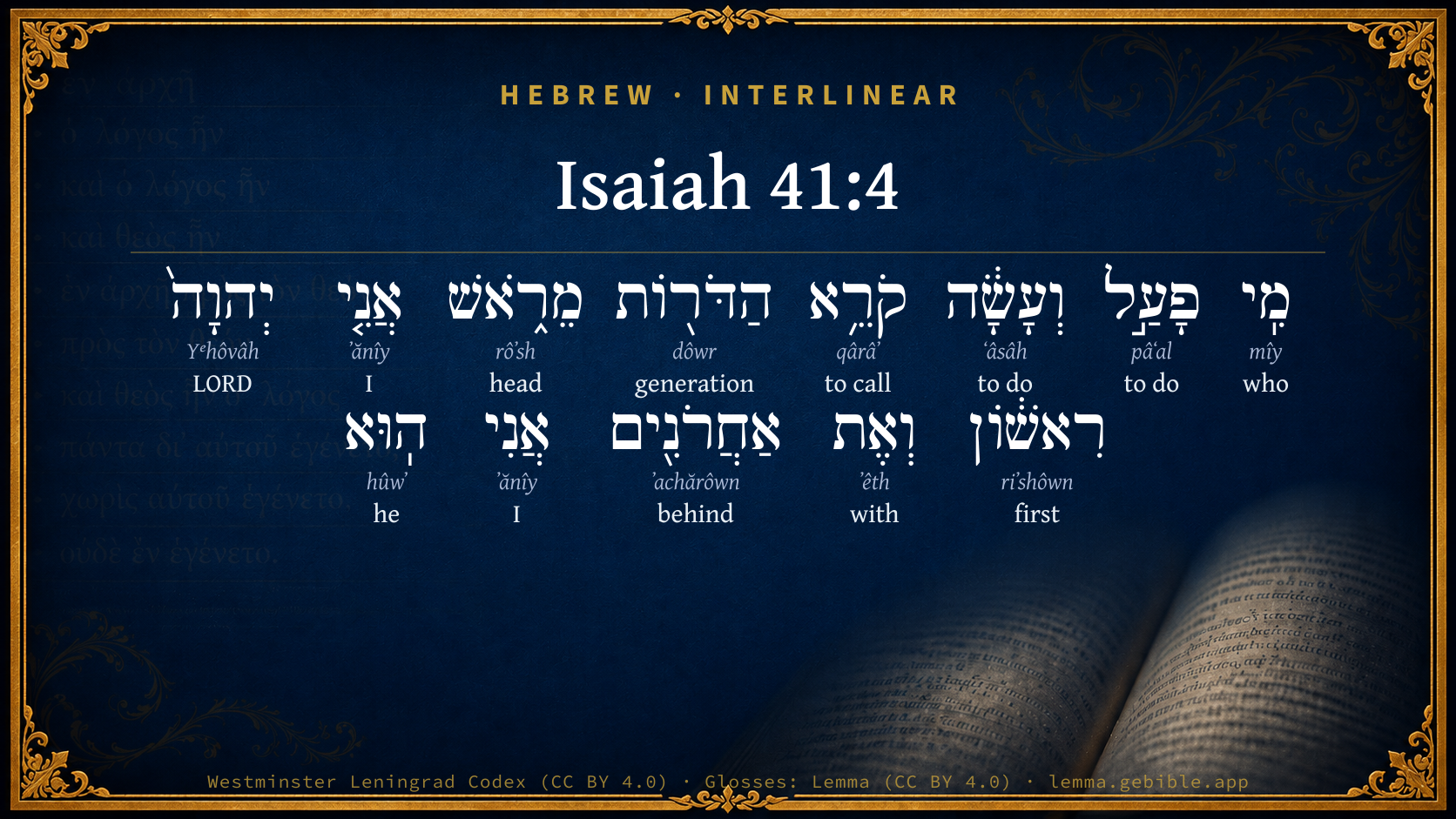
Isaiah 41:4

Hebrew (Westminster Leningrad Codex) Isaiah 41:4 appears in the Hebrew Old Testament. The text above is from the Westminster Leningrad Codex. Each word links to its Strong’s number, a concise gloss, and parsing drawn from the Open Scriptures Hebrew Bible morphology. Click any word for its full Brown-Driver-Briggs (BDB) entry.
Download image
Cite this verse

Isaiah 41:4 (World English Bible). Public Domain. Lemma interlinear Bible study tool, https://lemma.gebible.app/v/isaiah/41/4.

Show BibTeX & RIS
BibTeX
RIS
English Translation
Who has worked and done it, calling the generations from the beginning? I, Yahweh, the first, and with the last, I am he.
World English Bible · Public Domain
Download a study sheet

One document with this verse’s original text, its word-by-word gloss line, the meaning frame, cross-references with their text, attributed commentary, and full source and license credits — printable, and it pastes into notes with its structure intact.

This verse Autodidact and up

Study sheet (.html) Plain text (.txt)

A passage Seminary Student

Up to 50 verses in one chapter. A passage sheet keeps up to 6 commentary sources and 12 cross-references per verse, in the order this page ranks them, and says so on the sheet whenever that leaves anything out. Ask for a single verse and you get the Autodidact verse sheet above.

Everything on this page stays free to read, with no account — the sheet is a download of what is already on screen, not access to it.

Want to remove ads? Support Godless Engineer
Compare translations 3

The same verse in 3 English versions, stacked beneath the original-language interlinear above. Click any original word for its lexicon entry.

Each is an independent rendering of the whole verse — the interlinear is not word-aligned to these translations.

Highlighted words mark where these versions differ — a whole-verse word diff, not a word-by-word alignment.

  • World English Bible Public Domain
    Who has worked and done it, calling the generations from the beginning? I, Yahweh, the first, and with the last, I am he.
  • King James Version Public Domain
    Who hath wrought and done it, calling the generations from the beginning? I the LORD, the first, and with the last; I am he.
  • unfoldingWord Literal Text CC BY-SA 4.0
    Who has worked and done, summoning generations from the beginning? I, Yahweh, the first and with the lasts, I he.” q1

unfoldingWord Literal Text — © unfoldingWord, licensed CC BY-SA 4.0. Word-aligned USFM3 via Door43 (git.door43.org/unfoldingWord/en_ult).

Versions to compare (up to 4)

3 of 4 selected

Show all 18 translations

Every available English version of this verse, each an independent rendering of the whole verse.

  • World English Bible Public Domain
    Who has worked and done it, calling the generations from the beginning? I, Yahweh, the first, and with the last, I am he.
  • Berean Standard Bible Public Domain
    Who has performed this and carried it out, calling forth the generations from the beginning? I, the LORD—the first and the last—I am He.”
  • Majority Standard Bible Public Domain
    Who has performed this and carried it out, calling forth the generations from the beginning? I, the LORD—the first and the last—I am He.”
  • King James Version Public Domain
    Who hath wrought and done it, calling the generations from the beginning? I the LORD, the first, and with the last; I am he.
  • American Standard Version (1901) Public Domain
    Who hath wrought and done it, calling the generations from the beginning? I, Jehovah, the first, and with the last, I am he.
  • Revised Version (1885) Public Domain
    Who hath wrought and done it, calling the generations from the beginning? I the LORD, the first, and with the last, I am he.
  • Geneva Bible (1599) Public Domain
    Who hath wrought and done it? he that calleth the generations from the beginning. I the Lord am the first, and with the last I am ye same.
  • Douay-Rheims (1899) Public Domain
    Who hath wrought and done these things, calling the generations from the beginning? I the Lord, I am the first and the last.
  • Young's Literal Translation Public Domain
    Who hath wrought and done, Calling the generations from the first? I, Jehovah, the first, and with the last I `am' He.
  • Literal Standard Version CC BY-SA 4.0
    Who has worked and done, || Calling the generations from the first? I, YHWH, the first, and with the last I [am] He.
  • Unlocked Literal Bible CC BY-SA 4.0
    Who has performed and accomplished these deeds? Who has summoned the generations from the beginning? I, Yahweh, the first, and with the last ones, I am he.
  • unfoldingWord Literal Text CC BY-SA 4.0
    Who has worked and done, summoning generations from the beginning? I, Yahweh, the first and with the lasts, I he.” q1
  • Darby Bible Public Domain
    Who hath wrought and done [it], calling the generations from the beginning? I, Jehovah, the first; and with the last, I [am] HE.
  • World Messianic Bible Public Domain
    Who has worked and done it, calling the generations from the beginning? I, the LORD, the first, and with the last, I am he.”
  • Webster's Bible Public Domain
    Who hath wrought and done it, calling the generations from the beginning? I the LORD, the first, and with the last; I am he.
  • Free Bible Version CC BY-SA 4.0
    Who has achieved and done this, calling into existence each generation from the beginning of time? I, the Lord, the first and the last, I am the one.
  • Bible in Basic English Public Domain
    Whose purpose and work was it? His who sent out the generations from the start. I the Lord, the first, and with the last, I am he.
  • JPS Tanakh (1917) Public Domain
    Who hath wrought and done it? He that called the generations from the beginning. I, the LORD, who am the first, and with the last am the same.

Literal Standard Version (2020), Covenant Press — licensed CC BY-SA 4.0. Text via the HelloAO Bible API (eBible.org). Unlocked Literal Bible (unfoldingWord) — licensed CC BY-SA 4.0. Text via the HelloAO Bible API (eBible.org). unfoldingWord Literal Text — © unfoldingWord, licensed CC BY-SA 4.0. Word-aligned USFM3 via Door43 (git.door43.org/unfoldingWord/en_ult). Free Bible Version, Dr. Jonathan Gallagher — licensed CC BY-SA 4.0. Text via the HelloAO Bible API (eBible.org).

Word by word

More ways to search: Search by grammar → Find every occurrence → Compare this word →

Practice this passage: Drill this verse → Learn its vocabulary →

אַחֲרֹנִ֖ים
ʼachărôwn
H314
“behind”
Adjective, Adjective, Masculine, Plural, Absolute
Part of Speech
Adjective
Type
Adjective
Gender
Masculine
Number
Plural
State
Absolute
Full BDB Definition

Origin: from H309

TWOT: 68e

behind, following, subsequent, western - behind, hindermost, western (of location) - later, subsequent, latter, last (of time)
  1. מִֽי mîy H4310 “who” Particle, Interrogative
  2. פָעַ֣ל pâʻal H6466 “to do” Verb, Qal, Perfect, 3rd Person, Masculine, Singular
  3. וְעָשָׂ֔ה ʻâsâh H6213 “and · to do” Conjunction + Verb, Qal, Perfect, 3rd Person, Masculine, Singular
  4. קֹרֵ֥א qârâʼ H7121 “calling” Verb, Qal, Participle Active, Masculine, Singular, Absolute
  5. הַדֹּר֖וֹת dôwr H1755 “the · generations” Particle, Definite Article + Noun, Common, Masculine, Plural, Absolute
  6. מֵרֹ֑אשׁ rôʼsh H7218 “from · head” Preposition + Noun, Common, Masculine, Singular, Absolute
  7. אֲנִ֤י ʼănîy H589 “I” Pronoun, Personal, 1st Person, Common, Singular
  8. יְהוָה֙ Yᵉhôvâh H3068 “LORD” Noun, Proper
  9. רִאשׁ֔וֹן riʼshôwn H7223 “first” Adjective, Adjective, Masculine, Singular, Absolute
  10. וְאֶת ʼêth H854 “and · with” Conjunction + Preposition
  11. אֲנִי ʼănîy H589 “I” Pronoun, Personal, 1st Person, Common, Singular
  12. הֽוּא hûwʼ H1931 “he” Pronoun, Personal, 3rd Person, Masculine, Singular

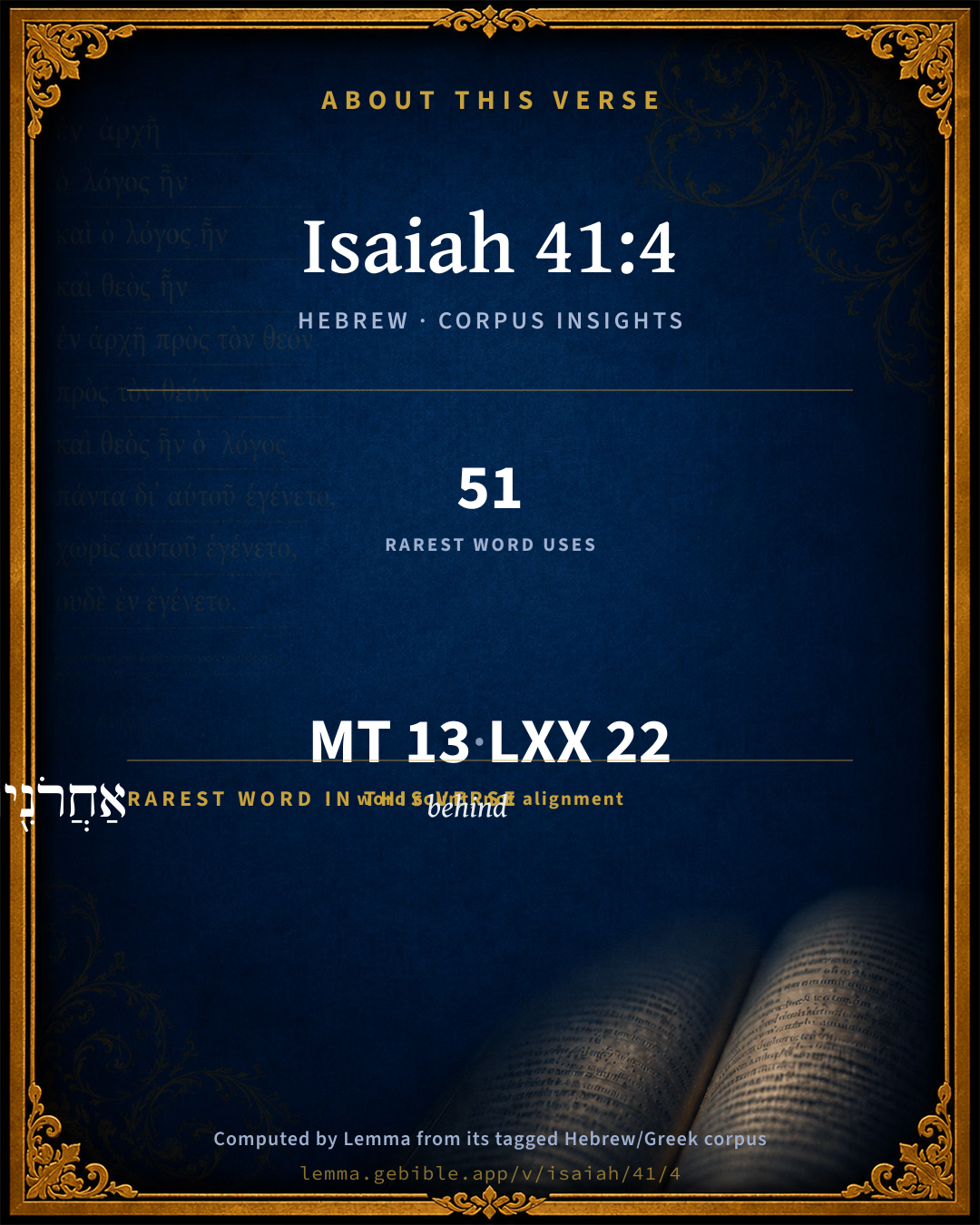
About this verse

These counts appear in no published source. They are computed here, from the morphology-tagged text and Lemma’s own curated glosses. What Lemma adds →

13
words
12
distinct lemmas
Prophets
section

Shared distinctive vocabulary

אַחֲרֹנִ֖ים behind H314 occurs in 48 verses of the Hebrew Bible. Also found in:

Grammatical profile

  • 3 verbs
  • 3 nouns
  • 2 adjectives
  • 3 pronouns
  • 1 preposition
  • 1 particle

Verb forms

  • פָעַ֣ל Qal · Perfect
  • וְעָשָׂ֔ה Qal · Perfect
  • קֹרֵ֥א Qal · Participle Active

Repetition

A word recurs within this verse — often emphatic in Hebrew:

  • אֲנִ֤י I H589 ×2

Hebrew & Septuagint length

In English translation the verse runs 23 words from the Hebrew and 29 from the Septuagint (LXX English) — closely comparable.

A rough comparison of the two English renderings, which tokenize alike — not a word-level alignment.

Word counts can differ between the Hebrew and the Greek without any difference in meaning — e.g. the Hebrew direct-object marker אֵת has no separate Greek word, and Greek often adds the article ὁ.

In the original languages it is 13 Hebrew tokens and 22 Greek tokens — but the two are counted differently (Hebrew bundles its prefixes and suffixes into one token; the Greek is in lemma form), so that isn’t a like-for-like length.

Cross-references

20

Topical passages linked to Isaiah 41:4 in the Treasury of Scripture Knowledge — connected by theme and wording, ordered by reader-vote popularity; previews shown in the World English Bible.

  • Isaiah 48:12 Listen to me, O Jacob, and Israel my called: I am he; I am the first, I also am the last.
  • Revelation 22:13 I am the Alpha and the Omega, the First and the Last, the Beginning and the End.
  • Revelation 1:17 When I saw him, I fell at his feet like a dead man. He laid his right hand on me, saying, "Don't be afraid. I am the first and the last,
  • Isaiah 44:6–7 Thus says Yahweh, the King of Israel, and his Redeemer, Yahweh of Hosts: I am the first, and I am the last; and besides me there is no God.
  • Isaiah 46:10 declaring the end from the beginning, and from ancient times things that are not [yet] done; saying, My counsel shall stand, and I will do all my pleasure;
  • Isaiah 41:26 Who has declared it from the beginning, that we may know? and before, that we may say, [He is] right? yes, there is none who declares, yes, there is none who shows, yes, there is none who hears your words.
  • Isaiah 43:10 You are my witnesses, says Yahweh, and my servant whom I have chosen; that you may know and believe me, and understand that I am he: before me there was no God formed, neither shall there be after me.
  • Revelation 1:8 "I am the Alpha and the Omega," says the Lord God, "who is and who was and who is to come, the Almighty."
  • Deuteronomy 32:7–8 Remember the days of old, Consider the years of many generations: Ask your father, and he will show you; Your elders, and they will tell you.
  • Acts 17:26 He made from one blood every nation of men to dwell on all the surface of the earth, having determined appointed seasons, and the boundaries of their dwellings,
  • Revelation 2:8 "To the angel of the assembly in Smyrna write: "The first and the last, who was dead, and has come to life says these things:
  • Isaiah 42:24 Who gave Jacob for a spoil, and Israel to the robbers? Didn't Yahweh? he against whom we have sinned, and in whose ways they would not walk, neither were they obedient to his law.
  • Isaiah 40:12 Who has measured the waters in the hollow of his hand, and meted out the sky with the span, and comprehended the dust of the earth in a measure, and weighed the mountains in scales, and the hills in a balance?
  • Isaiah 48:3–7 I have declared the former things from of old; yes, they went forth out of my mouth, and I shown them: suddenly I did them, and they happened.
  • Revelation 1:11 saying, "What you see, write in a book and send to the seven assemblies: to Ephesus, Smyrna, Pergamum, Thyatira, Sardis, Philadelphia, and to Laodicea."
  • Isaiah 40:26 Lift up your eyes on high, and see who has created these, who brings out their host by number; he calls them all by name; by the greatness of his might, and because he is strong in power, not one is lacking.
  • Isaiah 46:3–4 Listen to me, house of Jacob, and all the remnant of the house of Israel, that have been borne [by me] from their birth, that have been carried from the womb;
  • Matthew 1:23 "Behold, the virgin shall be with child, And shall bring forth a son. They shall call his name Immanuel;" Which is, being interpreted, "God with us."
  • Matthew 28:20 teaching them to observe all things that I commanded you. Behold, I am with you always, even to the end of the age." Amen.
  • Acts 15:18 All his works are known to God from eternity.'

Cross-references courtesy of OpenBible.info (CC BY 4.0).

Hebrew and Greek witnesses Masoretic Hebrew ↔ Greek Septuagint

The same verse in the two great witnesses to the Old Testament, shown verse-for-verse.

These are two independent witnesses, not word-aligned to each other, and the Septuagint is shown in lemma (dictionary) form.

Hebrew Isaiah 41:4 Masoretic · Westminster Leningrad Codex

מִֽי פָעַ֣ל וְעָשָׂ֔ה קֹרֵ֥א הַדֹּר֖וֹת מֵרֹ֑אשׁ אֲנִ֤י יְהוָה֙ רִאשׁ֔וֹן וְאֶת אַחֲרֹנִ֖ים אֲנִי הֽוּא

Who has worked and done it, calling the generations from the beginning? I, Yahweh, the first, and with the last, I am he.

World English Bible · Public Domain

Greek LXX Isaiah 41:4 Septuagint · lemma form

τίς ἐνεργέω καί ποιέω οὗτος καλέω αὐτός ὁ καλέω αὐτός ἀπό γενεά ἀρχή ἐγώ θεός πρῶτος καί εἰς ὁ ἐπιἔρχομαι ἐγώ εἰμί

Who has wrought and done these things? he has called it who called it from the generations of old; I God, the first and to all futurity, I AM.

LXX2012 (modern English Septuagint) · Public Domain

On this verse, Adam Clarke's Commentary discusses the Septuagint’s reading. Read the note in Commentary ↓

Hebrew: Westminster Leningrad Codex (CC BY 4.0). Greek: Septuagint (public domain); English from LXX2012 (modern English Septuagint) (Public Domain). How the Septuagint differs from the Hebrew →

Targum (Aramaic paraphrase)

1

The Targum is the ancient Jewish Aramaic paraphrase of the Hebrew Scriptures — an interpretive translation, not the Hebrew text itself. Onkelos (literal) and Pseudo-Jonathan (expansive) render the Torah, and Jonathan the Prophets. Coverage is partial: where no permissively-licensed English translation exists for a verse, only the Aramaic is shown. This is verse-level text, not a word-by-word alignment to the Hebrew.

  1. Targum Jonathan Prophets (Joshua–Malachi)
    מַן אֲמַר אִלֵין קַיָם אֲמַר וַעֲבִיד וְסִדַר דָרַיָא מִלְקָדְמִין אֲנָא יְיָ בָּרֵית עַלְמָא מִבְּרֵאשִׁית אַף עַלְמֵי עָלְמַיָא דִילִי אִינוּן בַּר מִנִי לֵית אֱלָהָא:

    Who hath promised these things and established them? Who hath spoken, and it was done? And who hath ranged the generations in their order from the beginning? I, the Lord, I created the world from the beginning; yea, ages after ages are mine, and besides me there is no God.

    Targum Jonathan — Aramaic: “Mikraot Gedolot” (public domain). English: “Sefaria Community Translation” (CC0 1.0 (public-domain dedication)); “London "Chaldee Paraphrase," 1871” (public domain). Text via Sefaria.

Commentary

Notes on Isaiah 41:4 from classic Christian and Jewish commentators (each source and its license shown beneath its notes). The classic Christian expositions comment on the surrounding passage and are grouped to its opening verse, so a note may address several verses; the Jewish commentaries on the Tanakh (Rashi and others) are per-verse, so they appear only where the commentator wrote on this verse.

Lemma curates 59 commentaries, every one of them public domain or Creative Commons licensed, each selected and text-cleaned for this edition rather than reprinted as found. About our sources →

Trapp's Complete Commentary

John Trapp

Isa 41:4 Who hath wrought and done [it], calling the generations from the beginning? I the LORD, the first, and with the last; I [am] he.

Ver. 4. Who hath wrought and done it?] Here the Gentiles should have answered for God, which because they did not, but were senselessly silent, therefore he answereth by a description of himself.

Calling the generations from the beginning.] Giving them their being, and having them at a beck.

I the Lord, the first, and with the last.] πρωτος τε και υστατος, εν τε μεσοι σιν. This was anciently believed concerning God, as Plato {a} testifieth. A te principium tibi desinet. {b}

{a} De Leg., lib. iv.

{b} Virgil.

John Trapp, A Commentary or Exposition upon All the Books of the Old and New Testament (1647–1656) — public domain. Text from a community e-Sword module.

The Biblical Illustrator

Joseph S. Exell

Isa_41:4

I the Lord, the first, and with the last

I.

LOOK AT GOD IN HIS PRIMARY RELATION TO HIS CREATURE. Understand clearly that everything which is was first an idea in the mind of God. Thence, by a creative act, it came forth and took form and being. So God was first, long before all His works--as the mould is before the castings. Here is the truth and glory of predestination, that great argument of all comfort. It places God far away, beyond our little horizon, in advance of everything. Whatever is, is to fulfil its preordained purpose; each thing coming up and rising in its turn; everything a reflection of the eternal love, care, and wisdom which dwelt from everlasting in the mind of God.

II. WITH THE LAST. There are those who say, This world is on the decline and growing worse. Can it be, if He who was First is with the last--the same God yesterday, to-day, and for ever,the equal portion of all times? Is it not sufficient argument? The golden age cannot be over. From the fleeting and the changing, from the disappointing and the dying, I yearn to ask, Where is the true? Where is that which my soul wants, and for which my restless spirit has so long been craving, what shall satisfy my immortality? And the answer comes, as a whisper in the desert, louder and clearer from the solitude of my hearts waste places, I the Lord, the First, and with the last; I am He. (J. Vaughan, M. A.)

The Biblical Illustrator, edited by Joseph S. Exell (c. 1880s–1900s) — public domain. Text from a community e-Sword module.

Joseph Benson's Commentary

Isa 41:4-6. Who hath done it? — Whose work was this but mine? Calling the generations — Calling them out of nothing; giving them breath and being; disposing and employing them as I see fit: from the beginning — All persons and generations of mankind from the beginning of the world. I the Lord, the first, &c. — Who was before all things, even from eternity, and shall be unto eternity: the isles saw it, and feared — Even remote countries discerned the mighty work of God in delivering his people, and overthrowing their enemies in so wonderful a manner, and were afraid lest they should be involved in the same calamity. The ends of the earth drew near and came — They gathered themselves together to consult for their common safety, and to maintain the cause of their idols, which, by this instance, they perceived to be in great jeopardy. They helped every one his neighbour — They encouraged and assisted one another in their idolatrous practices. “Remote countries,” says Lowth, “were astonished at the sudden rise of the conqueror Cyrus, and joined in an alliance to check his growing greatness, just as several artificers that are concerned in the trade of idol- making assist one another in carrying on their common interest, and stir up the zeal of others in defence of image-worship:” see Act 19:25. Or, according to others, the prophet describes in these verses the vain and fruitless attempt of idolaters to hinder the effect of Cyrus’s appearance, namely, the demolition of Babylon and its idols. “The passage maybe also fitly applied to the heathen powers combining together to support idolatry, and suppress the Christian religion.”

Joseph Benson's Commentary on the Old and New Testaments (1811–1818) — public domain. Text from a community e-Sword module.

Tyndale Open Study Notes

Tyndale Open Resources

41:4 each new generation from the beginning of time: God is sovereign over all things. From the beginning he has unfolded each stage of history according to his plan. • In the book of Revelation, Jesus identifies himself as the Alpha and the Omega, the First and the Last, the Beginning and the End (Rev 1:8, 17; 2:8; 21:6; 22:13). • I alone am he: The Lord alone is God (see also Isa 43:10, 13; 46:4; 48:12; Deut 32:39). Jesus used similar expressions for himself (see John 6:35; 8:12, 24; 9:5; 10:7, 9, 11, 14; 11:25; 14:6; 15:1, 5).

Tyndale Open Study Notes — © Tyndale Open Resources, licensed CC BY-SA 4.0. Text via the HelloAO Bible API.

Geneva Bible (1599)

Geneva Bible translators

Who hath created man and maintained his succession.

Though the world set up never so many gods, yet they diminish nothing of my glory: for I am all one, unchangeable, which have ever been, and shall be forever.

Geneva Bible (1599) marginal notes — public domain. Text via Bolls.life.

Jamieson, Fausset & Brown

Robert Jamieson, A. R. Fausset & David Brown

Who--else but God?

calling . . . generations from . . . beginning--The origin and position of all nations are from God (Deu 32:8; Act 17:26); what is true of Cyrus and his conquests is true of all the movements of history from the first; all are from God.

with the last--that is, the last (Isa 44:6; Isa 48:12).

Jamieson, Fausset & Brown — Commentary Critical and Explanatory on the Whole Bible (1871) — public domain (CC PDM 1.0). Text via the HelloAO Bible API.

Adam Clarke's Commentary

Verse 4. Who hath wrought and done it - "Who hath performed and made these things"] A word is here lost out of the text. It is supplied by an ancient MS., אלה elleh, "these things;" and by the Septuagint, ταυτα; and by the Vulgate, haec; and by the Chaldee, אלן elin; all of the same meaning.

Adam Clarke's Commentary on the Bible (1810–1826) — public domain. Text from a community e-Sword/MySword module.

Ellicott's Commentary for English Readers

(4) I the Lord . . .—The words are the utterance of the great thought of eternity which is the essence of the creed of Israel (comp. Exo_3:14; Psa_90:2; Psa_102:26), and appear in the Alpha and Omega of Rev_1:11; Rev_4:8. The identical formula, “I am He” meets us in Isa_43:10; Isa_43:13; Isa_46:4; Isa_48:12. It is probably used as an assertion of an eternal being in the “I AM” of Joh_8:58.

A Bible Commentary for English Readers, edited by Charles John Ellicott (1878–1897) — public domain. Text from a community e-Sword module.

The Cambridge Bible for Schools and Colleges

gen. ed. J. J. S. Perowne

4. The answer.

calling the generations from the beginning] i.e. guiding the destinies of the nations from the origins of human history. The clause should be connected with what follows: it belongs to the answer, not to the question (“He that calleth”).

I am he] Cf. ch. Isa_43:10; Isa_43:13, Isa_46:4, Isa_48:12, also Psa_102:27. The sense which best suits the various passages is, “I am the same.” There is probably an allusion to the explanation of the name Jehovah in Exo_3:14 ff. Jehovah is “the First,” existing before history began to run its course, and He is “with the last,” an ever-present, unchanging God.

The Cambridge Bible for Schools and Colleges (gen. ed. J. J. S. Perowne; Cambridge University Press, 1878–1918) — public domain. Text from a community e-Sword module.

John Gill's Exposition

Who hath wrought and done it,.... Contrived and effected it, formed the scheme, and brought it to pass; namely, raising up the righteous man from the east, and succeeding him in the manner described:

calling the generations from the beginning? or rather here begins the answer to the above question, which may be rendered,

he that calleth the generations from the beginning (k); he has wrought and done this; and to this agree the Syriac and Arabic versions; even he that knew them from all eternity, before they were, and all the men that would be in them, and could call them by their names; and who calls things that are not, as though they were; and who calls them into being at the appointed time, and continues a succession of them, one after another; who calls by his grace all that are called in successive generations, and rules over them by his power, providence, and grace:

I the Lord, the first, and with the last; I am he; the immutable Jehovah, the everlasting I AM, the Alpha and the Omega, the beginning and the ending, the first and the last; all which is said of Christ, and is the person here speaking, Rev 1:8, phrases expressive of his eternity and deity; he is the first and the last in God's thoughts, purposes, and decrees; in the covenant of grace; in the creation of all things; in the salvation, justification, sanctification, adoption, and glorification of his people; and in the church, above and below:

and with the last, may be understood either of the last generations God is with, and calls as well as the first, as De Dieu; or of all believers, with whom he shall be and they with him to all eternity, so Gussetius (l). Now the conversion of the Apostle Paul, his commission to preach the Gospel, the extraordinary qualifications he was endowed with, the wonderful things done by him, in the conversion of sinners, and planting of churches in the Gentile world, and towards the abolition of Paganism in it, are incontestable proofs of the deity of Christ; no mere creature could ever have raised up, such a man, and accomplished him in such a manner, or wrought such things by him.

(k) "ille qui vocat vel vocavit generationes ab inito", Munster, Tigurine version. So some in Vatablus. (l) Comment. Ebr. p. 29.

John Gill's Exposition of the Whole Bible (1746–1763) — public domain (CC PDM 1.0). Text via the HelloAO Bible API.

Albert Barnes' Notes on the Bible

Who hath wrought and done it? - By whom has all this been accomplished? Has it been by the arm of Cyrus? Has it been by human skill and powers. The design of this question is obvious. It is to direct attention to the fact that all this had been done by God, and that he who had raised up such a man, and had accomplished all this by means of him, had power to deliver his people.

Calling the generations from the beginning - The idea here seems to be, that all the nations that dwell on the earth in every place owed their origin to God (compare Act 17:26). The word ‘calling’ here, seems to be used in the sense of commanding, directing, or ordering them; and the truth taught is, that all the nations were under his control, and had been from the beginning. It was not only true of Cyrus, and of those who were subdued before him, but it was true of all nations and generations. The object seems to be, to lift up the thoughts from the conquests of Cyrus to God’s universal dominion over all kingdoms from the beginning of the world.

I the Lord, the first - Before any creature was made; existing before any other being. The description that God here gives of himself as ‘the first and the last,’ is one that is often applied to him in the Scriptures, and is one that properly expresses eternity (see Isa 44:6; Isa 48:12). It is remarkable also that this expression, which so obviously implies proper eternity, is applied to the Lord Jesus in Rev 1:17; Rev 22:13.

And with the last - The usual form in which this is expressed is simply ‘the last’ Isa 44:6; Isa 48:12. The idea here seems to be, ‘and with the last, I am the same;’ that is, I am unchanging and eternal. None will subsist after me; since with the last of all created objects I shall be the same that I was in the beginning. Nothing would survive God; or in other words, he would exist forever and ever. The argument here is, that to this unchanging and eternal God, who had thus raised up and directed Cyrus, and who had control over all nations, they might commit themselves with unwavering confidence, and be assured that he was able to protect and deliver them.

Albert Barnes' Notes on the Bible (1834–1885) — public domain. Text from a community e-Sword/MySword module.

Haydock's Catholic Bible Commentary

Beginning. Disposing all things, as the conquests of Cyrus, announced so long before by name, evince. --- Last. Alpha and Omega, Apocalypse i. 8., and xxii. 13.

George Leo Haydock (1774–1849), Haydock's Catholic Family Bible and Commentary, 1859 edition — public domain. Excludes Psalms (Douay-Rheims chapter numbering differs from Protestant) and Deuterocanonical books (Catholic canon only).

Matthew Poole's English Annotations

Who hath wrought and done it? whose work was this but mine?

Calling; either,

1. Calling them out of nothing, giving to them breath and being; or,

2. Calling them to his foot, as he said above, Isa 41:2, disposing and employing them as he sees fit, sending them upon his errands.

The generations from the beginning; all persons and generations of mankind from the beginning of the world to the end of it.

The first, and with the last; who was before all things, even from eternity, and shall be unto eternity; whereas the idols, to whom God herein opposeth himself, were but of yesterday, being made by men’s hands, and shall within a little time vanish, and be destroyed.

Matthew Poole's English Annotations on the Holy Bible (1683–1685) — public domain. Text from a community e-Sword/MySword module.

Whedon's Commentary on the Bible

Daniel D. Whedon

4. Who hath wrought and done it — That is, hath raised up such a conqueror, and from the beginning, from the far past, has had the fact predicted? With august authority the Lord claims himself as the sole author.

I the Lord, the first, and with the last — “The first,” before any other being existed: “with the last,” or to the last, in all the movements of history.

Daniel D. Whedon (gen. ed.), Commentary on the Old and New Testaments (1874–1909) — public domain. Text from a community e-Sword module.

The Pulpit Commentary

Who hath wrought and done it? i.e. "by whom has this mighty conqueror been raised up?" Can any of the idol-gods claim him as their protege? Assuredly not. He is my work; I, Jehovah, that have called (into being) the generations (of man) from the beginning (of the world) I, Jehovah, the First, and with the last, am he that he has done this thing. By "the First, and with the last a favourite phrase in these later chapters (see Isa_45:6 and Isa_48:12) seems to be meant simply "the Eternal". (comp. Rev_1:8, Rev_1:11, 17 2:8 21:6 22:13)

HOMILIES BY R. TUCK Ver. 4. The eternal Alpha and Omega.

The idea of these verses seems to be this look back, if you will, to the very beginnings of nations: God is there. Watch the changes of nations, the uprising of great kings and leaders: God is presiding over all. Peer into the dim mysteries of the future, and still God is controlling and overruling all. The thought here set before the nation finds expression in the private meditations of the psalmist (Psalm 139). Nowhere can he get away from the sense of God"s presence, and nowhere would he if he could. How fully the Apostle John was imbued with the spirit of the great prophets is well illustrated in the fact that his thought of the manifested God is the old prophetic thought. The glorified and living Christ is revealed to him as saying, "I am Alpha and Omega, the Beginning and the Ending, which is, and which was, and which is to come, the Almighty". (Rev_1:8) Some think the "righteous man," referred to in ver. 2, is Abraham, regarded as the first father of the Hebrew nation; and this view finds some support in the expression found in ver. 4, "calling the generations from the beginning;" but it is evident that the mind of Isaiah was at this time filled with the return from captivity, and with the Divine raising up of Cyrus as the human agent in effecting that return. And this Cyrus is to him the suggestion of the glorious spiritual Deliverer, who should appear later on to redeem his people from their sins; not first from their sorrows, but first and chiefly from their sins. So we may cover the long ages in our thought. Abraham raised up by God. Moses set forth by God. Cyrus called out by God. Messiah the Sent One of God. "I the Lord, the First, and with the last, I am he." This view of our God may be taken as

I A CONTRAST WITH ALL MAN-MADE GODS. This is the prophet"s great point. A man-made, or man-conceived, god comes second. Man, in that case is first; the god is his creature, and the creation of a being involves that it is inferior to its creator. God comes first; he is before man. Man is his creature, and set under his conditions.

II A HOPE WHEN MAN CAN MAKE NO MORE GODS. That time comes by dissatisfaction. None of his gods bring him rest, and at last he will try to make no more. Then God lives, and may be the soul"s Rest. That time comes by the ending of the earth-life; but even then God lives, and we may live in him.

III A SATISFACTION FOR ALL BETWEEN TIMES. If he is first, and is last, then surely he covers and includes all the space between, and we may well turn from all self-trusts and idol-trusts, and seek now the rest, the joy, of his love and favour and service. "This God is our God for ever and ever; he will be our Guide unto death. R.T.

The Pulpit Commentary (1880–1919), ed. H.D.M. Spence-Jones & Joseph S. Exell — public domain. Text from a community e-Sword module.

John Wesley's Explanatory Notes

Calling - Them out of nothing, giving them breath and being: disposing and employing them as he sees fit. From the beginning - All persons and generations of mankind from the beginning of the world. I - Who was before all things even from eternity, and shall be unto eternity.

John Wesley, Explanatory Notes Upon the Whole Bible (1754–1765) — public domain. Text via the GEBible commentary corpus.

Keil & Delitzsch

C. F. Keil & F. Delitzsch

The great fact of the present time, which not one of the gods of the heathen can boast of having brought to pass, is now explained. Jehovah is its author. "Who hath wrought and executed it? He who calleth the generations of men from the beginning, I Jehovah am first, and with the last am I He." The synonyms פּעל and עשׂה are distinguished from each other in the same way as "to work" (or bring about) and "to realize" (or carry out). Hence the meaning is, Who is the author to whom both the origin and progress of such an occurrence are to be referred? It is He who "from the beginning," i.e., ever since there has been a human history, has called into existence the generations of men through His authoritative command. And this is no other than Jehovah, who can declare of Himself, in contrast with the heathen and their gods, who are of yesterday, and tomorrow will not be: I am Jehovah, the very first, whose being precedes all history; and with the men of the latest generations yet to come "I am it." הוּא is not introduced here to strengthen the subject, ego ille "I and no other," as in Isa 37:16, which see); but, as in Isa 43:10, Isa 43:13; Isa 56:4; Isa 48:12, it is a predicate of the substantive clause, ego sum is (ille), viz., 'Elōhı̄m; or even as in Psa 102:28 (cf., Job 3:19 and Heb 13:8), ego sum idem (Hitzig). They are both included, without any distinction in the assertion. He is this, viz., God throughout all ages, and is through all ages He, i.e., the Being who is ever the same in this His deity. It is the full meaning of the name Jehovah which is unfolded here; for God is called Jehovah as the absolute I, the absolutely free Being, pervading all history, and yet above all history, as He who is Lord of His own absolute being, in revealing which He is purely self-determined; in a word, as the unconditionally free and unchangeably eternal personality.

Keil & Delitzsch — Biblical Commentary on the Old Testament (1861–1891) — public domain (CC PDM 1.0). Text via the HelloAO Bible API. (Old Testament only.)

J. A. Alexander on Isaiah

Joseph Addison Alexander

“Who hath wrought and done (it), calling the generations from the beginning? I Jehovah, the first and with the last, I (am) He.” ‘Calling the generations’ may either mean calling them into existence or proclaiming them, (i.e., predicting them); probably the latter, since the event itself, although it proved a superhuman agency, did not prove it to be that of Jehovah, which could only be established by the fulfillment of predictions uttered in his name. ‘With the last’ does not simply mean the last, which is the form employed in Isa 41:21-25; Isa 46:8-10, but co-existent with ‘the last’, a mode of expression which would seem to imply that although Jehovah existed before all other beings He will not outlast them all. I am He, (i.e., the being to whom the interrogation has respect), ‘I am He Who has wrought and done it’.

Joseph Addison Alexander, The Prophecies of Isaiah (1846–1847; New York: Scribner, 1870–1878) — public domain. Text from a community e-Sword module.

Rashi

Rabbi Shlomo Yitzchaki (Rashi)

Who worked and did for him all this? He Who called the generations from the beginning, to Adam, He did this also for Abraham.

I, the Lord, am first to perform wonders and to aid.

and with the last ones I am He Also with you, the last sons, I will be, and I will aid you.

Rashi on the Tanakh — English translations: “The Judaica Press complete Tanach with Rashi, translated by A. J. Rosenberg” (CC BY 4.0); “Pentateuch with Rashi's commentary by M. Rosenbaum and A.M. Silbermann, 1929-1934” (public domain); “The Metsudah Tanach series, Lakewood, N.J” (CC BY 4.0); and “The Book of Joshua, Metsudah Publications, 1997” (CC BY 4.0). Text via Sefaria.

Ibn Ezra

Rabbi Abraham ibn Ezra

עשה Hath prepared. Comp. לעשות to dress (Gen. 18:7). Who has done this? God has done it, who is calling the generations from the beginning, before they come into existence; who knows all future generations, and cites each of them to appear in its right time.

The first of all generations that have hitherto existed. And with the last, with the last generations.

Ibn Ezra on the Tanakh — English translations: “Sefaria Community Translation” (CC0 1.0 (public-domain dedication)); “Yalkut, Sifsei Chachomim Chumash, Metsudah Publications, 2009” (CC BY 4.0); and “Commentary of Ibn Ezra on Isaiah - trans. by M. Friedlander, 1873” (public domain). Text via Sefaria.

Lesson kit

Teaching starters — assembled from the data on this page, not authored interpretation. Every prompt links to the verse data it draws on. Edit before teaching.

Isaiah, in the Prophets, opens this verse with 13 words (12 distinct Hebrew lemmas). Its most distinctive word is ʼachărôwn (“behind”). A historical commentator’s framing appears above. Read the whole chapter for the surrounding context.

Discussion questions

  1. What does “behind” (ʼachărôwn) contribute to the verse as a whole?
  2. Genesis 33:2 shares the word «behind» with this verse. How do the two illuminate each other?
  3. “I” occurs 2× in this one verse. What is the effect of the repetition?
  4. These translations render this verse differently. What is at stake in choosing one wording over another?
  5. The verb «פָעַ֣ל» is Qal Perfect. How does its form color the action?
  6. Reading how Trapp's Complete Commentary and The Biblical Illustrator read this verse, where do the two commentators agree and where do they part?

Things to notice

Reading settings

Reading text

Shown beneath each verse's original-language words.

Old Testament
Old Testament edition

Read the OT as the Masoretic Hebrew (MT) or the Greek Septuagint (LXX).

English shown for the Greek Septuagint (in the Hebrew ↔ Greek comparison).

Comparing translations? Open the Compare panel on any verse page to stack up to four side by side.