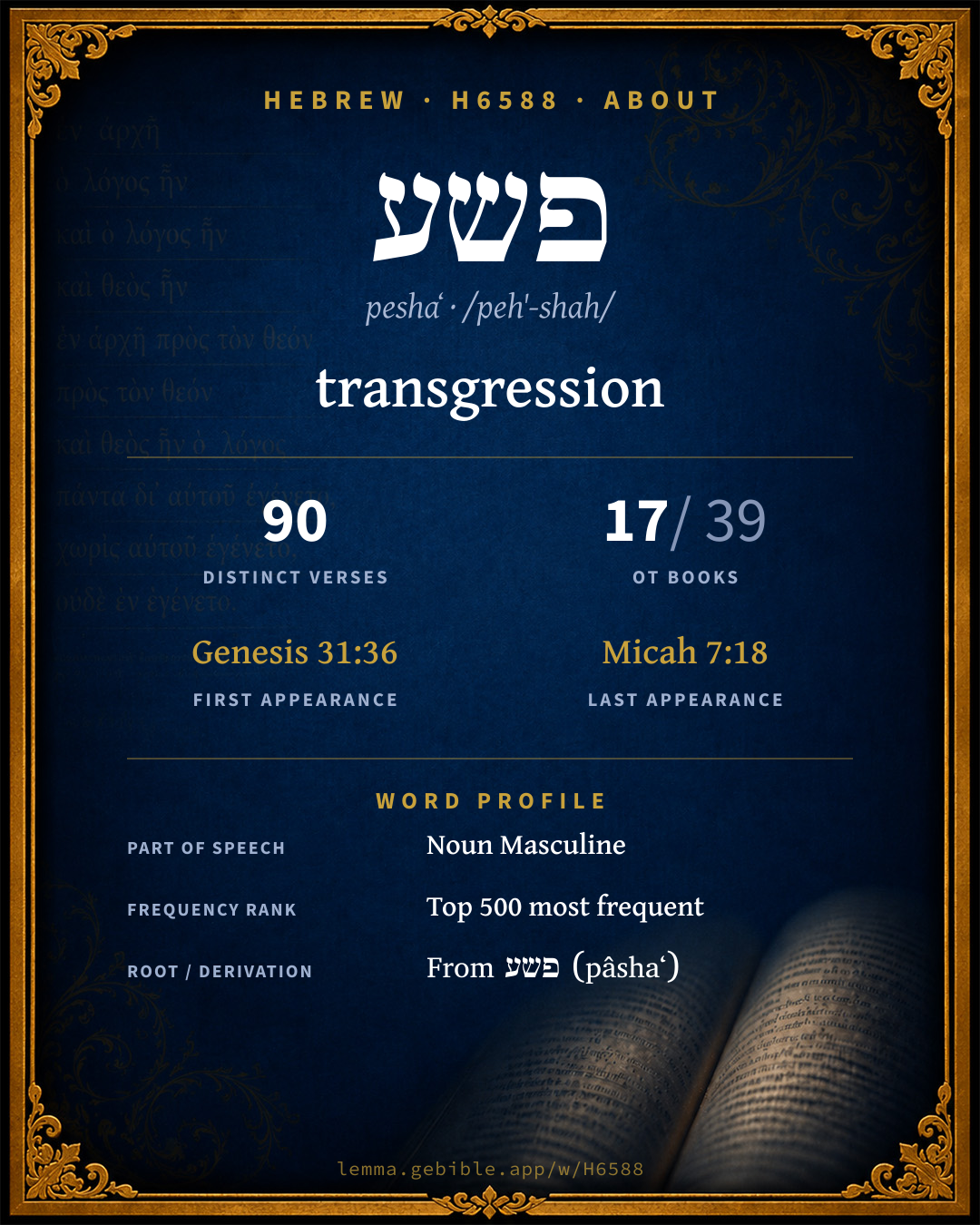
פֶּ֫שַׁע
transgression
‘transgression’ is one of 7 main senses fuller range ↓
Full lexicon entry — Brown-Driver-Briggs (BDB)
From Brown-Driver-Briggs (BDB)
Where this word appears
See every Construct-state word in the Hebrew Bible →
Grammar key — what these labels mean
Part of speech
- Noun
- A naming word — a person, place, thing, or idea.
Noun type
- Common
- A common noun — a general class of person, place, or thing (“king,” “city,” “water”), not a specific name.
State
- Absolute
- The independent form of a noun, not bound to a following word.
- Construct
- A noun bound to a following noun in a possessive / “of” relationship (the construct chain).
Gender
- Masculine
- Grammatically masculine.
Number
- Singular
- One.
- Plural
- More than one (in Hebrew, generally three or more).
Grammatical forms
- Noun, Common, Masculine, Plural, Construct 45 times (48%)
- Noun, Common, Masculine, Singular, Construct 24 times (26%)
- Noun, Common, Masculine, Singular, Absolute 23 times (25%)
- Noun, Common, Masculine, Plural, Absolute 1 time (1%)
Parsed forms decoded from the imported morphology (morphhb / Westminster Leningrad Codex — WLC text public domain, morphhb tagging CC BY 4.0), counted across 93 parsed occurrences — not distinct verses.
Every verse where H6588 appears — 90 distinct verses across 17 books. Click any verse to open its interlinear word-by-word view. Verse text shown in the World English Bible for context — . Each verse’s Hebrew form is shown with its reference; the English is not keyword-highlighted, since the data carries no word-level English alignment. Use “Compare translations” on any verse to read it across multiple English versions. This concordance covers the Hebrew Bible; Septuagint (Greek Old Testament) occurrences are not indexed here.
Genesis 2 verses
- Genesis 31:36 פִּשְׁעִ/י֙ n c ms cs + sfx pers 1cs Jacob was angry, and argued with Laban. Jacob answered Laban, "What is my trespass? What is my sin, that you have hotly pursued after me?
- Genesis 50:17 פֶּ֣שַׁע לְ/פֶ֥שַׁע n c ms cs prep + n c ms cs "So you shall tell Joseph, 'Now please forgive the disobedience of your brothers, and their sin, because they did evil to you.' Now, please forgive the disobedience of the servants of the God of your father." Joseph wept when they spoke to him.
Exodus 3 verses
- Exodus 22:9 פֶּ֡שַׁע n c ms For every matter of trespass, whether it be for ox, for donkey, for sheep, for clothing, or for any kind of lost thing, about which one says, 'This is mine,' the cause of both parties shall come before God. He whom God condemns shall pay double to his neighbor.
- Exodus 23:21 לְ/פִשְׁעֲ/כֶ֔ם prep + n c ms cs + sfx pers 2mp Pay attention to him, and listen to his voice. Don't provoke him, for he will not pardon your disobedience, for my name is in him.
- Exodus 34:7 וָ/פֶ֖שַׁע conj + n c ms keeping loving kindness for thousands, forgiving iniquity and disobedience and sin; and that will by no means clear the guilty, visiting the iniquity of the fathers on the children, and on the children's children, on the third and on the fourth generation."
Leviticus 2 verses
- Leviticus 16:16 וּ/מִ/פִּשְׁעֵי/הֶ֖ם conj + prep + n c mp cs + sfx pers 3mp and he shall make atonement for the Holy Place, because of the uncleanness of the children of Israel, and because of their transgressions, even all their sins; and so he shall do for the Tent of Meeting, that dwells with them in the midst of their uncleanness.
- Leviticus 16:21 פִּשְׁעֵי/הֶ֖ם n c mp cs + sfx pers 3mp Aaron shall lay both his hands on the head of the live goat, and confess over him all the iniquities of the children of Israel, and all their transgressions, even all their sins; and he shall put them on the head of the goat, and shall send him away into the wilderness by the hand of a man who is in readiness.
Numbers 1 verse
Joshua 1 verse
1 Samuel 2 verses
- 1 Samuel 24:11 וָ/פֶ֨שַׁע֙ conj + n c ms Moreover, my father, behold, yes, see the skirt of your robe in my hand; for in that I cut off the skirt of your robe, and didn't kill you, know you and see that there is neither evil nor disobedience in my hand, and I have not sinned against you, though you hunt after my life to take it.
- 1 Samuel 25:28 לְ/פֶ֣שַׁע prep + n c ms cs Please forgive the trespass of your handmaid: for Yahweh will certainly make my lord a sure house, because my lord fights the battles of Yahweh; and evil shall not be found in you all your days.
1 Kings 1 verse
Job 10 verses
- Job 7:21 פִשְׁעִ/י֮ n c ms cs + sfx pers 1cs Why do you not pardon my disobedience, and take away my iniquity? For now shall I lie down in the dust. You will seek me diligently, but I shall not be."
- Job 8:4 פִּשְׁעָֽ/ם n c ms cs + sfx pers 3mp If your children have sinned against him, He has delivered them into the hand of their disobedience;
- Job 13:23 פִּֽשְׁעִ֥/י n c ms cs + sfx pers 1cs How many are my iniquities and sins? Make me know my disobedience and my sin.
- Job 14:17 פִּשְׁעִ֑/י n c ms cs + sfx pers 1cs My disobedience is sealed up in a bag. You fasten up my iniquity.
- Job 31:33 פְּשָׁעָ֑/י n c mp cs + sfx pers 1cs If like Adam I have covered my transgressions, By hiding my iniquity in my heart,
- Job 33:9 פָ֥שַׁע n c ms 'I am clean, without disobedience. I am innocent, neither is there iniquity in me:
- Job 34:6 פָֽשַׁע n c ms Notwithstanding my right I am considered a liar; My wound is incurable, though I am without disobedience.'
- Job 34:37 פֶ֭שַׁע n c ms For he adds rebellion to his sin. He claps his hands among us, And multiplies his words against God."
- Job 35:6 פְ֝שָׁעֶ֗י/ךָ n c mp cs + sfx pers 2ms If you have sinned, what effect do you have against him? If your transgressions are multiplied, what do you do to him?
- Job 36:9 וּ֝/פִשְׁעֵי/הֶ֗ם conj + n c mp cs + sfx pers 3mp Then he shows them their work, And their transgressions, that they have behaved themselves proudly.
Psalms 14 verses
- Psalms 5:10 פִּ֭שְׁעֵי/הֶם n c mp cs + sfx pers 3mp Hold them guilty, God. Let them fall by their own counsels; Thrust them out in the multitude of their transgressions, For they have rebelled against you.
- Psalms 19:13 מִ/פֶּ֥שַֽׁע prep + n c ms Keep back your servant also from presumptuous sins. Let them not have dominion over me. Then I will be upright, I will be blameless and innocent of great transgression.
- Psalms 25:7 וּ/פְשָׁעַ֗/י conj + n c mp cs + sfx pers 1cs Don't remember the sins of my youth, nor my transgressions. Remember me according to your loving kindness, For your goodness' sake, Yahweh.
- Psalms 32:1 פֶּ֗שַׁע n c ms Blessed is he whose disobedience is forgiven, Whose sin is covered.
- Psalms 32:5 פְ֭שָׁעַ/י n c mp cs + sfx pers 1cs I acknowledged my sin to you. I didn't hide my iniquity. I said, I will confess my transgressions to Yahweh, And you forgave the iniquity of my sin. Selah.
- Psalms 36:1 פֶּ֣שַׁע n c ms An oracle is within my heart about the disobedience of the wicked: "There is no fear of God before his eyes."
- Psalms 39:8 פְּשָׁעַ֥/י n c mp cs + sfx pers 1cs Deliver me from all my transgressions. Don't make me the reproach of the foolish.
- Psalms 51:1 פְשָׁעָֽ/י n c mp cs + sfx pers 1cs Have mercy on me, God, according to your loving kindness. According to the multitude of your tender mercies, blot out my transgressions.
- Psalms 51:3 פְ֭שָׁעַ/י n c mp cs + sfx pers 1cs For I know my transgressions. My sin is constantly before me.
- Psalms 59:3 פִשְׁעִ֖/י n c ms cs + sfx pers 1cs For, behold, they lie in wait for my soul. The mighty gather themselves together against me, Not for my disobedience, nor for my sin, Yahweh.
- Psalms 65:3 פְּ֝שָׁעֵ֗י/נוּ n c mp cs + sfx pers 1cp Sins overwhelmed me, But you atoned for our transgressions.
- Psalms 89:32 פִּשְׁעָ֑/ם n c ms cs + sfx pers 3mp Then I will punish their sin with the rod, And their iniquity with stripes.
- Psalms 103:12 פְּשָׁעֵֽי/נוּ n c mp cs + sfx pers 1cp As far as the east is from the west, So far has he removed our transgressions from us.
- Psalms 107:17 פִּשְׁעָ֑/ם n c ms cs + sfx pers 3mp Fools are afflicted because of their disobedience, And because of their iniquities.
Proverbs 12 verses
- Proverbs 10:12 פְּ֝שָׁעִ֗ים n c mp Hatred stirs up strife, But love covers all wrongs.
- Proverbs 10:19 פָּ֑שַׁע n c ms In the multitude of words there is no lack of disobedience, But he who restrains his lips does wisely.
- Proverbs 12:13 בְּ/פֶ֣שַׁע prep + n c ms cs An evil man is trapped by sinfulness of lips, But the righteous shall come out of trouble.
- Proverbs 17:9 פֶּ֭שַׁע n c ms He who covers an offense promotes love; But he who repeats a matter separates best friends.
- Proverbs 17:19 פֶּ֭שַׁע n c ms He who loves disobedience loves strife. One who builds a high gate seeks destruction.
- Proverbs 19:11 פָּֽשַׁע n c ms The discretion of a man makes him slow to anger. It is his glory to overlook an offense.
- Proverbs 28:2 בְּ/פֶ֣שַֽׁע prep + n c ms cs In rebellion, a land has many rulers, But order is maintained by a man of understanding and knowledge.
- Proverbs 28:13 פְ֭שָׁעָי/ו n c mp cs + sfx pers 3ms He who conceals his sins doesn't prosper, But whoever confesses and renounces them finds mercy.
- Proverbs 28:24 פָּ֑שַׁע n c ms Whoever robs his father or his mother, and says, "It's not wrong." He is a partner with a destroyer.
- Proverbs 29:6 בְּ/פֶ֤שַֽׁע prep + n c ms cs An evil man is snared by his sin, But the righteous can sing and be glad.
- Proverbs 29:16 פָּ֑שַׁע n c ms When the wicked increase, sin increases; But the righteous will see their downfall.
- Proverbs 29:22 פָּֽשַׁע n c ms An angry man stirs up strife, And a wrathful man abounds in sin.
Isaiah 10 verses
- Isaiah 24:20 פִּשְׁעָ֔/הּ n c ms cs + sfx pers 3fs The earth shall stagger like a drunken man, and shall sway back and forth like a hammock; and the disobedience of it shall be heavy on it, and it shall fall, and not rise again.
- Isaiah 43:25 פְשָׁעֶ֖י/ךָ n c mp cs + sfx pers 2ms I, even I, am he who blots out your transgressions for my own sake; and I will not remember your sins.
- Isaiah 44:22 פְּשָׁעֶ֔י/ךָ n c mp cs + sfx pers 2ms I have blotted out, as a thick cloud, your transgressions, and, as a cloud, your sins: return to me; for I have redeemed you.
- Isaiah 50:1 וּ/בְ/פִשְׁעֵי/כֶ֖ם conj + prep + n c mp cs + sfx pers 2mp Thus says Yahweh, Where is the bill of your mother's divorce, with which I have put her away? or which of my creditors is it to whom I have sold you? Behold, for your iniquities were you sold, and for your transgressions was your mother put away.
- Isaiah 53:5 מִ/פְּשָׁעֵ֔/נוּ prep + n c mp cs + sfx pers 1cp But he was pierced for our transgressions, he was crushed for our iniquities; the punishment that brought our peace was on him; and by his wounds we are healed.
- Isaiah 53:8 מִ/פֶּ֥שַׁע prep + n c ms cs By oppression and judgment he was taken away; and as for his generation, who [among them] considered that he was cut off out of the land of the living for the disobedience of my people to whom the stroke [was due]?
- Isaiah 57:4 פֶ֖שַׁע n c ms Against whom do you sport yourselves? against whom make you a wide mouth, and put out the tongue? Aren't you children of disobedience, a seed of falsehood,
- Isaiah 58:1 פִּשְׁעָ֔/ם n c ms cs + sfx pers 3mp Cry aloud, don't spare, lift up your voice like a trumpet, and declare to my people their disobedience, and to the house of Jacob their sins.
- Isaiah 59:12 פְשָׁעֵ֨י/נוּ֙ פְשָׁעֵ֣י/נוּ n c mp cs + sfx pers 1cp n c mp cs + sfx pers 1cp For our transgressions are multiplied before you, and our sins testify against us; for our transgressions are with us, and as for our iniquities, we know them:
- Isaiah 59:20 פֶ֖שַׁע n c ms A Redeemer will come to Zion, and to those who turn from disobedience in Jacob, says Yahweh.
Jeremiah 1 verse
Lamentations 3 verses
- Lamentations 1:5 פְּשָׁעֶ֑י/הָ n c mp cs + sfx pers 3fs Her adversaries are become the head, her enemies prosper; For Yahweh has afflicted her for the multitude of her transgressions: Her young children are gone into captivity before the adversary.
- Lamentations 1:14 פְּשָׁעַ֜/י n c mp cs + sfx pers 1cs The yoke of my transgressions is bound by his hand; They are knit together, they are come up on my neck; he has made my strength to fail: The Lord has delivered me into their hands, against whom I am not able to stand.
- Lamentations 1:22 פְּשָׁעָ֑/י n c mp cs + sfx pers 1cs Let all their wickedness come before you; Do to them, as you have done to me for all my transgressions: For my sighs are many, and my heart is faint.
Ezekiel 10 verses
- Ezekiel 14:11 פִּשְׁעֵי/הֶ֑ם n c mp cs + sfx pers 3mp that the house of Israel may go no more astray from me, neither defile themselves any more with all their transgressions; but that they may be my people, and I may be their God, says the Lord Yahweh.
- Ezekiel 18:22 פְּשָׁעָי/ו֙ n c mp cs + sfx pers 3ms None of his transgressions that he has committed shall be remembered against him: in his righteousness that he has done he shall live.
- Ezekiel 18:28 פְּשָׁעָ֖י/ו n c mp cs + sfx pers 3ms Because he considers, and turns away from all his transgressions that he has committed, he shall surely live, he shall not die.
- Ezekiel 18:30 פִּשְׁעֵי/כֶ֔ם n c mp cs + sfx pers 2mp Therefore I will judge you, house of Israel, everyone according to his ways, says the Lord Yahweh. Return you, and turn yourselves from all your transgressions; so iniquity shall not be your ruin.
- Ezekiel 18:31 פִּשְׁעֵי/כֶם֙ n c mp cs + sfx pers 2mp Cast away from you all your transgressions, in which you have transgressed; and make you a new heart and a new spirit: for why will you die, house of Israel?
- Ezekiel 21:24 פִּשְׁעֵי/כֶ֗ם n c mp cs + sfx pers 2mp Therefore thus says the Lord Yahweh: Because you have made your iniquity to be remembered, in that your transgressions are uncovered, so that in all your doings your sins do appear; because you have come to memory, you shall be taken with the hand.
- Ezekiel 33:10 פְשָׁעֵ֥י/נוּ n c mp cs + sfx pers 1cp You, son of man, tell the house of Israel: Thus you speak, saying, Our transgressions and our sins are on us, and we pine away in them; how then can we live?
- Ezekiel 33:12 פִּשְׁע֔/וֹ n c ms cs + sfx pers 3ms You, son of man, tell the children of your people, The righteousness of the righteous shall not deliver him in the day of his disobedience; and as for the wickedness of the wicked, he shall not fall thereby in the day that he turns from his wickedness; neither shall he who is righteous be able to live thereby in the day that he sins.
- Ezekiel 37:23 פִּשְׁעֵי/הֶ֑ם n c mp cs + sfx pers 3mp neither shall they defile themselves any more with their idols, nor with their detestable things, nor with any of their transgressions; but I will save them out of all their dwelling-places, in which they have sinned, and will cleanse them: so shall they be my people, and I will be their God.
- Ezekiel 39:24 וּ/כְ/פִשְׁעֵי/הֶ֖ם conj + prep + n c mp cs + sfx pers 3mp According to their uncleanness and according to their transgressions did I to them; and I hid my face from them.
Daniel 3 verses
- Daniel 8:12 בְּ/פָ֑שַׁע prep + n c ms The host was given over [to it] together with the continual [burnt offering] through disobedience; and it cast down truth to the ground, and it did [its pleasure] and prospered.
- Daniel 8:13 וְ/הַ/פֶּ֣שַׁע conj + ptcl def.art + n c ms Then I heard a holy one speaking; and another holy one said to that certain one who spoke, How long shall be the vision [concerning] the continual [burnt-offering], and the disobedience that makes desolate, to give both the sanctuary and the host to be trodden under foot?
- Daniel 9:24 הַ/פֶּ֜שַׁע ptcl def.art + n c ms Seventy weeks are decreed on your people and on your holy city, to finish disobedience, and to make an end of sins, and to make reconciliation for iniquity, and to bring in everlasting righteousness, and to seal up vision and prophecy, and to anoint the most holy.
Amos 10 verses
- Amos 1:3 פִּשְׁעֵ֣י n c mp cs Thus says Yahweh: "For three transgressions of Damascus, yes, for four, I will not turn away its punishment; Because they have threshed Gilead with threshing instruments of iron;
- Amos 1:6 פִּשְׁעֵ֣י n c mp cs Thus says Yahweh: "For three transgressions of Gaza, yes, for four, I will not turn away its punishment; Because they carried away captive the whole community, To deliver them up to Edom;
- Amos 1:9 פִּשְׁעֵי n c mp cs Thus says Yahweh: "For three transgressions of Tyre, yes, for four, I will not turn away its punishment; Because they delivered up the whole community to Edom, And didn't remember the brotherly covenant;
- Amos 1:11 פִּשְׁעֵ֣י n c mp cs Thus says Yahweh: "For three transgressions of Edom, yes, for four, I will not turn away its punishment; Because he pursued his brother with the sword, And cast off all pity, And his anger raged continually, And he kept his wrath forever;
- Amos 1:13 פִּשְׁעֵ֣י n c mp cs Thus says Yahweh: "For three transgressions of the children of Ammon, yes, for four, I will not turn away its punishment; Because they have ripped open the pregnant women of Gilead, That they may enlarge their border.
- Amos 2:1 פִּשְׁעֵ֣י n c mp cs Thus says Yahweh: "For three transgressions of Moab, yes, for four, I will not turn away its punishment; Because he burned the bones of the king of Edom into lime;
- Amos 2:4 פִּשְׁעֵ֣י n c mp cs Thus says Yahweh: "For three transgressions of Judah, yes, for four, I will not turn away its punishment; Because they have rejected Yahweh's law, And have not kept his statutes, And their lies have led them astray, After which their fathers walked;
- Amos 2:6 פִּשְׁעֵ֣י n c mp cs Thus says Yahweh: "For three transgressions of Israel, yes, for four, I will not turn away its punishment; Because they have sold the righteous for silver, And the needy for a pair of shoes;
- Amos 3:14 פִשְׁעֵֽי n c mp cs "For in the day that I visit the transgressions of Israel on him, I will also visit the altars of Bethel; And the horns of the altar will be cut off, And fall to the ground.
- Amos 5:12 פִּשְׁעֵי/כֶ֔ם n c mp cs + sfx pers 2mp For I know how many your offenses, And how great are your sins-- You who afflict the just, Who take a bribe, And who turn aside the needy in the courts.
Micah 5 verses
- Micah 1:5 בְּ/פֶ֤שַׁע פֶ֣שַׁע prep + n c ms cs n c ms cs "All this is for the disobedience of Jacob, And for the sins of the house of Israel. What is the disobedience of Jacob? Isn't it Samaria? And what are the high places of Judah? Aren't they Jerusalem?
- Micah 1:13 פִּשְׁעֵ֥י n c mp cs Harness the chariot to the swift steed, inhabitant of Lachish. She was the beginning of sin to the daughter of Zion; For the transgressions of Israel were found in you.
- Micah 3:8 פִּשְׁע֔/וֹ n c ms cs + sfx pers 3ms But as for me, I am full of power by the Spirit of Yahweh, And of judgment, and of might, To declare to Jacob his disobedience, And to Israel his sin.
- Micah 6:7 פִּשְׁעִ֔/י n c ms cs + sfx pers 1cs Will Yahweh be pleased with thousands of rams? With tens of thousands of rivers of oil? Shall I give my firstborn for my disobedience? The fruit of my body for the sin of my soul?
- Micah 7:18 פֶּ֔שַׁע n c ms Who is a God like you, who pardons iniquity, And passes over the disobedience of the remnant of his heritage? He doesn't retain his anger forever, Because he delights in loving kindness.
About this entry
At a glance — auto-summarized from this page’s data, not written by a person. Every figure links to its source below. This summary describes the numbers; it doesn’t interpret them.
פשע (peshaʻ) is a Hebrew noun most often rendered “transgression.” Not a single-sense word: explore its full sense range. Spanning 90 verses in 17 books, it ranks among the moderately common words of the Hebrew Bible. Scripture first uses it in Genesis 31:36. For the data behind this summary, explore the sense tree and the renderings breakdown below.
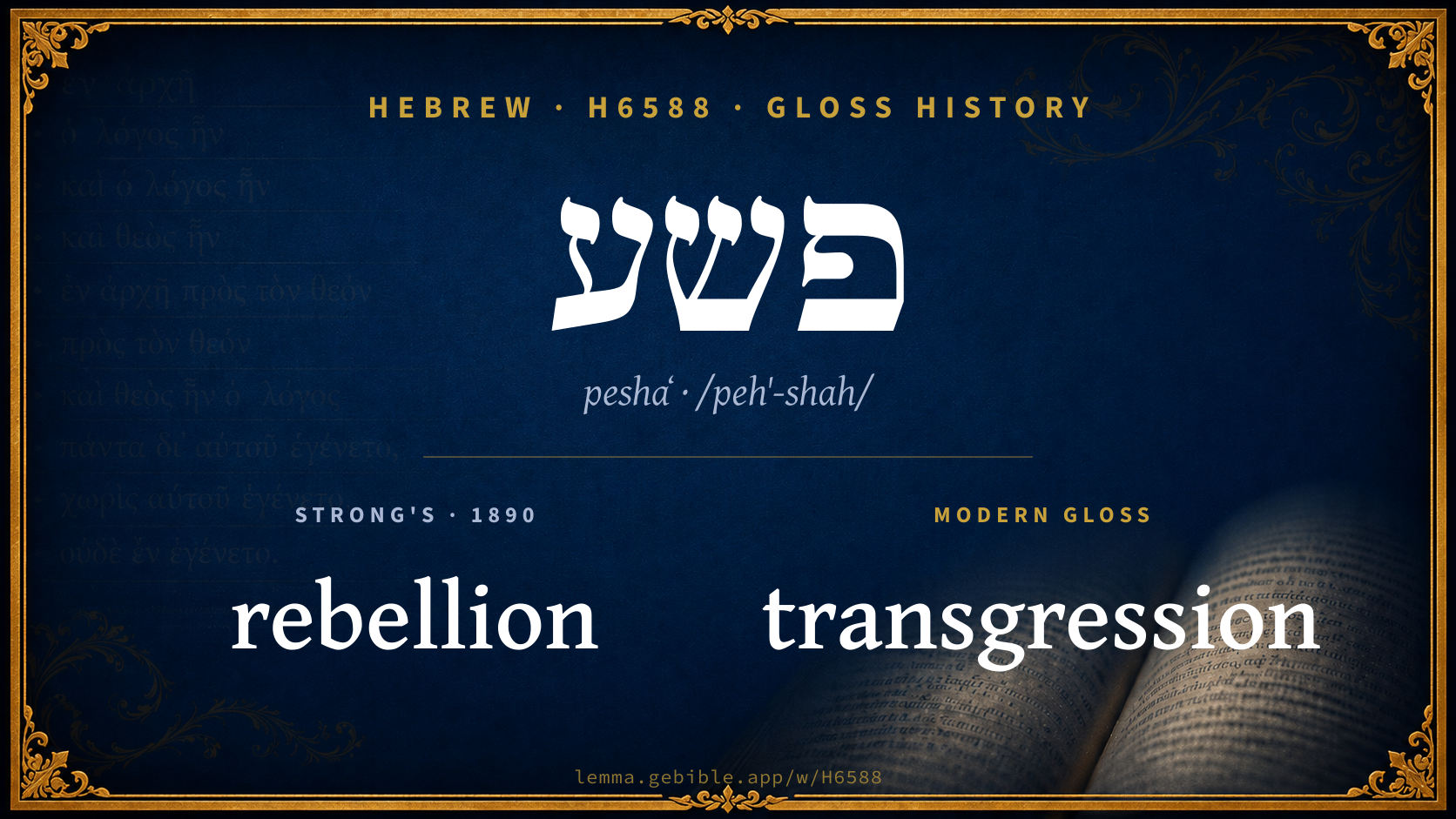
Gloss history
Strong's 1890 vs modern scholarship
About this word
Strong's H6588 catalogs a Hebrew word from the Hebrew Old Testament.
These counts are not copied from any lexicon or concordance. They are computed here, from the morphology-tagged Hebrew Old Testament. What Lemma adds →
- 90
- distinct verses
- The word appears in 90 distinct verses.
- 17 / 39
- OT books
- The word appears in 17 of 39 Old Testament books.
- #446
- by frequency
- Top 500 most frequent Hebrew words (rank 446 of 8,640 Hebrew words by occurrence).
View all 90 occurrences in the concordance →
By section of the Old Testament
By traditional corpus
Conventional, traditional groupings — biblical authorship is debated, so this is a traditional corpus grouping, not an authorship claim. Each share is this word’s portion of its verses in that division of the Hebrew canon. Each figure is a share of the word’s 90 distinct verses.
- Writings (Ketuvim) 42 verses · 47%
- Prophets (Nevi'im) 40 verses · 44%
- Torah (Pentateuch) 8 verses · 9%
How translations render this word
Counts come from each version’s own published word-to-Strong’s tagging or interlinear alignment — an approximate guide to how each version renders this word, not a word-level alignment the data otherwise carries. Because each total is that version’s own tagged count, the per-version totals vary from one another and need not match the appearance or distinct-verse counts above. These counts may also differ from a printed concordance because Lemma counts each distinctly tagged rendering and does not collapse phrase taggings into a single head-word total. This is a fixed set of word-tagged versions (KJV, ASV, BSB, ULT) and does not change with the reading translation you choose elsewhere. Each version’s license is shown beside its name below (and on Sources).
- King James Version: Transgressions 31×, Transgression 30×, Trespass 3×
- American Standard Version: Transgression 32×, Transgressions 28×, Burnt-offering 2×
- Berean Standard Bible: Transgressions 40×, Transgression 25×, Rebellion 8×
- unfoldingWord Literal Text: Transgressions 31×, Transgression 30×, Sins of 9×
King James Version Public Domain
Renders H6588 across 93 tagged occurrences — most commonly:
Plus 23 renderings that appear only once — usually multi-word phrases or single function words the recovered tagging swept in, not distinct renderings.
American Standard Version Public Domain
Renders H6588 across 93 tagged occurrences — most commonly:
Plus 31 renderings that appear only once — usually multi-word phrases or single function words the recovered tagging swept in, not distinct renderings.
Berean Standard Bible Public Domain
Renders H6588 across 93 tagged occurrences — most commonly:
Plus 11 renderings that appear only once — usually multi-word phrases or single function words the recovered tagging swept in, not distinct renderings.
unfoldingWord Literal Text CC BY-SA 4.0
Renders H6588 across 96 tagged occurrences — most commonly:
Plus 13 renderings that appear only once — usually multi-word phrases or single function words the recovered tagging swept in, not distinct renderings.
10 senses and sub-senses in the full BDB
What do BDB’s symbols mean?
BDB uses these scholarly abbreviations:
| Symbol | Meaning |
|---|---|
| 𝔊 | the Septuagint (the ancient Greek translation, LXX) |
| 𝔙 | the Vulgate (the Latin translation) |
| 𝔖 | the Syriac version (the Peshitta) |
| 𝔗 | the Targum (the Aramaic translation) |
| ψ | the Psalms |
| √ | root (the underlying root or stem) |
| ‖ | parallel passage (a synonymous or contrasted parallel) |
| † | the dagger: every passage where the word occurs is cited |
The 10 senses and sub-senses the full Brown-Driver-Briggs lexicon distinguishes for this word, in lexicon order (not ranked by frequency), with BDB’s own verbatim wording and sub-sense lettering. Shown in Hebrew script with BDB’s own scholarly abbreviations. The condensed entry is in the Lexicon Entry tab. See also the Forms in the corpus table below.
- 1. transgression against individuals Gn 31:36; 50:17(×2); Ex 22:8 (E), 1 S 24:12; 25:28; Pr 10:19; 17:19; 28:24; 29:6, 16, 22; פ׳ שְׂפָתַיִם 12:13; על כל־פשׁעים תְּכַסֶּה אַהֲבָה 10:12, cf. 17:9; 19:11; 28:13. e.g. Genesis 31:36
- 2. of nation, against nation: Am 1:3, 6, 9, 11, 13; 2:1; of land Pr 28:2. Elsewh. e.g. Amos 1:3
- 3. against God:
- a. in gen., ‖ חטאת Is 58:1; 59:12; Mi 1:5(×2), 13; 3:8 Am 5:12; ‖ עון Ez 21:29 ψ 107:17; עשׂה פ׳ Ez 18:22, 28; ביום פ׳ 33:12; רַבּוּ פ׳ Is 59:12; Jb 35:6; Je 5:6 (?); יֹסִיף על חטאתו פ׳ Jb 34:37 he addeth transgression unto his sin; יִלְדֵי פ׳ Is 57:4; personified as evil spirit, נאם פשׁע ψ 36:2. e.g. Isaiah 58:1
- b. as recognized by by sinner; he knows it ψ 51:5, make known concerning it to י׳ 32:5, does not cover it (כסה) Jb 31:33; turns from it Is 59:20 Ez 18:30; casts it away from him Ez 18:31. e.g. Psalms 51:5
- c. God deals with it: by visiting it (פקד) Am 3:14 ψ 89:33, dealing with one according to it, עשׂה כ Ez 39:24, making it known to sinner Jb 13:23; 36:9; punishing in various ways: מִפּ׳ because of it Is 53:5, 8; c. על, according to it Am 2:4, 6 La 1:5, 22; for it, c. ב Is 50:1; עֹל פ׳ La 1:14 yoke of transgression; personified, וַיְשַׁלְּחֵם בְּיַד פ׳ Jb 8:4; he does not grant forgiveness to it, לֹא נשׂא ל׳ Ex 23:21 Jos 24:19 (E). e.g. Amos 3:14
- d. God forgives (נשׂא) it Ex 34:7 Nu 14:18 (J), Jb 7:21, cf. ψ 32:1; pardons (סלח) 1 K 8:50; passes over (עבר על, cf. Pr 19:11) Mi 7:18; removes (הרחיק) ψ 103:12; covers over (כפר) 65:4;—cf. (of priest) וְכִפֶּר עַל־הַקֹּדֶשׁ מִפ׳ Lv 16:16, and confession of פ׳ over (על) goat v 21;—God blots out (מחה) Is 43:25; 44:22 ψ 51:3; וּפ׳ אַל־תִּזְכֹּר 25:7; delivers from, הציל מן 39:9.—Jb 35:15 read פֶּשַׁע for פַשׁ q.v. e.g. Exodus 34:7
- 4. guilt of transgression (cf. עון 2), בְּלִי פ׳ without (guilt of) transgression Jb 33:9; 34:6; לא פ׳ ψ 59:4; פ׳ עלינו Ez 33:10; כבד עליה פ׳ Is 24:20; בְּרֹב פ׳ ψ 5:11; נקיתי מפ׳ 19:14; יִטַּמְּאוּ בְּכָל־פ׳ defile themselves with all (the guilt of) their transgressions Ez 14:11; 37:23; חָתֻם בִּצְרוֹר פ׳ Jb 14:17. e.g. Job 33:9
- 5. punishment for transgression, Dn 8:12, 13; 9:24, cf. עון 3. e.g. Daniel 8:12
- 6. offering for transgression, האתן בכורי פשׁעי Mi 6:7 shall I give my first-born as an offering for my transgression (cf. חטאת 4). e.g. Micah 6:7
Senses from the full Brown-Driver-Briggs lexicon (Brown, Driver, Briggs; Oxford 1906 — public domain), digitized via Sefaria, supplemented by the OpenScriptures HebrewLexicon (CC BY 4.0). Full attribution on Sources.
Word origin
n.m. ψ 19:14 transgression;—abs. פ׳ Ex 22:8 +, פָּ֑שַׁע Pr 10:19 +; cstr. פֶּשַׁע Gn 50:17 +; sf. פִּשְׁעִי Gn 31:36 + 14 times sfs.; pl. פְּשָׁעִים Pr 10:12; cstr. פִּשְׁעֵי Am 1:3 +, etc.;—
— Brown-Driver-Briggs (Oxford 1906, public domain), digitized via Sefaria, supplemented by the OpenScriptures HebrewLexicon (CC BY 4.0). See Sources.
Derived from פשע (pâshaʻ) (H6586) — to rebel.
Jastrow Dictionary
A second Hebrew/Aramaic lexicon for comparison, covering Aramaic and post-biblical (Talmudic, Targumic, Midrashic) usage that the biblical-Hebrew BDB does not. Matched by lemma rather than by Strong’s number, so a lemma may carry more than one Jastrow headword (shown separately below), and the entries cover usage well beyond the Bible.
פָּשַׁע
- (b. h.) [to pass beyond,]
- 1. to be wilful, rebellious. Yoma IV, 2 פָּשַׁעְתִּי; ib. VI, 2 פָּשְׁעוּ, v. עָוָה; a. fr.—פּוֹשֵׁעַ a wilful transgressor, rebel, apostate. Gitt. 57ᵃ פ׳ ישראל a Jewish apostate (the censor’s disguise for Jesus). Ib. תא חזי מה בין פּוֹשְׁעֵי ישראל וכ׳ come and see the difference between Jewish apostates and gentile prophets. R. Hash. 17ᵃ פ׳ ישראל בגופן Jewish sinners with their bodies (disregarding the ceremonial laws intended to guard the purity of life); פ׳ אומות העולם בגופן gentile sinners with their bodies (lustful and violent). Midr. Till. to Ps. LI כשאתה אומר לפּוֹשְׁעִים … אם תקבלני כל הפושעים משלימים לך when thou sayest to the sinners, why have you not repented? (they may plead ignorance of thy goodness, but) if thou receivest me, all sinners will make peace with thee; a. fr.
- 2. to be faithless. Gen. R. s. 52 (ref. to Prov. XVIII, 19) פָּשַׁעְתָּ באברהם thou (Lot) wast faithless to Abraham; Num. R. s. 18 זה קרח שפ׳ בתורה וכ׳ this refers to Korah who was faithless to the Law, which is called ‘strength’; a. fr.—Esp. (with ref. to Ex. XXII, 8) to be negligent in guarding a trust. B. Mets. 36ᵇ פ׳ בה וכ׳ if he was careless in guarding the animal, and it went out &c. Ib. 34ᵃ כיון שאמר פשעתי וכ׳ as soon as he says, ‘I have been at fault’, he surrenders the eventual fine (of the thief) to the owner. Ib. 58ᵃ כי היכי דלא לקרו להו פושעים in order that they may not be called faithless guardians; a. fr.—Ber. 28ᵃ ונקרא פושע and he is called negligent (because he delayed his prayers). e.g. Proverbs 18:19
- to cause to transgress. Num. R. s. 9 (ref. to Ex. XXII, 8) מדבר באהרן שה׳ ישראל בדיבור לא יהיה it alludes to Aaron who caused Israel to transgress the commandment, ‘thou shalt have no other gods &c.’ (Ex. XX, 3). e.g. Exodus 22:8
פְּשַׁע
- Taan. 24ᵃ כל מאן דפ׳ מחשדינא וכ׳ if a child rebels (refuses to study), I bribe him by giving him &c. Gitt. 36ᵃ הוה פָּשַׁע בינוקי he was faithless to (maltreated) the children; Macc. 16ᵇ
פֶּשַׁע
- preced.) rebellion, sin. Gen. R. s. 22 ילפִשְׁעִי, v. סָבַל. Tanḥ. Vayesheb 4 מה פשעי what wrong have I done?; a. e.—Pl. פְּשָׁעִים. Yoma III, 8; IV, 2. Ib. 36ᵇ פ׳ אלו המרדים by p’shaʿim are meant rebellious acts; Y. ib. III, 40ᵈ bot. פִּשְׁעֵיהֶם; Tosef. ib. II, 1; a. e.
A Dictionary of the Targumim, the Talmud Babli and Yerushalmi, and the Midrashic Literature (Marcus Jastrow; London, Luzac, 1903) — Public Domain. Digitized via Sefaria. Digitized via Sefaria. Full attribution on Sources.
Forms in the corpus
The 74 distinct written forms H6588 takes in the Hebrew Bible, most frequent first — each parse links to that state’s occurrences in the concordance. Hebrew forms include their vowel points and cantillation, so a single lemma takes many written forms.
The 60 most common forms are shown; 14 rarer forms follow in the full concordance.
Septuagint verse parallels
This word appears in 87 verses that also exist in the Greek Old Testament (Septuagint), out of the 90 Hebrew verses it occurs in. You can read those verses in Greek by switching the Old Testament edition to the Septuagint.
Read these verses in the Septuagint
- Genesis 31:36
- Exodus 22:9
- Leviticus 16:16
- Numbers 14:18
- Joshua 24:19
- 1 Samuel 24:11
- 1 Kings 8:50
- Job 7:21
- Psalms 5:10
- Proverbs 10:12
- Isaiah 24:20
- Jeremiah 5:6
This is a verse-level parallel only — the same verses exist in both the Hebrew and Greek Old Testaments. No word-level Hebrew↔Greek correspondence is claimed: the data carries no such alignment, so no Greek word is shown as this Hebrew word’s translation. Coverage is not total — the Septuagint omits the deuterocanon and renumbers the Psalms, so some Hebrew verses have no direct Greek parallel.