
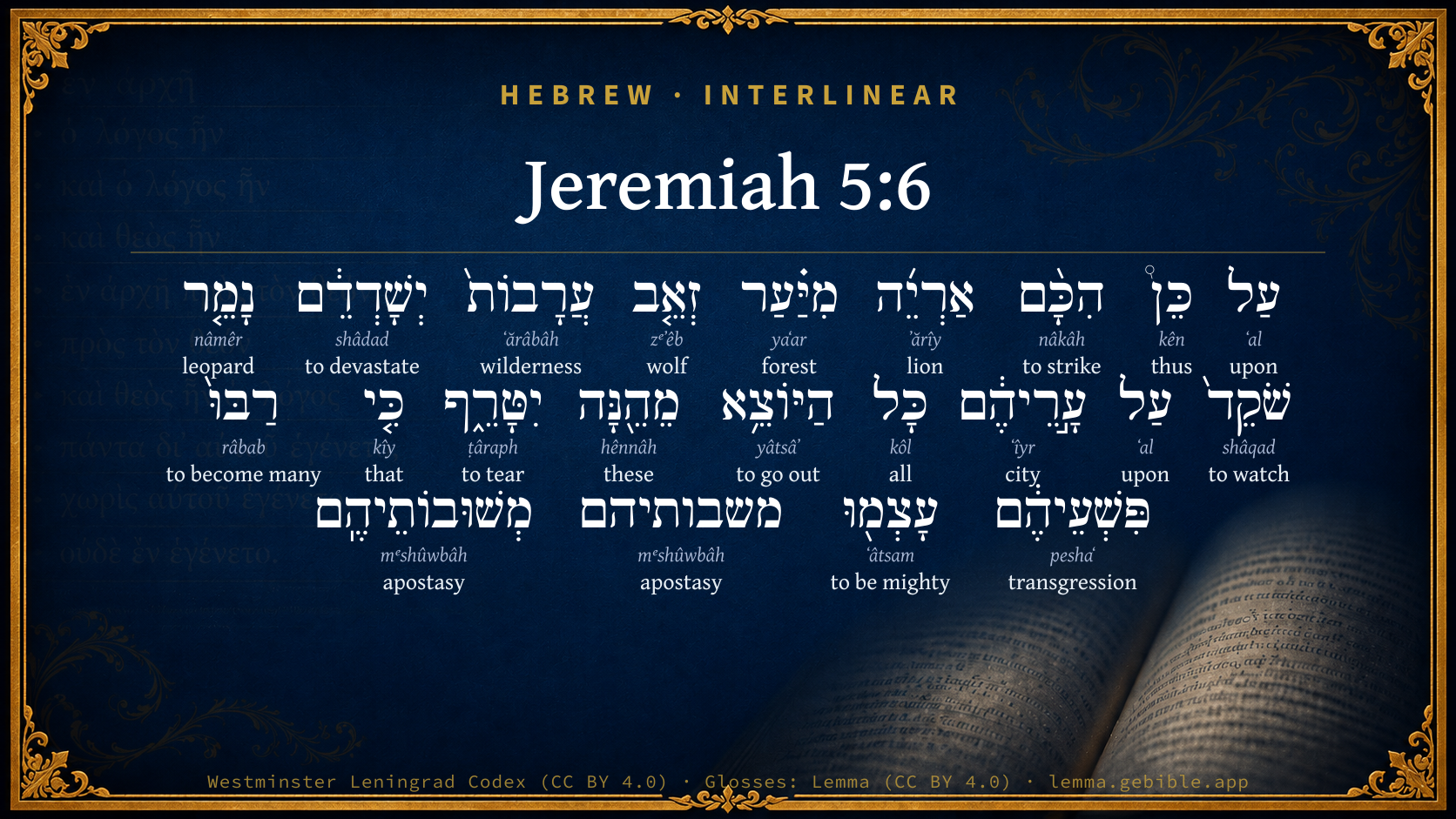
Jeremiah 5:6

Hebrew (Westminster Leningrad Codex) Jeremiah 5:6 appears in the Hebrew Old Testament. The text above is from the Westminster Leningrad Codex. Each word links to its Strong’s number, a concise gloss, and parsing drawn from the Open Scriptures Hebrew Bible morphology. Click any word for its full Brown-Driver-Briggs (BDB) entry.
Download image
Cite this verse

Jeremiah 5:6 (World English Bible). Public Domain. Lemma interlinear Bible study tool, https://lemma.gebible.app/v/jeremiah/5/6.

Show BibTeX & RIS
BibTeX
RIS
English Translation
Therefore a lion out of the forest shall kill them, a wolf of the evenings shall destroy them, a leopard shall watch against their cities; everyone who goes out there shall be torn in pieces; because their transgressions are many, [and] their backsliding is increased.
World English Bible · Public Domain
Download a study sheet

One document with this verse’s original text, its word-by-word gloss line, the meaning frame, cross-references with their text, attributed commentary, and full source and license credits — printable, and it pastes into notes with its structure intact.

This verse Autodidact and up

Study sheet (.html) Plain text (.txt)

A passage Seminary Student

Up to 50 verses in one chapter. A passage sheet keeps up to 6 commentary sources and 12 cross-references per verse, in the order this page ranks them, and says so on the sheet whenever that leaves anything out. Ask for a single verse and you get the Autodidact verse sheet above.

Everything on this page stays free to read, with no account — the sheet is a download of what is already on screen, not access to it.

Want to remove ads? Support Godless Engineer
Compare translations 3

The same verse in 3 English versions, stacked beneath the original-language interlinear above. Click any original word for its lexicon entry.

Each is an independent rendering of the whole verse — the interlinear is not word-aligned to these translations.

Highlighted words mark where these versions differ — a whole-verse word diff, not a word-by-word alignment.

  • World English Bible Public Domain
    Therefore a lion out of the forest shall kill them, a wolf of the evenings shall destroy them, a leopard shall watch against their cities; everyone who goes out there shall be torn in pieces; because their transgressions are many, [and] their backsliding is increased.
  • King James Version Public Domain
    Wherefore a lion out of the forest shall slay them, and a wolf of the evenings shall spoil them, a leopard shall watch over their cities: every one that goeth out thence shall be torn in pieces: because their transgressions are many, and their backslidings are increased.
  • unfoldingWord Literal Text CC BY-SA 4.0
    Therefore a lion from the forest will strike them down; a wolf of the deserts will devastate them; a leopard watches over their cities; all who go out from there will be torn apart, for their transgressions increase; their apostasies are numerous. ts\*

unfoldingWord Literal Text — © unfoldingWord, licensed CC BY-SA 4.0. Word-aligned USFM3 via Door43 (git.door43.org/unfoldingWord/en_ult).

Versions to compare (up to 4)

3 of 4 selected

Show all 18 translations

Every available English version of this verse, each an independent rendering of the whole verse.

  • World English Bible Public Domain
    Therefore a lion out of the forest shall kill them, a wolf of the evenings shall destroy them, a leopard shall watch against their cities; everyone who goes out there shall be torn in pieces; because their transgressions are many, [and] their backsliding is increased.
  • Berean Standard Bible Public Domain
    Therefore a lion from the forest will strike them down, a wolf from the desert will ravage them. A leopard will lie in wait near their cities, and everyone who ventures out will be torn to pieces. For their rebellious acts are many, and their unfaithful deeds are numerous.
  • Majority Standard Bible Public Domain
    Therefore a lion from the forest will strike them down, a wolf from the desert will ravage them. A leopard will lie in wait near their cities, and everyone who ventures out will be torn to pieces. For their rebellious acts are many, and their unfaithful deeds are numerous.
  • King James Version Public Domain
    Wherefore a lion out of the forest shall slay them, and a wolf of the evenings shall spoil them, a leopard shall watch over their cities: every one that goeth out thence shall be torn in pieces: because their transgressions are many, and their backslidings are increased.
  • American Standard Version (1901) Public Domain
    Wherefore a lion out of the forest shall slay them, a wolf of the evenings shall destroy them, a leopard shall watch against their cities; every one that goeth out thence shall be torn in pieces; because their transgressions are many, `and' their backslidings are increased.
  • Revised Version (1885) Public Domain
    Wherefore a lion out of the forest shall slay them, a wolf of the evenings shall spoil them, a leopard shall watch over their cities, every one that goeth out thence shall be torn in pieces: because their transgressions are many, and their backslidings are increased.
  • Geneva Bible (1599) Public Domain
    Wherefore a lyon out of the forest shall slay them, and a wolfe of the wildernesse shall destroy them: a leopard shall watch ouer their cities: euery one that goeth out thence, shall be torne in pieces, because their trespasses are many, and their rebellions are increased.
  • Douay-Rheims (1899) Public Domain
    Wherefore a lion out of the wood hath slain them, a wolf in the evening, hath spoiled them, a leopard watcheth for their cities: every one that shall go out thence shall be taken, because their transgressions are multiplied, their rebellions are strengthened.
  • Young's Literal Translation Public Domain
    Therefore smitten them hath a lion out of the forest, A wolf of the deserts doth spoil them, A leopard is watching over their cities, Every one who is going out of them is torn, For many have been their transgressions, Mighty have been their backslidings.
  • Literal Standard Version CC BY-SA 4.0
    Therefore a lion out of the forest has struck them, || A wolf of the deserts spoils them, || A leopard is watching over their cities, || Everyone who is going out of them is torn, || For their transgressions have been many, || Their backslidings have been mighty.
  • Unlocked Literal Bible CC BY-SA 4.0
    So a lion from a thicket will attack them. A wolf from the Arabah will ruin them. A lurking panther will come against their cities. Anyone who goes outside his city will be torn apart. For their transgressions increase. Their acts of faithlessness are unlimited.
  • unfoldingWord Literal Text CC BY-SA 4.0
    Therefore a lion from the forest will strike them down; a wolf of the deserts will devastate them; a leopard watches over their cities; all who go out from there will be torn apart, for their transgressions increase; their apostasies are numerous. ts\*
  • Darby Bible Public Domain
    Therefore a lion out of the forest shall slay them, a wolf of the evenings shall waste them; the leopard lurketh against their cities, every one that goeth out thence is torn in pieces: for their transgressions are multiplied, their backslidings are increased.
  • World Messianic Bible Public Domain
    Therefore a lion out of the forest will kill them. A wolf of the evenings will destroy them. A leopard will watch against their cities. Everyone who goes out there will be torn in pieces, because their transgressions are many and their backsliding has increased.
  • Webster's Bible Public Domain
    Wherefore a lion from the forest shall slay them, and a wolf of the evenings shall spoil them, a leopard shall watch over their cities: every one that goeth out thence shall be torn in pieces: because their transgressions are many, and their backslidings are increased.
  • Free Bible Version CC BY-SA 4.0
    As a result a lion from the forest will attack them; a wolf from the desert will rip them apart. A leopard will lie in wait for them near their towns, ready to tear to pieces anyone who goes outside. For they keep on rebelling, and turn away from me so often.
  • Bible in Basic English Public Domain
    And so a lion from the woods will put them to death, a wolf of the waste land will make them waste, a leopard will keep watch on their towns, and everyone who goes out from them will be food for the beasts; because of the great number of their sins and the increase of their wrongdoing.
  • JPS Tanakh (1917) Public Domain
    Wherefore a lion out of the forest doth slay them, a wolf of the deserts doth spoil them, a leopard watcheth over their cities, every one that goeth out thence is torn in pieces; because their transgressions are many, their backslidings are increased.

Literal Standard Version (2020), Covenant Press — licensed CC BY-SA 4.0. Text via the HelloAO Bible API (eBible.org). Unlocked Literal Bible (unfoldingWord) — licensed CC BY-SA 4.0. Text via the HelloAO Bible API (eBible.org). unfoldingWord Literal Text — © unfoldingWord, licensed CC BY-SA 4.0. Word-aligned USFM3 via Door43 (git.door43.org/unfoldingWord/en_ult). Free Bible Version, Dr. Jonathan Gallagher — licensed CC BY-SA 4.0. Text via the HelloAO Bible API (eBible.org).

Word by word

More ways to search: Search by grammar → Find every occurrence → Compare this word →

Practice this passage: Drill this verse → Learn its vocabulary →

נָמֵ֤ר
nâmêr
H5246
“leopard”
Noun, Common, Masculine, Singular, Absolute
Part of Speech
Noun
Type
Common
Gender
Masculine
Number
Singular
State
Absolute
Full BDB Definition

Origin: from an unused root meaning properly, to filtrate, i.e. be limpid [comp H5247 and H5249 ]

TWOT: 1372a

leopard
  1. עַל ʻal H5921 “upon” Preposition
  2. כֵּן֩ kên H3651 “thus” Particle, Demonstrative
  3. הִכָּ֨ם nâkâh H5221 “to strike · them” Verb, Hiphil, Perfect, 3rd Person, Masculine, Singular + Suffix, Personal, 3rd Person, Masculine, Plural
  4. אַרְיֵ֜ה ʼărîy H738 “lion” Noun, Common, Masculine, Singular, Absolute
  5. מִיַּ֗עַר yaʻar H3293 “from · forest” Preposition + Noun, Common, Masculine, Singular, Absolute
  6. זְאֵ֤ב zᵉʼêb H2061 “wolf of” Noun, Common, Masculine, Singular, Construct
  7. עֲרָבוֹת֙ ʻărâbâh H6160 “wildernesses” Noun, Common, Feminine, Plural, Absolute
  8. יְשָׁדְדֵ֔ם shâdad H7703 “to devastate · them” Verb, Qal, Imperfect, 3rd Person, Masculine, Singular + Suffix, Personal, 3rd Person, Masculine, Plural
  9. שֹׁקֵד֙ shâqad H8245 “watching” Verb, Qal, Participle Active, Masculine, Singular, Absolute
  10. עַל ʻal H5921 “upon” Preposition
  11. עָ֣רֵיהֶ֔ם ʻîyr H5892 “cities · their” Noun, Common, Feminine, Plural, Construct + Suffix, Personal, 3rd Person, Masculine, Plural
  12. כָּל kôl H3605 “all of” Noun, Common, Masculine, Singular, Construct
  13. הַיּוֹצֵ֥א yâtsâʼ H3318 “the · going out” Particle, Definite Article + Verb, Qal, Participle Active, Masculine, Singular, Absolute
  14. מֵהֵ֖נָּה hênnâh H2007 “from · these” Preposition + Pronoun, Personal, 3rd Person, Feminine, Plural
  15. יִטָּרֵ֑ף ṭâraph H2963 “to tear” Verb, Niphal, Imperfect, 3rd Person, Masculine, Singular
  16. כִּ֤י kîy H3588 “that” Conjunction
  17. רַבּוּ֙ râbab H7231 “to become many” Verb, Qal, Perfect, 3rd Person, Common, Plural
  18. פִּשְׁעֵיהֶ֔ם peshaʻ H6588 “transgressions · their” Noun, Common, Masculine, Plural, Construct + Suffix, Personal, 3rd Person, Masculine, Plural
  19. עָצְמ֖וּ ʻâtsam H6105 “to be mighty” Verb, Qal, Perfect, 3rd Person, Common, Plural
  20. משבותיהם mᵉshûwbâh H4878 “apostasies · their” Noun, Common, Feminine, Plural, Construct + Suffix, Personal, 3rd Person, Masculine, Plural
  21. מְשׁוּבוֹתֵיהֶֽם mᵉshûwbâh H4878 “apostasies · their” Noun, Common, Feminine, Plural, Construct + Suffix, Personal, 3rd Person, Masculine, Plural

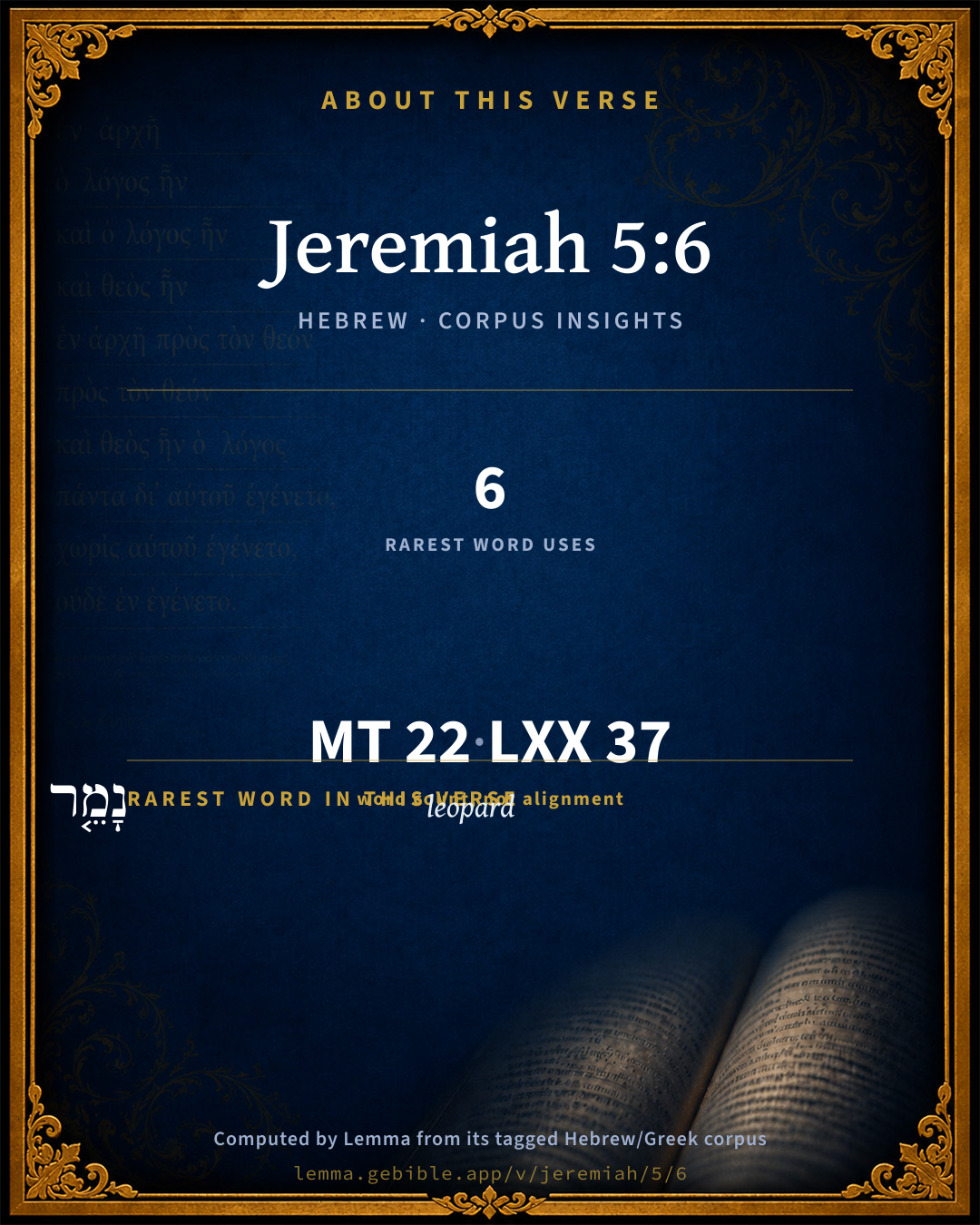
About this verse

These counts appear in no published source. They are computed here, from the morphology-tagged text and Lemma’s own curated glosses. What Lemma adds →

22
words
20
distinct lemmas
Prophets
section

Notable vocabulary

The rarest word here is נָמֵ֤ר leopard H5246 — appearing just 6 times in the whole Hebrew Bible.

Shared distinctive vocabulary

נָמֵ֤ר leopard H5246 occurs in 6 verses of the Hebrew Bible. Also found in:

Grammatical profile

  • 7 verbs
  • 10 nouns
  • 1 pronoun
  • 2 prepositions
  • 1 conjunction
  • 1 particle

Verb forms

  • הִכָּ֨ם Hiphil · Perfect
  • יְשָׁדְדֵ֔ם Qal · Imperfect
  • שֹׁקֵד֙ Qal · Participle Active
  • הַיּוֹצֵ֥א Qal · Participle Active
  • יִטָּרֵ֑ף Niphal · Imperfect
  • רַבּוּ֙ Qal · Perfect
  • עָצְמ֖וּ Qal · Perfect

Repetition

Words recur within this verse — often emphatic in Hebrew:

  • עַל upon H5921 ×2
  • משבותיהם apostasy H4878 ×2

Hebrew & Septuagint length

In the original languages it is 22 Hebrew tokens and 37 Greek tokens — but the two are counted differently (Hebrew bundles its prefixes and suffixes into one token; the Greek is in lemma form), so that isn’t a like-for-like length.

Cross-references

30

Topical passages linked to Jeremiah 5:6 in the Treasury of Scripture Knowledge — connected by theme and wording, ordered by reader-vote popularity; previews shown in the World English Bible.

  • Jeremiah 4:7 A lion is gone up from his thicket, and a destroyer of nations; he is on his way, he is gone forth from his place, to make your land desolate, that your cities be laid waste, without inhabitant.
  • Habakkuk 1:8 Their horses also are swifter than leopards, and are more fierce than the evening wolves. Their horsemen press proudly on. Yes, their horsemen come from afar. They fly as an eagle that hurries to devour.
  • Ezekiel 22:27 Her princes in the midst of it are like wolves ravening the prey, to shed blood, [and] to destroy souls, that they may get dishonest gain.
  • Zephaniah 3:3 Her princes in the midst of her are roaring lions. Her judges are evening wolves. They leave nothing until the next day.
  • Numbers 32:14 Behold, you are risen up in your fathers' place, an increase of sinful men, to augment yet the fierce anger of Yahweh toward Israel.
  • Ezra 9:6 and I said, my God, I am ashamed and blush to lift up my face to you, my God; for our iniquities are increased over our head, and our guiltiness is grown up to the heavens.
  • Ezra 10:10 Ezra the priest stood up, and said to them, You have trespassed, and have married foreign women, to increase the guilt of Israel.
  • Psalms 104:20 You make darkness, and it is night, In which all the animals of the forest prowl.
  • Isaiah 59:12 For our transgressions are multiplied before you, and our sins testify against us; for our transgressions are with us, and as for our iniquities, we know them:
  • Jeremiah 2:15 The young lions have roared on him, and yelled; and they have made his land waste: his cities are burned up, without inhabitant.
  • Jeremiah 2:17 Haven't you procured this to yourself, in that you have forsaken Yahweh your God, when he led you by the way?
  • Jeremiah 2:19 Your own wickedness shall correct you, and your backsliding shall reprove you: know therefore and see that it is an evil thing and a bitter, that you have forsaken Yahweh your God, and that my fear is not in you, says the Lord, Yahweh of Hosts.
  • Jeremiah 9:12–14 Who is the wise man, that may understand this? and [who is] he to whom the mouth of Yahweh has spoken, that he may declare it? why is the land perished and burned up like a wilderness, so that none passes through?
  • Jeremiah 14:7 Though our iniquities testify against us, work you for your name's sake, Yahweh; for our backslidings are many; we have sinned against you.
  • Jeremiah 16:10–12 It shall happen, when you shall show this people all these words, and they shall tell you, Why has Yahweh pronounced all this great evil against us? or what is our iniquity? or what is our sin that we have committed against Yahweh our God?
  • Jeremiah 25:38 He has left his covert, as the lion; for their land is become an astonishment because of the fierceness of the oppressing [sword], and because of his fierce anger.
  • Jeremiah 30:14 All your lovers have forgotten you; they don't seek you: for I have wounded you with the wound of an enemy, with the chastisement of a cruel one, for the greatness of your iniquity, because your sins were increased.
  • Jeremiah 30:24 The fierce anger of Yahweh shall not return, until he has executed, and until he have performed the intents of his heart: in the latter days you shall understand it.
  • Jeremiah 49:19 Behold, he shall come up like a lion from the pride of the Jordan against the strong habitation: for I will suddenly make them run away from it; and whoever is chosen, him will I appoint over it: for who is like me? and who will appoint me a time? and who is the shepherd who will stand before me?
  • Lamentations 1:5 Her adversaries are become the head, her enemies prosper; For Yahweh has afflicted her for the multitude of her transgressions: Her young children are gone into captivity before the adversary.
  • Ezekiel 14:16–21 though these three men were in it, as I live, says the Lord Yahweh, they should deliver neither sons nor daughters; they only should be delivered, but the land should be desolate.
  • Ezekiel 16:25 You have built your lofty place at the head of every way, and have made your beauty an abomination, and have opened your feet to everyone who passed by, and multiplied your prostitution.
  • Ezekiel 23:19 Yet she multiplied her prostitution, remembering the days of her youth, in which she had played the prostitute in the land of Egypt.
  • Daniel 7:4 The first was like a lion, and had eagle's wings: I saw until the wings of it were plucked, and it was lifted up from the earth, and made to stand on two feet as a man; and a man's heart was given to it.
  • Daniel 7:6 After this I saw, and, behold, another, like a leopard, which had on its back four wings of a bird; the animal had also four heads; and dominion was given to it.
  • Hosea 5:14 For I will be to Ephraim like a lion, And like a young lion to the house of Judah. I myself will tear in pieces and go away. I will carry off, and there will be no one to deliver.
  • Hosea 13:7–8 Therefore am I to them like a lion; Like a leopard I will lurk by the path.
  • Amos 5:18–19 "Woe to you who desire the day of Yahweh! Why do you long for the day of Yahweh? It is darkness, And not light.
  • Nahum 2:11–12 Where is the den of the lions, and the feeding-place of the young lions, where the lion and the lioness walked, the lion's cubs, and no one made them afraid?
  • Revelation 13:2 The beast which I saw was like a leopard, and his feet were like those of a bear, and his mouth like the mouth of a lion. The dragon gave him his power, his throne, and great authority.

Cross-references courtesy of OpenBible.info (CC BY 4.0).

Hebrew and Greek witnesses Masoretic Hebrew ↔ Greek Septuagint

The same verse in the two great witnesses to the Old Testament, shown verse-for-verse.

These are two independent witnesses, not word-aligned to each other, and the Septuagint is shown in lemma (dictionary) form.

Hebrew Jeremiah 5:6 Masoretic · Westminster Leningrad Codex

עַל כֵּן֩ הִכָּ֨ם אַרְיֵ֜ה מִיַּ֗עַר זְאֵ֤ב עֲרָבוֹת֙ יְשָׁדְדֵ֔ם נָמֵ֤ר שֹׁקֵד֙ עַל עָ֣רֵיהֶ֔ם כָּל הַיּוֹצֵ֥א מֵהֵ֖נָּה יִטָּרֵ֑ף כִּ֤י רַבּוּ֙ פִּשְׁעֵיהֶ֔ם עָצְמ֖וּ משבותיהם מְשׁוּבוֹתֵיהֶֽם

Therefore a lion out of the forest shall kill them, a wolf of the evenings shall destroy them, a leopard shall watch against their cities; everyone who goes out there shall be torn in pieces; because their transgressions are many, [and] their backsliding is increased.

World English Bible · Public Domain

Greek LXX Structure differs

In the Septuagint, Jeremiah is about an eighth shorter than the Hebrew and arranges its material differently — the Oracles Against the Nations (Hebrew chapters 46–51) appear in the middle of the Greek book, after 25:13. Because the chapter and verse boundaries do not line up, a verse-for-verse comparison with the Hebrew is not shown.

A verse-for-verse comparison isn’t shown here because the chapters and verses don’t line up. Switch to the LXX edition with the MT / LXX toggle above to read the Greek directly.

Hebrew: Westminster Leningrad Codex (CC BY 4.0). Greek: Septuagint (public domain); English from a public-domain English Septuagint. How the Septuagint differs from the Hebrew →

Targum (Aramaic paraphrase)

1

The Targum is the ancient Jewish Aramaic paraphrase of the Hebrew Scriptures — an interpretive translation, not the Hebrew text itself. Onkelos (literal) and Pseudo-Jonathan (expansive) render the Torah, and Jonathan the Prophets. Coverage is partial: where no permissively-licensed English translation exists for a verse, only the Aramaic is shown. This is verse-level text, not a word-by-word alignment to the Hebrew.

  1. Targum Jonathan Prophets (Joshua–Malachi)
    עַל כֵּן מֶלֶךְ בְּמַשִׁרְיָתֵיהּ יִסַק עֲלֵיהוֹן כְּאַרְיָא מֵחוּרְשָׁא וְיִקְטְלִינוּן עַמְמַיָא דְתַקִיפִין כְּדֵיבֵי רַמְשָׁא יִבְזוֹזוּנוּן שִׁלְטוֹנִין דַחֲסִינִין כְּנִמְרָא כַמְנִין עַל קִרְוֵיהוֹן כָּל דִיפּוֹק מִנְהוֹן יִתְקְטֵיל אֲרֵי סַגִיאִין מָרְדֵיהוֹן תַּקִיפִין תִּיוּבַתְהוֹן:

    (no public-domain English translation for this verse)

    Targum Jonathan — Aramaic: “Mikraot Gedolot” (public domain). English: “Sefaria Community Translation” (CC0 1.0 (public-domain dedication)); “London "Chaldee Paraphrase," 1871” (public domain). Text via Sefaria.

Commentary

Notes on Jeremiah 5:6 from classic Christian and Jewish commentators (each source and its license shown beneath its notes). The classic Christian expositions comment on the surrounding passage and are grouped to its opening verse, so a note may address several verses; the Jewish commentaries on the Tanakh (Rashi and others) are per-verse, so they appear only where the commentator wrote on this verse.

Lemma curates 59 commentaries, every one of them public domain or Creative Commons licensed, each selected and text-cleaned for this edition rather than reprinted as found. About our sources →

Trapp's Complete Commentary

John Trapp

Jer 5:6 Wherefore a lion out of the forest shall slay them, [and] a wolf of the evenings shall spoil them, a leopard shall watch over their cities: every one that goeth out thence shall be torn in pieces: because their transgressions are many, [and] their backslidings are increased.

Ver. 6. Therefore a lion of the forest shall slay them.] So Nebuchadnezzar is called for his cruelty, a wolf for his voracity, and a leopard for his slyness and swiftness. All the malignities of other creatures meet in the Church’s enemies.

John Trapp, A Commentary or Exposition upon All the Books of the Old and New Testament (1647–1656) — public domain. Text from a community e-Sword module.

Joseph Benson's Commentary

Jer 5:6. Wherefore a lion, &c. — Nebuchadnezzar and the Chaldean army are here pointed at under the metaphor of beasts of prey, of three kinds: being powerful, courageous, and violent as a lion; rapacious, greedy, and devouring as a wolf; and swift, lively, and active as a leopard. The word ערבוה, rendered evenings in the text, is translated deserts in the margin of our Bibles, which probably is the sense here intended. “And those wide and extensive plains, or unenclosed commons, seem to be meant, which were used only for sheep-walks and pasturage, and were, of course, most likely to be infested with wolves.” — Blaney.

Joseph Benson's Commentary on the Old and New Testaments (1811–1818) — public domain. Text from a community e-Sword module.

Tyndale Open Study Notes

Tyndale Open Resources

5:6 The Babylonians would attack like a lion, a wolf, and a leopard. These ferocious beasts were capable of destroying human life. The people’s rebellion and sins were very serious to the Lord (4:7; 30:14-15; Ps 104:20; Ezek 22:27; Hos 13:7; Hab 1:8; Zeph 3:3).

Tyndale Open Study Notes — © Tyndale Open Resources, licensed CC BY-SA 4.0. Text via the HelloAO Bible API.

Geneva Bible (1599)

Geneva Bible translators

Meaning, Nebuchadnezzar and his army.

Geneva Bible (1599) marginal notes — public domain. Text via Bolls.life.

Jamieson, Fausset & Brown

Robert Jamieson, A. R. Fausset & David Brown

lion . . . wolf . . . leopard--the strongest, the most ravenous, and the swiftest, respectively, of beasts: illustrating the formidable character of the Babylonians.

of the evenings--Others not so well translate, of the deserts. The plural means that it goes forth every evening to seek its prey (Psa 104:20; Hab 1:8; Zep 3:3).

leopard . . . watch . . . cities-- (Hos 13:7). It shall lie in wait about their cities.

Jamieson, Fausset & Brown — Commentary Critical and Explanatory on the Whole Bible (1871) — public domain (CC PDM 1.0). Text via the HelloAO Bible API.

Adam Clarke's Commentary

Verse 6. Wherefore a lion] Nebuchadnezzar, according to the general opinion; who is called here a lion for his courage and violence, a bear for his rapaciousness, and a leopard for his activity. Dahler supposes the Scythians to be intended, both here and in Jer 4:7.

Adam Clarke's Commentary on the Bible (1810–1826) — public domain. Text from a community e-Sword/MySword module.

John Calvin's Commentaries

Here, at length, God shews that he was moderate in his judgments, so that the wicked in vain charged him, as it is usual with them, with too much rigor.

Some render the words in the past tense, and think the sense to be, that the Prophet reminds the Jews that they had not been afflicted without reason by so many evils, as they had deserved heavier punishments. But another view may be taken; for we know that in Hebrew the tenses often change; and I am inclined to regard the future tense as intended; for the Prophet seems not here to record what they had already suffered, but to remind them of the heavy punishment that was awaiting them. Smite them shall the lion from the forest

The wolf is called the wolf of solitudes, because of his coming forth from the desert. Some render the words, “the wolf of the evening;” and this may be allowed. We indeed know, that in other places hungry wolves are called the wolves of the evening; for after having sought their prey in the day — time, and finding none, they become in the evening almost mad, and their hunger causes them to run furiously in all directions. This explanation, then, may be admitted. But as he says first, that the lion would come from the forest, it is more probable that the wolf is described as coming from the desert. As to the general import of the passage there is not much difference.

He mentions here three wild beasts — the lion, the wolf, and the leopard. By these wild beasts he understands no doubt the enemies, who would shortly attack them with the greatest cruelty. It is indeed true that the Jews, before the time in which Jeremiah spoke to them, had been afflicted with many evils; for God had not punished them only once, but had given them frequent warnings; and had there been any hope of repentance, they might have still continued in safety, though considerably reduced. But Jeremiah seems to predict future punishment: he therefore refers, not only to the Egyptians and the Assyrians, but also to other enemies. For that people, we know, were hated by all their neighbors, and had suffered grievous wrongs even from their own kindred. Since, then, many nations were hostile to the Jews, it is nothing strange that the Prophet enumerates here three sorts of wild beasts; as though he had said, that enemies would come from every quarter, who would, like lions, wolves, and leopards, vent their fury on them, because they had so often, and for so long a time, provoked God’s wrath. At the same time, God does here check those false complaints which are wont to be often alleged by the wicked, and shews that he is a righteous Judge, and that the punishments he inflicted could not be blamed by the Jews: and it was for this purpose that he used the particle, Wherefore — על-כז, ol-kan.

He also adds, A leopard shall watch, that he may tear all who shall go out of the cities This language is no doubt metaphorical; and what he means is, that when the enemies would occupy the land, the Jews would be shut up in their cities, and would not venture to go forth, for dangers would await them everywhere.

At the end of the verse he repeats again, and speaks more fully of what he meant by “Wherefore — על-כז, “at the beginning of the verse; for he says, Because multiplied have their transgressions, and increased have their defections By these words he further proves what he had said, that God is a righteous judge, even when he seems to be too severe: for it could not have been otherwise, but that he must have visited with extreme vengeance a people so abandoned and irreclaimable. Nor does he only call them wicked, and apostates, but he says that their iniquities, or evil deeds, were many, and that their defections had increased And by the last expression he amplifies their guilt: for though פשע, pesho, does not mean simply to offend, but to act wickedly; yet to fall away from God is a baser and a more atrocious sin. We hence learn, that such was the wickedness of the Jews, that it could not be corrected by common means or moderate punishment. He afterwards adds —

John Calvin's Commentaries (1540-1563) — public domain. Text from the Calvin Translation Society English edition (1840s-50s) via the Christian Classics Ethereal Library (ccel.org). Calvin's coverage is partial (roughly two-thirds of the Bible); uncommented books and verses are honest gaps, never fabricated. The 19th-century editor's footnotes and remarks are omitted so the notes are faithfully Calvin's own voice.

Ellicott's Commentary for English Readers

(6) A lion out of the forest.—The imagery is vivid in itself. The three forms of animal ferocity, lion, wolf, leopard—representing, perhaps, the three phases of simple fierceness, ravenousness, and cunning; possibly even three oppressors in whom those attributes were to be impersonated—are brought together to embody the cruelty of the invader. The three animals were all common in Palestine, but it seems a weak rendering of the prophet’s words to take them literally as simply predicting that the land would be ravaged by the beasts of prey.

A wolf of the evenings.—Better, as in the margin, of the deserts; but the term “evening,” as applied to the habits of the beast of prey prowling in the darkness, is supported by Hab_1:8; Zep_3:3. The same three animals appear in the symbolism of the first canto of Dante’s Inferno, and the coincidence can hardly be thought of as accidental.

A leopard shall watch . . .—There is no adequate reason for substituting “panther.” The leopard finds its place in the Fauna of Syria (Hos_13:7; Hab_1:8). The “watching” is that of the crouching beast making ready for its spring.

A Bible Commentary for English Readers, edited by Charles John Ellicott (1878–1897) — public domain. Text from a community e-Sword module.

The Cambridge Bible for Schools and Colleges

gen. ed. J. J. S. Perowne

6. For the danger from actual wild beasts in Palestine cp. 1Sa_17:34; 1Ki_13:24; 1Ki_20:36. Here the description “spoiling,” “watching over” (i.e. lying in wait) shews that the passage is metaphorical. Cp. Jer_4:7.

evenings] deserts, as mg., thus preserving the parallelism with “forest.” The mistake arose from the similarity of the two words in Hebrew.

leopard] panther.

watch over] Cp. Hos_13:7.

The Cambridge Bible for Schools and Colleges (gen. ed. J. J. S. Perowne; Cambridge University Press, 1878–1918) — public domain. Text from a community e-Sword module.

John Gill's Exposition

Wherefore a lion out of the forest shall slay them,.... Meaning King Nebuchadnezzar out of Babylon, a place full of people, and so comparable to a forest, as the king is to a lion, for his strength, fierceness, and cruelty; and who came from thence, besieged and took Jerusalem; and who not only slew their young men with the sword, but also the king's sons, and the princes and nobles of Judah, Ch2 36:17.

and a wolf of the evenings shall spoil them; which, having sought for its prey all the day, or not daring to go out for any, is hungry, raging and furious, and tears and destroys whatever it meets with; see Zep 3:3, so the Targum and Kimchi understand it of such a wolf; but Jarchi and Ben Melech interpret it, "a wolf of the desert", or deserts; as the word (q) will bear to be rendered; one that frequents desert places, and rages about in the wilderness; as the king of Babylon with his army did among the wilderness of the people of the nations about him, and at length spoiled Judea, and laid it desolate:

a leopard shall watch over their cities; the same enemies, who are compared to watchers, and to keepers of a field, Jer 4:16. Kimchi interprets the lion of a king, that being the king among beasts; the wolf, of his army; and the leopard, of the princes of the army; and so the Targum,

"wherefore a king with his army shall come up against them, as a lion out of the forest; and the people, who are strong as the wolves of the evening, shall slay them; and the rulers, who are mighty as the leopard, shall make a prey of them, watching over their cities;''

but Jarchi applies them to the several monarchies; by the lion, he understands the kingdom of Babylon; by the wolf, the kingdom of the Medes; and by the leopard, the kingdom of Greece; and so Jerom:

everyone that goes out thence; from any of the cities of Judea, watched by the enemy:

shall be torn in pieces; by those beasts of prey. Jarchi adds, by the Persians; the reason of all which follows, and shows it to be a righteous judgment of God upon them:

because their transgressions are many: their rebellions against God, their violations of his righteous law, were not a few, but many; God had bore long with them, and they had abused his patience and longsuffering; and therefore now he determines to punish them by such instruments:

and their backslidings are increased; though he had so often, and so kindly and tenderly, invited them to return unto him, Jer 3:12.

(q) "lupus desertorum", Montanus; "lupus solitudinum", Calvin; "deserta incolaus", Pagninuns, Vatablus; "lupus camporum", Schmidt.

John Gill's Exposition of the Whole Bible (1746–1763) — public domain (CC PDM 1.0). Text via the HelloAO Bible API.

Albert Barnes' Notes on the Bible

Evenings - See the margin. From its habit of skulking about in the twilight the wolf is often called the “evening wolf” Hab 1:8; Zep 3:3, but the word used here means a sandy desert.

Leopard - panther.

Albert Barnes' Notes on the Bible (1834–1885) — public domain. Text from a community e-Sword/MySword module.

Haydock's Catholic Bible Commentary

Lion. Nabuchodonosor. --- Wolf. Cambyses, (Calmet) and leopard. Epiphanes. (Haydock) --- The Chaldeans, Persians and Greeks afflicted them. (St. Jerome) --- The first beast may designate Nabuc: the second Nabuzardon: the third, Alexander [the Great?] or Epiphanes. (Worthington)

George Leo Haydock (1774–1849), Haydock's Catholic Family Bible and Commentary, 1859 edition — public domain. Excludes Psalms (Douay-Rheims chapter numbering differs from Protestant) and Deuterocanonical books (Catholic canon only).

Matthew Poole's English Annotations

Nebuchadnezzar and the Chaldean army from Syria and Libanus, woody places, are here pointed at under the metaphor of beasts of prey of three kinds; the malignity that is proper to each of these creatures shall be put forth in this Babylonian army, compared, for instance, to a lion, Jer 4:7 which notes his great power, courage, pride, and insulting over his prey.

A wolf, for their greediness and unsatiableness; one wolf will destroy abundance of sheep; and said to be the wolf of the evenings, or deserts, or plains, they being the usual haunts of the wolf; or evenings, because then they are observed to be most ravenous, Hab 1:8, possibly because lying most part of the day in their dens for fear of the huntsmen, want of prey enrageth their hunger at night; and because of this greediness to devour, the judges among themselves are said to be

evening wolves, described Zep 3:3,

They gnaw not the bones till the morrow, either through hunger or rage.

A leopard; the Chaldean army compared to a leopard, not for its speed only, but especially for its vigilancy and subtlety; they will be so vigilant, that scarce any shall escape, according to Jer 4:16.

Increased, Heb. strong: here is the reason why God would bring such a devastation upon them, because they did, as it were, strengthen themselves in the multitude of their rebellions against him.

Matthew Poole's English Annotations on the Holy Bible (1683–1685) — public domain. Text from a community e-Sword/MySword module.

Whedon's Commentary on the Bible

Daniel D. Whedon

6. Lion… wolf… leopard — This is a drawing out in detail of the curse denounced in Lev_26:22 : “I will also send wild beasts among you,” etc. The strongest, the most ravenous, and the swiftest of the beasts are here mentioned, as showing the thorough fulfilment of this threatening. The verbs in this verse should be rendered by the English present rather than the future, for the intention seems to be to point out the infliction of this curse.

Of the evenings — Rather, of the plains. This, in the parallelism, stands over against out of the forest, which in itself is strongly confirmatory of the above rendering.

Daniel D. Whedon (gen. ed.), Commentary on the Old and New Testaments (1874–1909) — public domain. Text from a community e-Sword module.

The Pulpit Commentary

This verse reminds us of a famous passage in the first canto of Dante"s "Commedia," in which Dante the pilgrim is successively opposed by three wild beasts a panther, a lion, and a she-wolf. That the poet had Jeremiah in his mind cannot be doubted. The deep knowledge of the Scriptures possessed by medieval theologians (and such was Dante) may put many Protestants to shame. Curiously enough, whereas the early commentators on Dante interpret these wild beasts of vices, the moderns find historical references to nations. On the other hand, while modern expositors explain Jeremiah"s wild beasts as symbols of calamities, Rashi and St. Jerome understand them of the Chaldeans, Persians, and Greeks. A lion out of the forest. The first of a series of figures for the cruel invaders of Judah. (comp. Jer_4:7) The frequent references (see also Jer_12:8 Jer_25:38 Jer_49:19) show how common the lion was in the hills and valleys of the land of Israel. A wolf of the evenings; i.e. a wolf which goes out to seek for prey in the evening. So the Peshito, Targum, Vulgate. (comp. "wolves of the evening," Hab_1:8 Zep_3:3) But there is no evidence that erebh, evening, has for its plural arabhoth, which is, in fact, the regular plural of arabah, desert. Render, therefore, a wolf of the deserts, i.e. one which has its den in the deserts, and falls upon the cultivated parts when it is hungry. Luther, "the wolf out of the desert." A leopard; rather, a panther. The Chaldeans are compared to this animal, on account of its swiftness, in Hab_1:8.

The Pulpit Commentary (1880–1919), ed. H.D.M. Spence-Jones & Joseph S. Exell — public domain. Text from a community e-Sword module.

John Wesley's Explanatory Notes

A lion - Nebuchadnezzar and the Chaldean army are here pointed at under the metaphor of beasts of prey of three kinds; compared to a lion, which denotes his great power, courage, and pride. A wolf - For their greediness and unsatiableness. A leopard - The Chaldean army is compared to a leopard, not for its speed only, but for its vigilancy and subtilty.

John Wesley, Explanatory Notes Upon the Whole Bible (1754–1765) — public domain. Text via the GEBible commentary corpus.

Rashi

Rabbi Shlomo Yitzchaki (Rashi)

a lion The kingdom of Babylon.

a wolf The kingdom of Media.

a leopard The kingdom of Greece.

shall be torn to pieces by Edom.

a wolf of the deserts Heb. ערבות, an expression of (supra 2:6) ערבה ושוחה “plains and pits,” a wolf of the desert.

hastens Heb. שקד. Menahem (p. 180) associates it with an expression of watching. Comp. (Prov. 8:34) “To watch (לשקוד) My doors daily.” And Jonathan rendered it as an expression of lying in wait.

Rashi on the Tanakh — English translations: “The Judaica Press complete Tanach with Rashi, translated by A. J. Rosenberg” (CC BY 4.0); “Pentateuch with Rashi's commentary by M. Rosenbaum and A.M. Silbermann, 1929-1934” (public domain); “The Metsudah Tanach series, Lakewood, N.J” (CC BY 4.0); and “The Book of Joshua, Metsudah Publications, 1997” (CC BY 4.0). Text via Sefaria.

Lesson kit

Teaching starters — assembled from the data on this page, not authored interpretation. Every prompt links to the verse data it draws on. Edit before teaching.

Jeremiah, in the Prophets, opens this verse with 22 words (20 distinct Hebrew lemmas). Its most distinctive word is nâmêr (“leopard”). A historical commentator’s framing appears above. Read the whole chapter for the surrounding context.

Discussion questions

  1. How does “leopard” (nâmêr) shape what this verse is saying?
  2. Song of Solomon 4:8 shares the word «leopard» with this verse. How do the two illuminate each other?
  3. “upon” occurs 2× in this one verse. What is the effect of the repetition?
  4. These translations render this verse differently. What is at stake in choosing one wording over another?
  5. The verb «הִכָּ֨ם» is Hiphil Perfect. How does its form color the action?
  6. Reading how Trapp's Complete Commentary and Joseph Benson's Commentary read this verse, where do the two commentators agree and where do they part?

Things to notice

Reading settings

Reading text

Shown beneath each verse's original-language words.

Old Testament
Old Testament edition

Read the OT as the Masoretic Hebrew (MT) or the Greek Septuagint (LXX).

English shown for the Greek Septuagint (in the Hebrew ↔ Greek comparison).

Comparing translations? Open the Compare panel on any verse page to stack up to four side by side.