

2 Samuel 15:20

Hebrew (Westminster Leningrad Codex) 2 Samuel 15:20 appears in the Hebrew Old Testament. The text above is from the Westminster Leningrad Codex. Each word links to its Strong’s number, a concise gloss, and parsing drawn from the Open Scriptures Hebrew Bible morphology. Click any word for its full Brown-Driver-Briggs (BDB) entry.
Download image
Cite this verse

2 Samuel 15:20 (World English Bible). Public Domain. Lemma interlinear Bible study tool, https://lemma.gebible.app/v/2-samuel/15/20.

Show BibTeX & RIS
BibTeX
RIS
English Translation
Whereas you came but yesterday, should I this day make you go up and down with us, seeing I go where I may? return you, and take back your brothers; mercy and truth be with you.
World English Bible · Public Domain
Download a study sheet

One document with this verse’s original text, its word-by-word gloss line, the meaning frame, cross-references with their text, attributed commentary, and full source and license credits — printable, and it pastes into notes with its structure intact.

This verse Autodidact and up

Study sheet (.html) Plain text (.txt)

A passage Seminary Student

Up to 50 verses in one chapter. A passage sheet keeps up to 6 commentary sources and 12 cross-references per verse, in the order this page ranks them, and says so on the sheet whenever that leaves anything out. Ask for a single verse and you get the Autodidact verse sheet above.

Everything on this page stays free to read, with no account — the sheet is a download of what is already on screen, not access to it.

Want to remove ads? Support Godless Engineer
Compare translations 3

The same verse in 3 English versions, stacked beneath the original-language interlinear above. Click any original word for its lexicon entry.

Each is an independent rendering of the whole verse — the interlinear is not word-aligned to these translations.

Highlighted words mark where these versions differ — a whole-verse word diff, not a word-by-word alignment.

  • World English Bible Public Domain
    Whereas you came but yesterday, should I this day make you go up and down with us, seeing I go where I may? return you, and take back your brothers; mercy and truth be with you.
  • King James Version Public Domain
    Whereas thou camest but yesterday, should I this day make thee go up and down with us? seeing I go whither I may, return thou, and take back thy brethren: mercy and truth be with thee.
  • unfoldingWord Literal Text CC BY-SA 4.0
    Yesterday your coming, and today shall I make you wander with us to go, when I am going upon where I am going? Return, and make your brothers return. kindness and faithfulness with you.”

unfoldingWord Literal Text — © unfoldingWord, licensed CC BY-SA 4.0. Word-aligned USFM3 via Door43 (git.door43.org/unfoldingWord/en_ult).

Versions to compare (up to 4)

3 of 4 selected

Show all 18 translations

Every available English version of this verse, each an independent rendering of the whole verse.

  • World English Bible Public Domain
    Whereas you came but yesterday, should I this day make you go up and down with us, seeing I go where I may? return you, and take back your brothers; mercy and truth be with you.
  • Berean Standard Bible Public Domain
    In fact, you arrived only yesterday; should I make you wander around with us today while I do not know where I am going? Go back and take your brothers with you. May the LORD show you loving devotion and faithfulness.”
  • Majority Standard Bible Public Domain
    In fact, you arrived only yesterday; should I make you wander around with us today while I do not know where I am going? Go back and take your brothers with you. May the LORD show you loving devotion and faithfulness.”
  • King James Version Public Domain
    Whereas thou camest but yesterday, should I this day make thee go up and down with us? seeing I go whither I may, return thou, and take back thy brethren: mercy and truth be with thee.
  • American Standard Version (1901) Public Domain
    Whereas thou camest but yesterday, should I this day make thee go up and down with us, seeing I go whither I may? return thou, and take back thy brethren; mercy and truth be with thee.
  • Revised Version (1885) Public Domain
    Whereas thou camest but yesterday, should I this day make thee go up and down with us, seeing I go whither I may? return thou, and take back thy brethren; mercy and truth be with thee.
  • Geneva Bible (1599) Public Domain
    Thou camest yesterday, and should I cause thee to wander to day and go with vs? I will goe whither I can: therefore returne thou and cary againe thy brethren: mercy and trueth be with thee.
  • Douay-Rheims (1899) Public Domain
    Yesterday thou camest, and to day shalt thou be forced to go forth with us? but I shall go whither I am going: return thou, and take back thy brethren with thee, and the Lord will shew thee mercy, and truth, because thou hast shewn grace and fidelity.
  • Young's Literal Translation Public Domain
    Yesterday `is' thy coming in, and to-day I move thee to go with us, and I am going on that which I am going! -- turn back, and take back thy brethren with thee, -- kindness and truth.'
  • Literal Standard Version CC BY-SA 4.0
    Your coming in [was only] yesterday, and should I move you to go with us today, since I am going over [to] where [I do not know where] I am going? Return, and take your brothers back. Kindness and truth [be] with you.”
  • Unlocked Literal Bible CC BY-SA 4.0
    Since you just left yesterday, why should I make you wander all over with us? I do not even know where I am going. So return and take your fellow countrymen back. May loyalty and faithfulness go with you.”
  • unfoldingWord Literal Text CC BY-SA 4.0
    Yesterday your coming, and today shall I make you wander with us to go, when I am going upon where I am going? Return, and make your brothers return. kindness and faithfulness with you.”
  • Darby Bible Public Domain
    Thou didst come yesterday, and should I this day make thee go up and down with us, seeing I go whither I can? Return and take back thy brethren. Mercy and truth be with thee!
  • World Messianic Bible Public Domain
    Whereas you came but yesterday, should I today make you go up and down with us, since I go where I may? Return, and take back your brothers. Mercy and truth be with you.”
  • Webster's Bible Public Domain
    Whereas thou camest but yesterday, should I this day make thee go up and down with us? seeing I go whither I may; return thou, and take back thy brethren: mercy and truth be with thee.
  • Free Bible Version CC BY-SA 4.0
    You only just got here, so why should I make you wander around with us now when I don't even know where I am going? Go back and take your men with you. May the Lord show you kindness and faithfulness.”
  • Bible in Basic English Public Domain
    It was only yesterday you came to us; why then am I to make you go up and down with us? for I have to go where I may; go back then, and take your countrymen with you, and may the Lord's mercy and good faith be with you.
  • JPS Tanakh (1917) Public Domain
    Whereas thou camest but yesterday, should I this day make thee go up and down with us, seeing I go whither I may? return thou, and take back thy brethren with thee in kindness and truth.'

Literal Standard Version (2020), Covenant Press — licensed CC BY-SA 4.0. Text via the HelloAO Bible API (eBible.org). Unlocked Literal Bible (unfoldingWord) — licensed CC BY-SA 4.0. Text via the HelloAO Bible API (eBible.org). unfoldingWord Literal Text — © unfoldingWord, licensed CC BY-SA 4.0. Word-aligned USFM3 via Door43 (git.door43.org/unfoldingWord/en_ult). Free Bible Version, Dr. Jonathan Gallagher — licensed CC BY-SA 4.0. Text via the HelloAO Bible API (eBible.org).

Word by word

More ways to search: Search by grammar → Find every occurrence → Compare this word →

Practice this passage: Drill this verse → Learn its vocabulary →

תְּמ֣וֹל
tᵉmôwl
H8543
“formerly”
Adverb
Part of Speech
Adverb
Full BDB Definition

Origin: probably for H865

TWOT: 2521

before, before that time, beforetime, heretofore, of late, of old, these days, time(s) past, yesterday, day before yesterday, recently, formerly - yesterday - recently, formerly (usual usage) (figuratively) - as formerly, so more recently - from yesterday, already
  1. בּוֹאֶ֗ךָ bôwʼ H935 “to enter · you” Verb, Qal, Infinitive Construct + Suffix, Personal, 2nd Person, Masculine, Singular
  2. וְהַיּ֞וֹם yôwm H3117 “and · the · day” Conjunction + Particle, Definite Article + Noun, Common, Masculine, Singular, Absolute
  3. אנועך nûwaʻ H5128 “to shake · you” Verb, Qal, Imperfect, 1st Person, Common, Singular + Suffix, Personal, 2nd Person, Masculine, Singular
  4. אֲנִֽיעֲךָ֤ nûwaʻ H5128 “to shake · you” Verb, Hiphil, Imperfect, 1st Person, Common, Singular + Suffix, Personal, 2nd Person, Masculine, Singular
  5. עִמָּ֨נוּ֙ ʻim H5973 “with · us” Preposition + Suffix, Personal, 1st Person, Common, Plural
  6. לָלֶ֔כֶת yâlak H3212 “to walk” Preposition + Verb, Qal, Infinitive Construct
  7. וַאֲנִ֣י ʼănîy H589 “and · I” Conjunction + Pronoun, Personal, 1st Person, Common, Singular
  8. הוֹלֵ֔ךְ hâlak H1980 “walking” Verb, Qal, Participle Active, Masculine, Singular, Absolute
  9. עַ֥ל ʻal H5921 “upon” Preposition
  10. אֲשֶׁר ʼăsher H834 “which” Particle, Relative
  11. אֲנִ֖י ʼănîy H589 “I” Pronoun, Personal, 1st Person, Common, Singular
  12. הוֹלֵ֑ךְ hâlak H1980 “walking” Verb, Qal, Participle Active, Masculine, Singular, Absolute
  13. שׁ֣וּב shûwb H7725 “return” Verb, Qal, Imperative, 2nd Person, Masculine, Singular
  14. וְהָשֵׁ֧ב shûwb H7725 “and · return” Conjunction + Verb, Hiphil, Imperative, 2nd Person, Masculine, Singular
  15. אֶת ʼêth H853 “-” Particle, Direct Object
  16. אַחֶ֛יךָ ʼâch H251 “brothers · your” Noun, Common, Masculine, Plural, Construct + Suffix, Personal, 2nd Person, Masculine, Singular
  17. עִמָּ֖ךְ ʻim H5973 “with · you” Preposition + Suffix, Personal, 2nd Person, Feminine, Singular
  18. חֶ֥סֶד chêçêd H2617 “kindness” Noun, Common, Masculine, Singular, Absolute
  19. וֶאֱמֶֽת ʼemeth H571 “and · faithfulness” Conjunction + Noun, Common, Feminine, Singular, Absolute

About this verse

These counts appear in no published source. They are computed here, from the morphology-tagged text and Lemma’s own curated glosses. What Lemma adds →

20
words
15
distinct lemmas
Historical
section

Notable vocabulary

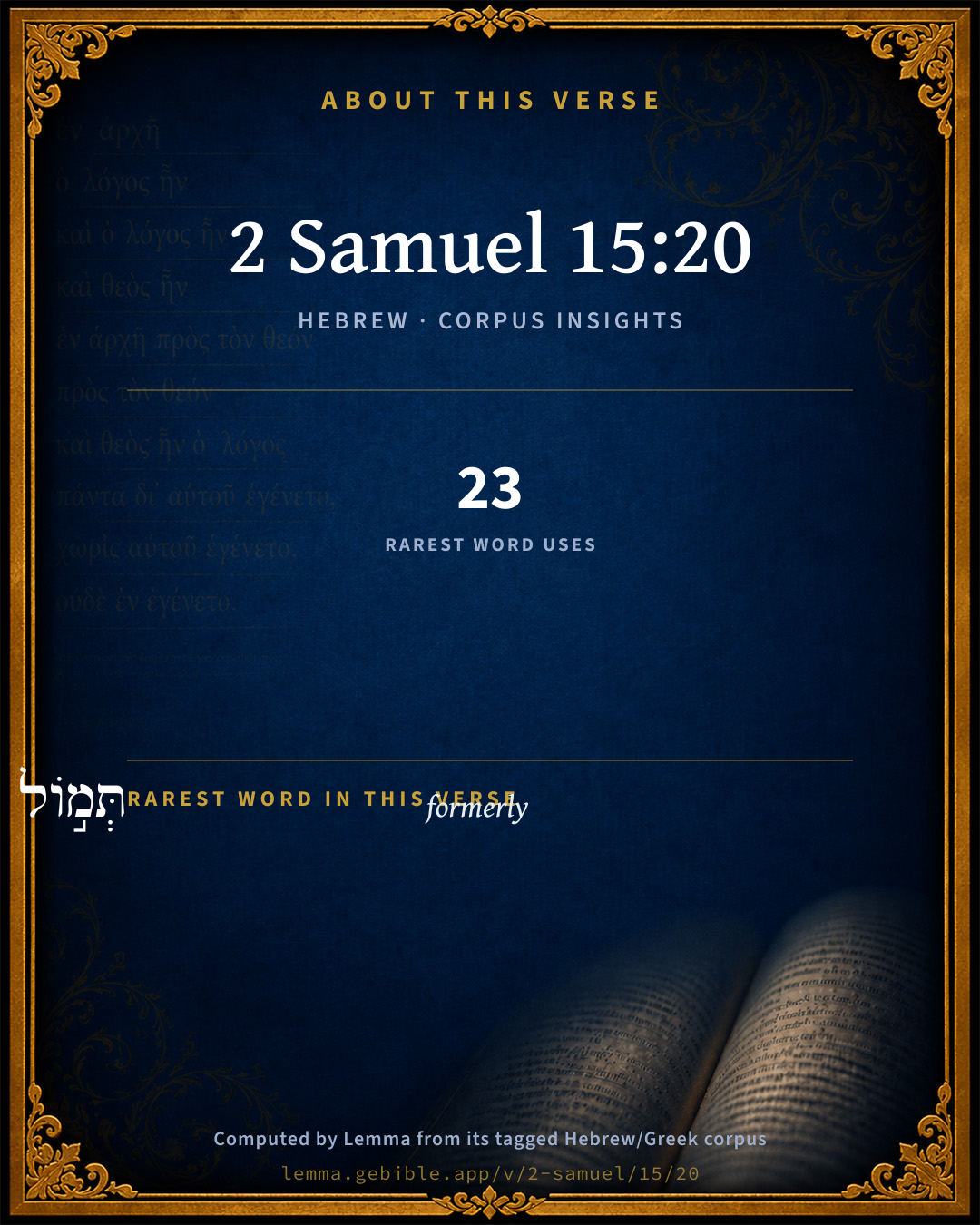
The rarest word here is תְּמ֣וֹל formerly H8543 — appearing just 23 times in the whole Hebrew Bible.

Shared distinctive vocabulary

תְּמ֣וֹל formerly H8543 occurs in 22 verses of the Hebrew Bible. Also found in:

Grammatical profile

  • 8 verbs
  • 4 nouns
  • 2 pronouns
  • 3 prepositions
  • 1 adverb
  • 2 particles

Verb forms

  • בּוֹאֶ֗ךָ Qal · Infinitive Construct
  • אנועך Qal · Imperfect
  • אֲנִֽיעֲךָ֤ Hiphil · Imperfect
  • לָלֶ֔כֶת Qal · Infinitive Construct
  • הוֹלֵ֔ךְ Qal · Participle Active
  • הוֹלֵ֑ךְ Qal · Participle Active
  • שׁ֣וּב Qal · Imperative
  • וְהָשֵׁ֧ב Hiphil · Imperative

Repetition

Words recur within this verse — often emphatic in Hebrew:

  • אנועך to shake H5128 ×2
  • הוֹלֵ֔ךְ to walk H1980 ×2
  • שׁ֣וּב to return H7725 ×2
  • עִמָּ֨נוּ֙ with H5973 ×2
  • וַאֲנִ֣י I H589 ×2

Hebrew & Septuagint length

In English translation the verse runs 36 words from the Hebrew and 66 from the Septuagint (LXX English) — the Septuagint runs noticeably longer here. See the side-by-side →

A rough comparison of the two English renderings, which tokenize alike — not a word-level alignment.

Word counts can differ between the Hebrew and the Greek without any difference in meaning — e.g. the Hebrew direct-object marker אֵת has no separate Greek word, and Greek often adds the article ὁ.

Cross-references

14

Topical passages linked to 2 Samuel 15:20 in the Treasury of Scripture Knowledge — connected by theme and wording, ordered by reader-vote popularity; previews shown in the World English Bible.

  • 1 Samuel 23:13 Then David and his men, who were about six hundred, arose and departed out of Keilah, and went wherever they could go. It was told Saul that David was escaped from Keilah; and he gave up going there.
  • 2 Samuel 2:6 Now Yahweh show loving kindness and truth to you: and I also will requite you this kindness, because you have done this thing.
  • John 1:17 For the law was given through Moses. Grace and truth came through Jesus Christ.
  • Hebrews 11:37–38 They were stoned. They were sawn apart. They were tempted. They were slain with the sword. They went around in sheep skins and in goat skins; being destitute, afflicted, ill-treated
  • Psalms 25:10 All the paths of Yahweh are loving kindness and truth To such as keep his covenant and his testimonies.
  • Psalms 56:8 You number my wanderings. You put my tears into your bottle. Aren't they in your book?
  • Psalms 57:3 He will send from heaven, and save me, He rebukes the one who is pursuing me. Selah. God will send out his loving kindness and his truth.
  • Psalms 59:15 They shall wander up and down for food, And wait all night if they aren't satisfied.
  • Psalms 61:7 He shall be enthroned in God's presence forever. Appoint your loving kindness and truth, that they may preserve him.
  • Psalms 85:10 Mercy and truth meet together. Righteousness and peace have kissed each other.
  • Psalms 89:14 Righteousness and justice are the foundation of your throne. Loving kindness and truth go before your face.
  • Proverbs 14:22 Don't they go astray who plot evil? But love and faithfulness belong to those who plan good.
  • Amos 8:12 They will wander from sea to sea, And from the north even to the east; They will run back and forth to seek the word of Yahweh, And will not find it.
  • 2 Timothy 1:16–18 May the Lord grant mercy to the house of Onesiphorus, for he often refreshed me, and was not ashamed of my chain,

Cross-references courtesy of OpenBible.info (CC BY 4.0).

Hebrew and Greek witnesses Masoretic Hebrew ↔ Greek Septuagint

The same verse in the two great witnesses to the Old Testament, shown verse-for-verse.

Here the Septuagint runs noticeably longer than the Hebrew — LXX2012 (modern English Septuagint) 66 words vs World English Bible 36. A rough length comparison of the two English translations, not a word-level alignment — read both below.

These are two independent witnesses, not word-aligned to each other, and the Septuagint is shown in lemma (dictionary) form.

Hebrew 2 Samuel 15:20 Masoretic · Westminster Leningrad Codex

תְּמ֣וֹל בּוֹאֶ֗ךָ וְהַיּ֞וֹם אנועך אֲנִֽיעֲךָ֤ עִמָּ֨נוּ֙ לָלֶ֔כֶת וַאֲנִ֣י הוֹלֵ֔ךְ עַ֥ל אֲשֶׁר אֲנִ֖י הוֹלֵ֑ךְ שׁ֣וּב וְהָשֵׁ֧ב אֶת אַחֶ֛יךָ עִמָּ֖ךְ חֶ֥סֶד וֶאֱמֶֽת

Whereas you came but yesterday, should I this day make you go up and down with us, seeing I go where I may? return you, and take back your brothers; mercy and truth be with you.

World English Bible · Public Domain

Greek LXX 2 Samuel 15:20 Septuagint · lemma form

εἰ ἐχθές παραγίγνομαι καί σήμερον κινέω σύ μετά ἐγώ καί γέ μετα ἀναἵστημι ὁ τόπος σύ ἐχθές ὁ ἐξέλευσίς σύ καί σήμερον μετακινέω σύ μετά ἐγώ ὁ πορεύομαι καί ἐγώ πορεύομαι ὅς ἄν ἐγώ πορεύομαι ἐπιστρέφω καί ἐπιστρέφω ὁ ἀδελφός σύ μετά σύ καί κύριος ποιέω μετά σύ ἔλεος καί ἀλήθεια

Whereas you came yesterday, shall I today cause you to travel with us, and shall you thus change your place? you did come forth yesterday, and today shall I set you in motion to go along with us? I indeed will go wherever I may go: return then, and cause your brethren to return with you, and may the Lord deal mercifully and truly with you.

LXX2012 (modern English Septuagint) · Public Domain

On this verse, Keil & Delitzsch discusses the Septuagint’s reading. Read the note in Commentary ↓

Hebrew: Westminster Leningrad Codex (CC BY 4.0). Greek: Septuagint (public domain); English from LXX2012 (modern English Septuagint) (Public Domain). How the Septuagint differs from the Hebrew →

Targum (Aramaic paraphrase)

1

The Targum is the ancient Jewish Aramaic paraphrase of the Hebrew Scriptures — an interpretive translation, not the Hebrew text itself. Onkelos (literal) and Pseudo-Jonathan (expansive) render the Torah, and Jonathan the Prophets. Coverage is partial: where no permissively-licensed English translation exists for a verse, only the Aramaic is shown. This is verse-level text, not a word-by-word alignment to the Hebrew.

  1. Targum Jonathan Prophets (Joshua–Malachi)
    תְּמָלֵי אֲתֵיתָא וְיוֹמָא דֵין אֲטַלְטְלִינָךְ עִמָנָא לְמֵיזַל וַאֲנָא אָזֵיל לַאֲתַר דְלֵית אֲנָא יְדַע לְאָן אֲנָא אָזֵיל תּוּב וַאֲתֵיב יַת אֲחָךְ עִמָךְ וַעֲבֵיד עִמְהוֹן טִיבוּ וּקְשׁוֹט:

    (no public-domain English translation for this verse)

    Targum Jonathan — Aramaic: “Mikraot Gedolot” (public domain). English: “Sefaria Community Translation” (CC0 1.0 (public-domain dedication)); “London "Chaldee Paraphrase," 1871” (public domain). Text via Sefaria.

Commentary

Notes on 2 Samuel 15:20 from classic Christian and Jewish commentators (each source and its license shown beneath its notes). The classic Christian expositions comment on the surrounding passage and are grouped to its opening verse, so a note may address several verses; the Jewish commentaries on the Tanakh (Rashi and others) are per-verse, so they appear only where the commentator wrote on this verse.

Lemma curates 59 commentaries, every one of them public domain or Creative Commons licensed, each selected and text-cleaned for this edition rather than reprinted as found. About our sources →

Trapp's Complete Commentary

John Trapp

2Sa 15:20 Whereas thou camest [but] yesterday, should I this day make thee go up and down with us? seeing I go whither I may, return thou, and take back thy brethren: mercy and truth [be] with thee.

Ver. 20. Should I this day make thee go up and down with us?] David had need enough of him; but yet would not do anything that had but a show of unwarrantableness in it.

Mercy and truth be with thee.] Mercy, the fruit of God’s faithfulness, covenant kindness. See Psa 25:10. So Paul prayeth for Onesiphorus. {2Ti 1:18} And such prayers could not be ineffectual; for God will gratify his afflicted; {Zec 13:9} they may have even what they will of him.

John Trapp, A Commentary or Exposition upon All the Books of the Old and New Testament (1647–1656) — public domain. Text from a community e-Sword module.

Geneva Bible (1599)

Geneva Bible translators

God require thee thy friendship and fidelity.

Meaning, them of his family.

Geneva Bible (1599) marginal notes — public domain. Text via Bolls.life.

Adam Clarke's Commentary

Verse 20. Mercy and truth be with thee.] May God ever show thee mercy, as thou showest it to me, and his truth ever preserve thee from error and delusion!

Adam Clarke's Commentary on the Bible (1810–1826) — public domain. Text from a community e-Sword/MySword module.

The Cambridge Bible for Schools and Colleges

gen. ed. J. J. S. Perowne

20. I go whither I may] Not knowing where he might find a home, as in the old days of his flight from Saul. Cp. 1Sa_23:13.

take back thy brethren: mercy and truth be with thee] The Hebrew as it stands must be rendered: take back thy brethren with thee in mercy and truth: but the true text is probably preserved by the Sept. and Vulg. Take back thy brethren with thee: and the Lord shew thee [or, shall shew thee] mercy and truth: to which some texts of the Vulg. add: because thou hast shewn kindness and faithfulness. Cp. ch. 2Sa_2:5-6.

The Cambridge Bible for Schools and Colleges (gen. ed. J. J. S. Perowne; Cambridge University Press, 1878–1918) — public domain. Text from a community e-Sword module.

John Gill's Exposition

Whereas thou camest but yesterday,.... From Gath, or from an expedition he and his men had been on:

should I this day make thee, go up and down with us? wander up and down from place to place with David, when he was but just come off a journey, weary and fatigued:

seeing I go whither I may; where it will be most safe for me, I know not where; may be obliged to flee here and there, which would be very inconvenient to Ittai in his circumstances:

return thou, and take back thy brethren; the six hundred men under him, and whom David could ill spare at this time, and yet, consulting their ease, advises to return to Jerusalem with them:

mercy and truth be with thee; the Lord show mercy and kindness to thee, in that thou hast shown favour and respect to me, and make good all his promises to thee, who hast been true and faithful to me.

John Gill's Exposition of the Whole Bible (1746–1763) — public domain (CC PDM 1.0). Text via the HelloAO Bible API.

Albert Barnes' Notes on the Bible

Thou camest but yesterday - Meaning, “Thou art not a native Israelite, but only a sojourner for a few years, it is not reason therefore that thou shouldst share my calamities. Return to thy place, thy adopted home Jerusalem, and to the king, Absalom” 2Sa 15:34-35.

Albert Barnes' Notes on the Bible (1834–1885) — public domain. Text from a community e-Sword/MySword module.

Haydock's Catholic Bible Commentary

The Lord. Hebrew, "mercy and truth with thee." As thou hast acted towards me, so mayest thou be rewarded. (Haydock)

George Leo Haydock (1774–1849), Haydock's Catholic Family Bible and Commentary, 1859 edition — public domain. Excludes Psalms (Douay-Rheims chapter numbering differs from Protestant) and Deuterocanonical books (Catholic canon only).

Matthew Poole's English Annotations

Thou camest but yesterday; by which it may be gathered that these were not the Israelitish soldiers which went with David to Gath, and came up with him from thence to Hebron, which was above thirty years before this time, but some proselytes which came from thence more lately. For though this word

yesterday be sometimes used of a time long before past, as 2Ki 9:26; Job 8:9; Isa 30:33; yet it seems to be here restrained to a shorter compass by the following words, and by the argument here used.

Go whither I may; I know not whither; having now no certain dwelling-place.

Thy brethren; thy countrymen and soldiers the Gittites, 2Sa 15:18.

Mercy and truth be with thee; since I am now unable to recompense thy kindness and fidelity to me, my hearty prayer to God is, that he would show to thee his mercy, in blessing thee with all sorts of blessings, and his faithfulness, in making good all those promises which he hath made, not to Israelites only, but in and with them to all true-hearted proselytes, such as thou art.

Matthew Poole's English Annotations on the Holy Bible (1683–1685) — public domain. Text from a community e-Sword/MySword module.

Whedon's Commentary on the Bible

Daniel D. Whedon

20. Take back thy brethren — These brethren are not to be regarded as identical with the six hundred Gittites mentioned above, but as a number of Ittai’s fellow-exiles, and perhaps blood relatives, who had been forced to leave their country for some cause now unknown.

Daniel D. Whedon (gen. ed.), Commentary on the Old and New Testaments (1874–1909) — public domain. Text from a community e-Sword module.

The Pulpit Commentary

A farewell blessing.

and truth be with thee." Times of adversity are testing times. They try and make manifest the character both of the sufferer and of his friends. The base and the noble in men, their selfishness and their disinterestedness, their faithlessness and their fidelity, are revealed and heightened. David never appeared in better light (in all but, perhaps, courage) than at the fearful crisis when his son was usurping his throne and ready to take his life, and he himself became for a time an exile from home and metropolis and sanctuary; and while some of his servants made manifest their inherent baseness, the virtues of others shone forth in new lustre. The conversation between David and Ittai illustrates these remarks. It is a contest of nobleness, in which both appear to great advantage. The words of the text were intended by David as a farewell Ittai would not, however, accept them as such, but persisted in accompanying him whithersoever he might go. They contain a prayer suitable for all in addressing their friends in parting, or indeed at any time. "Mercy and truth" are, of course, those of God. "May God exercise towards thee his mercy and truth.

I "MERCY:" HERE EQUIVALENT TO GRACE, KINDNESS, LOVE. Man is entirely dependent on the kindness of God both as a creature and as a sinner. All in some degree are its objects; but in desiring that it may be with any, we wish that they may enjoy it to the fullest extent, both in body and soul, in time and in eternity. It thus includes all manifestations and exercises of Divine grace.

1. Providential.

2. Pardoning.

3. Sanctifying.

4. Defending and preserving.

5. Comforting and gladdening.

6. Eternally saving.

II "TRUTH:" EQUIVALENT TO TRUTHFULNESS, FAITHFULNESS. That perfection of the Divine nature which assures us that God will ever act in a manner true to himself as be reveals himself in his Word, and to the promises he has given us. In desiring that the truth of God may be with any, We pray that they may to the fullest extent experience how trustworthy are the revelations he has made of himself, how faithfully his promises are fulfilled, how happy they are who confide in him.

III THE "MERCY AND TRUTH" OF GOD ARE OFTEN PRESENTED TOGETHER IN THE HOLY WRITINGS, ESPECIALLY IN THE BOOK OF PSALMS. They exhibit the two aspects of the nature of God with which we are chiefly concerned; and, taken comprehensively, include his whole moral character. To desire, therefore, that they may be with any one is to pray that God may be with him in the fulness of his Being, as his God; that he may experience for himself all that he can be to one of his creatures his kindness in the utmost meaning of his faithful representations; his truth, not in the accomplishment of his threatenings, but in the amplest fulfilment of his gracious promises.

IV THESE DIVINE PERFECTIONS ARE "WITH US" WHEN THEY ARE EXERCISED FOR OUR GOOD. This often takes place when they are not present to our consciousness. But the highest blessedness is to enjoy their exercise in the full consciousness that it is the "mercy and truth" of God that are blessing our lives. The crowning bliss is to enjoy their uninterrupted exercise towards us, and that forever.

V FOR TO HAVE GOD"S "MERCY AND TRUTH" WITH US IS TO ENJOY ALL REAL GOOD, AND TO BE SURE OF ITS ENJOYMENT FOREVER. Hence these words express all that the wisest, kindest, and best can address to their friends in parting with them, or on birthdays, new year"s days, etc. We cannot be so certain, that we are pronouncing a blessing on them when we wish them health, wealth, long life, abundance of friends, etc.

VI ONE OF THE BEST EFFECTS OF GOD"S "MERCY AND TRUTH" is to produce their own likeness in those with whom they dwell, making them kind and loving, true and faithful. The possession and cultivation of these qualities are a necessary part of the evidence that we have savingly experienced the Divine grace and faithfulness, and a necessary condition of our continuing to enjoy them. G.W. (see Pro_3:3, Pro_3:4)

The Pulpit Commentary (1880–1919), ed. H.D.M. Spence-Jones & Joseph S. Exell — public domain. Text from a community e-Sword module.

John Wesley's Explanatory Notes

Brethren - Thy countrymen the Gittites, ver. 18. Mercy, &c. - Since I am now unable to recompense thy kindness and fidelity to me, my hearty prayer to God is, that he would shew to thee his mercy, in blessing thee with all sorts of blessings, and his faithfulness in making good all these promises which he had made, not to Israelites only, but to all true hearted proselytes, such as thou art.

John Wesley, Explanatory Notes Upon the Whole Bible (1754–1765) — public domain. Text via the GEBible commentary corpus.

Keil & Delitzsch

C. F. Keil & F. Delitzsch

"Thy coming is yesterday (from yesterday), and should I disturb thee to-day to go with us, when I am going just where I go?" i.e., wherever my way may lie (I go I know not whither; Chald.: cf. Sa1 23:13). The Chethib אנוּעך is a copyist's error. The thought requires the Hiphil אניעך (Keri), as נוּע in the Kal has the intransitive meaning, to totter, sway about, or move hither and thither. "Return and take thy brethren back; grace and truth be with thee." It is evidently more in accordance with the train of thought to separate עמּך from the previous clause and connect it with ואמת חסד, though this is opposed to the accents, than to adopt the adverbial interpretation, "take back thy brethren with thee in grace and truth," as Maurer proposes. (For the thought itself, see Pro 3:3). The reference is to the grace and truth (faithfulness) of God, which David desired that Ittai should receive upon his way. In the Septuagint and Vulgate the passage is paraphrased thus: "Jehovah show thee grace and truth," after Sa2 2:6; but it by no means follows from this that עמּך ועשׂה והוה has fallen out of the Hebrew text.

Keil & Delitzsch — Biblical Commentary on the Old Testament (1861–1891) — public domain (CC PDM 1.0). Text via the HelloAO Bible API. (Old Testament only.)

Rashi

Rabbi Shlomo Yitzchaki (Rashi)

And should I today cause you to move with us. I have no place that I can settle you there to escape because I am going to where circumstances have me go each day. When I hear that the pursuers are here I flee here. And so Yonasan translates [the verse], "And if you are estranged [from Avsholom] you can go home" [as:] "And if you you are estranged go [back] to your city."

I will consider it kindness and truth. I will credit you the favor of kindness and truth that you have done for me.

Rashi on the Tanakh — English translations: “The Judaica Press complete Tanach with Rashi, translated by A. J. Rosenberg” (CC BY 4.0); “Pentateuch with Rashi's commentary by M. Rosenbaum and A.M. Silbermann, 1929-1934” (public domain); “The Metsudah Tanach series, Lakewood, N.J” (CC BY 4.0); and “The Book of Joshua, Metsudah Publications, 1997” (CC BY 4.0). Text via Sefaria.

Lesson kit

Teaching starters — assembled from the data on this page, not authored interpretation. Every prompt links to the verse data it draws on. Edit before teaching.

2 Samuel, in the Historical, opens this verse with 20 words (15 distinct Hebrew lemmas). Its most distinctive word is tᵉmôwl (“formerly”). The Greek Septuagint runs longer here. A historical commentator’s framing appears above. Read the whole chapter for the surrounding context.

Discussion questions

  1. The word tᵉmôwl carries the sense “formerly.” How does it shape the verse?
  2. How does Genesis 31:2, which shares the word «formerly», read alongside this verse?
  3. What does the repetition of “to shake” (2× in this one verse) do in this verse?
  4. The Septuagint runs longer here than the Hebrew. What might account for the difference?
  5. These translations render this verse differently; the difference is in the English rendering, not the original. What questions does that raise?
  6. «בּוֹאֶ֗ךָ» is a Qal Infinitive Construct verb. How does that grammatical form shape the action described?
  7. Compare how Trapp's Complete Commentary and Geneva Bible (1599) read this verse. Where do they agree or differ?

Things to notice

Reading settings

Reading text

Shown beneath each verse's original-language words.

Old Testament
Old Testament edition

Read the OT as the Masoretic Hebrew (MT) or the Greek Septuagint (LXX).

English shown for the Greek Septuagint (in the Hebrew ↔ Greek comparison).

Comparing translations? Open the Compare panel on any verse page to stack up to four side by side.