2 Samuel 14:5

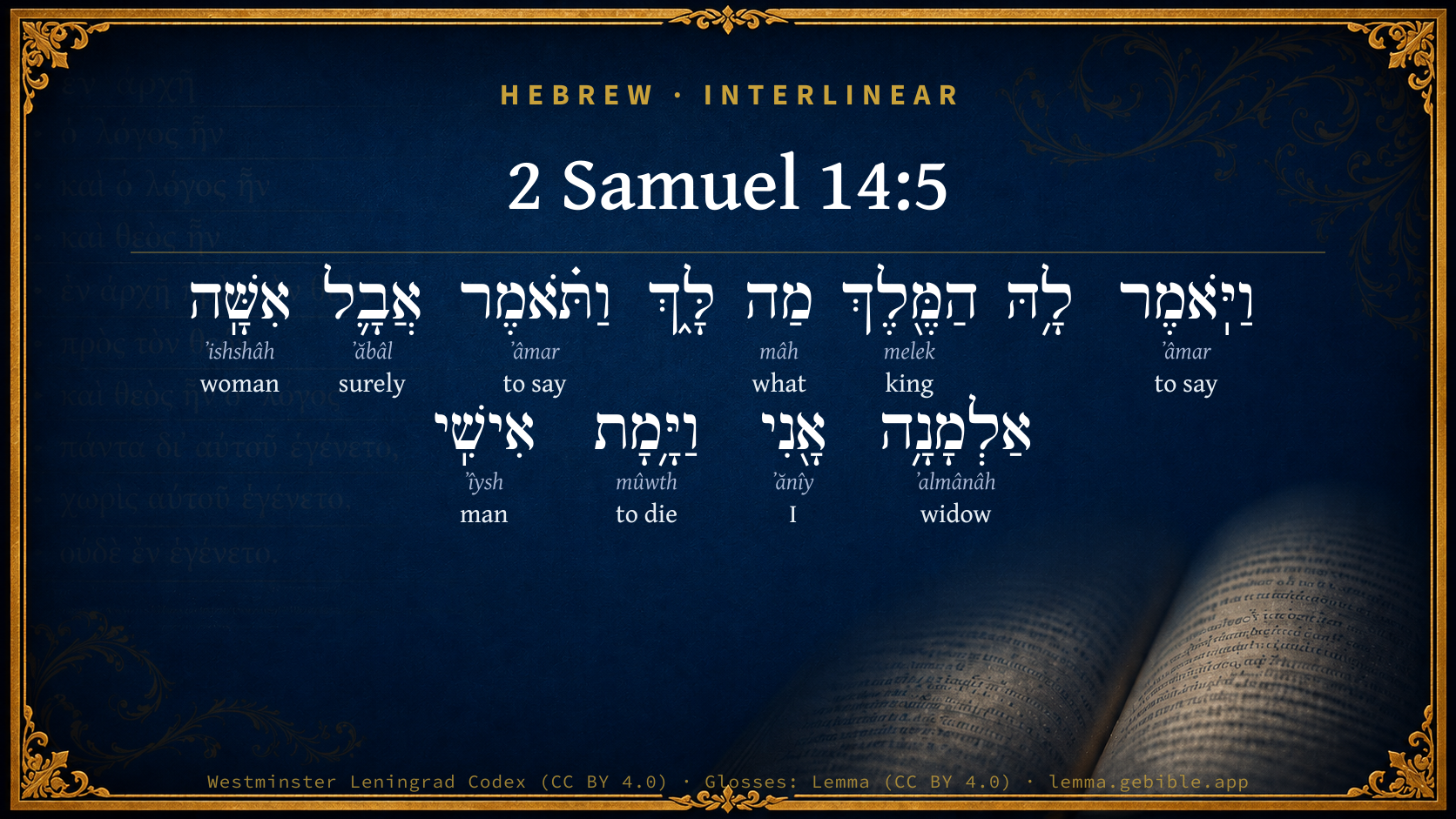
Hebrew (Westminster Leningrad Codex) 2 Samuel 14:5 appears in the Hebrew Old Testament. The text above is from the Westminster Leningrad Codex. Each word links to its Strong’s number, a concise gloss, and parsing drawn from the Open Scriptures Hebrew Bible morphology. Click any word for its full Brown-Driver-Briggs (BDB) entry.
Download image
Cite this verse

2 Samuel 14:5 (World English Bible). Public Domain. Lemma interlinear Bible study tool, https://lemma.gebible.app/v/2-samuel/14/5.

Show BibTeX & RIS
BibTeX
RIS
English Translation
The king said to her, What ails you? She answered, Of a truth I am a widow, and my husband is dead.
World English Bible · Public Domain
Download a study sheet

One document with this verse’s original text, its word-by-word gloss line, the meaning frame, cross-references with their text, attributed commentary, and full source and license credits — printable, and it pastes into notes with its structure intact.

This verse Autodidact and up

Study sheet (.html) Plain text (.txt)

A passage Seminary Student

Up to 50 verses in one chapter. A passage sheet keeps up to 6 commentary sources and 12 cross-references per verse, in the order this page ranks them, and says so on the sheet whenever that leaves anything out. Ask for a single verse and you get the Autodidact verse sheet above.

Everything on this page stays free to read, with no account — the sheet is a download of what is already on screen, not access to it.

Want to remove ads? Support Godless Engineer
Compare translations 3

The same verse in 3 English versions, stacked beneath the original-language interlinear above. Click any original word for its lexicon entry.

Each is an independent rendering of the whole verse — the interlinear is not word-aligned to these translations.

Highlighted words mark where these versions differ — a whole-verse word diff, not a word-by-word alignment.

  • World English Bible Public Domain
    The king said to her, What ails you? She answered, Of a truth I am a widow, and my husband is dead.
  • King James Version Public Domain
    And the king said unto her, What aileth thee? And she answered, I am indeed a widow woman, and mine husband is dead.
  • unfoldingWord Literal Text CC BY-SA 4.0
    And the king said to her, “What to you?” And she said, “Truly I a woman, a widow, for my husband has died.

unfoldingWord Literal Text — © unfoldingWord, licensed CC BY-SA 4.0. Word-aligned USFM3 via Door43 (git.door43.org/unfoldingWord/en_ult).

Versions to compare (up to 4)

3 of 4 selected

Show all 18 translations

Every available English version of this verse, each an independent rendering of the whole verse.

  • World English Bible Public Domain
    The king said to her, What ails you? She answered, Of a truth I am a widow, and my husband is dead.
  • Berean Standard Bible Public Domain
    “What troubles you?” the king asked her. “Indeed,” she said, “I am a widow, for my husband is dead.
  • Majority Standard Bible Public Domain
    “What troubles you?” the king asked her. “Indeed,” she said, “I am a widow, for my husband is dead.
  • King James Version Public Domain
    And the king said unto her, What aileth thee? And she answered, I am indeed a widow woman, and mine husband is dead.
  • American Standard Version (1901) Public Domain
    And the king said unto her, What aileth thee? And she answered, Of a truth I am a widow, and my husband is dead.
  • Revised Version (1885) Public Domain
    And the king said unto her, What aileth thee? And she answered; Of a truth I am a widow woman, and mine husband is dead.
  • Geneva Bible (1599) Public Domain
    Then the King sayd vnto her, What aileth thee? And she answered, I am in deede a widow, and mine husband is dead:
  • Douay-Rheims (1899) Public Domain
    And the king said to her: What is the matter with thee? She answered: Alas, I am a widow woman: for my husband is dead.
  • Young's Literal Translation Public Domain
    And the king saith to her, `What -- to thee?' and she saith, `Truly a widow woman `am' I, and my husband dieth,
  • Literal Standard Version CC BY-SA 4.0
    And the king says to her, “What do you [want]?” And she says, “I [am] truly a widow woman, and my husband dies,
  • Unlocked Literal Bible CC BY-SA 4.0
    The king said to her, “What is wrong?” She answered, “The truth is that I am a widow, and my husband is dead.
  • unfoldingWord Literal Text CC BY-SA 4.0
    And the king said to her, “What to you?” And she said, “Truly I a woman, a widow, for my husband has died.
  • Darby Bible Public Domain
    And the king said to her, What aileth thee? And she said, I am indeed a widow woman, and my husband is dead.
  • World Messianic Bible Public Domain
    The king said to her, “What ails you?” She answered, “Truly I am a widow, and my husband is dead.
  • Webster's Bible Public Domain
    And the king said to her, What aileth thee? And she answered, I am indeed a widow woman, and my husband is dead.
  • Free Bible Version CC BY-SA 4.0
    “What's the matter?” the king asked her. “Sadly I'm a widow. My husband is dead,” she replied.
  • Bible in Basic English Public Domain
    And the king said to her, What is your trouble? And her answer was, Truly I am a widow, and my husband is dead.
  • JPS Tanakh (1917) Public Domain
    And the king said unto her: 'What aileth thee?' And she answered: 'Of a truth I am a widow, my husband being dead.

Literal Standard Version (2020), Covenant Press — licensed CC BY-SA 4.0. Text via the HelloAO Bible API (eBible.org). Unlocked Literal Bible (unfoldingWord) — licensed CC BY-SA 4.0. Text via the HelloAO Bible API (eBible.org). unfoldingWord Literal Text — © unfoldingWord, licensed CC BY-SA 4.0. Word-aligned USFM3 via Door43 (git.door43.org/unfoldingWord/en_ult). Free Bible Version, Dr. Jonathan Gallagher — licensed CC BY-SA 4.0. Text via the HelloAO Bible API (eBible.org).

Word by word

More ways to search: Search by grammar → Find every occurrence → Compare this word →

Practice this passage: Drill this verse → Learn its vocabulary →

אֲבָ֛ל
ʼăbâl
H61
“surely”
Adverb
Part of Speech
Adverb
Full BDB Definition

Origin: apparently from H56 through the idea of negation

TWOT: 8

truly, verily, surely - but, however, howbeit - contrariwise, nay rather (negative)
  1. וַיֹּֽאמֶר ʼâmar H559 “and · to say” Conjunction + Verb, Qal, Sequential Imperfect, 3rd Person, Masculine, Singular
  2. הַמֶּ֖לֶךְ melek H4428 “the · king” Particle, Definite Article + Noun, Common, Masculine, Singular, Absolute
  3. מַה mâh H4100 “what” Particle, Interrogative
  4. וַתֹּ֗אמֶר ʼâmar H559 “and · to say” Conjunction + Verb, Qal, Sequential Imperfect, 3rd Person, Feminine, Singular
  5. אִשָּֽׁה ʼishshâh H802 “woman” Noun, Common, Feminine, Singular, Absolute
  6. אַלְמָנָ֥ה ʼalmânâh H490 “widow” Noun, Common, Feminine, Singular, Absolute
  7. אָ֖נִי ʼănîy H589 “I” Pronoun, Personal, 1st Person, Common, Singular
  8. וַיָּ֥מָת mûwth H4191 “and · to die” Conjunction + Verb, Qal, Sequential Imperfect, 3rd Person, Masculine, Singular
  9. אִישִֽׁי ʼîysh H376 “man · my” Noun, Common, Masculine, Singular, Construct + Suffix, Personal, 1st Person, Common, Singular

About this verse

These counts appear in no published source. They are computed here, from the morphology-tagged text and Lemma’s own curated glosses. What Lemma adds →

12
words
9
distinct lemmas
Historical
section

Notable vocabulary

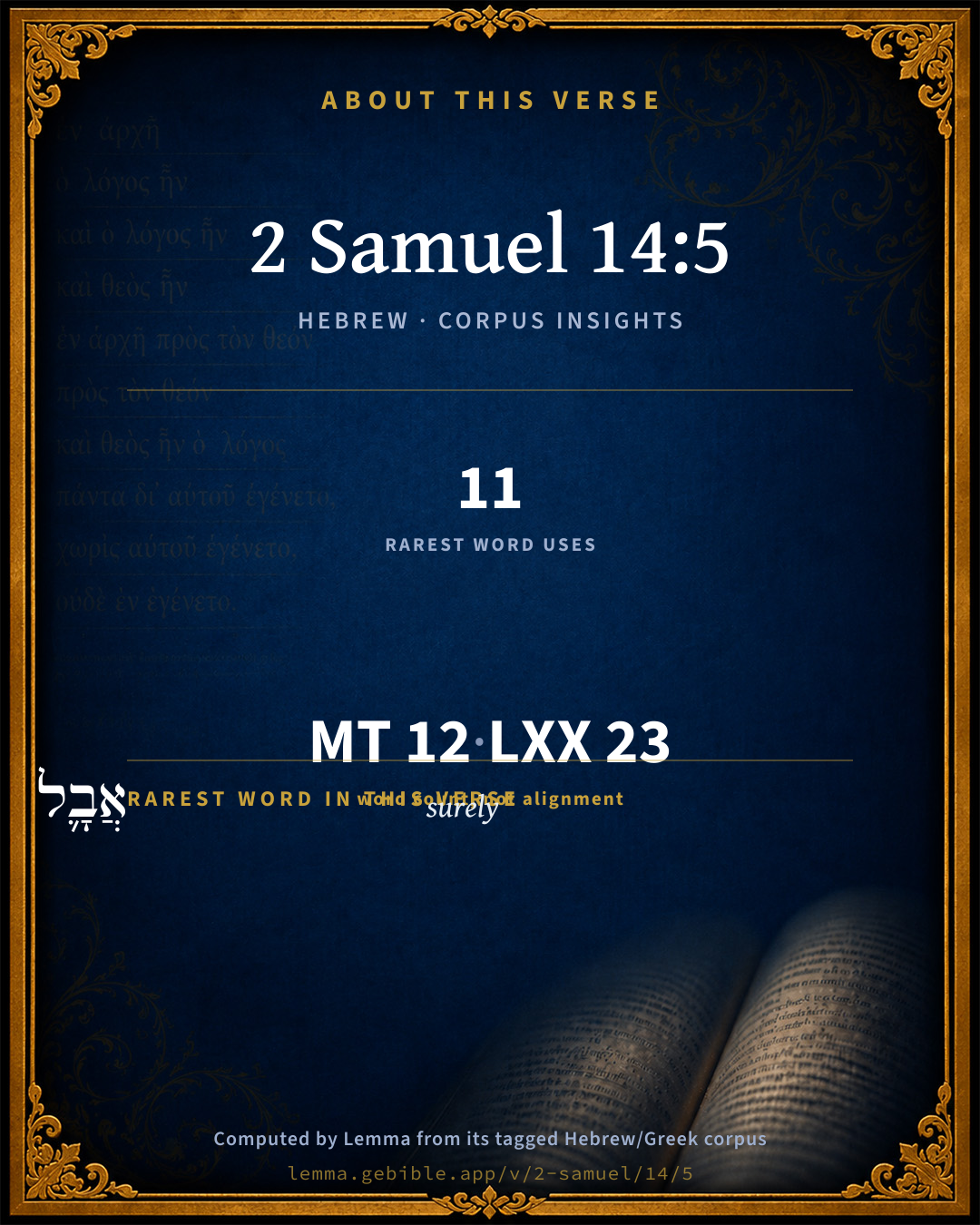
The rarest word here is אֲבָ֛ל surely H61 — appearing just 11 times in the whole Hebrew Bible.

Shared distinctive vocabulary

אֲבָ֛ל surely H61 occurs in 11 verses of the Hebrew Bible. Also found in:

Grammatical profile

  • 3 verbs
  • 4 nouns
  • 1 pronoun
  • 2 prepositions
  • 1 adverb
  • 1 particle

Verb forms

  • וַיֹּֽאמֶר Qal · Sequential Imperfect
  • וַתֹּ֗אמֶר Qal · Sequential Imperfect
  • וַיָּ֥מָת Qal · Sequential Imperfect

Repetition

A word recurs within this verse — often emphatic in Hebrew:

  • וַיֹּֽאמֶר to say H559 ×2

Hebrew & Septuagint length

In English translation the verse runs 22 words from the Hebrew and 26 from the Septuagint (LXX English) — closely comparable.

A rough comparison of the two English renderings, which tokenize alike — not a word-level alignment.

Word counts can differ between the Hebrew and the Greek without any difference in meaning — e.g. the Hebrew direct-object marker אֵת has no separate Greek word, and Greek often adds the article ὁ.

In the original languages it is 12 Hebrew tokens and 23 Greek tokens — but the two are counted differently (Hebrew bundles its prefixes and suffixes into one token; the Greek is in lemma form), so that isn’t a like-for-like length.

Cross-references

2

Topical passages linked to 2 Samuel 14:5 in the Treasury of Scripture Knowledge — connected by theme and wording, ordered by reader-vote popularity; previews shown in the World English Bible.

  • Judges 9:8–15 The trees went forth on a time to anoint a king over them; and they said to the olive tree, Reign you over us.
  • 2 Samuel 12:1–3 Yahweh sent Nathan to David. He came to him, and said to him, "There were two men in one city; the one rich, and the other poor.

Cross-references courtesy of OpenBible.info (CC BY 4.0).

Hebrew and Greek witnesses Masoretic Hebrew ↔ Greek Septuagint

The same verse in the two great witnesses to the Old Testament, shown verse-for-verse.

These are two independent witnesses, not word-aligned to each other, and the Septuagint is shown in lemma (dictionary) form.

Hebrew 2 Samuel 14:5 Masoretic · Westminster Leningrad Codex

וַיֹּֽאמֶר לָ֥הּ הַמֶּ֖לֶךְ מַה לָּ֑ךְ וַתֹּ֗אמֶר אֲבָ֛ל אִשָּֽׁה אַלְמָנָ֥ה אָ֖נִי וַיָּ֥מָת אִישִֽׁי

The king said to her, What ails you? She answered, Of a truth I am a widow, and my husband is dead.

World English Bible · Public Domain

Greek LXX 2 Samuel 14:5 Septuagint · lemma form

καί εἶπον πρός αὐτός ὁ βασιλεύς τίς εἰμί σύ ὁ δέ εἶπον καί μάλα γυνή χήρα ἐγώ εἰμί καί ἀποθνήσκω ὁ ἀνήρ ἐγώ

And the king said to her, What is the matter with you? And she said, I am indeed a widow woman, and my husband is dead.

LXX2012 (modern English Septuagint) · Public Domain

Hebrew: Westminster Leningrad Codex (CC BY 4.0). Greek: Septuagint (public domain); English from LXX2012 (modern English Septuagint) (Public Domain). How the Septuagint differs from the Hebrew →

Targum (Aramaic paraphrase)

1

The Targum is the ancient Jewish Aramaic paraphrase of the Hebrew Scriptures — an interpretive translation, not the Hebrew text itself. Onkelos (literal) and Pseudo-Jonathan (expansive) render the Torah, and Jonathan the Prophets. Coverage is partial: where no permissively-licensed English translation exists for a verse, only the Aramaic is shown. This is verse-level text, not a word-by-word alignment to the Hebrew.

  1. Targum Jonathan Prophets (Joshua–Malachi)
    וַאֲמַר לָהּ מַלְכָּא מַה לִיךְ וַאֲמָרַת בְּקוּשְׁטָא אִתְּתָא אַרְמַלְתָּא אֲנָא וּמִית בַּעֲלִי:

    (no public-domain English translation for this verse)

    Targum Jonathan — Aramaic: “Mikraot Gedolot” (public domain). English: “Sefaria Community Translation” (CC0 1.0 (public-domain dedication)); “London "Chaldee Paraphrase," 1871” (public domain). Text via Sefaria.

Commentary

Notes on 2 Samuel 14:5 from classic Christian and Jewish commentators (each source and its license shown beneath its notes). The classic Christian expositions comment on the surrounding passage and are grouped to its opening verse, so a note may address several verses; the Jewish commentaries on the Tanakh (Rashi and others) are per-verse, so they appear only where the commentator wrote on this verse.

Lemma curates 59 commentaries, every one of them public domain or Creative Commons licensed, each selected and text-cleaned for this edition rather than reprinted as found. About our sources →

Trapp's Complete Commentary

John Trapp

2Sa 14:5 And the king said unto her, What aileth thee? And she answered, I [am] indeed a widow woman, and mine husband is dead.

Ver. 5. And the king said unto her, What aileth thee?] Kings and princes should courteously admit, patiently hear, and readily help their suppliant subjects. Antonius the emperor was, for this good property, surnamed Pius; Titus, the darling of mankind; Trajan is much renowned in story for this, that being mounted to go against the enemy in battle, he alighted from his horse, only to do justice to a poor woman, that cried out unto him. {a}

I am indeed a widow woman.] And therefore in a calamitous condition: especially if thou knewest all. At mulier vidua sum.

{a} Ael. Spart.

John Trapp, A Commentary or Exposition upon All the Books of the Old and New Testament (1647–1656) — public domain. Text from a community e-Sword module.

The Biblical Illustrator

Joseph S. Exell

2Sa_14:5-20

And she answered, I am indeed a widow woman.

The parable of the woman of Tekoa

The contrast between this parable and the one preceding it is very great. The parable of the ewe-lamb was spoken of by a prophet inspired by God. This one was spoken by a theatrical persons at the instigation of a man of the world, one who, though thoroughly unprincipled, could read human character and discern human motives through a very small crevice. The parable of Nathan was the introduction to a scorching reproof of Davids iniquity, the parable of the Tekoan is full of fulsome flattery. The prophets parable was uttered to induce repentance in David; this one had for its end only the promotion of Joabs schemes of self-interest.

I. The argument of the parable.

1. That those who grant mercy abroad should first begin at home. The first reason which the woman urges why David should forgive his son is the willingness with which he would have forgiven hers. A king who is merciful to his subjects is inconsistent with himself if he is not forgiving towards the members of his own family.

2. That enmity ought to die before those who are at enmity die. For we must needs die, and are as water spilt on the ground, which cannot be gathered up again (2Sa_14:14). If Absalom were to die before a reconciliation had taken place, the fathers heart would be deeply grieved; and if he himself were to die before his sons return to favour he would go down to his grave mourning the estrangement.

3. The Divine Fathers example in relation to His banished ones.

II. Its immediate and remote results. The immediate result was the recall of Absalom without outward reconciliation. Let him turn to his own house, and let him not see my face (2Sa_14:24). Evils arose from this half-measure. Joab was disappointed, and Absalom was irritated.

Lessons:

1. That the most worthless characters sometimes have the best pleaders. We find this the case occasionally in our law courts. Men with no character, but lacking nothing else, with money and influence in abundance, can have the benefit of the most skilful barristers to bring them out of the grip of the law.

2. That imaginary narratives of human life have most influence when they find a counterpart in our own experience. The power of a story may he very great even when it contains nothing in it that has any likeness to anything that has happened to ourselves.

3. That those who are conscious of having committed great sins are not fit to deal with other offenders. The sin of David included the crimes of both his sons, and the consciousness of this made him weak in purpose, and unsteady in his dealings with them.

4. To restore to favour unconditionally is a sin against the person forgiven. (A London Minister.)

The Biblical Illustrator, edited by Joseph S. Exell (c. 1880s–1900s) — public domain. Text from a community e-Sword module.

Geneva Bible (1599)

Geneva Bible translators

Hebrew, a widow woman.

Geneva Bible (1599) marginal notes — public domain. Text via Bolls.life.

Adam Clarke's Commentary

Verse 5. I am indeed a widow woman] It is very possible that the principal facts mentioned here were real, and that Joab found out a person whose circumstances bore a near resemblance to that which he wished to represent.

Adam Clarke's Commentary on the Bible (1810–1826) — public domain. Text from a community e-Sword/MySword module.

John Gill's Exposition

And the king said unto her, what aileth thee?.... Or what is thy case? What is the condition, and what the circumstances, that thou art in, which require help and assistance? intimating that he was ready to grant it on knowledge thereof; however, he was ready to hear what she had to say:

and she answered, I am indeed a widow woman; of a truth a widow, as the Targum; she was really one, a widow indeed, as in Ti1 5:3; not one that was separated from her husband, he being alive, or divorced from him on any account; and therefore she adds:

and mine husband is dead; and has been a long time; this she said to move the pity and compassion of the king, who, as the supreme magistrate in God's stead, was a Father of the fatherless, and the judge of the widow.

John Gill's Exposition of the Whole Bible (1746–1763) — public domain (CC PDM 1.0). Text via the HelloAO Bible API.

Haydock's Catholic Bible Commentary

Dead. Some conclude from ver. 16, that this is a true history; but it appears rather, that it was only a parable, (ver. 19.; Calmet) invented by Joab. (Menochius)

George Leo Haydock (1774–1849), Haydock's Catholic Family Bible and Commentary, 1859 edition — public domain. Excludes Psalms (Douay-Rheims chapter numbering differs from Protestant) and Deuterocanonical books (Catholic canon only).

Matthew Poole's English Annotations

I am indeed a widow woman; one of them who most need thy compassion and assistance, and whom thou art by God’s law obliged in a singular manner to protect and relieve.

Matthew Poole's English Annotations on the Holy Bible (1683–1685) — public domain. Text from a community e-Sword/MySword module.

John Wesley's Explanatory Notes

Widow - One of them who most need thy compassion, and whom thou art by God's law obliged in a singular manner to relieve.

John Wesley, Explanatory Notes Upon the Whole Bible (1754–1765) — public domain. Text via the GEBible commentary corpus.

Rashi

Rabbi Shlomo Yitzchaki (Rashi)

In truth, I am a widowed woman.אֲבָל means "In truth."

Rashi on the Tanakh — English translations: “The Judaica Press complete Tanach with Rashi, translated by A. J. Rosenberg” (CC BY 4.0); “Pentateuch with Rashi's commentary by M. Rosenbaum and A.M. Silbermann, 1929-1934” (public domain); “The Metsudah Tanach series, Lakewood, N.J” (CC BY 4.0); and “The Book of Joshua, Metsudah Publications, 1997” (CC BY 4.0). Text via Sefaria.

Lesson kit

Teaching starters — assembled from the data on this page, not authored interpretation. Every prompt links to the verse data it draws on. Edit before teaching.

2 Samuel, in the Historical, opens this verse with 12 words (9 distinct Hebrew lemmas). Its most distinctive word is ʼăbâl (“surely”). A historical commentator’s framing appears above. Read the whole chapter for the surrounding context.

Discussion questions

  1. The word ʼăbâl carries the sense “surely.” How does it shape the verse?
  2. How does Genesis 17:19, which shares the word «surely», read alongside this verse?
  3. What does the repetition of “to say” (2× in this one verse) do in this verse?
  4. The translations on this page render this verse differently — a whole-verse word diff, not a word-by-word alignment. What might account for the different wordings?
  5. «וַיֹּֽאמֶר» is a Qal Sequential Imperfect verb. How does that grammatical form shape the action described?
  6. Compare how Trapp's Complete Commentary and The Biblical Illustrator read this verse. Where do they agree or differ?

Things to notice

Reading settings

Reading text

Shown beneath each verse's original-language words.

Old Testament
Old Testament edition

Read the OT as the Masoretic Hebrew (MT) or the Greek Septuagint (LXX).

English shown for the Greek Septuagint (in the Hebrew ↔ Greek comparison).

Comparing translations? Open the Compare panel on any verse page to stack up to four side by side.