2 Samuel 16:19

Hebrew (Westminster Leningrad Codex) 2 Samuel 16:19 appears in the Hebrew Old Testament. The text above is from the Westminster Leningrad Codex. Each word links to its Strong’s number, a concise gloss, and parsing drawn from the Open Scriptures Hebrew Bible morphology. Click any word for its full Brown-Driver-Briggs (BDB) entry.
Download image
Cite this verse

2 Samuel 16:19 (World English Bible). Public Domain. Lemma interlinear Bible study tool, https://lemma.gebible.app/v/2-samuel/16/19.

Show BibTeX & RIS
BibTeX
RIS
English Translation
Again, whom should I serve? Shouldn't I serve in the presence of his son? as I have served in your father's presence, so will I be in your presence.
World English Bible · Public Domain
Download a study sheet

One document with this verse’s original text, its word-by-word gloss line, the meaning frame, cross-references with their text, attributed commentary, and full source and license credits — printable, and it pastes into notes with its structure intact.

This verse Autodidact and up

Study sheet (.html) Plain text (.txt)

A passage Seminary Student

Up to 50 verses in one chapter. A passage sheet keeps up to 6 commentary sources and 12 cross-references per verse, in the order this page ranks them, and says so on the sheet whenever that leaves anything out. Ask for a single verse and you get the Autodidact verse sheet above.

Everything on this page stays free to read, with no account — the sheet is a download of what is already on screen, not access to it.

Want to remove ads? Support Godless Engineer
Compare translations 3

The same verse in 3 English versions, stacked beneath the original-language interlinear above. Click any original word for its lexicon entry.

Each is an independent rendering of the whole verse — the interlinear is not word-aligned to these translations.

Highlighted words mark where these versions differ — a whole-verse word diff, not a word-by-word alignment.

  • World English Bible Public Domain
    Again, whom should I serve? Shouldn't I serve in the presence of his son? as I have served in your father's presence, so will I be in your presence.
  • King James Version Public Domain
    And again, whom should I serve? should I not serve in the presence of his son? as I have served in thy father's presence, so will I be in thy presence.
  • unfoldingWord Literal Text CC BY-SA 4.0
    And second, I, before whom shall I serve? not to the face of his son? Just as I served to the face of your father, thus I will be to your face.”

unfoldingWord Literal Text — © unfoldingWord, licensed CC BY-SA 4.0. Word-aligned USFM3 via Door43 (git.door43.org/unfoldingWord/en_ult).

Versions to compare (up to 4)

3 of 4 selected

Show all 18 translations

Every available English version of this verse, each an independent rendering of the whole verse.

  • World English Bible Public Domain
    Again, whom should I serve? Shouldn't I serve in the presence of his son? as I have served in your father's presence, so will I be in your presence.
  • Berean Standard Bible Public Domain
    Furthermore, whom should I serve if not the son? As I served in your father’s presence, so also I will serve in yours.”
  • Majority Standard Bible Public Domain
    Furthermore, whom should I serve if not his son? As I served in your father’s presence, so also I will serve in yours.”
  • King James Version Public Domain
    And again, whom should I serve? should I not serve in the presence of his son? as I have served in thy father's presence, so will I be in thy presence.
  • American Standard Version (1901) Public Domain
    And again, whom should I serve? `should I' not `serve' in the presence of his son? as I have served in thy father's presence, so will I be in thy presence.
  • Revised Version (1885) Public Domain
    And again, whom should I serve? should I not serve in the presence of his son? as I have served in thy father’s presence, so will I be in thy presence.
  • Geneva Bible (1599) Public Domain
    And moreouer vnto whome shall I doe seruice? not to his sonne? as I serued before thy father, so will I before thee.
  • Douay-Rheims (1899) Public Domain
    Besides this, whom shall I serve? is it not the king's son? as I have served thy father, so will I serve thee also.
  • Young's Literal Translation Public Domain
    and secondly, for whom do I labour? is it not before his son? as I served before thy father so am I before thee.'
  • Literal Standard Version CC BY-SA 4.0
    and secondly, for whom do I labor? Is it not before his son? As I served before your father, so I am before you.”
  • Unlocked Literal Bible CC BY-SA 4.0
    Also, what man should I serve? Should I not serve in the presence of his son? As I have served in your father's presence, I will serve in your presence.”
  • unfoldingWord Literal Text CC BY-SA 4.0
    And second, I, before whom shall I serve? not to the face of his son? Just as I served to the face of your father, thus I will be to your face.”
  • Darby Bible Public Domain
    And again, whom should I serve? should it not be in the presence of his son? as I have served in thy father's presence, so will I be in thy presence.
  • World Messianic Bible Public Domain
    Again, whom should I serve? Shouldn’t I serve in the presence of his son? As I have served in your father’s presence, so I will be in your presence.”
  • Webster's Bible Public Domain
    And again, whom should I serve? should I not serve in the presence of his son? as I have served in thy father's presence, so will I be in thy presence.
  • Free Bible Version CC BY-SA 4.0
    In any case, why shouldn't I serve his son? In the same way I served your father I will serve you.”
  • Bible in Basic English Public Domain
    And more than this! where is my place as a servant? is it not before his son? as I have been your father's servant, so will I be yours.
  • JPS Tanakh (1917) Public Domain
    And again, whom should I serve? should I not serve in the presence of his son? as I have served in thy father's presence, so will I be in thy presence.'

Literal Standard Version (2020), Covenant Press — licensed CC BY-SA 4.0. Text via the HelloAO Bible API (eBible.org). Unlocked Literal Bible (unfoldingWord) — licensed CC BY-SA 4.0. Text via the HelloAO Bible API (eBible.org). unfoldingWord Literal Text — © unfoldingWord, licensed CC BY-SA 4.0. Word-aligned USFM3 via Door43 (git.door43.org/unfoldingWord/en_ult). Free Bible Version, Dr. Jonathan Gallagher — licensed CC BY-SA 4.0. Text via the HelloAO Bible API (eBible.org).

Word by word

More ways to search: Search by grammar → Find every occurrence → Compare this word →

Practice this passage: Drill this verse → Learn its vocabulary →

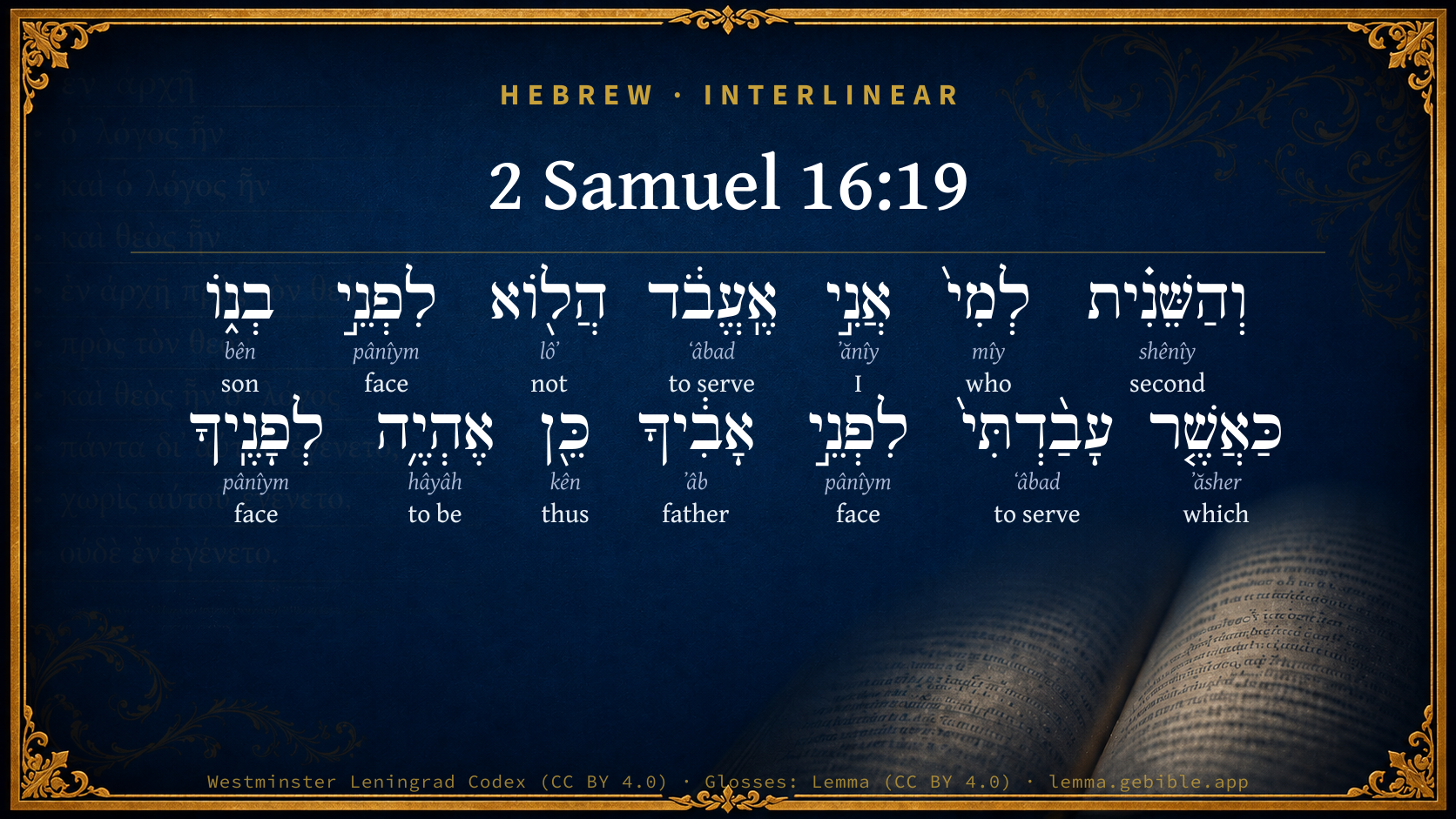
וְהַשֵּׁנִ֗ית
shênîy
H8145
“and · the · second”
Conjunction + Particle, Definite Article + Adjective, Ordinal number, Feminine, Singular, Absolute
Part of Speech
Conjunction + Particle + Adjective
Type
Ordinal number
Gender
Feminine
Number
Singular
State
Absolute
Full BDB Definition

Origin: from H8138

TWOT: 2421b

second - second (the ordinal number) - again (a second time) - another, other (something as distinct from something else)
  1. לְמִי֙ mîy H4310 “to/for · who” Preposition + Particle, Interrogative
  2. אֲנִ֣י ʼănîy H589 “I” Pronoun, Personal, 1st Person, Common, Singular
  3. אֶֽעֱבֹ֔ד ʻâbad H5647 “to serve” Verb, Qal, Imperfect, 1st Person, Common, Singular
  4. הֲל֖וֹא lôʼ H3808 “not” Particle, Interrogative + Particle, Negative
  5. לִפְנֵ֣י pânîym H6440 “to/for · face(s) of” Preposition + Noun, Common, Both, Plural, Construct
  6. בְנ֑וֹ bên H1121 “son · his” Noun, Common, Masculine, Singular, Construct + Suffix, Personal, 3rd Person, Masculine, Singular
  7. כַּאֲשֶׁ֤ר ʼăsher H834 “like/as · which” Preposition + Particle, Relative
  8. עָבַ֨דְתִּי֙ ʻâbad H5647 “to serve” Verb, Qal, Perfect, 1st Person, Common, Singular
  9. לִפְנֵ֣י pânîym H6440 “to/for · face(s) of” Preposition + Noun, Common, Both, Plural, Construct
  10. אָבִ֔יךָ ʼâb H1 “father · your” Noun, Common, Masculine, Singular, Construct + Suffix, Personal, 2nd Person, Masculine, Singular
  11. כֵּ֖ן kên H3651 “thus” Particle, Demonstrative
  12. אֶהְיֶ֥ה hâyâh H1961 “to be” Verb, Qal, Imperfect, 1st Person, Common, Singular
  13. לְפָנֶֽיךָ pânîym H6440 “to/for · face(s) · your” Preposition + Noun, Common, Both, Plural, Construct + Suffix, Personal, 2nd Person, Masculine, Singular

About this verse

These counts appear in no published source. They are computed here, from the morphology-tagged text and Lemma’s own curated glosses. What Lemma adds →

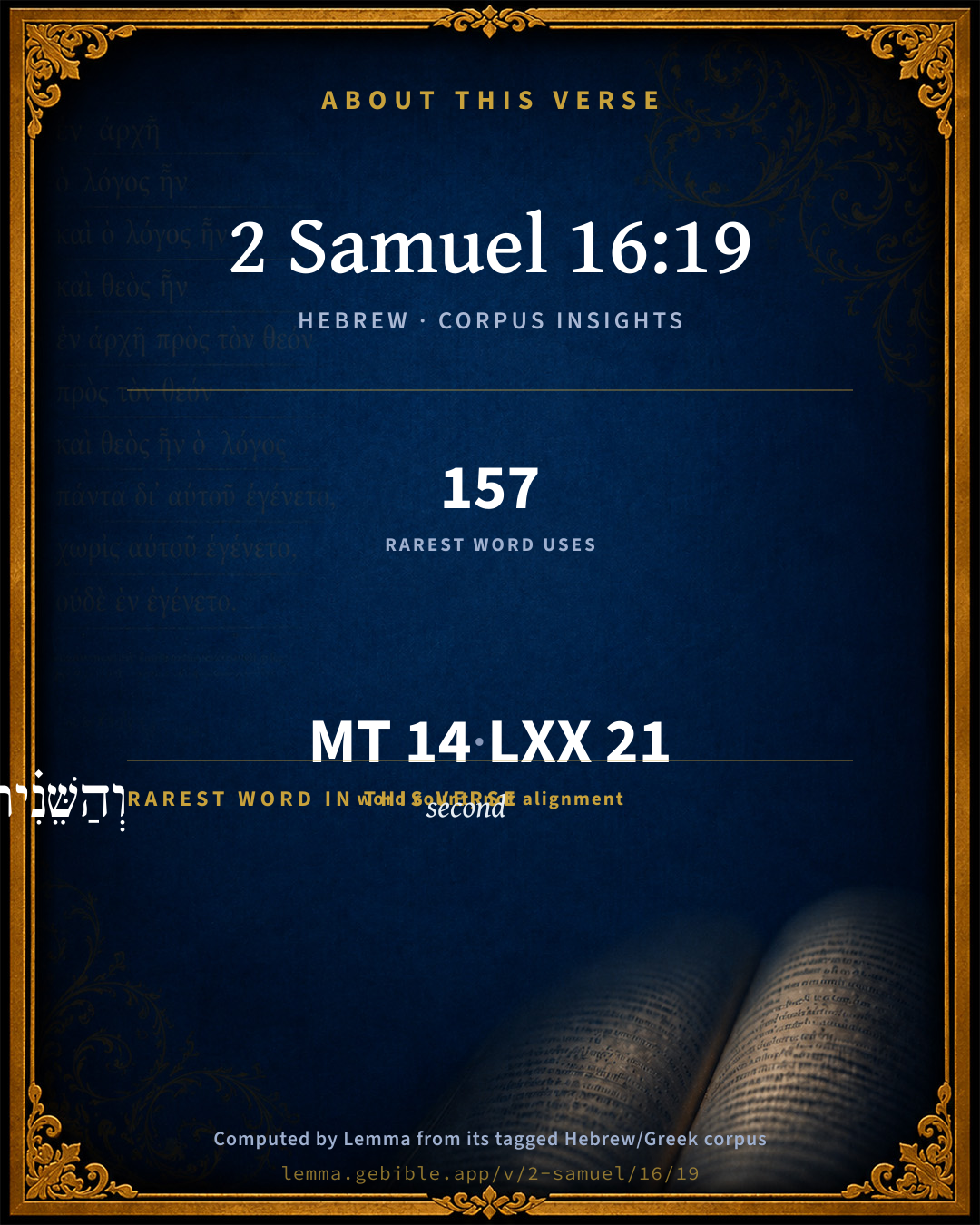
14
words
11
distinct lemmas
Historical
section

Grammatical profile

  • 3 verbs
  • 5 nouns
  • 1 adjective
  • 1 pronoun
  • 4 particles

Verb forms

  • אֶֽעֱבֹ֔ד Qal · Imperfect
  • עָבַ֨דְתִּי֙ Qal · Perfect
  • אֶהְיֶ֥ה Qal · Imperfect

Repetition

Words recur within this verse — often emphatic in Hebrew:

  • לִפְנֵ֣י face H6440 ×3
  • אֶֽעֱבֹ֔ד to serve H5647 ×2

Hebrew & Septuagint length

In English translation the verse runs 29 words from the Hebrew and 31 from the Septuagint (LXX English) — closely comparable.

A rough comparison of the two English renderings, which tokenize alike — not a word-level alignment.

Word counts can differ between the Hebrew and the Greek without any difference in meaning — e.g. the Hebrew direct-object marker אֵת has no separate Greek word, and Greek often adds the article ὁ.

In the original languages it is 14 Hebrew tokens and 21 Greek tokens — but the two are counted differently (Hebrew bundles its prefixes and suffixes into one token; the Greek is in lemma form), so that isn’t a like-for-like length.

Cross-references

5

Topical passages linked to 2 Samuel 16:19 in the Treasury of Scripture Knowledge — connected by theme and wording, ordered by reader-vote popularity; previews shown in the World English Bible.

  • 2 Samuel 15:34 but if you return to the city, and tell Absalom, I will be your servant, O king; as I have been your father's servant in time past, so will I now be your servant; then will you defeat for me the counsel of Ahithophel.
  • Psalms 55:21 His mouth was smooth as butter, But his heart was war. His words were softer than oil, Yet they were drawn swords.
  • 1 Samuel 28:2 David said to Achish, Therefore you shall know what your servant will do. Achish said to David, Therefore will I make you keeper of my head for ever.
  • 1 Samuel 29:8 David said to Achish, But what have I done? and what have you found in your servant so long as I have been before you to this day, that I may not go and fight against the enemies of my lord the king?
  • Galatians 2:13 And the rest of the Jews joined him in his hypocrisy; so that even Barnabas was carried away with their hypocrisy.

Cross-references courtesy of OpenBible.info (CC BY 4.0).

Hebrew and Greek witnesses Masoretic Hebrew ↔ Greek Septuagint

The same verse in the two great witnesses to the Old Testament, shown verse-for-verse.

These are two independent witnesses, not word-aligned to each other, and the Septuagint is shown in lemma (dictionary) form.

Hebrew 2 Samuel 16:19 Masoretic · Westminster Leningrad Codex

וְהַשֵּׁנִ֗ית לְמִי֙ אֲנִ֣י אֶֽעֱבֹ֔ד הֲל֖וֹא לִפְנֵ֣י בְנ֑וֹ כַּאֲשֶׁ֤ר עָבַ֨דְתִּי֙ לִפְנֵ֣י אָבִ֔יךָ כֵּ֖ן אֶהְיֶ֥ה לְפָנֶֽיךָ

Again, whom should I serve? Shouldn't I serve in the presence of his son? as I have served in your father's presence, so will I be in your presence.

World English Bible · Public Domain

Greek LXX 2 Samuel 16:19 Septuagint · lemma form

καί ὁ δεύτερος τίς ἐγώ δουλεύω οὐ ἐνώπιον ὁ υἱός αὐτός καθάπερ δουλεύω ἐνώπιον ὁ πατήρ σύ οὕτως εἰμί ἐνώπιον σύ

And again, whom shall I serve? should I not in the presence of his son? As I served in the sight of your father, so will I be in your presence.

LXX2012 (modern English Septuagint) · Public Domain

Hebrew: Westminster Leningrad Codex (CC BY 4.0). Greek: Septuagint (public domain); English from LXX2012 (modern English Septuagint) (Public Domain). How the Septuagint differs from the Hebrew →

Targum (Aramaic paraphrase)

1

The Targum is the ancient Jewish Aramaic paraphrase of the Hebrew Scriptures — an interpretive translation, not the Hebrew text itself. Onkelos (literal) and Pseudo-Jonathan (expansive) render the Torah, and Jonathan the Prophets. Coverage is partial: where no permissively-licensed English translation exists for a verse, only the Aramaic is shown. This is verse-level text, not a word-by-word alignment to the Hebrew.

  1. Targum Jonathan Prophets (Joshua–Malachi)
    וְתִנְיָנוּת קֳדָם מַן אֲנָא אֶפְלַח הֲלָא קֳדָם בְּרֵיהּ כְּמָא דְפַלְחִית קֳדָם אֲבוּךְ כֵּן אֲהֵי פְלַח קֳדָמָךְ:

    (no public-domain English translation for this verse)

    Targum Jonathan — Aramaic: “Mikraot Gedolot” (public domain). English: “Sefaria Community Translation” (CC0 1.0 (public-domain dedication)); “London "Chaldee Paraphrase," 1871” (public domain). Text via Sefaria.

Commentary

Notes on 2 Samuel 16:19 from classic Christian and Jewish commentators (each source and its license shown beneath its notes). The classic Christian expositions comment on the surrounding passage and are grouped to its opening verse, so a note may address several verses; the Jewish commentaries on the Tanakh (Rashi and others) are per-verse, so they appear only where the commentator wrote on this verse.

Lemma curates 59 commentaries, every one of them public domain or Creative Commons licensed, each selected and text-cleaned for this edition rather than reprinted as found. About our sources →

Trapp's Complete Commentary

John Trapp

2Sa 16:19 And again, whom should I serve? [should I] not [serve] in the presence of his son? as I have served in thy father’s presence, so will I be in thy presence.

Ver. 19. Whom should I serve?] Here Hushai offereth Absalom his service, that he might dive into his secrets, and defeat his counsels.

John Trapp, A Commentary or Exposition upon All the Books of the Old and New Testament (1647–1656) — public domain. Text from a community e-Sword module.

Tyndale Open Study Notes

Tyndale Open Resources

16:19 why shouldn’t I serve you? (literally and second, to whom will I do service? Not before his son?): The ambiguous language continues. Hushai phrased his profession of loyalty as a question rather than as a commitment. His intent, lost on Absalom, was to serve David while fooling Absalom into thinking that he had changed sides. Similarly, just as I was your father’s adviser, now I will be your adviser! is literally, as I served before your father, so I will [serve your father] before you.

Tyndale Open Study Notes — © Tyndale Open Resources, licensed CC BY-SA 4.0. Text via the HelloAO Bible API.

Geneva Bible (1599)

Geneva Bible translators

Hebrew, the second time.

Geneva Bible (1599) marginal notes — public domain. Text via Bolls.life.

John Gill's Exposition

And again, whom should I serve?.... Or "secondly" (e), a second reason is here given for serving Absalom: the first was the choice of God and the people, the second follows:

should I not serve in the presence of his son? as I have served in thy father's presence, so will I be in thy presence: he signifies, that as the kingdom was not translated into another family, but continued in succession in David's house, the alteration made was of no great consequence; it was indifferent to him whom he served, the father or the son; and he could as freely, and would as faithfully serve the son as the father; nor did he think it any breach of friendship to David, nor would David resent it, that he should serve his son, and do the best offices, and give him the best counsel he could; and he seems to bespeak the office of a counsellor, in which he had been to David, that he might be admitted into the presence of Absalom, and be of his privy council, and have the opportunity of giving his best advice.

(e) "secunda", Montanus, Munster, Vatablus; "secundo", Junius & Tremellius, Piscator.

John Gill's Exposition of the Whole Bible (1746–1763) — public domain (CC PDM 1.0). Text via the HelloAO Bible API.

Matthew Poole's English Annotations

Thou art his son, and heir, and successor, and now in his place and stead; whereby my friendship which was due to him is devolved upon thee by right of inheritance; and I reckon that my friendship is not wholly alienated from him, when it is transferred upon one that came out of his bowels.

Matthew Poole's English Annotations on the Holy Bible (1683–1685) — public domain. Text from a community e-Sword/MySword module.

unfoldingWord translationNotes

Door43 World Missions Community

what man should I serve? Should I not serve in the presence of his son?

Hushai asks these rhetorical questions to emphasize that he wants to serve Absalom. They can be written as a statement. AT: "I should serve only David's son, so I will serve in his presence." or "I should serve you, for you are David's son." (See: Rhetorical Question)

translationWords

servant

son

ancestor

unfoldingWord translationNotes — © Distant Shores Media and the Door43 World Missions Community, licensed CC BY-SA 4.0. Source: git.door43.org/Door43/en_tn.

Lesson kit

Teaching starters — assembled from the data on this page, not authored interpretation. Every prompt links to the verse data it draws on. Edit before teaching.

2 Samuel, in the Historical, opens this verse with 14 words (11 distinct Hebrew lemmas). Its most distinctive word is shênîy (“second”). A historical commentator’s framing appears above. Read the whole chapter for the surrounding context.

Discussion questions

  1. The word shênîy carries the sense “second.” How does it shape the verse?
  2. 2 Samuel 15:34 shares this passage’s theme. How do the two illuminate each other?
  3. “face” occurs 3× in this one verse. What is the effect of the repetition?
  4. These translations render this verse differently; the difference is in the English rendering, not the original. What questions does that raise?
  5. The verb «אֶֽעֱבֹ֔ד» is Qal Imperfect. How does its form color the action?
  6. Reading how Trapp's Complete Commentary and Tyndale Open Study Notes read this verse, where do the two commentators agree and where do they part?

Things to notice

Reading settings

Reading text

Shown beneath each verse's original-language words.

Old Testament
Old Testament edition

Read the OT as the Masoretic Hebrew (MT) or the Greek Septuagint (LXX).

English shown for the Greek Septuagint (in the Hebrew ↔ Greek comparison).

Comparing translations? Open the Compare panel on any verse page to stack up to four side by side.