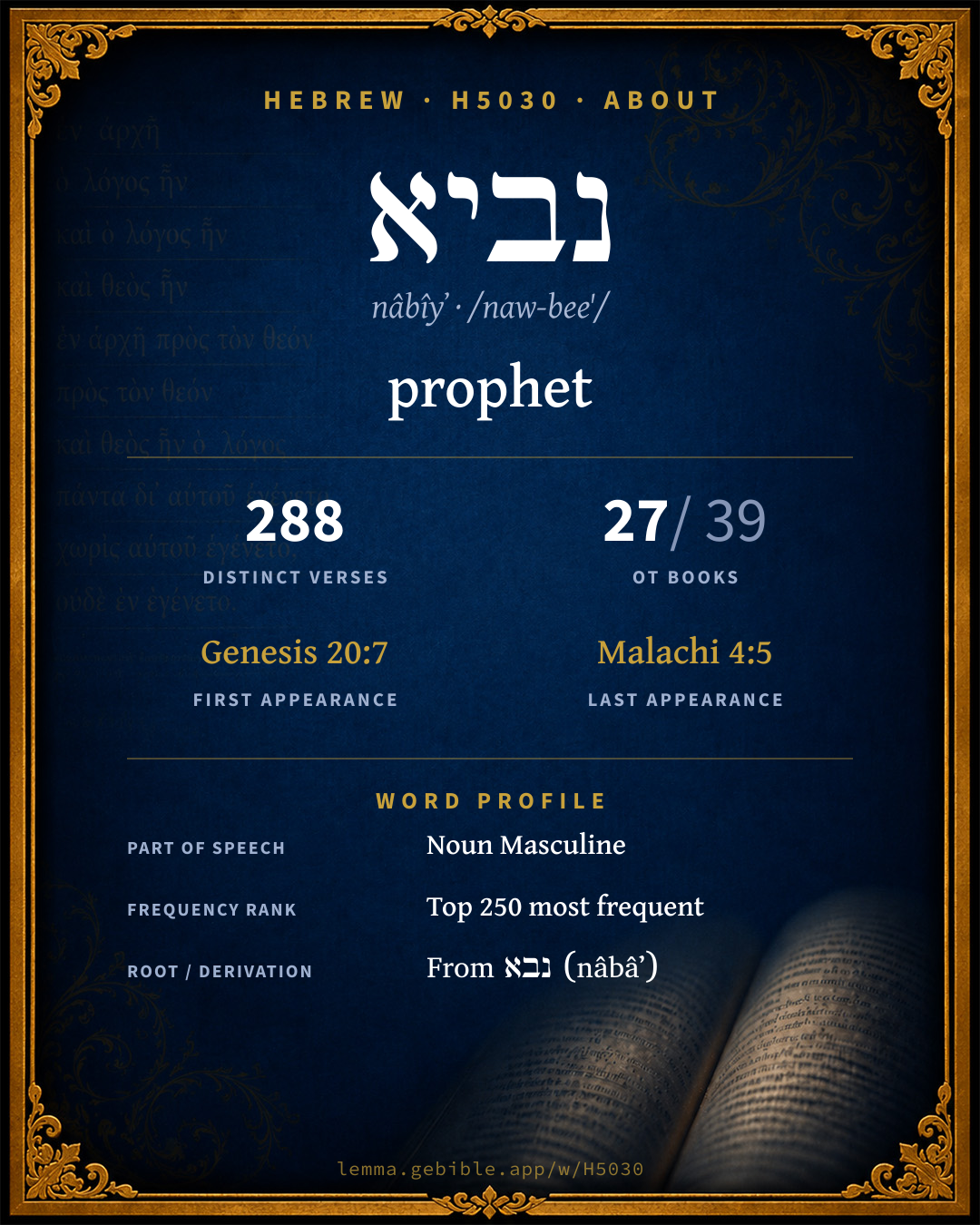
נָבִיא
prophet
also: spokesman, speaker fuller range ↓
Full lexicon entry — Brown-Driver-Briggs (BDB)
From Brown-Driver-Briggs (BDB)
Where this word appears
See every Absolute-state word in the Hebrew Bible →
Grammar key — what these labels mean
Part of speech
- Noun
- A naming word — a person, place, thing, or idea.
Noun type
- Common
- A common noun — a general class of person, place, or thing (“king,” “city,” “water”), not a specific name.
State
- Absolute
- The independent form of a noun, not bound to a following word.
- Construct
- A noun bound to a following noun in a possessive / “of” relationship (the construct chain).
Gender
- Masculine
- Grammatically masculine.
Number
- Singular
- One.
- Plural
- More than one (in Hebrew, generally three or more).
Every verse where H5030 appears in the Book of Ezekiel — 15 distinct verses. Click any verse to open its interlinear word-by-word view. Verse text shown in the World English Bible for context — . Each verse’s Hebrew form is shown with its reference; the English is not keyword-highlighted, since the data carries no word-level English alignment. Use “Compare translations” on any verse to read it across multiple English versions. This concordance covers the Hebrew Bible; Septuagint (Greek Old Testament) occurrences are not indexed here.
Ezekiel
- Ezekiel 2:5 נָבִ֖יא n c ms They, whether they will hear, or whether they will forbear, (for they are a rebellious house), yet shall know that there has been a prophet among them.
- Ezekiel 7:26 מִ/נָּבִ֔יא prep + n c ms Mischief shall come on mischief, and rumor shall be on rumor; and they shall seek a vision of the prophet; but the law shall perish from the priest, and counsel from the elders.
- Ezekiel 13:2 נְבִיאֵ֥י לִ/נְבִיאֵ֣י n c mp cs prep + n c mp cs Son of man, prophesy against the prophets of Israel who prophesy, and say you to those who prophesy out of their own heart, Hear you the word of Yahweh:
- Ezekiel 13:3 הַ/נְּבִיאִ֣ים ptcl def.art + n c mp Thus says the Lord Yahweh, Woe to the foolish prophets, who follow their own spirit, and have seen nothing!
- Ezekiel 13:4 נְבִיאֶ֥י/ךָ n c mp cs + sfx pers 2ms Israel, your prophets have been like foxes in the waste places.
- Ezekiel 13:9 הַ/נְּבִיאִ֞ים ptcl def.art + n c mp My hand shall be against the prophets who see false visions, and who divine lies: they shall not be in the council of my people, neither shall they be written in the writing of the house of Israel, neither shall they enter into the land of Israel; and you shall know that I am the Lord Yahweh.
- Ezekiel 13:16 נְבִיאֵ֣י n c mp cs [to wit], the prophets of Israel who prophesy concerning Jerusalem, and who see visions of peace for her, and there is no peace, says the Lord Yahweh.
- Ezekiel 14:4 הַ/נָּבִ֑יא ptcl def.art + n c ms Therefore speak to them, and tell them, Thus says the Lord Yahweh: Every man of the house of Israel who takes his idols into his heart, and puts the stumbling block of his iniquity before his face, and comes to the prophet; I Yahweh will answer him therein according to the multitude of his idols;
- Ezekiel 14:7 הַ/נָּבִיא֙ ptcl def.art + n c ms For everyone of the house of Israel, or of the strangers who sojourn in Israel, who separates himself from me, and takes his idols into his heart, and puts the stumbling block of his iniquity before his face, and comes to the prophet to inquire for himself of me; I Yahweh will answer him by myself:
- Ezekiel 14:9 וְ/הַ/נָּבִ֤יא הַ/נָּבִ֣יא conj + ptcl def.art + n c ms ptcl def.art + n c ms If the prophet be deceived and speak a word, I, Yahweh, have deceived that prophet, and I will stretch out my hand on him, and will destroy him from the midst of my people Israel.
- Ezekiel 14:10 הַ/נָּבִ֖יא ptcl def.art + n c ms They shall bear their iniquity: the iniquity of the prophet shall be even as the iniquity of him who seeks [to him];
- Ezekiel 22:25 נְבִיאֶ֨י/הָ֙ n c mp cs + sfx pers 3fs There is a conspiracy of her prophets in the midst of it, like a roaring lion ravening the prey: they have devoured souls; they take treasure and precious things; they have made her widows many in the midst of it.
- Ezekiel 22:28 וּ/נְבִיאֶ֗י/הָ conj + n c mp cs + sfx pers 3fs Her prophets have daubed for them with whitewash, seeing false visions, and divining lies to them, saying, Thus says the Lord Yahweh, when Yahweh has not spoken.
- Ezekiel 33:33 נָבִ֖יא n c ms When this comes to pass, (behold, it comes), then shall they know that a prophet has been among them.
- Ezekiel 38:17 נְבִיאֵ֣י n c mp cs Thus says the Lord Yahweh: Are you he of whom I spoke in old time by my servants the prophets of Israel, who prophesied in those days for [many] years that I would bring you against them?
About this entry
At a glance — auto-summarized from this page’s data, not written by a person. Every figure links to its source below. This summary describes the numbers; it doesn’t interpret them.
“prophet” is the headline sense of the Hebrew noun נביא (nâbîyʼ). Beyond “prophet” it also covers “spokesman” and “speaker” — see its full sense range. With 288 verses in 27 books, it is a common word in the Hebrew Bible. It concentrates in Jeremiah, which alone accounts for 30% of its uses. First canonically at Genesis 20:7, it enters the text early. The sections below give every sense, occurrence, and version rendering.
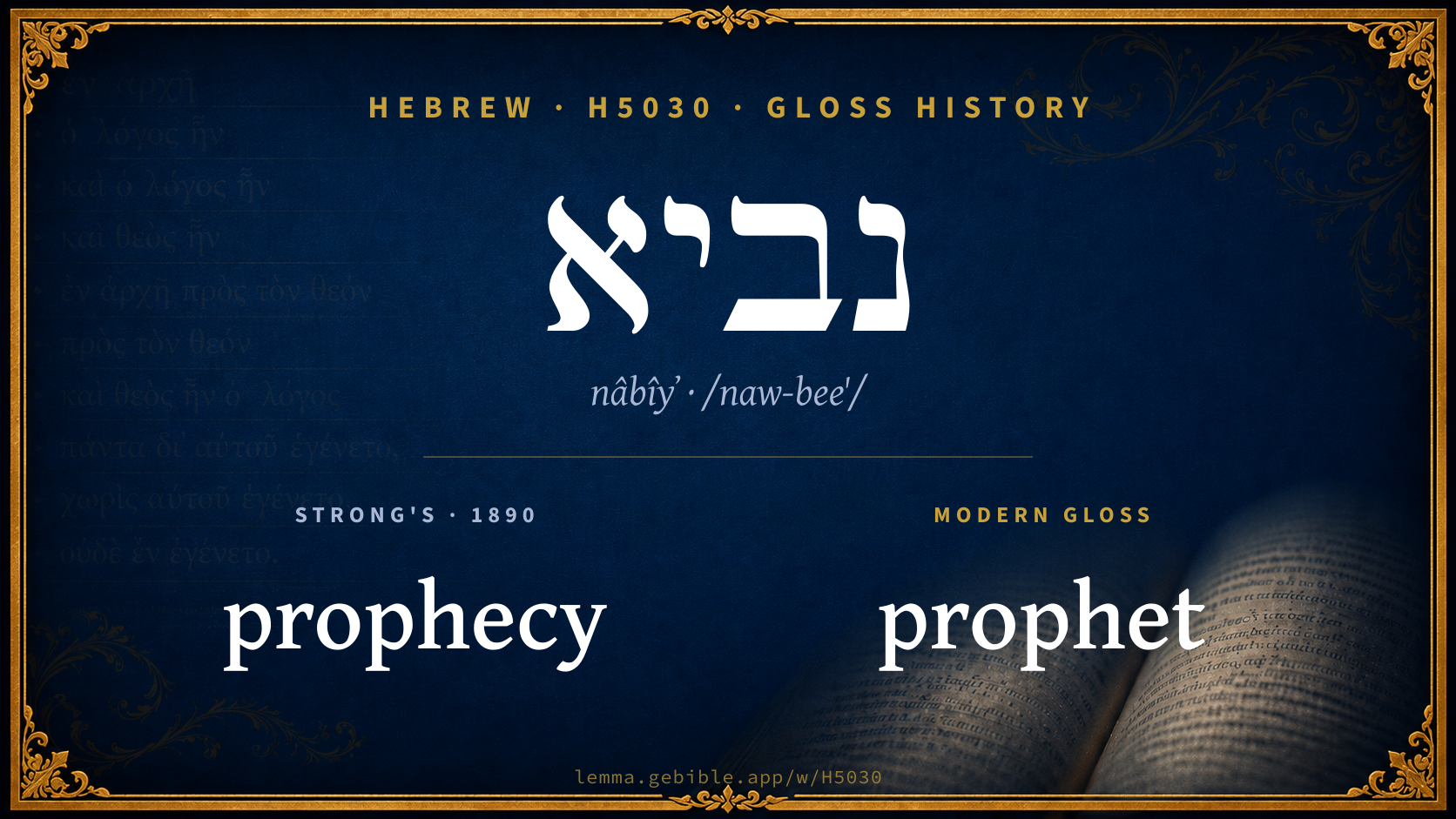
Gloss history
Strong's 1890 vs modern scholarship
About this word
Strong's H5030 catalogs a Hebrew word from the Hebrew Old Testament.
These counts are not copied from any lexicon or concordance. They are computed here, from the morphology-tagged Hebrew Old Testament. What Lemma adds →
- 288
- distinct verses
- The word appears in 288 distinct verses.
- 27 / 39
- OT books
- The word appears in 27 of 39 Old Testament books.
- #158
- by frequency
- Top 250 most frequent Hebrew words (rank 158 of 8,640 Hebrew words by occurrence).
View all 288 occurrences in the concordance →
By section of the Old Testament
By traditional corpus
Conventional, traditional groupings — biblical authorship is debated, so this is a traditional corpus grouping, not an authorship claim. Each share is this word’s portion of its verses in that division of the Hebrew canon. Each figure is a share of the word’s 288 distinct verses.
- Prophets (Nevi'im) 230 verses · 80%
- Writings (Ketuvim) 46 verses · 16%
- Torah (Pentateuch) 12 verses · 4%
How translations render this word
Counts come from each version’s own published word-to-Strong’s tagging or interlinear alignment — an approximate guide to how each version renders this word, not a word-level alignment the data otherwise carries. Because each total is that version’s own tagged count, the per-version totals vary from one another and need not match the appearance or distinct-verse counts above. These counts may also differ from a printed concordance because Lemma counts each distinctly tagged rendering and does not collapse phrase taggings into a single head-word total. This is a fixed set of word-tagged versions (KJV, ASV, BSB, ULT) and does not change with the reading translation you choose elsewhere. Each version’s license is shown beside its name below (and on Sources).
- King James Version: Prophet 139×, Prophets 108×, All the prophets 7×
- American Standard Version: Prophet 131×, Prophets 99×, All the prophets 6×
- Berean Standard Bible: Prophet 150×, Prophets 135×, Among the prophets 5×
- unfoldingWord Literal Text: Prophet 134×, Prophets 114×, Prophets of 13×
King James Version Public Domain
Renders H5030 across 314 tagged occurrences — most commonly:
Plus 40 renderings that appear only once — usually multi-word phrases or single function words the recovered tagging swept in, not distinct renderings. Not rendered by a distinct English word in 2 further occurrences.
American Standard Version Public Domain
Renders H5030 across 313 tagged occurrences — most commonly:
Plus other, less common renderings. Plus 51 renderings that appear only once — usually multi-word phrases or single function words the recovered tagging swept in, not distinct renderings.
Berean Standard Bible Public Domain
Renders H5030 across 310 tagged occurrences — most commonly:
Plus 12 renderings that appear only once — usually multi-word phrases or single function words the recovered tagging swept in, not distinct renderings. Not rendered by a distinct English word in 6 further occurrences.
unfoldingWord Literal Text CC BY-SA 4.0
Renders H5030 across 292 tagged occurrences — most commonly:
Plus 12 renderings that appear only once — usually multi-word phrases or single function words the recovered tagging swept in, not distinct renderings.
Senses in the full BDB
What do BDB’s symbols mean?
BDB uses these scholarly abbreviations:
| Symbol | Meaning |
|---|---|
| 𝔊 | the Septuagint (the ancient Greek translation, LXX) |
| 𝔙 | the Vulgate (the Latin translation) |
| 𝔖 | the Syriac version (the Peshitta) |
| 𝔗 | the Targum (the Aramaic translation) |
| ψ | the Psalms |
| √ | root (the underlying root or stem) |
| ‖ | parallel passage (a synonymous or contrasted parallel) |
| † | the dagger: every passage where the word occurs is cited |
The 3 senses and sub-senses the full Brown-Driver-Briggs lexicon distinguishes for this word, in lexicon order (not ranked by frequency), with BDB’s own verbatim wording and sub-sense lettering. Shown in Hebrew script with BDB’s own scholarly abbreviations. The condensed entry is in the Lexicon Entry tab. See also the Forms in the corpus table below.
- 1. genuine prophet of י׳, נביא, anciently called רֹאֶה, 1 S 9:9 (antiquarian note); change prob. occurred in times of Elijah and is first reflected in Ephr. lit. as applied to Abraham Gn 20:7; Moses Dt 34:10, M. and other early proph. Ho 6:5; 12:11(×2), 14(×2) Am 2:11, 12; of proph. in ecstatic state Nu 12:6 (E), 11:24 (JE). So in Judaic lit., of prophet like Moses Dt 18:15, 18 (D), of Aaron (as mouthpiece of M.) Ex 7:1 (P), of Sam. 1 S 3:20, an unknown Ju 6:8; in time of Sam. proph. were organized in bands: †הֶבֶל נביאים 1 S 10:5, 10; †להקת הנ׳ 1 S 19:20; and in time of Elijah were †בְּנֵי הַנְּבִיאִים = members of prophets’ guilds 1 K 20:35 2 K 2:3, 5, 7, 15; 4:1, 38(×2) נָבִיא of genuine proph. (besides phrases), in Judaic prophets, only of Jer., Je 1:5; Ezekiel, Ez 2:5 = 33:33; of ancient prophets Je 28:8, 9(×3) Zc 1:6; 8:9; especially †הנביאים הראשׁנים Zc 1:4; 7:7, 12, cf. †עבדי(ו) הנביאים my (his) servants the prophets 2 K 9:7; 17:13, 23; 21:10; 24:2 (all RD) Ezr 9:11 Dn 9:10 Je 7:25; 25:4; 26:5; 29:19; 35:15; 44:4 Am 3:7 Zc 1:6, cf. Ez 38:17 Dn 9:6; †עבדוֹ הַנּ׳ his servant the prophet 1 K 14:18 2 K 14:25; הַנָּבִיא with n.pr.: Jer, 2 Ch 36:12 Dn 9:2 + 31 times Je (but 𝔊 only 4 times, the rest prob. redactional, see GieJer. xxvii); Elijah 1 K 18:36 (om 𝔊), 2 Ch 21:12 Mal 3:23; Nathan 2 S 7:2 + 10 times S. and K.; 4 times Chr ψ 51:2 (title); Isaiah, 2 K 19:2; 20:1, 14 = Is 37:2; 38:1; 39:1; 2 K 20:11; 2 Ch 26:22; 32:20, 32; Habakkuk Hb 1:1; 3:1 (titles); Haggai, Hg 1:1, 3, 12; 2:1, 10; Zech., Zc 1:1, 7 (titles); elsewhere several others in S., K. and Chr. 15 times; נביא is used elsewhere of genuine proph. only 1 S 9:9 + 34 times S. and K.; 1 Ch 16:22 = ψ 105:15, + 13 times Chr.; ψ 74:9 complains of absence of נ׳; לַחְתֹּם חָזוֹן וְנָבִיא Dn 9:24 v. חתם. e.g. 1 Samuel 9:9
- 2. false prophets: †prophets as official class, beside priests, charact. as false prophets: Is 28:7 Je 2:26; 4:9; 6:13; 8:1, 10; 13:13; 14:18; 18:18; 23:11, 33, 34; 26:7, 8, 11, 16; 32:32 Zc 7:3, app. also 2 K 23:2 Ne 9:32 La 2:20 Je 29:1 Ez 7:26 (in these not characterized); always false (except of ancient and special prophets given above) in Am 7:14 Ho 4:5; 9:7, 8 Mi 3:5, 6, 11 Is 3:2; 9:14; 29:10 Je 2:8, 30; 5:13, 31; 14:13, 14, 15(×2); 23:9 + 16 times; 27:9, 14, 15, 16, 18; 29:8, 15; 37:19 Ez 13:2(×2), 3, 4, 9, 16; 14:4, 7, 9(×2), 10; 22:25, 28 Zp 3:4 La 2:9, 14; 4:13; especially discredited Dt 13:2, 4, 6; 18:20(×2), 22(×2) Zc 13:2, 4, 5; such a prophet Hananiah called הַנָּבִיא Je 28:1, 5, 10, 12, 15, 17 (𝔊 omits in all but v 1, where Ψευδοπροφήτης). Usage of prophets themselves gives such a bad flavour to נביא, that we are not surprised that it is absent from exilic Isaiah, the Wisd. lit., and ψψ (except for special reasons in 3 ψψ given under 1). e.g. Isaiah 28:7
- 3. heathen prophets 1 K 18:20; 19:1; 2 K 3:13(×2); נביאי האשׁרה 1 K 18:19; נביאי הבעל 1 K 18:19, 22, 25, 40 2 K 10:19; 1 K 22:6, 10, 12, 13, 22, 23 = 2 Ch 18:5, 9, 11, 12, 21, 22. e.g. 1 Kings 18:20
Senses from the full Brown-Driver-Briggs lexicon (Brown, Driver, Briggs; Oxford 1906 — public domain), digitized via Sefaria, supplemented by the OpenScriptures HebrewLexicon (CC BY 4.0). Full attribution on Sources.
Word origin
n.m. spokesman, speaker, prophet—נ׳ Gn 20:7 + 155 times; sf. נְבִיאֶ֑ךָ Ex 7:1; pl. נְבִיאִים Nu 11:29 + 82 times; נְבִאִים Je 27:18 + 16 times; sf. נְבִיאַי ψ 105:15; נְבִאָיו 1 K 22:22; נְבִיאָו֯ 2 K 17:13, etc.;—
— Brown-Driver-Briggs (Oxford 1906, public domain), digitized via Sefaria, supplemented by the OpenScriptures HebrewLexicon (CC BY 4.0). See Sources.
Derived from נבא (nâbâʼ) (H5012) — to prophesy.
Jastrow Dictionary
A second Hebrew/Aramaic lexicon for comparison, covering Aramaic and post-biblical (Talmudic, Targumic, Midrashic) usage that the biblical-Hebrew BDB does not. Matched by lemma rather than by Strong’s number, so a lemma may carry more than one Jastrow headword (shown separately below), and the entries cover usage well beyond the Bible.
נָבִיא
- preced. wds.) prophet. B. Bath. 12ᵃ אטו חכם לאו נ׳ וכ׳ was a scholar never a prophet? Ib. חכם עדיף מנ׳ a scholar is superior to a prophet. Meg. 15ᵃ; a. v. fr.—Pl. נְבִיאִים, נְבִיאִין. Sot. IX, 12 נ׳ הראשונים the early prophets (of the first Temple). Lev. R. s. 1, beg., v. בַּיִת. Pes. 66ᵃ אם אין נ׳ הן בני נ׳ הן if they (the Israelites) are no prophets, yet they are sons of prophets (they will find what is right intuitively); Y. Sabb. XIX, 17ᵃ top. Lev. R. l. c.; Gen. R. s. 74 נְבִיאֵי ישראל Israelitish prophets; נ׳ אומות העולם heathen prophets; a. v. fr.—נָבִיא (sub. ספר) נְבִיאִים (sub. ספרי) N’biim, Prophets, the second division of the Scriptures. Tosef. Meg. IV (III), 18 אין מפטירין בנביא וכ׳ we read in the Prophets for the Haftarah no more than three verses at a time (to be interpreted). Meg. 21ᵇ ובנביא אחד וכ׳ and when reading from the Prophets (for the Haftarah), one reads and two may interpret. Ib. 27ᵃ מניחין … על גבי נביאים וכתובים you may put … parts of the Pentateuch on the Prophets or the Hagiographa, but not the Prophets &c. B. Bath. 14ᵇ סדרן של נ׳ the order of the books of Prophets; a. fr.—Fem. נְבִיאָה. Pes. 9ᵇ וכי חולדה נ׳ וכ׳ is the weasel (ḥuldah) a prophetess to know &c.? Deut. R. s. 6; a. fr.—Pl. נְבִיאוֹת. Meg. 14ᵃ; a. e.
נְבִיָּא
- ; constr. נְבִי, נְבֵי. Targ. Jud. VI, 8. Targ. Gen. XX, 7 (O. Ms. II נַבְיָא). Targ. Deut. XVIII, 20; a. v. fr.—Gitt. 57ᵇ נ׳ הוה בן וכ׳ there was a prophet among us who rebuked us &c.; Lam. R. to II, 2 נ׳ כהנא וכ׳ a prophet priest was ours &c.; a. e.—Pl. נְבִיאִין, נְבִיאַיָּא; נְבִיאָן, נְבִיָּין (נִבְיָין); נְבִיאֵי. Targ. I Kings XVIII, 4. Targ. Num. XI, 29; a. fr.—Kidd. 49ᵃ נְבִיאֵי the Books of the Prophets, v. preced.—Fem. נְבִיאֲתָא, נְבִיאָתָא. Targ. Ex. XV, 20. Targ. Jud. IV, 4; a. fr.
A Dictionary of the Targumim, the Talmud Babli and Yerushalmi, and the Midrashic Literature (Marcus Jastrow; London, Luzac, 1903) — Public Domain. Digitized via Sefaria. Digitized via Sefaria. Full attribution on Sources.
Forms in the corpus
The 131 distinct written forms H5030 takes in the Hebrew Bible, most frequent first — each parse links to that state’s occurrences in the concordance. Hebrew forms include their vowel points and cantillation, so a single lemma takes many written forms.
The 60 most common forms are shown; 71 rarer forms follow in the full concordance.
Same root — word family
Other BDB entries built from the same root as H5030, grouped by Strong’s listed origin. These share a root / origin per the lexicon — not necessarily a shared meaning. Each links to that word’s own entry.
Derives from
Shares the same root
Derived from this word
Compare all same-root words → Showing 4 of 6 — not the complete family. They share a root, not necessarily a meaning.
Septuagint verse parallels
This word appears in 270 verses that also exist in the Greek Old Testament (Septuagint), out of the 288 Hebrew verses it occurs in. You can read those verses in Greek by switching the Old Testament edition to the Septuagint.
Read these verses in the Septuagint
- Genesis 20:7
- Exodus 7:1
- Numbers 11:29
- Deuteronomy 13:1
- Judges 6:8
- 1 Samuel 3:20
- 2 Samuel 7:2
- 1 Kings 1:8
- 2 Kings 2:3
- 1 Chronicles 16:22
- 2 Chronicles 9:29
- Ezra 9:11
This is a verse-level parallel only — the same verses exist in both the Hebrew and Greek Old Testaments. No word-level Hebrew↔Greek correspondence is claimed: the data carries no such alignment, so no Greek word is shown as this Hebrew word’s translation. Coverage is not total — the Septuagint omits the deuterocanon and renumbers the Psalms, so some Hebrew verses have no direct Greek parallel.