Hosea 4:5

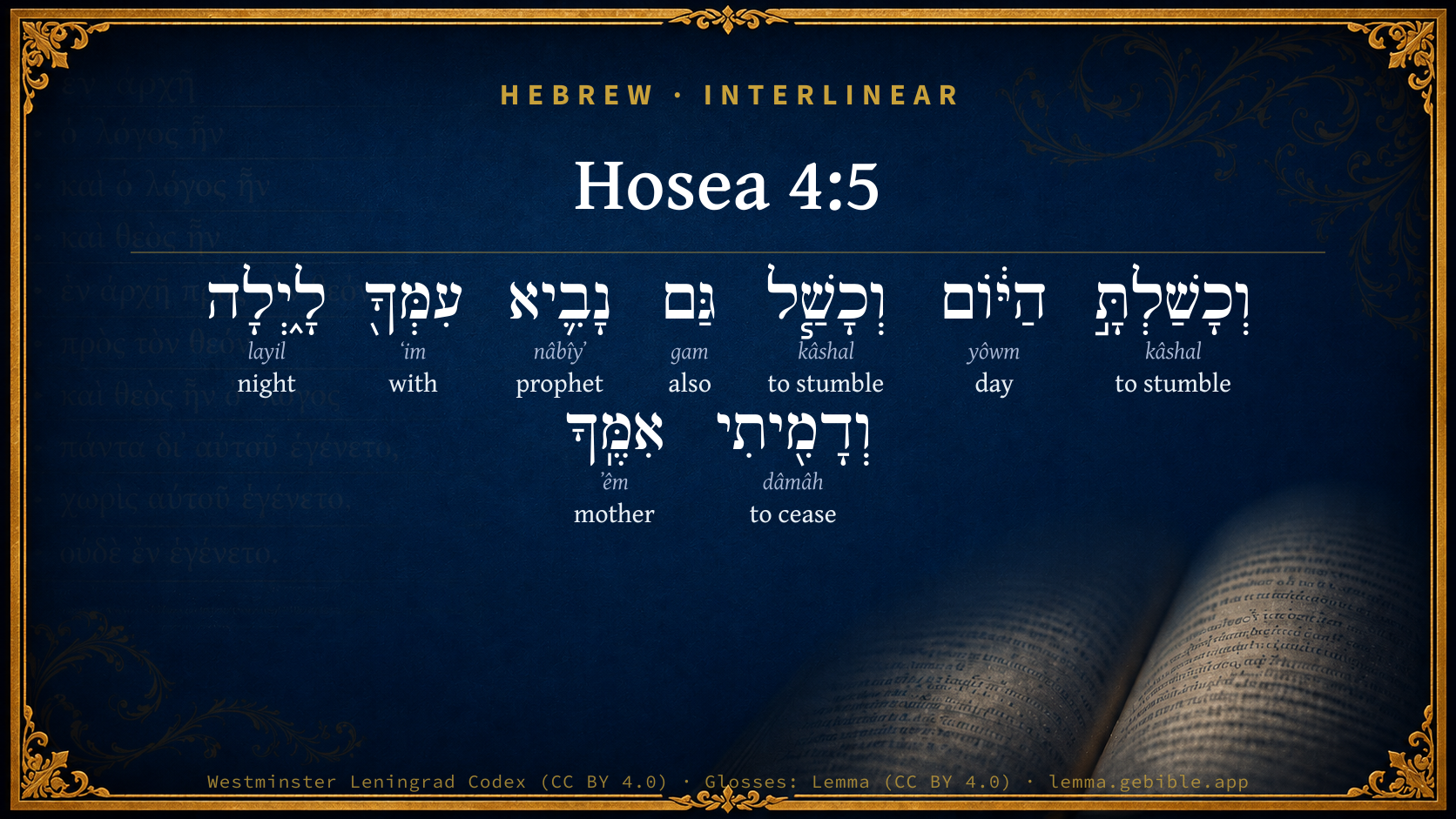
Hebrew (Westminster Leningrad Codex) Hosea 4:5 appears in the Hebrew Old Testament. The text above is from the Westminster Leningrad Codex. Each word links to its Strong’s number, a concise gloss, and parsing drawn from the Open Scriptures Hebrew Bible morphology. Click any word for its full Brown-Driver-Briggs (BDB) entry.
Download image
Cite this verse

Hosea 4:5 (World English Bible). Public Domain. Lemma interlinear Bible study tool, https://lemma.gebible.app/v/hosea/4/5.

Show BibTeX & RIS
BibTeX
RIS
English Translation
You will stumble in the day, And the prophet will also stumble with you in the night; And I will destroy your mother.
World English Bible · Public Domain
Download a study sheet

One document with this verse’s original text, its word-by-word gloss line, the meaning frame, cross-references with their text, attributed commentary, and full source and license credits — printable, and it pastes into notes with its structure intact.

This verse Autodidact and up

Study sheet (.html) Plain text (.txt)

A passage Seminary Student

Up to 50 verses in one chapter. A passage sheet keeps up to 6 commentary sources and 12 cross-references per verse, in the order this page ranks them, and says so on the sheet whenever that leaves anything out. Ask for a single verse and you get the Autodidact verse sheet above.

Everything on this page stays free to read, with no account — the sheet is a download of what is already on screen, not access to it.

Want to remove ads? Support Godless Engineer
Compare translations 3

The same verse in 3 English versions, stacked beneath the original-language interlinear above. Click any original word for its lexicon entry.

Each is an independent rendering of the whole verse — the interlinear is not word-aligned to these translations.

Highlighted words mark where these versions differ — a whole-verse word diff, not a word-by-word alignment.

  • World English Bible Public Domain
    You will stumble in the day, And the prophet will also stumble with you in the night; And I will destroy your mother.
  • King James Version Public Domain
    Therefore shalt thou fall in the day, and the prophet also shall fall with thee in the night, and I will destroy thy mother.
  • unfoldingWord Literal Text CC BY-SA 4.0
    And you will stumble by day, and also the prophet will stumble with you by night, and I will destroy your mother.

unfoldingWord Literal Text — © unfoldingWord, licensed CC BY-SA 4.0. Word-aligned USFM3 via Door43 (git.door43.org/unfoldingWord/en_ult).

Versions to compare (up to 4)

3 of 4 selected

Show all 18 translations

Every available English version of this verse, each an independent rendering of the whole verse.

  • World English Bible Public Domain
    You will stumble in the day, And the prophet will also stumble with you in the night; And I will destroy your mother.
  • Berean Standard Bible Public Domain
    You will stumble by day, and the prophet will stumble with you by night; so I will destroy your mother—
  • Majority Standard Bible Public Domain
    You will stumble by day, and the prophet will stumble with you by night; so I will destroy your mother—
  • King James Version Public Domain
    Therefore shalt thou fall in the day, and the prophet also shall fall with thee in the night, and I will destroy thy mother.
  • American Standard Version (1901) Public Domain
    And thou shalt stumble in the day, and the prophet also shall stumble with thee in the night; and I will destroy thy mother.
  • Revised Version (1885) Public Domain
    And thou shalt stumble in the day, and the prophet also shall stumble with thee in the night; and I will destroy thy mother.
  • Geneva Bible (1599) Public Domain
    Therefore shalt thou fall in the day, and the Prophet shall fall with thee in the night, and I will destroy thy mother.
  • Douay-Rheims (1899) Public Domain
    And thou shalt fall to day, and the prophet also shall fall with thee: in the night I have made thy mother to be silent.
  • Young's Literal Translation Public Domain
    And thou hast stumbled in the day, And stumbled hath also a prophet with thee in the night, And I have cut off thy mother.
  • Literal Standard Version CC BY-SA 4.0
    And you have stumbled in the day, || And a prophet has also stumbled with you in the night, || And I have cut off your mother.
  • Unlocked Literal Bible CC BY-SA 4.0
    You priests will stumble during the day; the prophets will also stumble with you by night, and I will destroy your mother.
  • unfoldingWord Literal Text CC BY-SA 4.0
    And you will stumble by day, and also the prophet will stumble with you by night, and I will destroy your mother.
  • Darby Bible Public Domain
    And thou shalt stumble by day; and the prophet also shall stumble with thee by night: and I will destroy thy mother.
  • World Messianic Bible Public Domain
    You will stumble in the day, and the prophet will also stumble with you in the night; and I will destroy your mother.
  • Webster's Bible Public Domain
    Therefore shalt thou fall in the day, and the prophet also shall fall with thee in the night, and I will destroy thy mother.
  • Free Bible Version CC BY-SA 4.0
    Consequently you will stumble in daylight, and the prophet will stumble together with you in the night, and I will destroy your mother.
  • Bible in Basic English Public Domain
    You will not be able to keep on your feet by day, and by night the prophet will be falling down with you, and I will give your mother to destruction.
  • JPS Tanakh (1917) Public Domain
    Therefore shalt thou stumble in the day, and the prophet also shall stumble with thee in the night; and I will destroy thy mother.

Literal Standard Version (2020), Covenant Press — licensed CC BY-SA 4.0. Text via the HelloAO Bible API (eBible.org). Unlocked Literal Bible (unfoldingWord) — licensed CC BY-SA 4.0. Text via the HelloAO Bible API (eBible.org). unfoldingWord Literal Text — © unfoldingWord, licensed CC BY-SA 4.0. Word-aligned USFM3 via Door43 (git.door43.org/unfoldingWord/en_ult). Free Bible Version, Dr. Jonathan Gallagher — licensed CC BY-SA 4.0. Text via the HelloAO Bible API (eBible.org).

Word by word

More ways to search: Search by grammar → Find every occurrence → Compare this word →

Practice this passage: Drill this verse → Learn its vocabulary →

וְדָמִ֖יתִי
dâmâh
H1820
“and · to cease”
Conjunction + Verb, Qal, Sequential Perfect, 1st Person, Common, Singular
Part of Speech
Conjunction + Verb
Stem
Qal
Form
Sequential Perfect
Person
1st Person
Gender
Common
Number
Singular
Full BDB Definition

Origin: a primitive root

TWOT: 438

to cease, cause to cease, cut off, destroy, perish - (Qal) - to cease - to cause to cease, destroy - (Niphal) - to be cut off - to be undone, be cut off at sight of the theophany
  1. וְכָשַׁלְתָּ֣ kâshal H3782 “and · to stumble” Conjunction + Verb, Qal, Sequential Perfect, 2nd Person, Masculine, Singular
  2. הַיּ֔וֹם yôwm H3117 “the · day” Particle, Definite Article + Noun, Common, Masculine, Singular, Absolute
  3. וְכָשַׁ֧ל kâshal H3782 “and · to stumble” Conjunction + Verb, Qal, Sequential Perfect, 3rd Person, Masculine, Singular
  4. גַּם gam H1571 “also” Particle, Accusative
  5. נָבִ֛יא nâbîyʼ H5030 “prophet” Noun, Common, Masculine, Singular, Absolute
  6. עִמְּךָ֖ ʻim H5973 “with · you” Preposition + Suffix, Personal, 2nd Person, Masculine, Singular
  7. לָ֑יְלָה layil H3915 “night” Noun, Common, Masculine, Singular, Absolute
  8. אִמֶּֽךָ ʼêm H517 “mother · your” Noun, Common, Feminine, Singular, Construct + Suffix, Personal, 2nd Person, Masculine, Singular

About this verse

These counts appear in no published source. They are computed here, from the morphology-tagged text and Lemma’s own curated glosses. What Lemma adds →

9
words
8
distinct lemmas
Prophets
section

Notable vocabulary

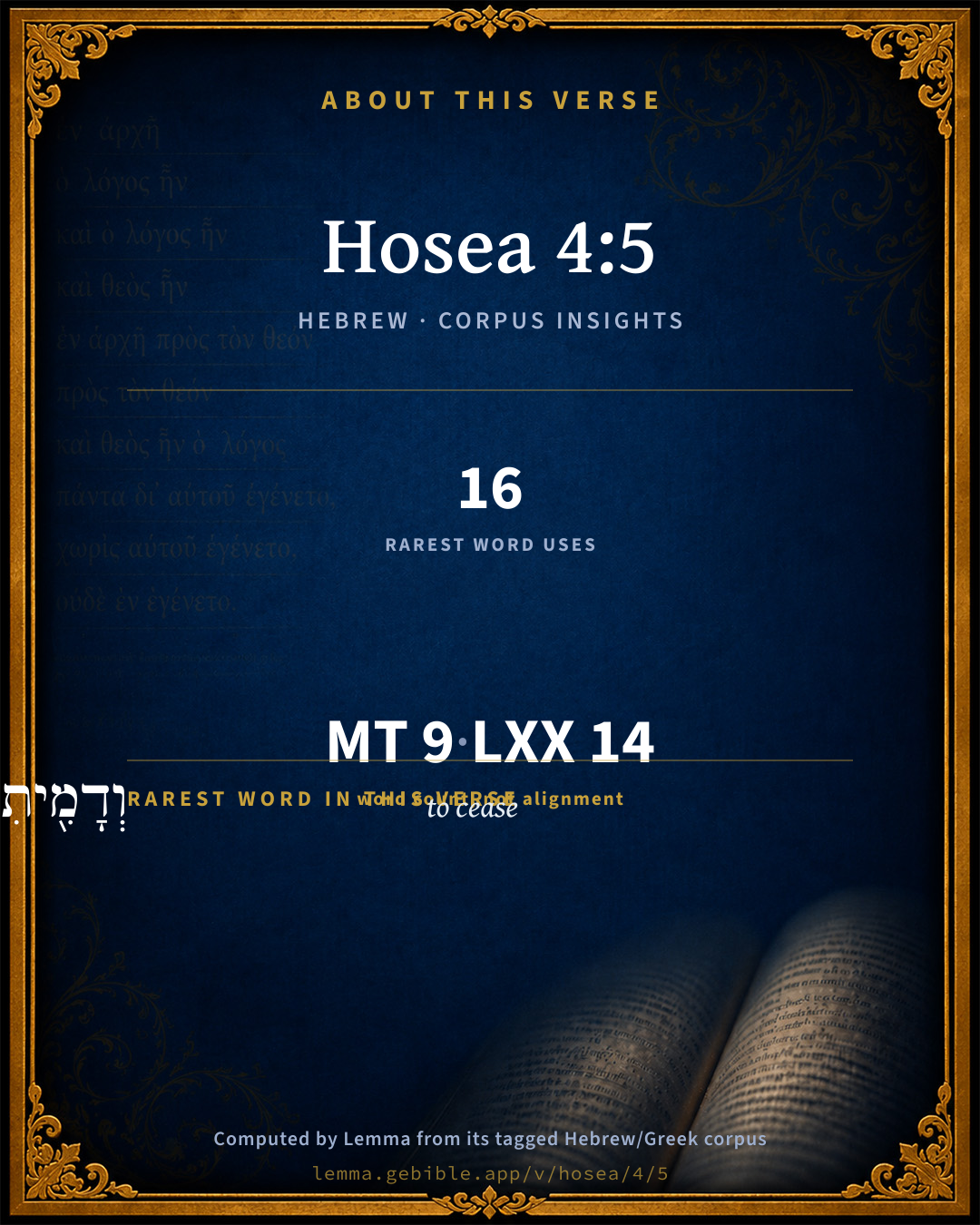
The rarest word here is וְדָמִ֖יתִי to cease H1820 — appearing just 16 times in the whole Hebrew Bible.

Shared distinctive vocabulary

וְדָמִ֖יתִי to cease H1820 occurs in 14 verses of the Hebrew Bible. Also found in:

Grammatical profile

  • 3 verbs
  • 4 nouns
  • 1 preposition
  • 1 particle

Verb forms

  • וְכָשַׁלְתָּ֣ Qal · Sequential Perfect
  • וְכָשַׁ֧ל Qal · Sequential Perfect
  • וְדָמִ֖יתִי Qal · Sequential Perfect

Repetition

A word recurs within this verse — often emphatic in Hebrew:

  • וְכָשַׁלְתָּ֣ to stumble H3782 ×2

Hebrew & Septuagint length

In English translation the verse runs 23 words from the Hebrew and 20 from the Septuagint (LXX English) — closely comparable.

A rough comparison of the two English renderings, which tokenize alike — not a word-level alignment.

Word counts can differ between the Hebrew and the Greek without any difference in meaning — e.g. the Hebrew direct-object marker אֵת has no separate Greek word, and Greek often adds the article ὁ.

In the original languages it is 9 Hebrew tokens and 14 Greek tokens — but the two are counted differently (Hebrew bundles its prefixes and suffixes into one token; the Greek is in lemma form), so that isn’t a like-for-like length.

Cross-references

18

Topical passages linked to Hosea 4:5 in the Treasury of Scripture Knowledge — connected by theme and wording, ordered by reader-vote popularity; previews shown in the World English Bible.

  • Jeremiah 15:8 Their widows are increased to me above the sand of the seas; I have brought on them against the mother of the young men a destroyer at noonday: I have caused anguish and terrors to fall on her suddenly.
  • Hosea 2:2 Contend with your mother! Contend, for she is not my wife, Neither am I her husband; And let her put away her prostitution from her face, And her adulteries from between her breasts;
  • Galatians 4:26 But the Jerusalem that is above is free, which is the mother of us all.
  • Zechariah 13:2 It will come to pass in that day, says Yahweh of Hosts, that I will cut off the names of the idols out of the land, and they will no more be remembered; and also I will cause the prophets and the spirit of impurity to pass out of the land.
  • Isaiah 9:13–17 Yet the people have not turned to him who struck them, neither have they sought Yahweh of Hosts.
  • Isaiah 50:1 Thus says Yahweh, Where is the bill of your mother's divorce, with which I have put her away? or which of my creditors is it to whom I have sold you? Behold, for your iniquities were you sold, and for your transgressions was your mother put away.
  • Jeremiah 6:4–5 Prepare you war against her; arise, and let us go up at noon. Woe to us! for the day declines, for the shadows of the evening are stretched out.
  • Jeremiah 6:12–15 Their houses shall be turned to others, their fields and their wives together; for I will stretch out my hand on the inhabitants of the land, says Yahweh.
  • Jeremiah 8:10–12 Therefore will I give their wives to others, and their fields to those who shall possess them: for everyone from the least even to the greatest is given to covetousness; from the prophet even to the priest every one deals falsely.
  • Jeremiah 14:15–16 Therefore thus says Yahweh concerning the prophets who prophesy in my name, and I didn't send them, yet they say, Sword and famine shall not be in this land: By sword and famine shall those prophets be consumed.
  • Jeremiah 23:9 Concerning the prophets. My heart within me is broken, all my bones shake; I am like a drunken man, and like a man whom wine has overcome, because of Yahweh, and because of his holy words.
  • Jeremiah 50:12 your mother shall be utterly disappointed; she who bore you shall be confounded: behold, she shall be the least of the nations, a wilderness, a dry land, and a desert.
  • Ezekiel 13:9–16 My hand shall be against the prophets who see false visions, and who divine lies: they shall not be in the council of my people, neither shall they be written in the writing of the house of Israel, neither shall they enter into the land of Israel; and you shall know that I am the Lord Yahweh.
  • Ezekiel 14:7–10 For everyone of the house of Israel, or of the strangers who sojourn in Israel, who separates himself from me, and takes his idols into his heart, and puts the stumbling block of his iniquity before his face, and comes to the prophet to inquire for himself of me; I Yahweh will answer him by myself:
  • Ezekiel 16:44–45 Behold, everyone who uses proverbs shall use [this] proverb against you, saying, As is the mother, so is her daughter.
  • Hosea 9:7–8 The days of visitation have come. The days of reckoning have come. Israel will consider the prophet to be a fool, And the man who is inspired to be insane, Because of the abundance of your sins, And because your hostility is great.
  • Micah 3:5–7 Thus says Yahweh concerning the prophets who lead my people astray; for those who feed their teeth, they proclaim, "Peace!" and whoever doesn't provide for their mouths, they prepare war against him:
  • Zechariah 11:8 I cut off the three shepherds in one month; for my soul was weary of them, and their soul also loathed me.

Cross-references courtesy of OpenBible.info (CC BY 4.0).

Hebrew and Greek witnesses Masoretic Hebrew ↔ Greek Septuagint

The same verse in the two great witnesses to the Old Testament, shown verse-for-verse.

These are two independent witnesses, not word-aligned to each other, and the Septuagint is shown in lemma (dictionary) form.

Hebrew Hosea 4:5 Masoretic · Westminster Leningrad Codex

וְכָשַׁלְתָּ֣ הַיּ֔וֹם וְכָשַׁ֧ל גַּם נָבִ֛יא עִמְּךָ֖ לָ֑יְלָה וְדָמִ֖יתִי אִמֶּֽךָ

You will stumble in the day, And the prophet will also stumble with you in the night; And I will destroy your mother.

World English Bible · Public Domain

Greek LXX Hosea 4:5 Septuagint · lemma form

καί ἀσθενέω ἡμέρα καί ἀσθενέω καί προφήτης μετά σύ νύξ ὁμοιόω ὁ μήτηρ σύ

Therefore they shall fall by day, and the prophet with you shall fall: I have compared your mother to night.

LXX2012 (modern English Septuagint) · Public Domain

On this verse, Haydock's Catholic Bible Commentary discusses the Septuagint’s reading. Read the note in Commentary ↓

Hebrew: Westminster Leningrad Codex (CC BY 4.0). Greek: Septuagint (public domain); English from LXX2012 (modern English Septuagint) (Public Domain). How the Septuagint differs from the Hebrew →

Targum (Aramaic paraphrase)

1

The Targum is the ancient Jewish Aramaic paraphrase of the Hebrew Scriptures — an interpretive translation, not the Hebrew text itself. Onkelos (literal) and Pseudo-Jonathan (expansive) render the Torah, and Jonathan the Prophets. Coverage is partial: where no permissively-licensed English translation exists for a verse, only the Aramaic is shown. This is verse-level text, not a word-by-word alignment to the Hebrew.

  1. Targum Jonathan Prophets (Joshua–Malachi)
    וְתִתְקְלוּן בִּימָמָא וְיִתְקְלוּן אַף נְבִיַיָא דְשִׁקְרָא דִי עִמְכוֹן כַּד בְּלֵילְיָא וְאַבְהֵית כְּנִשְׁתְּכוֹן:

    (no public-domain English translation for this verse)

    Targum Jonathan — Aramaic: “Mikraot Gedolot” (public domain). English: “Sefaria Community Translation” (CC0 1.0 (public-domain dedication)); “London "Chaldee Paraphrase," 1871” (public domain). Text via Sefaria.

Commentary

Notes on Hosea 4:5 from classic Christian and Jewish commentators (each source and its license shown beneath its notes). The classic Christian expositions comment on the surrounding passage and are grouped to its opening verse, so a note may address several verses; the Jewish commentaries on the Tanakh (Rashi and others) are per-verse, so they appear only where the commentator wrote on this verse.

Lemma curates 59 commentaries, every one of them public domain or Creative Commons licensed, each selected and text-cleaned for this edition rather than reprinted as found. About our sources →

Trapp's Complete Commentary

John Trapp

Hos 4:5 Therefore shalt thou fall in the day, and the prophet also shall fall with thee in the night, and I will destroy thy mother.

Ver. 5. Therefore shalt thou fall] How could they do otherwise that were a nation so incorrigibly flagitious, so unthankful for mercies, so impatient of remedies, so incapable of repentance, so obliged, so warned, so shamelessly, so lawlessly wicked?

Therefore shalt thou fall in the day] Vivens vidensque peribis, thou shalt stumble at noon day, because there is no knowledge of God in the land; but thou hast loved darkness rather than light, therefore shalt thou have enough of it; thy feet shall stumble upon the dark mountains, Jer 13:16, yea, thou shalt stumble and fall and never rise again, which is threatened expressly to these swearers, Amo 8:14, and implied in the Hebrew word here used. Such was Eli’s fall off his stool, and Haman’s fall before Mordecai the Jew, Est 6:13. Impenitent persons are brats of fathomless perdition, they are ripe for ruin, shall fall into remediless misery, and (though never so insolent and angry against those that deal plainly and faithfully with them, as in the former verse, yet) they shall never want a Hosea to tell them so to their teeth; that those that will not bend may break, that if they will needs fall they may fall with open eyes, and not have cause to say that they were not forewarned. And this shall be done today, αυθημαρ, that is, very shortly, in this present age (so some interpret it), aut certe clarissima luce, saith Mercer, or else in the open light, and in the view of all men, not in huggermugger. Tremellius thinks it is as much as rebus adhuc integris subito opprimentur, Thou shalt be suddenly surprised when thou art in thy flourish, and fearest no changes. What can be more fair and flourishing than the field a day before harvest? than the vineyard a day before the vintage? certissime citissimeque corrues. Most ertainly, most certainly, fall down. Every wicked man may apply it; wherefore also it is delivered in the second person singular, Thou, even thou: to thee be it spoken.

And the prophet also shall fall with thee in the night] The Chaldee hath it, "as in the night, if a man walk in the night, he stumbleth, because there is no light in him," Joh 11:10. The false prophet cannot lay his hand upon his breast and say, as dying Oecolampadius did, Hic sat lucis, Here is store of light. Such are woefully benighted, yet more may look to be, for "their right eye shall be utterly darkened," Zec 11:17 (being blind leaders of the blind), yea, the night shall be upon them, and it shall be dark unto them; the sun shall go down over their heads, Mic 3:6, and when they fall together with those seduced souls into the ditch of destruction, themselves shall fall undermost, Mat 15:14, and receive the deeper damnation, Mat 23:14. If others shall be damned, they must look to be double damned, as Dives feared to be, if ever his brethren (by his example) came to that place of torment. Mercer’s note here is very good, Nocte casuros dicit, &c. He saith they shall fall in the night, as signifying, by an allegory, that when calamity shall lay hold upon these false prophets, they shall also be pricked in their consciences, which shall tell them that ventris causa, for their bellies’ sake, and other base respects, they have brought upon the seduced people so great mischiefs. This shall be as a dagger at their hearts, and shall fill their consciences with horror and distress.

And I will destroy thy mother] i.e. the whole synagogue, yea, the whole Church and state, the university of the Israelites; so that their nation and name should perish together. Is it not so with the ten tribes? who can tell at this day where to find them or whence to expect them? whether from China, as some think and allege, Isa 49:12, or from Tartary, as others, who say that Tartar (alias Tatari, or Totari) comes from תותר Tothar, a residue or remnant. This is no other than a vain and capricious fancy, saith learned Breerwood. Is it not altogether unlikely that the Lord in this threat might allude to that law, Deu 22:6, "Thou shalt not take the dam" (Heb. the mother) "with the young"; but I that am above law, saith God, will cut off dam and young together in the nest, I will utterly cut off the whole nation. This was fulfilled 2Ki 17:5-7, and our prophet lived to see it, to his great heart-break. O that we could be warned, &c. Let holy mother Church of Rome (as they call her) look to it, with her doctrine of infallibility. These Israelites gloried as much of their mother, and thought (as Dionysius did of his kingdom) that the Church had been tied to their nation with chains of adamant (’Aδαμαντι δεδεμενην ωετο την αρχην κεκτησθαι), but their mother is here threatened to be cut off: and of the see of Rome it is long since foretold, "Babylon is fallen, is fallen," Rev 18:2. It is a question among divines whether the Church can fail? It is answered, that the Catholic invisible Church cannot; but any particular and visible Church may, as this of Israel, and that of Rome, which hath long since cast off Christ, and the public exercise of true religion; and is become ex aurea argentea, ex argentea ferrea, ex ferrea terrea: superest iam ut in stercus abeat, said one of her own sons, an Augustine friar, in 1414, and many others of their own writers say the same, necessario potius quam libenter, as wrested from them by the truth, rather than of any itching humour to disgrace their mother by uncovering her nakedness.

John Trapp, A Commentary or Exposition upon All the Books of the Old and New Testament (1647–1656) — public domain. Text from a community e-Sword module.

The Biblical Illustrator

Joseph S. Exell

Hos_4:5

Therefore shalt thou fall in the day, and the prophet also shall fall with thee in the night, and I will destroy thy mother.

Common destruction

The threatening is that destruction should come upon such sinners and on the false prophets who flattered and soothed them up in this course. Learn--

1. Mens opposing of the Word, their rejecting of reproof, and blessing themselves when they are rid of it, will not avail them, nor hold off wrath, but rather hasten it.

2. How high soever men exalt themselves in their opposition to God and His truth, yet that guilt will bring them down, and when God begins to reckon, He will teach every sinner particularly.

3. Vengeance can reach sinners in the height of their prosperity, and can ruin them suddenly and unavoidably.

4. It is a plague upon sinners that when they go farthest wrong, and oppose the faithful servants of God, yet they will never want corrupt men pretending to come in Gods name to bolster them up in their evil way, and God hath a sad controversy against such seducers.

5. However sinners shelter themselves under the privileges of a visible Church or state, yet the Lord may let them find that their sin doth not only undo themselves, but bring utter desolation also on the Church and nation whereof they are. Therefore it is subjoined, And I will destroy thy mother. (George Hutcheson.)

The Biblical Illustrator, edited by Joseph S. Exell (c. 1880s–1900s) — public domain. Text from a community e-Sword module.

Geneva Bible (1599)

Geneva Bible translators

Ye shall perish all together the one because he would not obey, and the other, because he would not admonish.

That is, the Synagogue wherein thou boastest.

Geneva Bible (1599) marginal notes — public domain. Text via Bolls.life.

Jamieson, Fausset & Brown

Robert Jamieson, A. R. Fausset & David Brown

fall in the day--in broad daylight, a time when an attack would not be expected (see on Jer 6:4-5; Jer 15:8).

in . . . night--No time, night or day, shall be free from the slaughter of individuals of the people, as well as of the false prophets.

thy mother--the Israelitish state, of which the citizens are the children (Hos 2:2).

Jamieson, Fausset & Brown — Commentary Critical and Explanatory on the Whole Bible (1871) — public domain (CC PDM 1.0). Text via the HelloAO Bible API.

Adam Clarke's Commentary

Verse 5. Therefore shalt thou fall in the day] In the most open and public manner, without snare or ambush.

And the prophet also shall fall - in the night] The false prophet, when employed in taking prognostications from stars, meteors, &c.

And I will destroy thy mother.] The metropolis or mother city. Jerusalem or Samaria is meant.

Adam Clarke's Commentary on the Bible (1810–1826) — public domain. Text from a community e-Sword/MySword module.

John Calvin's Commentaries

The copulative is to be taken here for an illative, Fall, therefore, shalt thou. Here God denounces vengeance on refractory men; as though he said, “As ye pay no regard to my authority, when by words I reprove you, I will not now deal with you in this way; but I will visit you for this contempt of my word.” And thus God is wont to do: he first tries men, or he makes the trial, whether they can be brought to repentance; he severely reproves them, and expostulates with them: but having tried all means by words, he then comes to the last remedy, by exercising his power; for, as it has been said, he deigns no longer to contend with men. Hence the Lord, when he saw that his Prophets were despised, and that their whole teaching was a matter of sport, determined, as it appears from this passage, that the people should shortly be destroyed.

Some render היום, eium, to-day, and think that a short time is denoted: but as the Prophet immediately subjoins, And fall together shall the Prophet with thee”, לילה, lile, in the night, I explain it thus, — that the people would be destroyed together, and then that the Prophets, even those who, in a great measure, brought such vengeance on the people, would be drawn also into the same ruin. Fall shalt thou then in the day, and fall in the night shall the Prophet, that is, “The same destruction shall at the same time include all: but if ruin should not immediately take away the Prophets, they shall not yet escape my hand; they shall follow in their turn.” Hence the Prophet joins day and night together in a continued order; as though he said, “I will destroy them all from the first to the last, and no one shall rescue himself from punishment; and if they think that those shall be unpunished who shall be later led to vengeance, they are mistaken; for as the night follows the day, so also some will draw others after them into the same ruin.” Yet at the same time the Prophet, I doubt not, means by this metaphor, the day, that tranquil and joyous time during which the people indulged their pride. He then means that the punishment he predicted would be sudden: for except the ungodly see the hand of God near, they ever, as it has been observed before, laugh to scorn all threatening. God then says that he would punish the people in the day, even at mid-day, while the sun was shining; and that when the dusk should come, the Prophets would also follow in their turn.

It is evident enough that Hosea speaks not here of God’s true and faithful ministers, but of impostors, who deceived the people by their blandishments, as it is usually the case: for as soon as any Prophet sincerely wished to discharge his office for God, there came forth flatterers before the public, — “This man is too rigid, and makes a wrong use of God’s name, by denouncing so grievous a punishment; we are God’s people.” Such, then, were the Prophets, we must remember, who are here referred to; for few were those who then faithfully discharged their office; and there was a great number of those who were indulgent to the people and to their vices.

It is afterwards added, I will also consume thy mother. The term, mother, is to be taken here for the Church, on account of which the Israelites, we know, were wont to exult against God; as the Papists do at this day, who boast of their mother church, which, as they say, is their shield of Ajax. When any one points out their corruptions, they instantly flee to this protection, — “What! Are we not the Church of God?” Hence when the Prophet saw that the Israelites made a wrong use of this falsely-assumed title, he said, ‘I will also destroy your mother,’ that is, “This your boasting, and the dignity of Abraham’s race, and the sacred name of Church, will not prevent God from taking dreadful vengeance on you all; for he will tear from the roots and abolish the very name of your mother; he will disperse that smoke of which you boast, inasmuch as you hide your crimes under the title of Church.” It follows —

John Calvin's Commentaries (1540-1563) — public domain. Text from the Calvin Translation Society English edition (1840s-50s) via the Christian Classics Ethereal Library (ccel.org). Calvin's coverage is partial (roughly two-thirds of the Bible); uncommented books and verses are honest gaps, never fabricated. The 19th-century editor's footnotes and remarks are omitted so the notes are faithfully Calvin's own voice.

Ellicott's Commentary for English Readers

(5) The priest’s function is discharged in the day, and the prophet dreams in the night. Both will totter to their fall.

Thy mother—i.e., thy nation.

A Bible Commentary for English Readers, edited by Charles John Ellicott (1878–1897) — public domain. Text from a community e-Sword module.

The Cambridge Bible for Schools and Colleges

gen. ed. J. J. S. Perowne

5. the prophet also] Hosea of course refers to the lower class of prophets, to whom prophecy was simply a means of livelihood (comp. Mic_3:11 and Amaziah’s words in Amo_7:12), and who, like the priests, often came visibly drunk to their most solemn functions (Isa_28:7). The spiritually-minded prophets of this period do not inveigh against their rivals as false prophets (this term came from the Sept. version of Jeremiah), but as those who prostitute a sacred calling to selfish purposes. Very similar charges are brought against the priests, who are not on that account called false priests, though from the highest point of view they were such.

thy mother] i.e. the stock from which thou springest, i.e. either the entire Israelitish race (comp. Hos_2:2), or some partly independent portion of that race, not indeed here a city (as 2Sa_20:19; comp. Psa_149:2), but the caste or clan of the priests (so Prof. Robertson Smith). The expression ‘I will also forget thy children’ (see below) favours the latter view.

The Cambridge Bible for Schools and Colleges (gen. ed. J. J. S. Perowne; Cambridge University Press, 1878–1918) — public domain. Text from a community e-Sword module.

John Gill's Exposition

Therefore shall thou fall in the day,.... Either, O ye people, everyone of you, being so refractory and incorrigible; or, O thou priest, being as bad as the people; for both, on account of their sins, should fall from their present prosperity and happiness into great evils and calamities; particularly into the hands of their enemies, and be carried captive into another land: and this should be "in the day", or "today" (r); immediately, quickly, in a very short time; or in the daytime, openly, publicly, in the sight of all, of all the nations round about, who shall rejoice at it; or in the day of prosperity, while things go well, amidst great plenty of all good things, and when such a fall was least expected:

and the prophet also shall fall with thee in the night: or the false prophets that are with you, as the Targum, and so Jarchi; either with you, O people, that dwell with you, teach you, and cause you to err; or with thee, O priest, being of the same family, as the prophets, many of them, were priests; now these should fall likewise into the same calamities, as it was but just they should, being the occasion of them: and this should be in the night; in the night of adversity and affliction, in the common calamity; or in the night of darkness, when they could not see at what they stumbled and fell, and so the more uncomfortable to them; or as the one falls in the day, the other falls in the night; as certainly as the one falls, so shall the other, and that very quickly, immediately, as the night follows the day:

and I will destroy thy mother; either Samaria, the metropolis of the nation; or the whole body of the people, the congregation, as the Targum, and Kimchi, and Ben Melech, being as a mother with respect to individuals; and are threatened with destruction because the corruption was general among prophets, priests, and people, and therefore none could hope to escape.

(r) "hodie", Munster, Montanus, Drusius, Tarnovius, Rivet; "hoc tempore", Pagninus. So Kimchi and Ben Melech.

John Gill's Exposition of the Whole Bible (1746–1763) — public domain (CC PDM 1.0). Text via the HelloAO Bible API.

Albert Barnes' Notes on the Bible

Therefore shalt thou fall - The two parts of the verse fill up each other. “By day and by night shall they fall, people and prophets together.” Their calamities should come upon them successively, day and night. They should stumble by day, when there is least fear of stumbling Joh 11:9-10; and night should not by its darkness protect them. Evil should come “at noon-day” Jer 15:8 upon them, seeing it, but unable to repel it; as Isaiah speaks of it as an aggravation of trouble, “thy land strangers devour it in thy presence” Isa 1:7; and the false prophets, who saw their visions in the night, should themselves be overwhelmed in the darkness, blinded by moral, perishing in actual, darkness.

And I will destroy thy mother - Individuals are spoken of as the children; the whole nation, as the mother. He denounces then the destruction of all, collectively and individually. They were to be cut off, root and branch. They were to lose their collective existence as a nation; and, lest private persons should flatter themselves with hope of escape, it is said to them, as if one by one, “thou shalt fall.”

Albert Barnes' Notes on the Bible (1834–1885) — public domain. Text from a community e-Sword/MySword module.

Haydock's Catholic Bible Commentary

CHAPTER IV.

Prophet, both true and false. --- Night of tribulation. Hebrew and Septuagint, "I have compared thy mother to the night."

George Leo Haydock (1774–1849), Haydock's Catholic Family Bible and Commentary, 1859 edition — public domain. Excludes Psalms (Douay-Rheims chapter numbering differs from Protestant) and Deuterocanonical books (Catholic canon only).

Matthew Poole's English Annotations

Therefore, because thy sins are so many and so great, and thou art incorrigible in them,

shalt thou fall; the prophet turns his speech to the people, thou, O Israel; he speaks to them as to one person, they were all of one piece in sin, and should be so one in punishment. Fall; stumble, and fall, and be broken.

In the day; or this day, i.e. very suddenly, your fall shall be presently effected by your enemies’ power, vigilance, and successes; it shall be no longer delayed.

The prophet; who spake smooth things, who prophesied lies; the false prophets of Baal and the groves, Jer 14:13-16; 23:15.

Shall fall; be in as sad calamitous condition as any.

With thee; either the prophet that is with thee, that lived with and prophesied to this people; or, as we read it, when the people are ruined and captivated, with them the false prophet shall be likewise ruined and captivated.

In the night; either proverbially taken, people and prophet shall continually fall; or allusively, both shall fall as a man that falls in the night. Or else, the prophet shall fall in the darkest calamities, he shall be covered with thickest clouds, who falsely foretold and promised light unto such people.

And I, the Lord, against whom thou hast sinned, will destroy, cut off, or make to cease or be silent for ever: see Hos 1:4.

Thy mother; both the state, or kingdom, and the synagogues, or mock churches: the public is as a mother to private persons: so all shall be destroyed; which also came to pass before the prophet Hosea died, he lived to see his threats fulfilled.

Matthew Poole's English Annotations on the Holy Bible (1683–1685) — public domain. Text from a community e-Sword/MySword module.

The Pulpit Commentary

The parallelism of this verse is marked by the peculiarity of dividing between the two members what belongs to the sentence as one whole. Instead of saying that the people would fall (literally, stumble) in the day, and the prophet with them in the night, the meaning of the sentence, divested of its peculiar form of parallelism, is that people and prophet alike would fall together, at all times, both by day and by night, that is to say, there would be no time free from the coming calamities; and there would be no possibility of escape, either for the sinful people or their unfaithful priests; the darkness of the night would not hide them, the light of the day would not aid them; destruction was the doom of priests and people, inevitable and at all times. And I will destroy thy mother. Their mother was the whole nation as such the kingdom of Israel. The expression is somewhat contemptuous, as though he said of the individual members that they were truly their mother"s children resembling her erewhile in sin and soon in sorrow.

(1) Though the verb hmd is seldom used in Qal to denote "likeness," Abarbanel, as quoted by Rosenm translates, "I have been like thy mother," and explains of the people addressing priest and prophet as a mother reproving her petulant children in order to improve them. Besides the far-fetched nature of such a rendering, there is the formidable grammatical objection that, in the sense of "similitude," this verb requires to be constructed with le or el. so that it should be le immeka or el immeka. "This word, when derived from demuth, likewise has el with seghol after it; but without el, it has the meaning of destroy," is the statement of Aben Ezra. The LXX, assigning to the verb the sense of "similarity," renders the phrase by pukti omoiwsa thra sou , "I have compared thy mother to night.

(2) Jerome, connecting the verb with or understands it in the sense of "silence:" "I have made thy mother silent in the night; that is, "Israel is delivered up in the dark night of captivity, sorrow, and overwhelming distress." The Syriac likewise has: "And thy mother has become silent" (if shathketh be read). The Chaldee, though more periphrastic, brings out nearly the same sense: "I will overspread your assembly with stupefaction." To the same purport is the exposition of Rashi: "My people shall be stupefied as a man who sits and is overwhelmed with stupor, so that no answer is heard from his mouth." The meaning "destroy" is well supported by the cognate Arabic, and gives a good sense; thus Gesenius renders: "I destroy thy mother, that is, lay waste thy country." Rather, the nation, collectively, is the mother; while the members individually are the children. Nor shall private persons escape in the public catastrophe root and branch are to perish. Kimchi"s comment on yjymd is: "I will cut off the whole congregation, so that no congregation shall remain in Israel; for they shall be scattered in the exile, the one here, the other there."

The Pulpit Commentary (1880–1919), ed. H.D.M. Spence-Jones & Joseph S. Exell — public domain. Text from a community e-Sword module.

John Wesley's Explanatory Notes

Therefore - The prophet turns his speech to the people, thou O Israel; he speaks to them as to one person. Fall - Stumble, and fall, and be broken. This day - Very suddenly; your fall shall be no longer delayed. The prophet - Prophesied lies. In the night - In the darkest calamities. Thy mother - Both the state, or kingdom; and the synagogues, or churches: the publick is as a mother to private persons, so all shall be destroyed.

John Wesley, Explanatory Notes Upon the Whole Bible (1754–1765) — public domain. Text via the GEBible commentary corpus.

Keil & Delitzsch

C. F. Keil & F. Delitzsch

"And so wilt thou stumble by day, and the prophet with thee will also stumble by night, and I will destroy thy mother." Kshal is not used here with reference to the sin, as Simson supposes, but for the punishment, and signifies to fall, in the sense of to perish, as in Hos 14:2; Isa 31:3, etc. היּום is not to-day, or in the day when the punishment shall fall, but "by day," interdiu, on account of the antithesis לילה, as in Neh 4:16. נביא, used without an article in the most indefinite generality, refers to false prophets - not of Baal, however, but of Jehovah as worshipped under the image of a calf - who practised prophesying as a trade, and judging from Kg1 22:6, were very numerous in the kingdom of Israel. The declaration that the people should fall by day and the prophets by night, does not warrant our interpreting the day and night allegorically, the former as the time when the way of right is visible, and the latter as the time when the way is hidden or obscured; but according to the parallelism of the clauses, it is to be understood as signifying that the people and the prophets would fall at all times, by night and by day. "There would be no time free from the slaughter, either of individuals in the nation at large, or of false prophets" (Rosenmller). In the second half of the verse, the destruction of the whole nation and kingdom is announced ('ēm is the whole nation, as in Hos 2:2; Heb 4:1).

Keil & Delitzsch — Biblical Commentary on the Old Testament (1861–1891) — public domain (CC PDM 1.0). Text via the HelloAO Bible API. (Old Testament only.)

Rashi

Rabbi Shlomo Yitzchaki (Rashi)

stumble You shall stumble in the daytime and the false prophets with you shall also stumble as if it were night, and I will (thereby) put to shame your assembly. [from Targum Jonathan]

the prophet that is with you To be understood as the plural: The prophets that are with you.

silence Heb. וְדָמִתִי similar to: “my people were silenced (Heb. נִדְמוּ עַמִי of v. 6)” just as a man who sits bewildered and cannot respond.

Rashi on the Tanakh — English translations: “The Judaica Press complete Tanach with Rashi, translated by A. J. Rosenberg” (CC BY 4.0); “Pentateuch with Rashi's commentary by M. Rosenbaum and A.M. Silbermann, 1929-1934” (public domain); “The Metsudah Tanach series, Lakewood, N.J” (CC BY 4.0); and “The Book of Joshua, Metsudah Publications, 1997” (CC BY 4.0). Text via Sefaria.

Lesson kit

Teaching starters — assembled from the data on this page, not authored interpretation. Every prompt links to the verse data it draws on. Edit before teaching.

Hosea, in the Prophets, opens this verse with 9 words (8 distinct Hebrew lemmas). Its most distinctive word is dâmâh (“to cease”). A historical commentator’s framing appears above. Read the whole chapter for the surrounding context.

Discussion questions

  1. How does “to cease” (dâmâh) shape what this verse is saying?
  2. How does Psalms 49:12, which shares the word «to cease», read alongside this verse?
  3. What does the repetition of “to stumble” (2× in this one verse) do in this verse?
  4. These translations render this verse differently. What is at stake in choosing one wording over another?
  5. «וְכָשַׁלְתָּ֣» is a Qal Sequential Perfect verb. How does that grammatical form shape the action described?
  6. Compare how Trapp's Complete Commentary and The Biblical Illustrator read this verse. Where do they agree or differ?

Things to notice

Reading settings

Reading text

Shown beneath each verse's original-language words.

Old Testament
Old Testament edition

Read the OT as the Masoretic Hebrew (MT) or the Greek Septuagint (LXX).

English shown for the Greek Septuagint (in the Hebrew ↔ Greek comparison).

Comparing translations? Open the Compare panel on any verse page to stack up to four side by side.