

Ezekiel 13:4

Hebrew (Westminster Leningrad Codex) Ezekiel 13:4 appears in the Hebrew Old Testament. The text above is from the Westminster Leningrad Codex. Each word links to its Strong’s number, a concise gloss, and parsing drawn from the Open Scriptures Hebrew Bible morphology. Click any word for its full Brown-Driver-Briggs (BDB) entry.
Download image
Cite this verse

Ezekiel 13:4 (World English Bible). Public Domain. Lemma interlinear Bible study tool, https://lemma.gebible.app/v/ezekiel/13/4.

Show BibTeX & RIS
BibTeX
RIS
English Translation
Israel, your prophets have been like foxes in the waste places.
World English Bible · Public Domain
Download a study sheet

One document with this verse’s original text, its word-by-word gloss line, the meaning frame, cross-references with their text, attributed commentary, and full source and license credits — printable, and it pastes into notes with its structure intact.

This verse Autodidact and up

Study sheet (.html) Plain text (.txt)

A passage Seminary Student

Up to 50 verses in one chapter. A passage sheet keeps up to 6 commentary sources and 12 cross-references per verse, in the order this page ranks them, and says so on the sheet whenever that leaves anything out. Ask for a single verse and you get the Autodidact verse sheet above.

Everything on this page stays free to read, with no account — the sheet is a download of what is already on screen, not access to it.

Want to remove ads? Support Godless Engineer
Compare translations 3

The same verse in 3 English versions, stacked beneath the original-language interlinear above. Click any original word for its lexicon entry.

Each is an independent rendering of the whole verse — the interlinear is not word-aligned to these translations.

Highlighted words mark where these versions differ — a whole-verse word diff, not a word-by-word alignment.

  • World English Bible Public Domain
    Israel, your prophets have been like foxes in the waste places.
  • King James Version Public Domain
    O Israel, thy prophets are like the foxes in the deserts.
  • unfoldingWord Literal Text CC BY-SA 4.0
    Israel, your prophets have been like jackals in the wastelands.

unfoldingWord Literal Text — © unfoldingWord, licensed CC BY-SA 4.0. Word-aligned USFM3 via Door43 (git.door43.org/unfoldingWord/en_ult).

Versions to compare (up to 4)

3 of 4 selected

Show all 18 translations

Every available English version of this verse, each an independent rendering of the whole verse.

  • World English Bible Public Domain
    Israel, your prophets have been like foxes in the waste places.
  • Berean Standard Bible Public Domain
    Your prophets, O Israel, are like foxes among the ruins.
  • Majority Standard Bible Public Domain
    Your prophets, O Israel, are like foxes among the ruins.
  • King James Version Public Domain
    O Israel, thy prophets are like the foxes in the deserts.
  • American Standard Version (1901) Public Domain
    O Israel, thy prophets have been like foxes in the waste places.
  • Revised Version (1885) Public Domain
    O Israel, thy prophets have been like foxes in the waste places.
  • Geneva Bible (1599) Public Domain
    O Israel, thy Prophets are like the foxes in the waste places.
  • Douay-Rheims (1899) Public Domain
    Thy prophets, O Israel, were like foxes in the deserts.
  • Young's Literal Translation Public Domain
    As foxes in the wastes, Thy prophets, O Israel, have been.
  • Literal Standard Version CC BY-SA 4.0
    Your prophets have been || As foxes in the wasteland, O Israel.
  • Unlocked Literal Bible CC BY-SA 4.0
    Israel, your prophets have been like jackals in the wastelands.
  • unfoldingWord Literal Text CC BY-SA 4.0
    Israel, your prophets have been like jackals in the wastelands.
  • Darby Bible Public Domain
    O Israel, thy prophets have been like foxes in desert places.
  • World Messianic Bible Public Domain
    Israel, your prophets have been like foxes in the waste places.
  • Webster's Bible Public Domain
    O Israel, thy prophets are like the foxes in the deserts.
  • Free Bible Version CC BY-SA 4.0
    Israel, your prophets are like foxes that live in the ruins.
  • Bible in Basic English Public Domain
    O Israel, your prophets have been like jackals in the waste places.
  • JPS Tanakh (1917) Public Domain
    O Israel, thy prophets have been like foxes in ruins.

Literal Standard Version (2020), Covenant Press — licensed CC BY-SA 4.0. Text via the HelloAO Bible API (eBible.org). Unlocked Literal Bible (unfoldingWord) — licensed CC BY-SA 4.0. Text via the HelloAO Bible API (eBible.org). unfoldingWord Literal Text — © unfoldingWord, licensed CC BY-SA 4.0. Word-aligned USFM3 via Door43 (git.door43.org/unfoldingWord/en_ult). Free Bible Version, Dr. Jonathan Gallagher — licensed CC BY-SA 4.0. Text via the HelloAO Bible API (eBible.org).

Word by word

More ways to search: Search by grammar → Find every occurrence → Compare this word →

Practice this passage: Drill this verse → Learn its vocabulary →

About this verse

These counts appear in no published source. They are computed here, from the morphology-tagged text and Lemma’s own curated glosses. What Lemma adds →

5
words
5
distinct lemmas
Prophets
section

Notable vocabulary

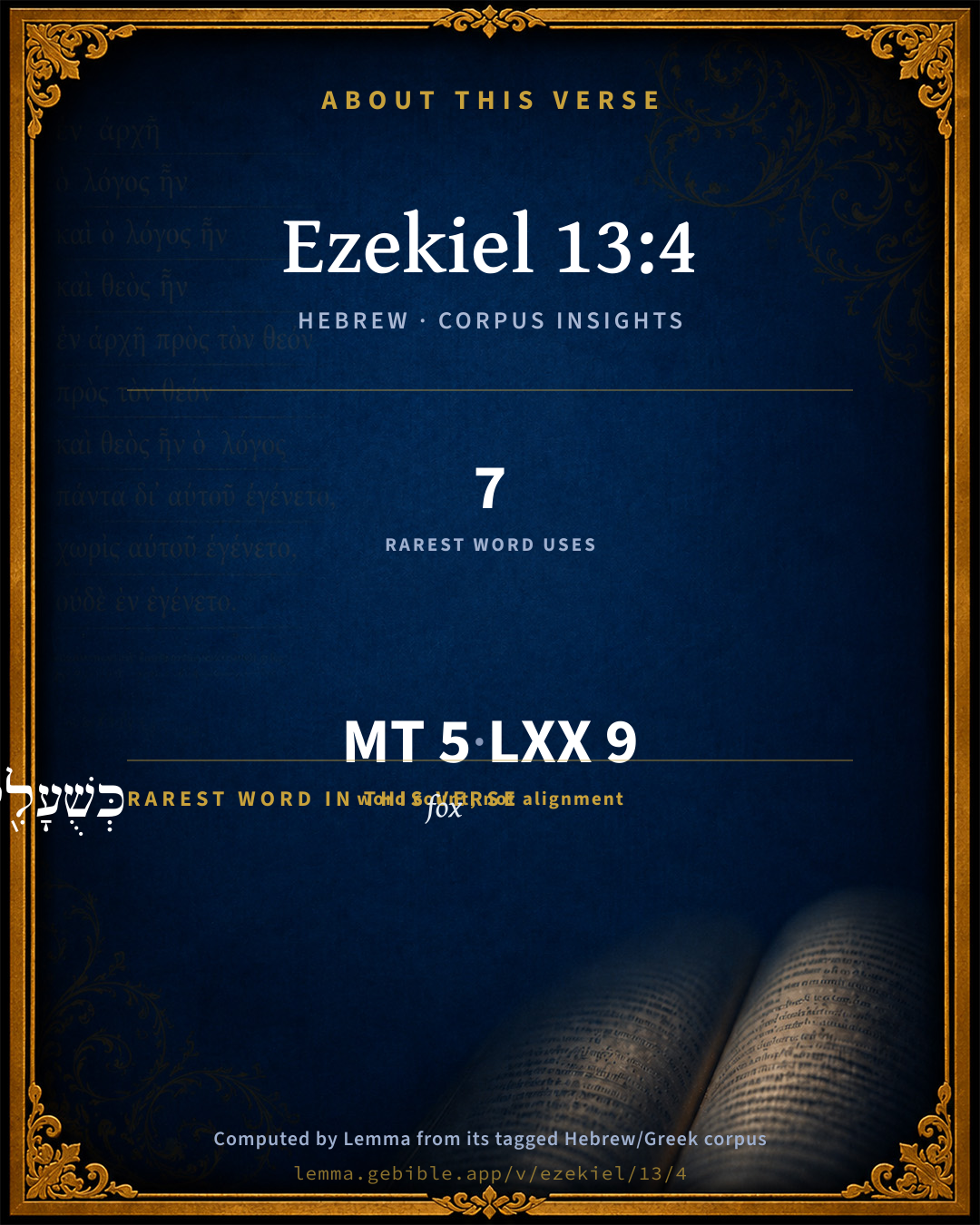
The rarest word here is כְּשֻׁעָלִ֖ים fox H7776 — appearing just 7 times in the whole Hebrew Bible.

Shared distinctive vocabulary

כְּשֻׁעָלִ֖ים fox H7776 occurs in 6 verses of the Hebrew Bible. Also found in:

Grammatical profile

  • 1 verb
  • 4 nouns

Verb forms

  • הָיֽוּ Qal · Perfect

Hebrew & Septuagint length

In English translation the verse runs 11 words from the Hebrew and 10 from the Septuagint (LXX English) — closely comparable.

A rough comparison of the two English renderings, which tokenize alike — not a word-level alignment.

Word counts can differ between the Hebrew and the Greek without any difference in meaning — e.g. the Hebrew direct-object marker אֵת has no separate Greek word, and Greek often adds the article ὁ.

In the original languages it is 5 Hebrew tokens and 9 Greek tokens — but the two are counted differently (Hebrew bundles its prefixes and suffixes into one token; the Greek is in lemma form), so that isn’t a like-for-like length.

Cross-references

13

Topical passages linked to Ezekiel 13:4 in the Treasury of Scripture Knowledge — connected by theme and wording, ordered by reader-vote popularity; previews shown in the World English Bible.

  • Revelation 19:20 The beast was taken, and with him the false prophet who worked the signs in his sight, with which he deceived those who had received the mark of the beast and those who worshiped his image. These two were thrown alive into the lake of fire that burns with sulfur.
  • Song of Solomon 2:15 Catch for us the foxes, The little foxes that spoil the vineyards; For our vineyards are in blossom. Beloved
  • Micah 2:11 If a man walking in a spirit of falsehood lies: 'I will prophesy to you of wine and of strong drink;' He would be the prophet of this people.
  • Micah 3:5 Thus says Yahweh concerning the prophets who lead my people astray; for those who feed their teeth, they proclaim, "Peace!" and whoever doesn't provide for their mouths, they prepare war against him:
  • Matthew 7:15 "Beware of false prophets, who come to you in sheep's clothing, but inwardly are ravening wolves.
  • Romans 16:18 For those who are such don't serve our Lord, Jesus Christ, but their own belly; and by their smooth and flattering speech, they deceive the hearts of the innocent.
  • 2 Corinthians 11:13–15 For such men are false apostles, deceitful workers, masquerading as Christ's apostles.
  • Galatians 2:4 This was because of the false brothers secretly brought in, who stole in to spy out our liberty which we have in Christ Jesus, that they might bring us into bondage;
  • Ephesians 4:14 that we may no longer be children, tossed back and forth and carried about with every wind of doctrine, by the trickery of men, in craftiness, after the wiles of error;
  • 2 Thessalonians 2:9–10 even he whose coming is according to the working of Satan with all power and signs and lying wonders,
  • 1 Timothy 4:1–2 But the Spirit says expressly that in later times some will fall away from the faith, paying attention to seducing spirits and doctrines of demons,
  • Titus 1:10–12 For there are also many unruly men, vain talkers and deceivers, especially those of the circumcision,
  • Revelation 13:11–14 I saw another beast coming up out of the earth. He had two horns like a lamb, and he spoke like a dragon.

Cross-references courtesy of OpenBible.info (CC BY 4.0).

Hebrew and Greek witnesses Masoretic Hebrew ↔ Greek Septuagint

The same verse in the two great witnesses to the Old Testament, shown verse-for-verse.

These are two independent witnesses, not word-aligned to each other, and the Septuagint is shown in lemma (dictionary) form.

Hebrew Ezekiel 13:4 Masoretic · Westminster Leningrad Codex

כְּשֻׁעָלִ֖ים בָּחֳרָב֑וֹת נְבִיאֶ֥יךָ יִשְׂרָאֵ֖ל הָיֽוּ

Israel, your prophets have been like foxes in the waste places.

World English Bible · Public Domain

Greek LXX Ezekiel 13:4 Septuagint · lemma form

ὁ προφήτης σύ ἰσραήλ ὡς ἀλώπηξ ἐν ὁ ἔρημος

Your prophets, O Israel, are like foxes in the deserts.

LXX2012 (modern English Septuagint) · Public Domain

Hebrew: Westminster Leningrad Codex (CC BY 4.0). Greek: Septuagint (public domain); English from LXX2012 (modern English Septuagint) (Public Domain). How the Septuagint differs from the Hebrew →

Targum (Aramaic paraphrase)

1

The Targum is the ancient Jewish Aramaic paraphrase of the Hebrew Scriptures — an interpretive translation, not the Hebrew text itself. Onkelos (literal) and Pseudo-Jonathan (expansive) render the Torah, and Jonathan the Prophets. Coverage is partial: where no permissively-licensed English translation exists for a verse, only the Aramaic is shown. This is verse-level text, not a word-by-word alignment to the Hebrew.

  1. Targum Jonathan Prophets (Joshua–Malachi)
    כִּתְעָלִין בְּחָרְבָתָא נְבִיֵי שִׁקְרָךְ יִשְׂרָאֵל הֲווֹ:

    (no public-domain English translation for this verse)

    Targum Jonathan — Aramaic: “Mikraot Gedolot” (public domain). English: “Sefaria Community Translation” (CC0 1.0 (public-domain dedication)); “London "Chaldee Paraphrase," 1871” (public domain). Text via Sefaria.

Commentary

Notes on Ezekiel 13:4 from classic Christian and Jewish commentators (each source and its license shown beneath its notes). The classic Christian expositions comment on the surrounding passage and are grouped to its opening verse, so a note may address several verses; the Jewish commentaries on the Tanakh (Rashi and others) are per-verse, so they appear only where the commentator wrote on this verse.

Lemma curates 59 commentaries, every one of them public domain or Creative Commons licensed, each selected and text-cleaned for this edition rather than reprinted as found. About our sources →

Trapp's Complete Commentary

John Trapp

Eze 13:4 O Israel, thy prophets are like the foxes in the deserts.

Ver. 4. O Israel, thy prophets are like the foxes.] Cowardly, crafty, cruel, greedy: venatores eludunt, et cum mortuae videntur, reviviscunt. Heretics are such, and false prophets; Arius, for instance.

John Trapp, A Commentary or Exposition upon All the Books of the Old and New Testament (1647–1656) — public domain. Text from a community e-Sword module.

The Biblical Illustrator

Joseph S. Exell

Eze_13:4

Thy prophets are like the foxes in the desert.

False prophets like foxes

1. These creatures are lovers of grapes, as we know by a common proverb; and consequently they did much damage in such countries as Judea, which abounded with vineyards, as is noted in Son_2:15, not only by devouring the grapes but also by making holes in the walls and fences, whereby they laid open the vineyards to other ravenous beasts as well as to themselves. Just so did the false prophets to the cities of Judah: they did not only beguile people of their substance, by the character which they assumed, and the figure which they made among them; but by their false doctrines and subversions of the genuine will and Word of God they broke down the walls and fences from about them; I mean that blessing and protection of the Almighty which was annexed to the obedience of His own laws.

2. In another respect did these prophets resemble the foxes in the deserts, that they could make breaches, but had not the faculty of stopping them up again. They did not call the people to repentance; or if they did, it was but such a superficial fast as we read of (Jer_36:1-32), at which they read his prophecy, and then cut it in pieces and threw it into the fire. Their making up of their breaches this way was but like the labour of unfaithful builders; one laid the stones in the wall, and others daubed it with untempered mortar.

3. These false prophets resembled foxes in their fraudulent practices. By crafty speeches and cunningly devised fables they misled the hearts of the simple. They studied how to suit their discourses to the various tempers of the people whom they conversed with; to prophesy smooth things to the stout-hearted, and terrible things to the timorous, that they might keep them all in the way which they would have them to walk in.

4. These false prophets had another property of foxes, which was a prowling ravenous appetite. When they came out of their colleges into the vineyard, they resolved that the making of their fortune, the arriving at a plentiful condition, a goodly heritage, should be the first and greatest of all their cares. So little were they concerned for the welfare of the people over whom they pretended to be guardians and spiritual watchmen, that they would sell their souls, as God complains here, for handfuls of barley and morsels of bread.

5. As foxes are of the number of unclean beasts, so these prophets were men of corrupt minds and loose morals. How prone they were to prevaricate with God, and seduce the people, to counterfeit a Divine mission, to run when they were not sent, to prophesy out of their own heart without a revelation, to proclaim their visions of peace when there was no peace, is abundantly set forth in this chapter. (W. Reading, M. A.)

False prophets like foxes

The prophets are like foxes: ruins are congenial to them; a condition of decay is their proper sphere; there they can burrow as their instincts prompt them. The main idea, however, is that their operations only increase the devastation, and Undermine and bring down anything that may yet be standing. In a declining and disastrous time the minds of men are excited and feed on the wildest schemes; and, feeling themselves helpless, they readily turn to those who pretend to speak to them in Gods name. And it only adds to their ruin when those to whom they turn have no higher wisdom than themselves. (A. B. Davidson, D. D.)

The Biblical Illustrator, edited by Joseph S. Exell (c. 1880s–1900s) — public domain. Text from a community e-Sword module.

Tyndale Open Study Notes

Tyndale Open Resources

13:4-5 The false prophets are compared to jackals digging in the ruins to prey on the small animals living there. The false prophets did not repair the breaks in the walls by calling the people who were suffering at the hands of the Babylonians to repent, live holy lives, and fight evil. Instead, they gained prestige—and perhaps money—by telling lies that encouraged the people to continue to rebel. Like jackals, these false prophets were actually breaking the walls down, not building them up (cp. Neh 4:3).

Tyndale Open Study Notes — © Tyndale Open Resources, licensed CC BY-SA 4.0. Text via the HelloAO Bible API.

Geneva Bible (1599)

Geneva Bible translators

Watching to destroy the vineyard.

Geneva Bible (1599) marginal notes — public domain. Text via Bolls.life.

Jamieson, Fausset & Brown

Robert Jamieson, A. R. Fausset & David Brown

foxes--which cunningly "spoil the vines" (Sol 2:15), Israel being the vineyard (Psa 80:8-15; Isa 5:1-7; Isa 27:2; Jer 2:21); their duty was to have guarded it from being spoiled, whereas they themselves spoiled it by corruptions.

in . . . deserts--where there is nothing to eat; whence the foxes become so ravenous and crafty in their devices to get food. So the prophets wander in Israel, a moral desert, unrestrained, greedy of gain which they get by craft.

Jamieson, Fausset & Brown — Commentary Critical and Explanatory on the Whole Bible (1871) — public domain (CC PDM 1.0). Text via the HelloAO Bible API.

Adam Clarke's Commentary

Verse 4. Thy prophets are like the foxes in the deserts.] The cunning of the fox in obtaining his prey has been long proverbial. These false prophets are represented as the foxes who, having got their prey by great subtlety, run to the desert to hide both themselves and it. So the false prophets, when the event did not answer to their prediction, got out of the way, that they might not be overwhelmed with the reproaches and indignation of the people.

Adam Clarke's Commentary on the Bible (1810–1826) — public domain. Text from a community e-Sword/MySword module.

John Calvin's Commentaries

Hence Ezekiel exposes the snares of the false prophets. The ten tribes had been dispersed, just as if a field or a vineyard had been removed from a habitable neighborhood into desert regions, and foxes held their sway there instead. For they have many hiding-places; they insinuate themselves through hedges and all openings, and so break into the vineyard or field, and lay waste its fruits. Such, as I have said, was the condition of the people from the time of its dispersion. While the Israelites dwelt at home, they were in some way retained within their duty, as if fortified by certain ramparts. At Jerusalem, too, the high Priest presided over spiritual trials, that no impious doctrine should creep in: but now, since the people were so dispersed, greater license was given to the false prophets to corrupt the people, since the miserable exiles were exposed to these foxes; for they were liable to injuries just as if desert regions surrounded them. Being thus destitute of protection, it was easy for foxes to enter by clandestine arts, and to destroy whatever good fruits existed. Meanwhile Ezekiel obliquely reproves the people’s carelessness. Although they were dispersed, and were so open to the snares of the false prophets, yet they thought to have been attentive and cautious, and God would doubtless have afforded them aid, as he promises to his people the spirit of discretion and judgment whenever they need it. (1 Corinthians 12:10.) But when the Israelites were wandering exiles, and attention to the law no longer flourished among them, it came to pass that foxes, meaning their false prophets, easily entered. Whence it follows that the people were not free from faults, since they exposed themselves to the snares of these false prophets. It follows —

John Calvin's Commentaries (1540-1563) — public domain. Text from the Calvin Translation Society English edition (1840s-50s) via the Christian Classics Ethereal Library (ccel.org). Calvin's coverage is partial (roughly two-thirds of the Bible); uncommented books and verses are honest gaps, never fabricated. The 19th-century editor's footnotes and remarks are omitted so the notes are faithfully Calvin's own voice.

Ellicott's Commentary for English Readers

(4) Like the foxes in the deserts.—The comparison is sufficiently close if it is considered as extending only to these mischievous men living unconcerned among the ruins of their state and country, as the foxes find their home in desolated cities (Lam_5:18); but many extend the simile to the undermining of the ground by the foxes, as these prophets accelerated the ruin of their people.

A Bible Commentary for English Readers, edited by Charles John Ellicott (1878–1897) — public domain. Text from a community e-Sword module.

The Cambridge Bible for Schools and Colleges

gen. ed. J. J. S. Perowne

4. foxes in the deserts] in the waste places, i.e. ruins. The prophets are like foxes; ruins are congenial to them; a condition of decay is their proper sphere; there they can burrow as their instincts prompt them. The main idea, however, is that their operations only increase the devastation and undermine and bring down anything that may yet be standing. In a declining and disastrous time the minds of men are excited and feed on the wildest schemes, and feeling themselves helpless they readily turn to those who pretend to speak to them in God’s name. And it only adds to their ruin when those to whom they turn have no higher wisdom than themselves.

The Cambridge Bible for Schools and Colleges (gen. ed. J. J. S. Perowne; Cambridge University Press, 1878–1918) — public domain. Text from a community e-Sword module.

John Gill's Exposition

They have seen vanity, and lying divination,.... The visions the false prophets pretended to see were nothing but the fruit of their own fancies and imaginations, and had nothing real in them; and what they divined or foretold should be were all lies, and never came to pass, and never would:

saying the Lord saith: and the Lord hath not sent them; they came to the people with a lie in their mouths, giving out that the Lord spoke by them; when they had no mission from him; nor any commission to say what they did; or any warrant from him for their prophecies:

and they have made others to hope that they would confirm the word; or, "that the word would be confirmed" (e); that what was said by them would have its accomplishment; and that their prophecies would be fulfilled. By their solemn way of speaking; by the use they made of the name of the Lord; by the strong assurances they gave, and by their frequent repetition of their predictions, the people were brought to hope and believe that the event would answer to what they said; wherefore, instead of bringing them to a sense of their sins, and repentance for them, whereby the judgments of God would have been prevented, they hardened them in them, and hastened their ruin.

(e) "ut praestet verbum", Junius & Tremellius, Piscator, Polanus; "ratum fore", Grotius; "eventurum esse", Castalio.

John Gill's Exposition of the Whole Bible (1746–1763) — public domain (CC PDM 1.0). Text via the HelloAO Bible API.

Albert Barnes' Notes on the Bible

In the deserts - Foxes find a home among ruins etc. Lam 5:18. So the prophets find their profit in the ruin of their country.

Albert Barnes' Notes on the Bible (1834–1885) — public domain. Text from a community e-Sword/MySword module.

Haydock's Catholic Bible Commentary

Deserts, or ruins. They sought only to gratify themselves.

George Leo Haydock (1774–1849), Haydock's Catholic Family Bible and Commentary, 1859 edition — public domain. Excludes Psalms (Douay-Rheims chapter numbering differs from Protestant) and Deuterocanonical books (Catholic canon only).

Matthew Poole's English Annotations

O Israel; a pathetical exclamation to awake Israel, both the dwellers at Jerusalem and those at Babylon.

Thy prophets, not mine, as Eze 13:2.

Like the foxes; hungry and ravening, crafty and guileful, and living by their wits, but not one whit helpful to those they deceive. Such are false prophets. In the deserts, where want of prey makes them more eager of their prey, and where other devouring beasts endanger travellers, but no defence to them from foxes; these flee into their holes betimes, and leave the endangered ones. Or thus, O Israel, thou art like the desert, spoiled and robbed, and thy false prophets, like foxes hungry and hunting for some prey, live upon what they can catch, but will be no more profitable to thee than foxes are to the wilderness.

Matthew Poole's English Annotations on the Holy Bible (1683–1685) — public domain. Text from a community e-Sword/MySword module.

Whedon's Commentary on the Bible

Daniel D. Whedon

4. Like the foxes in the deserts — Foxes do not build walls, but undermine them (Neh_4:3; Lam_5:18). Having seized their prey with great subtlety they run to the desert and hide themselves and it (Adam Clarke). Those who pretend falsely to speak in the name of Jehovah are worse than open enemies — they are sly and dangerous as the greatest pest of the Orient (Son_2:15; Isa_5:7).

Daniel D. Whedon (gen. ed.), Commentary on the Old and New Testaments (1874–1909) — public domain. Text from a community e-Sword module.

The Pulpit Commentary

Like the foxes in the deserts, etc. The points of comparison are manifold. The fox is cunning. (Luk_13:32, where the term is applied to Herod Antipas) It spoils the vine and its fruits; (Son_2:15) it burrows among ruins. (Neh_4:3; Lam_5:18) So the false prophets were crafty, laid waste the vineyard of the Lord of, (Isa_5:7) made their profit out of the ruin of Israel, and made that ruin worse. The "Reineke Fuchs," in satirizing the monks and priests of the sixteenth century under the same comparison, presents a curious, though probably unconscious, analogue. in Mat_7:15 and Act_20:29 wolves appear as the types of the false prophet.

Foxes.

Ezekiel here likens the false prophets to foxes in waste places. This cutting comparison shows the daring of the true prophet, the extremity of the evil of false prophecy, and the crying need of exposure of this evil. There is a limit to the reserve of politeness when truth is dishonoured and God insulted by those whom a culpable charity still flatters with terms of friendliness. Christ called Herod a fox. (Luk_13:32) Still, it needs the grace of Christ or the inspiration of an Ezekiel to be sure that one"s use of such a title for a fellow man is not misapplied. Consider in what respects false teachers may be compared to foxes.

I FOXES ARE WILD ANIMALS. The comparison is with creatures untamed and practically untamable. Now, to all appearance the false prophets were very different, were the very opposite in manners and demeanour. They were the trained sophists of an ancient civilization, court preachers well skilled in the use of oily phrases, masters of polite diction. To call such men foxes would seem to be an extravagant insult. Nevertheless, beneath the gracious exterior there was the heart of the untamed animal. These teachers were not submissive to the guidance of the Spirit of God. All who refuse that guidance are wandering in the wilderness of life. They are not the sheep of God"s flock, but like the foxes that range at large outside the fold.

II FOXES ARE DESTRUCTIVE ANIMALS. Among the Hebrews they were not celebrated for the cunning for which they were famous in Greek fables, but for their wasting mischief. False teachers are compared to these ravenous beasts. The wilful teachers of error are like the wreckers who hang out false lights to draw ships to the rocks. The destruction is twofold.

1. By driving from the true pastures. Thus the flock is starved in the wilderness. Error draws men off from the wholesome food of truth.

2. By direct injury. The foxes tear and devour the Iambs of the flock. Error has deadly fangs in spite of its gracious aspect.

III FOXES HAUNT RUINOUS PLACES. Ezekiel imagines the foxes among ruins. False teaching flourishes when the Church has fallen into decay. A low moral tone prepares the way for error. If the soul were in a vigorous condition, the deceitfulness of an unworthy teacher would be speedily detected. It is only spiritual degeneracy that can give an opportunity for the religious charlatan.

IV FOXES ROAM ABOUT IN THE DARK. They are creatures of the night. Deceitful teachers prey upon the ignorant and superstitious. Like the wild animals that only creep out under shelter of night, they prowl about in the shadows of dark times. They dread the day. Therefore the remedy is to be found in the spread of light. We cannot conquer error by directly refuting it so well as by fortifying people against it with a clear, strong teaching of truth. The foxes of error are on the look out liar their victims. Let the shepherds of light be to the fore in keeping the pure truth of the New Testament well in the minds and hearts of the people.

The Pulpit Commentary (1880–1919), ed. H.D.M. Spence-Jones & Joseph S. Exell — public domain. Text from a community e-Sword module.

John Wesley's Explanatory Notes

Thy prophets - Thy prophets, not mine. Like the foxes - Hungry, and ravening, crafty, and guileful. In the deserts - Where want makes them more eager after their prey.

John Wesley, Explanatory Notes Upon the Whole Bible (1754–1765) — public domain. Text via the GEBible commentary corpus.

Rashi

Rabbi Shlomo Yitzchaki (Rashi)

Like foxes in ruins When a man comes upon a breach in a ruin, the fox flees through another breach, and it does not stand in the breach to fight.

Rashi on the Tanakh — English translations: “The Judaica Press complete Tanach with Rashi, translated by A. J. Rosenberg” (CC BY 4.0); “Pentateuch with Rashi's commentary by M. Rosenbaum and A.M. Silbermann, 1929-1934” (public domain); “The Metsudah Tanach series, Lakewood, N.J” (CC BY 4.0); and “The Book of Joshua, Metsudah Publications, 1997” (CC BY 4.0). Text via Sefaria.

Lesson kit

Teaching starters — assembled from the data on this page, not authored interpretation. Every prompt links to the verse data it draws on. Edit before teaching.

Ezekiel, in the Prophets, opens this verse with 5 words (5 distinct Hebrew lemmas). Its most distinctive word is shûwʻâl (“fox”). A historical commentator’s framing appears above. Read the whole chapter for the surrounding context.

Discussion questions

  1. What does “fox” (shûwʻâl) contribute to the verse as a whole?
  2. How does Judges 15:4, which shares the word «fox», read alongside this verse?
  3. These translations render this verse differently. What is at stake in choosing one wording over another?
  4. «הָיֽוּ» is a Qal Perfect verb. How does that grammatical form shape the action described?
  5. Compare how Trapp's Complete Commentary and The Biblical Illustrator read this verse. Where do they agree or differ?

Things to notice

Reading settings

Reading text

Shown beneath each verse's original-language words.

Old Testament
Old Testament edition

Read the OT as the Masoretic Hebrew (MT) or the Greek Septuagint (LXX).

English shown for the Greek Septuagint (in the Hebrew ↔ Greek comparison).

Comparing translations? Open the Compare panel on any verse page to stack up to four side by side.