Ezekiel 13:2

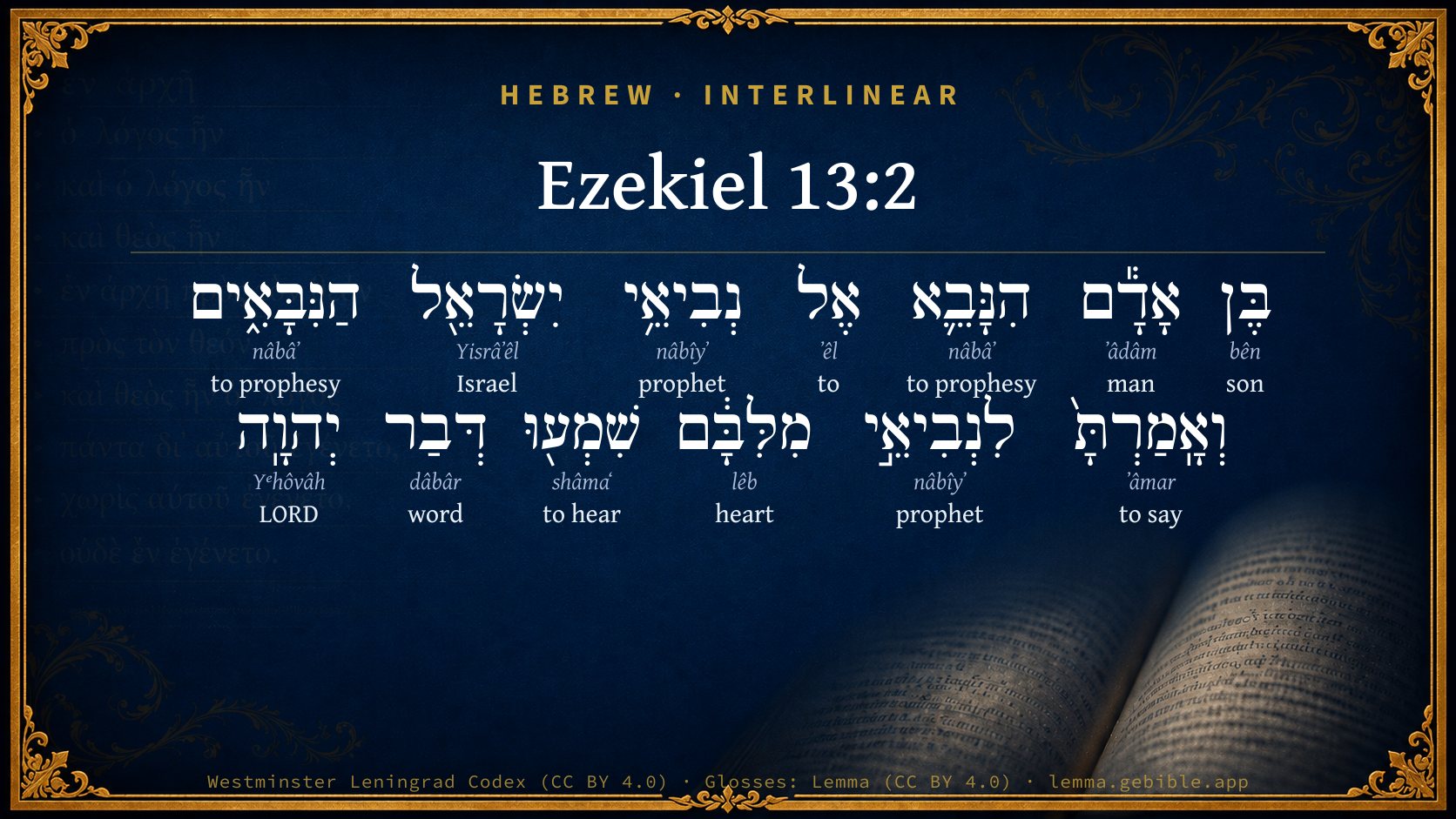
Hebrew (Westminster Leningrad Codex) Ezekiel 13:2 appears in the Hebrew Old Testament. The text above is from the Westminster Leningrad Codex. Each word links to its Strong’s number, a concise gloss, and parsing drawn from the Open Scriptures Hebrew Bible morphology. Click any word for its full Brown-Driver-Briggs (BDB) entry.
Download image
Cite this verse

Ezekiel 13:2 (World English Bible). Public Domain. Lemma interlinear Bible study tool, https://lemma.gebible.app/v/ezekiel/13/2.

Show BibTeX & RIS
BibTeX
RIS
English Translation
Son of man, prophesy against the prophets of Israel who prophesy, and say you to those who prophesy out of their own heart, Hear you the word of Yahweh:
World English Bible · Public Domain
Download a study sheet

One document with this verse’s original text, its word-by-word gloss line, the meaning frame, cross-references with their text, attributed commentary, and full source and license credits — printable, and it pastes into notes with its structure intact.

This verse Autodidact and up

Study sheet (.html) Plain text (.txt)

A passage Seminary Student

Up to 50 verses in one chapter. A passage sheet keeps up to 6 commentary sources and 12 cross-references per verse, in the order this page ranks them, and says so on the sheet whenever that leaves anything out. Ask for a single verse and you get the Autodidact verse sheet above.

Everything on this page stays free to read, with no account — the sheet is a download of what is already on screen, not access to it.

Want to remove ads? Support Godless Engineer
Compare translations 3

The same verse in 3 English versions, stacked beneath the original-language interlinear above. Click any original word for its lexicon entry.

Each is an independent rendering of the whole verse — the interlinear is not word-aligned to these translations.

Highlighted words mark where these versions differ — a whole-verse word diff, not a word-by-word alignment.

  • World English Bible Public Domain
    Son of man, prophesy against the prophets of Israel who prophesy, and say you to those who prophesy out of their own heart, Hear you the word of Yahweh:
  • King James Version Public Domain
    Son of man, prophesy against the prophets of Israel that prophesy, and say thou unto them that prophesy out of their own hearts, Hear ye the word of the LORD;
  • unfoldingWord Literal Text CC BY-SA 4.0
    “Son of man, prophesy against the prophets who are prophesying in Israel, and say to those who are prophesying out of their own imaginations, ‘Listen to the word of Yahweh.

unfoldingWord Literal Text — © unfoldingWord, licensed CC BY-SA 4.0. Word-aligned USFM3 via Door43 (git.door43.org/unfoldingWord/en_ult).

Versions to compare (up to 4)

3 of 4 selected

Show all 18 translations

Every available English version of this verse, each an independent rendering of the whole verse.

  • World English Bible Public Domain
    Son of man, prophesy against the prophets of Israel who prophesy, and say you to those who prophesy out of their own heart, Hear you the word of Yahweh:
  • Berean Standard Bible Public Domain
    “Son of man, prophesy against the prophets of Israel who are now prophesying. Tell those who prophesy out of their own imagination: Hear the word of the LORD!
  • Majority Standard Bible Public Domain
    “Son of man, prophesy against the prophets of Israel who are now prophesying. Tell those who prophesy out of their own imagination: Hear the word of the LORD!
  • King James Version Public Domain
    Son of man, prophesy against the prophets of Israel that prophesy, and say thou unto them that prophesy out of their own hearts, Hear ye the word of the LORD;
  • American Standard Version (1901) Public Domain
    Son of man, prophesy against the prophets of Israel that prophesy, and say thou unto them that prophesy out of their own heart, Hear ye the word of Jehovah:
  • Revised Version (1885) Public Domain
    Son of man, prophesy against the prophets of Israel that prophesy, and say thou unto them that prophesy out of their own heart, Hear ye the word of the LORD;
  • Geneva Bible (1599) Public Domain
    Sonne of man, prophecie against the prophets of Israel, that prophecie, and say thou vnto them, that prophecie out of their owne hearts, Heare the worde of the Lord.
  • Douay-Rheims (1899) Public Domain
    Son of man, prophesy thou against the prophets of Israel that prophesy: and thou shalt say to them that prophesy out of their own heart: Hear ye the word of the Lord:
  • Young's Literal Translation Public Domain
    `Son of man, prophesy concerning the prophets of Israel who are prophesying, and thou hast said to those prophesying from their own heart: Hear ye a word of Jehovah:
  • Literal Standard Version CC BY-SA 4.0
    “Son of man, prophesy concerning the prophets of Israel who are prophesying, and you have said to those prophesying from their own heart, Hear a word of YHWH!
  • Unlocked Literal Bible CC BY-SA 4.0
    “Son of man, prophesy against the prophets who are prophesying in Israel, and say to those who are prophesying out of their own imaginations, 'Listen to the word of Yahweh.
  • unfoldingWord Literal Text CC BY-SA 4.0
    “Son of man, prophesy against the prophets who are prophesying in Israel, and say to those who are prophesying out of their own imaginations, ‘Listen to the word of Yahweh.
  • Darby Bible Public Domain
    Son of man, prophesy against the prophets of Israel that prophesy, and say unto them that prophesy out of their own heart, Hear ye the word of Jehovah.
  • World Messianic Bible Public Domain
    “Son of man, prophesy against the prophets of Israel who prophesy, and say to those who prophesy out of their own heart, ‘Hear the LORD’s word:
  • Webster's Bible Public Domain
    Son of man, prophesy against the prophets of Israel that prophesy, and say thou to them that prophesy out of their own hearts, Hear ye the word of the LORD;
  • Free Bible Version CC BY-SA 4.0
    “Son of man, you are to prophesy against the prophets of Israel who right now are busy prophesying. Tell those who make up their own prophecies: Listen to the word of the Lord!
  • Bible in Basic English Public Domain
    Son of man, be a prophet against the prophets of Israel, and say to those prophets whose words are the invention of their hearts, Give ear to the word of the Lord;
  • JPS Tanakh (1917) Public Domain
    'Son of man, prophesy against the prophets of Israel that prophesy, and say thou unto them that prophesy out of their own heart: Hear ye the word of the LORD:

Literal Standard Version (2020), Covenant Press — licensed CC BY-SA 4.0. Text via the HelloAO Bible API (eBible.org). Unlocked Literal Bible (unfoldingWord) — licensed CC BY-SA 4.0. Text via the HelloAO Bible API (eBible.org). unfoldingWord Literal Text — © unfoldingWord, licensed CC BY-SA 4.0. Word-aligned USFM3 via Door43 (git.door43.org/unfoldingWord/en_ult). Free Bible Version, Dr. Jonathan Gallagher — licensed CC BY-SA 4.0. Text via the HelloAO Bible API (eBible.org).

Word by word

More ways to search: Search by grammar → Find every occurrence → Compare this word →

Practice this passage: Drill this verse → Learn its vocabulary →

הִנָּבֵ֛א
nâbâʼ
H5012
“prophesy”
Verb, Niphal, Imperative, 2nd Person, Masculine, Singular
Part of Speech
Verb
Stem
Niphal
Form
Imperative
Person
2nd Person
Gender
Masculine
Number
Singular
Full BDB Definition

Origin: a primitive root

TWOT: 1277

to prophesy - (Niphal) - to prophesy - under influence of divine spirit - of false prophets - (Hithpael) - to prophesy - under influence of divine spirit - of false prophets
  1. בֶּן bên H1121 “son of” Noun, Common, Masculine, Singular, Construct
  2. אָדָ֕ם ʼâdâm H120 “man” Noun, Common, Masculine, Singular, Absolute
  3. אֶל ʼêl H413 “to” Preposition
  4. נְבִיאֵ֥י nâbîyʼ H5030 “prophets of” Noun, Common, Masculine, Plural, Construct
  5. יִשְׂרָאֵ֖ל Yisrâʼêl H3478 “Israel” Noun, Proper
  6. הַנִּבָּאִ֑ים nâbâʼ H5012 “the · prophesying” Particle, Definite Article + Verb, Niphal, Participle Active, Masculine, Plural, Absolute
  7. וְאָֽמַרְתָּ֙ ʼâmar H559 “and · to say” Conjunction + Verb, Qal, Sequential Perfect, 2nd Person, Masculine, Singular
  8. לִנְבִיאֵ֣י nâbîyʼ H5030 “to/for · prophets of” Preposition + Noun, Common, Masculine, Plural, Construct
  9. מִלִּבָּ֔ם lêb H3820 “from · heart · their” Preposition + Noun, Common, Masculine, Singular, Construct + Suffix, Personal, 3rd Person, Masculine, Plural
  10. שִׁמְע֖וּ shâmaʻ H8085 “hear” Verb, Qal, Imperative, 2nd Person, Masculine, Plural
  11. דְּבַר dâbâr H1697 “word of” Noun, Common, Masculine, Singular, Construct
  12. יְהוָֽה Yᵉhôvâh H3068 “LORD” Noun, Proper

About this verse

These counts appear in no published source. They are computed here, from the morphology-tagged text and Lemma’s own curated glosses. What Lemma adds →

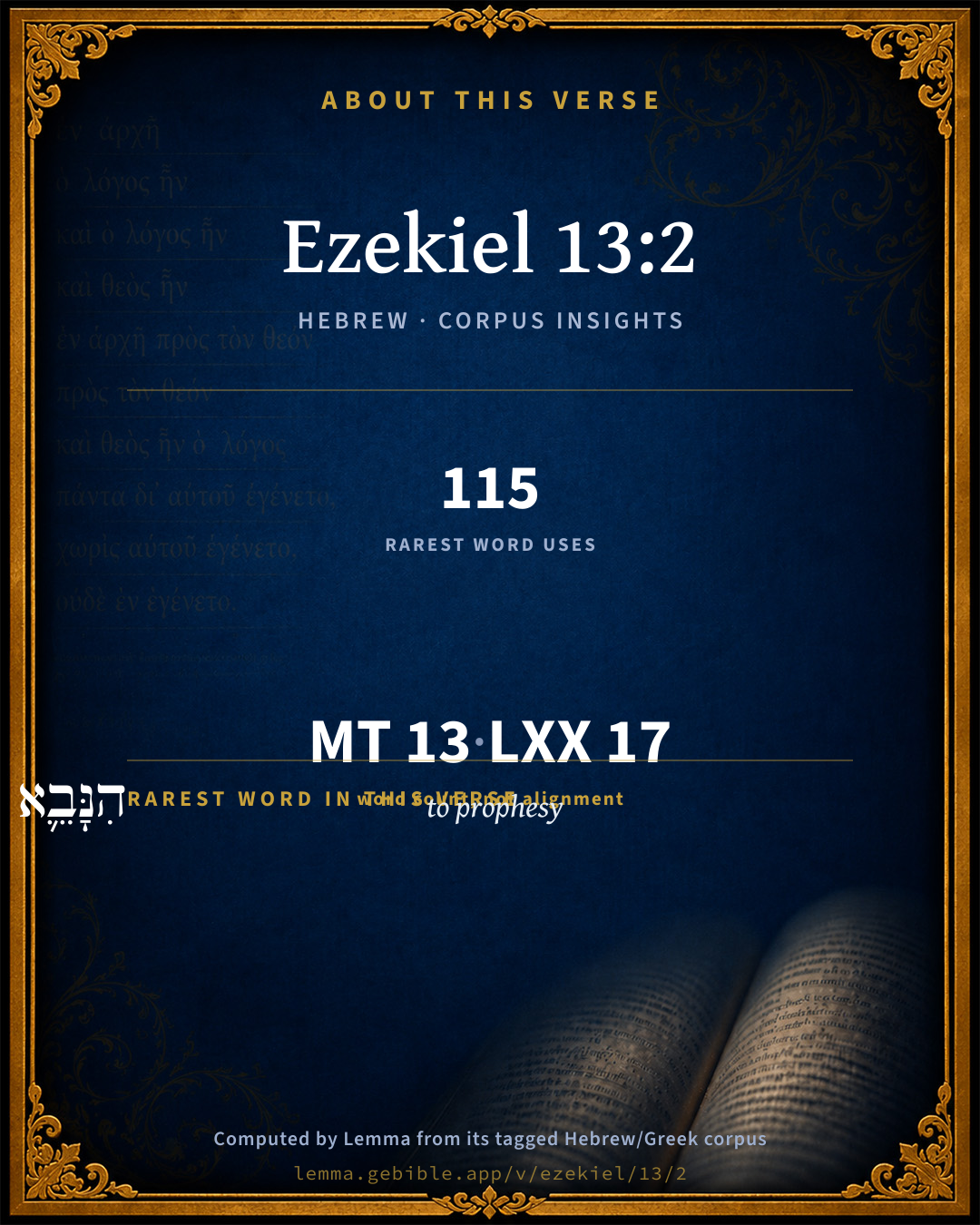
13
words
11
distinct lemmas
Prophets
section

Grammatical profile

  • 4 verbs
  • 8 nouns
  • 1 preposition

Verb forms

  • הִנָּבֵ֛א Niphal · Imperative
  • הַנִּבָּאִ֑ים Niphal · Participle Active
  • וְאָֽמַרְתָּ֙ Qal · Sequential Perfect
  • שִׁמְע֖וּ Qal · Imperative

Repetition

Words recur within this verse — often emphatic in Hebrew:

  • הִנָּבֵ֛א to prophesy H5012 ×2
  • נְבִיאֵ֥י prophet H5030 ×2

Hebrew & Septuagint length

In English translation the verse runs 29 words from the Hebrew and 25 from the Septuagint (LXX English) — closely comparable.

A rough comparison of the two English renderings, which tokenize alike — not a word-level alignment.

Word counts can differ between the Hebrew and the Greek without any difference in meaning — e.g. the Hebrew direct-object marker אֵת has no separate Greek word, and Greek often adds the article ὁ.

In the original languages it is 13 Hebrew tokens and 17 Greek tokens — but the two are counted differently (Hebrew bundles its prefixes and suffixes into one token; the Greek is in lemma form), so that isn’t a like-for-like length.

Cross-references

33

Topical passages linked to Ezekiel 13:2 in the Treasury of Scripture Knowledge — connected by theme and wording, ordered by reader-vote popularity; previews shown in the World English Bible.

  • Ezekiel 13:17 You, son of man, set your face against the daughters of your people, who prophesy out of their own heart; and prophesy you against them,
  • Jeremiah 37:19 Where now are your prophets who prophesied to you, saying, The king of Babylon shall not come against you, nor against this land?
  • Isaiah 1:10 Hear the word of Yahweh, you rulers of Sodom! Listen to the law of our God, you people of Gomorrah!
  • Isaiah 9:15 The elder and the honorable man, he is the head; and the prophet who teaches lies, he is the tail.
  • Ezekiel 22:25 There is a conspiracy of her prophets in the midst of it, like a roaring lion ravening the prey: they have devoured souls; they take treasure and precious things; they have made her widows many in the midst of it.
  • Ezekiel 22:28 Her prophets have daubed for them with whitewash, seeing false visions, and divining lies to them, saying, Thus says the Lord Yahweh, when Yahweh has not spoken.
  • 1 Kings 22:19 [Micaiah] said, Therefore hear you the word of Yahweh: I saw Yahweh sitting on his throne, and all the host of heaven standing by him on his right hand and on his left.
  • 2 Chronicles 18:18–24 [Micaiah] said, Therefore hear you the word of Yahweh: I saw Yahweh sitting on his throne, and all the host of heaven standing on his right hand and on his left.
  • Isaiah 28:14 Why hear the word of Yahweh, you scoffers, that rule this people that is in Jerusalem:
  • Isaiah 56:9–12 All you animals of the field, come to devour, [yes], all you animals in the forest.
  • Jeremiah 5:31 the prophets prophesy falsely, and the priests bear rule by their means; and my people love to have it so: and what will you do in the end of it?
  • Jeremiah 6:13–14 For from the least of them even to the greatest of them everyone is given to covetousness; and from the prophet even to the priest everyone deals falsely.
  • Jeremiah 8:10 Therefore will I give their wives to others, and their fields to those who shall possess them: for everyone from the least even to the greatest is given to covetousness; from the prophet even to the priest every one deals falsely.
  • Jeremiah 14:13–15 Then said I, Ah, Lord Yahweh! behold, the prophets tell them, You shall not see the sword, neither shall you have famine; but I will give you assured peace in this place.
  • Jeremiah 23:2 Therefore thus says Yahweh, the God of Israel, against the shepherds who feed my people: You have scattered my flock, and driven them away, and have not visited them; behold, I will visit on you the evil of your doings, says Yahweh.
  • Jeremiah 23:11–22 for both prophet and priest are profane; yes, in my house have I found their wickedness, says Yahweh.
  • Jeremiah 23:25–26 I have heard what the prophets have said, who prophesy lies in my name, saying, I have dreamed, I have dreamed.
  • Jeremiah 27:14 Don't listen to the words of the prophets who speak to you, saying, You shall not serve the king of Babylon; for they prophesy a lie to you.
  • Jeremiah 27:18 But if they be prophets, and if the word of Yahweh be with them, let them now make intercession to Yahweh of Hosts, that the vessels which are left in the house of Yahweh, and in the house of the king of Judah, and at Jerusalem, don't go to Babylon.
  • Jeremiah 28:12–17 Then the word of Yahweh came to Jeremiah, after that Hananiah the prophet had broken the bar from off the neck of the prophet Jeremiah, saying,
  • Jeremiah 29:8–9 For thus says Yahweh of hosts, the God of Israel: Don't let your prophets who are in the midst of you, and your diviners, deceive you; neither listen you to your dreams which you cause to be dreamed.
  • Jeremiah 29:20–24 Hear you therefore the word of Yahweh, all you of the captivity, whom I have sent away from Jerusalem to Babylon.
  • Jeremiah 29:31–32 Send to all them of the captivity, saying, Thus says Yahweh concerning Shemaiah the Nehelamite: Because Shemaiah has prophesied to you, and I didn't send him, and he has caused you to trust in a lie;
  • Lamentations 4:13 [It is] because of the sins of her prophets, [and] the iniquities of her priests, That have shed the blood of the just in the midst of her.
  • Ezekiel 13:3 Thus says the Lord Yahweh, Woe to the foolish prophets, who follow their own spirit, and have seen nothing!
  • Ezekiel 14:9–10 If the prophet be deceived and speak a word, I, Yahweh, have deceived that prophet, and I will stretch out my hand on him, and will destroy him from the midst of my people Israel.
  • Ezekiel 34:7 Therefore, you shepherds, hear the word of Yahweh:
  • Ezekiel 34:9 therefore, you shepherds, hear the word of Yahweh:
  • Amos 7:16–17 Now therefore listen to the word of Yahweh: 'You say, Don't prophesy against Israel, and don't preach against the house of Isaac.'
  • Micah 3:6 "Therefore night is over you, with no vision, And it is dark to you, that you may not divine; And the sun will go down on the prophets, And the day will be black over them.
  • Micah 3:11 Her leaders judge for bribes, And her priests teach for a price, And her prophets of it tell forturnes for money: Yet they lean on Yahweh, and say, Isn't Yahweh in the midst of us? No disaster will come on us.
  • Zephaniah 3:4 Her prophets are arrogant and treacherous people. Her priests have profaned the sanctuary. They have done violence to the law.
  • 2 Peter 2:1–3 But there also arose false prophets among the people, as among you also there will be false teachers, who will secretly bring in destructive heresies, denying even the Master who bought them, bringing on themselves swift destruction.

Cross-references courtesy of OpenBible.info (CC BY 4.0).

Hebrew and Greek witnesses Masoretic Hebrew ↔ Greek Septuagint

The same verse in the two great witnesses to the Old Testament, shown verse-for-verse.

These are two independent witnesses, not word-aligned to each other, and the Septuagint is shown in lemma (dictionary) form.

Hebrew Ezekiel 13:2 Masoretic · Westminster Leningrad Codex

בֶּן אָדָ֕ם הִנָּבֵ֛א אֶל נְבִיאֵ֥י יִשְׂרָאֵ֖ל הַנִּבָּאִ֑ים וְאָֽמַרְתָּ֙ לִנְבִיאֵ֣י מִלִּבָּ֔ם שִׁמְע֖וּ דְּבַר יְהוָֽה

Son of man, prophesy against the prophets of Israel who prophesy, and say you to those who prophesy out of their own heart, Hear you the word of Yahweh:

World English Bible · Public Domain

Greek LXX Ezekiel 13:2 Septuagint · lemma form

υἱός ἄνθρωπος προφητεύω ἐπί ὁ προφήτης ὁ ἰσραήλ καί προφητεύω καί εἶπον πρός αὐτός ἀκούω λόγος κύριος

Son of man, prophesy against the prophets of Israel, and you shall prophesy, and shall say to them, Hear you⌃ the word of the Lord:

LXX2012 (modern English Septuagint) · Public Domain

On this verse, The Cambridge Bible for Schools and Colleges discusses the Septuagint’s reading. Read the note in Commentary ↓

Hebrew: Westminster Leningrad Codex (CC BY 4.0). Greek: Septuagint (public domain); English from LXX2012 (modern English Septuagint) (Public Domain). How the Septuagint differs from the Hebrew →

Targum (Aramaic paraphrase)

1

The Targum is the ancient Jewish Aramaic paraphrase of the Hebrew Scriptures — an interpretive translation, not the Hebrew text itself. Onkelos (literal) and Pseudo-Jonathan (expansive) render the Torah, and Jonathan the Prophets. Coverage is partial: where no permissively-licensed English translation exists for a verse, only the Aramaic is shown. This is verse-level text, not a word-by-word alignment to the Hebrew.

  1. Targum Jonathan Prophets (Joshua–Malachi)
    בַּר אָדָם אִתְנַבֵּי עַל נְבִיֵי שִׁקְרָא דְמִתְנַבֵּן וְתֵימַר לִדְמִתְנַבֵּן בִּרְעוּת לִבְּהוֹן קַבִּילוּ פִתְגָמָא דַיָי:

    (no public-domain English translation for this verse)

    Targum Jonathan — Aramaic: “Mikraot Gedolot” (public domain). English: “Sefaria Community Translation” (CC0 1.0 (public-domain dedication)); “London "Chaldee Paraphrase," 1871” (public domain). Text via Sefaria.

Commentary

Notes on Ezekiel 13:2 from classic Christian and Jewish commentators (each source and its license shown beneath its notes). The classic Christian expositions comment on the surrounding passage and are grouped to its opening verse, so a note may address several verses; the Jewish commentaries on the Tanakh (Rashi and others) are per-verse, so they appear only where the commentator wrote on this verse.

Lemma curates 59 commentaries, every one of them public domain or Creative Commons licensed, each selected and text-cleaned for this edition rather than reprinted as found. About our sources →

Trapp's Complete Commentary

John Trapp

Eze 13:2 Son of man, prophesy against the prophets of Israel that prophesy, and say thou unto them that prophesy out of their own hearts, Hear ye the word of the LORD;

Ver. 2. Prophesy against the prophets.] Illis enim crania mala feruntur accepts. See Jer 23:32-33; Jer 23:38.

That prophesy out of their own hearts.] Whose prophecies came by the will of man, {2Pe 1:21} and not cum privilegio. with by right.

John Trapp, A Commentary or Exposition upon All the Books of the Old and New Testament (1647–1656) — public domain. Text from a community e-Sword module.

Joseph Benson's Commentary

Eze 13:2-4. Son of man, prophesy against the prophets of Israel — So they called themselves, as if none but they had been worthy of the name of Israel’s prophets, who were indeed Israel’s deceivers. Say unto them that prophesy out of their own hearts — According to their own fancy, without having received any revelation from God. The true prophets often denounced God’s judgments against the false ones: laying to their charge many misdemeanours in their private life and conversation, and upbraiding them for their unfaithfulness in the office they undertook of declaring God’s will to his people. Wo unto the foolish prophets — Ignorant and wicked, and who, while they wilfully deceived the people, unthinkingly brought destruction upon themselves. Observe, reader, foolish prophets are not of God’s sending: those whom he sends, he either finds or makes fit for his work. Where he gives warrant, he gives wisdom. That follow their own spirit, and have seen nothing — Who utter their own imaginations for true prophecies, and pretend to have visions when they never had any. O Israel, thy prophets, not mine, are like the foxes in the deserts — Hungry and ravening, crafty and guileful: “deceitful workers, (as the apostle styles such persons, 2Co 11:13,) who craftily insinuate false doctrines into weak and unstable minds, and greedily catch at any appearance of advantage to themselves.” — Lowth.

Joseph Benson's Commentary on the Old and New Testaments (1811–1818) — public domain. Text from a community e-Sword module.

Geneva Bible (1599)

Geneva Bible translators

After their own fantasy, and not as having the revelation of the Lord, Jer. 23:16.

Geneva Bible (1599) marginal notes — public domain. Text via Bolls.life.

Jamieson, Fausset & Brown

Robert Jamieson, A. R. Fausset & David Brown

that prophesy--namely, a speedy return to Jerusalem.

out of . . . own hearts--alluding to the words of Jeremiah (Jer 23:16, Jer 23:26); that is, what they prophesied was what they and the people wished; the wish was father to the thought. The people wished to be deceived, and so were deceived. They were inexcusable, for they had among them true prophets (who spoke not their own thoughts, but as they were moved by the Holy Ghost, Pe2 1:21), whom they might have known to be such, but they did not wish to know (Joh 3:19).

Jamieson, Fausset & Brown — Commentary Critical and Explanatory on the Whole Bible (1871) — public domain (CC PDM 1.0). Text via the HelloAO Bible API.

Adam Clarke's Commentary

Verse 2. That prophesy out of their own hearts] Who are neither inspired nor sent by ME. They are prophets out of their own hearts. They have their mission from their own assumption, and proceed in it from their own presumption. Such either go of themselves, or are sent by man. Such prophets, ministers, preachers, and clergy have been a curse to the Church and to the world for some thousands of years.

Adam Clarke's Commentary on the Bible (1810–1826) — public domain. Text from a community e-Sword/MySword module.

The Cambridge Bible for Schools and Colleges

gen. ed. J. J. S. Perowne

2. prophets of Israel that prophesy] There seems a kind of sarcasm on “prophets of Israel,”—those whom Israel accepts and delights to regard as prophets (Mic_2:11); and a similar sarcasm in “that prophesy.” They prophesied and that without limit: their mouths were always full of “thus saith the Lord” (Eze_13:6). LXX., however, reads rather differently. Jer_18:18 shews how the people regarded their prophets; they had faith in them and believed that Jehovah spoke by them, while such men as Jeremiah they judged to be false prophets: Come, let us devise devices against Jeremiah, for the law shall not perish from the priest, nor counsel from the wise, nor the word from the prophet. Cf. Jer_43:2.

their own hearts] The inspiration of these prophets came from their own hearts or minds—their own thoughts and hopes, and judgment upon the situation in which they were placed. They had nothing higher than human wisdom, while the inspiration of the true prophet came from the spirit of God.

The Cambridge Bible for Schools and Colleges (gen. ed. J. J. S. Perowne; Cambridge University Press, 1878–1918) — public domain. Text from a community e-Sword module.

John Gill's Exposition

Thus saith the Lord God, woe unto the foolish prophets,.... The false prophets, as the Targum; who are foolish, as all are who are not sent of God, and furnished by him with wisdom and knowledge, and who prophesy out of their own hearts; for what else but folly can proceed from thence? this must be a great mortification to these prophets to be called foolish, when they reckoned themselves wise men, being vainly puffed up in their fleshly minds, and were accounted so by others; but what is wisdom with men is foolishness with God:

that follow their own spirit; or "walk after it" (c); and not the Spirit of God, who leads into all truth; they pretended to a spirit of prophecy, but it was their own spirit and the dictates of it they followed, and not the Spirit of the Lord; and therefore it is no wonder that they prophesied false things, and led the people wrong; as all such teachers do, who give way to their own fancies and imaginations, and forsake the word of God, and do not implore the assistance and teachings of the blessed Spirit:

and have seen nothing; no vision, as the Syriac version renders it; they pretended to have revelations of things future from the Lord, but they had none; what they saw were vain visions and lying divinations, and were as nothing, and worse than nothing; yea, they said what they never saw.

(c) "qui ambulant post spiritm suum": Pagninus, Calvin, Cocceius, Starckius.

John Gill's Exposition of the Whole Bible (1746–1763) — public domain (CC PDM 1.0). Text via the HelloAO Bible API.

Haydock's Catholic Bible Commentary

Heart; what pleases them, (Haydock) without being inspired. There were always such impostors. These deluded the people at Jerusalem, (Calmet) or at Babylon, ver. 9. (Sanctius) --- They might be distinguished by the sincere: yet caused irreparable injury to the ignorant people. (Haydock)

George Leo Haydock (1774–1849), Haydock's Catholic Family Bible and Commentary, 1859 edition — public domain. Excludes Psalms (Douay-Rheims chapter numbering differs from Protestant) and Deuterocanonical books (Catholic canon only).

Matthew Poole's English Annotations

Prophesy; declare aforehand what I will do.

Against the prophets; against prince and people first, next against prophets and prophetesses; against the former in the foregoing chapters, against the latter in this chapter.

Of Israel, because approved of Israel, encouraged by Israel, and followed; but not prophets of the Lord, he sent them not. Whether these were in Babylon, or in Jerusalem, some inquiry is made; probably these false prophets were in both places.

That prophesy; foretell what is pleasing to the Jews, a sudden return out of captivity, with the vessels of the Lord’s house, and prosperity in their own land.

Out of their own hearts; but all their promising words are of themselves, out of their own deceiving hearts, not from God, and so all will be lies.

Hear ye the word of the Lord; cease to deceive my people, and attend now to what God speaks of you.

Matthew Poole's English Annotations on the Holy Bible (1683–1685) — public domain. Text from a community e-Sword/MySword module.

Whedon's Commentary on the Bible

Daniel D. Whedon

2. Prophets of Israel that prophesy — Dr. Davidson sees a kind of sarcasm in this phrase. The false prophets were indeed prophets of Israel, though not prophets of Jehovah. The people eagerly grasped their smooth sayings as true and repudiated Jeremiah and Ezekiel as the false prophets (Jer_18:18; Jer_43:2).

Prophesy out of their own hearts — Their own wish to be popular and please the people (Eze_13:19; Jer_23:16) colors their message. They are the mouthpiece of the people, Ezekiel speaks the word which is opposed to his natural desire. These men speak the smooth things which their own selfish hope suggests and their own human judgment seeks to sustain (Mic_3:8; compare Jer_28:8-9).

Daniel D. Whedon (gen. ed.), Commentary on the Old and New Testaments (1874–1909) — public domain. Text from a community e-Sword module.

The Pulpit Commentary

Vers. 2, 3. Son of man, prophesy, etc. The sin of the men whom Ezekiel denounced was that they prophesied out of their own hearts, (Jer_14:14 Jer_23:16, Jer_23:26) and followed their own spirit instead of the Spirit of Jehovah. All was human and of the earth. Not a single fact in the future, not a single eternal law governing both the future and the past, was brought to light by it. To one who was conscious that he had a message which he had not devised himself, and which he had not been taught by men; (Gal_1:12) that he had no selfish by-ends in what he said and did; that he was risking peace, reputation, life itself, for the truth revealed to him, nothing could be more repulsive than this claim to have seen a vision of Jehovah, by men who bad in reality seen nothing. For foolish prophets, read, with the stronger Hebrew, the prophets, the fools, the words deriving their force from a kind of paronomasia of alliteration. The nabiim are also the n"balim.

HOMILETICS.

Prophesying against the prophets.

I THEY WHO TEACH OTHERS NEED THEMSELVES TO BE TAUGHT. No man is a perfect fountain of original knowledge. The teacher must not only be a scholar in his early days, he must be a learner all through his life. Moreover, in regard to his own experience he needs light and help. He is not merely a voice for other souls. He too has a soul which may be in darkness, even while he is striving to illumine his hearers. There is great danger in the professionalism of the pulpit. It comes to be taken for granted too readily that familiarity in handling the words of eternal life presupposes a healthy possession of that life. Preachers hear but few sermons. We want missionaries to the pulpit of our land, that the leaders of the people"s religion may be led by the truth of God.

II THEY WHO TEACH OTHERS MAY BE WHOLLY WRONG THEMSELVES. The professional prophets of Israel were many of them false prophets. They were not simply blind and m error. They made lying pretences to an inspiration which they did not possess, and they flattered people with vain visions which they bad themselves cunningly devised. Their"s was guilt of deepest dye. The teacher may fall into error unintentionally, for he is a fallible man; and then his mistake will not be culpable. But deception and moral failure are fatal sins. Surely every one who stands in the responsible position of a leader of others has a double motive tot searching his own soul to see that he is not a false prophet.

III THEY WHO TEACH OTHERS WILL BE CALLED TO ACCOUNT BY GOD. God has been watching the false prophets, and now Ezekiel is sent with a special message to them. What, then, is the advantage of prostituting the high mission of a servant of God for the sake of popular favour? The flatteries of a deluded multitude will not save the deceiver when he is called to account by his great Master. Nay, those flatteries will turn to curses when the victims of his base deception have their eyes open to the snare which he has laid for them. Of all pursuits, that of preaching simply for popularity is the most dangerous and degrading.

IV THEY WHO TEACH OTHERS ONLY THEIR OWN IDEAS IN THE NAME OF GOD ARE THE MOST FALSE TEACHERS. The prophets of Jerusalem did not only flatter the people with popular teaching, they carried that teaching out of their own hearts, and then ascribed it to God. Now, the prophet was an inspired man, or he was nothing. His sole business was to declare the Divine message saith the Lord." But in speaking only out of his own heart he knew that he had no such message. Yet by professing to be a prophet he claimed to be giving it. Here was his great sin. He was forging the name of God for his own inventions (see ver. 6). Similar is the sin of the preacher in a Christian pulpit who uses that vantage ground to expound his own private ideas to the neglect of, or even in opposition to, the teachings of the Bible, and yet on the authority of the Christian ministry. This is treason against Christ.

The Pulpit Commentary (1880–1919), ed. H.D.M. Spence-Jones & Joseph S. Exell — public domain. Text from a community e-Sword module.

John Wesley's Explanatory Notes

That prophesy - Out of their own deceiving hearts, not from God.

John Wesley, Explanatory Notes Upon the Whole Bible (1754–1765) — public domain. Text via the GEBible commentary corpus.

Lesson kit

Teaching starters — assembled from the data on this page, not authored interpretation. Every prompt links to the verse data it draws on. Edit before teaching.

Ezekiel, in the Prophets, opens this verse with 13 words (11 distinct Hebrew lemmas). Its most distinctive word is nâbâʼ (“to prophesy”). A historical commentator’s framing appears above. Read the whole chapter for the surrounding context.

Discussion questions

  1. How does “to prophesy” (nâbâʼ) shape what this verse is saying?
  2. How does Ezekiel 13:17, which shares this passage’s theme, read alongside this verse?
  3. What does the repetition of “to prophesy” (2× in this one verse) do in this verse?
  4. These translations render this verse differently; the difference is in the English rendering, not the original. What questions does that raise?
  5. «הִנָּבֵ֛א» is a Niphal Imperative verb. How does that grammatical form shape the action described?
  6. Compare how Trapp's Complete Commentary and Joseph Benson's Commentary read this verse. Where do they agree or differ?

Things to notice

Reading settings

Reading text

Shown beneath each verse's original-language words.

Old Testament
Old Testament edition

Read the OT as the Masoretic Hebrew (MT) or the Greek Septuagint (LXX).

English shown for the Greek Septuagint (in the Hebrew ↔ Greek comparison).

Comparing translations? Open the Compare panel on any verse page to stack up to four side by side.